- Market Value (2025): USD 3.67 Bn
- Estimated Value (2026): USD 3.67 Bn
- Forecast Value (2036): USD 6.28 Bn
- CAGR (2026-2036): 5.0%
What is the Parasol Market forecast to be worth by 2036?
USD 3.9 billion in 2026 to USD 6.3 billion by 2036, at a 5.0% CAGR.
- The parasol market was valued at USD 3.67 billion in 2025.
- Demand is projected to increase from USD 3.85 billion in 2026 to USD 6.28 billion in 2036.
- Revenue is forecast to grow at a 5.0% CAGR from 2026 to 2036, supported by personal purchases and continuing investment in outdoor seating.
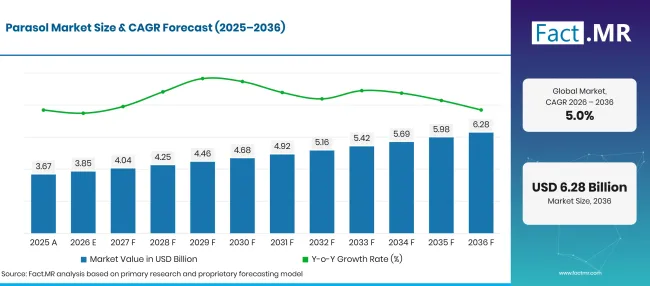
Parasol Market Forecast Global | Source: Fact.MR
| Year | Basis | Market Value (USD billion) |
|---|---|---|
| 2025 | Actual | 3.67 |
| 2026 | Estimate | 3.85 |
| 2036 | Forecast | 6.28 |
| CAGR 2026 to 2036 | Forecast period | 5.0% |
Source: Fact.MR analysis. Updated Oct 27, 2026
What are the defining numbers behind Parasol Market growth?
The market is expected to add USD 2.4 billion in annual revenue by 2036. Personal Parasol is the largest product category and Personal Use accounts for most spending. This gives portability and retail price points an outsized influence on the market, even though commercial installations may generate higher revenue per order. The larger commercial purchase can be harder to close: site dimensions, anchoring, replacement parts and operating conditions all enter the decision.
- Demand Drivers in the Market
- Shade performance is an issue of evidence, not just fabric labelling. ARPANSA notes that reflected and scattered ultraviolet radiation can reach people beneath shade. [1] A canopy's fabric rating therefore cannot be treated as a rating for the entire setup. That distinction matters to both product claims and the way parasols are positioned alongside sun protection products. Sellers able to explain coverage accurately have a more credible premium offer than those relying on an unqualified protection claim.
- Portable models face a straightforward commercial test: are they carried often enough to justify the purchase? Folded size and weight matter most when the product competes for space in a work bag or is taken on public transport. Automatic opening can command a premium, but only when it reduces effort without making the item unnecessarily bulky or unreliable. Seasonal impulse sales remain important; repeat demand is more likely where the product works in an ordinary routine.
- Hospitality operators spend on shade to make existing outdoor seating usable. The canopy has to cover the intended tables without blocking circulation, and the base has to fit the layout. That ties parasol spending to the economics of outdoor garden furniture rather than to the parasol's appearance alone. A product that looks appealing in a catalogue can fail commercially if staff lose seating space or need to move it throughout service.
- A public campaign can create awareness without establishing how many people ultimately buy. Ehime Prefecture announced a July-to-August parasol promotion across Shikoku's four prefectures in 2026. [2] For retailers, its value lies in a defined selling occasion and a chance to encourage trial. Subsequent sales will depend less on the campaign itself than on whether customers find a parasol worth carrying after the promotional period.
- Key Segments Analyzed
- By Product Types: Personal Parasol accounts for 42.3% of 2026 revenue. Its scale makes mainstream price points and repeat everyday use central to the market outlook.
- By Industries: Personal Use represents 62.0% of 2026 revenue. Most spending is therefore decided by individual shoppers rather than venue procurement budgets.
- Analyst Opinion at Fact.MR
- Shambhu Nath Jha, Lead Consultant, Fact.MR
- The 62.0% personal-use share says more about this market's direction than a broad claim about interest in sun protection. Individual buyers are price-sensitive, and a purchase that remains in a drawer does little to establish repeat demand. The next commercial opportunity is to make the product useful across everyday journeys without inflating its weight or cost. Hospitality buyers are a smaller but more service-intensive market. They compare the complete installation, including base placement, storage and the ability to replace damaged parts. These two revenue streams call for different ranges and different retail messages. Treating a lightweight personal parasol and a large terrace assembly as interchangeable products obscures the economics of both.
- Strategic Implications
- Show the carrying dimensions before asking shoppers to pay for a premium finish. Folded length, weight and opened coverage help consumers judge whether a parasol fits their daily routine. For online retail, a clear in-use photograph is more informative than a close-up of the canopy fabric alone.
- Commercial and beach buyers should compare the anchoring arrangement as part of the full purchase. CPSC guidance issued in May 2025 cites ASTM F3681 and the importance of compatible anchors for beach umbrellas. [4] This is an installation-safety issue, not evidence that a particular fabric or canopy size will make the product secure in wind.
- Portable shade can be sold alongside camping equipment, but the overlap should not blur different intended uses. A travel parasol competes on pack size and ease of carrying; a stationary model competes on coverage, base stability and operating space. Clear product boundaries help avoid returns from customers who bought for the wrong setting.
- Commercial replacement sales deserve more attention than they usually receive in seasonal ranges. A venue with a sound frame has little reason to replace the complete installation when only the canopy has worn. Suppliers that keep compatible parts available can retain the account across seasons, rather than competing again for a one-off full replacement.
Germany has the highest CAGR in the five-country comparison, followed by Brazil. Neither market follows exactly the same buying pattern. The German opportunity spans constrained residential spaces and specified hospitality installations; Brazil places more weight on frequent outdoor use and replenishment. In Japan, the challenge is to convert a recognised seasonal item into one that buyers choose to carry routinely.
How does the Parasol Market break down by segment?
Personal Parasol 42.3%; Personal Use 62.0% in 2026.
Why do personal parasols hold the largest product share?
The Personal Parasol segment leads Product Types with a 42.3% revenue share in 2026.
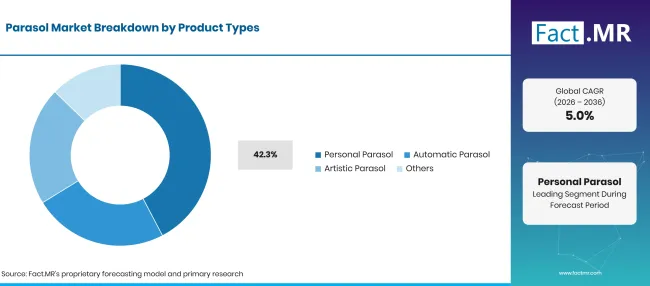
Parasol Market Breakdown Product Types | Source: Fact.MR
| Product Types | Share (2026) |
|---|---|
| Personal Parasol (Leading segment) | 42.3% |
| Other segments combined | 57.7% |
| Total | 100.0% |
Source: Fact.MR analysis. Updated Oct 27, 2026
Personal Parasol leads the product mix at 42.3%, giving high-volume retail decisions a strong influence on revenue. A larger canopy may appear to offer more value, but that benefit can disappear if the folded product is difficult to carry. The market is consequently segmented by willingness to trade coverage for convenience and by the frequency with which a buyer expects to use the item. Mechanism quality matters because a failed automatic opener can shorten the product's useful life. Artistic parasols serve a different purchase occasion, where finish and design can justify a higher price. However, claims about sun protection still need care: ARPANSA separates the UV properties of the material from the protection provided by the complete shade arrangement. [1] Premium positioning becomes more defensible when product information reflects that difference.
How does personal use differ from commercial purchasing?
The Personal Use segment leads Industries with a 62.0% revenue share in 2026.
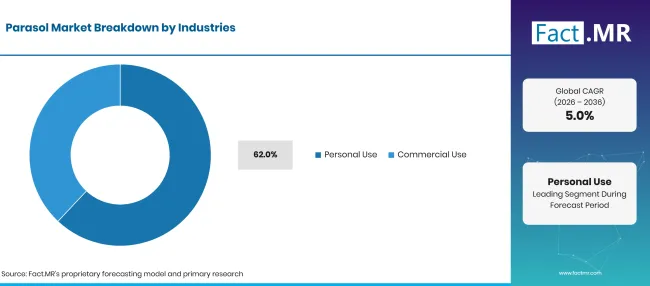
Parasol Market Breakdown Industries | Source: Fact.MR
| Industries | Share (2026) |
|---|---|
| Personal Use (Leading segment) | 62.0% |
| Other segments combined | 38.0% |
| Total | 100.0% |
Source: Fact.MR analysis. Updated Oct 27, 2026
Personal Use accounts for 62.0% of industry demand, so distribution and price architecture have an unusually large effect on the market. Shoppers can compare folded size and price quickly and may make a purchase without seeking technical advice. Venue operators face a slower decision, because they are paying for a workable site arrangement as well as the parasol. Base footprint and staff movement can affect the number of tables that remain usable. Replacement behaviour further separates the two groups. Households often replace a complete product after mechanical damage or a change in preference. A hotel or restaurant is more likely to value a supplier that can replace a canopy without changing the base and frame. The commercial relationship with the latter may extend beyond the original sale, provided parts are identifiable and still stocked.
What will broaden parasol use, and where does demand remain vulnerable?
Sun-safety advice gives parasols a recognised place in outdoor purchasing, but not an unlimited protection claim. UK Health Security Agency guidance issued in June 2025 treats shade as one measure alongside clothing and sunscreen. [3] Market expansion is therefore more plausibly linked to the number of practical occasions for using shade than to positioning any single parasol as complete protection.
Seasonality creates an inventory risk that a favourable long-term forecast does not remove. Retailers can be left with bulky, slow-moving stock if demand arrives later than expected or low-priced alternatives reset customer expectations. Commercial operators face a different constraint: secure installation and replacement costs can delay purchases even when additional shade would be useful. These are distinct risks and should be managed as such.
Drivers Impact Analysis
| DRIVER | (~) % IMPACT ON CAGR | GEOGRAPHIC RELEVANCE | IMPACT TIMELINE |
|---|---|---|---|
| Adoption of compact parasols for daily journeys | +0.7% | East Asia, Europe | 2026 to 2030 |
| Shade provision in hospitality seating areas | +0.6% | Europe, North America, coastal tourism markets | 2026 to 2031 |
| Clearer fabric and canopy performance information | +0.4% | Global | 2026 to 2029 |
| Replacement of damaged personal products | +0.3% | Global | 2026 to 2036 |
| Public promotion of portable shade | +0.2% | Japan and selected urban markets | 2026 to 2028 |
Source: Fact.MR analysis. Updated Oct 27, 2026
Opportunity Impact Analysis
| OPPORTUNITY | (~) % IMPACT ON CAGR | GEOGRAPHIC RELEVANCE | IMPACT TIMELINE |
|---|---|---|---|
| Lighter carry formats with useful canopy coverage | +0.5% | Japan, Europe, North America | 2027 to 2031 |
| Replacement canopies for commercial installations | +0.3% | Europe, North America | 2027 to 2032 |
| Parasol ranges suited to shared leisure facilities | +0.4% | Global tourism markets | 2026 to 2030 |
| Better online comparison of size and handling | +0.2% | Global | 2026 to 2029 |
Source: Fact.MR analysis. Updated Oct 27, 2026
Restraints Impact Analysis
| RESTRAINT | (~) % IMPACT ON CAGR | GEOGRAPHIC RELEVANCE | IMPACT TIMELINE |
|---|---|---|---|
| Seasonal sales and excess inventory | -0.6% | Europe, North America | 2026 to 2029 |
| Low-price competition and limited product differentiation | -0.5% | Global | 2026 to 2036 |
| Wind exposure and installation requirements | -0.3% | Coastal and commercial outdoor locations | 2026 to 2031 |
| Carry weight and storage compromises | -0.2% | Urban personal-use markets | 2026 to 2030 |
Source: Fact.MR analysis. Updated Oct 27, 2026
Which countries are scaling the Parasol Market through 2036?
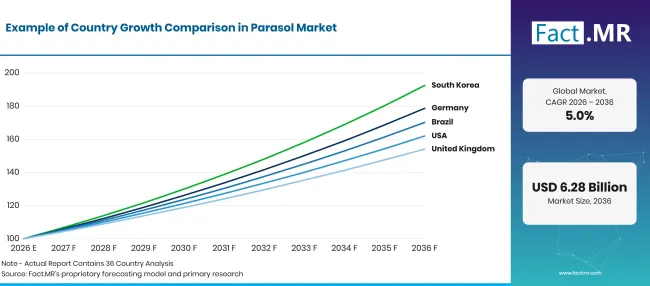
Parasol Market Growth Index | Source: Fact.MR
| Country | CAGR (2026 to 2036) |
|---|---|
| Germany | 6.0% |
| Brazil | 5.5% |
| United States | 4.9% |
| United Kingdom | 4.4% |
| Japan | 3.9% |
Source: Fact.MR analysis. Updated Oct 27, 2026
Where can German buyers justify spending more on a parasol?
Germany: 6.0% CAGR from 2026 to 2036. Balcony use and commercial seating create different product requirements.
Germany's 6.0% forecast reflects opportunities at two price points. Small balconies can favour compact, space-conscious models, while commercial terraces require a more deliberate installation choice. In a cafe, the relevant revenue measure is the seating that remains usable once bases and circulation paths are accounted for. A larger canopy is not necessarily the better investment if it reduces the operating area.
For premium suppliers, the opportunity extends into replacement parts and clarity of fit. A venue that can source a matching canopy in a later season has a stronger reason to retain the original system. Published dimensions and installation requirements also reduce costly ordering mistakes.
How can Brazilian demand translate into repeat commercial orders?
Brazil: 5.5% CAGR from 2026 to 2036. Durability and replenishment matter where parasols face frequent outdoor use.
Brazil's 5.5% outlook is tied to how well suppliers serve outdoor venues that move and store parasols regularly. Wear at hinges, bases and canopy fittings creates replacement demand, but it also exposes unreliable ranges. The distributor who can supply compatible parts in practical order quantities has a better claim on repeat commercial revenue than one selling a different collection each season.
Personal sales face tighter price limits. Carrying convenience and adequate coverage matter across a broader customer base than elaborate mechanical features. For suppliers importing finished goods, freight and distribution costs can narrow the range of price points that still support a healthy margin.
Why does anchoring belong in the United States purchase decision?
United States: 4.9% CAGR from 2026 to 2036. Beach and recreational use put installation performance under scrutiny.
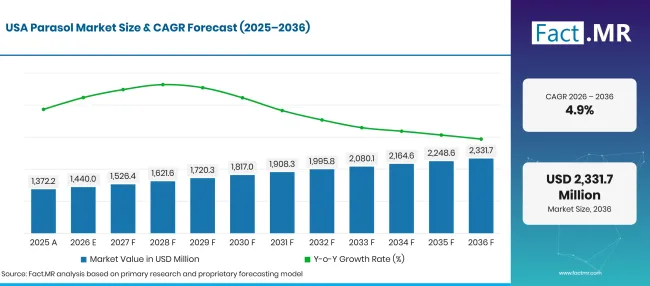
Parasol Market Forecast Usa | Source: Fact.MR
CPSC guidance from 2025 identifies the risk of airborne beach umbrellas and describes a voluntary standard involving resistance to at least 75 pounds of upward force or performance in winds up to 30 miles per hour under specified conditions. [4] Those requirements put compatible anchoring and instructions firmly within the US beach-product purchase decision. They do not establish a general safety claim for every type of parasol.
This issue affects beach retail and rental operators directly because they are responsible for a correctly installed unit, not simply the canopy selected from a catalogue. The standard should not be borrowed to sell lightweight handheld parasols, which address a different task and face different operating conditions.
How can UK retailers make parasols useful across several buying occasions?
United Kingdom: 4.4% CAGR from 2026 to 2036. A clear use case supports seasonal sales without relying on a single holiday trip.
In the United Kingdom, the same customer may encounter parasols as garden equipment, travel accessories or outdoor-event purchases. The range should reflect those distinct occasions. Clear packed dimensions help a shopper compare portable options, while terrace models need enough information about bases and storage to avoid a mismatch after delivery. Retailers can position portable models alongside sports sun care without confusing their use cases.
The UK Health Security Agency includes shade within its wider UV guidance. [3] That offers a factual basis for explaining why shade is useful, while avoiding a claim that an umbrella alone eliminates exposure, particularly when radiation can be reflected around the canopy.
What will sustain parasol replacement demand in Japan?
Japan: 3.9% CAGR from 2026 to 2036. Comfort in everyday carrying gives product upgrades a practical purpose.
Ehime Prefecture's 2026 programme invited workplaces and other organisations to use parasol-promotional materials. [2] It is evidence of organised public outreach, not proof of a corresponding rise in sales. The commercial question is whether office commuters continue to carry a parasol once the campaign ends. Retailers can test that through purchases of practical daily-use formats rather than relying on promotional interest alone.
The more durable upgrade opportunity is likely to come from better handling and mechanisms, not cosmetic changes by themselves. Customers who use a product repeatedly will notice grip comfort, folded length and opening reliability. A premium that does not improve the daily routine will be difficult to sustain.
Who leads the Parasol Market?
Parasol competition is divided between high-volume personal products and lower-volume installations for outdoor venues. The first market rewards distribution reach, price clarity and designs people are willing to carry. The second rewards specification support, appropriate bases and replacement supply. Comparing prices without accounting for those differences says little about which offer is stronger.
The named suppliers serve different parts of this market, from everyday umbrellas to specialist designs. For a personal range, product clarity and consistent availability help build repeat sales. For a commercial range, compatible replacement canopies and after-sales response can protect the original account. The next competitive gains are more likely to come from executing those basics well than from adding claims about universal suitability.
Which companies are the key providers?
- Totes Isotoner Corporation
- Fulton Umbrellas Ltd.
- Knirps International GmbH
- Blunt Umbrellas
- Senz Umbrellas
- ShedRain Corporation
- Euroschirm GmbH
- Doppler H. Würflingsdobler GmbH
- Pasotti Ombrelli S.r.l.
- Davek Accessories
Bibliography
- [1] Australian Radiation Protection and Nuclear Safety Agency. (n.d.). Sun protection using shade.
- [2] Ehime Prefecture. (2026, June 30). Reiwa 8-nendo 'Shikoku higasa riyo sokushin kyanpen' ni tsuite [FY2026 Shikoku parasol use promotion campaign].
- [3] UK Health Security Agency. (2025, June 27). What you need to know about UV (ultraviolet) radiation.
- [4] U.S. Consumer Product Safety Commission. (2025, May 23). Beach umbrella safety 2025.
This Report Answers
- Which product attributes help a personal parasol become a routine carrying item?
- How do commercial buyers assess installation, storage and replacement needs?
- What separates fabric protection claims from the coverage of a finished parasol?
- Where do the five country outlooks imply different routes to demand?
- How can after-sales support improve the commercial value of a parasol range?
What does the Parasol Market cover?
The report examines the global parasol market through personal and commercial use. It connects product choice with the practical requirements of carrying, placing and maintaining shade. Analysis considers the role of automatic mechanisms and artistic designs as well as the balance between canopy coverage and storage. The country outlook compares Germany, Brazil, the United States, the United Kingdom and Japan within the global forecast, with attention to the different buying occasions relevant to each market.
What is included in the scope?
Coverage includes handheld parasols and parasol products used in household gardens, leisure settings and commercial outdoor areas. Associated components belong within the product offer when supplied as part of the parasol assembly. The assessment considers purchases for personal use and for commercial operation, including product replacement. The segmentation retains Personal Parasol, Automatic Parasol, Artistic Parasol and Others as the product categories.
What is excluded from the scope?
The scope excludes permanent roofs, building awnings, gazebos and shade sails sold as separate structures. Sunscreen, protective clothing and outdoor furniture are adjacent categories rather than parasol revenue. Rain umbrellas sold solely for wet-weather use are outside the core sun-shade boundary. Venue revenue, rental-service income and installation labor supplied independently of the product are also outside the market valuation.
How Was the Analysis Built?
The analysis draws on 120+ sources, 35+ company portfolios, 25+ countries, and more than 20 industry interviews.
- Primary Research: Primary research includes discussions with manufacturers, service providers, technology developers, distributors, end users, and subject-matter experts. These conversations examine purchasing priorities, product adoption, operational challenges, approval requirements, competitive positioning, and the factors that influence wider market acceptance.
- Desk Research: Desk research covers government statistics, regulatory publications, company filings, trade data, technical studies, industry associations, standards, public policy, and other authoritative sources. Every source used in the analysis is documented in the bibliography.
- Market Sizing and Forecasting: Market estimates combine historical performance, demand indicators, pricing and volume trends, segment shares, company participation, country-level growth, adoption patterns, investment activity, and barriers to market expansion.
- Data Validation and Update Cycle: Findings are validated by comparing primary interviews with public data, company activity, regulatory changes, trade patterns, and industry developments. Regular updates review new product launches, capacity changes, partnerships, approvals, and shifts in commercial adoption.
Segmentation
What is the report’s scope and coverage?
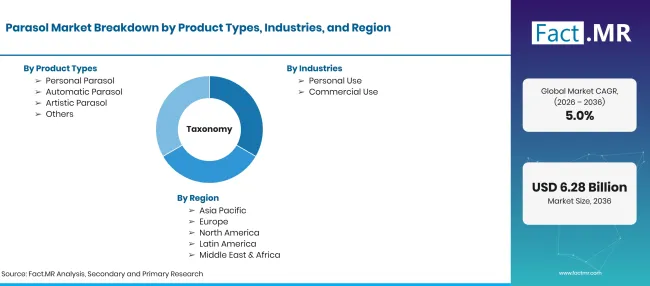
Parasol Market Taxonomy | Source: Fact.MR
| Attribute | Details |
|---|---|
| Industry Classification | Consumer |
| Quantitative Units | USD billion; revenue share and CAGR in percentages |
| Market Definition | The market covers parasols sold for portable personal shade and for household or commercial outdoor use. Products include personal, automatic and artistic parasols, together with other parasol formats. The commercial boundary follows the shade product and its supplied assembly. Permanent building canopies and unrelated outdoor furnishings remain separate markets. |
| Product Types | Personal Parasol; Automatic Parasol; Artistic Parasol; Others |
| Industries | Personal Use; Commercial Use |
| Regions Covered | North America; Latin America; Western Europe; Eastern Europe; East Asia; South Asia & Pacific; Middle East & Africa |
| Countries Covered | Germany; Brazil; United States; United Kingdom; Japan |
| Companies Profiled | Totes Isotoner Corporation; Fulton Umbrellas Ltd.; Knirps International GmbH; Blunt Umbrellas; Senz Umbrellas; ShedRain Corporation; Euroschirm GmbH; Doppler H. Würflingsdobler GmbH; Pasotti Ombrelli S.r.l.; Davek Accessories |
| Forecast Period | 2026 to 2036; base year 2026; historical year 2025 |
| Approach | Assessment of carrying formats, shade coverage, household and commercial buying requirements, country growth prospects and the operating conditions that influence product selection and replacement. |
Source: Fact.MR analysis. Updated Oct 27, 2026
How is the market segmented?
-
By Product Types
- Personal Parasol
- Automatic Parasol
- Artistic Parasol
- Others
-
By Industries
- Personal Use
- Commercial Use
-
By Region
- North America
- Latin America
- Western Europe
- Eastern Europe
- East Asia
- South Asia & Pacific
- Middle East & Africa
Frequently Asked Questions
How large is the parasol market?
What is the projected growth rate?
Which parasol product category leads in 2026?
How much demand comes from personal use?
Which companies are covered in the parasol market?
Who worked on this report


Preview the report firsthand - request a free sample
Free SampleGet the brochure for pricing and purchase details
Download PDF