- Market Value (2025): USD 41.5 Bn
- Estimated Value (2026): USD 42.7 Bn
- Forecast Value (2036): USD 56.8 Bn
- CAGR (2026-2036): 2.9%
What is the Passenger Car Motor Oil Market forecast to be worth by 2036?
USD 42.7 billion in 2026 to USD 56.8 billion by 2036, at 2.9% CAGR.
- The market reached USD 41.5 billion in 2025 as recurring maintenance supported combustion and hybrid vehicle service.
- Demand is projected to rise from USD 42.7 billion in 2026 to USD 56.8 billion by 2036.
- The market is forecast to record a 2.9% CAGR through 2036 as specification-led products offset slower service frequency.
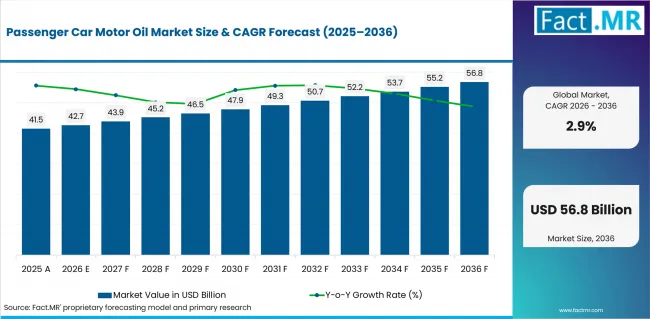
Passenger Car Motor Oil Market Value Analysis | Source: Fact.MR
What are the defining numbers behind Passenger Car Motor Oil Market growth?
USD 14.1 billion absolute opportunity by 2036, led by Synthetic Motor Oil and Passenger Cars alongside Individual Vehicle Owners.
- Demand Drivers in the Market
- Aging combustion and hybrid vehicles create repeat demand through scheduled oil changes across the serviceable passenger fleet.
- Incorrect oil selection influence warranty and service risks, so workshops value precise specification matching during maintenance.
- Low-viscosity oils protect turbocharged and hybrid engines during frequent restarts and demanding passenger vehicle temperatures.
- Quick-lube chains and garages convert maintenance triggers into purchases by guiding owners through grade and approval choices.
- Key Segments Analyzed
- By Product: Synthetic motor oil is projected to hold 47.0% share in 2026 due to dependable cold-flow performance.
- By Application: Passenger cars are expected to capture 61.0% share in 2026 because large fleets create recurring maintenance.
- By End User: Individual vehicle owners are estimated to represent 54.0% share in 2026 owing to service control.
- By Distribution Channel: Automotive aftermarket is forecast to hold 45.0% share in 2026 through independent retail access.
- By Viscosity Grade: 5W-30 is projected to account for 38.0% share in 2026 due to broad engine coverage.
- Analyst Opinion at Fact.MR
- Shambhu Nath Jha, Sr. Consultant at Fact.MR, opines: “Passenger car motor oil competes on fitment accuracy. Revenue is expected to favor brands combining verified approvals with dependable workshop availability.”
- Strategic Implications
- Manufacturers need to validate performance categories and manufacturer approvals before extending claims across passenger vehicle platforms.
- Portfolio managers should balance hybrid oils with high-mileage protection across vehicles with different service needs.
- Distributors should use vehicle lookup tools and stocking rules to limit slow-moving inventory across overlapping grades.
- Workshop managers should document installed oil specifications to protect credibility and strengthen trust across repeat visits.
Authorized dealer programs reduce fitment risk through model-specific grades. In February 2025, Castrol became the genuine engine-oil distributor for Volkswagen and Audi dealerships across the United States and Canada. The agreement converts verified approval into recurring service revenue.
USA and Japan are expected to rise at 3.8% CAGR and 3.5% CAGR, respectively, with travel intensity and dealer guidance shaping service demand. Germany follows at 3.2% CAGR through automotive lubricant portfolios, while the United Kingdom and Canada are projected to garner 2.9% CAGR and 2.6% CAGR driven by aging fleets and aftermarket automotive parts access.
How does the Passenger Car Motor Oil Market break down by segment?
Synthetic motor oil leads at 47.0%, passenger cars lead at 61.0%.
Which product dominates?
Synthetic motor oil holds 47.0% share in 2026.
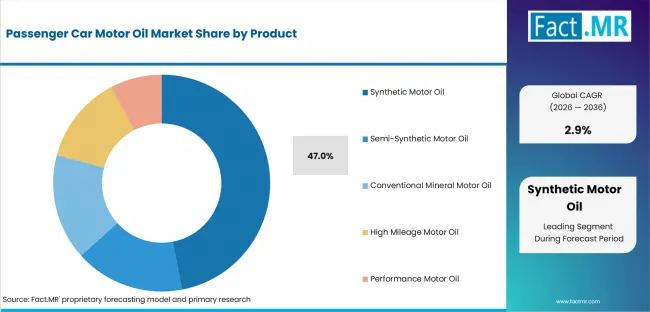
Passenger Car Motor Oil Market Analysis By Product | Source: Fact.MR
Based on product, synthetic motor oil is projected to account for 47.0% share in 2026 due to cold-flow stability. Synthetic lubricant formulations and anti-wear additives help meet lower-viscosity requirements.
What leads the application segment?
Passenger cars account for 61.0% share in 2026.
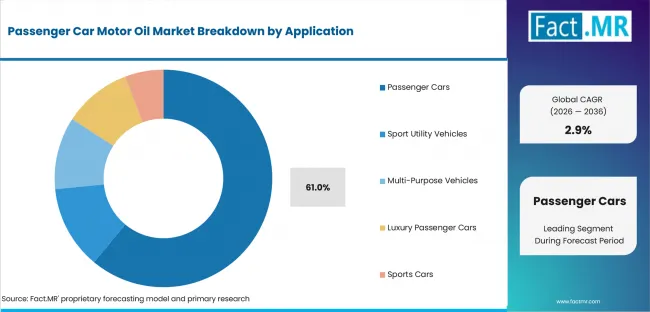
Passenger Car Motor Oil Market Analysis By Application | Source: Fact.MR
In 2026, passenger cars are expected to lead application with 61.0% share because hatchbacks and sedans require regular maintenance. ACEA reported in January 2026 that 256 million cars operated on European Union roads during 2024. Routine engine oil filters replacement adds related workshop revenue.
How do individual vehicle owners shape demand?
Individual vehicle owners represent 54.0% share in 2026.
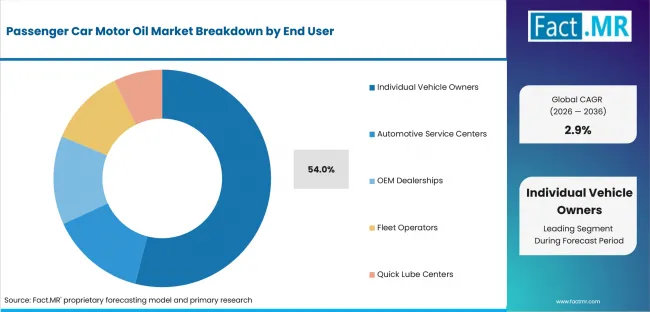
Passenger Car Motor Oil Market Analysis By End User | Source: Fact.MR
By end user, individual vehicle owners are estimated to hold 54.0% share in 2026 owing to direct service control. Workshops can recommend premium oil or engine flush products without forcing households to interpret labels. Broad lubricant portfolios serve varied vehicle ages.
What supports automotive aftermarket leadership?
Automotive aftermarket holds 45.0% share in 2026.
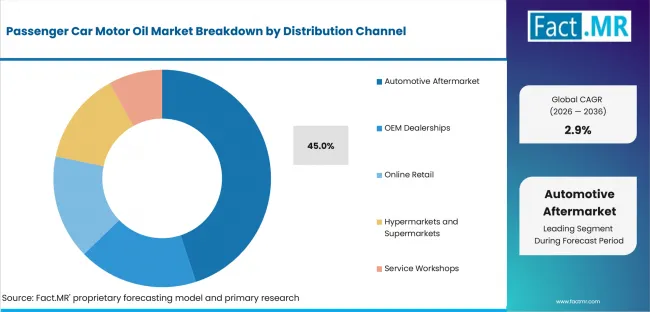
Passenger Car Motor Oil Market Analysis By Distribution Channel | Source: Fact.MR
By distribution channel, automotive aftermarket is forecast to represent 45.0% share in 2026 driven by independent access. TotalEnergies Marketing USA signed a February 2025 Meineke partnership covering more than 900 United States stores. Parts-store traffic connects motor oil with automotive filter demand.
What drives 5W-30 demand?
5W-30 accounts for 38.0% share in 2026.
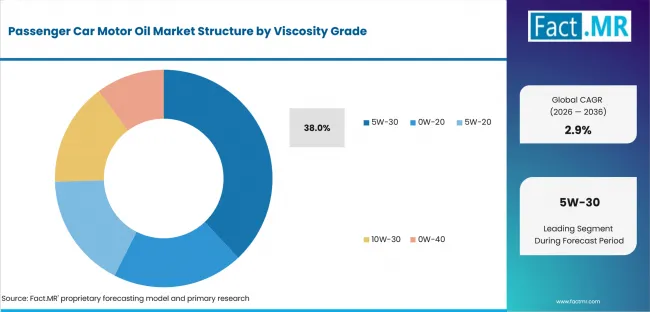
Passenger Car Motor Oil Market Analysis By Viscosity Grade | Source: Fact.MR
5W-30 is projected to hold 38.0% share in 2026 owing to broad gasoline-engine coverage. Castrol and Renault launched an RN17 5W-30 oil in December 2025 for more than half of Renault vehicles in Europe. Hybrid engine oil requirements and lubricant antioxidants support demanding engines.
What is accelerating Passenger Car Motor Oil Market adoption, and what is holding it back?
Recurring maintenance and specification renewal increase value, while electrification and longer drain intervals restrain oil-change frequency.
Drivers Impact Analysis
| DRIVER | (~) % IMPACT ON CAGR |
GEOGRAPHIC RELEVANCE | IMPACT TIMELINE |
|---|---|---|---|
| Aging combustion and hybrid vehicle parc | +0.7% | North America, Europe | Medium term |
| API SQ and GF-7 specification renewal | +0.6% | North America, East Asia | Short term |
| Workshop and quick-lube recommendation power | +0.5% | North America, Western Europe | Medium term |
| Low-viscosity hybrid and turbo formulations | +0.4% | East Asia, Western Europe | Medium term |
| Rising light-duty travel and long ownership | +0.3% | Global | Long term |
Source: Fact.MR analysis. Updated Jul 31, 2026
- Aging vehicle parc: Older combustion vehicles sustain high-mileage purchases when workshops identify deposits or oil consumption during recurring maintenance.
- Specification renewal: New performance categories increase formulation requirements, while licensed claims reduce technician uncertainty and protect service accuracy.
- Service-channel influence: Owners delegate grade selection to workshops, so reliable fitment tools and local availability shape brand conversion.
Opportunity Impact Analysis
| OPPORTUNITY | (~) % IMPACT ON CAGR |
GEOGRAPHIC RELEVANCE | IMPACT TIMELINE |
|---|---|---|---|
| Hybrid-duty passenger car formulations | +0.4% | East Asia, Western Europe | Medium term |
| High-mileage synthetic portfolios | +0.4% | North America, Europe | Medium term |
| Digital fitment and approval lookup | +0.3% | Global | Short term |
| Re-refined base-oil OEM programs | +0.2% | Western Europe | Long term |
Source: Fact.MR analysis. Updated Jul 31, 2026
- Hybrid-duty formulations: Frequent restarts and intermittent loads support oils with verified deposit control and component protection.
- High-mileage ranges: Older vehicles support synthetic products that address deposits and oil consumption through defensible protection claims.
- Digital fitment support: Vehicle lookup tools reduce viscosity complexity and misfill risk during scheduled passenger vehicle maintenance.
Restraints Impact Analysis
| RESTRAINT | (~) % IMPACT ON CAGR |
GEOGRAPHIC RELEVANCE | IMPACT TIMELINE |
|---|---|---|---|
| Battery-electric adoption removing oil-change events | -0.6% | Western Europe, East Asia | Long term |
| Extended manufacturer service intervals | -0.4% | Global | Medium term |
| Viscosity and approval complexity | -0.3% | Western Europe, North America | Medium term |
| Price sensitivity in mixed-age fleets | -0.2% | Latin America, South Asia | Long term |
Source: Fact.MR analysis. Updated Jul 31, 2026
- Battery-electric adoption: Battery-electric cars remove engine-oil service occasions, so brands are estimated to align channel investment with local powertrain turnover.
- Extended service intervals: Longer manufacturer recommendations reduce purchase frequency, requiring premium products to defend value without shortening specified maintenance cycles.
- Approval complexity: More viscosity grades increase inventory costs, while weak fitment information and limited availability slow service completion.
Which countries are scaling Passenger Car Motor Oil Market fastest?
USA 3.8%, Japan 3.5%, Germany 3.2%, United Kingdom 2.9%, Canada 2.6%.
Regional analysis covers North America, Latin America, Western Europe, Eastern Europe, East Asia, South Asia and Pacific, and the Middle East and Africa.
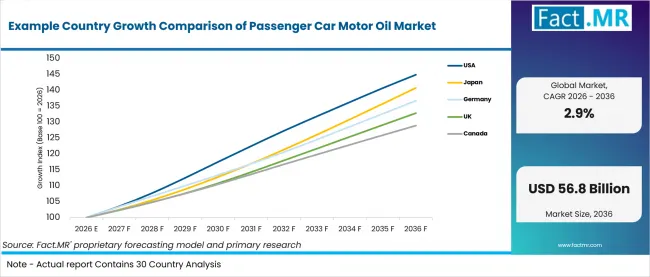
Example Country Growth Comparison Of Passenger Car Motor Oil Market | Source: Fact.MR
| COUNTRY | CAGR |
|---|---|
| USA | 3.8% |
| Japan | 3.5% |
| Germany | 3.2% |
| United Kingdom | 2.9% |
| Canada | 2.6% |
Source: Fact.MR analysis. Updated Jul 31, 2026
What is driving growth in the USA through 2036?
3.8% CAGR, supported by high travel and dense quick-service access.
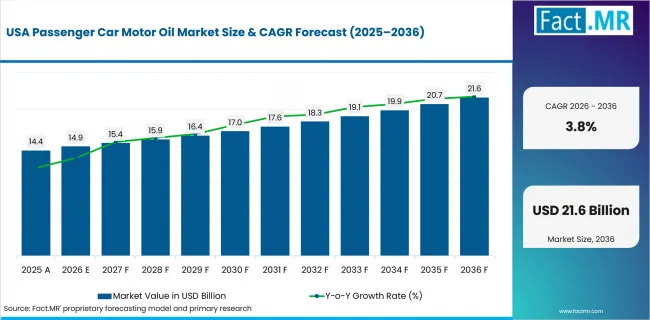
Passenger Car Motor Oil Market Country Value Analysis | Source: Fact.MR
U.S. owners reach passenger car oil through quick-lube chains and independent workshops. FHWA projected in September 2025 that light-duty vehicle travel would increase annually through 2053. Demand is forecast at 3.8% CAGR through 2036 as service access offsets approval complexity.
How is Japan scaling Passenger Car Motor Oil demand?
3.5% CAGR, shaped by dealer guidance and hybrid vehicle ownership.
Japanese owners rely on dealer guidance for compact engines and hybrid powertrains. JAMA reported in April 2026 that average vehicle holding reached 7.2 years and nearly 30% exceeded ten years. Demand is projected at 3.5% CAGR through 2036 as maintenance offsets cost pressure.
What supports Germany’s outlook?
3.2% CAGR, influenced by strict approvals and specialist workshop coverage.
German workshops prioritize documented approvals across premium passenger vehicles. ACEA reported in January 2026 that Germany had 49.3 million passenger cars during 2024. The market is forecast at 3.2% CAGR through 2036 as approval depth offsets stocking complexity.
What underpins growth in the United Kingdom?
2.9% CAGR, owing to a large aging fleet and transparent service channels.
United Kingdom owners use dealers and independent garages while online comparison increases price transparency. The Department for Transport reported in April 2026 that 42.3 million vehicles were licensed at the end of 2025. Demand is estimated at 2.9% CAGR through 2036 as combustion vehicles offset zero-emission substitution.
How is Canada developing Passenger Car Motor Oil demand?
2.6% CAGR, driven by cold starts and long regional service distances.
Canadian service demand reflects cold starts and dispersed ownership across long routes. Statistics Canada reported in October 2025 that 24.6 million light-duty vehicles were registered during 2024. Demand is expected at 2.6% CAGR through 2036 as synthetic performance offsets inventory pressure.
Who leads the Passenger Car Motor Oil Market?
Shell holds 11.4% share, while ExxonMobil and Castrol provide broad passenger car oil coverage across global service channels.
Competition includes integrated energy groups and specialist brands with different approval strengths. Shell’s 11.4% share leaves most revenue outside one provider, so workshop access remains decisive. Regional blenders can enter through local approvals, but national scale requires dependable supply and technician recognition.
Shell and ExxonMobil compete through broad portfolios and international distribution. Castrol and TotalEnergies use manufacturer relationships while Chevron and Valvoline Global emphasize retail coverage. ENEOS adds Japanese viscosity expertise. Competition is expected to center on approval depth and inventory reliability.
Which companies are the key providers?
Key providers include Shell plc, Exxon Mobil Corporation, Castrol, Chevron Corporation, TotalEnergies SE, Valvoline Global Operations, and ENEOS Corporation.
- Shell plc
- Exxon Mobil Corporation
- Castrol
- Chevron Corporation
- TotalEnergies SE
- Valvoline Global Operations
- ENEOS Corporation
Bibliography
- American Petroleum Institute. (2026, July). API 1509 - Engine Oil Licensing and Certification System (24th ed.).
- Castrol. (2025, February 17). Volkswagen/Audi select Castrol.
- Castrol. (2025, December 17). New Renault Castrol GTX with RRBO.
- Department for Transport. (2026, April 29). Vehicle licensing statistics, United Kingdom: 2025. GOV.UK.
- European Automobile Manufacturers’ Association. (2026, January 15). Report – Vehicles on European roads 2026.
- Federal Highway Administration. (2025, September). 2025 FHWA Forecasts of Vehicle Miles Traveled (VMT). U.S. Department of Transportation.
- Japan Automobile Manufacturers Association. (2026, April 14). 2025年度乗用車市場動向調査について [2025 passenger car market trends survey].
- Shell. (2025, May 30). Shell Helix unveils striking new packaging and launches ‘Unleash the Power Within’ campaign.
- Statistics Canada. (2025, October 17). Vehicle registrations, 2024.
- TotalEnergies. (2025, February 21). Lubricant Partnership with car care center, Meineke.
This Report Addresses
- The report evaluates oil choices that shape recurring maintenance across combustion and hybrid passenger vehicles.
- Segment analysis covers synthetic motor oil and passenger cars as the approved 2026 share positions.
- Country analysis compares USA and Japan with Germany while the United Kingdom and Canada complete coverage.
- Competitive analysis profiles key lubricant companies across global portfolios and regional service strengths.
- Product assessment covers synthetic and mineral formulations for different engine ages and performance requirements.
- Application assessment covers mainstream passenger vehicles and premium models within the defined serviceable fleet.
What does the Passenger Car Motor Oil Market cover?
Revenue from engine oil sold for passenger vehicles with combustion engines and hybrid powertrains.
The market covers finished engine oils for gasoline and hybrid passenger vehicles across synthetic and mineral families. High-mileage and performance oils qualify through retail or professional service channels.
What is included in the scope?
Passenger car engine oils across synthetic and mineral formulations, major viscosity grades, service channels, and defined regions.
Included revenue covers finished synthetic and mineral oils for passenger cars and defined premium models. End users include owners and service centers alongside dealerships and fleets. Distribution spans aftermarket and dealership routes together with online retail and workshops.
What is excluded from the scope?
Oil-change labor and adjacent vehicle fluids remain excluded from the measured market revenue.
The analysis excludes base oils and additives sold before finished formulation. Commercial vehicle oils and motorcycle oils remain outside the boundary alongside transmission fluids. Oil-change labor is excluded even when bundled with engine oil.
How was the analysis built?
The analysis draws on 120+ sources, 35+ company portfolios, 25+ countries, and more than 20 industry interviews.
- Primary Research: Primary research includes discussions with manufacturers, service providers, technology developers, distributors, end users, procurement teams, and subject-matter experts. These conversations examine purchasing priorities, product adoption, operational challenges, approval requirements, competitive positioning, and the factors that influence wider market acceptance.
- Desk Research: Desk research covers government statistics, regulatory publications, company filings, trade data, technical studies, industry associations, standards, public policy, and other authoritative sources. Every source used in the analysis is documented in the bibliography.
- Market Sizing and Forecasting: Market estimates combine historical performance, demand indicators, pricing and volume trends, segment shares, company participation, country-level growth, adoption patterns, investment activity, and barriers to market expansion.
- Data Validation and Update Cycle: Findings are validated by comparing primary interviews with public data, company activity, regulatory changes, trade patterns, and industry developments. Regular updates review new product launches, capacity changes, partnerships, approvals, procurement trends, and shifts in commercial adoption.
Segmentation
What is the report’s scope and coverage?
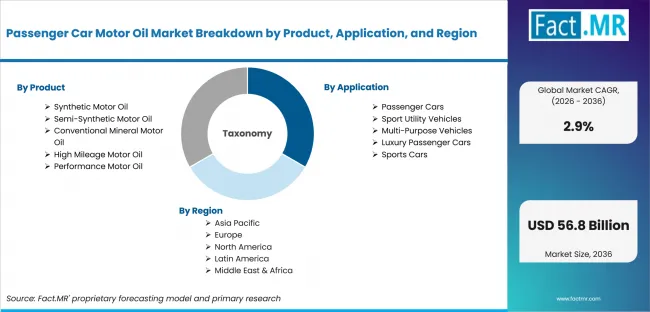
Passenger Car Motor Oil Market Breakdown By Product, Application, And Region | Source: Fact.MR
| Coverage field | Report scope |
|---|---|
| Quantitative Units | USD Billion |
| Market Definition | Revenue from finished passenger car motor oil used in combustion and hybrid vehicles within the defined scope. |
| Product | Synthetic Motor Oil, Semi-Synthetic Motor Oil, Conventional Mineral Motor Oil, High Mileage Motor Oil, Performance Motor Oil |
| Application | Passenger Cars, Sport Utility Vehicles, Multi-Purpose Vehicles, Luxury Passenger Cars, Sports Cars |
| End User | Individual Vehicle Owners, Automotive Service Centers, OEM Dealerships, Fleet Operators, Quick Lube Centers |
| Distribution Channel | Automotive Aftermarket, OEM Dealerships, Online Retail, Hypermarkets and Supermarkets, Service Workshops |
| Viscosity Grade | 5W-30, 0W-20, 5W-20, 10W-30, 0W-40 |
| Regions Covered | North America, Latin America, Western Europe, Eastern Europe, East Asia, South Asia and Pacific, Middle East and Africa |
| Countries Covered | USA, Japan, Germany, United Kingdom, Canada, Brazil, Mexico, and more than twenty-five additional countries |
| Key Companies Profiled | Shell plc, Exxon Mobil Corporation, Castrol, Chevron Corporation, TotalEnergies SE, Valvoline Global Operations, ENEOS Corporation |
| Forecast Period | 2026 to 2036 |
| Approach | A combined model links serviceable vehicles with oil-change frequency and product mix across countries. |
Source: Fact.MR analysis. Updated Jul 31, 2026
How is the market segmented?
-
By Product:
- Synthetic Motor Oil
- Full Synthetic Oil
- High Mileage Synthetic Oil
- Semi-Synthetic Motor Oil
- Synthetic Blend Oil
- High Performance Blend Oil
- Conventional Mineral Motor Oil
- Mineral Engine Oil
- Standard Passenger Car Oil
- High Mileage Motor Oil
- Seal Conditioner Oil
- Wear Protection Oil
- Performance Motor Oil
- Racing Motor Oil
- Fuel Economy Motor Oil
- Synthetic Motor Oil
-
By Application:
- Passenger Cars
- Hatchbacks
- Sedans
- Sport Utility Vehicles
- Compact SUVs
- Full-Size SUVs
- Multi-Purpose Vehicles
- Minivans
- Crossovers
- Luxury Passenger Cars
- Premium Sedans
- Luxury SUVs
- Sports Cars
- Performance Cars
- Grand Touring Cars
- Passenger Cars
-
By End User:
- Individual Vehicle Owners
- Private Car Owners
- Multi-Car Households
- Automotive Service Centers
- Independent Workshops
- Authorized Service Centers
- OEM Dealerships
- Franchised Dealerships
- Certified Service Networks
- Fleet Operators
- Corporate Fleets
- Car Rental Companies
- Quick Lube Centers
- Express Oil Change Centers
- Fast Service Garages
- Individual Vehicle Owners
-
By Distribution Channel:
- Automotive Aftermarket
- Auto Parts Retailers
- Independent Lubricant Dealers
- OEM Dealerships
- Authorized Dealerships
- Manufacturer Service Centers
- Online Retail
- E-Commerce Platforms
- Brand-Owned Online Stores
- Hypermarkets and Supermarkets
- Hypermarkets
- Automotive Sections
- Service Workshops
- Quick Lube Chains
- Independent Garages
- Automotive Aftermarket
-
By Viscosity Grade:
- 5W-30
- Full Synthetic 5W-30
- Synthetic Blend 5W-30
- 0W-20
- Fuel Economy 0W-20
- Full Synthetic 0W-20
- 5W-20
- Conventional 5W-20
- High Mileage 5W-20
- 10W-30
- Mineral 10W-30
- Semi-Synthetic 10W-30
- 0W-40
- High Performance 0W-40
- European Formula 0W-40
- 5W-30
-
By Region:
- North America
- United States
- Canada
- Latin America
- Brazil
- Mexico
- Argentina
- Chile
- Western Europe
- Germany
- France
- United Kingdom
- Italy
- Spain
- Benelux
- Nordics
- Eastern Europe
- Poland
- Czech Republic
- Romania
- Hungary
- East Asia
- China
- Japan
- South Korea
- South Asia and Pacific
- India
- ASEAN
- Australia and New Zealand
- Middle East and Africa
- GCC Countries
- South Africa
- Türkiye
- Israel
- North America
Frequently Asked Questions
What supports synthetic motor oil within the product category?
How are passenger cars positioned within application demand?
How are individual vehicle owners positioned within end-user demand?
What supports automotive aftermarket share within distribution?
How much share is 5W-30 expected to capture?
How does the USA compare within the country outlook?
What creates recurring passenger car motor oil demand?
Which condition creates the primary restraint on demand?
Who worked on this report


Preview the report firsthand - request a free sample
Free SampleGet the brochure for pricing and purchase details
Download PDF