- Base Value(2025): 1.1 Bn
- Estimated Value(2026): 1.3 Bn
- Forecast Value (2036): 4.3 Bn
- CAGR (2026 - 2036): 12.6%
Passenger Side Interactive Display Systems Market Forecast and Outlook by Fact.MR
In 2025, the passenger side interactive display systems market was valued at USD 1.1 billion. Based on Fact.MR analysis, demand for passenger side interactive display systems is estimated to grow to USD 1.3 billion in 2026 and USD 4.3 billion by 2036. FACT.MR projects a CAGR of 12.6% during the forecast period.
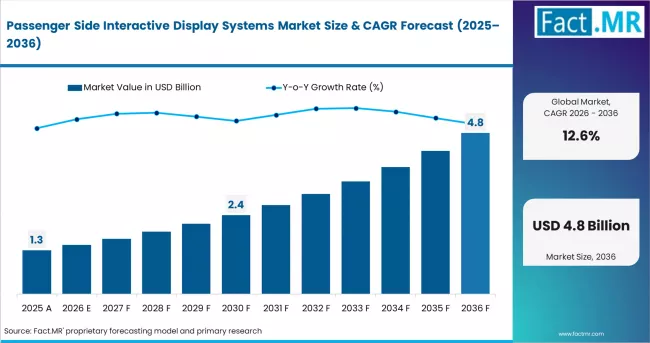
Passenger Side Interactive Display Systems Market Value Analysis | Source: Fact.MR
Summary of Passenger Side Interactive Display Systems Market
- Market Definition
- The market covers TFT-LCD, OLED, and MicroLED interactive display assemblies with touch, voice, and gesture interfaces supplied for passenger and luxury vehicle co-pilot and cabin zones globally.
- Demand Drivers
- China's NEV platform mandates are requiring large-format passenger-side displays as standard cockpit fitment, directly expanding unit demand across domestically produced electric vehicles.
- European luxury OEMs including BMW and Mercedes-Benz are embedding OLED co-pilot displays as standard on flagship platforms from 2024 model year, driving adoption and setting global design benchmarks.
- India's mid-range vehicle OEMs are accelerating feature standardisation, with Tata Motors and Maruti Suzuki integrating touch-based passenger interfaces across new model launches in 2024 and 2025.
- Key Segments Analyzed
- By Display Technology: OLED leads with approximately 42% share in 2026, driven by premium vehicle adoption and curved display compatibility across luxury cabin architectures.
- By Vehicle Type: Premium and luxury passenger vehicles hold approximately 55% share in 2026, reflecting passenger-side displays as still largely a premium-feature driven fitment across global OEM programmes.
- By Interaction Type: Touch-based systems lead with approximately 60% share in 2026, as the primary interface for co-driver interaction across all passenger vehicle segments globally.
- Analyst Opinion at FACT.MR
- Shambhu Nath Jha, Principal Consultant at Fact.MR, opines, CXOs will see passenger-side display content as the fastest-growing per-vehicle revenue stream. It is becoming a key value driver for cabin electronics suppliers. Vendors integrating OLED with voice and gesture control will gain an advantage. These suppliers will capture a larger share of premium programme contracts through 2036.
- Strategic Implications
- Invest in OLED passenger display integration capability targeting luxury OEM programmes in Germany, Japan, and the United States where premium cockpit mandates are accelerating.
- Develop cost-optimised touch-based display platforms for India and Southeast Asia mid-range vehicle OEM supply to capture high-growth volume segments.
- Build voice and gesture interface competency alongside hardware supply to secure bundled HMI contracts and higher margin positioning within OEM platform programmes.
- Methodology
- Market sizing based on vehicle production volumes, passenger display attach rates by segment, and average selling prices by technology. Validated with 2024–2025 OEM sourcing data.
- Uses OEM earnings disclosures, DSCC panel shipment records, China NEV policy documents, and EU automotive electronics regulatory filings for demand analysis.
- Forecasts incorporate vehicle electrification trends, OEM platform refresh cycles, display technology cost curves, and regional NEV and safety policy mandates.
| Metric | Value |
|---|---|
| Estimated Value in 2026 | USD 1.3 billion |
| Forecast Value in 2036 | USD 4.3 billion |
| Forecast CAGR (2026 to 2036) | 12.6% |
Between 2026 and 2036, the market is projected to generate USD 3.0 billion in absolute opportunity. Growth is anchored in OLED adoption across luxury platforms and accelerating touch-based interface fitment in mid-range vehicles. Restraints include high OLED substrate costs, OEM integration complexity, and lengthy homologation cycles limiting speed of technology refresh across model generations.
OEMs across Europe and Asia are embedding passenger-side displays as standard rather than optional equipment across new model launches. Continental AG and Visteon Corporation have both disclosed long-term supply agreements tied to next-generation cockpit platforms. Tier-1 executives at Visteon noted in a Q4 2024 earnings call that co-pilot and passenger display modules represent one of the fastest-growing content categories per vehicle in their forward order book.
India leads with a projected CAGR of 14.2% through 2036, driven by rapid feature penetration in mid-range vehicles and expanding OEM standard fitment policies. China follows at 13.5%, anchored in electric vehicle platform mandates and smart cockpit integration requirements. Germany records 12.8%, driven by luxury OEM innovation cycles at BMW Group and Mercedes-Benz. The United States grows at 12.1%, supported by strong premium vehicle demand and NHTSA-compliant interface standards adoption. Japan records 11.9%, supported by advanced electronics integration and deep OEM-supplier ecosystem depth. Mature markets including Japan and the United States face longer homologation cycles as a structural moderator.
Segmental Analysis
Passenger Side Interactive Display Systems Market Analysis by Display Technology
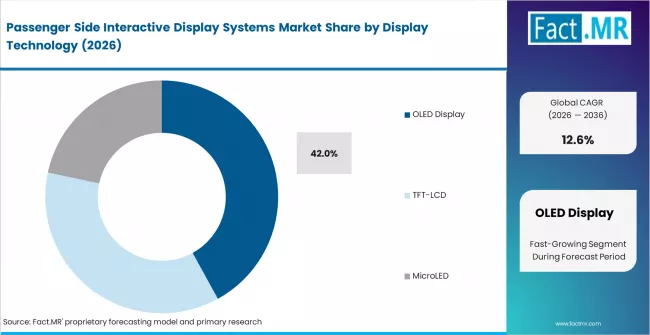
Passenger Side Interactive Display Systems Market Analysis By Display Technology | Source: Fact.MR
OLED display holds 42% share in 2026, driven by premium design demand. Thin panels and high contrast support advanced cabins. Adoption is moving into near-premium vehicles.
- LG Display Investment: USD 1.1 billion invested in 2024 to expand OLED capacity for automotive supply from 2026 [1].
- Continental AG OLED Development: Curved OLED passenger display with touch and anti-glare showcased at CES 2025 [2].
- TFT-LCD Cost Compression Trend: 10-inch TFT-LCD prices declined 12% YoY in Q3 2024, supporting volume demand [3].
Passenger Side Interactive Display Systems Market Analysis by Vehicle Type
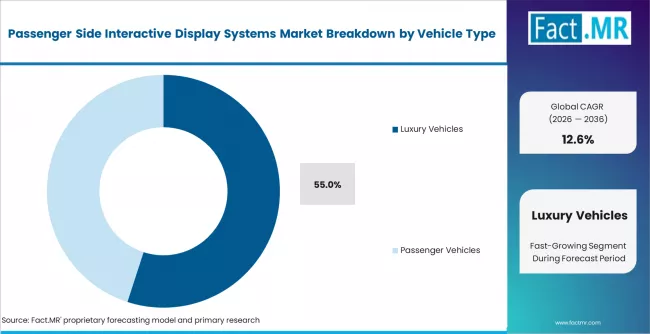
Passenger Side Interactive Display Systems Market Analysis By Vehicle Type | Source: Fact.MR
Premium and luxury vehicles hold 55% share in 2026. Standardization in high-end models is driving broader adoption.
- Visteon OEM Programme Win: Selected for two European luxury OEM programmes (~400,000 units annually from 2026) [4].
- Panasonic Automotive Platform: Supply deal for passenger displays covering ~600,000 units annually from 2026 [5].
- Passenger Vehicle Electrification Link: 91% of new BEV platforms in 2024 include passenger displays, up from 74% in 2022 [6].
Drivers, Restraints, and Opportunities
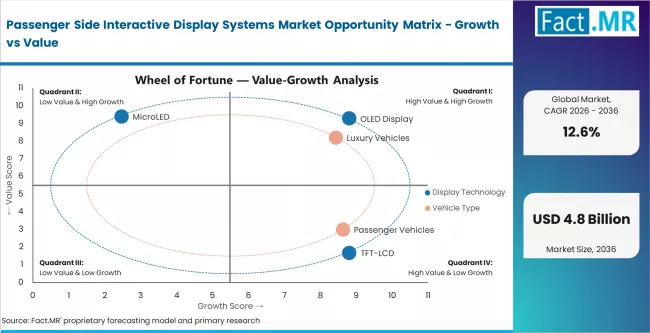
Passenger Side Interactive Display Systems Market Opportunity Matrix Growth Vs Value | Source: Fact.MR
FACT.MR analysts observe that the passenger side interactive display systems market is structurally growth-driven and aligned with vehicle electrification and OEM cabin digitalisation. Passenger displays are shifting from optional to standard fitment in mid-premium and luxury vehicles. China’s NEV policies and European luxury refresh cycles remain core growth drivers.
The market is splitting between low-cost touch systems for emerging markets and premium OLED with multimodal interfaces for luxury vehicles. TFT-LCD faces margin pressure. OLED and voice plus gesture systems command 30–50% higher pricing. Suppliers lacking multimodal capability risk exclusion by 2027.
- China NEV Cockpit Policy: China’s 2024 MIIT policy mandates smart cockpit integration for subsidy eligibility. BYD deployed DiLink 5.0 in Seal and Han EVs. Regional programmes reinforced adoption. This boosted display attach rates
- EU Automotive Type Approval Mandate: EU Regulation 2019/2144 enforces stricter in-cabin safety and EMC compliance from July 2024. This raised integration complexity. Continental AG and Robert Bosch GmbH expanded compliant solutions.
- India OEM Fitment Acceleration: India’s 2024 PLI extension incentivised cabin electronics. Tata Motors added passenger displays in Harrier and Safari (2025). Maruti Suzuki plans rollout in mid-range SUVs by 2026.
Regional Analysis
The passenger side interactive display systems market is assessed across Asia Pacific, North America, Europe, Latin America, and Middle East and Africa, covering major vehicle production and consumption markets with distinct OEM ecosystems, regulatory environments, and cabin feature adoption profiles. The full report provides market attractiveness analysis by region and country.
.webp "Top Country Growth Comparison Passenger Side Interactive Display Systems Market Cagr (2026 2036)")
Top Country Growth Comparison Passenger Side Interactive Display Systems Market Cagr (2026 2036) | Source: Fact.MR
|
Country |
CAGR (2026 to 2036) |
|---|---|
| India | 14.2% |
| China | 13.5% |
| Germany | 12.8% |
| United States | 12.1% |
| Japan | 11.9% |
Source: Fact.MR (FACT.MR) analysis, based on proprietary forecasting model and primary research
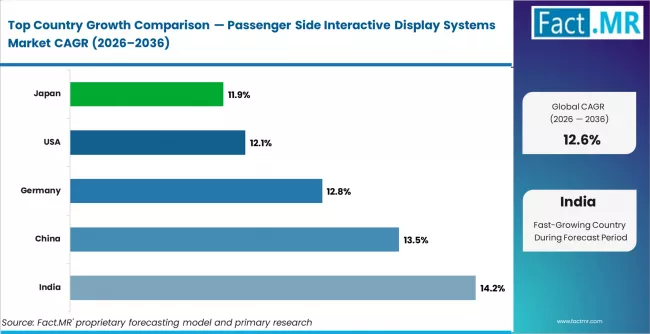
Passenger Side Interactive Display Systems Market Cagr Analysis By Country | Source: Fact.MR
Asia Pacific Passenger Side Interactive Display Systems Market Analysis
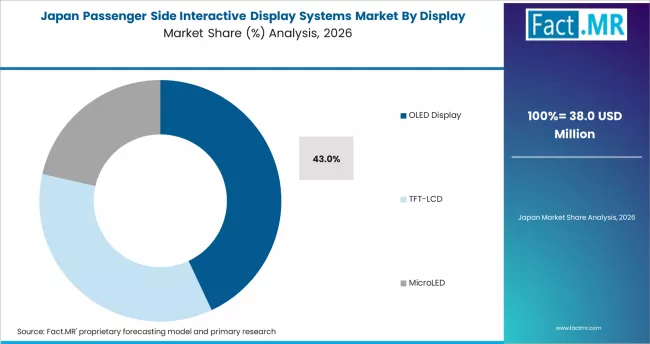
Passenger Side Interactive Display Systems Market Japan Market Share Analysis By Display Technology | Source: Fact.MR
Asia Pacific is the fastest-growing region and a key production hub for passenger display modules. China and India drive volume through NEV policies and mid-range adoption. Japan leads in technology depth and integration quality. Regional competition is shaped by Denso Corporation, Panasonic Automotive, and Chinese panel suppliers.
- India: India is projected to grow at 14.2% CAGR through 2036, the fastest globally. Growth is driven by rapid mid-range feature adoption. Tata Motors introduced passenger displays in Harrier and Safari from Q1 2025. The 2024 PLI extension boosted local assembly and reduced imports. Maruti Suzuki plans co-pilot display rollout in 2026 SUVs, expanding mass-market demand.
- China: China is expected to grow at 13.5% CAGR through 2036, supported by its dominant NEV ecosystem. The 2024 MIIT policy mandates smart cockpit integration for subsidies. BYD deployed DiLink 5.0 across Seal and Han EVs in Q2 2024. BOE Technology and Jinhua Ruisi expanded capacity, strengthening domestic supply chains.
- Japan: Japan is forecast to grow at 11.9% CAGR through 2036, reflecting steady and quality-led adoption. Toyota introduced Arene OS with passenger display interfaces in 2024. Denso Corporation expanded voice and gesture HMI R&D for 2026 supply. Growth is shaped by preference for seamless integration over aggressive display expansion.
FACT.MR’s analysis of the passenger side interactive display systems market in Asia Pacific covers India, China, Japan, South Korea, ASEAN, and Australia and New Zealand. Readers can find vehicle production trends, NEV policy impacts, OEM specification shifts, and panel supply chain insights.
Europe Passenger Side Interactive Display Systems Market Analysis
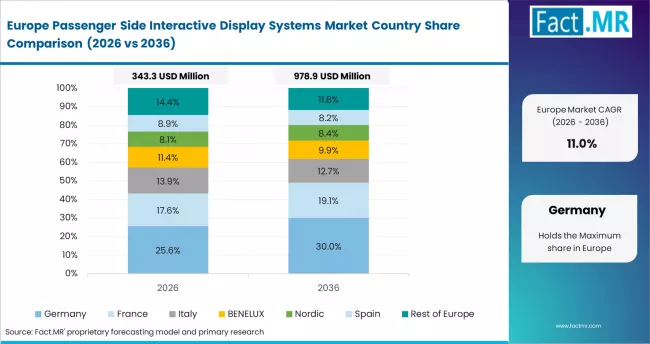
Passenger Side Interactive Display Systems Market Europe Country Market Share Analysis, 2026 & 2036 | Source: Fact.MR
Europe is a premium innovation hub for passenger display design. German OEMs define global OLED and curved display standards. Continental AG, Robert Bosch GmbH, and LG Display’s regional operations shape competition.
- Germany: Germany is projected to grow at 12.8% CAGR through 2036, driven by luxury innovation cycles. BMW Group launched iDrive 9 with a 14.9-inch curved OLED passenger display in 2024. Mercedes-Benz confirmed MBUX Superscreen rollout from 2025. EU Regulation 2019/2144 increased EMC requirements, strengthening barriers for non-certified suppliers.
FACT.MR’s analysis of the passenger side interactive display systems market in Europe covers Germany, United Kingdom, France, Italy, Spain, Nordic Countries, and BENELUX. Readers can find regulatory data, OEM trends, and premium demand forecasts.
North America Passenger Side Interactive Display Systems Market Analysis
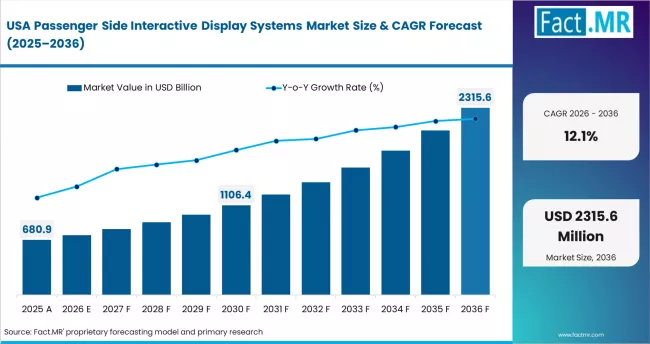
Passenger Side Interactive Display Systems Market Country Value Analysis | Source: Fact.MR
North America is a high-value market driven by premium vehicle demand and safety regulations. Visteon Corporation, Harman International, and Panasonic Automotive supply major OEM programmes. NHTSA guidelines and connected vehicle investments shape demand.
- United States: The U.S. is expected to grow at 12.1% CAGR through 2036, supported by high premium vehicle penetration. NHTSA updated guidelines in 2024 to include passenger display safety limits. Ford expanded SYNC 4A integration across F-150 and Explorer from 2025. General Motors confirmed Ultifi-based passenger displays for Cadillac and Equinox EV from 2026.
FACT.MR’s analysis of the passenger side interactive display systems market in North America covers the United States, Canada, and Mexico. Readers can find OEM sourcing trends, regulatory insights, and display adoption data.
Competitive Aligners for Market Players
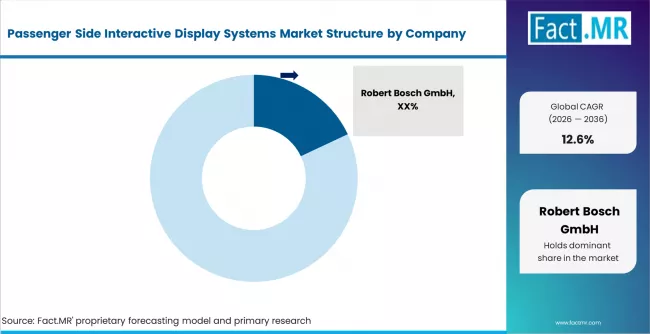
Passenger Side Interactive Display Systems Market Analysis By Company | Source: Fact.MR
The passenger side interactive display systems market is moderately consolidated, with competition centred on Tier-1 automotive electronics suppliers, display panel manufacturers, and integrated cockpit solution providers. Leading players compete on display technology, system integration capability, and long-term OEM programme alignment. The market is shifting from standalone display supply to fully integrated smart cockpit ecosystems, increasing entry barriers for smaller vendors.
Continental AG, Robert Bosch GmbH, and Denso Corporation focus on end-to-end cockpit integration, combining passenger displays with ADAS-linked interfaces and HMI software. These players benefit from deep OEM relationships and strong compliance capabilities, particularly in Europe and Japan.
LG Display and BOE Technology Group dominate the panel supply layer, especially in OLED and advanced TFT-LCD segments. Their scale advantages and continuous capacity investments support pricing competitiveness and technology leadership. OLED capability is emerging as a key differentiator in premium OEM sourcing decisions.
Visteon Corporation, Panasonic Automotive Systems, and Harman International are strengthening their positions through digital cockpit platforms and software-driven user interfaces. These companies are increasingly offering multimodal interaction systems, including touch, voice, and gesture integration. Chinese suppliers are gaining share in volume segments through cost-optimised solutions and strong domestic OEM alignment. However, premium segment competition remains dominated by global Tier-1 suppliers with advanced integration and regulatory compliance capabilities. Strategic partnerships, OLED investments, and software ecosystem development will remain key competitive factors through 2030.
Key Players
- Robert Bosch GmbH
- Continental AG
- Visteon Corporation
- Denso Corporation
- Panasonic Automotive Systems Co., Ltd.
- LG Display Co., Ltd.
- Samsung Electronics Co., Ltd. (Harman International)
- Harman International Industries, Inc.
- Aptiv PLC
- Alpine Electronics, Inc.
Bibliography
- [1] LG Display. (2024). Investment announcement on expansion of automotive OLED panel production capacity at Paju facility.
- [2] Continental AG. (2025). Curved OLED passenger display module showcased at CES 2025 with integrated touch and anti-glare technology.
- [3] Display Supply Chain Consultants (DSCC). (2024). Q3 Automotive Display Panel Price Index Report highlighting TFT-LCD price trends.
- [4] Visteon Corporation. (2024). OEM programme win announcement for passenger-zone display modules across European luxury platforms.
- [5] Panasonic Automotive Systems. (2024). Passenger display cockpit system supply agreement for premium vehicle platforms.
- [6] BloombergNEF. (2024). Electric Vehicle Outlook report detailing BEV platform feature integration trends.
This Report Addresses
- Strategic intelligence on passenger side interactive display demand across TFT-LCD, OLED, and MicroLED display technologies and touch, voice, and gesture interaction types for passenger and luxury vehicle OEM programmes globally.
- Market forecast from USD 1.3 billion in 2026 to USD 4.3 billion by 2036, at a CAGR of 12.6%.
- Growth opportunity mapping across India mid-range feature adoption, China NEV cockpit mandates, Germany luxury OLED platform integration, and U.S. premium vehicle demand.
- Segment analysis by display technology (TFT-LCD, OLED, MicroLED), vehicle type (passenger, luxury), and interaction type (touch-based, voice plus gesture-enabled).
- Regional outlook covering Asia Pacific NEV-driven volume growth, North America NHTSA compliance-driven adoption, and Europe EU Regulation 2019/2144 type approval mandate impact on premium passenger display fitment.
- Competitive analysis of Robert Bosch GmbH, Continental AG, Visteon Corporation, LG Display, Samsung Harman, Denso Corporation, and Panasonic Automotive. Focus on OEM programme integration depth, OLED supply positioning, and multimodal HMI bundling strategy.
- Regulatory impact analysis covering NHTSA in-vehicle information system guidelines, EU Regulation 2019/2144 type approval requirements, China MIIT NEV smart cockpit mandates, and India PLI Scheme cabin electronics assembly incentives.
- Report delivered in PDF, Excel datasets, and presentation formats, supported by OEM and Tier-1 primary interviews, panel shipment data, NEV policy documents, and manufacturer sourcing disclosures.
Passenger Side Interactive Display Systems Market Definition
The passenger side interactive display systems market includes touchscreen, voice, and gesture-enabled display modules integrated into the co-pilot and rear passenger zones of vehicles.
Passenger Side Interactive Display Systems Market Inclusions
Covers global and regional forecasts from 2026 to 2036 by display technology, vehicle type, and interaction type. Includes TFT-LCD, OLED, and MicroLED display assemblies. Covers touch-based and voice plus gesture-enabled interaction systems. Includes OEM factory-fit and integrated cabin display modules across passenger and luxury vehicle segments.
Passenger Side Interactive Display Systems Market Exclusions
Excludes central infotainment displays and driver-facing instrument cluster displays unless physically integrated into a shared passenger display module. Omits standalone rear-seat entertainment screens not connected to a co-pilot interactive interface. Excludes display semiconductor components and raw panel glass not supplied as assembled modules to OEM programmes.
Passenger Side Interactive Display Systems Market Research Methodology
- Primary Research
- Interviews with vehicle OEM cabin electronics leads, Tier-1 display system integrators, HMI software engineers, and automotive procurement managers across Germany, China, Japan, India, and the United States.
- Desk Research
- Uses OEM annual reports, DSCC automotive panel shipment data, EU automotive electronics directives, China NEV policy documents, and company disclosures from Visteon Corporation, Continental AG, and LG Display from 2024 to 2025.
- Market-Sizing and Forecasting
- Hybrid model using vehicle production volumes by type, passenger display attach rates by vehicle segment, average selling prices by display technology, and OEM platform refresh cycles across all covered geographies.
- Data Validation and Update Cycle
- Validated using OEM sourcing disclosures, Tier-1 earnings call references, and automotive electronics trade data. Cross-checked with HMI engineering expert interviews. Updated annually.
Segmentation
Scope of Report
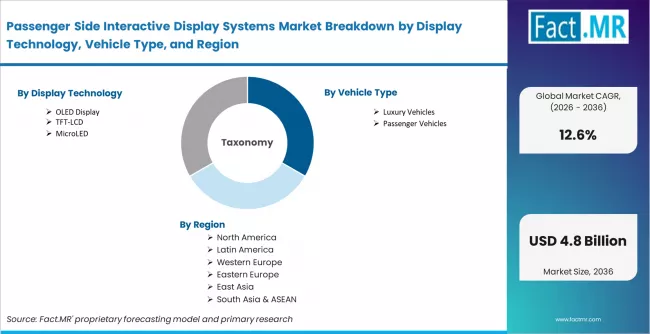
Passenger Side Interactive Display Systems Market Breakdown By Display Technology Vehicle Type And Region | Source: Fact.MR
|
Attribute |
Details |
|---|---|
| Quantitative Units | USD 1.3 billion (2026) to USD 4.3 billion (2036), at a CAGR of 12.6% |
| Market Definition | TFT-LCD, OLED, and MicroLED interactive display modules with touch, voice, and gesture interfaces integrated into passenger and luxury vehicle co-pilot and cabin zones, supplied as OEM factory-fit assemblies by Tier-1 automotive cabin electronics integrators globally. |
| Display Technology Segmentation | TFT-LCD, OLED, MicroLED |
| Vehicle Type Segmentation | Passenger Vehicles, Luxury Vehicles |
| Interaction Type Segmentation | Touch-based, Voice + Gesture-enabled |
| Application Coverage | OEM factory-fit co-pilot interactive display systems, passenger cabin infotainment and connectivity interfaces, multimodal HMI integration across electric, hybrid, and ICE vehicle platforms globally. |
| Regions Covered | North America, Europe, Asia Pacific, Latin America, Middle East and Africa |
| Countries Covered | USA, Canada, Mexico, Germany, UK, France, Italy, Spain, Nordic, BENELUX, China, Japan, South Korea, India, ASEAN, Australia and New Zealand, Brazil, Argentina, Colombia, Saudi Arabia, GCC, Turkey, South Africa, Rest of MEA |
| Key Companies Profiled | Robert Bosch GmbH, Continental AG, Visteon Corporation, Denso Corporation, Panasonic Automotive, LG Display, Samsung (Harman), Harman International, Aptiv PLC, Alpine Electronics |
| Forecast Period | 2026 to 2036 |
| Approach | Hybrid top-down and bottom-up model using vehicle production volumes by type, passenger display attach rates by segment, average selling prices by display technology, OEM platform refresh cycles, NEV policy mandates, and primary interviews with OEM cabin electronics leads and Tier-1 display integrators. |
Passenger Side Interactive Display Systems Market by Segments
-
By Display Technology:
- TFT-LCD
- OLED
- MicroLED
-
By Vehicle Type:
- Passenger Vehicles
- Luxury Vehicles
-
By Interaction Type:
- Touch-based
- Voice + Gesture-enabled
-
By Region:
- North America
- United States
- Canada
- Mexico
- Latin America
- Brazil
- Argentina
- Colombia
- Rest of Latin America
- Western Europe
- Germany
- United Kingdom
- France
- Italy
- Spain
- Nordic Countries
- BENELUX
- Rest of Western Europe
- Eastern Europe
- Russia
- Poland
- Rest of Eastern Europe
- East Asia
- China
- Japan
- South Korea
- South Asia and Pacific
- India
- ASEAN
- Australia and New Zealand
- Rest of South Asia and Pacific
- Middle East and Africa
- Kingdom of Saudi Arabia
- Other GCC Countries
- Turkey
- South Africa
- Rest of Middle East and Africa
- North America
Frequently Asked Questions
How large is the global passenger side interactive display systems market in 2025?
What will the market size be in 2026?
What is the projected market size by 2036?
What is the expected CAGR from 2026 to 2036?
Which display technology segment is poised to lead the market?
Which vehicle type holds the largest share?
Which interaction type dominates the market?
Which country shows the fastest growth?
What are the major restraints?
Who are the key players in this market?
Who worked on this report


Preview the report firsthand - request a free sample
Free SampleGet the brochure for pricing and purchase details
Download PDF