Passenger Vehicle Structural Fasteners Market (2026 - 2036)

Passenger Vehicle Structural Fasteners Market Size and Share Forecast Outlook 2026 to 2036

Core Findings

    Passenger Vehicle Structural Fasteners Market Forecast Outlook 2026 to 2036

    The passenger vehicle structural fasteners market is anticipated to reach USD 12.8 billion in 2026 and grow to USD 16.4 billion by 2036, reflecting a CAGR of 2.5%.

    Passenger Vehicle Structural Fasteners Market Analysis - Key Takeaways

    • The passenger vehicle structural fasteners market is projected to reach USD 12.8 billion in 2026 and grow to USD 16.4 billion by 2036, reflecting a CAGR of 2.5%, based on Fact.MR forecasting. This growth is driven by steady demand for durable, high-performance fasteners used in vehicle assembly, particularly in the automotive industry's increasing focus on safety and lightweight materials.
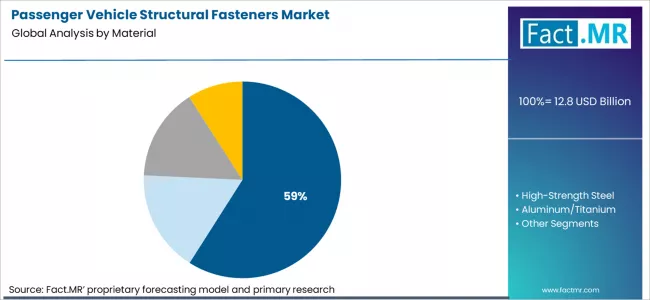
    • Carbon steel dominates the material segment, holding a 59% share in 2026. Its strength, durability, and cost-effectiveness make it the preferred choice for structural fasteners in the automotive industry.
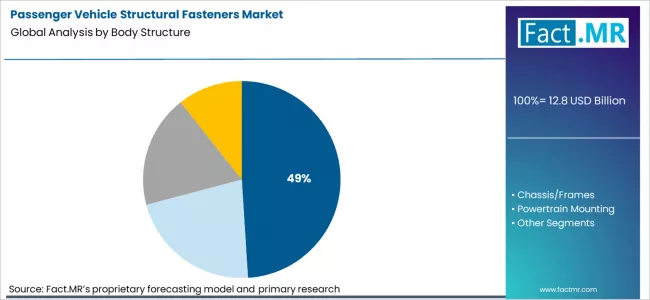
    • BIW & closures lead the body structure segment, capturing 49% of the market in 2026. As a critical component in ensuring vehicle safety and structural integrity, the demand for fasteners in this category remains strong.
    • OEM direct remains the leading sales channel, holding approximately 57% of the market share. OEMs continue to prefer direct sourcing for structural fasteners during vehicle assembly to ensure consistency in quality and performance.
    • China is expected to experience the fastest growth, with a CAGR of 3.9%, driven by its growing automotive manufacturing sector, including the increasing production of electric and hybrid vehicles.
    • Key players include Stanley Engineered Fastening, Bulten AB, and LISI Automotive, who are competing by offering advanced, lightweight, high-strength fastening solutions tailored to meet the evolving needs of vehicle manufacturers.
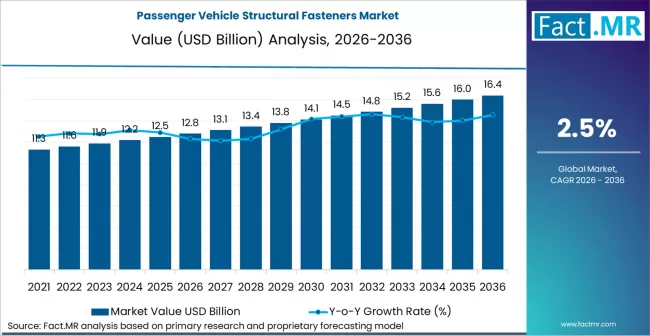
    Passenger Vehicle Structural Fasteners Market Market Value Analysis

    While the market offers steady growth, execution risks remain, particularly for suppliers navigating complex supply chains and fluctuating raw material costs. Adoption friction is expected in markets where vehicle manufacturers may be hesitant to switch fastener solutions due to the high costs of re-engineering or certification processes.

    Economic sensitivity also plays a role, as fluctuations in automotive production levels or shifts in consumer demand can impact the overall market. Additionally, tightening regulatory standards around vehicle safety and emissions could impose extra costs, further influencing supplier strategies. As the market grows, balancing these risks with operational efficiency and quality will be crucial for stakeholders aiming to maintain profitability and secure long-term customer relationships.

    Passenger Vehicle Structural Fasteners Market

    Metric Value
    Estimated Value in (2026E) USD 12.8 billion
    Forecast Value in (2036F) USD 16.4 billion
    Forecast CAGR 2026 to 2036 2.5%

    Category

    Category Sub-Segment
    By Fastener Type Bolts/Screws; Rivets (incl. SPR); Clinch Nuts/Studs; Other
    By Material Carbon Steel; High-Strength Steel; Aluminum/Titanium; Other
    By Body Structure BIW & Closures; Chassis/Frames; Powertrain Mounting; Other
    By Sales Channel OEM Direct; Tier-1 Modules; Aftermarket; Other
    Region North America; Europe; Asia Pacific; Latin America; Middle East & Africa

    Segmental Analysis

    What are the Key Insights from the Material Segment in the Passenger Vehicle Structural Fasteners Market?
    Passenger Vehicle Structural Fasteners Market Analysis By Material

    The material segment in the passenger vehicle structural fasteners market is predominantly driven by carbon steel, which holds a 59% market share. Carbon steel is favored in the automotive industry due to its strength, durability, and cost-effectiveness. Its widespread use in the manufacturing of structural fasteners, which are integral to vehicle assembly, ensures its continued dominance. As passenger vehicle manufacturers focus on producing lightweight yet robust vehicles, carbon steel remains the material of choice for structural components, further reinforcing its leading position in the market.

    What Role Does the Body Structure Segment Play in the Passenger Vehicle Structural Fasteners Market?
    Passenger Vehicle Structural Fasteners Market Analysis By Body Structure

    The body structure segment is led by the BIW (Body in White) and closures category, which accounts for 49% of the market share. BIW and closures are critical components of a vehicle’s structural integrity, where fasteners play an essential role in ensuring stability and safety. The growing emphasis on vehicle safety and performance drives the demand for high-quality structural fasteners in these areas. As automotive manufacturers continue to innovate in body structure designs, the demand for structural fasteners in BIW and closures is expected to maintain its strong market position.

    What are the Principal Drivers, Constraints, and Evolving Dynamics of the Passenger Vehicle Structural Fasteners Market?

    Growth in the passenger vehicle structural fasteners market is supported by sustained production of cars and light vehicles that require reliable joining solutions for chassis, body panels, and safety structures. Crash performance standards and regulatory requirements for occupant protection shape fastener specifications and testing protocols. A constraint arises from the shift toward modular assemblies and bonded joints that can reduce the number of mechanical fasteners in some designs. Lightweighting efforts also influence material choices and fastening methods, as alternative joining technologies compete in weight sensitive applications.

    Product development emphasizes corrosion resistance, high tensile strength, and compatibility with mixed materials such as high strength steel and aluminum. Precision manufacturing and quality control help reduce assembly defects and field failures. Aftermarket demand persists as aging vehicles require replacement components, especially in collision repair. Supply chain strategies focus on securing consistent quality and lead times to support just in time assembly processes.

    Analysis of the Passenger Vehicle Structural Fasteners Market by Key Country
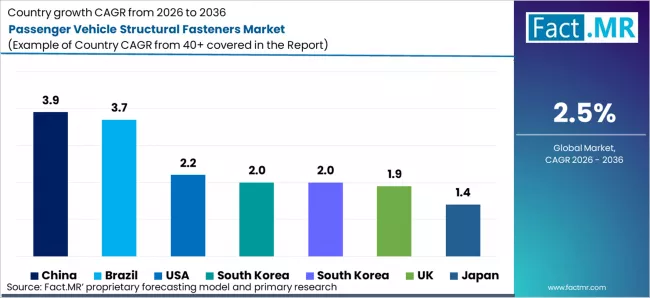
    Passenger Vehicle Structural Fasteners Market Cagr Analysis By Country

    Country CAGR (2026-2036)
    USA 2.2%
    Japan 1.4%
    South Korea 2.0%
    Germany 2.0%
    China 3.9%
    UK 1.9%
    Brazil 3.7%

    The report covers an in-depth analysis of 40+ countries; top-performing countries are highlighted below.

    What drives the growth in the USA Passenger Vehicle Structural Fasteners Market?

    The Passenger Vehicle Structural Fasteners market in the USA is growing at a CAGR of 2.2%, driven by the increasing demand for lightweight, durable, and efficient materials in vehicle production. As automakers continue to focus on enhancing fuel efficiency and safety, structural fasteners play a key role in ensuring the reliability and strength of vehicle structures. The shift towards electric vehicles (EVs) and hybrid models is also contributing to the demand for high-performance fasteners to support advanced materials and lightweight designs in vehicle structures. Additionally, ongoing advancements in automotive manufacturing technology further fuel market growth in the USA.

    How does the Japan Passenger Vehicle Structural Fasteners Market expand?

    The Passenger Vehicle Structural Fasteners market in Japan is expanding at a CAGR of 1.4%, influenced by the country’s strong automotive industry. Japan's emphasis on vehicle safety, efficiency, and performance has driven the demand for high-quality structural fasteners in passenger vehicles. While the market growth is relatively modest, the adoption of lightweight materials and focus on fuel efficiency continues to increase the need for advanced fasteners. Japan’s automotive manufacturers, such as Toyota and Honda, prioritize high-strength fasteners to meet stringent safety standards, further supporting steady growth in the passenger vehicle structural fasteners market.

    What influences the growth of the South Korea Passenger Vehicle Structural Fasteners Market?

    The Passenger Vehicle Structural Fasteners market in South Korea is growing at a CAGR of 2.0%, driven by the country’s prominent automotive industry. Automakers like Hyundai and Kia are increasingly adopting advanced fastener solutions to improve the durability, performance, and safety of passenger vehicles. As the demand for electric and hybrid vehicles rises, the need for structural fasteners to support lightweight, high-strength materials in vehicle designs is also increasing. The country’s ongoing investment in automotive innovation and efficiency is further propelling the demand for high-performance structural fasteners in the passenger vehicle sector.

    How does the Germany Passenger Vehicle Structural Fasteners Market expand?

    The Passenger Vehicle Structural Fasteners market in Germany is expanding at a CAGR of 2.0%, supported by Germany’s leadership in automotive engineering and manufacturing. As German automakers like Volkswagen, BMW, and Mercedes-Benz continue to innovate in vehicle design, structural fasteners are becoming more critical in ensuring vehicle safety and performance. The growing trend of adopting lightweight materials to meet fuel efficiency and emission standards is driving the demand for advanced fasteners that provide strength without adding unnecessary weight. Germany's focus on producing high-quality, durable vehicles continues to support steady growth in the passenger vehicle structural fasteners market.

    What factors support the growth of the China Passenger Vehicle Structural Fasteners Market?

    The Passenger Vehicle Structural Fasteners market in China is growing at a CAGR of 3.9%, driven by the country’s rapid automotive industry expansion. As China becomes a global leader in vehicle production, the demand for reliable and cost-effective structural fasteners increases. The growing focus on electric vehicle (EV) manufacturing, coupled with government incentives for the adoption of environmentally friendly vehicles, is further fueling demand. Additionally, the trend towards lightweight and high-strength materials in vehicle design is pushing automakers to rely on advanced fastener solutions to enhance vehicle performance and safety, driving the market's growth in China.

    What influences the growth of the UK Passenger Vehicle Structural Fasteners Market?

    The Passenger Vehicle Structural Fasteners market in the UK is expanding at a CAGR of 1.9%, influenced by the country’s automotive industry and ongoing advancements in vehicle design. As UK automakers work towards improving fuel efficiency and reducing vehicle weight, the demand for high-performance structural fasteners that can meet these objectives continues to rise. Additionally, the growing adoption of electric and hybrid vehicles in the UK contributes to the need for fasteners that support lightweight materials and advanced structural designs. Although the market growth is moderate, ongoing industry innovations continue to drive demand for high-quality structural fasteners in passenger vehicles.

    What drives the growth of the Brazil Passenger Vehicle Structural Fasteners Market?

    The Passenger Vehicle Structural Fasteners market in Brazil is growing at a CAGR of 3.7%, primarily driven by the expansion of the automotive sector. As Brazil continues to develop its automotive manufacturing base, the demand for reliable and durable fasteners in passenger vehicles increases. The growth of electric vehicle production and the push for more fuel-efficient, lightweight vehicles are contributing to the need for high-performance fasteners. Brazil’s focus on strengthening its automotive industry and meeting global standards for vehicle safety and efficiency further fuels the demand for advanced structural fasteners in the passenger vehicle market.

    How Are Key Players Competing in the Passenger Vehicle Structural Fasteners Market?
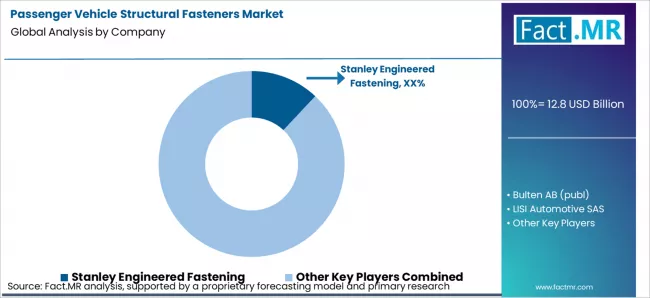
    Passenger Vehicle Structural Fasteners Market Analysis By Company

    In the passenger vehicle structural fasteners market, leading players like Stanley Engineered Fastening, Bulten AB, and LISI Automotive drive competition through advanced fastening solutions designed for lightweight, high-strength applications. Stanley Engineered Fastening focuses on providing reliable and durable fasteners for automotive assemblies, while Bulten AB and LISI Automotive emphasize innovative, cost-effective fastening systems tailored to meet the needs of vehicle manufacturers. Bossard Holding and ITW leverage their global supply networks to ensure fast and efficient delivery of fasteners. Würth Industrie Service and Nifco Inc. concentrate on integrating high-performance materials and technologies. SFS Group, KAMAX, and Sundram Fasteners lead in offering customized fastener solutions, enhancing vehicle safety and performance. These companies are strengthening their market positions by focusing on product innovation, regional manufacturing capabilities, and collaboration with OEMs to meet the evolving demands of the automotive industry.

    Recent Industry Developments

    • Acquisition - Bossard acquires Dejond Fastening NV (Announced Jul 1, 2024) Bossard announced the acquisition of Dejond Fastening NV, a Belgian manufacturer focused on blind rivet nuts (Tubtara®). The move strengthens Bossard’s position across structural fastening elements used in sheet metal, composites, and mixed-material assemblies, which are common in passenger vehicle BIW and closures. ???? Bossard acquisition announcement - Dejond Fastening NV (blind rivet nuts)
    • Product / Technology Update - Böllhoff expands KAPTI® functional elements starting with high-strength rivet nuts (Published Jun 11, 2024) Böllhoff published an update renaming KAPTI NUT® to KAPTI® and positioning KAPTI® Rivet as the first step in a broader functional-elements range. The product is described as a high-strength rivet nut designed to create screw joints in thin steel or aluminium sheets, supporting lightweight multi-material vehicle structures. ???? Böllhoff product update - KAPTI® Rivet (high-strength rivet nuts)
    • Patent - Rivet, Riveting Structure and Riveting Equipment for Multi-Material Vehicle Bodies (Published Mar 18, 2025; Filed Sep 8, 2023) This patent publication (assignee: Guangzhou Automobile Group Co., Ltd.) describes a rivet and joining structure aimed at solving connection challenges for ultra-high-strength steel with multi-layer aluminium and other dissimilar materials. It targets co-line production of mixed-material bodies, a core requirement driving innovation in passenger vehicle structural fasteners and joining hardware. ???? Rivet + riveting structure for mixed-material car bodies - CN119641777A

    Key Players of the Passenger Vehicle Structural Fasteners Market

    • Stanley Engineered Fastening
    • Bulten AB (publ)
    • LISI Automotive SAS
    • Bossard Holding AG
    • Illinois Tool Works Inc. (ITW)
    • Würth Industrie Service GmbH & Co. KG
    • Nifco Inc.
    • SFS Group AG
    • KAMAX Holding GmbH & Co. KG
    • Sundram Fasteners Limited

    Scope of the Report

    Items Values
    Quantitative Units (2026) USD 2.2 Billion
    By Coupling Type Flat-Face Quick Couplers, Poppet Quick Couplers, Multi-Coupling Plates, Other
    By Equipment Type Construction Equipment, Agricultural, Mining, Other
    By Pressure Class Up to 250 bar, 250-350 bar, 350+ bar, Other
    By Sales Channel OEM Line-Fit, Aftermarket/MRO, Dealer/OES, Other
    Regions Covered North America, Europe, Asia Pacific, Latin America, Middle East & Africa
    Countries Covered United States, Canada, Mexico, Germany, United Kingdom, France, Japan, South Korea, China, India, Brazil, and other countries
    Key Companies Profiled Parker-Hannifin Corporation, Eaton Corporation plc, Stäubli International AG, CEJN AB, Faster S.p.A., Danfoss A/S, Holmbury Ltd. (Holmbury Hydraulics), Dixon Valve & Coupling Company, LLC, Gates Industrial Corporation plc, Bosch Rexroth AG
    Additional Attributes Market trends by coupling type, equipment type, pressure class, and sales channel; regional demand trends; competitive landscape; technological advancements in off-road hydraulic attachment couplings; operational performance optimization initiatives; and product development strategies

    Passenger Vehicle Structural Fasteners Market Key Segments

    • By Fastener Type :

      • Bolts/Screws
      • Rivets (incl. SPR)
      • Clinch Nuts/Studs
      • Other
    • By Material :

      • Carbon Steel
      • High-Strength Steel
      • Aluminum/Titanium
      • Other
    • By Body Structure :

      • BIW & Closures
      • Chassis/Frames
      • Powertrain Mounting
      • Other
    • By Sales Channel :

      • OEM Direct
      • Tier-1 Modules
      • Aftermarket
      • Other
    • Region :

      • North America
        • USA
        • Canada
        • Mexico
      • Europe
        • Germany
        • UK
        • France
        • Italy
        • Spain
        • Nordic Countries
        • BENELUX
        • Rest of Europe
      • Asia Pacific
        • China
        • Japan
        • South Korea
        • India
        • Australia
        • Rest of Asia Pacific
      • Latin America
        • Brazil
        • Argentina
        • Rest of Latin America
      • Middle East and Africa
        • Kingdom of Saudi Arabia
        • United Arab Emirates
        • South Africa
        • Rest of Middle East and Africa
      • Other Regions
        • Oceania
        • Central Asia
        • Other Markets

    Bibliographies

    • National Highway Traffic Safety Administration. (2024). Federal Motor Vehicle Safety Standards (FMVSS) - Crashworthiness and Structural Requirements. U.S. Department of Transportation.
    • World Steel Association. (2024). Steel in Automotive Applications: Material Performance and Sustainability Indicators. World Steel Association.
    • National Institute of Standards and Technology. (2024). Advanced Manufacturing and Materials for Automotive Structural Applications. U.S. Department of Commerce.
    • International Energy Agency. (2024). Global EV Outlook 2024: Vehicle Efficiency and Structural Design Implications. IEA.
    • ASTM International. (2024). ASTM F568M: Standard Specification for Carbon and Alloy Steel Externally Threaded Metric Fasteners. ASTM International.

    Table of Content

    1. Executive Summary
      • Global Market Outlook
      • Demand to side Trends
      • Supply to side Trends
      • Technology Roadmap Analysis
      • Analysis and Recommendations
    2. Market Overview
      • Market Coverage / Taxonomy
      • Market Definition / Scope / Limitations
    3. Research Methodology
      • Chapter Orientation
      • Analytical Lens and Working Hypotheses
        • Market Structure, Signals, and Trend Drivers
        • Benchmarking and Cross-market Comparability
        • Market Sizing, Forecasting, and Opportunity Mapping
      • Research Design and Evidence Framework
        • Desk Research Programme (Secondary Evidence)
          • Company Annual and Sustainability Reports
          • Peer-reviewed Journals and Academic Literature
          • Corporate Websites, Product Literature, and Technical Notes
          • Earnings Decks and Investor Briefings
          • Statutory Filings and Regulatory Disclosures
          • Technical White Papers and Standards Notes
          • Trade Journals, Industry Magazines, and Analyst Briefs
          • Conference Proceedings, Webinars, and Seminar Materials
          • Government Statistics Portals and Public Data Releases
          • Press Releases and Reputable Media Coverage
          • Specialist Newsletters and Curated Briefings
          • Sector Databases and Reference Repositories
          • FMR Internal Proprietary Databases and Historical Market Datasets
          • Subscription Datasets and Paid Sources
          • Social Channels, Communities, and Digital Listening Inputs
          • Additional Desk Sources
        • Expert Input and Fieldwork (Primary Evidence)
          • Primary Modes
            • Qualitative Interviews and Expert Elicitation
            • Quantitative Surveys and Structured Data Capture
            • Blended Approach
          • Why Primary Evidence is Used
          • Field Techniques
            • Interviews
            • Surveys
            • Focus Groups
            • Observational and In-context Research
            • Social and Community Interactions
          • Stakeholder Universe Engaged
            • C-suite Leaders
            • Board Members
            • Presidents and Vice Presidents
            • R&D and Innovation Heads
            • Technical Specialists
            • Domain Subject-matter Experts
            • Scientists
            • Physicians and Other Healthcare Professionals
          • Governance, Ethics, and Data Stewardship
            • Research Ethics
            • Data Integrity and Handling
        • Tooling, Models, and Reference Databases
      • Data Engineering and Model Build
        • Data Acquisition and Ingestion
        • Cleaning, Normalisation, and Verification
        • Synthesis, Triangulation, and Analysis
      • Quality Assurance and Audit Trail
    4. Market Background
      • Market Dynamics
        • Drivers
        • Restraints
        • Opportunity
        • Trends
      • Scenario Forecast
        • Demand in Optimistic Scenario
        • Demand in Likely Scenario
        • Demand in Conservative Scenario
      • Opportunity Map Analysis
      • Product Life Cycle Analysis
      • Supply Chain Analysis
      • Investment Feasibility Matrix
      • Value Chain Analysis
      • PESTLE and Porter’s Analysis
      • Regulatory Landscape
      • Regional Parent Market Outlook
      • Production and Consumption Statistics
      • Import and Export Statistics
    5. Global Market Analysis 2021 to 2025 and Forecast, 2026 to 2036
      • Historical Market Size Value (USD Million) Analysis, 2021 to 2025
      • Current and Future Market Size Value (USD Million) Projections, 2026 to 2036
        • Y to o to Y Growth Trend Analysis
        • Absolute $ Opportunity Analysis
    6. Global Market Pricing Analysis 2021 to 2025 and Forecast 2026 to 2036
    7. Global Market Analysis 2021 to 2025 and Forecast 2026 to 2036, By Material
      • Introduction / Key Findings
      • Historical Market Size Value (USD Million) Analysis By Material, 2021 to 2025
      • Current and Future Market Size Value (USD Million) Analysis and Forecast By Material, 2026 to 2036
        • Carbon Steel
        • High-Strength Steel
        • Aluminum/Titanium
        • Other
      • Y to o to Y Growth Trend Analysis By Material, 2021 to 2025
      • Absolute $ Opportunity Analysis By Material, 2026 to 2036
    8. Global Market Analysis 2021 to 2025 and Forecast 2026 to 2036, By Body Structure
      • Introduction / Key Findings
      • Historical Market Size Value (USD Million) Analysis By Body Structure, 2021 to 2025
      • Current and Future Market Size Value (USD Million) Analysis and Forecast By Body Structure, 2026 to 2036
        • BIW & Closures
        • Chassis/Frames
        • Powertrain Mounting
        • Other
      • Y to o to Y Growth Trend Analysis By Body Structure, 2021 to 2025
      • Absolute $ Opportunity Analysis By Body Structure, 2026 to 2036
    9. Global Market Analysis 2021 to 2025 and Forecast 2026 to 2036, By Region
      • Introduction
      • Historical Market Size Value (USD Million) Analysis By Region, 2021 to 2025
      • Current Market Size Value (USD Million) Analysis and Forecast By Region, 2026 to 2036
        • North America
        • Latin America
        • Western Europe
        • Eastern Europe
        • East Asia
        • South Asia and Pacific
        • Middle East & Africa
      • Market Attractiveness Analysis By Region
    10. North America Market Analysis 2021 to 2025 and Forecast 2026 to 2036, By Country
      • Historical Market Size Value (USD Million) Trend Analysis By Market Taxonomy, 2021 to 2025
      • Market Size Value (USD Million) Forecast By Market Taxonomy, 2026 to 2036
        • By Country
          • USA
          • Canada
          • Mexico
        • By Material
        • By Body Structure
      • Market Attractiveness Analysis
        • By Country
        • By Material
        • By Body Structure
      • Key Takeaways
    11. Latin America Market Analysis 2021 to 2025 and Forecast 2026 to 2036, By Country
      • Historical Market Size Value (USD Million) Trend Analysis By Market Taxonomy, 2021 to 2025
      • Market Size Value (USD Million) Forecast By Market Taxonomy, 2026 to 2036
        • By Country
          • Brazil
          • Chile
          • Rest of Latin America
        • By Material
        • By Body Structure
      • Market Attractiveness Analysis
        • By Country
        • By Material
        • By Body Structure
      • Key Takeaways
    12. Western Europe Market Analysis 2021 to 2025 and Forecast 2026 to 2036, By Country
      • Historical Market Size Value (USD Million) Trend Analysis By Market Taxonomy, 2021 to 2025
      • Market Size Value (USD Million) Forecast By Market Taxonomy, 2026 to 2036
        • By Country
          • Germany
          • UK
          • Italy
          • Spain
          • France
          • Nordic
          • BENELUX
          • Rest of Western Europe
        • By Material
        • By Body Structure
      • Market Attractiveness Analysis
        • By Country
        • By Material
        • By Body Structure
      • Key Takeaways
    13. Eastern Europe Market Analysis 2021 to 2025 and Forecast 2026 to 2036, By Country
      • Historical Market Size Value (USD Million) Trend Analysis By Market Taxonomy, 2021 to 2025
      • Market Size Value (USD Million) Forecast By Market Taxonomy, 2026 to 2036
        • By Country
          • Russia
          • Poland
          • Hungary
          • Balkan & Baltic
          • Rest of Eastern Europe
        • By Material
        • By Body Structure
      • Market Attractiveness Analysis
        • By Country
        • By Material
        • By Body Structure
      • Key Takeaways
    14. East Asia Market Analysis 2021 to 2025 and Forecast 2026 to 2036, By Country
      • Historical Market Size Value (USD Million) Trend Analysis By Market Taxonomy, 2021 to 2025
      • Market Size Value (USD Million) Forecast By Market Taxonomy, 2026 to 2036
        • By Country
          • China
          • Japan
          • South Korea
        • By Material
        • By Body Structure
      • Market Attractiveness Analysis
        • By Country
        • By Material
        • By Body Structure
      • Key Takeaways
    15. South Asia and Pacific Market Analysis 2021 to 2025 and Forecast 2026 to 2036, By Country
      • Historical Market Size Value (USD Million) Trend Analysis By Market Taxonomy, 2021 to 2025
      • Market Size Value (USD Million) Forecast By Market Taxonomy, 2026 to 2036
        • By Country
          • India
          • ASEAN
          • Australia & New Zealand
          • Rest of South Asia and Pacific
        • By Material
        • By Body Structure
      • Market Attractiveness Analysis
        • By Country
        • By Material
        • By Body Structure
      • Key Takeaways
    16. Middle East & Africa Market Analysis 2021 to 2025 and Forecast 2026 to 2036, By Country
      • Historical Market Size Value (USD Million) Trend Analysis By Market Taxonomy, 2021 to 2025
      • Market Size Value (USD Million) Forecast By Market Taxonomy, 2026 to 2036
        • By Country
          • Kingdom of Saudi Arabia
          • Other GCC Countries
          • Turkiye
          • South Africa
          • Other African Union
          • Rest of Middle East & Africa
        • By Material
        • By Body Structure
      • Market Attractiveness Analysis
        • By Country
        • By Material
        • By Body Structure
      • Key Takeaways
    17. Key Countries Market Analysis
      • USA
        • Pricing Analysis
        • Market Share Analysis, 2025
          • By Material
          • By Body Structure
      • Canada
        • Pricing Analysis
        • Market Share Analysis, 2025
          • By Material
          • By Body Structure
      • Mexico
        • Pricing Analysis
        • Market Share Analysis, 2025
          • By Material
          • By Body Structure
      • Brazil
        • Pricing Analysis
        • Market Share Analysis, 2025
          • By Material
          • By Body Structure
      • Chile
        • Pricing Analysis
        • Market Share Analysis, 2025
          • By Material
          • By Body Structure
      • Germany
        • Pricing Analysis
        • Market Share Analysis, 2025
          • By Material
          • By Body Structure
      • UK
        • Pricing Analysis
        • Market Share Analysis, 2025
          • By Material
          • By Body Structure
      • Italy
        • Pricing Analysis
        • Market Share Analysis, 2025
          • By Material
          • By Body Structure
      • Spain
        • Pricing Analysis
        • Market Share Analysis, 2025
          • By Material
          • By Body Structure
      • France
        • Pricing Analysis
        • Market Share Analysis, 2025
          • By Material
          • By Body Structure
      • India
        • Pricing Analysis
        • Market Share Analysis, 2025
          • By Material
          • By Body Structure
      • ASEAN
        • Pricing Analysis
        • Market Share Analysis, 2025
          • By Material
          • By Body Structure
      • Australia & New Zealand
        • Pricing Analysis
        • Market Share Analysis, 2025
          • By Material
          • By Body Structure
      • China
        • Pricing Analysis
        • Market Share Analysis, 2025
          • By Material
          • By Body Structure
      • Japan
        • Pricing Analysis
        • Market Share Analysis, 2025
          • By Material
          • By Body Structure
      • South Korea
        • Pricing Analysis
        • Market Share Analysis, 2025
          • By Material
          • By Body Structure
      • Russia
        • Pricing Analysis
        • Market Share Analysis, 2025
          • By Material
          • By Body Structure
      • Poland
        • Pricing Analysis
        • Market Share Analysis, 2025
          • By Material
          • By Body Structure
      • Hungary
        • Pricing Analysis
        • Market Share Analysis, 2025
          • By Material
          • By Body Structure
      • Kingdom of Saudi Arabia
        • Pricing Analysis
        • Market Share Analysis, 2025
          • By Material
          • By Body Structure
      • Turkiye
        • Pricing Analysis
        • Market Share Analysis, 2025
          • By Material
          • By Body Structure
      • South Africa
        • Pricing Analysis
        • Market Share Analysis, 2025
          • By Material
          • By Body Structure
    18. Market Structure Analysis
      • Competition Dashboard
      • Competition Benchmarking
      • Market Share Analysis of Top Players
        • By Regional
        • By Material
        • By Body Structure
    19. Competition Analysis
      • Competition Deep Dive
        • Stanley Engineered Fastening
          • Overview
          • Product Portfolio
          • Profitability by Market Segments (Product/Age /Sales Channel/Region)
          • Sales Footprint
          • Strategy Overview
            • Marketing Strategy
            • Product Strategy
            • Channel Strategy
        • Bulten AB (publ)
        • LISI Automotive SAS
        • Bossard Holding AG
        • Illinois Tool Works Inc. (ITW)
        • Würth Industrie Service GmbH & Co. KG
        • Nifco Inc.
        • SFS Group AG
        • KAMAX Holding GmbH & Co. KG
        • Sundram Fasteners Limited
    20. Assumptions & Acronyms Used

    List Of Table

    • Table 1: Global Market Value (USD Million) Forecast by Region, 2021 to 2036
    • Table 2: Global Market Value (USD Million) Forecast by Material, 2021 to 2036
    • Table 3: Global Market Value (USD Million) Forecast by Body Structure, 2021 to 2036
    • Table 4: North America Market Value (USD Million) Forecast by Country, 2021 to 2036
    • Table 5: North America Market Value (USD Million) Forecast by Material, 2021 to 2036
    • Table 6: North America Market Value (USD Million) Forecast by Body Structure, 2021 to 2036
    • Table 7: Latin America Market Value (USD Million) Forecast by Country, 2021 to 2036
    • Table 8: Latin America Market Value (USD Million) Forecast by Material, 2021 to 2036
    • Table 9: Latin America Market Value (USD Million) Forecast by Body Structure, 2021 to 2036
    • Table 10: Western Europe Market Value (USD Million) Forecast by Country, 2021 to 2036
    • Table 11: Western Europe Market Value (USD Million) Forecast by Material, 2021 to 2036
    • Table 12: Western Europe Market Value (USD Million) Forecast by Body Structure, 2021 to 2036
    • Table 13: Eastern Europe Market Value (USD Million) Forecast by Country, 2021 to 2036
    • Table 14: Eastern Europe Market Value (USD Million) Forecast by Material, 2021 to 2036
    • Table 15: Eastern Europe Market Value (USD Million) Forecast by Body Structure, 2021 to 2036
    • Table 16: East Asia Market Value (USD Million) Forecast by Country, 2021 to 2036
    • Table 17: East Asia Market Value (USD Million) Forecast by Material, 2021 to 2036
    • Table 18: East Asia Market Value (USD Million) Forecast by Body Structure, 2021 to 2036
    • Table 19: South Asia and Pacific Market Value (USD Million) Forecast by Country, 2021 to 2036
    • Table 20: South Asia and Pacific Market Value (USD Million) Forecast by Material, 2021 to 2036
    • Table 21: South Asia and Pacific Market Value (USD Million) Forecast by Body Structure, 2021 to 2036
    • Table 22: Middle East & Africa Market Value (USD Million) Forecast by Country, 2021 to 2036
    • Table 23: Middle East & Africa Market Value (USD Million) Forecast by Material, 2021 to 2036
    • Table 24: Middle East & Africa Market Value (USD Million) Forecast by Body Structure, 2021 to 2036

    List Of Figures

    • Figure 1: Global Market Pricing Analysis
    • Figure 2: Global Market Value (USD Million) Forecast 2021 to 2036
    • Figure 3: Global Market Value Share and BPS Analysis by Material, 2026 and 2036
    • Figure 4: Global Market Y to o to Y Growth Comparison by Material, 2026 to 2036
    • Figure 5: Global Market Attractiveness Analysis by Material
    • Figure 6: Global Market Value Share and BPS Analysis by Body Structure, 2026 and 2036
    • Figure 7: Global Market Y to o to Y Growth Comparison by Body Structure, 2026 to 2036
    • Figure 8: Global Market Attractiveness Analysis by Body Structure
    • Figure 9: Global Market Value (USD Million) Share and BPS Analysis by Region, 2026 and 2036
    • Figure 10: Global Market Y to o to Y Growth Comparison by Region, 2026 to 2036
    • Figure 11: Global Market Attractiveness Analysis by Region
    • Figure 12: North America Market Incremental Dollar Opportunity, 2026 to 2036
    • Figure 13: Latin America Market Incremental Dollar Opportunity, 2026 to 2036
    • Figure 14: Western Europe Market Incremental Dollar Opportunity, 2026 to 2036
    • Figure 15: Eastern Europe Market Incremental Dollar Opportunity, 2026 to 2036
    • Figure 16: East Asia Market Incremental Dollar Opportunity, 2026 to 2036
    • Figure 17: South Asia and Pacific Market Incremental Dollar Opportunity, 2026 to 2036
    • Figure 18: Middle East & Africa Market Incremental Dollar Opportunity, 2026 to 2036
    • Figure 19: North America Market Value Share and BPS Analysis by Country, 2026 and 2036
    • Figure 20: North America Market Value Share and BPS Analysis by Material, 2026 and 2036
    • Figure 21: North America Market Y to o to Y Growth Comparison by Material, 2026 to 2036
    • Figure 22: North America Market Attractiveness Analysis by Material
    • Figure 23: North America Market Value Share and BPS Analysis by Body Structure, 2026 and 2036
    • Figure 24: North America Market Y to o to Y Growth Comparison by Body Structure, 2026 to 2036
    • Figure 25: North America Market Attractiveness Analysis by Body Structure
    • Figure 26: Latin America Market Value Share and BPS Analysis by Country, 2026 and 2036
    • Figure 27: Latin America Market Value Share and BPS Analysis by Material, 2026 and 2036
    • Figure 28: Latin America Market Y to o to Y Growth Comparison by Material, 2026 to 2036
    • Figure 29: Latin America Market Attractiveness Analysis by Material
    • Figure 30: Latin America Market Value Share and BPS Analysis by Body Structure, 2026 and 2036
    • Figure 31: Latin America Market Y to o to Y Growth Comparison by Body Structure, 2026 to 2036
    • Figure 32: Latin America Market Attractiveness Analysis by Body Structure
    • Figure 33: Western Europe Market Value Share and BPS Analysis by Country, 2026 and 2036
    • Figure 34: Western Europe Market Value Share and BPS Analysis by Material, 2026 and 2036
    • Figure 35: Western Europe Market Y to o to Y Growth Comparison by Material, 2026 to 2036
    • Figure 36: Western Europe Market Attractiveness Analysis by Material
    • Figure 37: Western Europe Market Value Share and BPS Analysis by Body Structure, 2026 and 2036
    • Figure 38: Western Europe Market Y to o to Y Growth Comparison by Body Structure, 2026 to 2036
    • Figure 39: Western Europe Market Attractiveness Analysis by Body Structure
    • Figure 40: Eastern Europe Market Value Share and BPS Analysis by Country, 2026 and 2036
    • Figure 41: Eastern Europe Market Value Share and BPS Analysis by Material, 2026 and 2036
    • Figure 42: Eastern Europe Market Y to o to Y Growth Comparison by Material, 2026 to 2036
    • Figure 43: Eastern Europe Market Attractiveness Analysis by Material
    • Figure 44: Eastern Europe Market Value Share and BPS Analysis by Body Structure, 2026 and 2036
    • Figure 45: Eastern Europe Market Y to o to Y Growth Comparison by Body Structure, 2026 to 2036
    • Figure 46: Eastern Europe Market Attractiveness Analysis by Body Structure
    • Figure 47: East Asia Market Value Share and BPS Analysis by Country, 2026 and 2036
    • Figure 48: East Asia Market Value Share and BPS Analysis by Material, 2026 and 2036
    • Figure 49: East Asia Market Y to o to Y Growth Comparison by Material, 2026 to 2036
    • Figure 50: East Asia Market Attractiveness Analysis by Material
    • Figure 51: East Asia Market Value Share and BPS Analysis by Body Structure, 2026 and 2036
    • Figure 52: East Asia Market Y to o to Y Growth Comparison by Body Structure, 2026 to 2036
    • Figure 53: East Asia Market Attractiveness Analysis by Body Structure
    • Figure 54: South Asia and Pacific Market Value Share and BPS Analysis by Country, 2026 and 2036
    • Figure 55: South Asia and Pacific Market Value Share and BPS Analysis by Material, 2026 and 2036
    • Figure 56: South Asia and Pacific Market Y to o to Y Growth Comparison by Material, 2026 to 2036
    • Figure 57: South Asia and Pacific Market Attractiveness Analysis by Material
    • Figure 58: South Asia and Pacific Market Value Share and BPS Analysis by Body Structure, 2026 and 2036
    • Figure 59: South Asia and Pacific Market Y to o to Y Growth Comparison by Body Structure, 2026 to 2036
    • Figure 60: South Asia and Pacific Market Attractiveness Analysis by Body Structure
    • Figure 61: Middle East & Africa Market Value Share and BPS Analysis by Country, 2026 and 2036
    • Figure 62: Middle East & Africa Market Value Share and BPS Analysis by Material, 2026 and 2036
    • Figure 63: Middle East & Africa Market Y to o to Y Growth Comparison by Material, 2026 to 2036
    • Figure 64: Middle East & Africa Market Attractiveness Analysis by Material
    • Figure 65: Middle East & Africa Market Value Share and BPS Analysis by Body Structure, 2026 and 2036
    • Figure 66: Middle East & Africa Market Y to o to Y Growth Comparison by Body Structure, 2026 to 2036
    • Figure 67: Middle East & Africa Market Attractiveness Analysis by Body Structure
    • Figure 68: Global Market - Tier Structure Analysis
    • Figure 69: Global Market - Company Share Analysis

    - FAQs -

    How big is the passenger vehicle structural fasteners market in 2026?

    The global passenger vehicle structural fasteners market is estimated to be valued at USD 12.8 billion in 2026.

    What will be the size of passenger vehicle structural fasteners market in 2036?

    The market size for the passenger vehicle structural fasteners market is projected to reach USD 16.4 billion by 2036.

    How much will be the passenger vehicle structural fasteners market growth between 2026 and 2036?

    The passenger vehicle structural fasteners market is expected to grow at a 2.5% CAGR between 2026 and 2036.

    What are the key product types in the passenger vehicle structural fasteners market?

    The key product types in passenger vehicle structural fasteners market are carbon steel, high-strength steel, aluminum/titanium and other.

    Which body structure segment to contribute significant share in the passenger vehicle structural fasteners market in 2026?

    In terms of body structure, biw & closures segment to command 49.0% share in the passenger vehicle structural fasteners market in 2026.

    Passenger Vehicle Structural Fasteners Market