Passenger Vehicle Fuel Line Quick Couplings Market (2026 - 2036)
Passenger Vehicle Fuel Line Quick Couplings Market is segmented by Fuel Type (Gasoline, Diesel, Ethanol Blends, and Others), Material (Plastic Quick Couplings, Metal Quick Couplings, Hybrid/Composite, and Others), Connection Type (Push-to-Connect, Clip/Retainer, Threaded/Other, and Others), Sales Channel (OEM Line-Fit, Aftermarket, Dealer/OES, and Others), and Region. Forecast for 2026 to 2036.
Core Findings
Passenger Vehicle Fuel Line Quick Couplings Market Forecast 2026 to 2036
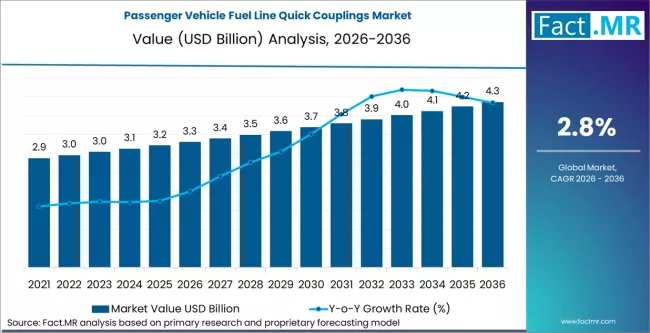
In 2025, the passenger vehicle fuel line quick couplings market was valued at USD 3.1 billion. Based on Fact MR's analysis, demand for passenger vehicle fuel line quick couplings is estimated to grow to USD 3.3 billion in 2026 and USD 4.2 billion by 2036. FMI projects a CAGR of 2.8% during the forecast period.
The absolute dollar growth from 2026 to 2036 is USD 900 million. While the market experiences steady growth, it remains relatively incremental, primarily driven by gradual increases in automotive production and demand for fuel-efficient solutions. However, challenges like regulatory standards and material costs could slow down the growth pace, especially in mature markets.
China leads with a CAGR of 3.8%, driven by a growing automotive production base and rising demand for efficient fuel systems. Brazil follows closely with a 3.7% CAGR, fueled by increasing vehicle production and demand for fuel-efficient solutions. The USA is projected to grow at 2.6%, supported by steady automotive production and regulatory pushes for fuel efficiency. South Korea, with a 2.4% CAGR, is seeing moderate growth due to its established automotive industry. Germany and the United Kingdom both show CAGRs of 2.4% and 2.3%, respectively, as they focus on improving fuel efficiency within their mature automotive sectors. Japan shows the slowest growth at 1.9%, as its market matures, focusing more on replacement demand. Europe generates mainly replacement demand due to market saturation and rising costs.
Passenger Vehicle Fuel Line Quick Couplings Market Definition
The Passenger Vehicle Fuel Line Quick Couplings Market involves the production and sale of quick‑connect coupling devices used in fuel delivery lines of passenger vehicles. These couplings enable fast, secure connections between fuel hoses and components without tools, ensuring leak‑free fuel flow. Their primary function is to support fuel system assembly and maintenance while meeting safety and emission standards. Key end users include original equipment manufacturers (OEMs) and aftermarket service providers in the automotive sector.
Market Inclusions
This report covers global and regional market sizes for passenger vehicle fuel line quick couplings with a defined forecast period. It includes segment breakdowns by product type (push‑to‑connect, threaded, bayonet), material (plastic, metal), and application (gasoline, diesel, alternative fuel systems). The analysis also incorporates pricing trends, production volumes, and trade flow data to reflect market dynamics.
Market Exclusions
The scope excludes unrelated fuel system components such as pumps, injectors, fuel tanks, and complete fuel delivery modules. Finished vehicles and broader powertrain assemblies are not covered. Niche coupling types used in non‑fuel fluid systems, like coolant or brake lines, are omitted to focus on fuel line quick couplings.
Research Methodology
- Primary Research: Interviews were conducted with automotive engineers, procurement leads, and industry experts.
- Desk Research: Public data was sourced from OEM publications, industry databases, and government statistics.
- Market‑Sizing and Forecasting: A hybrid approach was used, combining top‑down and bottom‑up analysis.
Data Validation and Update Cycle
Outputs were validated through expert reviews and aligned with recent production figures.
Passenger Vehicle Fuel Line Quick Couplings Market Summary
Market Definition
The market focuses on quick connect coupling devices used in fuel delivery lines for passenger vehicles. These couplings enable secure and efficient fuel flow by providing easy, tool-free connections between fuel hoses and components. They play a critical role in ensuring fuel system integrity, safety, and compliance with emission standards.
Demand Drivers
- Fuel Efficiency: Growing demand for efficient fuel delivery systems to meet tightening fuel economy and emissions regulations.
- Vehicle Production Growth: Increased production of passenger vehicles, especially in emerging markets like China and Brazil.
- Safety & Regulations: Stricter safety and emission standards drive the need for high-quality, leak-proof fuel line couplings.
Key Segments
- Connection Type: Push-to-connect couplings (59% market share by 2026).
- Fuel Type: Gasoline (57% market share by 2026).
- Material: Plastic and Metal Quick Couplings.
- Sales Channel: OEM Line-Fit (71% market share by 2026).
Regional Outlook
- China: Leading growth at 3.8% CAGR, supported by expanding automotive production and rising fuel efficiency demands.
- Brazil: Following closely with a 3.7% CAGR due to increasing vehicle production and government incentives for fuel-efficient technologies.
- USA: Projected to grow at 2.6%, driven by steady automotive production and regulatory pushes for fuel efficiency.
Analyst Opinion
The market is expanding steadily, driven by a combination of fuel efficiency demands, safety regulations, and growing vehicle production, especially in emerging markets. However, challenges like material costs and evolving safety regulations could limit rapid growth in mature markets.
Strategic Takeaways
- OEM Integration: OEM line-fit solutions will continue to dominate, integrating fuel line quick couplings into new vehicle models.
- Technological Focus: Innovations in coupling materials and designs to meet rising fuel system demands.
- Regional Opportunities: Key growth in China and Brazil, with a focus on manufacturing advancements and fuel system optimization.
Methodology
Forecasts are based on primary research with industry experts and manufacturers, along with historical data on vehicle production and fuel system technologies.
Segmental Analysis
Passenger Vehicle Fuel Line Quick Couplings Market Analysis by Connection Type
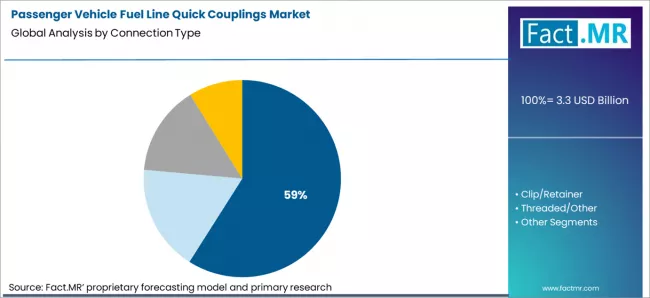
- Market Overview: Push-to-connect couplings are expected to hold 59% of the passenger vehicle fuel line quick couplings market by 2026. These couplings offer a convenient and secure method for connecting fuel lines, providing quick and easy assembly without the need for tools. Their growing popularity is driven by their ease of use, reliability, and the increasing complexity of fuel systems in modern vehicles.
- Demand Drivers:
- Ease of Installation: Push-to-connect couplings are highly favored in the automotive industry due to their simplicity and fast installation process, reducing labor time during vehicle assembly and maintenance.
- Improved Leak Prevention: These couplings provide a secure connection that helps prevent fuel leaks, contributing to safer vehicle operation and reducing the risk of fire hazards.
- Industry Shift Toward Efficiency: As automotive manufacturers focus on increasing assembly line efficiency and lowering production costs, the demand for quick and reliable connection systems like push-to-connect couplings grows.
Passenger Vehicle Fuel Line Quick Couplings Market Analysis by Fuel Type
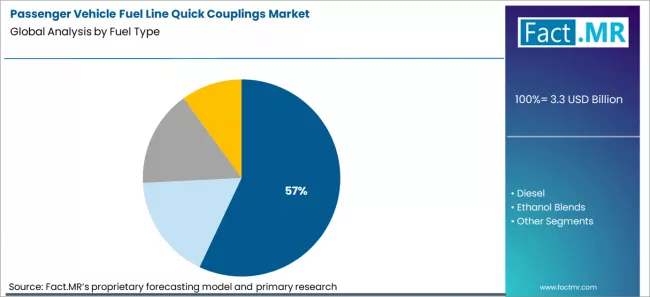
- Market Overview: Gasoline is projected to capture 57% of the market share by 2026. As gasoline remains the dominant fuel type in passenger vehicles, quick couplings designed for gasoline fuel lines are in high demand for secure and efficient fuel line connections across a wide range of vehicle models.
- Demand Drivers:
- Prevalence of Gasoline Vehicles: The continued dominance of gasoline-powered passenger vehicles contributes to the sustained demand for quick couplings designed for gasoline fuel lines. These couplings are integral in connecting the fuel line to the vehicle's engine and ensuring a stable flow of fuel.
- Safety and Durability Requirements: Gasoline fuel systems require couplings that are resistant to pressure and temperature variations, making high-quality quick couplings essential for maintaining fuel system integrity and preventing leaks.
- Technological Advancements in Gasoline Engines: With improvements in gasoline engine designs, the need for precise, high-performance fuel line connections increases, driving demand for specialized quick couplings that meet these requirements.
Passenger Vehicle Fuel Line Quick Couplings Market Drivers, Restraints, and Opportunities
FMR analysts observe that the passenger vehicle fuel line quick couplings market is a transitioning, compliance‑driven segment, rooted in the shift toward stricter emissions and safety requirements. Historically, simple mechanical couplings met the needs of carbureted and early fuel‑injected engines, but tighter leakage control and higher pressure demands in modern engines increased the need for improved quick coupling designs. The 2026 valuation reflects this structural reality, where regulatory mandates and OEM specification standards sustain demand despite slowing growth in traditional passenger vehicle production.
While demand for basic, low‑pressure couplings is declining, advanced leak‑proof and high‑pressure quick couplings are gaining share. These advanced versions command higher per‑unit prices, contributing to net value growth even as overall unit volumes align with broader shifts in powertrain mix. The market exists at its current size because legacy ICE vehicles still constitute a sizable fleet, but tightening emissions and safety requirements limit expansion of the basic product segment.
- Emissions and Safety Standards: Regulations such as EPA Tier 3 and Euro 6d emission limits require low‑leakage fuel systems, pushing OEMs to adopt advanced quick couplings that meet these regulatory thresholds.
- Powertrain Shift Impact: As electrification increases and ICE vehicle production slows, demand for traditional fuel line quick couplings declines, while high‑spec components remain necessary in hybrid and high‑pressure direct‑injection systems.
- Regional Market Dynamics: In regions like Europe and North America, stringent emissions rules and high safety expectations drive uptake of premium quick couplings, while in some Asia‑Pacific markets cost‑led variants persist where regulatory pressure is lower.
Regional Analysis
The market analysis covers key global regions, including North America, Latin America, Western Europe, Eastern Europe, South Asia and Pacific, East Asia, and Middle East & Africa. It is segmented geographically, with specific market dynamics for each region. The full report provides a detailed market attractiveness analysis.
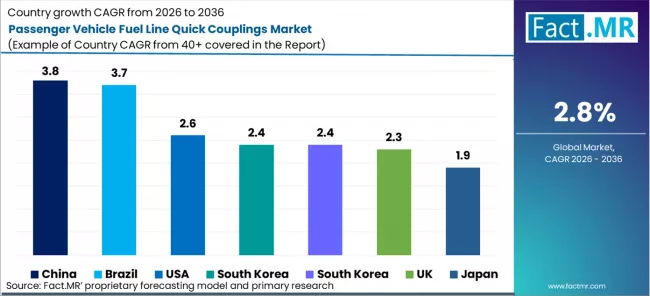
| Country | CAGR (%) |
|---|---|
| USA | 2.6% |
| Japan | 1.9% |
| South Korea | 2.4% |
| Germany | 2.4% |
| China | 3.8% |
| United Kingdom | 2.3% |
| Brazil | 3.7% |
Source: Fact MR (FMR) analysis, based on proprietary forecasting model and primary research.
Asia Pacific:
Asia Pacific is a "global production hub" for fuel line quick couplings, with growing investments from major automakers in electric and hybrid vehicle technologies.
- China: Demand for passenger vehicle fuel line quick couplings in China is projected to rise at 3.8% CAGR through 2036. China’s Green Vehicle Manufacturing Initiatives (2025) and the rapid growth of BYD Auto in electric vehicle production are major market drivers.
- Japan: Demand for passenger vehicle fuel line quick couplings in Japan is projected to rise at 1.9% CAGR through 2036. Toyota’s investment in hybrid vehicle technologies and the Japanese Green Vehicle Incentive Program (2024) continue to drive growth, albeit at a moderate pace.
- South Korea: Demand for passenger vehicle fuel line quick couplings in South Korea is projected to rise at 2.4% CAGR through 2036. Hyundai’s focus on hybrid and electric vehicles and the Korean Green New Deal (2025) support market expansion.
Europe:
Europe remains a key player in the push for fuel efficiency and environmentally friendly vehicle components. Regulatory incentives and consumer demand for green solutions continue to accelerate growth.
- Germany: Demand for passenger vehicle fuel line quick couplings in Germany is projected to rise at 2.4% CAGR through 2036. The German National Electric Mobility Development Plan (2025) and Volkswagen’s shift toward electric vehicles contribute to the gradual growth of the market.
- United Kingdom: Demand for passenger vehicle fuel line quick couplings in the UK is projected to rise at 2.3% CAGR through 2036. The UK’s Road to Zero Strategy (2025) encourages EV adoption, and Jaguar Land Rover’s investments in sustainable automotive solutions continue to support market expansion.
Latin America:
In Latin America, especially Brazil, the market is growing steadily with increasing government support for green vehicle technologies and investments from global automotive players.
- Brazil: Demand for passenger vehicle fuel line quick couplings in Brazil is projected to rise at 3.7% CAGR through 2036. The Brazilian National Electric Mobility Plan (2024) and investments from Fiat Chrysler Automobiles in electric vehicle infrastructure are significant contributors to market growth.
Fact MR's analysis of the Passenger Vehicle Fuel Line Quick Couplings Market in Asia Pacific, Europe, and Latin America consists of country-wise assessments that include China, Japan, South Korea, Germany, the United Kingdom, and Brazil. Readers can find detailed trends, regulatory updates, and company-specific investments shaping the market’s growth in these countries.
How Are Key Players Competing in the Passenger Vehicle Fuel Line Quick Couplings Market?
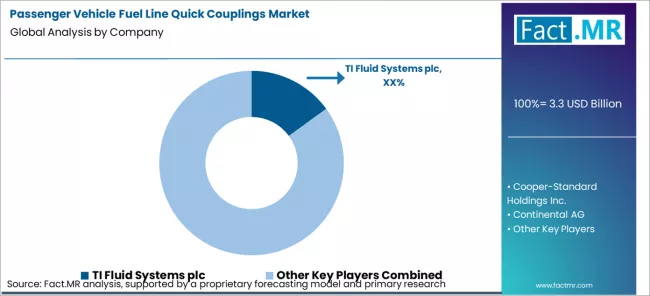
The passenger vehicle fuel line quick couplings market is marked by competition from major players like TI Fluid Systems plc, Cooper-Standard Holdings Inc., and Continental AG, all of which focus on enhancing fuel delivery efficiency and safety. Parker-Hannifin Corporation and Gates Industrial Corporation plc are driving innovation through advanced coupling designs that ensure leak-proof connections and ease of installation. Eaton Corporation plc and Toyoda Gosei Co., Ltd. are incorporating advanced materials and technologies to meet the growing demand for lightweight and durable components. Sumitomo Riko Company Limited, NORMA Group SE, and Marelli Holdings Co., Ltd. focus on optimizing quick coupling solutions to address the increasing performance and environmental standards of modern passenger vehicles.
Recent Industry Developments
- Patent - Fluid connector with dry-break shutoff (Published Mar 9, 2023): This patent publication describes a fuel-line style connector that automatically breaks/shuts off fluid flow when the tube is removed, reducing spill and vapour release risk during service.
- Patent - Fuel/fluid line quick connector with retainer-revealed data matrix for connection verification (Published Apr 6, 2023): This patent publication discloses a quick connector where a retainer obstructs a data matrix until a spigot is fully inserted, enabling scan-based confirmation of proper connection.
- Patent - Quick connector with verification element to confirm full engagement (Published Dec 10, 2024): This granted patent covers a quick connector that uses a verifier/verification element to indicate the male member is securely latched, targeting mis-assembly and leak prevention in vehicle fluid lines (including fuel lines).
Key Players of the Passenger Vehicle Fuel Line Quick Couplings Market
- TI Fluid Systems plc
- Cooper-Standard Holdings Inc.
- Continental AG
- Parker-Hannifin Corporation
- Gates Industrial Corporation plc
- Eaton Corporation plc
- Toyoda Gosei Co., Ltd.
- Sumitomo Riko Company Limited
- NORMA Group SE
- Marelli Holdings Co., Ltd.
Report Scope
| Metric | Value |
|---|---|
| Quantitative Units | USD 3.2 billion (2026) to USD 4.2 billion (2036), at a CAGR of 2.8% |
| Market Definition | The Passenger Vehicle Fuel Line Quick Couplings Market includes quick couplings used in passenger vehicles' fuel lines, ensuring safe and efficient connections for the transfer of fuels like gasoline, diesel, and ethanol blends. |
| By Fuel Type | Gasoline, Diesel, Ethanol Blends, Other |
| By Material | Plastic Quick Couplings, Metal Quick Couplings, Hybrid/Composite, Other |
| By Connection Type | Push-to-Connect, Clip/Retainer, Threaded/Other, Other |
| By Sales Channel | OEM Line-Fit, Aftermarket, Dealer/OES, Other |
| Regions Covered | North America, Latin America, Europe, East Asia, South Asia, Oceania, Middle East and Africa |
| Countries Covered | United States, Canada, Mexico, Brazil, Argentina, Germany, France, United Kingdom, Italy, Spain, China, India, Japan, South Korea, Indonesia, Australia, and 40+ countries |
| Key Companies Profiled | TI Fluid Systems plc, Cooper-Standard Holdings Inc., Continental AG, Parker-Hannifin Corporation, Gates Industrial Corporation plc, Eaton Corporation plc, Toyoda Gosei Co., Ltd., Sumitomo Riko Company Limited, NORMA Group SE, Marelli Holdings Co., Ltd. |
| Forecast Period | 2026 to 2036 |
| Approach | Hybrid top-down and bottom-up market modeling validated through primary interviews with manufacturers and supported by trade data benchmarking and market research. |
Passenger Vehicle Fuel Line Quick Couplings Market Key Segments
-
By Fuel Type :
- Gasoline
- Diesel
- Ethanol Blends
- Other
-
By Material :
- Plastic Quick Couplings
- Metal Quick Couplings
- Hybrid/Composite
- Other
-
By Connection Type :
- Push-to-Connect
- Clip/Retainer
- Threaded/Other
- Other
-
By Sales Channel :
- OEM Line-Fit
- Aftermarket
- Dealer/OES
- Other
-
Region :
- North America
- USA
- Canada
- Mexico
- Europe
- Germany
- UK
- France
- Italy
- Spain
- Nordic Countries
- BENELUX
- Rest of Europe
- Asia Pacific
- China
- Japan
- South Korea
- India
- Australia
- Rest of Asia Pacific
- Latin America
- Brazil
- Argentina
- Rest of Latin America
- Middle East and Africa
- Kingdom of Saudi Arabia
- United Arab Emirates
- South Africa
- Rest of Middle East and Africa
- Other Regions
- Oceania
- Central Asia
- Other Markets
- North America
Bibliographies
- Patent - Fluid Connector with Dry-Break Shutoff: U.S. Patent No. 11,852,346. (2023, March 9). Fluid connector with dry-break shutoff. United States Patent and Trademark Office.
- Patent - Fuel/Fluid Line Quick Connector with Retainer-Revealed Data Matrix for Connection Verification: U.S. Patent No. 11,865,239. (2023, April 6). Fuel/fluid line quick connector with retainer-revealed data matrix for connection verification. United States Patent and Trademark Office.
- Patent - Quick Connector with Verification Element to Confirm Full Engagement: U.S. Patent No. 11,984,537. (2024, December 10). Quick connector with verification element to confirm full engagement. United States Patent and Trademark Office.
Table of Content
- Executive Summary
- Global Market Outlook
- Demand to side Trends
- Supply to side Trends
- Technology Roadmap Analysis
- Analysis and Recommendations
- Market Overview
- Market Coverage / Taxonomy
- Market Definition / Scope / Limitations
- Research Methodology
- Chapter Orientation
- Analytical Lens and Working Hypotheses
- Market Structure, Signals, and Trend Drivers
- Benchmarking and Cross-market Comparability
- Market Sizing, Forecasting, and Opportunity Mapping
- Research Design and Evidence Framework
- Desk Research Programme (Secondary Evidence)
- Company Annual and Sustainability Reports
- Peer-reviewed Journals and Academic Literature
- Corporate Websites, Product Literature, and Technical Notes
- Earnings Decks and Investor Briefings
- Statutory Filings and Regulatory Disclosures
- Technical White Papers and Standards Notes
- Trade Journals, Industry Magazines, and Analyst Briefs
- Conference Proceedings, Webinars, and Seminar Materials
- Government Statistics Portals and Public Data Releases
- Press Releases and Reputable Media Coverage
- Specialist Newsletters and Curated Briefings
- Sector Databases and Reference Repositories
- FMR Internal Proprietary Databases and Historical Market Datasets
- Subscription Datasets and Paid Sources
- Social Channels, Communities, and Digital Listening Inputs
- Additional Desk Sources
- Expert Input and Fieldwork (Primary Evidence)
- Primary Modes
- Qualitative Interviews and Expert Elicitation
- Quantitative Surveys and Structured Data Capture
- Blended Approach
- Why Primary Evidence is Used
- Field Techniques
- Interviews
- Surveys
- Focus Groups
- Observational and In-context Research
- Social and Community Interactions
- Stakeholder Universe Engaged
- C-suite Leaders
- Board Members
- Presidents and Vice Presidents
- R&D and Innovation Heads
- Technical Specialists
- Domain Subject-matter Experts
- Scientists
- Physicians and Other Healthcare Professionals
- Governance, Ethics, and Data Stewardship
- Research Ethics
- Data Integrity and Handling
- Primary Modes
- Tooling, Models, and Reference Databases
- Desk Research Programme (Secondary Evidence)
- Data Engineering and Model Build
- Data Acquisition and Ingestion
- Cleaning, Normalisation, and Verification
- Synthesis, Triangulation, and Analysis
- Quality Assurance and Audit Trail
- Market Background
- Market Dynamics
- Drivers
- Restraints
- Opportunity
- Trends
- Scenario Forecast
- Demand in Optimistic Scenario
- Demand in Likely Scenario
- Demand in Conservative Scenario
- Opportunity Map Analysis
- Product Life Cycle Analysis
- Supply Chain Analysis
- Investment Feasibility Matrix
- Value Chain Analysis
- PESTLE and Porter’s Analysis
- Regulatory Landscape
- Regional Parent Market Outlook
- Production and Consumption Statistics
- Import and Export Statistics
- Market Dynamics
- Global Market Analysis 2021 to 2025 and Forecast, 2026 to 2036
- Historical Market Size Value (USD Million) Analysis, 2021 to 2025
- Current and Future Market Size Value (USD Million) Projections, 2026 to 2036
- Y to o to Y Growth Trend Analysis
- Absolute $ Opportunity Analysis
- Global Market Pricing Analysis 2021 to 2025 and Forecast 2026 to 2036
- Global Market Analysis 2021 to 2025 and Forecast 2026 to 2036, By Connection Type
- Introduction / Key Findings
- Historical Market Size Value (USD Million) Analysis By Connection Type , 2021 to 2025
- Current and Future Market Size Value (USD Million) Analysis and Forecast By Connection Type , 2026 to 2036
- Push-to-Connect
- Clip/Retainer
- Threaded/Other
- Other
- Push-to-Connect
- Y to o to Y Growth Trend Analysis By Connection Type , 2021 to 2025
- Absolute $ Opportunity Analysis By Connection Type , 2026 to 2036
- Global Market Analysis 2021 to 2025 and Forecast 2026 to 2036, By Fuel Type
- Introduction / Key Findings
- Historical Market Size Value (USD Million) Analysis By Fuel Type, 2021 to 2025
- Current and Future Market Size Value (USD Million) Analysis and Forecast By Fuel Type, 2026 to 2036
- Gasoline
- Diesel
- Ethanol Blends
- Other
- Gasoline
- Y to o to Y Growth Trend Analysis By Fuel Type, 2021 to 2025
- Absolute $ Opportunity Analysis By Fuel Type, 2026 to 2036
- Global Market Analysis 2021 to 2025 and Forecast 2026 to 2036, By Region
- Introduction
- Historical Market Size Value (USD Million) Analysis By Region, 2021 to 2025
- Current Market Size Value (USD Million) Analysis and Forecast By Region, 2026 to 2036
- North America
- Latin America
- Western Europe
- Eastern Europe
- East Asia
- South Asia and Pacific
- Middle East & Africa
- Market Attractiveness Analysis By Region
- North America Market Analysis 2021 to 2025 and Forecast 2026 to 2036, By Country
- Historical Market Size Value (USD Million) Trend Analysis By Market Taxonomy, 2021 to 2025
- Market Size Value (USD Million) Forecast By Market Taxonomy, 2026 to 2036
- By Country
- USA
- Canada
- Mexico
- By Connection Type
- By Fuel Type
- By Country
- Market Attractiveness Analysis
- By Country
- By Connection Type
- By Fuel Type
- Key Takeaways
- Latin America Market Analysis 2021 to 2025 and Forecast 2026 to 2036, By Country
- Historical Market Size Value (USD Million) Trend Analysis By Market Taxonomy, 2021 to 2025
- Market Size Value (USD Million) Forecast By Market Taxonomy, 2026 to 2036
- By Country
- Brazil
- Chile
- Rest of Latin America
- By Connection Type
- By Fuel Type
- By Country
- Market Attractiveness Analysis
- By Country
- By Connection Type
- By Fuel Type
- Key Takeaways
- Western Europe Market Analysis 2021 to 2025 and Forecast 2026 to 2036, By Country
- Historical Market Size Value (USD Million) Trend Analysis By Market Taxonomy, 2021 to 2025
- Market Size Value (USD Million) Forecast By Market Taxonomy, 2026 to 2036
- By Country
- Germany
- UK
- Italy
- Spain
- France
- Nordic
- BENELUX
- Rest of Western Europe
- By Connection Type
- By Fuel Type
- By Country
- Market Attractiveness Analysis
- By Country
- By Connection Type
- By Fuel Type
- Key Takeaways
- Eastern Europe Market Analysis 2021 to 2025 and Forecast 2026 to 2036, By Country
- Historical Market Size Value (USD Million) Trend Analysis By Market Taxonomy, 2021 to 2025
- Market Size Value (USD Million) Forecast By Market Taxonomy, 2026 to 2036
- By Country
- Russia
- Poland
- Hungary
- Balkan & Baltic
- Rest of Eastern Europe
- By Connection Type
- By Fuel Type
- By Country
- Market Attractiveness Analysis
- By Country
- By Connection Type
- By Fuel Type
- Key Takeaways
- East Asia Market Analysis 2021 to 2025 and Forecast 2026 to 2036, By Country
- Historical Market Size Value (USD Million) Trend Analysis By Market Taxonomy, 2021 to 2025
- Market Size Value (USD Million) Forecast By Market Taxonomy, 2026 to 2036
- By Country
- China
- Japan
- South Korea
- By Connection Type
- By Fuel Type
- By Country
- Market Attractiveness Analysis
- By Country
- By Connection Type
- By Fuel Type
- Key Takeaways
- South Asia and Pacific Market Analysis 2021 to 2025 and Forecast 2026 to 2036, By Country
- Historical Market Size Value (USD Million) Trend Analysis By Market Taxonomy, 2021 to 2025
- Market Size Value (USD Million) Forecast By Market Taxonomy, 2026 to 2036
- By Country
- India
- ASEAN
- Australia & New Zealand
- Rest of South Asia and Pacific
- By Connection Type
- By Fuel Type
- By Country
- Market Attractiveness Analysis
- By Country
- By Connection Type
- By Fuel Type
- Key Takeaways
- Middle East & Africa Market Analysis 2021 to 2025 and Forecast 2026 to 2036, By Country
- Historical Market Size Value (USD Million) Trend Analysis By Market Taxonomy, 2021 to 2025
- Market Size Value (USD Million) Forecast By Market Taxonomy, 2026 to 2036
- By Country
- Kingdom of Saudi Arabia
- Other GCC Countries
- Turkiye
- South Africa
- Other African Union
- Rest of Middle East & Africa
- By Connection Type
- By Fuel Type
- By Country
- Market Attractiveness Analysis
- By Country
- By Connection Type
- By Fuel Type
- Key Takeaways
- Key Countries Market Analysis
- USA
- Pricing Analysis
- Market Share Analysis, 2025
- By Connection Type
- By Fuel Type
- Canada
- Pricing Analysis
- Market Share Analysis, 2025
- By Connection Type
- By Fuel Type
- Mexico
- Pricing Analysis
- Market Share Analysis, 2025
- By Connection Type
- By Fuel Type
- Brazil
- Pricing Analysis
- Market Share Analysis, 2025
- By Connection Type
- By Fuel Type
- Chile
- Pricing Analysis
- Market Share Analysis, 2025
- By Connection Type
- By Fuel Type
- Germany
- Pricing Analysis
- Market Share Analysis, 2025
- By Connection Type
- By Fuel Type
- UK
- Pricing Analysis
- Market Share Analysis, 2025
- By Connection Type
- By Fuel Type
- Italy
- Pricing Analysis
- Market Share Analysis, 2025
- By Connection Type
- By Fuel Type
- Spain
- Pricing Analysis
- Market Share Analysis, 2025
- By Connection Type
- By Fuel Type
- France
- Pricing Analysis
- Market Share Analysis, 2025
- By Connection Type
- By Fuel Type
- India
- Pricing Analysis
- Market Share Analysis, 2025
- By Connection Type
- By Fuel Type
- ASEAN
- Pricing Analysis
- Market Share Analysis, 2025
- By Connection Type
- By Fuel Type
- Australia & New Zealand
- Pricing Analysis
- Market Share Analysis, 2025
- By Connection Type
- By Fuel Type
- China
- Pricing Analysis
- Market Share Analysis, 2025
- By Connection Type
- By Fuel Type
- Japan
- Pricing Analysis
- Market Share Analysis, 2025
- By Connection Type
- By Fuel Type
- South Korea
- Pricing Analysis
- Market Share Analysis, 2025
- By Connection Type
- By Fuel Type
- Russia
- Pricing Analysis
- Market Share Analysis, 2025
- By Connection Type
- By Fuel Type
- Poland
- Pricing Analysis
- Market Share Analysis, 2025
- By Connection Type
- By Fuel Type
- Hungary
- Pricing Analysis
- Market Share Analysis, 2025
- By Connection Type
- By Fuel Type
- Kingdom of Saudi Arabia
- Pricing Analysis
- Market Share Analysis, 2025
- By Connection Type
- By Fuel Type
- Turkiye
- Pricing Analysis
- Market Share Analysis, 2025
- By Connection Type
- By Fuel Type
- South Africa
- Pricing Analysis
- Market Share Analysis, 2025
- By Connection Type
- By Fuel Type
- USA
- Market Structure Analysis
- Competition Dashboard
- Competition Benchmarking
- Market Share Analysis of Top Players
- By Regional
- By Connection Type
- By Fuel Type
- Competition Analysis
- Competition Deep Dive
- TI Fluid Systems plc
- Overview
- Product Portfolio
- Profitability by Market Segments (Product/Age /Sales Channel/Region)
- Sales Footprint
- Strategy Overview
- Marketing Strategy
- Product Strategy
- Channel Strategy
- Cooper-Standard Holdings Inc.
- Continental AG
- Parker-Hannifin Corporation
- Gates Industrial Corporation plc
- Eaton Corporation plc
- Toyoda Gosei Co., Ltd.
- Sumitomo Riko Company Limited
- NORMA Group SE
- Marelli Holdings Co., Ltd.
- TI Fluid Systems plc
- Competition Deep Dive
- Assumptions & Acronyms Used
List Of Table
- Table 1: Global Market Value (USD Million) Forecast by Region, 2021 to 2036
- Table 2: Global Market Value (USD Million) Forecast by Connection Type, 2021 to 2036
- Table 3: Global Market Value (USD Million) Forecast by Fuel Type, 2021 to 2036
- Table 4: North America Market Value (USD Million) Forecast by Country, 2021 to 2036
- Table 5: North America Market Value (USD Million) Forecast by Connection Type, 2021 to 2036
- Table 6: North America Market Value (USD Million) Forecast by Fuel Type, 2021 to 2036
- Table 7: Latin America Market Value (USD Million) Forecast by Country, 2021 to 2036
- Table 8: Latin America Market Value (USD Million) Forecast by Connection Type, 2021 to 2036
- Table 9: Latin America Market Value (USD Million) Forecast by Fuel Type, 2021 to 2036
- Table 10: Western Europe Market Value (USD Million) Forecast by Country, 2021 to 2036
- Table 11: Western Europe Market Value (USD Million) Forecast by Connection Type, 2021 to 2036
- Table 12: Western Europe Market Value (USD Million) Forecast by Fuel Type, 2021 to 2036
- Table 13: Eastern Europe Market Value (USD Million) Forecast by Country, 2021 to 2036
- Table 14: Eastern Europe Market Value (USD Million) Forecast by Connection Type, 2021 to 2036
- Table 15: Eastern Europe Market Value (USD Million) Forecast by Fuel Type, 2021 to 2036
- Table 16: East Asia Market Value (USD Million) Forecast by Country, 2021 to 2036
- Table 17: East Asia Market Value (USD Million) Forecast by Connection Type, 2021 to 2036
- Table 18: East Asia Market Value (USD Million) Forecast by Fuel Type, 2021 to 2036
- Table 19: South Asia and Pacific Market Value (USD Million) Forecast by Country, 2021 to 2036
- Table 20: South Asia and Pacific Market Value (USD Million) Forecast by Connection Type, 2021 to 2036
- Table 21: South Asia and Pacific Market Value (USD Million) Forecast by Fuel Type, 2021 to 2036
- Table 22: Middle East & Africa Market Value (USD Million) Forecast by Country, 2021 to 2036
- Table 23: Middle East & Africa Market Value (USD Million) Forecast by Connection Type, 2021 to 2036
- Table 24: Middle East & Africa Market Value (USD Million) Forecast by Fuel Type, 2021 to 2036
List Of Figures
- Figure 1: Global Market Pricing Analysis
- Figure 2: Global Market Value (USD Million) Forecast 2021 to 2036
- Figure 3: Global Market Value Share and BPS Analysis by Connection Type, 2026 and 2036
- Figure 4: Global Market Y to o to Y Growth Comparison by Connection Type, 2026 to 2036
- Figure 5: Global Market Attractiveness Analysis by Connection Type
- Figure 6: Global Market Value Share and BPS Analysis by Fuel Type, 2026 and 2036
- Figure 7: Global Market Y to o to Y Growth Comparison by Fuel Type, 2026 to 2036
- Figure 8: Global Market Attractiveness Analysis by Fuel Type
- Figure 9: Global Market Value (USD Million) Share and BPS Analysis by Region, 2026 and 2036
- Figure 10: Global Market Y to o to Y Growth Comparison by Region, 2026 to 2036
- Figure 11: Global Market Attractiveness Analysis by Region
- Figure 12: North America Market Incremental Dollar Opportunity, 2026 to 2036
- Figure 13: Latin America Market Incremental Dollar Opportunity, 2026 to 2036
- Figure 14: Western Europe Market Incremental Dollar Opportunity, 2026 to 2036
- Figure 15: Eastern Europe Market Incremental Dollar Opportunity, 2026 to 2036
- Figure 16: East Asia Market Incremental Dollar Opportunity, 2026 to 2036
- Figure 17: South Asia and Pacific Market Incremental Dollar Opportunity, 2026 to 2036
- Figure 18: Middle East & Africa Market Incremental Dollar Opportunity, 2026 to 2036
- Figure 19: North America Market Value Share and BPS Analysis by Country, 2026 and 2036
- Figure 20: North America Market Value Share and BPS Analysis by Connection Type, 2026 and 2036
- Figure 21: North America Market Y to o to Y Growth Comparison by Connection Type, 2026 to 2036
- Figure 22: North America Market Attractiveness Analysis by Connection Type
- Figure 23: North America Market Value Share and BPS Analysis by Fuel Type, 2026 and 2036
- Figure 24: North America Market Y to o to Y Growth Comparison by Fuel Type, 2026 to 2036
- Figure 25: North America Market Attractiveness Analysis by Fuel Type
- Figure 26: Latin America Market Value Share and BPS Analysis by Country, 2026 and 2036
- Figure 27: Latin America Market Value Share and BPS Analysis by Connection Type, 2026 and 2036
- Figure 28: Latin America Market Y to o to Y Growth Comparison by Connection Type, 2026 to 2036
- Figure 29: Latin America Market Attractiveness Analysis by Connection Type
- Figure 30: Latin America Market Value Share and BPS Analysis by Fuel Type, 2026 and 2036
- Figure 31: Latin America Market Y to o to Y Growth Comparison by Fuel Type, 2026 to 2036
- Figure 32: Latin America Market Attractiveness Analysis by Fuel Type
- Figure 33: Western Europe Market Value Share and BPS Analysis by Country, 2026 and 2036
- Figure 34: Western Europe Market Value Share and BPS Analysis by Connection Type, 2026 and 2036
- Figure 35: Western Europe Market Y to o to Y Growth Comparison by Connection Type, 2026 to 2036
- Figure 36: Western Europe Market Attractiveness Analysis by Connection Type
- Figure 37: Western Europe Market Value Share and BPS Analysis by Fuel Type, 2026 and 2036
- Figure 38: Western Europe Market Y to o to Y Growth Comparison by Fuel Type, 2026 to 2036
- Figure 39: Western Europe Market Attractiveness Analysis by Fuel Type
- Figure 40: Eastern Europe Market Value Share and BPS Analysis by Country, 2026 and 2036
- Figure 41: Eastern Europe Market Value Share and BPS Analysis by Connection Type, 2026 and 2036
- Figure 42: Eastern Europe Market Y to o to Y Growth Comparison by Connection Type, 2026 to 2036
- Figure 43: Eastern Europe Market Attractiveness Analysis by Connection Type
- Figure 44: Eastern Europe Market Value Share and BPS Analysis by Fuel Type, 2026 and 2036
- Figure 45: Eastern Europe Market Y to o to Y Growth Comparison by Fuel Type, 2026 to 2036
- Figure 46: Eastern Europe Market Attractiveness Analysis by Fuel Type
- Figure 47: East Asia Market Value Share and BPS Analysis by Country, 2026 and 2036
- Figure 48: East Asia Market Value Share and BPS Analysis by Connection Type, 2026 and 2036
- Figure 49: East Asia Market Y to o to Y Growth Comparison by Connection Type, 2026 to 2036
- Figure 50: East Asia Market Attractiveness Analysis by Connection Type
- Figure 51: East Asia Market Value Share and BPS Analysis by Fuel Type, 2026 and 2036
- Figure 52: East Asia Market Y to o to Y Growth Comparison by Fuel Type, 2026 to 2036
- Figure 53: East Asia Market Attractiveness Analysis by Fuel Type
- Figure 54: South Asia and Pacific Market Value Share and BPS Analysis by Country, 2026 and 2036
- Figure 55: South Asia and Pacific Market Value Share and BPS Analysis by Connection Type, 2026 and 2036
- Figure 56: South Asia and Pacific Market Y to o to Y Growth Comparison by Connection Type, 2026 to 2036
- Figure 57: South Asia and Pacific Market Attractiveness Analysis by Connection Type
- Figure 58: South Asia and Pacific Market Value Share and BPS Analysis by Fuel Type, 2026 and 2036
- Figure 59: South Asia and Pacific Market Y to o to Y Growth Comparison by Fuel Type, 2026 to 2036
- Figure 60: South Asia and Pacific Market Attractiveness Analysis by Fuel Type
- Figure 61: Middle East & Africa Market Value Share and BPS Analysis by Country, 2026 and 2036
- Figure 62: Middle East & Africa Market Value Share and BPS Analysis by Connection Type, 2026 and 2036
- Figure 63: Middle East & Africa Market Y to o to Y Growth Comparison by Connection Type, 2026 to 2036
- Figure 64: Middle East & Africa Market Attractiveness Analysis by Connection Type
- Figure 65: Middle East & Africa Market Value Share and BPS Analysis by Fuel Type, 2026 and 2036
- Figure 66: Middle East & Africa Market Y to o to Y Growth Comparison by Fuel Type, 2026 to 2036
- Figure 67: Middle East & Africa Market Attractiveness Analysis by Fuel Type
- Figure 68: Global Market - Tier Structure Analysis
- Figure 69: Global Market - Company Share Analysis
- FAQs -
How large is the demand for Passenger Vehicle Fuel Line Quick Couplings in the global market in 2026?
Demand for Passenger Vehicle Fuel Line Quick Couplings in the global market is estimated to be valued at USD 3.2 billion in 2026.
What will be the market size of Passenger Vehicle Fuel Line Quick Couplings in the global market by 2036?
The market size for Passenger Vehicle Fuel Line Quick Couplings is projected to reach USD 4.2 billion by 2036.
What is the expected demand growth for Passenger Vehicle Fuel Line Quick Couplings in the global market between 2026 and 2036?
Demand for Passenger Vehicle Fuel Line Quick Couplings in the global market is expected to grow at a CAGR of 2.8% - between 2026 and 2036.
Which region is expected to show the highest growth rate for Passenger Vehicle Fuel Line Quick Couplings?
China is projected to show the highest regional CAGR at 3.8% during the forecast period, driven by the growing automotive production and demand for fuel efficiency improvements in passenger vehicles.
How significant is the growth outlook for Brazil in this market?
Brazil is expected to grow at a CAGR of 3.7%, reflecting steady growth in passenger vehicle production and fuel efficiency standards driving demand for fuel line quick couplings.
What is the growth outlook for the United States in this report?
The United States is anticipated to grow at a CAGR of 2.6% from 2026 to 2036, supported by continued vehicle production and regulatory standards requiring advanced fuel line coupling technologies.
What is the growth forecast for Japan in the Passenger Vehicle Fuel Line Quick Couplings market?
Japan is expected to grow at a CAGR of 1.9%, driven by steady demand for automotive components and the continued advancement of fuel efficiency technologies in the automotive sector.
What is the growth forecast for South Korea in this market?
South Korea is projected to expand at a CAGR of 2.4%, with a stable automotive market and increasing demand for efficient fuel system components in passenger vehicles.
Which European markets are highlighted in this analysis?
Germany and the United Kingdom are key European markets, with projected CAGRs of 2.4% and 2.3%, respectively, reflecting stable automotive production and the need for efficient fuel line systems.
What is the leading sales channel for Passenger Vehicle Fuel Line Quick Couplings?
The OEM line-fit sales channel is expected to dominate the market, accounting for 71% of the market share in 2026, as original equipment manufacturers integrate fuel line quick couplings into their passenger vehicle production lines.
Which company is identified as a leading player in the Passenger Vehicle Fuel Line Quick Couplings market?
TI Fluid Systems plc is recognized as a leading player in this market, providing advanced fuel system components, including quick couplings for passenger vehicles.
What are Passenger Vehicle Fuel Line Quick Couplings used for?
Passenger Vehicle Fuel Line Quick Couplings are used to connect fuel lines in vehicles quickly and efficiently, ensuring secure and leak-free connections in the fuel delivery system.
What does the Passenger Vehicle Fuel Line Quick Couplings market include in this report?
The market scope includes quick couplings used in the fuel delivery systems of passenger vehicles, designed to improve fuel system efficiency, safety, and ease of assembly during manufacturing.
How is the market forecast developed in this report?
The forecast is developed using historical data on passenger vehicle production, trends in fuel system technologies, and input from key industry players involved in automotive fuel systems.
What is meant by the Passenger Vehicle Fuel Line Quick Couplings market in this report?
The market refers to the global production, trade, and consumption of fuel line quick couplings used in passenger vehicles to ensure efficient fuel delivery and secure connections in automotive fuel systems.