Passive Sampler Sorbents for Emerging Pollutants Market
Passive Sampler Sorbents for Emerging Pollutants Market Size and Share Forecast Outlook 2026 to 2036
Passive sampler sorbents for emerging pollutants market is projected to grow from USD 198.0 million in 2026 to USD 464.5 million by 2036, at a CAGR of 8.9%. PFAS & other persistent organic pollutants (POPs) will dominate with a 26.0% market share, while polymer-based sorbents (e.g., pocis-type) will lead the sorbent type segment with a 32.0% share.
Passive Sampler Sorbents for Emerging Pollutants Market Forecast and Outlook 2026 to 2036
The global passive sampler sorbents for emerging pollutants market is projected to reach USD 464.46 million by 2036. The market is valued at USD 198.00 million in 2026 and is set to rise at a CAGR of 8.9% during the assessment period.
By pollutant class, sorbents for PFAS & other persistent organic pollutants (POPs) hold a leading 26% share. Polymer-based sorbents represent the dominant sorbent type at 32%, while surface water monitoring is the primary deployment medium at 34.0%. Environmental regulatory agencies are the leading end user at 28.0%.
Key Takeaways from the Passive Sampler Sorbents for Emerging Pollutants Market
- Market Value for 2026: USD 198.00 Million
- Market Value for 2036: USD 464.46 Million
- Forecast CAGR (2026-2036): 8.9%
- Leading Pollutant Class Share (2026): PFAS & other persistent organic pollutants (POPs) (26%)
- Leading Sorbent Type Share (2026): Polymer-based sorbents (e.g., POCIS-type) (32%)
- Leading Deployment Medium Share (2026): Surface water monitoring (34.0%)
- Leading End User Share (2026): Environmental regulatory agencies (28.0%)
- Key Players in the Market: Restek, Sigma-Aldrich (Merck), Eurofins Technologies, Pacific Rim Laboratories, SiREM, ALS, Merck, Envirotech
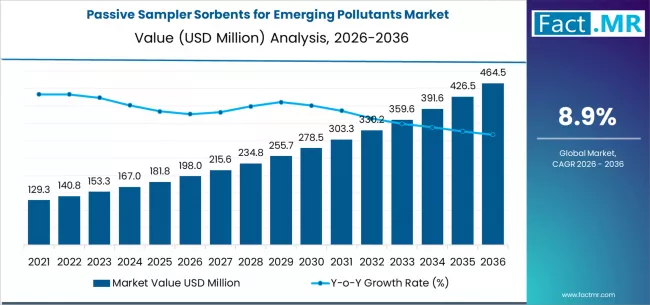
Defining trends involve the advancement of high-surface-area, nano-engineered sorbent materials such as electrospun nanofiber mats (ENMs) and functionalized polymers designed for rapid, sensitive uptake of specific contaminant classes. Innovation is focused on developing sorbents with tailored affinity for challenging, low-concentration pollutants like pharmaceuticals and PFAS, moving beyond traditional grab sampling to provide time-weighted average concentration data. Integration of these advanced sorbents into standardized, easy-to-deploy passive sampling devices is central to market strategy.
Globally tightening environmental regulations mandating the monitoring of previously unregulated emerging contaminants are the primary market driver. The pressing need for cost-effective, long-term environmental surveillance in water, wastewater, and air to assess ecological and public health risks acts as a significant catalyst, creating sustained demand for sensitive and reliable passive sampling technologies.
Passive Sampler Sorbents for Emerging Pollutants Market
| Metric | Value |
|---|---|
| Market Value (2026) | USD 198.00 Million |
| Market Forecast Value (2036) | USD 464.46 Million |
| Forecast CAGR (2026-2036) | 8.9% |
Category
| Category | Segments |
|---|---|
| Pollutant Class Targeted | PFAS & other persistent organic pollutants (POPs), Pharmaceuticals & personal care products (PPCPs), Pesticides & endocrine-disrupting compounds, Hydrocarbons (PAHs, VOCs), Industrial solvents & plasticizers, Heavy metals & inorganic ions, Nanomaterials & engineered particles |
| Sorbent Type | Polymer-based sorbents (e.g., POCIS-type), Activated carbon & carbon composites, Ion-exchange & functionalized resins, Molecularly imprinted polymers (MIPs), Zeolites & mineral sorbents, Hybrid nano-sorbent formulations |
| Deployment Medium | Surface water monitoring, Groundwater wells & remediation sites, Wastewater & industrial effluent monitoring, Drinking water networks, Coastal & ocean monitoring, Atmospheric & air passive diffusive samplers |
| End User | Environmental regulatory agencies, Research & academic institutions, Industrial Operators (chemicals, pharma, food, electronics), Water & Wastewater Utilities, Environmental consulting & monitoring firms, NGOs & global monitoring programs |
| Region | North America, Latin America, Western Europe, Eastern Europe, East Asia, South Asia & Pacific, MEA |
Segmental Analysis
By Pollutant Class, Which Contaminants are Driving Regulatory and Technological Focus?
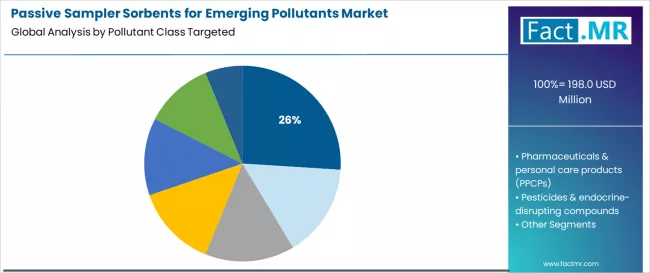
Sorbents for PFAS & other persistent organic pollutants lead the segment with a 26% share. This dominance is due to their status as a global regulatory priority, with extremely low health advisory limits requiring highly sensitive monitoring. The persistent, bioaccumulative nature of PFAS drives demand for specialized sorbent chemistries, such as functionalized polymers and anion-exchange resins, capable of reliable, low-level detection in complex environmental matrices over extended deployment periods.
By Sorbent Type, Which Material Platform Offers Versatility for Polar Contaminants?
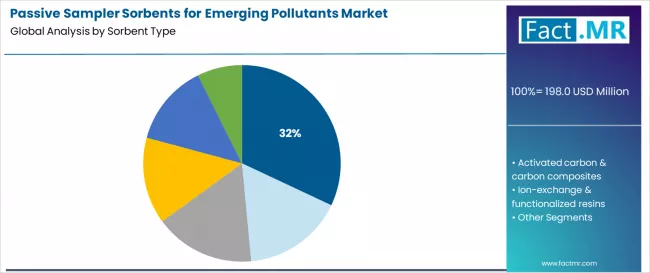
Polymer-based sorbents command the largest sorbent type share at 32%. Their dominance is attributed to their well-established use in devices like the Polar Organic Chemical Integrative Sampler (POCIS), which is effective for a wide range of hydrophilic and moderately hydrophobic emerging contaminants like pharmaceuticals, pesticides, and industrial chemicals. Ongoing innovation in polymer composition and nanostructuring, such as electrospun nanofiber mats, continues to enhance their uptake kinetics and capacity.
By Deployment Medium, Which Application is the Frontline for Environmental Surveillance?
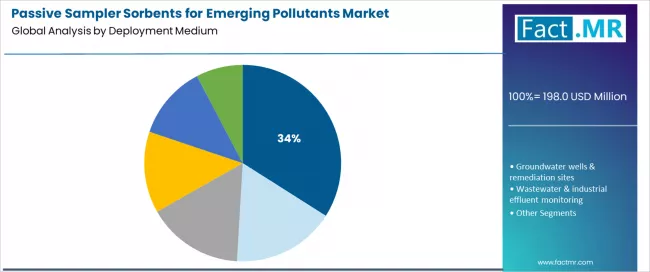
Surface water monitoring represents the leading deployment medium at 34.0%. This encompasses rivers, lakes, and coastal waters, which are primary receptors for agricultural, urban, and industrial runoff. Passive samplers deployed in surface water provide critical time-integrated data on pollutant fluxes and trends, which is essential for regulatory compliance, watershed management, and ecological risk assessments, driving consistent demand.
By End User, Which Entity Sets Compliance Standards and Drives Adoption?
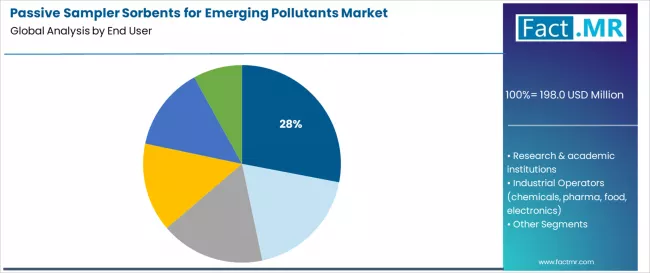
Environmental regulatory agencies are the leading end user at 28.0%. These agencies establish monitoring requirements, validate new methods, and often fund large-scale surveillance programs. Their demand for robust, standardized, and defensible data to inform policy and enforcement makes them the primary specifier and volume buyer of advanced sorbent technologies, setting the performance benchmarks for the entire market.
What are the Drivers, Restraints, and Key Trends of the Passive Sampler Sorbents for Emerging Pollutants Market?
The expansion of regulatory frameworks worldwide to include emerging contaminants like PFAS, PPCPs, and endocrine disruptors in water quality standards drives market growth. The limitations of traditional grab sampling for capturing episodic pollution or time-weighted average concentrations further propel adoption. Growing investment in wastewater-based epidemiology for public health surveillance also creates new demand for sorbents capable of capturing viral genetic material and chemical biomarkers.
A significant restraint is the lack of universal standardization for many passive sampling methods and sorbents, leading to uncertainties in data comparison and regulatory acceptance. The technical complexity of calibrating sampling rates for kinetic samplers under varying field conditions can be a barrier. Competition from advancing active sampling and sensor technologies for some applications requires continuous demonstration of the cost-benefit advantage of passive approaches.
Key trends include the development of equilibrium-passive samplers using nanomaterials like electrospun nanofibers, which offer faster uptake and simplify concentration calculations by eliminating the need for flow-rate-dependent calibration. There is a strong focus on creating multi-residue sorbents and sampler designs that can simultaneously capture diverse pollutant classes, including metals, organics, or pathogens in a single deployment. The market is also moving towards smarter deployments integrated with IoT platforms for better tracking and data management.
Analysis of the Passive Sampler Sorbents for Emerging Pollutants Market by Key Countries
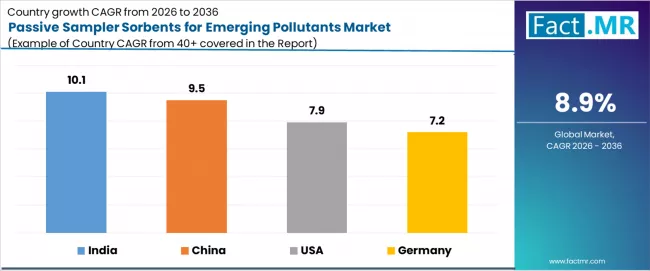
| Country | CAGR (2026-2036) |
|---|---|
| India | 10.10% |
| China | 9.50% |
| USA | 7.90% |
| Germany | 7.20% |
How does India's Water Quality Challenges and Regulatory Development Drive High Growth?
India leads with a 10.10% CAGR, driven by severe water pollution pressures and increasing governmental initiatives like the National Water Mission. The need to monitor rampant contamination from industrial discharge, pesticides, and untreated sewage in rivers and groundwater is creating urgent demand for affordable, scalable passive monitoring solutions to supplement limited laboratory capacity and inform remediation efforts.
Why is China's Comprehensive Pollution Action Plans a Key Market Driver?
China’s 9.50% growth is fueled by its "Water Ten Plan" and related policies that mandate rigorous monitoring and control of emerging pollutants. The scale of its surface water and groundwater monitoring networks, combined with strict enforcement against industrial polluters, generates substantial demand for advanced sorbent technologies to track priority pollutants and assess the effectiveness of clean-up actions.
What Role does the USA's Mature Regulatory Framework and Research Leadership Play?

The USA's 7.90% growth is underpinned by proactive regulations from the EPA targeting PFAS and other contaminants, alongside significant research funding from agencies like the NIH and NSF. State and federal monitoring programs, site remediation projects under Superfund, and leading research institutions developing and validating next-generation sorbent materials, drive demand.
How does Germany's EU Leadership and Precision Engineering Influence the Market?
Germany’s 7.20% growth reflects its central role in shaping EU environmental directives (e.g., Water Framework Directive, Drinking Water Directive) which set stringent standards for emerging pollutants. The market demands high-precision, reliable sorbents that meet rigorous quality assurance criteria for use in the country's extensive environmental monitoring networks and advanced wastewater treatment research.
Competitive Landscape of the Passive Sampler Sorbents for Emerging Pollutants Market

The competitive landscape features a mix of specialized environmental technology firms and large life science conglomerates. Leading analytical and environmental companies like Merck (via Sigma-Aldrich and MilliporeSigma) and Eurofins compete through their extensive portfolios of certified reference materials, sample preparation products, and integrated analytical services, offering complete solutions from sampling to data reporting.
Specialist manufacturers like Restek, SiREM, and ALS compete with deep expertise in sorbent chemistry and passive sampler device design for specific environmental applications. Competition centers on technical thought leadership, proven performance data in peer-reviewed studies, and the ability to provide robust analytical methods and support that ensure data defensibility for regulatory compliance.
Key Players in the Passive Sampler Sorbents for Emerging Pollutants Market
- Restek
- Sigma-Aldrich (Merck)
- Eurofins Technologies
- Pacific Rim Laboratories
- SiREM
- ALS
- Merck & Co. Inc.
- Envirotech
Scope of Report
| Items | Values |
|---|---|
| Quantitative Units | USD Million |
| Pollutant Class Targeted | PFAS & other persistent organic pollutants (POPs), Pharmaceuticals & personal care products (PPCPs), Pesticides & endocrine-disrupting compounds, Hydrocarbons (PAHs, VOCs), Industrial solvents & plasticizers, Heavy metals & inorganic ions, Nanomaterials & engineered particles |
| Sorbent Type | Polymer-based sorbents (e.g., POCIS-type), Activated carbon & carbon composites, Ion-exchange & functionalized resins, Molecularly imprinted polymers (MIPs), Zeolites & mineral sorbents, Hybrid nano-sorbent formulations |
| Deployment Medium | Surface water monitoring, Groundwater wells & remediation sites, Wastewater & industrial effluent monitoring, Drinking water networks, Coastal & ocean monitoring, Atmospheric & air passive diffusive samplers |
| End User | Environmental regulatory agencies, Research & academic institutions, Industrial Operators (chemicals, pharma, food, electronics), Water & Wastewater Utilities, Environmental consulting & monitoring firms, NGOs & global monitoring programs |
| Key Countries | India, China, USA, Germany |
| Key Companies | Restek, Sigma-Aldrich (Merck), Eurofins Technologies, Pacific Rim Laboratories, SiREM, ALS, Merck, Envirotech |
| Additional Analysis | Analysis of sorbent uptake kinetics and capacity for novel pollutant classes, comparison of equilibrium vs. kinetic sampling approaches, total cost-of-monitoring models versus active sampling, competitive assessment against biosensors and continuous monitors, and regulatory acceptance pathways in key regions. |
Passive Sampler Sorbents for Emerging Pollutants Market by Segments
Pollutant Class Targeted :
- PFAS & other persistent organic pollutants (POPs)
- Pharmaceuticals & personal care products (PPCPs)
- Pesticides & endocrine-disrupting compounds
- Hydrocarbons (PAHs, VOCs)
- Industrial solvents & plasticizers
- Heavy metals & inorganic ions
- Nanomaterials & engineered particles
Sorbent Type :
- Polymer-based sorbents (e.g., POCIS-type)
- Activated carbon & carbon composites
- Ion-exchange & functionalized resins
- Molecularly imprinted polymers (MIPs)
- Zeolites & mineral sorbents
- Hybrid nano-sorbent formulations
Deployment Medium :
- Surface water monitoring
- Groundwater wells & remediation sites
- Wastewater & industrial effluent monitoring
- Drinking water networks
- Coastal & ocean monitoring
- Atmospheric & air passive diffusive samplers
End User :
- Environmental regulatory agencies
- Research & academic institutions
- Industrial Operators (chemicals, pharma, food, electronics)
- Water & Wastewater Utilities
- Environmental consulting & monitoring firms
- NGOs & global monitoring programs
Region :
- North America
- USA
- Canada
- Latin America
- Brazil
- Mexico
- Argentina
- Rest of Latin America
- Western Europe
- Germany
- UK
- France
- Spain
- Italy
- BENELUX
- Rest of Western Europe
- Eastern Europe
- Russia
- Poland
- Czech Republic
- Rest of Eastern Europe
- East Asia
- China
- Japan
- South Korea
- Rest of East Asia
- South Asia & Pacific
- India
- ASEAN
- Australia
- Rest of South Asia & Pacific
- MEA
- Saudi Arabia
- UAE
- Turkiye
- Rest of MEA
Table of Content
- Executive Summary
- Global Market Outlook
- Demand to side Trends
- Supply to side Trends
- Technology Roadmap Analysis
- Analysis and Recommendations
- Market Overview
- Market Coverage / Taxonomy
- Market Definition / Scope / Limitations
- Market Background
- Market Dynamics
- Drivers
- Restraints
- Opportunity
- Trends
- Scenario Forecast
- Demand in Optimistic Scenario
- Demand in Likely Scenario
- Demand in Conservative Scenario
- Opportunity Map Analysis
- Product Life Cycle Analysis
- Supply Chain Analysis
- Investment Feasibility Matrix
- Value Chain Analysis
- PESTLE and Porter’s Analysis
- Regulatory Landscape
- Regional Parent Market Outlook
- Production and Consumption Statistics
- Import and Export Statistics
- Market Dynamics
- Global Market Analysis 2021 to 2025 and Forecast, 2026 to 2036
- Historical Market Size Value (USD Million) Analysis, 2021 to 2025
- Current and Future Market Size Value (USD Million) Projections, 2026 to 2036
- Y to o to Y Growth Trend Analysis
- Absolute $ Opportunity Analysis
- Global Market Pricing Analysis 2021 to 2025 and Forecast 2026 to 2036
- Global Market Analysis 2021 to 2025 and Forecast 2026 to 2036, By Pollutant Class Targeted
- Introduction / Key Findings
- Historical Market Size Value (USD Million) Analysis By Pollutant Class Targeted, 2021 to 2025
- Current and Future Market Size Value (USD Million) Analysis and Forecast By Pollutant Class Targeted, 2026 to 2036
- PFAS & other persistent organic pollutants (POPs)
- Pharmaceuticals & personal care products (PPCPs)
- Pesticides & endocrine-disrupting compounds
- Hydrocarbons (PAHs, VOCs)
- Industrial solvents & plasticizers
- Heavy metals & inorganic ions
- Nanomaterials & engineered particles
- PFAS & other persistent organic pollutants (POPs)
- Y to o to Y Growth Trend Analysis By Pollutant Class Targeted, 2021 to 2025
- Absolute $ Opportunity Analysis By Pollutant Class Targeted, 2026 to 2036
- Global Market Analysis 2021 to 2025 and Forecast 2026 to 2036, By Sorbent Type
- Introduction / Key Findings
- Historical Market Size Value (USD Million) Analysis By Sorbent Type, 2021 to 2025
- Current and Future Market Size Value (USD Million) Analysis and Forecast By Sorbent Type, 2026 to 2036
- Polymer-based sorbents (e.g., POCIS-type)
- Activated carbon & carbon composites
- Ion-exchange & functionalized resins
- Molecularly imprinted polymers (MIPs)
- Zeolites & mineral sorbents
- Hybrid nano-sorbent formulations
- Polymer-based sorbents (e.g., POCIS-type)
- Y to o to Y Growth Trend Analysis By Sorbent Type, 2021 to 2025
- Absolute $ Opportunity Analysis By Sorbent Type, 2026 to 2036
- Global Market Analysis 2021 to 2025 and Forecast 2026 to 2036, By Deployment Medium
- Introduction / Key Findings
- Historical Market Size Value (USD Million) Analysis By Deployment Medium, 2021 to 2025
- Current and Future Market Size Value (USD Million) Analysis and Forecast By Deployment Medium, 2026 to 2036
- Surface water monitoring
- Groundwater wells & remediation sites
- Wastewater & industrial effluent monitoring
- Drinking water networks
- Coastal&ocean monitoring
- Atmospheric&air passive diffusive samplers
- Surface water monitoring
- Y to o to Y Growth Trend Analysis By Deployment Medium, 2021 to 2025
- Absolute $ Opportunity Analysis By Deployment Medium, 2026 to 2036
- Global Market Analysis 2021 to 2025 and Forecast 2026 to 2036, By End User
- Introduction / Key Findings
- Historical Market Size Value (USD Million) Analysis By End User, 2021 to 2025
- Current and Future Market Size Value (USD Million) Analysis and Forecast By End User, 2026 to 2036
- Environmental regulatory agencies
- Research & academic institutions
- Industrial Operators (chemicals, pharma, food, electronics)
- Water & Wastewater Utilities
- Environmental consulting & monitoring firms
- NGOs & global monitoring programs
- Environmental regulatory agencies
- Y to o to Y Growth Trend Analysis By End User, 2021 to 2025
- Absolute $ Opportunity Analysis By End User, 2026 to 2036
- Global Market Analysis 2021 to 2025 and Forecast 2026 to 2036, By Region
- Introduction
- Historical Market Size Value (USD Million) Analysis By Region, 2021 to 2025
- Current Market Size Value (USD Million) Analysis and Forecast By Region, 2026 to 2036
- North America
- Latin America
- Western Europe
- Eastern Europe
- East Asia
- South Asia and Pacific
- Middle East & Africa
- Market Attractiveness Analysis By Region
- North America Market Analysis 2021 to 2025 and Forecast 2026 to 2036, By Country
- Historical Market Size Value (USD Million) Trend Analysis By Market Taxonomy, 2021 to 2025
- Market Size Value (USD Million) Forecast By Market Taxonomy, 2026 to 2036
- By Country
- USA
- Canada
- Mexico
- By Pollutant Class Targeted
- By Sorbent Type
- By Deployment Medium
- By End User
- By Country
- Market Attractiveness Analysis
- By Country
- By Pollutant Class Targeted
- By Sorbent Type
- By Deployment Medium
- By End User
- Key Takeaways
- Latin America Market Analysis 2021 to 2025 and Forecast 2026 to 2036, By Country
- Historical Market Size Value (USD Million) Trend Analysis By Market Taxonomy, 2021 to 2025
- Market Size Value (USD Million) Forecast By Market Taxonomy, 2026 to 2036
- By Country
- Brazil
- Chile
- Rest of Latin America
- By Pollutant Class Targeted
- By Sorbent Type
- By Deployment Medium
- By End User
- By Country
- Market Attractiveness Analysis
- By Country
- By Pollutant Class Targeted
- By Sorbent Type
- By Deployment Medium
- By End User
- Key Takeaways
- Western Europe Market Analysis 2021 to 2025 and Forecast 2026 to 2036, By Country
- Historical Market Size Value (USD Million) Trend Analysis By Market Taxonomy, 2021 to 2025
- Market Size Value (USD Million) Forecast By Market Taxonomy, 2026 to 2036
- By Country
- Germany
- UK
- Italy
- Spain
- France
- Nordic
- BENELUX
- Rest of Western Europe
- By Pollutant Class Targeted
- By Sorbent Type
- By Deployment Medium
- By End User
- By Country
- Market Attractiveness Analysis
- By Country
- By Pollutant Class Targeted
- By Sorbent Type
- By Deployment Medium
- By End User
- Key Takeaways
- Eastern Europe Market Analysis 2021 to 2025 and Forecast 2026 to 2036, By Country
- Historical Market Size Value (USD Million) Trend Analysis By Market Taxonomy, 2021 to 2025
- Market Size Value (USD Million) Forecast By Market Taxonomy, 2026 to 2036
- By Country
- Russia
- Poland
- Hungary
- Balkan & Baltic
- Rest of Eastern Europe
- By Pollutant Class Targeted
- By Sorbent Type
- By Deployment Medium
- By End User
- By Country
- Market Attractiveness Analysis
- By Country
- By Pollutant Class Targeted
- By Sorbent Type
- By Deployment Medium
- By End User
- Key Takeaways
- East Asia Market Analysis 2021 to 2025 and Forecast 2026 to 2036, By Country
- Historical Market Size Value (USD Million) Trend Analysis By Market Taxonomy, 2021 to 2025
- Market Size Value (USD Million) Forecast By Market Taxonomy, 2026 to 2036
- By Country
- China
- Japan
- South Korea
- By Pollutant Class Targeted
- By Sorbent Type
- By Deployment Medium
- By End User
- By Country
- Market Attractiveness Analysis
- By Country
- By Pollutant Class Targeted
- By Sorbent Type
- By Deployment Medium
- By End User
- Key Takeaways
- South Asia and Pacific Market Analysis 2021 to 2025 and Forecast 2026 to 2036, By Country
- Historical Market Size Value (USD Million) Trend Analysis By Market Taxonomy, 2021 to 2025
- Market Size Value (USD Million) Forecast By Market Taxonomy, 2026 to 2036
- By Country
- India
- ASEAN
- Australia & New Zealand
- Rest of South Asia and Pacific
- By Pollutant Class Targeted
- By Sorbent Type
- By Deployment Medium
- By End User
- By Country
- Market Attractiveness Analysis
- By Country
- By Pollutant Class Targeted
- By Sorbent Type
- By Deployment Medium
- By End User
- Key Takeaways
- Middle East & Africa Market Analysis 2021 to 2025 and Forecast 2026 to 2036, By Country
- Historical Market Size Value (USD Million) Trend Analysis By Market Taxonomy, 2021 to 2025
- Market Size Value (USD Million) Forecast By Market Taxonomy, 2026 to 2036
- By Country
- Kingdom of Saudi Arabia
- Other GCC Countries
- Turkiye
- South Africa
- Other African Union
- Rest of Middle East & Africa
- By Pollutant Class Targeted
- By Sorbent Type
- By Deployment Medium
- By End User
- By Country
- Market Attractiveness Analysis
- By Country
- By Pollutant Class Targeted
- By Sorbent Type
- By Deployment Medium
- By End User
- Key Takeaways
- Key Countries Market Analysis
- USA
- Pricing Analysis
- Market Share Analysis, 2025
- By Pollutant Class Targeted
- By Sorbent Type
- By Deployment Medium
- By End User
- Canada
- Pricing Analysis
- Market Share Analysis, 2025
- By Pollutant Class Targeted
- By Sorbent Type
- By Deployment Medium
- By End User
- Mexico
- Pricing Analysis
- Market Share Analysis, 2025
- By Pollutant Class Targeted
- By Sorbent Type
- By Deployment Medium
- By End User
- Brazil
- Pricing Analysis
- Market Share Analysis, 2025
- By Pollutant Class Targeted
- By Sorbent Type
- By Deployment Medium
- By End User
- Chile
- Pricing Analysis
- Market Share Analysis, 2025
- By Pollutant Class Targeted
- By Sorbent Type
- By Deployment Medium
- By End User
- Germany
- Pricing Analysis
- Market Share Analysis, 2025
- By Pollutant Class Targeted
- By Sorbent Type
- By Deployment Medium
- By End User
- UK
- Pricing Analysis
- Market Share Analysis, 2025
- By Pollutant Class Targeted
- By Sorbent Type
- By Deployment Medium
- By End User
- Italy
- Pricing Analysis
- Market Share Analysis, 2025
- By Pollutant Class Targeted
- By Sorbent Type
- By Deployment Medium
- By End User
- Spain
- Pricing Analysis
- Market Share Analysis, 2025
- By Pollutant Class Targeted
- By Sorbent Type
- By Deployment Medium
- By End User
- France
- Pricing Analysis
- Market Share Analysis, 2025
- By Pollutant Class Targeted
- By Sorbent Type
- By Deployment Medium
- By End User
- India
- Pricing Analysis
- Market Share Analysis, 2025
- By Pollutant Class Targeted
- By Sorbent Type
- By Deployment Medium
- By End User
- ASEAN
- Pricing Analysis
- Market Share Analysis, 2025
- By Pollutant Class Targeted
- By Sorbent Type
- By Deployment Medium
- By End User
- Australia & New Zealand
- Pricing Analysis
- Market Share Analysis, 2025
- By Pollutant Class Targeted
- By Sorbent Type
- By Deployment Medium
- By End User
- China
- Pricing Analysis
- Market Share Analysis, 2025
- By Pollutant Class Targeted
- By Sorbent Type
- By Deployment Medium
- By End User
- Japan
- Pricing Analysis
- Market Share Analysis, 2025
- By Pollutant Class Targeted
- By Sorbent Type
- By Deployment Medium
- By End User
- South Korea
- Pricing Analysis
- Market Share Analysis, 2025
- By Pollutant Class Targeted
- By Sorbent Type
- By Deployment Medium
- By End User
- Russia
- Pricing Analysis
- Market Share Analysis, 2025
- By Pollutant Class Targeted
- By Sorbent Type
- By Deployment Medium
- By End User
- Poland
- Pricing Analysis
- Market Share Analysis, 2025
- By Pollutant Class Targeted
- By Sorbent Type
- By Deployment Medium
- By End User
- Hungary
- Pricing Analysis
- Market Share Analysis, 2025
- By Pollutant Class Targeted
- By Sorbent Type
- By Deployment Medium
- By End User
- Kingdom of Saudi Arabia
- Pricing Analysis
- Market Share Analysis, 2025
- By Pollutant Class Targeted
- By Sorbent Type
- By Deployment Medium
- By End User
- Turkiye
- Pricing Analysis
- Market Share Analysis, 2025
- By Pollutant Class Targeted
- By Sorbent Type
- By Deployment Medium
- By End User
- South Africa
- Pricing Analysis
- Market Share Analysis, 2025
- By Pollutant Class Targeted
- By Sorbent Type
- By Deployment Medium
- By End User
- USA
- Market Structure Analysis
- Competition Dashboard
- Competition Benchmarking
- Market Share Analysis of Top Players
- By Regional
- By Pollutant Class Targeted
- By Sorbent Type
- By Deployment Medium
- By End User
- Competition Analysis
- Competition Deep Dive
- Restek
- Overview
- Product Portfolio
- Profitability by Market Segments (Product/Age /Sales Channel/Region)
- Sales Footprint
- Strategy Overview
- Marketing Strategy
- Product Strategy
- Channel Strategy
- Sigma-Aldrich
- Eurofins Technologies
- Pacific Rim Laboratories
- SiREM
- ALS
- Merck & Co. Inc.
- Envirotech
- Restek
- Competition Deep Dive
- Assumptions & Acronyms Used
- Research Methodology
List Of Table
- Table 1: Global Market Value (USD Million) Forecast by Region, 2021 to 2036
- Table 2: Global Market Value (USD Million) Forecast by Pollutant Class Targeted, 2021 to 2036
- Table 3: Global Market Value (USD Million) Forecast by Sorbent Type, 2021 to 2036
- Table 4: Global Market Value (USD Million) Forecast by Deployment Medium, 2021 to 2036
- Table 5: Global Market Value (USD Million) Forecast by End User, 2021 to 2036
- Table 6: North America Market Value (USD Million) Forecast by Country, 2021 to 2036
- Table 7: North America Market Value (USD Million) Forecast by Pollutant Class Targeted, 2021 to 2036
- Table 8: North America Market Value (USD Million) Forecast by Sorbent Type, 2021 to 2036
- Table 9: North America Market Value (USD Million) Forecast by Deployment Medium, 2021 to 2036
- Table 10: North America Market Value (USD Million) Forecast by End User, 2021 to 2036
- Table 11: Latin America Market Value (USD Million) Forecast by Country, 2021 to 2036
- Table 12: Latin America Market Value (USD Million) Forecast by Pollutant Class Targeted, 2021 to 2036
- Table 13: Latin America Market Value (USD Million) Forecast by Sorbent Type, 2021 to 2036
- Table 14: Latin America Market Value (USD Million) Forecast by Deployment Medium, 2021 to 2036
- Table 15: Latin America Market Value (USD Million) Forecast by End User, 2021 to 2036
- Table 16: Western Europe Market Value (USD Million) Forecast by Country, 2021 to 2036
- Table 17: Western Europe Market Value (USD Million) Forecast by Pollutant Class Targeted, 2021 to 2036
- Table 18: Western Europe Market Value (USD Million) Forecast by Sorbent Type, 2021 to 2036
- Table 19: Western Europe Market Value (USD Million) Forecast by Deployment Medium, 2021 to 2036
- Table 20: Western Europe Market Value (USD Million) Forecast by End User, 2021 to 2036
- Table 21: Eastern Europe Market Value (USD Million) Forecast by Country, 2021 to 2036
- Table 22: Eastern Europe Market Value (USD Million) Forecast by Pollutant Class Targeted, 2021 to 2036
- Table 23: Eastern Europe Market Value (USD Million) Forecast by Sorbent Type, 2021 to 2036
- Table 24: Eastern Europe Market Value (USD Million) Forecast by Deployment Medium, 2021 to 2036
- Table 25: Eastern Europe Market Value (USD Million) Forecast by End User, 2021 to 2036
- Table 26: East Asia Market Value (USD Million) Forecast by Country, 2021 to 2036
- Table 27: East Asia Market Value (USD Million) Forecast by Pollutant Class Targeted, 2021 to 2036
- Table 28: East Asia Market Value (USD Million) Forecast by Sorbent Type, 2021 to 2036
- Table 29: East Asia Market Value (USD Million) Forecast by Deployment Medium, 2021 to 2036
- Table 30: East Asia Market Value (USD Million) Forecast by End User, 2021 to 2036
- Table 31: South Asia and Pacific Market Value (USD Million) Forecast by Country, 2021 to 2036
- Table 32: South Asia and Pacific Market Value (USD Million) Forecast by Pollutant Class Targeted, 2021 to 2036
- Table 33: South Asia and Pacific Market Value (USD Million) Forecast by Sorbent Type, 2021 to 2036
- Table 34: South Asia and Pacific Market Value (USD Million) Forecast by Deployment Medium, 2021 to 2036
- Table 35: South Asia and Pacific Market Value (USD Million) Forecast by End User, 2021 to 2036
- Table 36: Middle East & Africa Market Value (USD Million) Forecast by Country, 2021 to 2036
- Table 37: Middle East & Africa Market Value (USD Million) Forecast by Pollutant Class Targeted, 2021 to 2036
- Table 38: Middle East & Africa Market Value (USD Million) Forecast by Sorbent Type, 2021 to 2036
- Table 39: Middle East & Africa Market Value (USD Million) Forecast by Deployment Medium, 2021 to 2036
- Table 40: Middle East & Africa Market Value (USD Million) Forecast by End User, 2021 to 2036
List Of Figures
- Figure 1: Global Market Pricing Analysis
- Figure 2: Global Market Value (USD Million) Forecast 2021 to 2036
- Figure 3: Global Market Value Share and BPS Analysis by Pollutant Class Targeted, 2026 and 2036
- Figure 4: Global Market Y to o to Y Growth Comparison by Pollutant Class Targeted, 2026 to 2036
- Figure 5: Global Market Attractiveness Analysis by Pollutant Class Targeted
- Figure 6: Global Market Value Share and BPS Analysis by Sorbent Type, 2026 and 2036
- Figure 7: Global Market Y to o to Y Growth Comparison by Sorbent Type, 2026 to 2036
- Figure 8: Global Market Attractiveness Analysis by Sorbent Type
- Figure 9: Global Market Value Share and BPS Analysis by Deployment Medium, 2026 and 2036
- Figure 10: Global Market Y to o to Y Growth Comparison by Deployment Medium, 2026 to 2036
- Figure 11: Global Market Attractiveness Analysis by Deployment Medium
- Figure 12: Global Market Value Share and BPS Analysis by End User, 2026 and 2036
- Figure 13: Global Market Y to o to Y Growth Comparison by End User, 2026 to 2036
- Figure 14: Global Market Attractiveness Analysis by End User
- Figure 15: Global Market Value (USD Million) Share and BPS Analysis by Region, 2026 and 2036
- Figure 16: Global Market Y to o to Y Growth Comparison by Region, 2026 to 2036
- Figure 17: Global Market Attractiveness Analysis by Region
- Figure 18: North America Market Incremental Dollar Opportunity, 2026 to 2036
- Figure 19: Latin America Market Incremental Dollar Opportunity, 2026 to 2036
- Figure 20: Western Europe Market Incremental Dollar Opportunity, 2026 to 2036
- Figure 21: Eastern Europe Market Incremental Dollar Opportunity, 2026 to 2036
- Figure 22: East Asia Market Incremental Dollar Opportunity, 2026 to 2036
- Figure 23: South Asia and Pacific Market Incremental Dollar Opportunity, 2026 to 2036
- Figure 24: Middle East & Africa Market Incremental Dollar Opportunity, 2026 to 2036
- Figure 25: North America Market Value Share and BPS Analysis by Country, 2026 and 2036
- Figure 26: North America Market Value Share and BPS Analysis by Pollutant Class Targeted, 2026 and 2036
- Figure 27: North America Market Y to o to Y Growth Comparison by Pollutant Class Targeted, 2026 to 2036
- Figure 28: North America Market Attractiveness Analysis by Pollutant Class Targeted
- Figure 29: North America Market Value Share and BPS Analysis by Sorbent Type, 2026 and 2036
- Figure 30: North America Market Y to o to Y Growth Comparison by Sorbent Type, 2026 to 2036
- Figure 31: North America Market Attractiveness Analysis by Sorbent Type
- Figure 32: North America Market Value Share and BPS Analysis by Deployment Medium, 2026 and 2036
- Figure 33: North America Market Y to o to Y Growth Comparison by Deployment Medium, 2026 to 2036
- Figure 34: North America Market Attractiveness Analysis by Deployment Medium
- Figure 35: North America Market Value Share and BPS Analysis by End User, 2026 and 2036
- Figure 36: North America Market Y to o to Y Growth Comparison by End User, 2026 to 2036
- Figure 37: North America Market Attractiveness Analysis by End User
- Figure 38: Latin America Market Value Share and BPS Analysis by Country, 2026 and 2036
- Figure 39: Latin America Market Value Share and BPS Analysis by Pollutant Class Targeted, 2026 and 2036
- Figure 40: Latin America Market Y to o to Y Growth Comparison by Pollutant Class Targeted, 2026 to 2036
- Figure 41: Latin America Market Attractiveness Analysis by Pollutant Class Targeted
- Figure 42: Latin America Market Value Share and BPS Analysis by Sorbent Type, 2026 and 2036
- Figure 43: Latin America Market Y to o to Y Growth Comparison by Sorbent Type, 2026 to 2036
- Figure 44: Latin America Market Attractiveness Analysis by Sorbent Type
- Figure 45: Latin America Market Value Share and BPS Analysis by Deployment Medium, 2026 and 2036
- Figure 46: Latin America Market Y to o to Y Growth Comparison by Deployment Medium, 2026 to 2036
- Figure 47: Latin America Market Attractiveness Analysis by Deployment Medium
- Figure 48: Latin America Market Value Share and BPS Analysis by End User, 2026 and 2036
- Figure 49: Latin America Market Y to o to Y Growth Comparison by End User, 2026 to 2036
- Figure 50: Latin America Market Attractiveness Analysis by End User
- Figure 51: Western Europe Market Value Share and BPS Analysis by Country, 2026 and 2036
- Figure 52: Western Europe Market Value Share and BPS Analysis by Pollutant Class Targeted, 2026 and 2036
- Figure 53: Western Europe Market Y to o to Y Growth Comparison by Pollutant Class Targeted, 2026 to 2036
- Figure 54: Western Europe Market Attractiveness Analysis by Pollutant Class Targeted
- Figure 55: Western Europe Market Value Share and BPS Analysis by Sorbent Type, 2026 and 2036
- Figure 56: Western Europe Market Y to o to Y Growth Comparison by Sorbent Type, 2026 to 2036
- Figure 57: Western Europe Market Attractiveness Analysis by Sorbent Type
- Figure 58: Western Europe Market Value Share and BPS Analysis by Deployment Medium, 2026 and 2036
- Figure 59: Western Europe Market Y to o to Y Growth Comparison by Deployment Medium, 2026 to 2036
- Figure 60: Western Europe Market Attractiveness Analysis by Deployment Medium
- Figure 61: Western Europe Market Value Share and BPS Analysis by End User, 2026 and 2036
- Figure 62: Western Europe Market Y to o to Y Growth Comparison by End User, 2026 to 2036
- Figure 63: Western Europe Market Attractiveness Analysis by End User
- Figure 64: Eastern Europe Market Value Share and BPS Analysis by Country, 2026 and 2036
- Figure 65: Eastern Europe Market Value Share and BPS Analysis by Pollutant Class Targeted, 2026 and 2036
- Figure 66: Eastern Europe Market Y to o to Y Growth Comparison by Pollutant Class Targeted, 2026 to 2036
- Figure 67: Eastern Europe Market Attractiveness Analysis by Pollutant Class Targeted
- Figure 68: Eastern Europe Market Value Share and BPS Analysis by Sorbent Type, 2026 and 2036
- Figure 69: Eastern Europe Market Y to o to Y Growth Comparison by Sorbent Type, 2026 to 2036
- Figure 70: Eastern Europe Market Attractiveness Analysis by Sorbent Type
- Figure 71: Eastern Europe Market Value Share and BPS Analysis by Deployment Medium, 2026 and 2036
- Figure 72: Eastern Europe Market Y to o to Y Growth Comparison by Deployment Medium, 2026 to 2036
- Figure 73: Eastern Europe Market Attractiveness Analysis by Deployment Medium
- Figure 74: Eastern Europe Market Value Share and BPS Analysis by End User, 2026 and 2036
- Figure 75: Eastern Europe Market Y to o to Y Growth Comparison by End User, 2026 to 2036
- Figure 76: Eastern Europe Market Attractiveness Analysis by End User
- Figure 77: East Asia Market Value Share and BPS Analysis by Country, 2026 and 2036
- Figure 78: East Asia Market Value Share and BPS Analysis by Pollutant Class Targeted, 2026 and 2036
- Figure 79: East Asia Market Y to o to Y Growth Comparison by Pollutant Class Targeted, 2026 to 2036
- Figure 80: East Asia Market Attractiveness Analysis by Pollutant Class Targeted
- Figure 81: East Asia Market Value Share and BPS Analysis by Sorbent Type, 2026 and 2036
- Figure 82: East Asia Market Y to o to Y Growth Comparison by Sorbent Type, 2026 to 2036
- Figure 83: East Asia Market Attractiveness Analysis by Sorbent Type
- Figure 84: East Asia Market Value Share and BPS Analysis by Deployment Medium, 2026 and 2036
- Figure 85: East Asia Market Y to o to Y Growth Comparison by Deployment Medium, 2026 to 2036
- Figure 86: East Asia Market Attractiveness Analysis by Deployment Medium
- Figure 87: East Asia Market Value Share and BPS Analysis by End User, 2026 and 2036
- Figure 88: East Asia Market Y to o to Y Growth Comparison by End User, 2026 to 2036
- Figure 89: East Asia Market Attractiveness Analysis by End User
- Figure 90: South Asia and Pacific Market Value Share and BPS Analysis by Country, 2026 and 2036
- Figure 91: South Asia and Pacific Market Value Share and BPS Analysis by Pollutant Class Targeted, 2026 and 2036
- Figure 92: South Asia and Pacific Market Y to o to Y Growth Comparison by Pollutant Class Targeted, 2026 to 2036
- Figure 93: South Asia and Pacific Market Attractiveness Analysis by Pollutant Class Targeted
- Figure 94: South Asia and Pacific Market Value Share and BPS Analysis by Sorbent Type, 2026 and 2036
- Figure 95: South Asia and Pacific Market Y to o to Y Growth Comparison by Sorbent Type, 2026 to 2036
- Figure 96: South Asia and Pacific Market Attractiveness Analysis by Sorbent Type
- Figure 97: South Asia and Pacific Market Value Share and BPS Analysis by Deployment Medium, 2026 and 2036
- Figure 98: South Asia and Pacific Market Y to o to Y Growth Comparison by Deployment Medium, 2026 to 2036
- Figure 99: South Asia and Pacific Market Attractiveness Analysis by Deployment Medium
- Figure 100: South Asia and Pacific Market Value Share and BPS Analysis by End User, 2026 and 2036
- Figure 101: South Asia and Pacific Market Y to o to Y Growth Comparison by End User, 2026 to 2036
- Figure 102: South Asia and Pacific Market Attractiveness Analysis by End User
- Figure 103: Middle East & Africa Market Value Share and BPS Analysis by Country, 2026 and 2036
- Figure 104: Middle East & Africa Market Value Share and BPS Analysis by Pollutant Class Targeted, 2026 and 2036
- Figure 105: Middle East & Africa Market Y to o to Y Growth Comparison by Pollutant Class Targeted, 2026 to 2036
- Figure 106: Middle East & Africa Market Attractiveness Analysis by Pollutant Class Targeted
- Figure 107: Middle East & Africa Market Value Share and BPS Analysis by Sorbent Type, 2026 and 2036
- Figure 108: Middle East & Africa Market Y to o to Y Growth Comparison by Sorbent Type, 2026 to 2036
- Figure 109: Middle East & Africa Market Attractiveness Analysis by Sorbent Type
- Figure 110: Middle East & Africa Market Value Share and BPS Analysis by Deployment Medium, 2026 and 2036
- Figure 111: Middle East & Africa Market Y to o to Y Growth Comparison by Deployment Medium, 2026 to 2036
- Figure 112: Middle East & Africa Market Attractiveness Analysis by Deployment Medium
- Figure 113: Middle East & Africa Market Value Share and BPS Analysis by End User, 2026 and 2036
- Figure 114: Middle East & Africa Market Y to o to Y Growth Comparison by End User, 2026 to 2036
- Figure 115: Middle East & Africa Market Attractiveness Analysis by End User
- Figure 116: Global Market - Tier Structure Analysis
- Figure 117: Global Market - Company Share Analysis
- FAQs -
How big is the passive sampler sorbents for emerging pollutants market in 2026?
The global heat-shield coatings for ev battery trays market is estimated to be valued at USD 182.7 million in 2026.
What will be the size of passive sampler sorbents for emerging pollutants market in 2036?
The market size for the heat-shield coatings for ev battery trays market is projected to reach USD 634.6 million by 2036.
How much will be the passive sampler sorbents for emerging pollutants market growth between 2026 and 2036?
The heat-shield coatings for ev battery trays market is expected to grow at a 13.3% CAGR between 2026 and 2036.
What are the key product types in the passive sampler sorbents for emerging pollutants market?
The key product types in heat-shield coatings for ev battery trays market are skateboard bev platforms , module-based pack-in-frame designs , cell-to-pack & cell-to-chassis packs and others (retrofitted or niche packs) .
Which sorbent type segment to contribute significant share in the passive sampler sorbents for emerging pollutants market in 2026?
In terms of coating type , ceramic or ceramic-filled heat-shield coatings segment to command 32.0% share in the heat-shield coatings for ev battery trays market in 2026.