- Market Value (2025): USD 1.84 Bn
- Estimated Value (2026): USD 2.12 Bn
- Forecast Value (2036): USD 8.65 Bn
- CAGR (2026-2036): 15.1%
What is the Patient Monitoring and Assistance Robots Market forecast to be worth by 2036?
USD 2.1 billion in 2026 to USD 8.7 billion by 2036 at a CAGR of 15.1%.
- Fact.MR estimates that the Patient Monitoring and Assistance Robots Market was valued at USD 1.84 billion in 2025.
- Revenue is projected to increase from USD 2.12 billion in 2026 to USD 8.65 billion by 2036 as healthcare providers explore robotic assistance and connected patient monitoring.
- The Fact.MR forecast indicates 15.1% CAGR from 2026 to 2036, while the displayed rounded market endpoints imply approximately 15.3%; the difference requires reconciliation with the unrounded model. The market growth is supported by developments in sensors, artificial intelligence and healthcare automation.
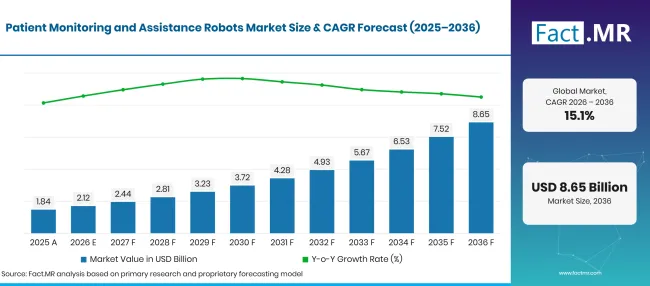
Factmr Patient Monitoring And Assistance Robots Market Forecast Global | Source: Fact.MR
| Year | Basis | Market Value (USD billion) |
|---|---|---|
| 2025 | Estimate | 1.8 |
| 2026 | Estimate | 2.1 |
| 2036 | Forecast | 8.7 |
| CAGR 2026 to 2036 | Forecast period | 15.1% |
Source: Fact.MR analysis. Updated Oct 21, 2026
What are the defining numbers behind Patient Monitoring and Assistance Robots Market growth?
USD 6.6 billion in additional market value between 2026 and 2036.
- Demand Drivers in the Market
- Connected patient monitoring is expanding healthcare technology infrastructure. Hospitals are adopting centralized systems that collect patient information, creating opportunities for robotic platforms capable of integrating with clinical monitoring workflows. In September 2026, Brazil’s Ministry of Health reported that six hospitals participating in the public health system’s Intelligent ICUs initiative were transmitting patient vital signs in real time. The network included 60 active intelligent beds and plans for expansion to 280 smart beds across 14 health institutions [1].[1]
- Robotic assistance and automation has helped in the market growth. Healthcare organizations are assessing robotics for tasks that require repeatable procedures, sensor-based navigation and supervised automation. On August 19, 2026, the U.S. Food and Drug Administration authorized the Aletta autonomous robotic blood-collection device for adult outpatient settings under trained supervision. The example demonstrates regulatory progress in healthcare robotics, although blood collection is a related application rather than direct evidence of patient-assistance robot sales [2].
- AI-enabled rehabilitation and care are increasing the growth of the market. Artificial intelligence and connected devices can support remote assessment, individualized rehabilitation and monitoring outside traditional hospital settings. In June 2026, the UK government stated that AI-enabled physiotherapy and rehabilitation services were being piloted or deployed in parts of the NHS, including digital musculoskeletal pathways and remote monitoring [3].
- Expansion of home-based care: Healthcare systems are exploring technologies that can support patients after hospital discharge and help caregivers monitor recovery. In September 2026, the FDA updated its READI-Home Innovation Challenge information for medical devices intended to support home care and potentially reduce hospital readmissions. The initiative concerns home-use medical devices broadly, not exclusively robots [4].
- Key Segments Analyzed
- By Product Type: Mobile Robots are projected to account for 58.3% of the market in 2026, reflecting their potential use in patient transport, mobility support and movement across healthcare environments.
- By Application: Rehabilitation Centers are projected to account for 56.7% of the market in 2026.
- By Technology: Sensors are projected to account for 48.9% of the market in 2026, reflecting their role in collecting movement, position and patient-monitoring data.
- By End-User: Healthcare Providers are projected to account for 56.7% of the market in 2026.
- Analyst Opinion at Fact.MR
- Shambhu Nath Jha, Principal Consultant at Fact.MR, states, “The Patient Monitoring and Assistance Robots Market is positioned to benefit from advances in sensor technology, connected monitoring and AI-enabled healthcare workflows. Manufacturers that demonstrate clinical usefulness, safe operation and compatibility with existing hospital systems may be better placed to support adoption. However, monitoring devices, rehabilitation robots and autonomous assistance robots serve different purposes, so their commercial opportunities should be assessed separately.”
- Strategic Implications
- Robot manufacturers must demonstrate safety, reliability and practical benefits for the specific clinical or care task a system is designed to support.
- Healthcare providers need to assess whether mobile robots, stationary systems or sensor-based monitoring platforms fit their staffing, patient-flow and clinical requirements.
- Technology developers must prioritize secure data exchange, dependable sensors and AI systems that support, rather than replace, clinical judgment.
- Rehabilitation and elderly-care facilities need to evaluate staff training, patient acceptance, maintenance and measurable improvements in care delivery before scaling deployments.
Brazil is projected to record the fastest country growth at 19.0% CAGR through 2036, followed by the United Kingdom at 15.7%, Japan at 14.4%, the United States at 13.2% and Germany at 11.0%.
How does the Patient Monitoring and Assistance Robots Market break down by segment?
Mobile Robots are projected to account for 58.3% of Product Type; Sensors will lead Technology at 48.9%; Rehabilitation Centers will lead Application at 56.7%; and Healthcare Providers will lead End-User at 56.7%.
Which Product Type leads?
Mobile Robots are projected to represent 58.3% of the market in 2026.
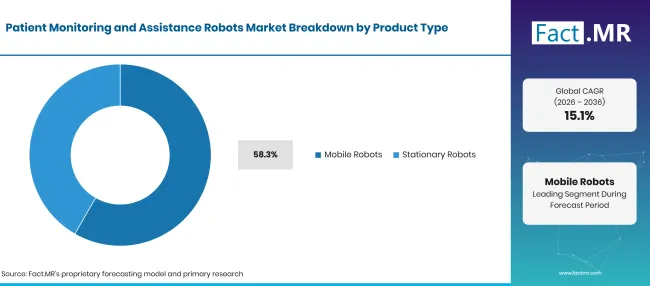
Factmr Patient Monitoring And Assistance Robots Market Breakdown Product Type | Source: Fact.MR
| Product Type | Share (2026) |
|---|---|
| Mobile Robots (Leading segment) | 58.3% |
| Other segments combined | 41.7%* |
| Total | 100.0% |
Source: Fact.MR analysis. Updated Oct 21, 2026
Mobile robots can move between rooms or designated care areas and may support delivery, patient assistance and routine operational tasks. Stationary systems are more suited to fixed locations where monitoring or assistance is performed from a designated position. Actual demand depends on the robot’s function, facility layout, safety requirements and integration with staff workflows.
Which Application leads?
Rehabilitation Centers is set to represent 56.7% of the market in 2026.
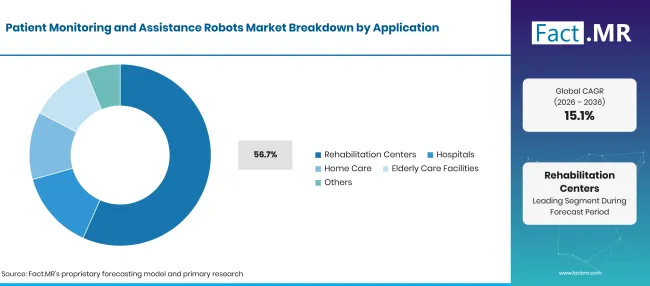
Factmr Patient Monitoring And Assistance Robots Market Breakdown Application | Source: Fact.MR
| Application | Share (2026) |
|---|---|
| Rehabilitation Centers (Leading segment) | 56.7% |
| Other segments combined | 43.3%* |
| Total | 100.0% |
Source: Fact.MR analysis. Updated Oct 21, 2026
Rehabilitation centers may use robotic systems to support repetitive movement exercises, guided physical therapy and progress assessment. Hospitals may use robotics for selected monitoring and assistance tasks, while home-care and elderly-care settings place greater emphasis on usability, safety and caregiver support. The suitability of a robot depends on its intended use and the needs of the patient.
What leads the Technology segment?
Sensors are projected to account for 48.9% of the market in 2026.
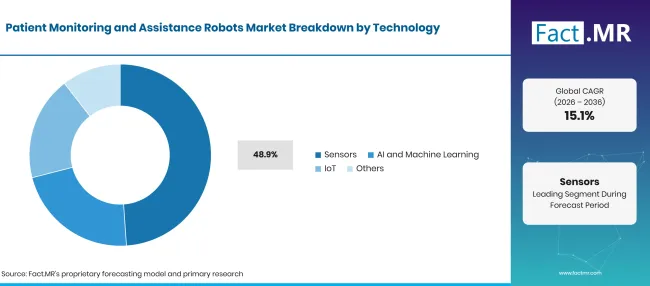
Factmr Patient Monitoring And Assistance Robots Market Breakdown Technology | Source: Fact.MR
| Technology | Share (2026) |
|---|---|
| Sensors (Leading segment) | 48.9% |
| Other segments combined | 51.1%* |
| Total | 100.0% |
Source: Fact.MR analysis. Updated Oct 21, 2026
Sensors allow systems to collect information such as position, movement and selected physiological measurements. AI and machine learning can help interpret collected data or support task planning, while Internet of Things (IoT) connectivity can transmit information between devices and monitoring platforms. Performance depends on sensor accuracy, data quality, connectivity and clinical validation.
Which End-User segment leads?
Healthcare Providers is set to represent 56.7% of the market in 2026.
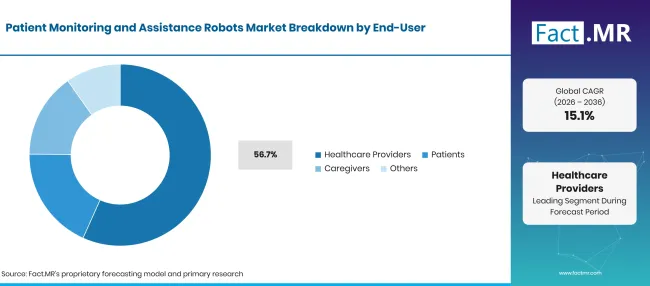
Factmr Patient Monitoring And Assistance Robots Market Breakdown End User | Source: Fact.MR
| End-User | Share (2026) |
|---|---|
| Healthcare Providers (Leading segment) | 56.7% |
| Other segments combined | 43.3%* |
| Total | 100.0% |
Source: Fact.MR analysis. Updated Oct 21, 2026
Healthcare providers may procure robotic systems for clinical monitoring, rehabilitation support and selected assistance tasks. Patients and caregivers may use suitable systems in home-based care, subject to intended use, training and supervision requirements. Procurement decisions typically depend on safety, clinical utility, cost, maintenance and compatibility with existing care processes.
What is accelerating Patient Monitoring and Assistance Robots Market adoption, and what is holding it back?
Advances in sensor technology, AI-supported monitoring and mobile robotic platforms are expanding the potential applications of robotics in healthcare. Adoption may be constrained by high acquisition costs, integration challenges, data-security requirements, staff training needs and uncertainty about clinical and economic benefits.
Growing demand for continuous patient monitoring and care support accelerates adoption, while high deployment costs and integration challenges slow market expansion.
Drivers Impact Analysis
| DRIVER | (~) % IMPACT ON CAGR | GEOGRAPHIC RELEVANCE | IMPACT TIMELINE |
|---|---|---|---|
| Rising demand for continuous patient monitoring | +1.0% | North America, Europe | Medium term (2–4 years) |
| Healthcare workforce shortages and caregiver burden | +0.9% | Global | Short term (≤ 2 years) |
| Growing elderly population and long-term care needs | +0.7% | Japan, Europe, Asia | Medium term (2–4 years) |
| Increasing adoption of hospital automation | +0.5% | North America, Asia | Short term (≤ 2 years) |
| Advances in AI-enabled sensors and autonomous navigation | +0.4% | Global | Long term (≥ 4 years) |
Source: Fact.MR analysis. Updated Oct 21, 2026
Opportunity Impact Analysis
| OPPORTUNITY | (~) % IMPACT ON CAGR | GEOGRAPHIC RELEVANCE | IMPACT TIMELINE |
|---|---|---|---|
| Integration with electronic health records and hospital systems | +0.8% | North America, Europe | Medium term (2–4 years) |
| Expansion into home healthcare and elderly assistance | +0.6% | Japan, North America, Europe | Medium term (2–4 years) |
| AI-powered fall detection and remote patient monitoring | +0.5% | Global | Long term (≥ 4 years) |
| Rehabilitation support and personalized patient assistance | +0.4% | Europe, Asia | Short term (≤ 2 years) |
Source: Fact.MR analysis. Updated Oct 21, 2026
Restraints Impact Analysis
| RESTRAINT | (~) % IMPACT ON CAGR | GEOGRAPHIC RELEVANCE | IMPACT TIMELINE |
|---|---|---|---|
| High initial investment and maintenance costs | -0.8% | Global | Short term (≤ 2 years) |
| Data privacy, cybersecurity and regulatory compliance concerns | -0.6% | North America, Europe | Medium term (2–4 years) |
| Integration challenges with existing healthcare infrastructure | -0.5% | Global | Short term (≤ 2 years) |
| Limited staff training and patient acceptance | -0.4% | Emerging markets, Global | Medium term (2–4 years) |
Source: Fact.MR analysis. Updated Oct 21, 2026
Which countries are scaling the Patient Monitoring and Assistance Robots Market through 2036?
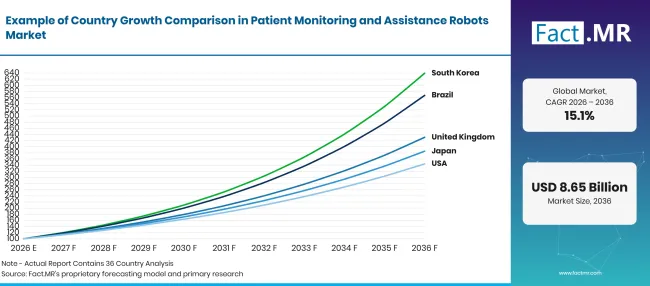
Factmr Patient Monitoring And Assistance Robots Market Growth Index | Source: Fact.MR
| Country | CAGR (2026–2036) |
|---|---|
| Germany | 11.0% |
| Brazil | 19.0% |
| USA | 13.2% |
| UK | 15.7% |
| Japan | 14.4% |
Source: Fact.MR analysis. Updated Oct 21, 2026
What supports Germany’s adoption?
11.0% CAGR, supported by healthcare digitalization and the development of connected care workflows.
Germany’s healthcare technology environment is being shaped by initiatives to integrate digital innovation into routine healthcare and nursing services. On February 11, 2026, the Federal Ministry of Health presented an updated digitalization strategy focused on bringing digital innovations into care delivery and making greater use of health data [5]. These priorities are relevant to connected monitoring and AI-supported healthcare systems, although the announcement does not establish a specific adoption rate for patient assistance robots.
What is driving Brazil’s adoption?
19.0% CAGR, led by public-sector investment in connected monitoring and intelligent hospital infrastructure.
Brazil’s healthcare sector is increasingly focused on improving patient care through digital transformation, hospital modernization and technology-enabled clinical services. Healthcare providers are exploring solutions that improve patient observation, support care coordination and reduce pressure on medical staff. These priorities create potential opportunities for patient monitoring and assistance robots across hospitals, rehabilitation centers and elderly-care facilities.
What supports adoption in the United States?
13.2% CAGR, backed by regulatory progress in healthcare robotics and connected medical technology.
The United States has an established medical-device regulatory framework and a developing ecosystem for healthcare automation. In September 2026, U.S.FDA reported that more than 1,600 AI-enabled medical devices had been authorized for marketing [6]. This broader regulatory indicator supports the context of AI adoption in healthcare, but it does not mean that all these devices are robots or that they belong to this market. Market growth will depend on the clinical performance, cost and intended applications of individual systems.
How is the United Kingdom developing adoption?
15.7% CAGR, shaped by digital rehabilitation and plans to expand robotic-assisted healthcare.
The United Kingdom is pursuing greater use of digital technologies and robotics across healthcare services. In a written parliamentary answer on March 5, 2026, the government stated that its 10-Year Health Plan commits to expanding robotic-assisted surgery over the following decade, with national registries planned from 2029 [7]. Although surgical robotics falls outside the core definition of patient monitoring and assistance robots, the policy illustrates public-sector attention to robotics in healthcare.
What supports Japan’s adoption?
14.4% CAGR, driven by government attention to care technology and the development of assistive systems for older people.
Japan’s ageing population and established care-technology ecosystem create a relevant setting for patient assistance, monitoring and rehabilitation solutions. The Ministry of Health, Labour and Welfare’s 2026 white paper includes evidence on the use of care robots and their effects on care quality and staff workload [8]. In addition, a clinical study registered in Japan in January 2026 is investigating the feasibility and acceptability of a large-language-model-enabled companion robot for older people living alone [9].
Who leads the Patient Monitoring and Assistance Robots Market?
Diligent Robotics and Relay Robotics develop mobile robotic platforms for healthcare environments, where ease of navigation, workflow fit, and dependable operation influence buyer decisions. Aeolus Robotics also works on service and assistance robots suited to care settings, while F&P Robotics focuses on collaborative and assistive robotic systems designed around close interaction with users.
SoftBank Robotics brings broader service-robot experience that can support selected healthcare and assistance applications. Competition in this market depends on the specific care task, sensor capability, software integration, safety, and compatibility with hospital or rehabilitation workflows rather than on a single robot design. Suppliers that provide reliable technical support and clear use-case positioning are better placed to serve healthcare providers.
Which companies are the key providers?
Key companies include Diligent Robotics, Inc.; Aeolus Robotics, Inc.; SoftBank Robotics; F&P Robotics AG; Relay Robotics, Inc..
- Diligent Robotics, Inc.
- Aeolus Robotics, Inc.
- SoftBank Robotics
- F&P Robotics AG
- Relay Robotics, Inc.
Bibliography
- [1] Ministério da Saúde. (2026, September 3). Ministério da Saúde apresenta Central de Comando das UTIs Inteligentes do SUS. https://www.gov.br/saude/pt-br/assuntos/noticias-ms/2026/setembro/ministerio-da-saude-apresenta-central-de-comando-das-utis-inteligentes-do-sus
- [2]U.S. Food and Drug Administration. (2026, August 19). FDA authorizes first-of-its-kind robotic blood draw device. https://www.fda.gov/news-events/press-announcements/fda-authorizes-first-its-kind-robotic-blood-draw-device
- [3] UK Parliament. (2026, June 22). Physiotherapy: Artificial Intelligence (UIN HL794). https://questions-statements.parliament.uk/written-questions/detail/2026-06-09/hl794
- [4] U.S. Food and Drug Administration. (n.d.). FDA READI-Home Innovation Challenge: Reducing readmissions through device innovation for the home. Retrieved October 19, 2026, from https://www.fda.gov/medical-devices/home-health-care-hub/fda-readi-home-innovation-challenge-reducing-readmissions-through-device-innovation-home
- [5] Bundesministerium für Gesundheit. (2026, February 11). Digitale Innovationen noch stärker in den Versorgungsalltag integrieren [Integrating digital innovations more strongly into everyday healthcare]. https://www.bundesgesundheitsministerium.de/presse/pressemitteilungen/weiterentwicklung-digitalisierungsstrategie-pm-11-02-26
- [6] U.S. Food and Drug Administration. (n.d.). Artificial intelligence-enabled medical devices. Retrieved October 19, 2026, from https://www.fda.gov/medical-devices/digital-health-center-excellence/artificial-intelligence-enabled-medical-devices
- [7] UK Parliament. (2026, March 5). Surgery: Robotics (UIN HL14869). https://questions-statements.parliament.uk/written-questions/detail/2026-02-25/hl14869
- [8] Ministry of Health, Labour and Welfare. (2026).[2026 White Paper on Health, Labour and Welfare: Figures and underlying data]. https://www.mhlw.go.jp/stf/wp/hakusyo/kousei/26/backdata/index.html
- [9] Ministry of Health, Labour and Welfare. (2026, July 23). A feasibility and acceptability study of a large language model enabled companion robot for older people living alone (UMIN000060410). Clinical Research Information Portal. https://rctportal.mhlw.go.jp/s/detail/um?trial_id=UMIN000060410
This Report Answers
- The report examines the Patient Monitoring and Assistance Robots Market across product type, application, technology and end-user categories.
- Segment analysis compares mobile and stationary robots, rehabilitation and care applications, and the technologies used to support monitoring and assistance.
- Country analysis discusses Germany, Brazil, the United States, the United Kingdom and Japan using official healthcare technology and policy indicators.
- The competitive overview assesses the medical technology companies, subject to confirmation of their relevance to the defined market.
- Drivers, opportunities and restraints are assessed for their potential influence on market development through 2036.
What does the Patient Monitoring and Assistance Robots Market cover?
The Patient Monitoring and Assistance Robots Market covers robotic systems designed to support patient observation, selected care activities, rehabilitation and assistance in healthcare or care-delivery environments. The market may include mobile platforms, stationary robotic systems and technologies that use sensors, AI and connectivity to support their intended functions.
Demand depends on the clinical task, patient requirements, facility infrastructure, safety standards, ease of use and integration with existing healthcare systems. The scope should distinguish patient assistance and rehabilitation robotics from conventional patient monitors, general-purpose hospital automation and surgical robots unless those products are explicitly included in the market definition.
What is included in the scope?
The market includes mobile and stationary robots used for the defined patient monitoring and assistance applications. Relevant technologies include sensors, AI and machine learning, IoT connectivity and other enabling technologies incorporated into eligible robotic systems.
Applications include rehabilitation centers, hospitals, home care and elderly care facilities. End-users include healthcare providers, patients and caregivers, depending on the system’s intended use and operating requirements.
What is excluded from the scope?
The analysis excludes conventional patient monitoring equipment sold independently of a qualifying robotic system unless explicitly included in the market definition. General industrial robots, warehouse automation and non-healthcare service robots are outside the scope.
Surgical robots should also be excluded unless the approved definition explicitly includes them. General hospital services, clinical staffing costs and unrelated medical equipment are not part of the market valuation. Software subscriptions and service revenue should be included only where the market-sizing methodology specifically accounts for them.
How Was the Analysis Built?
The analysis draws on market estimates, company information, public statistical publications, regulatory information, and industry evidence to assess market developments and forecasts.
- Primary Research: Primary research includes discussions with manufacturers, service providers, technology developers, distributors, end users, and subject-matter experts. These conversations examine purchasing priorities, product adoption, operational challenges, approval requirements, competitive positioning, and the factors that influence wider market acceptance.
- Desk Research: Desk research covers government statistics, regulatory publications, company filings, trade data, technical studies, industry associations, standards, public policy, and other authoritative sources. Every source used in the analysis is documented in the bibliography.
- Market Sizing and Forecasting: Market estimates combine historical performance, demand indicators, pricing and volume trends, segment shares, company participation, country-level growth, adoption patterns, investment activity, and barriers to market expansion.
- Data Validation and Update Cycle: Findings are validated by comparing primary interviews with public data, company activity, regulatory changes, trade patterns, and industry developments. Regular updates review new product launches, capacity changes, partnerships, approvals, and shifts in commercial adoption.
Segmentation
What is the report’s scope and coverage?
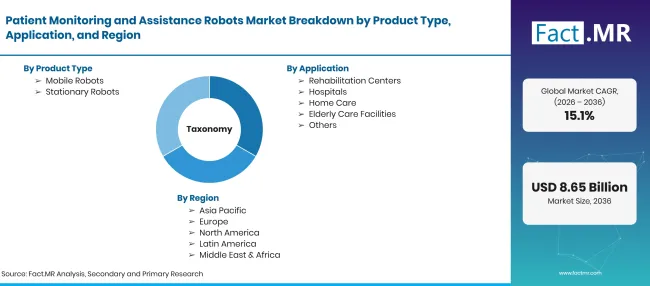
Factmr Patient Monitoring And Assistance Robots Market Taxonomy | Source: Fact.MR
| Attribute | Details |
|---|---|
| Quantitative Units | USD billion: 2026 valuation, 2036 forecast and CAGR |
| Market Definition | Patient monitoring and assistance robots used to support patient observation, mobility, rehabilitation and selected healthcare or care-delivery tasks |
| Product Type | Mobile Robots; Stationary Robots |
| Application | Rehabilitation Centers; Hospitals; Home Care; Elderly Care Facilities; Others |
| Technology | Sensors; AI and Machine Learning; IoT; Others |
| End-User | Healthcare Providers; Patients; Caregivers; Others |
| Regions Covered | North America; Latin America; Western Europe; Eastern Europe; East Asia; South Asia & Pacific; Middle East & Africa |
| Countries Covered | Germany; Brazil; United States; United Kingdom; Japan |
| Companies Profiled | Diligent Robotics, Inc.; SoftBank Robotics; Aeolus Robotics, Inc.; F&P Robotics AG; Relay Robotics, Inc. |
| Forecast Period | 2026 to 2036 |
| Approach | Market segmentation and scenario-based analysis supported by official healthcare technology, regulatory and country-level indicators |
Source: Fact.MR analysis. Updated Oct 21, 2026
How is the market segmented?
-
By Product Type
- Mobile Robots
- Stationary Robots
-
By Application
- Rehabilitation Centers
- Hospitals
- Home Care
- Elderly Care Facilities
- Others
-
By Technology
- Sensors
- AI and Machine Learning
- Internet of Things (IoT)
- Others
-
By End-User
- Healthcare Providers
- Patients
- Caregivers
- Others
-
By Region
- North America
- Latin America
- Western Europe
- Eastern Europe
- East Asia
- South Asia & Pacific
- Middle East & Africa
Frequently Asked Questions
How big is the Patient Monitoring and Assistance Robots Market in 2026?
What is the CAGR of the Patient Monitoring and Assistance Robots Market from 2026 to 2036?
Which product type leads the Patient Monitoring and Assistance Robots Market?
Which application segment leads the Patient Monitoring and Assistance Robots Market?
Which technology segment leads the Patient Monitoring and Assistance Robots Market?
Which end-user segment leads the Patient Monitoring and Assistance Robots Market?
Which country will grow the most in the Patient Monitoring and Assistance Robots Market?
Who are the main companies in the Patient Monitoring and Assistance Robots Market?
Who worked on this report


Preview the report firsthand - request a free sample
Free SampleGet the brochure for pricing and purchase details
Download PDF