- Base Value(2025): 62.6 Mn
- Estimated Value(2026): 69.2 Mn
- Forecast Value (2036): 169.9 Mn
- CAGR (2026 - 2036): 9.4%
Patient Monitoring System Market Forecast and Outlook 2026 to 2036
In 2025, the patient monitoring system market was valued at USD 62.6 million. Based on Fact.MR analysis, demand for patient monitoring systems is estimated to reach USD 69.2 million in 2026 and USD 169.9 million by 2036, registering a CAGR of 9.4% over the forecast period. Market expansion reflects increasing hospital admissions for chronic and acute conditions, wider deployment of multi-parameter monitoring in critical care, and rising acceptance of home-based monitoring solutions.
The market adds approximately USD 107.3 million in incremental value over the forecast window, indicating sustained compounding rather than episodic procurement-led growth. Early-period expansion is supported by replacement and upgrading of bedside monitors in ICUs and emergency departments, particularly across emerging healthcare systems. Mid-period growth aligns with broader adoption of wireless and remote monitoring devices for post-acute and chronic disease management. In the later years, value realization is increasingly shaped by elderly care monitoring and long-term disease surveillance, where continuous data capture and interoperability become central purchasing criteria.
China leads growth at 14.2% CAGR, supported by rapid hospital infrastructure expansion and digital health investments. India follows at 13.1%, driven by rising critical care capacity and private hospital expansion. Germany records 12.1%, reflecting strong adoption of advanced monitoring technologies in acute care. Brazil grows at 11.0%, while the United States at 10.0% remains driven by ICU demand and home monitoring penetration. The United Kingdom at 8.9% and Japan at 7.9% represent mature markets where growth is moderated by established installed bases and longer replacement cycles.
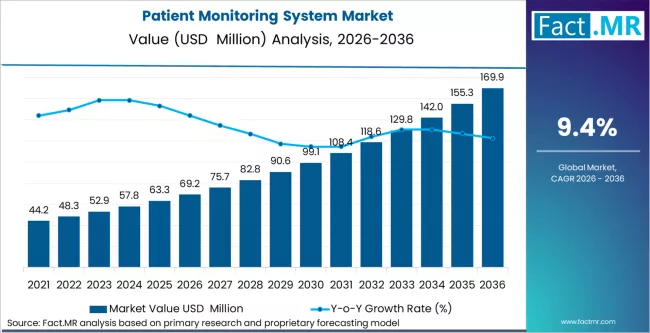
Patient Monitoring System Market Market Value Analysis | Source: Fact.MR
Patient Monitoring System Market Definition
The patient monitoring system market covers medical devices and software systems used to continuously or periodically track patient physiological parameters. These systems measure indicators such as heart rate, blood pressure, oxygen saturation, respiratory rate, and body temperature to support clinical decision making. Patient monitoring systems are used in hospitals, intensive care units, operating rooms, and home care settings. Device classification, safety, and clinical use are regulated under medical device frameworks issued by the US Food and Drug Administration and international health system guidance published by the World Health Organization.
Patient Monitoring System Market Inclusions
The report covers global and regional market size estimates in volume and value terms with a forecast period from 2026 to 2036. Segmentation includes device type such as bedside monitors, wearable monitors, and remote monitoring systems, parameter type including cardiac and respiratory monitoring, and end use across hospitals, ambulatory care centers, and home healthcare providers. The scope also includes regional demand patterns, pricing benchmarks, and international trade flows for regulated monitoring devices.
Patient Monitoring System Market Exclusions
The scope excludes standalone diagnostic imaging equipment such as ultrasound, MRI, and CT scanners. Laboratory analyzers and point of care testing devices are not included. Consumer fitness trackers and wellness devices without medical regulatory clearance are excluded. Clinical decision support software sold independently of monitoring hardware, hospital information systems, installation services, training programs, and healthcare delivery services are also outside the scope.
Patient Monitoring System Market Research Methodology
- Primary Research: Primary research involved interviews with patient monitoring device manufacturers, biomedical engineers, hospital procurement managers, and clinical care providers.
- Desk Research: Desk research used medical device classification databases, safety communications, and clearance records issued by the US Food and Drug Administration and technical guidance published by the World Health Organization, along with national healthcare utilization statistics and company regulatory filings.
- Market Sizing and Forecasting: Market sizing applied a hybrid top down and bottom up model using hospital bed counts, patient admission volumes, device utilization rates, and replacement cycles across care settings.
- Data Validation and Update Cycle: Outputs were cross checked against regulatory approval databases, hospital purchasing disclosures, trade statistics, and public healthcare expenditure records, with updates applied when verified public sources issue revisions.
Summary of patient monitoring system market
- Market Definition
- The patient monitoring system market includes medical devices and integrated software platforms used to measure and record physiological parameters such as heart rate, blood pressure, oxygen saturation, respiratory rate, and temperature across hospital and home care settings.
- Demand Drivers
- Rising chronic disease prevalence, ageing demographics, and expansion of critical care infrastructure increase demand for continuous cardiac and multi-parameter monitoring.
- Medical device classification, premarket clearance, and post-market surveillance requirements [1]directly influence product design, clinical validation, and commercialization timelines.
- Global health system guidance on essential medical devices and monitoring practices published [2] supports adoption in emerging healthcare systems expanding ICU and emergency care capacity.
- Key Segments Analyzed
- Cardiac monitoring systems account for about 40% share, reflecting high cardiovascular disease burden and continuous rhythm surveillance needs in acute and ambulatory settings.
- Hospitals represent roughly 65% of total demand due to ICU, operating room, emergency department, and general ward monitoring requirements.
- China and India show the fastest growth driven by infrastructure expansion, while the United States and Europe remain replacement and upgrade-led with increasing home monitoring penetration.
- Analyst Opinion at Fact.MR
- Shambhu Nath Jha, Principal Consultant at Fact.MR, opines, ‘CXOs will find this report useful for assessing how regulatory device frameworks, ICU capacity expansion, and remote patient monitoring adoption are shaping capital allocation and platform integration strategies in the patient monitoring system market.’
- Strategic Implications / Executive Takeaways
- Manufacturers should prioritize interoperable multi-parameter systems aligned with hospital IT integration standards.
- Expansion into home-based and wireless monitoring segments supports long-term value growth.
- Regulatory compliance and clinical validation remain decisive for multi-region market access.
- Methodology
- Market sizing is derived from hospital bed counts, admission volumes, monitoring utilization rates, and replacement cycles.
- Validation uses regulatory approval databases, healthcare expenditure data, and trade statistics.
- Forecasts apply reproducible top-down and bottom-up healthcare demand models grounded in verified public data.
Segmental Analysis
Patient Monitoring System Market Analysis by Type of System
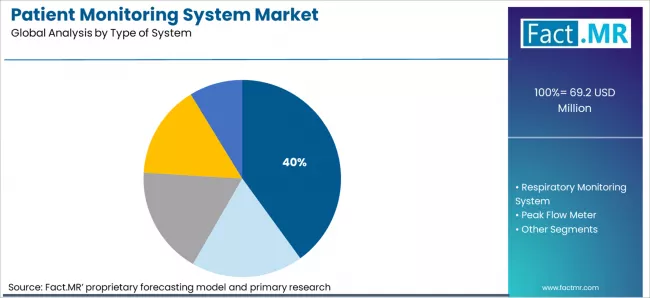
Patient Monitoring System Market Analysis By Type of system | Source: Fact.MR
Based on Fact.MR analysis, consumption of cardiac monitoring systems is estimated to hold 40% share of the global patient monitoring system market. Fact.MR analysts note that cardiac monitoring leads due to high prevalence of cardiovascular conditions requiring continuous rhythm and rate surveillance. As per Fact.MR, this system type addresses clinical needs for early detection of arrhythmias, ischemic events, and hemodynamic instability across acute and chronic care settings, supporting informed intervention decisions in hospitals and ambulatory environments worldwide today with increasing monitoring intensity.
- Device regulation: Cardiac monitoring devices are regulated as medical devices under national premarket and postmarket oversight frameworks. [3]
- Clinical priority: Fact.MR analysts note cardiac parameters are among the most frequently monitored vital signs.
- Technology breadth: Cardiac monitoring includes ECG, Holter, event, and implantable systems.
Patient Monitoring System Market Analysis by End Use
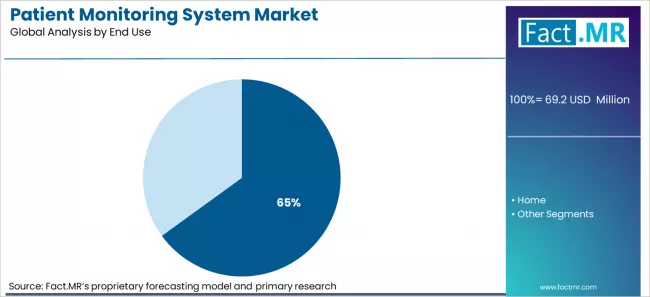
Patient Monitoring System Market Analysis By End Use | Source: Fact.MR
Based on Fact.MR analysis, consumption of patient monitoring systems in hospitals is estimated to hold 65% share of the global market. Fact.MR opines that hospitals lead due to high patient throughput, critical care requirements, and availability of trained clinical staff. As per Fact.MR, hospital settings address continuous monitoring needs across intensive care units, operating rooms, emergency departments, and general wards, supporting real-time clinical decision-making and patient safety across diverse care pathways worldwide today.
- Care delivery framework: Hospital monitoring practices are guided by national healthcare quality and safety programs.
Infrastructure scale: Fact.MR analysts note hospitals maintain the largest installed base of monitoring equipment. - Acuity mix: Hospitals manage both high-acuity and routine monitoring requirements.
Patient Monitoring System Market Drivers, Restraints, And Opportunities
Fact.MR analysis indicates that the patient monitoring system market exists as a critical healthcare technology segment encompassing devices and platforms used to continuously measure vital physiological parameters such as heart rate, blood pressure, oxygen saturation, and respiratory rate across hospital, emergency, and ambulatory care settings. As per Fact.MR assessment, hospital infrastructure and clinical care standards in many regions reference regulatory and safety frameworks such as the U.S. Food and Drug Administration (FDA) medical device requirements, which define classification, performance expectations, and post-market surveillance protocols for monitoring devices that support diagnostic and therapeutic decisions. Fact.MR analysts observe that the current market size is tied to ongoing investments in critical care infrastructure, rising incidence of chronic diseases, and hospitalisation trends that prioritise enhanced clinical decision support through integrated monitoring systems.
Fact.MR is of the opinion that current market dynamics reflect a transition toward connected and wearable monitoring technologies that extend predictive analytics and remote care capabilities beyond traditional bedside units. Based on Fact.MR assessment, conventional bedside patient monitoring systems remain dominant in acute care units due to established clinical workflows and regulatory clearance, but demand is growing for portable and wireless multi-parameter monitors that support telemedicine and out-of-hospital care pathways. Advanced monitoring systems that integrate with hospital information systems, electronic health records, and cloud-based analytics generally carry higher per-unit pricing because of software, connectivity, and compliance requirements, meaning realised value can grow even where shipment volumes advance at a moderate pace. Fact.MR analysis suggests this blend of technology transition and premium placement will shape near-term market evolution.
- Regulatory medical device frameworks: Fact.MR analysts note that regulatory requirements such as those governed by the U.S. Food and Drug Administration (FDA) influence design, performance evaluation, and market entry criteria for patient monitoring systems intended for clinical use [4].
- Shift to connected and remote monitoring: Based on Fact.MR assessment, increasing adoption of wireless, wearable, and network-integrated monitoring devices supports demand in ambulatory care and telehealth environments where continuous data capture enhances care delivery.
- Asia Pacific healthcare infrastructure growth: Fact.MR opines that expanding healthcare facility investments, critical care unit expansion, and telemedicine adoption in China, India, and Southeast Asia support regional uptake of patient monitoring systems across hospital and home care settings.
Regional Analysis
The market analysis covers key global regions, including East Asia, South Asia, Western Europe, North America, and Latin America. It is segmented geographically, with specific market dynamics for each region. The full report provides a detailed market attractiveness analysis.
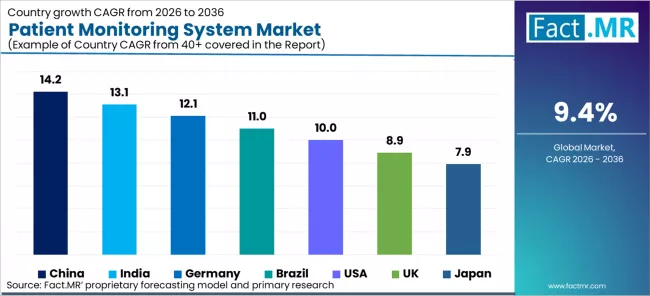
Patient Monitoring System Market Cagr Analysis By Country | Source: Fact.MR
| Country | CAGR (%) |
|---|---|
| China | 14.2% |
| India | 13.1% |
| Germany | 12.1% |
| Brazil | 11.0% |
| USA | 10.0% |
| United Kingdom | 8.9% |
| Japan | 7.9% |
Source: Fact.MR analysis. Updated Feb 25, 2026
Source: Fact MR (FMR) analysis, based on proprietary forecasting model and primary research.
East Asia:
In East Asia, China and Japan are significant players in the patient monitoring system market, driven by the growing demand for advanced healthcare technologies and increasing healthcare investments.
- China: Demand for patient monitoring systems in China is projected to rise at 14.2% CAGR through 2036. China’s large population, expanding healthcare infrastructure, and rising demand for advanced patient care solutions continue to drive the market.
- Japan: Demand for patient monitoring systems in Japan is projected to rise at 7.9% CAGR through 2036. Japan’s aging population and strong healthcare infrastructure contribute to steady growth in the market for patient monitoring technologies.
South Asia:
In South Asia, India leads the market for patient monitoring systems, driven by a growing healthcare sector, increasing demand for quality care, and rising healthcare expenditure.
- India: Demand for patient monitoring systems in India is projected to rise at 13.1% CAGR through 2036. India’s expanding healthcare infrastructure and increasing adoption of advanced medical technologies continue to fuel demand for patient monitoring systems.
Western Europe:
In Western Europe, Germany is the dominant market for patient monitoring systems, driven by advanced healthcare facilities, increasing chronic disease cases, and a high demand for remote patient monitoring solutions.
- Germany: Demand for patient monitoring systems in Germany is projected to rise at 12.1% CAGR through 2036. Germany’s robust healthcare system and increased focus on elderly care and chronic disease management continue to drive demand for advanced monitoring solutions.
- United Kingdom: Demand for patient monitoring systems in the UK is projected to rise at 8.9% CAGR through 2036. The UK’s aging population and growing demand for home care solutions continue to contribute to market growth.
Latin America:
In Latin America, Brazil is a key market for patient monitoring systems, supported by rising healthcare awareness, increasing investment in healthcare infrastructure, and growing demand for advanced patient care technologies.
- Brazil: Demand for patient monitoring systems in Brazil is projected to rise at 11.0% CAGR through 2036. Brazil’s expanding healthcare sector and growing demand for medical technologies continue to boost the adoption of patient monitoring systems.
North America:
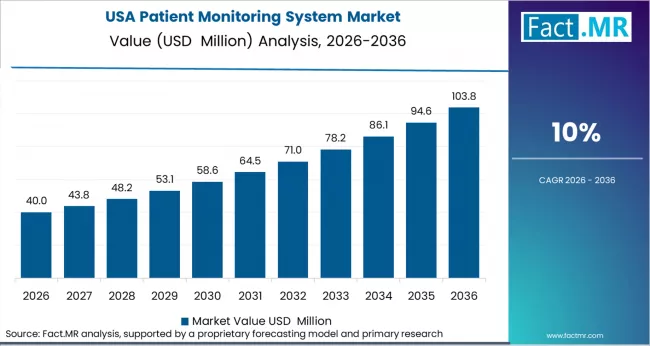
Patient Monitoring System Market Country Value Analysis | Source: Fact.MR
In North America, the USA remains a major market for patient monitoring systems, driven by technological advancements in healthcare, rising chronic diseases, and the demand for remote patient monitoring.
- USA: Demand for patient monitoring systems in the U.S. is projected to rise at 10.0% CAGR through 2036. The USA’s advanced healthcare system and growing adoption of home healthcare solutions continue to drive demand for patient monitoring systems.
Fact MR's analysis of the Patient Monitoring System Market in East Asia, South Asia, Western Europe, North America, and Latin America consists of country-wise assessments that include China, India, Germany, Brazil, the USA, the United Kingdom, and Japan. Readers can find detailed trends, regulatory updates, and company-specific investments shaping the market’s growth in these countries.
Competitive Landscape of Patient Monitoring System Market
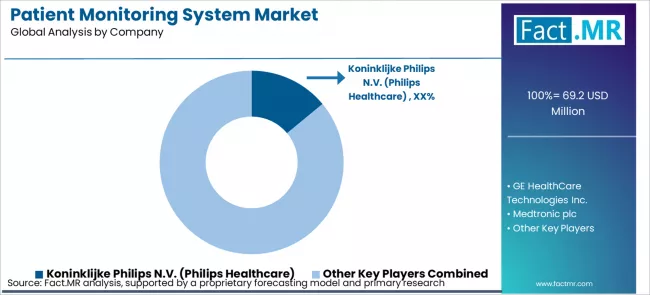
Patient Monitoring System Market Analysis By Company | Source: Fact.MR
As per Fact.MR analysis, the 2026 patient monitoring system market is defined by validated device accuracy, interoperability, and regulatory compliance, which determine competitive advantage. Koninklijke Philips N.V. (Philips Healthcare) and GE HealthCare Technologies lead with integrated monitoring platforms that combine multi-parameter sensing and hospital IT system connectivity, which strengthens adoption across high-acuity and multi-department hospitals. Medtronic plc and Abbott Laboratories focus on continuous cardiac and hemodynamic monitoring with verified accuracy, which improves clinician trust and reduces adverse events. Nihon Kohden Corporation and Mindray Medical International provide validated, multi-parameter monitors with documented performance in ICU and emergency care, which enhances adoption in Asia-Pacific and emerging markets. Masimo Corporation and Drägerwerk AG deliver advanced non-invasive and ventilator-integrated solutions, which increase clinical workflow efficiency. Baxter International (Hillrom), Boston Scientific Corporation, and Siemens Healthineers AG emphasize integration with hospital networks and data analytics, which improves operational decision-making. Fukuda Denshi, Spacelabs Healthcare, Schiller AG, Shenzhen Comen, EDAN Instruments, and Welch Allyn provide regionally compliant, validated devices, which support adoption in diverse hospital systems. BioTelemetry (Philips) delivers remote patient monitoring solutions with verified accuracy, which expands home and telehealth applications. Across the market, validated performance, multi-system interoperability, and regulatory compliance form enduring competitive moats, reducing reliance on price or isolated feature claims.
Recent Industry Developments
- Philips (Jan 2026): Unveiled at Arab Health 2025/2026, Philips launched the Visual Patient Avatar, an AI-driven monitoring tool that translates complex vital data into simple visual animations, significantly reducing interpretation time for intensive care clinicians. [5]
- Medtronic (Feb 2026): Reported record Q3 FY26 growth driven by its PulseSelect PFA system and the expanded integration of its Nellcor pulse oximetry and BIS brain monitoring into third-party hospital platforms via a renewed multi-year strategic ecosystem strategy. [6]
Key Players in Patient Monitoring System Market
- Koninklijke Philips N.V. (Philips Healthcare)
- GE HealthCare Technologies Inc.
- Medtronic plc
- Abbott Laboratories
- Nihon Kohden Corporation
- Mindray Medical International Limited
- Masimo Corporation
- Drägerwerk AG & Co. KGaA
- Baxter International Inc. (Hillrom)
- Boston Scientific Corporation
- Siemens Healthineers AG
- Fukuda Denshi Co., Ltd.
- Spacelabs Healthcare (OSI Systems, Inc.)
- Schiller AG
- Shenzhen Comen Medical Instruments Co., Ltd.
- EDAN Instruments, Inc.
- Welch Allyn (Hillrom)
- BioTelemetry, Inc. (Philips)
References
- [1] U.S. Food and Drug Administration. (2024). Medical devices: Overview, classification, and regulatory requirements. U.S. Department of Health and Human Services.
- [2] World Health Organization. (2024). Medical devices: Global guidance, essential device lists, and health system integration. World Health Organization.
- [3] U.S. Food and Drug Administration. (2024). Cardiovascular devices: Cardiac monitors and patient monitoring systems. U.S. Department of Health and Human Services.
- [4] U.S. Food and Drug Administration. (2024). Overview of medical devices and post-market surveillance requirements. U.S. Department of Health and Human Services.
- [5] Koninklijke Philips N.V. (2026). Philips unveils AI-driven patient monitoring innovations at Arab Health 2025 [Press release]. Philips.
- [6] Medtronic plc. (2026). Medtronic reports third-quarter fiscal 2026 results highlighting growth in patient monitoring and connected care platforms [Earnings release]. Medtronic plc.
This Report Addresses
- Market intelligence to support structured strategic decision making across global patient monitoring device manufacturing and healthcare delivery ecosystems
- Market size estimation and ten-year revenue forecasts from 2026 to 2036, supported by validated hospital infrastructure data, patient admission trends, device utilization rates, and replacement cycle benchmarking
- Growth opportunity assessment across cardiac, respiratory, anesthesia, hematological, and multi-parameter monitoring systems with emphasis on acute care intensity and long-term surveillance needs
- Segment and regional revenue forecasts covering system type and end use across hospitals, intensive care units, operating rooms, emergency departments, and home-based care settings
- Competitive strategy assessment including device accuracy, interoperability capability, regulatory clearance positioning, and supplier alignment with hospital procurement frameworks
- Technology and deployment tracking covering wireless monitoring, wearable systems, remote patient monitoring adoption, and integration with hospital information systems and electronic health records
- Regulatory impact analysis covering medical device classification, premarket clearance requirements, post-market surveillance obligations, and global health system guidance influencing adoption
- Market report delivery in PDF, Excel, PowerPoint, and interactive dashboard formats for executive, clinical, and operational decision support
Segmentation
Scope of the Report
| Metric | Value |
|---|---|
| Quantitative Units | USD 69.2 million (2026) to USD 169.9 million (2036), CAGR 9.4% |
| Market Definition | The patient monitoring system market covers medical devices and software systems used to continuously or periodically track patient physiological parameters such as heart rate, blood pressure, oxygen saturation, respiratory rate, and body temperature. Devices are deployed in hospitals, ICUs, operating rooms, emergency departments, and home care settings. Regulatory oversight is provided by authorities like the US FDA and WHO. |
| System Type Segmentation | Cardiac Monitoring Systems (ECG Monitors, Holter Monitors, Event Monitors, Implantable Cardiac Monitors), Respiratory Monitoring Systems (Spirometers, Capnographs, Pulse Oximeters, Peak Flow Meters), Anesthesia Monitoring, Hematological Monitoring Systems, Others (Neurological, Fetal, Multi-parameter Monitors) |
| End Use Segmentation | Hospitals (ICU, Operating Rooms, Emergency Departments, General Wards), Home (Chronic Disease Management, Post-Acute Care, Elderly Monitoring) |
| Regions Covered | Asia Pacific, Europe, North America, Latin America, Middle East & Africa |
| Countries Covered | India, China, Japan, South Korea, Indonesia, Australia & New Zealand, ASEAN, Rest of Asia Pacific, Germany, Italy, France, United Kingdom, Spain, Benelux, Nordics, Central & Eastern Europe, Rest of Europe, United States, Canada, Mexico, Brazil, Argentina, Chile, Rest of Latin America, Kingdom of Saudi Arabia, United Arab Emirates, South Africa, Turkey, Rest of Middle East & Africa |
| Key Companies Profiled | Koninklijke Philips N.V. (Philips Healthcare), GE HealthCare Technologies Inc., Medtronic plc, Abbott Laboratories, Nihon Kohden Corporation, Mindray Medical International Limited, Masimo Corporation, Drägerwerk AG & Co. KGaA, Baxter International Inc. (Hillrom), Boston Scientific Corporation, Siemens Healthineers AG, Fukuda Denshi Co., Ltd., Spacelabs Healthcare (OSI Systems, Inc.), Schiller AG, Shenzhen Comen Medical Instruments Co., Ltd., EDAN Instruments, Inc., Welch Allyn (Hillrom), BioTelemetry, Inc. (Philips) |
| Forecast Period | 2026 to 2036 |
| Approach | Hybrid top-down and bottom-up modeling validated with primary interviews of device manufacturers, hospital procurement managers, and clinical staff; cross-checked with regulatory approvals, hospital deployment data, and device utilization trends. |
Source: Fact.MR analysis. Updated Feb 25, 2026
Patient Monitoring System Market Analysis by Segments
-
Type of System :
- Cardiac Monitoring System
- ECG Monitors
- Holter Monitors
- Event Monitors
- Implantable Cardiac Monitors
- Respiratory Monitoring System
- Spirometers
- Capnographs
- Pulse Oximeters
- Peak Flow Meter
- Anesthesia Monitoring
- Hematological Monitoring Systems
- Others (Neurological, Fetal, Multi-parameter)
- Cardiac Monitoring System
-
End Use :
- Hospital
- Intensive Care Units (ICU)
- Operating Rooms
- Emergency Departments
- General Wards
- Home
- Chronic Disease Management
- Post-Acute Care
- Elderly Monitoring
- Hospital
-
Region :
- Asia Pacific
- India
- China
- Japan
- South Korea
- Indonesia
- Australia & New Zealand
- ASEAN
- Rest of Asia Pacific
- Europe
- Germany
- Italy
- France
- United Kingdom
- Spain
- Benelux
- Nordics
- Central & Eastern Europe
- Rest of Europe
- North America
- United States
- Canada
- Mexico
- Latin America
- Brazil
- Argentina
- Chile
- Rest of Latin America
- Middle East & Africa
- Kingdom of Saudi Arabia
- United Arab Emirates
- South Africa
- Turkey
- Rest of Middle East & Africa
- Asia Pacific
Frequently Asked Questions
What is the estimated size of the patient monitoring system market in 2026?
How large is the patient monitoring system market expected to be by 2036?
What is the projected CAGR of the patient monitoring system market from 2026 to 2036?
How much incremental value will the market add over the forecast window?
What are the primary factors driving growth in the patient monitoring system market?
Why is continuous monitoring becoming more important in healthcare settings?
Which system type accounts for the largest share of the market?
What factors support the dominance of cardiac monitoring systems?
Which end-use segment dominates the patient monitoring system market?
Why do hospitals account for the largest share of patient monitoring demand?
How is home-based patient monitoring influencing market growth?
What role does ageing population play in market expansion?
Which region is expected to grow the fastest in the patient monitoring system market?
Which country shows the highest projected growth rate?
What factors are driving rapid growth in China and India?
How does the growth profile differ in mature markets like the US, UK, and Japan?
What technological trends are shaping the patient monitoring system market?
Why is interoperability becoming a key purchasing criterion?
How do regulatory frameworks influence patient monitoring system adoption?
What are the key strategic priorities for manufacturers in this market?
Who worked on this report


Preview the report firsthand - request a free sample
Free SampleGet the brochure for pricing and purchase details
Download PDF