- Market Value (2025): USD 665.0 Mn
- Estimated Value (2026): USD 780.0 Mn
- Forecast Value (2036): USD 3850.0 Mn
- CAGR (2026-2036): 17.3%
What is the Remote Patient Monitoring for Obesity Market forecast to be worth by 2036?
USD 780.0 million in 2026 to USD 3,850.0 million by 2036 at 17.3% CAGR.
- The remote patient monitoring for obesity market reached USD 665.0 million in 2025.
- Demand is projected to increase from USD 780.0 million in 2026 to USD 3,850.0 million by 2036.
- The market is forecast to record 17.3% CAGR from 2026 to 2036 as obesity care moves toward regular review between office visits.
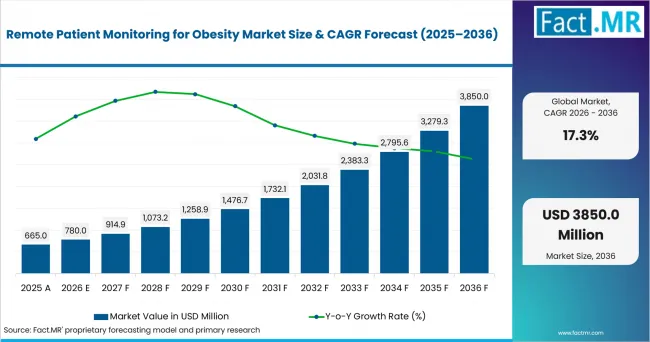
Remote Patient Monitoring For Obesity Market Value Analysis | Source: Fact.MR
What are the defining numbers behind Remote Patient Monitoring for Obesity Market growth?
USD 3,070.0 million absolute opportunity is expected between 2026 and 2036.
- Demand Drivers in the Market
- Connected scales and home medical devices give clinicians a clearer view between visits. Their value improves when readings move into a care plan with clear response steps.
- Reimbursement routes make remote monitoring easier to run inside provider groups. Providers are expected to invest when setup and review time are easy to document.
- Virtual obesity programs need home data that staff can trust. Platforms are expected to stand out when they reduce manual entry and keep staff responsibility clear.
- Key Segments Analyzed
- By Device Type: Connected scales are expected to hold 35.8% share in 2026. Weight is the first measurable signal in most obesity programs. The segment gains value when scale readings guide care staff action.
- By Monitoring Focus: Weight trajectory is projected to hold 47.4% share in 2026. A regular weight curve gives staff a clear way to judge whether treatment response is moving in the right direction. Body composition adds a second view when programs assess fat and lean mass.
- By Reimbursement Pathway: CPT RPM codes are anticipated to hold 50.1% share in 2026. Defined billing codes give providers a route for setup and review. Documentation therefore becomes a planned part of the service design.
- By Care Setting: Endocrinology/obesity medicine is estimated to hold 30.3% share in 2026. Specialist clinicians manage medication changes and metabolic risk during obesity care. Monitored weight change therefore becomes useful between scheduled visits.
- By End User: Health systems are forecast to hold 46.7% share in 2026. Health systems can place weight monitoring inside medication and nutrition programs. Regular review gives follow-up teams a clearer record for care documentation.
- Analyst Opinion at Fact.MR
- Shambhu Nath Jha, Senior Analyst at Fact.MR, states, “Remote patient monitoring for obesity must prove that connected measurements lead to clinical decisions. Customers are expected to value platforms that make device setup and response responsibility clear.”
- Strategic Implications
- Obesity-monitoring programs require clear response rules before device use expands. Weight or body-composition changes must trigger defined review steps rather than remain as passive measurements.
- Simple setup will matter more than a wide device portfolio. Platform vendors gain more value by connecting patient monitoring tools with care-team routines and EHR workflows.
- GLP-1 aftercare needs a clear boundary between medication access and long-term metabolic support. Sponsors must account for data review, refill coordination and follow-up after the initial prescription.
The USA is expected to record a 17.0% CAGR from 2026 to 2036 with provider reimbursement routes and employer-health plan demand. The UK is projected to record a 16.4% CAGR as NICE evidence expectations shape digital pathway review. Australia is anticipated to grow at 16.1% through remote-care access needs and professional oversight. Canada is estimated to post a 15.8% CAGR through provincial delivery and privacy alignment. Germany is forecast at 15.3% with structured evidence review and information-security expectations.
How does the Remote Patient Monitoring for Obesity Market break down by segment?
Connected scales are expected to lead Device Type at 35.8% share in 2026. Weight trajectory is projected to lead Monitoring Focus at 47.4% share in 2026.
Which device type dominates?
Connected scales are projected to account for 35.8% share in 2026.
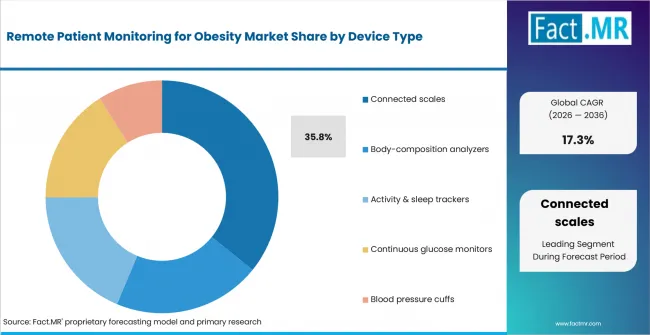
Remote Patient Monitoring For Obesity Market Analysis By Device Type | Source: Fact.MR
Connected scales hold the leading position because they provide a simple and repeatable home measurement for obesity programs. Patients can record weight without complex setup, while care staff can review changes over time. Body composition analyzers add fat and lean mass detail when treatment response needs closer interpretation. Activity trackers and glucose monitors support broader programs that also examine movement patterns and cardiometabolic risk.
What leads the Monitoring Focus segment?
Weight trajectory is expected to hold 47.4% share in 2026.
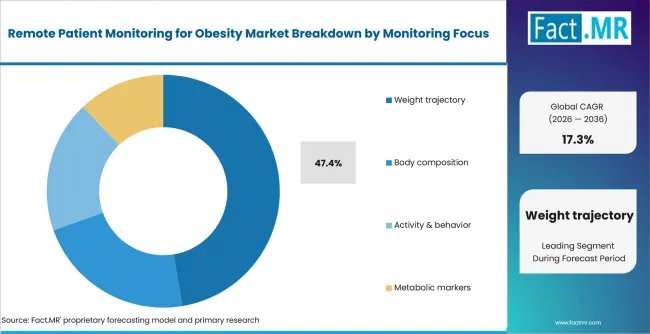
Remote Patient Monitoring For Obesity Market Analysis By Monitoring Focus | Source: Fact.MR
Weight trajectory remains the main monitoring focus because sustained change gives clinicians a practical basis for reviewing treatment progress. Regular readings help identify plateaus, rapid loss or unexpected regain between appointments. Body composition adds context by showing whether change reflects fat reduction or lean-mass loss. Metabolic markers are more suitable for intensive programs that have enough staff capacity to interpret additional information without creating review burden.
How does Reimbursement Pathway shape demand?
CPT RPM codes are anticipated to lead with 50.1% share in 2026.
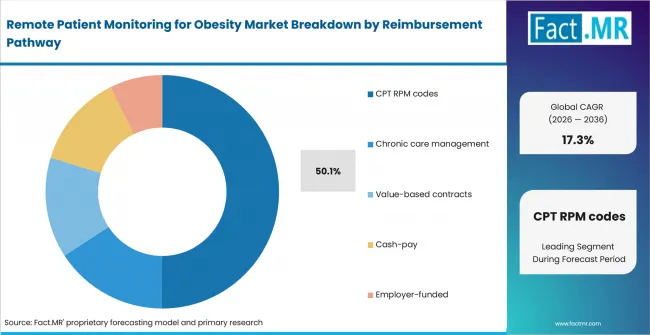
Remote Patient Monitoring For Obesity Market Analysis By Reimbursement Pathway | Source: Fact.MR
CPT RPM codes provide a defined reimbursement route for device setup, data collection and clinical review, which supports structured program design. Their use gives providers a clearer way to connect monitoring activity with billable care. Chronic care management and value-based contracts remain useful when obesity support forms part of a broader treatment model. Cash-pay programs depend more heavily on pricing, patient willingness and enrollment simplicity.
What supports Endocrinology/obesity medicine within Care Setting?
Endocrinology/obesity medicine is estimated to represent 30.3% share in 2026.
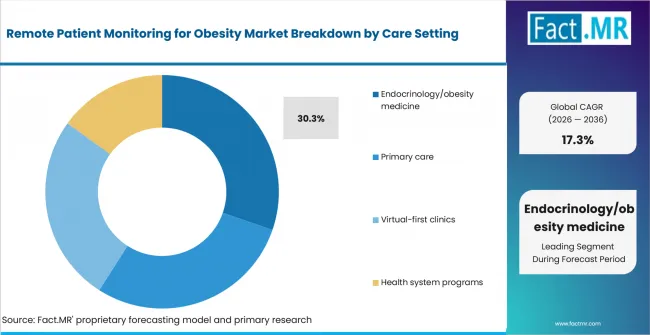
Remote Patient Monitoring For Obesity Market Analysis By Care Setting | Source: Fact.MR
Endocrinology and obesity medicine practices lead because their staff already manage medication adjustment, metabolic risk and weight-related complications. Home readings provide useful evidence between visits, especially when treatment response changes quickly. Primary care practices can use similar data but may need stronger referral pathways and clearer review responsibilities. Virtual-first clinics also depend on local testing and specialist support when monitored changes require physical examination or escalation.
What supports Health systems within End User?
Health systems are forecast to hold 46.7% share in 2026.
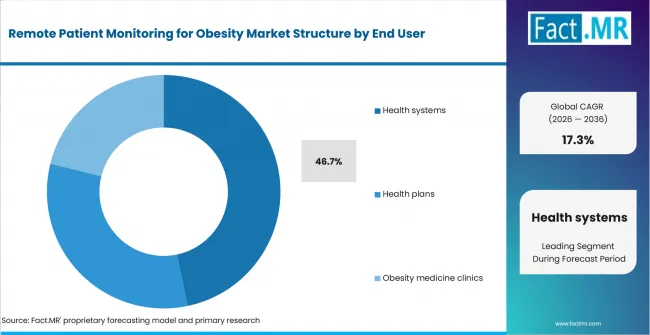
Remote Patient Monitoring For Obesity Market Analysis By End User | Source: Fact.MR
Health systems hold the largest share because they can connect remote monitoring with medication review, nutrition services and specialist referral pathways. Existing EHR infrastructure also helps staff place home readings within a wider clinical record. Health plans support adoption when monitoring improves documentation and follow-up consistency. Independent obesity medicine clinics remain important for patients who need frequent review, complex medication management or more intensive behavioral support.
What is accelerating Remote Patient Monitoring for Obesity Market adoption, and what is holding it back?
Demand is expected to be driven by connected device setup and reimbursement pathways. Adoption is expected to be held back by measurement quality and staff workload.
Drivers Impact Analysis
| DRIVER | (~) % IMPACT ON CAGR | GEOGRAPHIC RELEVANCE | IMPACT TIMELINE |
|---|---|---|---|
| Expansion of connected devices | +3.4% | Global | Short term (<= 2 years) |
| Remote monitoring reimbursement | +3.0% | USA and payer-funded markets | Short term (<= 2 years) |
| Medication monitoring needs | +2.4% | Global | Medium term (2-4 years) |
| Virtual obesity care | +1.9% | USA and enterprise markets | Medium term (2-4 years) |
Source: Fact.MR analysis. Updated Jul 27, 2026
- Expansion of connected devices: Scales and other home devices are expected to reduce manual entry and create steadier weight records. Programs need setup support so readings are reliable before staff act.
- Remote monitoring reimbursement: Defined service components are expected to support spending on devices and review workflows. Provider investment depends on documentation that shows data was reviewed and used.
- Medication monitoring needs: Obesity pharmacotherapy increases the need to review weight change between visits. Monitoring becomes more useful when medication response and side effects are handled together.
- Virtual obesity care: Remote-first clinics require home data for long-term management. Their results depend on alert rules and staff capacity instead of device count alone.
Opportunity Impact Analysis
| OPPORTUNITY | (~) % IMPACT ON CAGR | GEOGRAPHIC RELEVANCE | IMPACT TIMELINE |
|---|---|---|---|
| Body composition insight | +1.5% | Global | Short term (<= 2 years) |
| Risk-based alerting | +1.2% | USA and UK | Medium term (2-4 years) |
| Device-plus-care contracts | +0.9% | Global | Medium term (2-4 years) |
Source: Fact.MR analysis. Updated Jul 27, 2026
- Body composition insight: Validated body composition measures are expected to help staff discuss fat and lean mass change. The opportunity grows when programs use the data to adjust care.
- Risk-based alerting: Trend rules focus staff attention on unusual change or missing data. This opportunity is clearer when alerts are narrow enough to prevent unnecessary workload.
- Device-plus-care contracts: Vendors can pair hardware logistics with clinical workflow and outcomes reporting. Customers are expected to prefer partners that reduce setup failures and keep support responsibility clear.
Restraints Impact Analysis
| RESTRAINT | (~) % IMPACT ON CAGR | GEOGRAPHIC RELEVANCE | IMPACT TIMELINE |
|---|---|---|---|
| Measurement quality | -1.3% | Global | Short term (<= 2 years) |
| Data overload | -1.0% | Regulated and payer-funded markets | Medium term (2-4 years) |
| Reimbursement conditions | -0.7% | Global | Medium term (2-4 years) |
Source: Fact.MR analysis. Updated Jul 27, 2026
- Measurement quality: Scale placement and calibration can change a reading before the care team reviews it. Connectivity and user behavior add risk when programs do not teach setup well. Poor readings are expected to weaken clinical confidence.
- Data overload: Frequent readings create limited value when no staff role is defined. Programs need filtering rules so care teams review the readings that call for action.
- Reimbursement conditions: Coverage rules are expected to require clear device and clinical-time documentation. Providers are expected to move slowly when documentation requirements are hard to meet.
Which countries are scaling Remote Patient Monitoring for Obesity Market fastest?
The country comparison is defined by delivery design more than by a wide gap in growth rates. The USA leads the listed group with the UK and Australia forming the next tier. Canada and Germany follow closely as privacy practice and service readiness shape rollout timing.
- The USA shows a notable position because RPM billing familiarity creates a clearer commercial route. Obesity monitoring is expected to scale when weight data is reviewed by a care team.
- The UK follows a pathway-based route because digital access must fit NHS service design. Platforms are expected to gain review when obesity management supports structured follow-up.
- Australia is supported by remote-care access needs across dispersed communities. Programs are expected to favor device workflows that reduce travel burden and preserve professional oversight.
- Canada depends on provincial delivery fit because care pathways differ by province. Vendors are expected to compete on referral routing and privacy practice.
- Germany records a measured position because evidence and information security expectations lengthen buying reviews. Companies are expected to need stronger documentation before customers broaden obesity monitoring programs.
Comparable CAGRs can therefore produce different market entry conditions across these countries. Rollout timing depends on reimbursement fit and the ability to support patients after devices are issued.
The full report provides country-level CAGR analysis across North America and Europe. Asia-Pacific and other markets are represented in the global estimate.
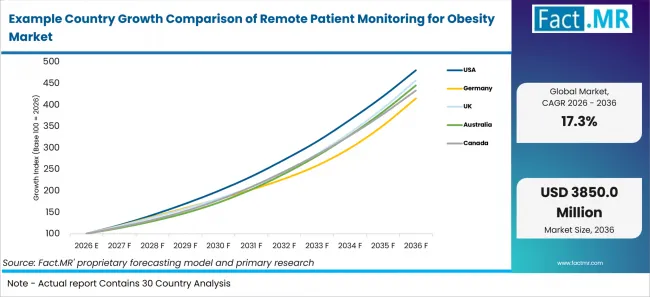
Example Country Growth Comparison Of Remote Patient Monitoring For Obesity Market | Source: Fact.MR
| Country | CAGR (2026-2036) |
|---|---|
| USA | 17.0% |
| UK | 16.4% |
| Australia | 16.1% |
| Canada | 15.8% |
| Germany | 15.3% |
Source: Fact.MR analysis. Updated Jul 27, 2026
What factors are strengthening remote obesity monitoring adoption in the USA?
17.0% CAGR, supported by established RPM billing and integrated obesity-care networks.
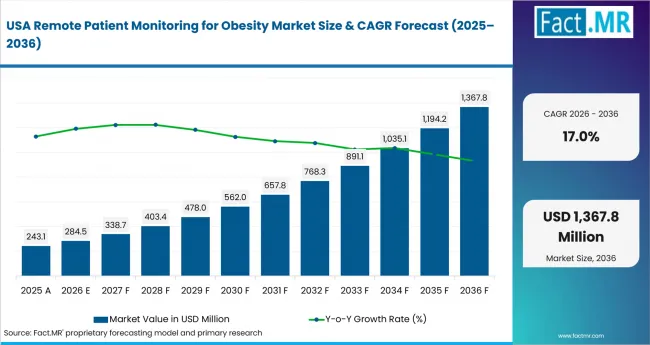
Remote Patient Monitoring For Obesity Market Country Value Analysis | Source: Fact.MR
The USA benefits from a well-developed remote patient monitoring environment across health systems and specialist practices. Obesity programs can connect home weight readings with medication review, nutrition support and scheduled clinical follow-up. Established billing routes also give providers a practical foundation for expanding services. Demand is expected to rise as care teams use connected measurements to guide timely treatment decisions and maintain regular contact between office visits.
How are structured digital-care pathways supporting growth in the UK?
16.4% CAGR, shaped by clinical evidence and organized digital service pathways.
The UK market is progressing through structured obesity-care programs that connect digital monitoring with established clinical pathways. Connected scales can help clinicians review treatment response and identify meaningful weight changes between appointments. Strong evidence standards also encourage providers to select platforms with clear clinical value. Growth is likely to strengthen as remote monitoring becomes part of coordinated weight-management services across primary and specialist care.
What conditions are supporting remote obesity care expansion across Australia?
16.1% CAGR, linked to wider remote-care access and specialist oversight.
Australia offers a strong setting for connected obesity monitoring because remote care can extend specialist support across large geographic areas. Home weight readings help clinicians review progress without requiring frequent travel. Programs that combine simple device setup with professional follow-up can improve continuity for patients outside major cities. Wider telehealth use is also expected to support adoption across obesity clinics, health systems and coordinated care programs.
How are provincial care systems advancing obesity monitoring in Canada?
15.8% CAGR, supported by provincial healthcare delivery and strong privacy practices.
Canada’s provincial healthcare structure creates several routes for remote obesity monitoring adoption. Platforms can align device onboarding, referral processes and clinical review with local care models. Strong privacy practices also support confidence among providers and patients using connected health tools. Demand is expected to grow as health systems introduce monitoring services that connect weight data with medication management, nutrition support and long-term obesity care.
What is shaping evidence-led remote obesity monitoring growth in Germany?
15.3% CAGR, led by clinical evidence standards and secure digital infrastructure.
Germany’s growth is supported by a healthcare environment that places high value on clinical evidence, data security and clearly defined care processes. Connected obesity monitoring platforms can gain wider acceptance when they demonstrate reliable measurements and structured clinical follow-up. Secure data handling also strengthens trust among healthcare organizations. Adoption is expected to expand as providers integrate home weight monitoring with specialist review and long-term metabolic care.
Who is shaping competition in the Remote Patient Monitoring for Obesity Market?
Withings Health Solutions has the strongest device-led position, while Cadence and Vivo Care bring clinical monitoring and care-delivery capabilities into the market.
Withings Health Solutions is closely aligned with obesity monitoring through connected scales and body-composition measurement. Cadence adds continuous patient oversight and care-team coordination across remote monitoring programs. Vivo Care contributes technology-enabled chronic-care management with regular review of patient data. Athelas, now part of Commure, expands the field through connected monitoring infrastructure and clinical workflow support. Impilo strengthens device logistics, onboarding and data connectivity for home-based monitoring programs.
Which companies are the key providers?
Key companies include Withings Health Solutions, Cadence, Vivo Care, Athelas (Commure), and Impilo.
- Withings Health Solutions
- Cadence
- Vivo Care
- Athelas (Commure)
- Impilo
Bibliography
- Centers for Medicare & Medicaid Services. (2026, May 13). Remote patient monitoring.
- Centers for Medicare & Medicaid Services. (2025, May 15). Remote Patient Monitoring: Use & Bill Correctly.
- National Institute for Health and Care Excellence. (2026, January 8). Overweight and obesity management.
- U.S. Department of Health and Human Services. (2026, January 20). Developing a remote patient monitoring strategy.
- Withings Health Solutions. Our remote patient monitoring solution for health professionals.
- Cadence. Clinical AI for chronic care.
- Vivo Care. Remote patient monitoring overview.
- Commure. AI-powered patient engagement.
- Impilo. Remote patient monitoring devices.
- World Health Organization. (2025, December 8). Obesity and overweight.
- World Health Organization. (2025, December 1). WHO issues global guideline on the use of GLP-1 medicines in treating obesity.
This Report Answers
- The report provides strategic intelligence on the Remote Patient Monitoring for Obesity Market across Device Type and Monitoring Focus choices that shape obesity care programs.
- Segment analysis covers Connected scales and Weight trajectory as the share leaders within the 2026 market.
- Country outlook evaluates the USA and UK alongside Australia and Canada. Germany completes the growth comparison across the profiled markets.
- Competitive analysis profiles Withings Health Solutions alongside Cadence and Vivo Care. Athelas (Commure) and Impilo complete the provider set.
- Care-pathway assessment covers CPT RPM codes and endocrinology/obesity medicine. Health systems complete the end-user view alongside health plans and obesity medicine clinics.
What does the Remote Patient Monitoring for Obesity Market cover?
Remote monitoring services support obesity care through connected devices and clinical review workflows.
The Remote Patient Monitoring for Obesity Market covers services that combine connected scales and body composition devices with care-team review. Coverage extends across device setup and data transmission when those steps lead to care-team review. Patient support and alert handling are included when they guide an obesity care decision.
The market differs from general wellness tracking because commercial value comes from clinical response. A reading has value when the program defines who reviews it and what action follows. Adjacent digital therapeutics are separate unless they include monitored data review.
What is included in the scope?
The scope includes connected devices and monitoring focus areas across reimbursement pathways and care settings. End users are included when monitored readings support clinical review.
Coverage includes Connected scales and Body-composition analyzers as the main device categories. Activity & sleep trackers and Continuous glucose monitors are included with Blood pressure cuffs. The report covers Weight trajectory and Body composition. Activity & behavior and Metabolic markers complete the monitoring focus scope.
What is excluded from the scope?
General wellness apps and unmanaged fitness tracking remain outside the market scope.
The scope excludes products that do not transmit readings for clinical review or structured care management. It excludes general obesity drugs and nutrition plans unless they are part of a remote monitoring workflow.
How Was the Analysis Built?
The analysis draws on 120+ sources and 35+ company portfolios. It uses 25+ countries and more than 20 industry interviews.
- Primary Research: Primary research includes discussions with manufacturers and service providers. It covers technology developers and distributors. End users, procurement teams and subject-matter experts are included where they shape adoption. These conversations examine purchasing priorities and product adoption. They review operational challenges, approval requirements and competitive positioning. The goal is to understand factors that influence wider market acceptance.
- Desk Research: Desk research covers government statistics and regulatory publications. Desk research reviews company filings and trade data against public material. Technical studies, industry associations and standards are checked against public policy and other authoritative sources. Every source used in the analysis is documented in the bibliography.
- Market Sizing and Forecasting: Market estimates combine historical performance and demand indicators. Pricing and volume trends are reviewed with segment shares and company participation. Country-level growth and adoption patterns are weighed against investment activity and barriers to market expansion.
- Data Validation and Update Cycle: Findings are validated by comparing primary interviews with public data and company activity. Regulatory changes, trade patterns and industry developments are reviewed during the same cycle. Regular updates review product launches and capacity changes. Partnerships, approvals and procurement trends are checked against shifts in commercial adoption.
Segmentation
What is the report’s scope and coverage?
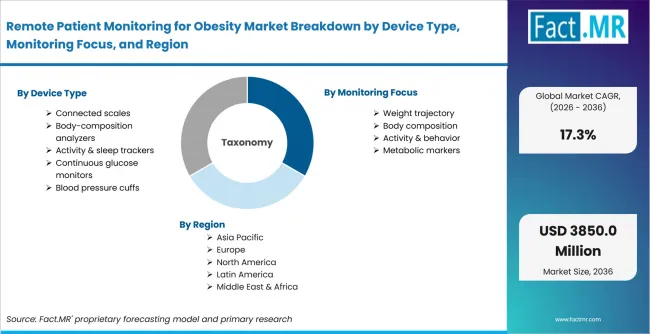
Remote Patient Monitoring For Obesity Market Breakdown By Device Type, Monitoring Focus, And Region | Source: Fact.MR
| Attribute | Details |
|---|---|
| Quantitative Units | USD 780.0 million in 2026 to USD 3,850.0 million by 2036 at 17.3% CAGR |
| Market Definition | Remote monitoring services that use connected scales, body-composition devices, activity trackers, glucose sensors or other connected devices to support obesity care. The scope includes device setup, data transmission, clinical review and intervention workflows. |
| Device Type | Connected scales; Body-composition analyzers; Activity & sleep trackers; Continuous glucose monitors; Blood pressure cuffs |
| Monitoring Focus | Weight trajectory; Body composition; Activity & behavior; Metabolic markers |
| Reimbursement Pathway | CPT RPM codes; Chronic care management; Value-based contracts; Cash-pay; Employer-funded |
| Care Setting | Endocrinology/obesity medicine; Primary care; Virtual-first clinics; Health system programs |
| End User | Health systems; Health plans; Obesity medicine clinics |
| Regions Covered | North America; Europe; Asia-Pacific; and other markets represented in the global estimate |
| Countries Covered | USA; UK; Australia; Canada; Germany |
| Key Companies Profiled | Withings Health Solutions; Cadence; Vivo Care; Athelas (Commure); Impilo |
| Forecast Period | 2026 to 2036 |
| Approach | Hybrid top-down and bottom-up approach using remote monitoring demand; obesity care pathways; connected device adoption; reimbursement design; care-setting readiness; end-user needs; country adoption patterns and company portfolio review |
Source: Fact.MR analysis. Updated Jul 27, 2026
How is the market segmented?
-
By Device Type:
- Connected scales
- Body-composition analyzers
- Activity & sleep trackers
- Continuous glucose monitors
- Blood pressure cuffs
-
By Monitoring Focus:
- Weight trajectory
- Body composition
- Activity & behavior
- Metabolic markers
-
By Reimbursement Pathway:
- CPT RPM codes
- Chronic care management
- Value-based contracts
- Cash-pay
- Employer-funded
-
By Care Setting:
- Endocrinology/obesity medicine
- Primary care
- Virtual-first clinics
- Health system programs
-
By End User:
- Health systems
- Health plans
- Obesity medicine clinics
-
By Region:
- North America
- Europe
- Asia-Pacific
Frequently Asked Questions
Which Device Type leads the market?
Which Monitoring Focus leads the market?
Which Reimbursement Pathway leads the market?
Which Care Setting leads the market?
Which End User leads the market?
Which country records the highest listed CAGR?
What is the primary driver in this market?
What is the main restraint?
Why do health systems lead demand?
Who worked on this report


Preview the report firsthand - request a free sample
Free SampleGet the brochure for pricing and purchase details
Download PDF