- Market Value (2025): USD 3.7 Bn
- Estimated Value (2026): USD 3.9 Bn
- Forecast Value (2036): USD 6.4 Bn
- CAGR (2026-2036): 5.1%
What is the Performance Fuel Detergents Market forecast to be worth by 2036?
USD 3.9 billion in 2026 to USD 6.4 billion by 2036 at a 5.1% CAGR.
- The Performance Fuel Detergents Market surpassed a value of USD 3.7 billion in 2025.
- Demand is projected to increase from USD 3.9 billion in 2026 to USD 6.4 billion by 2036.
- The market is forecast to record 5.1% CAGR from 2026 to 2036.
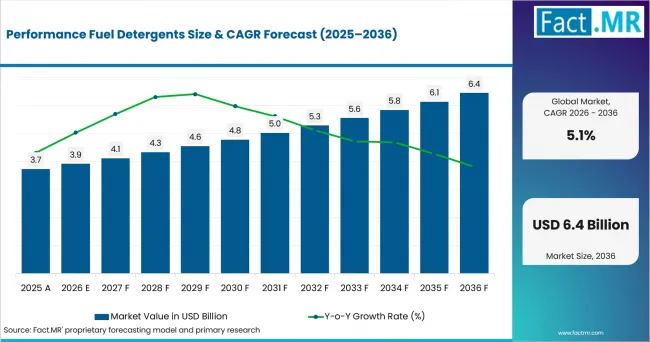
Performance Fuel Detergents Value Analysis | Source: Fact.MR
What are the defining numbers behind Performance Fuel Detergents Market growth?
An absolute opportunity of USD 2.5 billion is expected between 2026 and 2036.
- Demand Drivers in the Market
- Gasoline retailers need deposit-control packages that connect premium fuel claims with measurable engine-cleanliness tests. The U.S. Energy Information Administration reported in April 2026 that U.S. motor gasoline consumption averaged 8.9 million barrels per day in 2025.
- Diesel fleet operators require detergents that keep injector spray patterns stable as aftertreatment systems place tighter value on clean combustion. Lubrizol launched MF9145V in June 2025 to reduce diesel particulate matter formation at source.
- Retail brands are expected to use detergent claims to separate premium gasoline from baseline grades. TOP TIER reported in May 2026 that its TOP TIER+ gasoline standard was rolling out to retail stations, with the standard incorporating a GDI fuel-injector cleanliness engine dynamometer test for gasoline direct-injection engines.
- Key Segments Analyzed
- By Detergent Chemistry: Polyetheramine is expected to hold 36.0% share in 2026 because it suits high-temperature deposit-control programs across gasoline applications.
- By Fuel: Gasoline is projected to account for 54.0% share in 2026 as retail forecourts use detergency to protect brand performance claims.
- By Performance Target: Injector deposits are anticipated to capture 31.0% share in 2026 since direct-injection engines make nozzle cleanliness a visible operating issue.
- By Customer: Refineries are estimated to represent 36.0% share in 2026 owing to blending control before finished fuels enter terminals and branded distribution.
- Analyst Opinion at Fact.MR
- Shambhu Nath Jha, Principal Consultant at Fact.MR states, “Fuel detergency is moving closer to proof-based selling. Retailers and formulators are expected to favor packages that connect chemistry with injector cleanliness and registration readiness. Suppliers with testing depth and flexible formulation support are better placed than narrow product sellers.”
- Strategic Implications
- Additive formulators should prepare EPA registration files and TOP TIER+ readiness packs before approaching gasoline-brand customers.
- Fuel marketers should match detergent claims with one clear engine-cleanliness outcome so premium positioning remains easy for station networks to explain.
- Refineries should align detergent dosing with terminal blending controls to reduce rework when fuel streams move across several distribution points.
- Fleet-focused distributors should pair diesel detergent programs with service records so customers can link cleaner combustion with maintenance planning.
The UK is projected to post 6.6% CAGR through 2036, supported by road traffic and petrol treatment needs. The USA is expected to record 6.3% CAGR as gasoline and diesel volumes keep detergent programs active. Germany is forecast to reach 5.7% CAGR due to freight intensity and premium-fuel expectations. France is anticipated to advance at 5.3% CAGR owing to gasoline-hybrid registrations. Brazil is estimated to hold 4.9% CAGR with ethanol-blend complexity.
How does the Performance Fuel Detergents Market break down by segment?
Polyetheramine leads Detergent Chemistry at 36.0% share in 2026; gasoline leads Fuel at 54.0% share.
Which Detergent Chemistry dominates?
Polyetheramine is expected to hold 36.0% share in 2026.
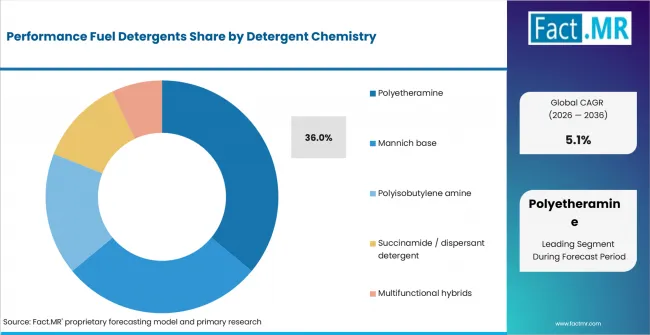
Performance Fuel Detergents Analysis By Detergent Chemistry | Source: Fact.MR
Polyetheramine leads because it works well in deposit-control packages that must survive hot intake and combustion environments. Fuel marketers use this chemistry where a gasoline detergent has to clean existing deposits and protect injectors during repeated fill cycles.
BASF announced the upcoming launch of its next-generation Keropur Gasoline Performance Additive Series on September 17, 2025. BASF states that the Keropur AP 225-20 formulation had passed the required TOP TIER+ tests for injector deposit control and stochastic pre-ignition protection, with deliveries planned for the first half of 2026.
What leads the Fuel segment?
Gasoline is projected to account for 54.0% share in 2026.
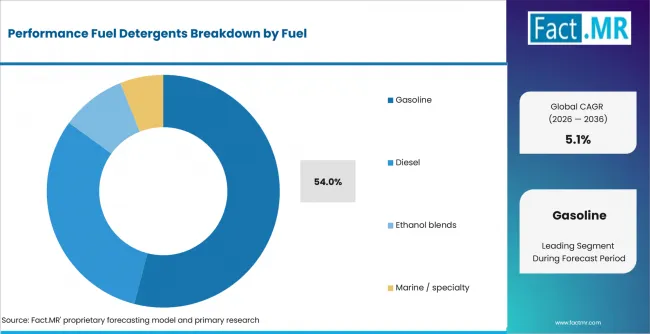
Performance Fuel Detergents Analysis By Fuel | Source: Fact.MR
Gasoline leads the fuel segment as passenger cars and branded retail stations create a high-frequency treatment base. Detergent packages are dosed before the consumer sees the fuel, so refiners and marketers can connect additive performance with visible station-level fuel positioning.
The U.S. Energy Information Administration reports that U.S. transportation-sector distillate (diesel) fuel consumption, excluding biodiesel and renewable diesel, was about 2.94 million barrels per day in 2025. Diesel therefore represents a substantial transportation-fuel application base. Gasoline remained the dominant U.S. transportation fuel by energy consumption, while major retail fuel brands such as Shell and Chevron prominently market detergent-based cleaning and deposit-control benefits in their gasoline products..
How does Performance Target shape demand?
Injector deposits are anticipated to lead with 31.0% share in 2026.
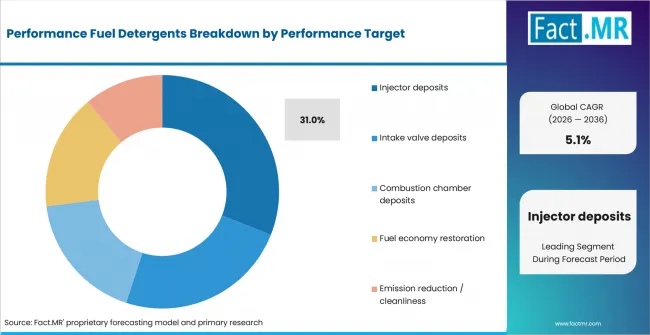
Performance Fuel Detergents Analysis By Performance Target | Source: Fact.MR
Injector deposits lead because small changes in spray quality can affect fuel-air mixing and combustion behavior. Gasoline direct-injection engines make the issue more visible since deposits form around the injector tip and can affect the consistency of each fuel pulse.
TOP TIER reported in May 2026 that TOP TIER+ was rolling out for modern gasoline direct-injection engines. The TOP TIER+ standard includes a GDI fuel-injector cleanliness engine dynamometer test, making injector-cleanliness performance an increasingly explicit criterion for qualifying gasoline and additive packages.
What supports Refineries within Customer?
Refineries are estimated to represent 36.0% share in 2026.
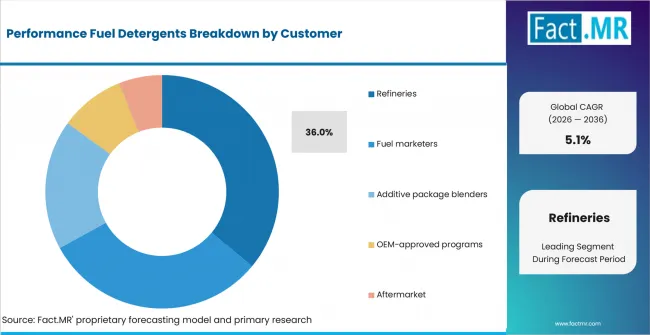
Performance Fuel Detergents Analysis By Customer | Source: Fact.MR
Refineries lead the customer segment because they control additive use before fuel leaves the primary blending system. This gives them a direct role in dosage control, documentation and the delivery of branded finished-fuel specifications to terminal and retail channels.
EPA requires motor vehicle gasoline, motor vehicle diesel fuel, and their additives to be registered under 40 CFR Part 79. The registration requirement makes Part 79 status a compliance consideration for manufacturers and importers supplying fuels and fuel additives for motor-vehicle use.
What is accelerating Performance Fuel Detergents Market adoption, and what is holding it back?
Demand is expected to rise through gasoline detergency standards and diesel cleanliness needs. Growth is restrained by fuel-price sensitivity, qualification work and electrification exposure.
Drivers Impact Analysis
| DRIVER | (~) % IMPACT ON CAGR | GEOGRAPHIC RELEVANCE | IMPACT TIMELINE |
|---|---|---|---|
| TOP TIER+ gasoline cleanliness tests | +1.2% | North America, Europe | Short term (<= 2 years) |
| Diesel injector and DPF maintenance pressure | +0.9% | Global | Medium term (2-4 years) |
| Ethanol and biofuel blend complexity | +0.7% | Brazil, North America, Europe | Medium term (2-4 years) |
| Refinery and terminal dosing control | +0.5% | Global | Long term (>= 4 years) |
Opportunity Impact Analysis
| OPPORTUNITY | (~) % IMPACT ON CAGR | GEOGRAPHIC RELEVANCE | IMPACT TIMELINE |
|---|---|---|---|
| Premium gasoline detergency programs | +0.8% | USA, UK, Germany | Short term (<= 2 years) |
| Diesel clean-combustion packages for fleets | +0.6% | USA, Brazil, Europe | Medium term (2-4 years) |
| Aftermarket and specialty-fuel packages | +0.4% | Global | Long term (>= 4 years) |
Restraints Impact Analysis
| RESTRAINT | (~) % IMPACT ON CAGR | GEOGRAPHIC RELEVANCE | IMPACT TIMELINE |
|---|---|---|---|
| Fuel-price sensitivity at retail stations | -0.6% | Europe, Brazil | Short term (<= 2 years) |
| Registration and test-cost burden | -0.4% | USA, Europe | Medium term (2-4 years) |
| Electric vehicle substitution in new fleets | -0.3% | USA, UK, Europe | Long term (>= 4 years) |
Which countries are scaling the Performance Fuel Detergents Market through 2036?
- The country comparison spans 1.7 percentage points across the forecast period.
- The UK remains 0.3 percentage point above the USA through road traffic and petrol treatment needs.
- The USA remains 0.6 percentage point above Germany as gasoline and diesel volumes keep detergent programs active.
- Germany remains 0.4 percentage point above France through road-freight intensity and premium-fuel expectations.
- France remains 0.4 percentage point above Brazil owing to gasoline-hybrid registrations and freight exposure.
- Brazil closes the displayed range with ethanol-blend complexity and fuel-quality monitoring.
Comparable CAGRs can create different entry conditions due to fuel mix and refining structure. Vehicle stock, retail branding and compliance requirements add further variation. Full coverage includes North America, Latin America, Western Europe, Eastern Europe, East Asia, South Asia & Pacific, Middle East & Africa.
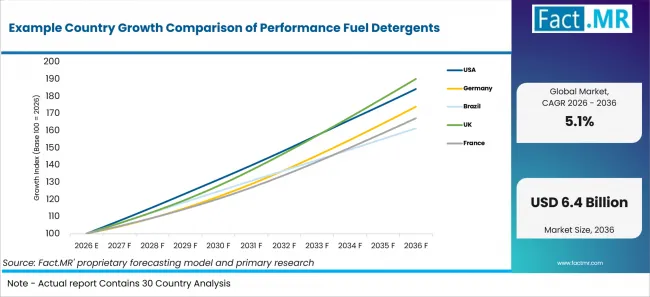
Example Country Growth Comparison Of Performance Fuel Detergents | Source: Fact.MR
| Country | CAGR (2026-2036) |
|---|---|
| United Kingdom | 6.6% |
| United States | 6.3% |
| Germany | 5.7% |
| France | 5.3% |
| Brazil | 4.9% |
What supports the United Kingdom’s growth?
6.6% CAGR, backed by road traffic and petrol treatment needs.
The UK has a large road-fuel base for detergent packages. The Department for Transport reported in May 2026 that motor vehicle traffic on Great Britain's roads reached 342.6 billion vehicle miles in 2025. DESNZ and Ofgem reported in December 2025 that transport fuels comprised approximately three-quarters of UK oil product demand in 2024. Fuel marketers need packages that work across petrol surplus and imported diesel streams.
What supports USA adoption?
6.3% CAGR, supported by gasoline volume and diesel fleet use.
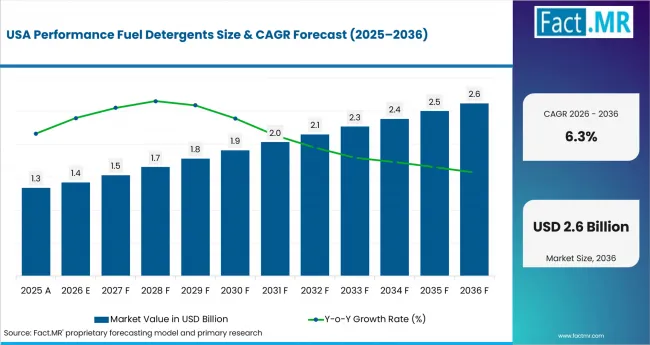
Performance Fuel Detergents Country Value Analysis | Source: Fact.MR
U.S. demand is anchored by large gasoline and diesel fuel pools. NHTSA reported in April 2026 that preliminary Federal Highway Administration data showed U.S. vehicle miles traveled increased by about 29.8 billion miles, or 0.9%, in 2025. EIA reported that U.S. transportation-sector distillate fuel consumption, excluding biodiesel and renewable diesel, averaged about 123 million gallons per day in 2025. EPA rules keep documentation central for applicable commercial additive packages.
How is Germany scaling demand?
5.7% CAGR, shaped by road-freight intensity and fuel-quality expectations.
Germany combines premium fuel standards with a large freight base. Destatis reported in July 2026 that diesel, including blended biodiesel, represented 60.8% of road-transport energy consumption in 2024. Eurostat reported in July 2026 that road freight transport performed by vehicles registered in Germany reached 277.4 billion tonne-kilometres in 2025. These conditions support diesel detergency and refinery-level additive control.
How is France developing demand?
5.3% CAGR, reinforced by gasoline registrations and road-transport fuel exposure.
France has a fuel mix that keeps gasoline detergent needs visible. SDES reported in January 2026 that gasoline powertrains, including non-plug-in gasoline hybrids, accounted for 57.9% of new passenger-car registrations in France in December 2025. Eurostat reported in July 2026 that road freight transport performed by vehicles registered in France reached 172.9 billion tonne-kilometres in 2025. Fuel marketers need packages for retail gasoline and commercial diesel channels.
How does Brazil perform?
4.9% CAGR, led by ethanol-blend complexity and fuel-quality monitoring.
Brazil’s detergent demand is shaped by gasoline C, ethanol and diesel B blending. ANP reported in June 2026 that ethanol production reached 35.9 billion litres in 2025. The Ministry of Transport updated its 2025 vehicle-fleet data in March 2026, including datasets by vehicle type and by fuel. ANP enforcement actions reported in April 2026 included checks on fuel quality, equipment compliance and documentation.
Who leads the Performance Fuel Detergents Market?
Afton Chemical participates through gasoline and diesel performance additives and refinery and distribution fuel-additive technologies serving fuel marketers, refiners and other fuel-industry customers. In August 2025, Afton launched its HiTEC 65522 Gasoline Performance Additive Series, approved for use in TOP TIER+ gasoline and formulated to provide deposit control for gasoline direct-injection engine technology.
Infineum participates through fuel-additive technologies and local blending and supply capabilities. In March 2026, Infineum inaugurated a new blending facility in Patalganga, India, operated exclusively for Infineum by LSR Specialty Oils. Infineum states that the facility expands its local footprint to provide greater supply reliability, faster responsiveness and solutions tailored to India's operating conditions.
Lubrizol supports gasoline and diesel fuel-additive applications, including the MF9145V diesel additive launched in June 2025. Chevron Oronite provides gasoline additive packages for refinery and branded-retail fuel applications, while Chevron introduced next-generation Techron in May 2026 for U.S. Chevron- and Texaco-branded gasolines.
BASF provides Keropur gasoline and diesel fuel-performance packages. In September 2025, BASF announced the upcoming launch of its next-generation Keropur Gasoline Performance Additive Series and stated that Keropur AP 225-20 had successfully passed all required TOP TIER+ tests. Innospec participates through its Fuel Specialties business; in June 2026, the company reported that its Fuel Specialties additives delivered emissions-related benefits equivalent to 21.6 million metric tonnes of CO2e in 2025.
Which companies are the key providers?
Key companies include Afton Chemical; Infineum; Lubrizol; Chevron Oronite; BASF; and Innospec.
- Afton Chemical
- Infineum
- Lubrizol
- Chevron Oronite
- BASF
- Innospec
Bibliography
- Afton Chemical Corporation. (2025, August 25). Afton Chemical launches HiTEC® 65522 Gasoline Performance Additive Series approved for TOP TIER+™ gasoline.
- Agência Nacional do Petróleo, Gás Natural e Biocombustíveis. (2026a, June 30). ANP divulga dados consolidados do setor regulado em 2025.
- Agência Nacional do Petróleo, Gás Natural e Biocombustíveis. (2026b, April 22). ANP divulga resultados de ações de fiscalização em 15 unidades da Federação (13 a 17/4/26).
- Agência Nacional do Petróleo, Gás Natural e Biocombustíveis. (2026c, July 31). E32: gasolina com 32% de etanol passa a valer, temporariamente, a partir de amanhã (1/8).
- BASF. (2025, September 17). BASF launches Keropur® Gasoline Performance Additive Series certified for new U.S. TOP TIER+™ standard.
- Chevron. (2026, May 21). Chevron introduces next-gen Techron in U.S. Chevron and Texaco gasolines.
- Department for Energy Security and Net Zero, & Ofgem. (2025, December 17). Statutory security of supply report: 2025. GOV.UK.
- Department for Transport. (2026a, May 20). Road traffic estimates in Great Britain: 2025. GOV.UK.
- Department for Transport. (2026b, April 29). Vehicle licensing statistics, United Kingdom: 2025. GOV.UK.
- Eurostat. (2026, July 31). EU road freight transport up by 0.9% in 2025.
- Infineum. (2026, March 9). Infineum inaugurates new blending facility in India to support the country’s growing mobility and energy needs.
- Innospec Inc. (2026, June 30). Innospec publishes 2025 sustainability report highlighting measurable progress and responsible growth.
- Lubrizol. (2025, June 18). Lubrizol launches Lubrizol® MF9145V diesel additive to solve DPF maintenance challenges.
- Ministério dos Transportes. (2026, March 30). Frota de veículos – 2025.
- National Highway Traffic Safety Administration. (2026, April 1). Trump’s Transportation Department announces record-low traffic deaths & fatality rates in 2025.
- Service des données et études statistiques. (2026, January 6). Motorisations des véhicules légers neufs – Émissions de CO2 et bonus écologique – Décembre 2025.
- Statistisches Bundesamt (Destatis). (2026a, May 7). Energiepreise wie in früheren Krisen stark gestiegen.
- Statistisches Bundesamt (Destatis). (2026b, July 3). Straßenverkehr macht im Jahr 2024 gut ein Fünftel des deutschen Energieverbrauchs aus.
- TOP TIER™. (2026, May 26). TOP TIER™ announces new TOP TIER™+ standard.
- U.S. Energy Information Administration. (2026, April 10). Increasing fuel efficiency leads to decreasing gasoline consumption.
- U.S. Environmental Protection Agency. (2026, September 1). Registration guidelines for fuels and fuel additives.
This Report Answers
- The report explains where performance fuel detergents are used across detergent chemistry and fuel type. It also covers performance target and customer group.
- Segment analysis identifies the leading subsegments and the operating reasons fuel marketers prioritize them.
- Country analysis examines the listed markets and the fuel-use, fleet and blending mechanisms supporting detergent adoption.
- Competitive analysis reviews current providers across gasoline detergency, diesel performance packages and refinery-grade additive support.
What does the Performance Fuel Detergents Market cover?
The Performance Fuel Detergents Market covers chemical packages that clean or control deposits in gasoline and diesel fuel systems. It includes refinery-dosed products and branded retail programs that overlap with gasoline additives where detergency is part of finished-fuel performance.
The assessment covers low-sulfur fuel additives where lubricity and cleanliness needs intersect with deposit control. It also includes fuel injector cleaner products when the active chemistry is sold into additive packages.
What is included in the scope?
The scope includes gasoline detergents, diesel detergents, ethanol-blend compatible packages and additive concentrates sold to refineries, fuel marketers and package blenders. It is adjacent to automotive additives where engine performance is the end-use link.
The scope includes deposit-control chemistry used before or during fuel distribution. It also covers package combinations that connect detergency with cold flow improvers when diesel performance requires low-temperature flow support.
What is excluded from the scope?
The scope excludes base fuels, crude-oil processing equipment, standalone octane boosters, pure lubricants and aftertreatment hardware such as diesel oxidation catalysts when sold apart from fuel-additive chemistry.
Standalone transmission fluids and gear-oil packages are outside the scope. Those applications are better covered under driveline additives where the additive works inside a lubricant system.
How Was the Analysis Built?
The analysis draws on 120+ sources, 35+ company portfolios, 25+ countries, and more than 20 industry interviews.
- Primary Research: Primary research includes discussions with manufacturers, service providers, technology developers, distributors, end users, and subject-matter experts. These conversations examine purchasing priorities, product adoption, operational challenges, approval requirements, competitive positioning, and the factors that influence wider market acceptance.
- Desk Research: Desk research covers government statistics, regulatory publications, company filings, trade data, technical studies, industry associations, standards, public policy, and other authoritative sources. Every source used in the analysis is documented in the bibliography.
- Market Sizing and Forecasting: Market estimates combine historical performance, demand indicators, pricing and volume trends, segment shares, company participation, country-level growth, adoption patterns, investment activity, and barriers to market expansion.
- Data Validation and Update Cycle: Findings are validated by comparing primary interviews with public data, company activity, regulatory changes, trade patterns, and industry developments. Regular updates review new product launches, capacity changes, partnerships, approvals, and shifts in commercial adoption.
What is the report’s scope and coverage?
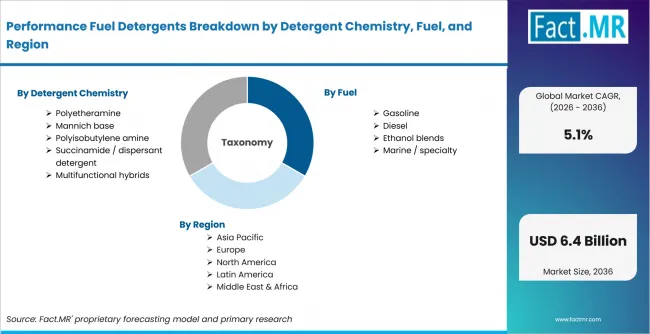
Performance Fuel Detergents Breakdown By Detergent Chemistry, Fuel, And Region | Source: Fact.MR
| Attribute | Details |
|---|---|
| Quantitative Units | USD billion in 2026 to USD billion by 2036 at a CAGR |
| Market Definition | Chemical detergent additives used in gasoline, diesel, ethanol blends and specialty fuels to manage injector deposits, intake valve deposits, combustion chamber deposits, fuel economy restoration and cleanliness. |
| Detergent Chemistry | Polyetheramine; Mannich base; Polyisobutylene amine; Succinamide dispersant detergent; Multifunctional hybrids |
| Fuel | Gasoline; Diesel; Ethanol blends; Marine and specialty |
| Performance Target | Injector deposits; Intake valve deposits; Combustion chamber deposits; Fuel economy restoration; Emission reduction and cleanliness |
| Customer | Refineries; Fuel marketers; Additive package blenders; OEM-approved programs; Aftermarket |
| Regions Covered | North America; Latin America; Western Europe; Eastern Europe; East Asia; South Asia & Pacific; Middle East & Africa |
| Countries Covered | United States; Germany; Brazil; United Kingdom; France |
| Key Companies Profiled | Afton Chemical; Infineum; Lubrizol; Chevron Oronite; BASF; Innospec |
| Forecast Period | 2026 to 2036 |
| Approach | Hybrid top-down and bottom-up approach using fuel consumption, vehicle-fleet exposure, additive chemistry, customer channels, country fuel trends and provider portfolio checks. |
How is the market segmented?
-
By Detergent Chemistry
- Polyetheramine
- Mannich base
- Polyisobutylene amine
- Succinamide dispersant detergent
- Multifunctional hybrids
-
By Fuel
- Gasoline
- Diesel
- Ethanol blends
- Marine and specialty
-
By Performance Target
- Injector deposits
- Intake valve deposits
- Combustion chamber deposits
- Fuel economy restoration
- Emission reduction and cleanliness
-
By Customer
- Refineries
- Fuel marketers
- Additive package blenders
- OEM-approved programs
- Aftermarket
-
By Region
- North America
- Latin America
- Western Europe
- Eastern Europe
- East Asia
- South Asia & Pacific
- Middle East & Africa