- Base Value(2025): 92.0 Mn
- Estimated Value(2026): 108.0 Mn
- Forecast Value (2036): 486.0 Mn
- CAGR (2026 - 2036): 16.2%
Perovskite Solar Module Recycling Market Forecast and Outlook By Fact.MR
In 2025, the perovskite solar module recycling market was valued at USD 92.0 million. Based on Fact MR analysis, demand for perovskite solar module recycling solutions is estimated to grow to USD 108.0 million in 2026 and USD 486.0 million by 2036. FMR projects a CAGR of 16.2% during the forecast period.
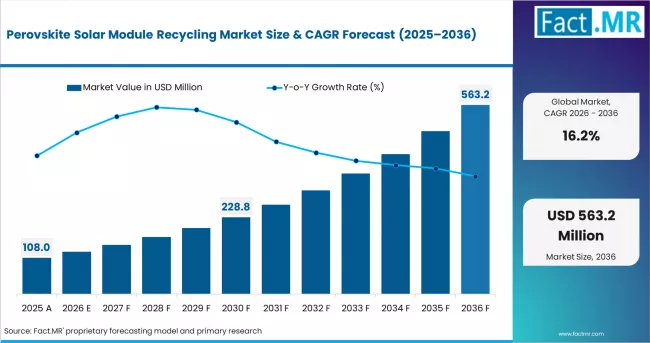
Perovskite Solar Module Recycling Market Market Value Analysis | Source: Fact.MR
Perovskite Solar Module Recycling Market
| Metric | Details |
|---|---|
| Industry Size (2026E) | USD 108.0 million |
| Industry Value (2036F) | USD 486.0 million |
| CAGR (2026 to 2036) | 16.2% |
Source: Fact.MR analysis. Updated Apr 21, 2026
Summary of Perovskite Solar Module Recycling Market
- Market Definition
- The market comprises technologies and processes designed to recover glass, conductive oxides, metals, polymers, and perovskite active materials from end of life or defective perovskite photovoltaic modules to support circular material utilization and controlled management of thin film solar waste streams.
- Demand Drivers
- Increasing deployment of perovskite photovoltaic modules requiring lifecycle material recovery capability.
- Rising requirement for recovery of conductive oxides, glass substrates, and metal contacts supporting reintegration into manufacturing workflows.
- Growing regulatory attention toward electronic waste management associated with emerging photovoltaic chemistries.
- Expansion of thin film solar manufacturing processes generating production scrap requiring controlled recycling pathways.
- Increasing focus on closed loop material utilization supporting reduction of raw material procurement dependency.
- Rising need for specialized recycling processes compatible with multilayer photovoltaic module architectures.
- Key Segments Analyzed
- End Use: PV manufacturers lead with 41% share supported by integration of recovered materials into production supply chains.
- Process: Mechanical recycling accounts for 36% share driven by scalability of shredding and separation workflows.
- Material Recovery Role: Glass, conductive oxides, and metals represent primary recovered materials across thin film module structures.
- Technology Function: Chemical recovery and solvent extraction enable purification of perovskite layer materials.
- Geography: Asia Pacific, Europe, and North America demonstrate emerging adoption supported by photovoltaic lifecycle management frameworks.
- Analyst Opinion at Fact MR
- Shambhu Nath Jha, Principal Consultant, Fact MR, opines, 'In this updated edition of the Perovskite Solar Module Recycling Market report, material recovery integration is expected to align with commercialization of thin film photovoltaic technologies supporting circular lifecycle management frameworks through 2036.'
- Strategic Implications or Executive Takeaways
- Invest in scalable recycling infrastructure supporting recovery of multilayer photovoltaic materials across thin film module architectures.
- Strengthen process optimization capability supporting separation of conductive oxides, glass substrates, and perovskite active compounds.
- Expand integration capability supporting reinsertion of recovered materials into photovoltaic manufacturing supply chains.
- Improve recovery yield efficiency supporting economic viability of recycling workflows across emerging solar technologies.
- Focus on regulatory aligned waste processing frameworks supporting controlled handling of lead containing photovoltaic materials.
- Enhance collaboration with photovoltaic manufacturers supporting early integration of end of life material recovery systems.
- Methodology
- Primary interviews conducted with photovoltaic manufacturers, recycling technology providers, and environmental engineering specialists.
- Benchmarked against solar installation indicators influencing future photovoltaic waste generation volumes.
- Evaluated recycling technology capability supporting recovery of thin film photovoltaic materials.
- Hybrid modeling applied combining top down photovoltaic deployment assessment with bottom up recycling process adoption benchmarking.
- Validation conducted using supplier level recycling technology deployment indicators across solar lifecycle management systems.
- Peer review applied using Fact MR analytical frameworks linking photovoltaic commercialization trends with material recovery technology demand.
A CAGR of 16.2% indicates transformational expansion with variability linked to commercialization pace of perovskite photovoltaic deployment and recycling process standardization. Growth is supported by material recovery economics, while volatility persists due to evolving module chemistries, regulatory frameworks for waste handling, and scale efficiency of recycling technologies.
China leads with a projected CAGR of 18.1%, supported by expansion of photovoltaic waste processing infrastructure linked to large-scale solar deployment programs. India follows with a CAGR of 17.6%, driven by increasing development of material recovery systems for next-generation solar panel components. The United Kingdom records a CAGR of 17.2%, reflecting steady adoption of recycling technologies across emerging perovskite photovoltaic supply chains. Germany shows a CAGR of 16.9%, supported by consistent integration of advanced material recovery processes across renewable energy lifecycle management systems. The United States records the slowest growth at 16.2%, reflecting an emerging recycling ecosystem tied to replacement demand as early-stage perovskite solar installations reach end-of-life processing cycles.
Segmental Analysis
Perovskite Solar Module Recycling Market Analysis by End Use
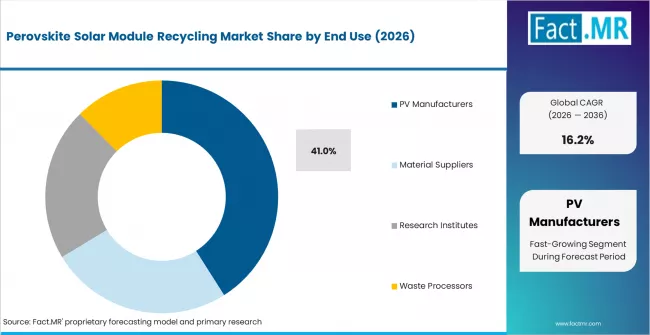
Perovskite Solar Module Recycling Market Analysis By End Use | Source: Fact.MR
- Market Overview: Based on Fact MR assessment, PV manufacturers are projected to account for 41% share of the perovskite solar module recycling market in 2026. Photovoltaic producers implement recycling workflows to recover glass substrates, conductive layers, and perovskite active materials from end of life solar modules requiring controlled separation processes. Recycling integration supports recovery of valuable materials enabling reintegration into photovoltaic manufacturing supply chains requiring stable material purity parameters. Process adoption supports management of production scrap and defective modules generated during thin film fabrication workflows requiring controlled waste handling procedures aligned with material recovery efficiency requirements.
- Demand Drivers:
- Material Recovery Requirements: Recycling processes support extraction of reusable components including conductive oxides and substrate materials across photovoltaic module disposal workflows.
- Manufacturing Loop Integration: PV manufacturers incorporate recovered materials enabling reduction of raw material consumption across solar module production operations.
- Waste Management Parameters: Recycling workflows support controlled handling of thin film module waste requiring separation of layered photovoltaic materials.
Perovskite Solar Module Recycling Market Analysis by Process
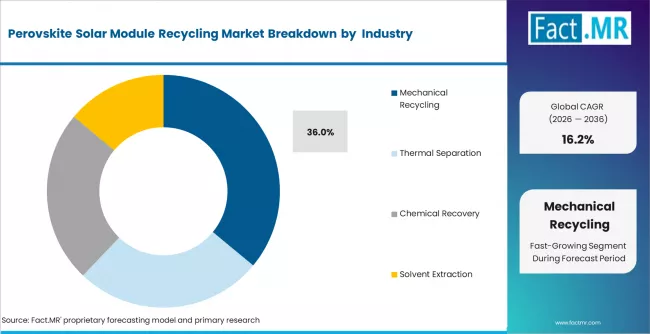
Perovskite Solar Module Recycling Market Analysis By Process | Source: Fact.MR
- Market Overview: Mechanical recycling is estimated to hold 36% share of the perovskite solar module recycling market in 2026, supported by utilization of shredding, crushing, and separation techniques enabling recovery of layered module materials without extensive chemical treatment processes. Mechanical separation supports extraction of glass, metal contacts, and encapsulation layers requiring controlled particle size reduction and sorting operations. Processing workflow supports integration across industrial recycling facilities requiring stable throughput performance across photovoltaic module waste streams requiring defined material recovery efficiency parameters.
- Demand Drivers:
- Material Separation Requirements: Mechanical recycling supports disassembly of module layers enabling recovery of substrate and conductive material components.
- Processing Efficiency Parameters: Mechanical methods support consistent throughput across photovoltaic waste streams requiring scalable recycling operations.
- Operational Compatibility Needs: Mechanical processing enables integration within existing recycling infrastructure supporting treatment of thin film photovoltaic module materials.
Key Dynamics
Perovskite Solar Module Recycling Market Drivers, Restraints, and Opportunities
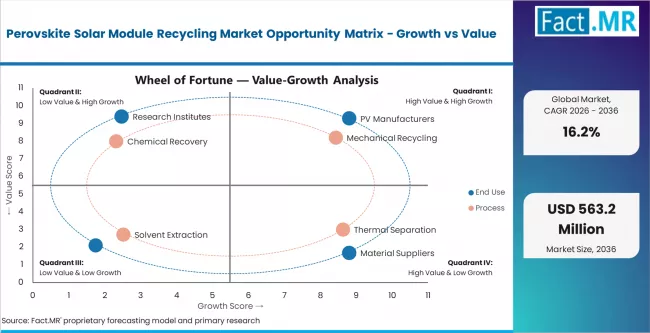
Perovskite Solar Module Recycling Market Opportunity Matrix Growth Vs Value | Source: Fact.MR
FMR analysts observe that historical photovoltaic recycling markets have been structured around crystalline silicon modules, where waste volumes emerged only after multi-decade installation cycles. The present market size reflects a pre-commercial but structurally necessary segment forming alongside rapid development of perovskite solar technologies, which incorporate lead-based absorber materials and multilayer thin-film architectures requiring specialized end-of-life processing. Structural reality indicates an emerging circular-economy-driven market because perovskite modules offer high efficiency and low manufacturing cost, yet shorter operational lifetimes and lead content create regulatory pressure to establish closed-loop material recovery pathways early in commercialization cycles.
The current structural shift reflects declining reliance on landfill disposal assumptions traditionally applied to early-stage photovoltaic technologies, while research demonstrates solvent-based and aqueous recycling processes capable of recovering glass substrates, conductive oxides, and perovskite active materials with high purity levels. Higher recycling processing cost per module is offset by recovery of high-value materials such as indium tin oxide and lead compounds, supporting lifecycle cost reductions as manufacturing scale increases. Early demand is primarily driven by pilot-scale recycling integration aligned with regulatory frameworks governing electronic waste management and hazardous material handling.
- Circular PV Design: Recycling processes recover glass, transport layers, and absorber materials, supporting closed-loop manufacturing strategies for next-generation photovoltaic modules.
- WEEE Compliance Pressure: EU Waste Electrical and Electronic Equipment Directive 2012/19/EU encourages producer responsibility for photovoltaic waste management and material recovery pathways.
- Europe Innovation Base: Germany and Switzerland support early development due to strong thin-film research ecosystems and policy emphasis on circular photovoltaic supply chains.
Regional Analysis
The perovskite solar module recycling market is assessed across North America, Europe, and Asia Pacific, segmented by country-level demand in photovoltaic material recovery, thin film module recycling, rare metal extraction technologies, and solar waste treatment processes. Regional demand reflects expansion of next-generation solar deployment and development of end-of-life photovoltaic material recovery infrastructure. The full report offers market attractiveness analysis.
.webp "Top Country Growth Comparison Perovskite Solar Module Recycling Market Cagr (2026 2036)")
Top Country Growth Comparison Perovskite Solar Module Recycling Market Cagr (2026 2036) | Source: Fact.MR
CAGR Table of Perovskite Solar Module Recycling Market
| Country | CAGR (2026–2036) |
|---|---|
| China | 18.1% |
| India | 17.6% |
| United Kingdom | 17.2% |
| Germany | 16.9% |
| United States | 16.2% |
Source: Fact.MR analysis. Updated Apr 21, 2026
Source: Fact MR analysis, based on proprietary forecasting model and primary research
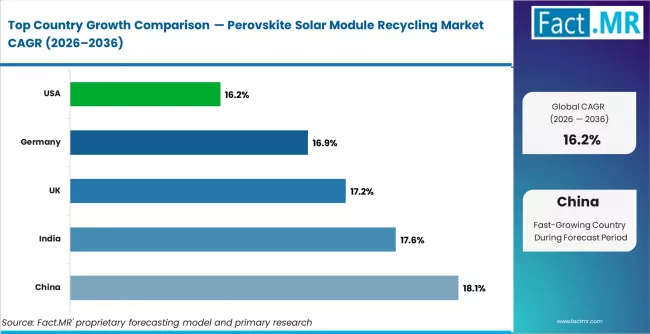
Perovskite Solar Module Recycling Market Cagr Analysis By Country | Source: Fact.MR
Asia Pacific
Asia Pacific functions as the next-generation photovoltaic recycling development hub, supported by expansion of perovskite solar manufacturing capacity and increasing focus on recovery of critical materials. First Solar Inc. strengthens photovoltaic recycling process engineering capability. Trina Solar Co., Ltd. expands solar module material recovery initiatives. LONGi Green Energy Technology Co., Ltd. supports advanced photovoltaic material lifecycle optimization.
- China: China is projected to record 18.1% CAGR in perovskite solar module recycling through 2036. Renewable energy circular economy development guideline update (National Development and Reform Commission, March 2024) supports photovoltaic material recovery technology adoption. Trina Solar Co., Ltd. expanded solar module recycling research capability (June 2023).
- India: Expansion of perovskite solar module recycling in India is forecast at 17.6% CAGR through 2036. National Solar Mission lifecycle management framework update (Ministry of New and Renewable Energy, January 2024) supports photovoltaic waste recycling deployment. ReNew Power expanded solar component recycling feasibility initiatives (May 2023).
Europe
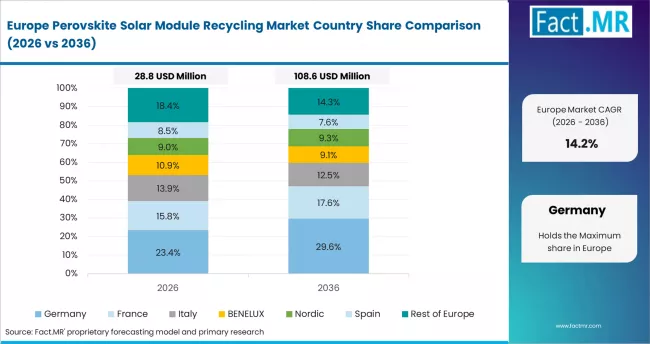
Perovskite Solar Module Recycling Market Europe Country Market Share Analysis, 2026 & 2036 | Source: Fact.MR
Europe operates as the photovoltaic circular economy compliance benchmark, supported by structured electronic waste directives and investment in advanced solar material recovery technologies. Veolia Environnement S.A. strengthens photovoltaic recycling engineering capability. ROSI Solar supports silver recovery technology innovation. First Solar Inc. expands module recycling engineering solutions.
- United Kingdom: Adoption of perovskite solar module recycling in United Kingdom is expected to expand at 17.2% CAGR through 2036. Waste Electrical and Electronic Equipment Directive compliance update (Environment Agency, February 2024) supports solar module recycling technology deployment. Veolia Environnement S.A. expanded photovoltaic waste processing capability (July 2023).
- Germany: Germany is anticipated to observe 16.9% CAGR in perovskite solar module recycling through 2036. EU Circular Economy Action Plan photovoltaic recovery alignment update (Federal Environment Agency, October 2023) supports material extraction technology adoption. ROSI Solar expanded advanced solar recycling engineering capability (April 2023).
North America
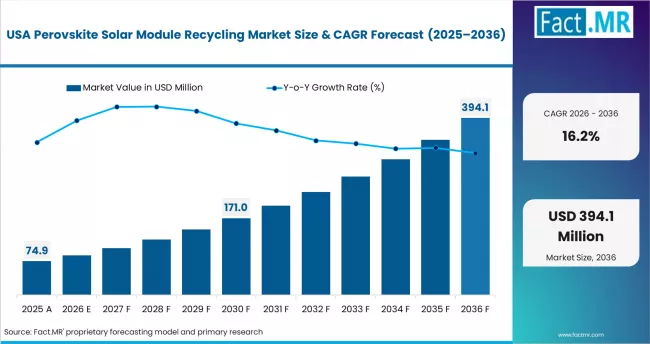
Perovskite Solar Module Recycling Market Country Value Analysis | Source: Fact.MR
North America represents the photovoltaic material recovery commercialization environment, supported by expansion of renewable energy installations and development of end-of-life solar module recycling infrastructure. First Solar Inc. strengthens photovoltaic recycling technology capability. Veolia North America expands electronic waste processing infrastructure. Solarcycle Inc. supports advanced material recovery platform development.
- United States: The United States is forecast to witness 16.2% CAGR in perovskite solar module recycling through 2036. Department of Energy solar lifecycle sustainability programme update (April 2024) supports photovoltaic recycling technology deployment. Solarcycle Inc. expanded solar module material recovery engineering capability (August 2023).
Fact MR's analysis of perovskite solar module recycling market in global regions consists of country-wise assessment that includes China, India, United Kingdom, Germany, and United States. Readers can find photovoltaic recycling technology trends, solar material recovery developments, circular economy signals, and competitive positioning across key markets.
Competitive Landscape
Competitive Structure and Buyer Dynamics in the Perovskite Solar Module Recycling Market
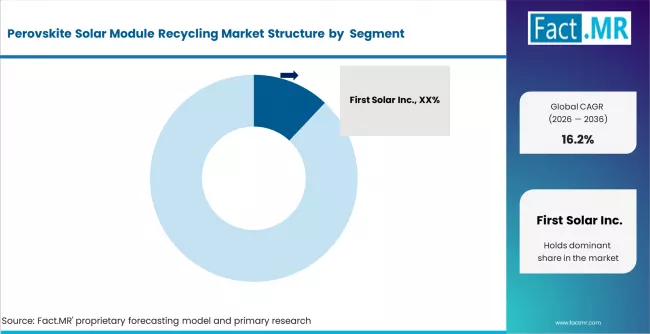
Perovskite Solar Module Recycling Market Analysis By Company | Source: Fact.MR
The competitive structure of the Perovskite Solar Module Recycling Market is moderately fragmented, with photovoltaic recycling specialists and environmental services companies participating in early stage recovery solutions. Companies such as Veolia Environment SA, Reiling GmbH & Co. KG, ROSI SAS, Envaris GmbH, Rinovasol Group, and Cleanaway Waste Management Ltd. maintain notable positions through expertise in electronic waste processing and photovoltaic material recovery. Additional participants including First Solar Inc., Canadian Solar Inc., Silcontel Ltd., and Echo Environmental LLC contribute through research initiatives and recycling process development for emerging perovskite module technologies. Competition is primarily influenced by material recovery efficiency, process scalability, regulatory compliance, and economic viability of recycling operations.
Several companies maintain structural advantages through established recycling infrastructure and strong expertise in photovoltaic waste processing technologies. Firms such as Veolia Environment SA and Reiling GmbH & Co. KG benefit from existing electronic material recovery networks supporting cost efficient processing. ROSI SAS and Envaris GmbH maintain advantages through specialized photovoltaic recycling technologies designed for material separation and purification. Solar manufacturers often collaborate with multiple recycling providers to reduce dependence on a single waste management partner and ensure regulatory compliance. Procurement decisions evaluate service providers based on recovery yield, process reliability, and long term economic feasibility, moderating supplier pricing leverage across solar module recycling services.
Key Players of the Perovskite Solar Module Recycling Market
- First Solar Inc.
- Veolia Environment SA
- Reiling GmbH & Co. KG
- ROSI SAS
- Canadian Solar Inc.
- Envaris GmbH
- Rinovasol Group
- Silcontel Ltd.
- Cleanaway Waste Management Ltd.
- Echo Environmental LLC
Bibliographies
- [1] Federal Environment Agency. (2023, October). EU circular economy action plan photovoltaic recovery alignment update. Government of Germany.
- [2] Ministry of New and Renewable Energy. (2024, January). National solar mission lifecycle management framework update. Government of India.
- [3] National Development and Reform Commission. (2024, March). Renewable energy circular economy development guideline update. Government of China.
- [4] U.S. Department of Energy. (2024, April). Solar lifecycle sustainability programme update. U.S. Department of Energy.
- [5] Environment Agency. (2024, February). Waste electrical and electronic equipment directive compliance update. UK Government.
- [6] First Solar Inc. (2023). Photovoltaic recycling process engineering capability expansion. First Solar Inc.
- [7] Trina Solar Co Ltd. (2023, June). Solar module recycling research capability expansion. Trina Solar Co Ltd.
- [8] Veolia Environnement SA. (2023, July). Photovoltaic waste processing capability expansion. Veolia Environnement SA.
- [9] ROSI Solar. (2023, April). Advanced solar recycling engineering capability expansion. ROSI Solar.
This Report Addresses
- Market size forecasts for 2026 to 2036 based on expansion of end-of-life processing requirements for next-generation perovskite photovoltaic modules.
- Opportunity mapping across mechanical recycling, thermal separation, chemical recovery, and solvent extraction processes supporting recovery of multilayer photovoltaic materials.
- Segment and regional forecasts covering recovery of glass substrates, conductive oxides, metals, polymers, and associated thin-film photovoltaic components.
- Competition benchmarking based on material recovery efficiency performance, process scalability characteristics, separation purity capability, and compatibility with photovoltaic manufacturing waste streams.
- Regulatory assessment covering electronic waste management frameworks and hazardous material handling requirements influencing photovoltaic recycling process adoption.
- Report delivery in PDF, Excel, PPT, and dashboard formats supporting photovoltaic manufacturers, recycling technology developers, environmental engineering firms, and material recovery specialists.
- Technology risk evaluation covering variability in module chemistry composition, process yield sensitivity, recycling cost structure, and evolving standards for lifecycle management of emerging photovoltaic materials.
Perovskite Solar Module Recycling Market Definition
The Perovskite Solar Module Recycling Market includes technologies, processes, and services used to recover valuable materials such as glass, conductive layers, metals, and perovskite compounds from end of life or defective perovskite photovoltaic modules to support resource recovery, waste reduction, and circular management of next generation solar panel materials.
Perovskite Solar Module Recycling Market Inclusions
The report includes global and regional market size estimates, forecast analysis, and segmentation by recycling technology, material recovery type, module structure, application stage, end use industry, pricing structure, and integration across photovoltaic waste management value chains.
Perovskite Solar Module Recycling Market Exclusions
The scope excludes recycling of conventional silicon based solar panels, photovoltaic module manufacturing equipment, solar installation services, and waste treatment processes not specifically designed for perovskite photovoltaic material recovery.
Perovskite Solar Module Recycling Market Research Methodology
- Primary Research: Interviews were conducted with photovoltaic recycling companies, material recovery technology providers, solar manufacturers, environmental engineering firms, and regulatory specialists.
- Desk Research: Public sources included photovoltaic research publications, regulatory documentation, company technical literature, patent filings, and studies on recycling of emerging solar cell materials.
- Market-Sizing and Forecasting: A hybrid model combining top-down solar capacity deployment evaluation and bottom-up analysis of perovskite module recycling process adoption was applied.
- Data Validation and Update Cycle: Outputs were validated through cross comparison of recycling technology data, expert consultation, and periodic monitoring of photovoltaic waste management developments.
Segmentation
Report Scope
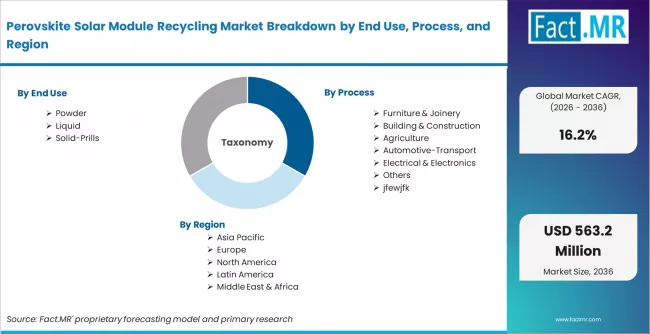
Perovskite Solar Module Recycling Market Breakdown By End Use, Process, And Region | Source: Fact.MR
| Metric | Value |
|---|---|
| Quantitative Units | USD 108.0 million (2026) to USD 486.0 million (2036), at a CAGR of 16.2% |
| Market Definition | The perovskite solar module recycling market includes material recovery processes designed to extract reusable glass, conductive layers, metals, and polymer components from end of life perovskite photovoltaic modules to support circular manufacturing and waste reduction. |
| Process Segmentation | Mechanical recycling, Thermal separation, Chemical recovery, Solvent extraction |
| Material Recovered Segmentation | Glass, Conductive oxides, Metals, Polymers, Other materials |
| End Use Segmentation | PV manufacturers, Material suppliers, Research institutes, Waste processors |
| Regions Covered | North America, Latin America, Europe, East Asia, South Asia, Oceania, Middle East and Africa |
| Countries Covered | United States, Canada, Germany, France, United Kingdom, Netherlands, Italy, Spain, China, Japan, South Korea, India, Singapore, Australia, Brazil, Mexico, United Arab Emirates, South Africa, and 40+ countries |
| Key Companies Profiled | First Solar Inc., Veolia Environment SA, Reiling GmbH & Co. KG, ROSI SAS, Canadian Solar Inc., Envaris GmbH, Rinovasol Group, Silcontel Ltd., Cleanaway Waste Management Ltd., Echo Environmental LLC |
| Forecast Period | 2026 to 2036 |
| Approach | Hybrid top-down and bottom-up market estimation based on photovoltaic waste volume benchmarking, solar module material recovery yield analysis, renewable energy lifecycle management trends, recycling infrastructure deployment rates, and validation through primary interviews with photovoltaic manufacturers, recycling technology providers, and environmental services companies. |
Source: Fact.MR analysis. Updated Apr 21, 2026
Perovskite Solar Module Recycling Market Key Segments
-
Process:
- Mechanical Recycling
- Thermal Separation
- Chemical Recovery
- Solvent Extraction
-
Material Recovered:
- Glass
- Conductive Oxides
- Metals
- Polymers
- Other Materials
-
End Use:
- PV Manufacturers
- Material Suppliers
- Research Institutes
- Waste Processors
-
Region:
- North America
- USA
- Canada
- Mexico
- Europe
- Germany
- UK
- France
- Italy
- Spain
- Nordic Countries
- BENELUX
- Rest of Europe
- Asia Pacific
- China
- Japan
- South Korea
- India
- Australia
- Rest of Asia Pacific
- Latin America
- Brazil
- Argentina
- Rest of Latin America
- Middle East and Africa
- Kingdom of Saudi Arabia
- United Arab Emirates
- South Africa
- Rest of Middle East and Africa
- Other Regions
- Oceania
- Central Asia
- Other Markets
- North America
Frequently Asked Questions
How large is the demand for Perovskite Solar Module Recycling in the global market in 2026?
What will be the market size of Perovskite Solar Module Recycling in the global market by 2036?
What is the expected demand growth for Perovskite Solar Module Recycling in the global market between 2026 and 2036?
Which company is identified as a leading participant in the Perovskite Solar Module Recycling market?
Which end use segment is projected to dominate perovskite solar module recycling demand by 2026?
Why is recycling of perovskite solar modules gaining relevance in photovoltaic manufacturing supply chains?
What is driving demand for perovskite solar module recycling systems in China?
What is the growth outlook for the Perovskite Solar Module Recycling market in China?
Why is India an important market for solar module recycling technologies?
What is the growth outlook for the Perovskite Solar Module Recycling market in India?
How is demand for perovskite solar module recycling evolving in the United Kingdom renewable energy sector?
What is the growth outlook for the Perovskite Solar Module Recycling market in the United Kingdom?
What is the growth outlook for the Perovskite Solar Module Recycling market in Germany?
How is the United States positioned in the Perovskite Solar Module Recycling market?
What is the growth outlook for the Perovskite Solar Module Recycling market in the United States?
What is perovskite solar module recycling and what is it mainly used for?
What does the Perovskite Solar Module Recycling market include in this report?
What applications are included in the scope of the Perovskite Solar Module Recycling market?
What is excluded from the scope of the Perovskite Solar Module Recycling market report?
What does market forecast mean in the Perovskite Solar Module Recycling market report?
How is the Perovskite Solar Module Recycling market forecast developed in this report?
What does primary validation indicate in the Perovskite Solar Module Recycling market analysis?
Who worked on this report


Preview the report firsthand - request a free sample
Free SampleGet the brochure for pricing and purchase details
Download PDF