- Base Value(2025): 1.2 Bn
- Estimated Value(2026): 1.2 Bn
- Forecast Value (2036): 2.4 Bn
- CAGR (2026 - 2036): 6.9%
Solar Light Tower Market Analysis and Forecast by Fact.MR
- The global solar light tower market covers solar-powered portable lighting systems used for construction sites, mining operations, oil and gas facilities, events, and emergency response applications.
- The category includes mobile solar light towers, static solar light towers, hybrid solar light towers, compact solar light towers, and high-mast solar light towers.
- These systems use LED lighting, solar photovoltaic, battery storage, control, and mobility technologies to deliver temporary site illumination without diesel generator dependency.
- Demand is shaped by construction site lighting requirements, mining operations, emission reduction targets, remote site electrification, and the growing adoption of zero-emission temporary lighting solutions.
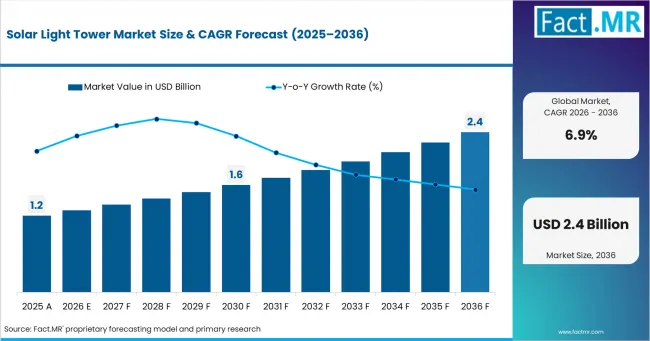
Solar Light Tower Market Market Value Analysis | Source: Fact.MR
Summary of Solar Light Tower Market Overview
- Market Snapshot
- In 2025, the global Solar Light Tower Market was valued at approximately USD 1.15 billion.
- The market is estimated to reach USD 1.23 billion in 2026 and is projected to attain USD 2.4 billion by 2036.
- The solar light tower market is likely to expand at a CAGR of 6.9% during the forecast period.
- The market is anticipated to create an absolute dollar opportunity of USD 1.17 billion between 2026 and 2036.
- Mobile Solar Light Towers accounts for 46% of product share in 2026.
- India (9.2%) and China (8%) are the key growth markets during the forecast period.
- Demand and Growth Drivers
- Construction site lighting requirements are generating the largest demand for solar light towers, with builders seeking zero-emission, low-noise alternatives to diesel-powered lighting for night work and site security.
- Mining operations require reliable portable lighting for pit illumination, haul road lighting, and camp area lighting in remote locations where solar operation reduces fuel logistics.
- Oil and gas facility temporary lighting for construction, turnarounds, and remote operations is driving adoption of solar light towers that eliminate diesel refueling and exhaust emissions.
- Event and emergency lighting applications use solar light towers for temporary illumination at outdoor venues, disaster relief sites, and public safety operations.
- Emission reduction targets and noise regulation compliance are accelerating the transition from diesel to solar light towers across regulated construction and industrial sites.
- Product and Segment View
- Mobile Solar Light Towers account for 46% of the product segment in 2026, supported by broad applicability and established installed base across core end-use verticals.
- Construction Sites represents 55% of the application segment in 2026, with demand shaped by institutional procurement, regulatory requirements, and expanding professional adoption.
- Lighting Technology accounts for 65% of the technology segment, reflecting its established position as the standard operational approach.
- Key segmentation includes:
- Product: Mobile Solar Light Towers, Static Solar Light Towers, Hybrid Solar Light Towers, Compact Solar Light Towers, High Mast Solar Light Towers
- Application: Construction Sites, Mining Operations, Oil and Gas Operations, Events and Emergency
- Distribution Channel: Direct Sales, Distributors, Rental Services, Aftermarket Services
- These systems enable:
- Measurement, monitoring, or control functions across distributed operational environments.
- Remote management and data integration through connected platforms.
- Performance optimization in applications where precision and reliability are primary procurement criteria.
- Geography and Competitive Outlook
- North America shows stable demand supported by established end-use verticals, replacement cycles, and technology upgrade activity.
- Europe is experiencing steady growth from regulatory compliance, process modernization, and expanding professional adoption.
- Asia Pacific is the fastest-growing region, with India (9.2%) and China (8%) leading demand expansion.
- Key companies include Aggreko, Wacker Neuson, Enersys, Allmand, Generac, and Atlas Copco, Solaris, Hitachi Power Solutions.
- Analyst Opinion
- Shambhu Nath Jha, Principal Consultant at Fact.MR, says 'The solar light tower market is shaped by the diesel-to-solar transition in temporary site lighting. Mobile solar light towers lead because they combine portability, autonomous solar operation, and zero direct emissions in the form factor that construction and mining sites require. Construction sites account for the largest application because every building site needs temporary lighting and increasingly faces emission and noise restrictions that favor solar over diesel. India and China are the fastest-growing markets because construction activity, mining expansion, and solar technology adoption are creating large-volume procurement demand. The strategic inflection is rental fleet conversion: when major rental companies convert their light tower fleets from diesel to solar, market growth accelerates, because rental is the primary channel for temporary lighting equipment.'
Key Growth Drivers, Constraints, and Opportunities
.webp "Top Country Growth Comparison Solar Light Tower Market Cagr (2026 2036)")
Top Country Growth Comparison Solar Light Tower Market Cagr (2026 2036) | Source: Fact.MR
Key Factors Driving Growth
- Construction site emission and noise restrictions are driving the move from diesel to solar light towers, with zero-emission operation becoming a spec requirement on regulated sites.
- Solar light towers are being used in remote locations to help reduce diesel fuel logistics, lower operating costs and meet environmental compliance targets.
- Customer demand for zero-emission temporary lighting solutions is driving rental fleet operators’ transition from diesel to solar light towers.
Key Market Constraints
- Higher upfront cost compared to diesel light towers limits adoption in price-sensitive markets where fuel cost savings are evaluated over short rental periods.
- Weather and seasonal dependency of solar charging creates performance variability, requiring battery storage sizing that adds weight and cost to solar light tower designs.
- Low awareness and availability in certain developing markets retards the adoption of solar light towers despite good solar resource conditions.
Key Opportunity Areas
- Hybrid solar-battery light towers with diesel backup are serving as a bridge technology for operators transitioning from diesel to fully solar systems.
- Smart solar light towers with remote monitoring, GPS tracking, and automated dimming are creating premium demand in fleet management applications.
- Off-grid and remote site electrification using solar light towers with power outlet capability is expanding the use case beyond pure lighting into portable energy supply.
Segment-wise Analysis of the Solar Light Tower Market
- Mobile Solar Light Towers are expected to hold 46% of the product segment in 2026 due to their wider applicability, less complexity and continued usage in the largest end-use verticals.
- Construction Sites is expected to account for 55% of the application segment in 2026 with institutional demand, regulatory requirements and professional use as the key demand channels.
- Lighting Technology is the largest technology segment at 65%, reflecting its established operational role and large installed base.
The solar light tower market is segmented by product, application, end use, technology, formulation, distribution channel and region. Based on Product, the market is segmented into Mobile Solar Light Towers, Static Solar Light Towers, Hybrid Solar Light Towers, Compact Solar Light Towers, High Mast Solar Light Towers. Coverage by application include Construction Sites, Mining Operations, Oil and Gas Operations, Events and Emergency Mobile Solar Light Towers are leading the value in the near term, owing to their installed base and wide applicability. Emerging segments are expected to drive the next phase of growth as requirements change.
Which Product Segment Dominates the Solar Light Tower Market?
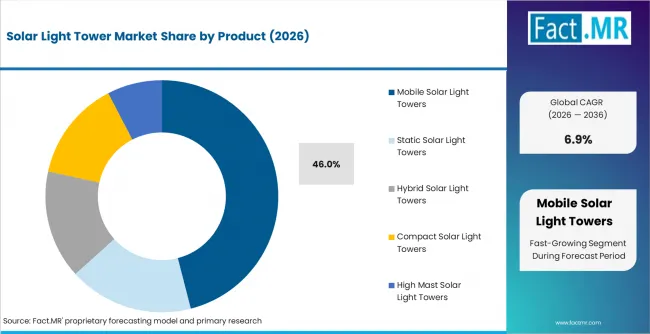
Solar Light Tower Market Analysis By Product | Source: Fact.MR
Mobile solar light towers are expected to have 46.0% share of the product type segment in 2026. Their leadership is a clear example of the critical need for portable, towable lighting systems that can be deployed, moved and relocated around active construction, mining and event sites without the need for a grid connection or fuel supply. Static solar light towers are expected to account for the second-largest share of demand as these are well suited for semi-permanent setups at mining camps, remote facilities, and infrastructure sites where the lighting positions remain fixed for long durations.
Which Application Segment Dominates the Solar Light Tower Market?
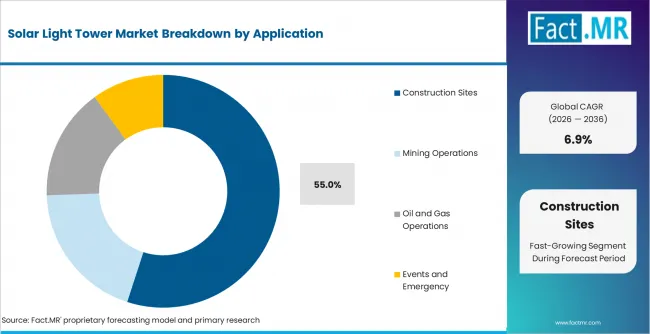
Solar Light Tower Market Analysis By Application | Source: Fact.MR
The application segment is projected to account for 55.0% for construction sites in 2026. This predominance is due to the volume of demand for temporary lighting in building sites, road construction, infra-structure projects and utility work where portable lighting is necessary for night operations. Mining operations are the second largest application, driven by demand for pit lighting, haul road illumination and camp area lighting in remote areas where solar operation reduces fuel dependency and operating cost.
Which Product Trend is Shaping the Next Phase of Growth in the Solar Light Tower Market?
Smart and hybrid solar light towers with remote monitoring and power outlet capability are not standard configuration yet but the fastest growing segment. Their share is likely to grow as rental fleet operators and site managers seek connected equipment, GPS tracking, automated dimming and the ability to double as portable power sources. The shift to smart solar towers is a sign of fleet digitalization and the broadening use case beyond just lighting. Site managers are increasingly looking for light towers that can report battery status, solar charge status and location to centralized fleet platforms. Manufacturers with cellular connectivity, automated scheduling and auxiliary power outlets on towers are well positioned to tap premium demand from rental companies and large construction operators.
Regional Outlook Across Key Markets
- India leads growth at 9.2%, supported by expanding domestic demand, infrastructure investment, and policy-driven adoption.
- North America shows mixed growth, with the U.S. at 6.5% reflecting a mature market with established replacement cycles and technology upgrade activity.
- European demand remains steady, with Germany at 6% supported by regulatory compliance, process modernization, and quality-driven procurement.
Top Country Growth Comparison Solar Light Tower Market Cagr (2026 2036) | Source: Fact.MR
CAGR Table
| Country | CAGR (%) |
|---|---|
| India | 9.2% |
| China | 8% |
| Australia | 7.8% |
| South Africa | 7% |
| USA | 6.5% |
| Canada | 6.2% |
| Germany | 6% |
Source: Fact.MR analysis. Updated May 22, 2026
Source: Fact MR (FMR) analysis, based on proprietary forecasting model and primary research.
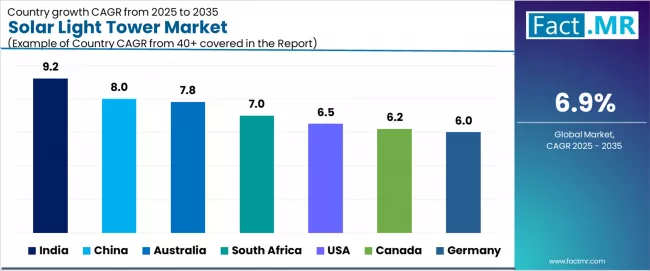
Solar Light Tower Market Cagr Analysis By Country | Source: Fact.MR
Market Outlook for Solar Light Towers in India
The India solar light tower market is projected to grow at a CAGR of 9.2% through 2036. Demand is shaped by construction activity, mining operations, solar resource advantage, and growing emission awareness on project sites.
- Construction activity drives the largest procurement volume.
- Mining operations generate demand for remote-site solar lighting.
- Solar resource advantage supports favorable operating economics.
China Solar Light Tower Demand Trends
The China solar light tower market is projected to grow at a CAGR of 8.0% through 2036. Demand is supported by construction, mining, emission regulation, and domestic solar light tower manufacturing capability.
- Construction generates core solar light tower demand.
- Mining operations drive remote-site lighting procurement.
- Domestic manufacturing supports competitive pricing and scale.
Australia Solar Light Tower Growth Assessment
The Australia solar light tower market is projected to grow at a CAGR of 7.8% through 2036. Demand is supported by mining operations, construction activity, strong solar resource, and emission reduction targets.
- Mining operations drive large-volume solar lighting demand.
- Strong solar resource supports favorable performance economics.
- Emission reduction targets accelerate diesel-to-solar conversion.
South Africa Solar Light Tower Market Demand Analysis
The South Africa solar light tower market is projected to grow at a CAGR of 7.0% through 2036. Demand is supported by mining activity, construction growth, and the advantage of solar operation in areas with unreliable grid electricity.
- Mining activity drives portable solar lighting demand.
- Construction growth generates temporary lighting procurement.
- Grid unreliability makes solar autonomy a practical advantage.
United States Solar Light Tower Market Outlook
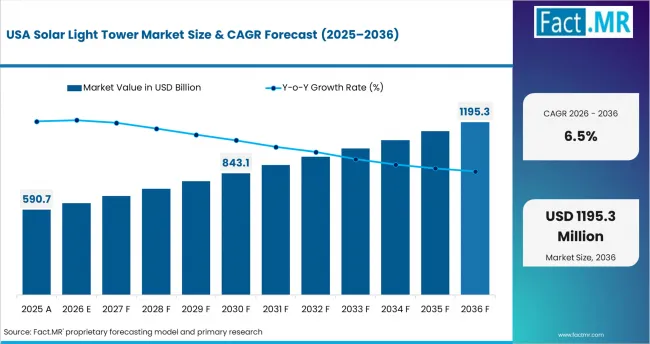
Solar Light Tower Market Country Value Analysis | Source: Fact.MR
The U.S. solar light tower market is projected to grow at a CAGR of 6.5% through 2036. Demand is supported by construction emission regulation, rental fleet conversion, and infrastructure project lighting requirements.
- Construction emission regulation drives diesel-to-solar transition.
- Rental fleet conversion accelerates solar light tower adoption.
- Infrastructure projects generate portable lighting demand.
Canada Solar Light Tower Growth Assessment
The Canada solar light tower market is projected to grow at a CAGR of 6.2% through 2036. Demand is supported by mining operations, construction activity, and emission reduction targets for temporary equipment.
- Mining operations drive remote-site solar lighting demand.
- Construction activity generates portable lighting procurement.
- Emission targets support zero-emission equipment adoption.
Germany Solar Light Tower Market Demand Analysis
The Germany solar light tower market is projected to grow at a CAGR of 6.0% through 2036. Demand is supported by construction emission standards, event lighting, and the transition toward zero-emission temporary equipment.
- Construction emission standards drive solar light tower specification.
- Event lighting generates temporary solar illumination demand.
- Zero-emission equipment transition sustains solar adoption.
Competitive Benchmarking and Company Positioning
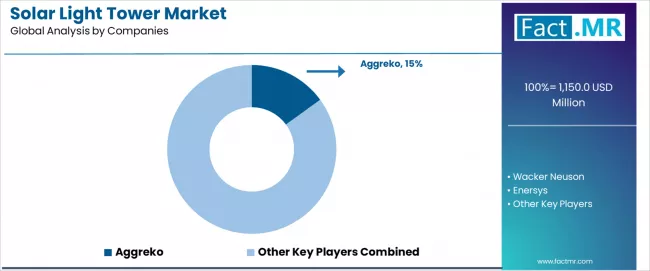
Solar Light Tower Market Analysis By Company | Source: Fact.MR
Solar Light Tower Market Analysis By Company
- Aggreko, Wacker Neuson, EnerSys, and Allmand have a strong presence in the global solar light tower market due to wide temporary power and lighting offerings, long-standing rental fleet relationships, and growing investments in solar and hybrid product offerings.
- Generac, Atlas Copco, Solaris and Hitachi Power Solutions compete on the basis of distinct solar technology capability, regional distribution strength and targeted positions in construction, mining and event lighting segments.
- Competition is increasingly defined by solar autonomy, battery capacity and smart fleet management, with manufacturers offering connected, GPS tracked solar light towers with remote monitoring getting specification advantage in rental fleet procurement.
The competitive landscape consists of the global temporary power companies and the specialized solar lighting manufacturers. Aggreko, Wacker Neuson, EnerSys and Allmand are competing for established rental fleet positions, broad distribution and growing solar product portfolios.
Generac, Atlas Copco, Solaris, Hitachi and Denyo are in position because of specific technology capability, regional distribution and targeted application focus.
Tower Light, JCB, Ritchie Engineering, Kingspan, GreenTower and Filippi compete in certain solar configurations, regional markets and niche applications.
Our strategic priorities are growing our solar and hybrid light tower portfolios, developing smart fleet management capability, strengthening relationships with rental companies and growing our distribution in high-growth mining and construction markets.
Key Companies in the Solar Light Tower Market
- Aggreko, Wacker Neuson, Enersys, Allmand are among the leading players in the solar light tower market globally, supported by strong brand visibility, broad product portfolios, and established positions across core end-use segments.
- Generac, Atlas Copco, Solaris, Hitachi Power Solutions hold established positions across specific application verticals, geographic markets, and technology tiers, supported by product quality, distribution penetration, and category experience.
- Denyo, Tower Light, JCB, Ritchie Engineering, Kingspan, GreenTower, Filippi continue to compete through focused product offerings, price-point coverage, and niche strength in specific applications or regional markets.
Recent Industry Developments
- The Solar Light Tower Market is expected to grow steadily over the next decade, supported by demand for cleaner, lower-emission site lighting.
- Its growth is driven by use in construction, mining, and off-grid work sites, where solar systems help reduce fuel use and operating costs.
- The market is also moving toward smart and hybrid light towers with battery storage, LED lamps, and remote monitoring to improve runtime and flexibility.
Leading Companies Shaping the Solar Light Tower Market
- Aggreko
- Wacker Neuson
- Enersys
- Allmand
- Generac
- Atlas Copco
- Solaris
- Hitachi Power Solutions
- Denyo
- Tower Light
- JCB
- Ritchie Engineering
- Kingspan
- GreenTower
- Filippi
Solar Light Tower Market Segmentation
-
Solar Light Tower Market Segmented by Product:
- Mobile Solar Light Towers
- Trailer Mounted Towers
- Towable Light Towers
- Heavy Duty Mobile Towers
- Skid Mounted Towers
- Compact Portable Towers
- Industrial Skid Systems
- Trailer Mounted Towers
- Static Solar Light Towers
- Fixed Installation Towers
- Construction Site Lighting Towers
- Infrastructure Lighting Systems
- Pole Mounted Towers
- Permanent Area Lighting
- Utility Lighting Systems
- Fixed Installation Towers
- Hybrid Solar Light Towers
- Solar Diesel Hybrid Towers
- Backup Generator Towers
- High Power Hybrid Systems
- Solar Battery Hybrid Towers
- Energy Storage Integrated Towers
- Off Grid Hybrid Systems
- Solar Diesel Hybrid Towers
- Compact Solar Light Towers
- Portable Units
- Hand Carry Towers
- Small Area Lighting Units
- Foldable Towers
- Collapsible Mast Systems
- Quick Deployment Towers
- Portable Units
- High Mast Solar Light Towers
- Telescopic Mast Towers
- High Reach Lighting Towers
- Wide Area Coverage Towers
- Fixed High Mast Towers
- Stadium Lighting Towers
- Large Area Illumination Systems
-
Solar Light Tower Market Segmented by Application:
- Construction Sites
- Infrastructure Construction
- Road Construction Projects
- Bridge Construction Sites
- Building Construction
- Residential Projects
- Commercial Projects
- Infrastructure Construction
- Mining Operations
- Surface Mining
- Open Pit Mining
- Quarry Operations
- Underground Mining
- Tunnel Lighting
- Shaft Operations
- Surface Mining
- Oil and Gas Operations
- Upstream Sites
- Drilling Site Lighting
- Exploration Camps
- Midstream and Downstream
- Pipeline Projects
- Refinery Maintenance
- Upstream Sites
- Events and Emergency
- Event Lighting
- Outdoor Events
- Temporary Installations
- Emergency Response
- Disaster Relief Operations
- Military Deployments
- Event Lighting
-
Solar Light Tower Market Segmented by End Use:
- Construction Companies
- Infrastructure Contractors
- Road and Highway Contractors
- Bridge Contractors
- Building Contractors
- Residential Builders
- Commercial Builders
- Infrastructure Contractors
- Mining Companies
- Large Mining Operators
- Global Mining Firms
- Regional Mining Companies
- Small Mining Operators
- Local Quarry Operators
- Independent Miners
- Large Mining Operators
- Oil and Gas Companies
- Exploration Companies
- Upstream Operators
- Drilling Contractors
- Processing Companies
- Refinery Operators
- Pipeline Operators
- Exploration Companies
- Government and Defense
- Public Authorities
- Municipal Corporations
- Disaster Management Agencies
- Defense Sector
- Military Units
- Border Security Forces
- Public Authorities
-
Solar Light Tower Market Segmented by Technology:
- Lighting Technology
- LED Lighting
- High Efficiency LED Lights
- Long Life LED Systems
- Conventional Lighting
- Halogen Lamps
- Metal Halide Lamps
- LED Lighting
- Solar Technology
- Photovoltaic Panels
- Monocrystalline Panels
- Polycrystalline Panels
- Energy Storage
- Lithium Ion Batteries
- Lead Acid Batteries
- Photovoltaic Panels
- Control Technology
- Manual Control
- Basic Switch Controls
- Timer Based Systems
- Smart Control
- Remote Monitoring Systems
- IoT Enabled Controllers
- Manual Control
- Mobility Technology
- Manual Mobility
- Towable Systems
- Portable Units
- Automated Mobility
- Self Deploying Towers
- Hydraulic Mast Systems
- Manual Mobility
-
Solar Light Tower Market Segmented by Formulation:
- Equipment Systems
- Light Tower Units
- Mobile Light Towers
- Static Light Towers
- Supporting Components
- Solar Panels
- Battery Systems
- Light Tower Units
- Integrated Systems
- Hybrid Systems
- Solar Diesel Systems
- Solar Battery Systems
- Power Management Systems
- Energy Storage Systems
- Load Management Systems
- Hybrid Systems
- Software Systems
- Control Software
- Lighting Control Systems
- Remote Monitoring Software
- Analytics Software
- Performance Monitoring Tools
- Energy Usage Analysis
- Control Software
- Service Systems
- Maintenance Services
- Repair Services
- Spare Parts Supply
- Upgrade Services
- System Upgrades
- Technology Enhancement Services
- Maintenance Services
-
Solar Light Tower Market Segmented by Distribution Channel:
- Direct Sales
- OEM Sales
- Construction Equipment Manufacturers
- Lighting Equipment Suppliers
- Project Sales
- Infrastructure Projects
- Mining Projects
- OEM Sales
- Distributors
- Industrial Distributors
- Equipment Dealers
- Regional Distributors
- Retail Dealers
- Local Equipment Suppliers
- Specialized Lighting Dealers
- Industrial Distributors
- Rental Services
- Short Term Rentals
- Event Rentals
- Construction Rentals
- Long Term Rentals
- Project Based Rentals
- Leasing Services
- Short Term Rentals
- Aftermarket Services
- Maintenance Services
- Repair Service Providers
- Spare Parts Suppliers
- Upgrade Services
- Equipment Upgrade Providers
- Technology Service Providers
- Maintenance Services
-
Solar Light Tower Market by Region:
- North America
- USA
- Canada
- Mexico
- Latin America
- Brazil
- Chile
- Rest of Latin America
- Western Europe
- Germany
- UK
- Italy
- Spain
- France
- Nordic
- BENELUX
- Rest of Western Europe
- Eastern Europe
- Russia
- Poland
- Hungary
- Balkan & Baltic
- Rest of Eastern Europe
- East Asia
- China
- Japan
- South Korea
- South Asia and Pacific
- India
- ASEAN
- Australia & New Zealand
- Rest of South Asia and Pacific
- Middle East & Africa
- Kingdom of Saudi Arabia
- Other GCC Countries
- Turkiye
- South Africa
- Other African Union
- Rest of Middle East & Africa
- Telescopic Mast Towers
Sources and Research References
- Wacker Neuson. Zero-emission solar light tower and fleet management updates.
- Generac. Smart solar light tower platform and connected equipment updates.
- Atlas Copco. Hybrid solar-diesel light tower and rental fleet transition products.
- Construction equipment rental statistics, mining operations data, temporary lighting market reports, and solar equipment industry publications.
- Primary interviews with light tower manufacturers, rental fleet operators, construction contractors, mining companies, and event management firms.
This bibliography is provided for reader reference and is not exhaustive. The full report contains the complete reference list and detailed citations.
Key Questions This Report Addresses
- What is the current and future size of the Solar Light Tower Market?
- How fast is the market expected to grow between 2026 and 2036?
- Which product type is likely to lead the market by 2026?
- Which application segment accounts for the highest demand by 2026?
- What factors are driving demand for solar light towers globally?
- How is the diesel-to-solar transition influencing the market?
- Why are India and China the fastest-growing markets?
- How are rental fleet operators shaping market growth?
- Which countries are projected to show the fastest growth through 2036?
- Who are the key companies active in the Solar Light Tower Market?
- How does Fact.MR estimate and validate the market forecast?
Solar Light Tower Market Defination
The solar light tower market covers solar-powered portable lighting systems for construction, mining, oil and gas, events, and emergency applications across mobile, static, hybrid, compact, and high-mast configurations.
Solar Light Tower Market Inclusions
- The scope covers global and regional market size and forecasts for 2026 to 2036 across product type, application, end use, technology, formulation, and distribution channel.
- It includes regional demand analysis based on construction activity, mining operations, emission regulation, and rental fleet conversion trends.
- The report covers technology trends, market drivers and constraints, and the competitive landscape, including product portfolios, rental relationships, and solar technology capability.
- It includes pricing and cost analysis across mobile, static, hybrid, and smart solar light tower categories.
Solar Light Tower Market Exclusions
- The scope excludes diesel-only light towers without solar capability.
- It excludes permanent street lighting, building-mounted lights, and grid-connected outdoor lighting fixtures.
- The report excludes solar panels, batteries, and LED modules sold independently as components.
- It also excludes diesel generators, portable power stations, and temporary power equipment without integrated lighting.
Solar Light Tower Market Research Methodology
- The methodology combines secondary research, primary interviews, and forecast modelling.
- It draws on 100+ secondary sources and benchmarks 50+ company product portfolios.
- Market sizing covers 30+ countries through a demand-side model, supported by top-down validation.
- Key inputs include application demand trends, regulatory activity, end-use adoption rates, pricing analysis, and distribution penetration.
- The model cross-checks demand with shipments, pricing trends, channel mix, and product launches.
- Primary validation includes 25+ interviews across manufacturers, distributors, end users, and industry participants.
- Final estimates go through trade-flow checks, sales-pattern review, and sensitivity testing.
Segmentation
Scope of Analysis
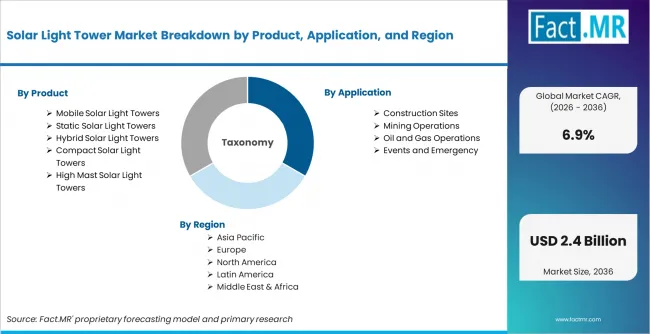
Solar Light Tower Market Breakdown By Product, Application, And Region | Source: Fact.MR
| Parameter | Details |
|---|---|
| Quantitative Units | USD 1.23 billion to USD 2.4 billion, at a CAGR of 6.9% |
| Market Definition | The solar light tower market covers solar-powered portable lighting systems for construction, mining, oil and gas, events, and emergency applications across mobile, static, hybrid, compact, and high-mast configurations. |
| Regions Covered | North America, Latin America, Europe, East Asia, South Asia and Pacific, Middle East and Africa |
| Countries Covered | India, China, Australia, South Africa, USA, Canada, Germany, 30 plus countries |
| Key Companies | Aggreko, Wacker Neuson, Enersys, Allmand, Generac, Atlas Copco, Solaris, Hitachi Power Solutions, Denyo, Tower Light, JCB, Ritchie Engineering, Kingspan, GreenTower, Filippi |
| Forecast Period | 2026 to 2036 |
| Approach | Hybrid demand-side and top-down methodology built on country-level application demand, product benchmarking, pricing analysis, shipment validation, and primary interviews across manufacturers, distributors, and end users |
Source: Fact.MR analysis. Updated May 22, 2026
Frequently Asked Questions
How big is the Solar Light Tower Market in 2025?
What will be the size of the Solar Light Tower Market in 2036?
How much will the Solar Light Tower Market grow between 2026 and 2036?
What are the key product types in the Solar Light Tower Market?
Which application segment will contribute significant share in the Solar Light Tower Market in 2026?
Who worked on this report


Preview the report firsthand - request a free sample
Free SampleGet the brochure for pricing and purchase details
Download PDF