- Market Value (2025): USD 634.2 Mn
- Estimated Value (2026): USD 693.0 Mn
- Forecast Value (2036): USD 1683.2 Mn
- CAGR (2026-2036): 9.3%
What is the PFAS-Free Automotive Interior Additives Market forecast to be worth by 2036?
USD 693.0 million in 2026 to USD 1683.2 million by 2036 at a 9.3% CAGR.
- The market was valued at USD 634.2 million in 2025.
- Demand will increase from USD 693.0 million in 2026 to USD 1683.2 million by 2036.
- The market is forecast to record 9.3% CAGR from 2026 to 2036 as cabin mixers test PFAS-free odor control systems for PP, TPO and engineering resins.
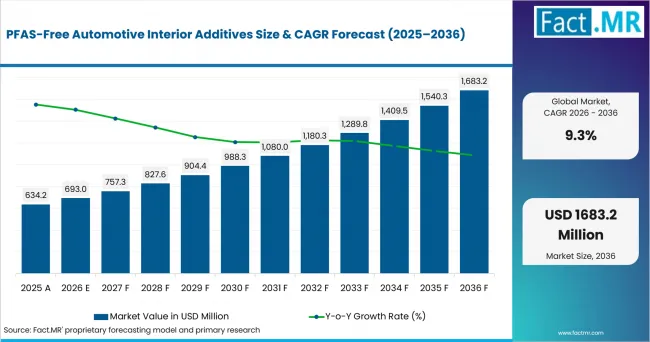
Pfas Free Automotive Interior Additives Value Analysis | Source: Fact.MR
What are the defining numbers behind PFAS-Free Automotive Interior Additives Market growth?
An absolute opportunity of USD 990.2 million is expected between 2026 and 2036.
- Demand Drivers in the Market
- cabin mixers need odor control that remains effective after molding and heat exposure. Cabin materials can release volatile mixes when surface temperature rises, so formulators assess odor control together with emission behavior. agents that capture aldehydes, amines or sulfur-based odorants will gain attention when they maintain surface finish and keep fluorinated chemistry outside the mix. This makes the choice easier to review. It also keeps the test plan clear. This can save time. It can also help firms pick the right mix.
- Polypropylene formulators need agent systems that disperse cleanly in high-volume cabin mixes. The test is direct. Check the mix, the heat, and the final part.
- Tier 1 cabin firms need records that supports material records and chemical checks. In April 2026, the U.S. Environmental Protection Agency confirmed that TSCA section 8(a)(7) covers PFAS manufactured or imported during 2011 through 2022. For companies subject to TSCA section 8(a)(7), EPA requires reporting of information including PFAS chemical identity and uses. Applying that records discipline to replacement-agent testing is an analytical implication rather than a separate EPA need for car material teams.
- Key Segments Analyzed
- By odor control Chemistry: Cyclodextrin system will hold 27.0% share in 2026 because molecule capture can capture selected volatile odor molecules while using a non-fluorinated mix route.
- By Target Odor: VOC / aldehyde will account for 31.0% share in 2026 as cabin-air and fogging specs keep vapors visible during cabin material approval.
- By cabin resin / Substrate: PP will capture 41.0% share in 2026 owing to its broad use in instrument panels, door trims, consoles and other molded cabin parts.
- By use: cabins will represent 40.0% share in 2026, reflecting the market boundary around cabin materials where odor, VOC and PFAS-free mix needs overlap.
- Analyst Opinion at Fact.MR
- Shambhu Nath Jha, Principal Consultant at Fact.MR, states, “The main challenge extends beyond removing one fluorinated ingredient. cabin firms must preserve odor control, surface finish and molding stability after mix change. Demand will favor agent firms that can document PFAS-free chemistry while matching the resin-specific results needed by car testing programs.” This makes the choice easier to review. It also keeps the test plan clear. The main need is clear. The agent must work well in the final part.
- Strategic Implications
- agent formulators should publish resin-specific dosage windows and emission data so cabin mixers can compare odor reduction with fewer avoidable trial cycles. Data should identify the host resin and processing temperature because an agent that performs well in PP can behave differently in TPO or an engineering resin.
- Tier 1 firms should test alternatives by substrate and temperature exposure because the same odor control chemistry can behave differently in PP, TPO and engineering resins. testing plans will carry more weight when they connect sensory results with fogging, surface appearance and heat-aging results for the intended cabin component.
- Masterbatch producers should maintain regional rule records because chemical rules and reporting rules differ across the USA, Europe and Asian vehicle supply chains. A clear declaration of added PFAS status, carrier resin and recommended dosage can shorten technical review when one cabin mix is reviewed for several vehicle programs.
Portugal will record 12.0% CAGR through 2036, supported by an export-oriented vehicle and components base. The USA is forecast to post 10.0% as PFAS reporting and large vehicle volumes increase mix scrutiny. Japan will reach 9.3% through continued car output and material quality needs. Germany is estimated at 8.3%, while France is projected at 7.0% as European car and PFAS rules shape agent testing. This gives firms a clear check point. It can also cut trial time. The test is direct. Check the mix, the heat, and the final part.
How does the PFAS-Free Automotive Interior Additives Market break down by segment?
PP will lead cabin resin / Substrate at 41.0% share in 2026. cabins lead use at 40.0% share. The focus stays on fit and results. That helps teams compare options. The rule is simple. Keep the mix safe and the end use clear.
Which Odor-Control Chemistry holds the largest share?
Cyclodextrin system will hold 27.0% share in 2026.
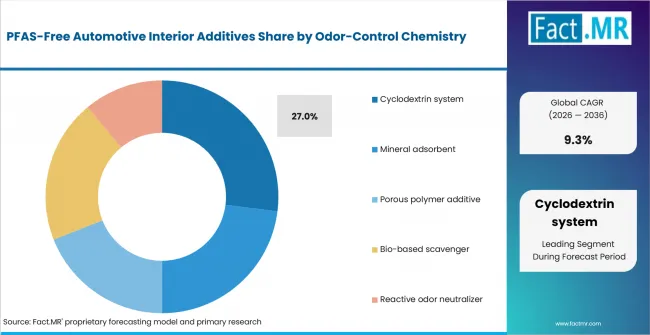
Pfas Free Automotive Interior Additives Analysis By Odor Control Chemistry | Source: Fact.MR
Cyclodextrin systems are positioned around small cavities that can host selected volatile mixes. That mechanism suits cabin mixes where odor reduction must preserve a neutral sensory profile. Mineral sorbents address broader physical adsorption needs and can be incorporated through established compounding routes. Porous resin agents offer another route when formulators need tunable affinity toward selected volatiles. Bio-based odor traps serve programs that place added weight on feedstock choice. Reactive odor blockers are used when the target odorant can be bound or converted chemically. firm selection is therefore expected to depend on odor spectrum, heat stability, dosing efficiency and fit with the host resin.
What leads the Target Odor segment?
VOC / aldehyde will account for 31.0% share in 2026.
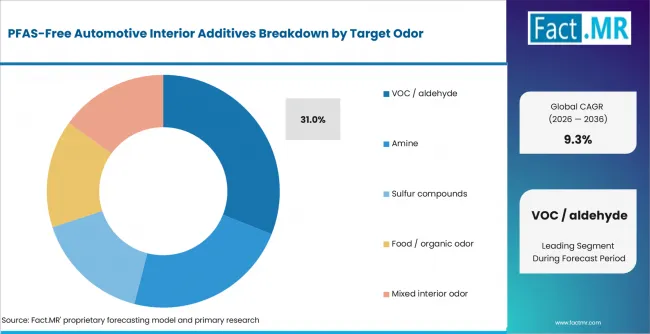
Pfas Free Automotive Interior Additives Analysis By Target Odor | Source: Fact.MR
VOC and aldehyde control carries the largest share because cabins combine large resin surface areas with elevated cabin temperatures. Material teams evaluate emissions from molded plastics and soft trim during cabin-air testing. Coatings and adhesives add further volatile sources around the same cabin assembly. Amine control is relevant to recycled or chemically modified resins, while sulfur-mix treatment serves more specific odor profiles. Food and organic odor management extends the chemistry toward packaging and consumer uses. Mixed cabin odor systems address several odor families where a broad treatment window is preferred.
How does Interior Polymer / Substrate shape demand?
PP will capture 41.0% share in 2026.
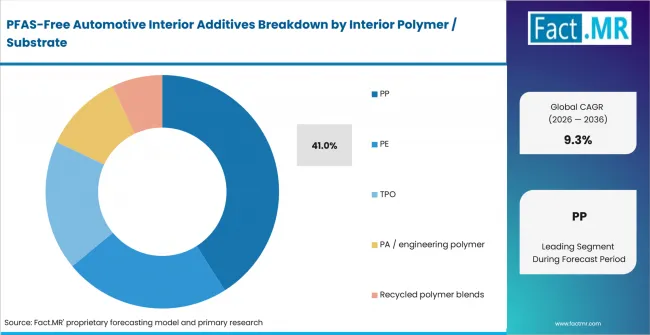
Pfas Free Automotive Interior Additives Analysis By Interior Polymer Substrate | Source: Fact.MR
PP leads the resin split because it is widely used in molded cabin parts and supports cost-efficient mineral-filled mixes. PE is relevant to films and soft structures that use similar masterbatch delivery routes. TPO connects directly with skins and flexible trim where odor results must be balanced with surface finish. PA and engineering resins create a higher-temperature testing environment that favors thermally stable agent packages. Recycled resin blends introduce broader odor variability because feedstock history differs by stream. That variability increases the value of broad-spectrum sorbents and reactive odor blockers that can tolerate changing volatile profiles.
What supports Automotive interiors within Application?
cabins will represent 40.0% share in 2026.
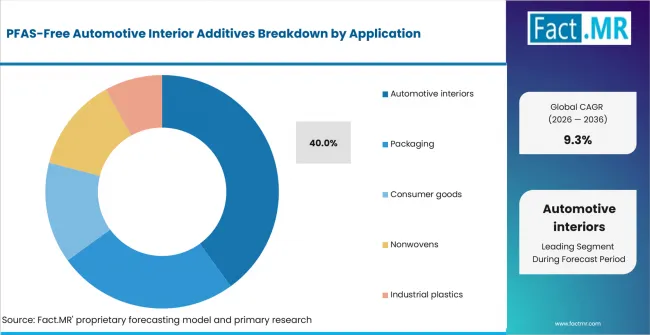
Pfas Free Automotive Interior Additives Analysis By Application | Source: Fact.MR
cabins lead because cabin materials face joint needs for appearance, low emissions and long-term heat exposure. Packaging is an adjacent use for odor control and PFAS-free processing technologies, especially in polyolefin conversion. Consumer goods use similar masterbatch routes when residual odor affects perceived material quality. Nonwovens add a high-surface-area substrate where volatile release can become noticeable quickly. Industrial plastics provide a broader outlet for odor traps used in recycled mixes and molded components.
What is accelerating PFAS-Free Automotive Interior Additives Market adoption, and what is holding it back?
PFAS substitution and cabin-air needs drive adoption. mix retesting and results trade-offs restrain it. This gives teams a plain test path. It also helps cut rework.
Drivers Impact Analysis
| DRIVER | (~) % IMPACT ON CAGR | GEOGRAPHIC RELEVANCE | IMPACT TIMELINE |
|---|---|---|---|
| PFAS substitution in polymer formulations | +1.9% | North America, Europe | Short term (<= 2 years) |
| Low-VOC automotive interior specifications | +1.5% | Global | Medium term (2-4 years) |
| Recycled polymer odor management | +1.1% | Europe, North America, East Asia | Medium term (2-4 years) |
| PP and TPO interior compound volume | +0.8% | Global | Long term (>= 4 years) |
Opportunity Impact Analysis
| OPPORTUNITY | (~) % IMPACT ON CAGR | GEOGRAPHIC RELEVANCE | IMPACT TIMELINE |
|---|---|---|---|
| Multi-odor scavenger masterbatches for recycled PP | +1.2% | Europe, North America | Medium term (2-4 years) |
| PFAS-free additive packages for TPO skins and trim | +0.9% | North America, Europe, Japan | Long term (>= 4 years) |
| Bio-based odor scavenger systems | +0.6% | Europe, Japan | Long term (>= 4 years) |
Restraints Impact Analysis
| RESTRAINT | (~) % IMPACT ON CAGR | GEOGRAPHIC RELEVANCE | IMPACT TIMELINE |
|---|---|---|---|
| Automotive requalification cost and testing time | -0.8% | Global | Short term (<= 2 years) |
| Performance variation across polymer grades | -0.6% | Global | Medium term (2-4 years) |
| PFAS definition and regulatory scope differences | -0.4% | North America, Europe | Medium term (2-4 years) |
Which countries are scaling the PFAS-Free Automotive Interior Additives Market through 2036?
- The country comparison spans 5.0 percentage points and forms three practical growth bands across the forecast period.
- Portugal remains 2.0 percentage points above the USA through export-oriented vehicle making and car component output serving multiple European programs.
- The USA remains 0.7 percentage point above Japan as PFAS reporting needs and large vehicle volumes increase scrutiny of agent chemistry and material mix change.
- Japan remains 1.0 percentage point above Germany through continued car output and strict material-quality needs for cabin resins and cabin mixes.
- Germany remains 1.3 percentage points above France as its large passenger-car base and established cabin-material testing systems support PFAS-free agent review.
- France closes the displayed range as vehicle registrations and PFAS-related material review sustain mix change activity across seats, trim and molded cabin components.
Comparable CAGRs can create different entry conditions due to vehicle output scale, PFAS regulation, resin testing needs, export exposure and car material standards. Full report coverage includes North America, Latin America, Western Europe, Eastern Europe, East Asia, South Asia & Pacific, Middle East & Africa.
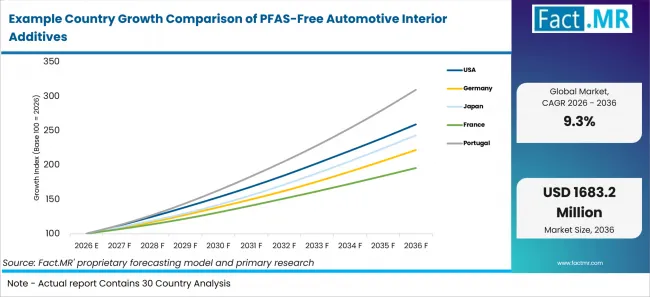
Example Country Growth Comparison Of Pfas Free Automotive Interior Additives | Source: Fact.MR
| Country | CAGR (2026-2036) |
|---|---|
| USA | 10.0% |
| Germany | 8.3% |
| Japan | 9.3% |
| France | 7.0% |
| Portugal | 12.0% |
What supports USA adoption?
10.0% CAGR, supported by PFAS reporting pressure and car material mix change.
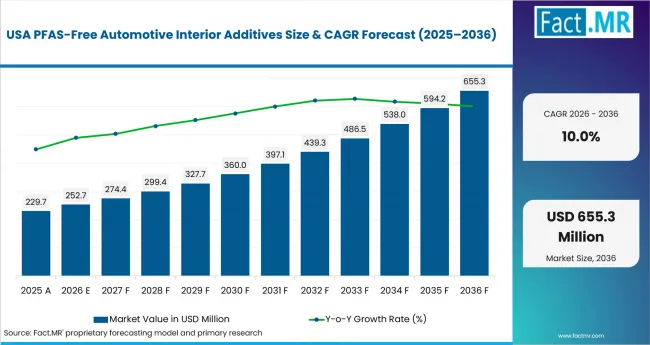
Pfas Free Automotive Interior Additives Country Value Analysis | Source: Fact.MR
U.S. cabin-material programs will place greater weight on traceable agent chemistry as PFAS review moves deeper into material records. The Bureau of Transportation Statistics published its 2025 Transportation Statistics Annual Report in May 2026, reporting 197.1 million registered short-wheelbase light-duty vehicles in the United States in 2023, illustrating the scale of the vehicle base served by U.S. material and component firms. PFAS-free odor control agents are therefore positioned where mixers need to combine chemical records with repeatable VOC and odor results in PP, TPO and recycled cabin mixes.
What is supporting Germany’s adoption?
8.3% CAGR, backed by a large passenger-car base and established cabin-material testing.
German car firms will favor agent packages that can move through established material approval systems while meeting changing chemical needs. Destatis reported in July 2026 that 49.5 million passenger cars were registered in Germany at the start of 2026. That installed base supports a broad network of OEM and Tier 1 material programs, giving PFAS-free odor control firms a route into PP and TPO mixes when they can document heat stability, dosing behavior and cabin-emission results.
How does Japan perform?
9.3% CAGR, led by car output and material-quality needs.
Japanese vehicle programs place close attention on consistent material behavior across long output runs, so odor control agents will compete on dosage precision and repeatable surface results. Destatis updated its international vehicle-output table in November 2025 and listed Japan at 7.139 million passenger cars produced in 2024. That output scale keeps cabin mixes commercially relevant for agent firms that can support PP, engineering resins and recycled blends while maintaining the sensory and heat-aging needs used in cabin-material approval.
What supports France adoption?
7.0% CAGR, driven by vehicle registrations and PFAS-related material review.
French cabin-material demand will develop around mix change work that aligns cabin results with broader chemical policy. The French Statistical Service for Data and Statistical Studies reported in February 2026 that 1.665 million new passenger cars were registered in France during 2025. That vehicle flow sustains recurring testing activity across seats, trim and molded cabin components, creating an addressable base for PFAS-free odor control agents where firms can demonstrate resin fit and stable VOC results.
How is Portugal developing demand?
12.0% CAGR, shaped by vehicle making and export-linked component output.
Portugal will gain from its role inside European vehicle supply chains because locally produced parts are tested for several destination markets. AICEP Portugal Global reported in May 2026 that the country produced 341,361 vehicles in 2025. Export-oriented making therefore gives agent firms a route into cabin mixes that must satisfy customer specs across multiple European programs, favoring PFAS-free systems with clear composition records and consistent odor control results in polyolefin and recycled mixes.
Who leads the PFAS-Free Automotive Interior Additives Market?
Clariant document non-PFAS or PFAS-free resin-processing aids, while BASF provides PFAS-alternative, non-fluorinated agents for coating uses. Evonik documents low-odor polyurethane agents for cabins, while Tosaf provides PFAS-free processing aids for polyolefin extrusion. These sources demonstrate relevant direct and adjacent capabilities but do not establish that every listed company supplies a single product combining PFAS-free processing and car-cabin odor control. This gives firms a clear check point. It can also cut trial time. This helps teams act fast. It can also cut risk in the test stage.
Firm differentiation will reflect PFAS-free mix status, odor control results, thermal and process fit, dose, resin fit, and expert help during use testing. The focus stays on fit and results. That helps teams compare options. The main need is clear. The agent must work well in the final part.
Which companies are the key providers?
Key companies include BASF. Clariant. Evonik. and Tosaf.
- BASF
- Clariant
- Evonik
- Tosaf
Bibliography
- U.S. Environmental Protection Agency. (2026, April 9). Update on reporting deadline for TSCA PFAS reporting rule.
- Bureau of Transportation Statistics. (2025, December). Transportation statistics annual report 2025.
- Statistisches Bundesamt (Destatis). (2026, July 22). Pkw-Dichte 2026 erneut gestiegen [Passenger car density increased again in 2026].
- Statistisches Bundesamt (Destatis). (2025, November 19). International statistics: Key table production of passenger cars.
- Service des données et études statistiques. (2026, February 11). Données 2025 sur les immatriculations des véhicules.
- AICEP Portugal Global. (2026, May). Newsletter Invest in Portugal | May 2026.
- Clariant. (2025, June 5). Clariant launches innovative PFAS-free polymer processing aids for more sustainable polyolefin extrusion.
- BASF. (2025, July 30). Innovating beyond fluoro-containing additives: BASF’s new additives offer performance and sustainability for the coatings industry.
- Avient Corporation. (2025, December 11). Avient launches liquid non-PFAS process aid with antioxidants in Latin America.
- Tosaf. (2024, January 21). PFAS-free additives for the plastics industry.
This Report Answers
- The report explains where PFAS-free automotive interior additives are used across odor-control chemistry and target odor. It also covers interior polymer / substrate and application requirements across vehicle cabin materials.
- Segment analysis identifies the leading subsegments and explains why odor capture, VOC control, polymer compatibility and processing stability influence additive selection.
- Country analysis examines the listed markets and the vehicle-production, material-qualification and PFAS-related conditions supporting adoption across automotive interior applications.
- Competitive analysis reviews current providers across PFAS-free processing aids, odor-control technologies and low-odor automotive material additives. It also distinguishes direct capabilities from adjacent formulation technologies.
- Application analysis assesses how odor reduction, VOC performance and polymer compatibility influence material selection. It also considers thermal stability, dosage, surface finish and qualification requirements across PP, TPO, engineering polymers and recycled blends.
What does the PFAS-Free Automotive Interior Additives Market cover?
The market covers additives used to reduce unwanted odors or volatile compounds in vehicle-interior polymers while supporting PFAS-free formulation. Adjacent demand overlaps with automotive upholstery materials, automotive plastic components and automotive interior polypropylene laminates. The focus stays on fit and results. That helps teams compare options. This helps the team judge fit. It also keeps the work easy to track.
Coverage includes PP and TPO compounds, engineering polymers and recycled blends used in cabin trim. It also considers formulation overlap with polyolefin odor neutralizers, recycled polymer odor-scavenging additives and odor-neutralizing additives in PCR plastics. This makes the choice easier to review. It also keeps the test plan clear.
What is included in the scope?
The scope includes odor-control masterbatches, mineral and porous adsorbents, cyclodextrin systems, reactive neutralizers and bio-based scavengers used in automotive interior compounds. Relevant processing context includes halogen-free polymer aids and halogen-free process aids where additive selection is tied to polymer processing and regulatory requirements. The key is steady results. Teams can then use the agent with more trust. The key is fit. Keep the mix sound. Keep the test plan short.
The assessment also includes PFAS-free additive reformulation for coated and molded interior surfaces. Related material environments include automotive coatings, odor-control technology for high-PCR HDPE and automotive seats. This keeps the goal clear. Teams can test the mix with less guesswork. This helps teams act fast. It can also cut risk in the test stage.
What is excluded from the scope?
The scope excludes general PFAS remediation chemicals, drinking-water treatment media and firefighting foams. Complete cabin parts fall outside the scope when the purchased function is the finished component instead of the agent. General fragrances, surface cleaners and cabin air fresheners remain outside the market. Fluorinated agents are excluded from the covered PFAS-free product set, even when they provide processing or release results in car resins.
How Was the Analysis Built?
The analysis draws on 120+ sources, 35+ company portfolios, 25+ countries, and more than 20 industry interviews.
- Primary Research: Primary research includes discussions with manufacturers, service providers, technology developers, distributors, end users, and subject-matter experts. These conversations examine purchasing priorities, product adoption, operational challenges, approval requirements, competitive positioning, and the factors that influence wider market acceptance.
- Desk Research: Desk research covers government statistics, regulatory publications, company filings, trade data, technical studies, industry associations, standards, public policy, and other authoritative sources. Every source used in the analysis is documented in the bibliography.
- Market Sizing and Forecasting: Market estimates combine historical performance, demand indicators, pricing and volume trends, segment shares, company participation, country-level growth, adoption patterns, investment activity, and barriers to market expansion.
- Data Validation and Update Cycle: Findings are validated by comparing primary interviews with public data, company activity, regulatory changes, trade patterns, and industry developments. Regular updates review new product launches, capacity changes, partnerships, approvals, and shifts in commercial adoption.
What is the report’s scope and coverage?
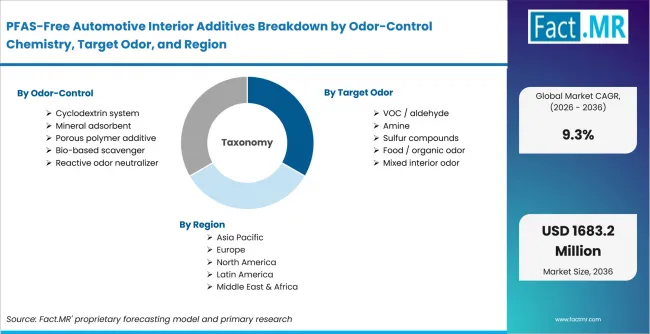
Pfas Free Automotive Interior Additives Breakdown By Odor Control Chemistry, Target Odor, And Region | Source: Fact.MR
| Attribute | Details |
|---|---|
| Quantitative Units | USD million in 2026 to USD million by 2036 at a CAGR |
| Market Definition | Additives used in automotive interior polymers, compounds, coatings or related substrates to control odor or volatile compounds while avoiding intentionally added PFAS chemistry within the covered formulation. |
| Odor-Control Chemistry | Cyclodextrin system; Mineral adsorbent; Porous polymer additive; Bio-based scavenger; Reactive odor neutralizer |
| Target Odor | VOC / aldehyde; Amine; Sulfur compounds; Food / organic odor; Mixed interior odor |
| Interior Polymer / Substrate | PP; PE; TPO; PA / engineering polymer; Recycled polymer blends |
| Application | Automotive interiors; Packaging; Consumer goods; Nonwovens; Industrial plastics |
| Regions Covered | North America; Latin America; Western Europe; Eastern Europe; East Asia; South Asia & Pacific; Middle East & Africa |
| Countries Covered | USA; Germany; Japan; France; Portugal |
| Key Companies Profiled | BASF; Clariant; Evonik; Tosaf |
| Forecast Period | 2026 to 2036 |
| Approach | Hybrid top-down and bottom-up approach using automotive material demand, polymer usage, additive function, country manufacturing activity and supplier portfolio review. |
How is the market segmented?
-
By Odor-Control Chemistry
- Cyclodextrin system
- Mineral adsorbent
- Porous polymer additive
- Bio-based scavenger
- Reactive odor neutralizer
-
By Target Odor
- VOC / aldehyde
- Amine
- Sulfur compounds
- Food / organic odor
- Mixed interior odor
-
By Interior Polymer / Substrate
- PP
- PE
- TPO
- PA / engineering polymer
- Recycled polymer blends
-
By Application
- Automotive interiors
- Packaging
- Consumer goods
- Nonwovens
- Industrial plastics
-
By Region
- North America
- Latin America
- Western Europe
- Eastern Europe
- East Asia
- South Asia & Pacific
- Middle East & Africa