- Market Value (2025): USD 1.1 Bn
- Estimated Value (2026): USD 1.2 Bn
- Forecast Value (2036): USD 2.7 Bn
- CAGR (2026-2036): 8.8%
What is the Halogen-Free Process Aids Market forecast to be worth by 2036?
USD 1.2 Billion in 2026 to USD 2.7 Billion by 2036, at 8.8% CAGR.
- The Halogen-Free Process Aids Market crossed a valuation of USD 1.1 Billion in 2025.
- Demand is projected to increase from USD 1.2 Billion in 2026 to USD 2.7 Billion by 2036.
- The market is forecast to record 8.8% CAGR from 2026 to 2036 as cable compounders, film converters and masterbatch makers shift to non-fluorinated extrusion support.
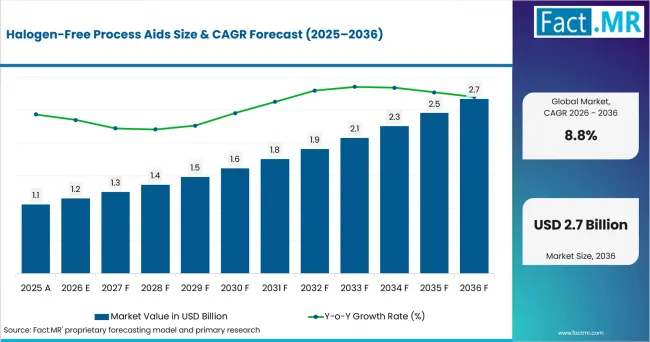
Halogen Free Process Aids Value Analysis | Source: Fact.MR
What are the defining numbers behind Halogen-Free Process Aids Market growth?
USD 1.5 Billion absolute opportunity by 2036, led by HFFR cable compounds, wire & cable and Japan.
- Demand Drivers in the Market
- Cable compounders need halogen-free aids that lower torque in heavily filled HFFR formulations.
- Film converters face a new compliance benchmark because the PPWR applies from 12 August 2026 and restricts PFAS above specified concentration limits in food-contact packaging.
- Regulation (EU) 2025/40 sets minimum post-consumer recycled-content requirements for plastic packaging for 2030, with higher minimum percentages for 2040. This creates a need for additive and masterbatch systems that remain compatible with recycled-content packaging formulations.
- Film processors are balancing process efficiency with cost pressure; The U.S. Bureau of Labor Statistics reported that producer prices for unsupported plastic film, sheet, and other shapes increased 1.6% over the 12 months ended December 2025, while the seasonally adjusted index rose 0.4% from November to December 2025.
- Key Segments Analyzed
- By Aid Platform: Silicone-based systems are expected to hold 32.0% share in 2026 due to their fit in polyolefin film extrusion.
- By Target Formulation: HFFR cable compounds are projected to account for 39.0% share in 2026 owing to high filler loading.
- By Process Benefit: Die pressure reduction is anticipated to capture 27.0% share in 2026 because lower melt pressure protects dies and screen packs.
- By End-use: Wire & cable is estimated to represent 43.0% share in 2026, supported by low-smoke compound demand.
- Analyst Opinion at Fact.MR
- Shambhu Nath Jha, Principal Consultant at Fact.MR, states, “Halogen-free process aids are drawing attention because converters want extrusion stability without fluorinated additive exposure. Demand is expected to favor chemistries that prove melt-fracture control and die-pressure relief in commercial runs. Suppliers need product data, food-contact files and local technical support in the same package.”
- Strategic Implications
- Additive producers should separate PFAS-free claims from broader halogen-free claims and document the exact chemistry used in each aid platform.
- Compounders should test aids inside the filled HFFR recipe instead of judging performance only in neat polyethylene or polypropylene.
- Film converters should measure melt fracture, haze and die build-up at line speed before replacing fluoropolymer PPAs.
- Masterbatch makers should offer carrier choices that match polyolefin films, filled compounds and recycled resin streams without raising plate-out risk.
Japan is forecast to post 10.2% CAGR through 2036. The USA is projected to record 8.4% CAGR as plastics investment meets PFAS reporting. France is anticipated at 7.6% CAGR, supported by EV registrations and low-smoke compound demand. The UK is estimated to reach 7.1% CAGR as packaging tax rules affect recycled-content formulation work. Germany is forecast at 6.4% CAGR through housing activity and building-product compound demand.
How does the Halogen-Free Process Aids Market break down by segment?
Wire & cable leads at 43.0%; HFFR cable compounds lead at 39.0%.
Which Aid Platform dominates?
Silicone-based systems hold 32.0% share in 2026.
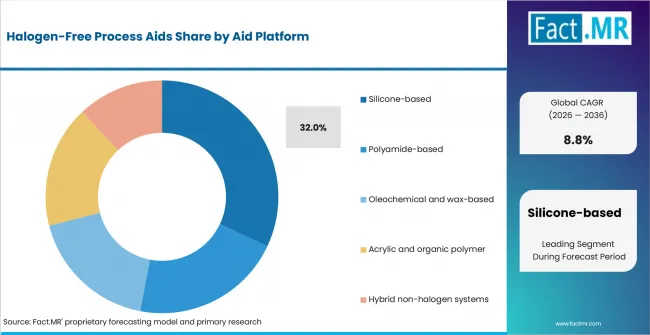
Halogen Free Process Aids Analysis By Aid Platform | Source: Fact.MR
Silicone-based aids lead because they give converters a non-fluorinated route for polyethylene film. Dow launched DOWSIL 5-1050 in September 2025 for film packaging made without fluoropolymer-based PPAs. The product targets melt fracture mitigation and die-lip build-up suppression in LLDPE grades, linking silicone chemistry to line quality in packaging film.
What leads the Target Formulation segment?
HFFR cable compounds account for 39.0% share in 2026.
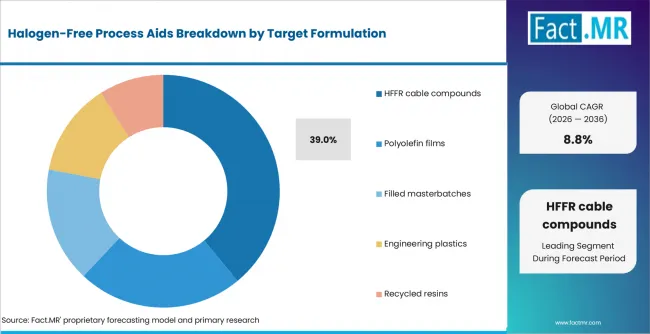
Halogen Free Process Aids Analysis By Target Formulation | Source: Fact.MR
HFFR cable compounds account for the main formulation target because mineral loading raises melt viscosity. Wire producers need smoother flow without chlorine, bromine or fluorinated PPA packages.
How does Process Benefit shape demand?
Die pressure reduction captures 27.0% share in 2026.
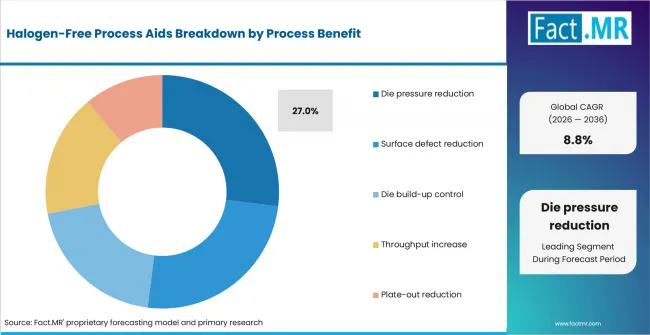
Halogen Free Process Aids Analysis By Process Benefit | Source: Fact.MR
Die pressure reduction leads because extrusion teams can measure the effect directly during production. Lower operating pressure can support longer screen-pack life, reduce die-cleaning frequency, stabilize melt flow, and improve line efficiency. These practical benefits make the process advantage easy to validate.
What supports Wire & cable within End-use?
Wire & cable represents 43.0% share in 2026.
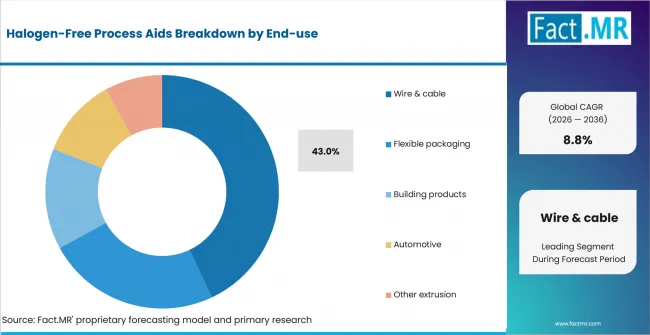
Halogen Free Process Aids Analysis By End Use | Source: Fact.MR
Wire & cable holds the reported end-use share because HFFR insulation and sheathing compounds combine fire performance with processing difficulty. Construction, vehicles and electrical infrastructure require cables that avoid halogen acid-gas risks. Halogen-free aids therefore help processors hold line stability while maintaining low-smoke material specifications.
What is accelerating Halogen-Free Process Aids Market adoption, and what is holding it back?
PFAS substitution drives it; qualification risk restrains it.
Drivers Impact Analysis
| DRIVER | (~) % IMPACT ON CAGR | GEOGRAPHIC RELEVANCE | IMPACT TIMELINE |
|---|---|---|---|
| PFAS-free extrusion transition | +1.9% | North America, Europe | Short term (<= 2 years) |
| HFFR cable compound processing needs | +1.5% | Global | Medium term (2-4 years) |
| Recycled-content packaging pressure | +1.1% | Europe, Japan | Medium term (2-4 years) |
| Film surface defect reduction | +0.9% | Global | Short term (<= 2 years) |
| Masterbatch handling convenience | +0.7% | Global | Short term (<= 2 years) |
Source: Fact.MR analysis. Updated Sep 4, 2026
- PFAS-free extrusion transition: Regulatory scrutiny of PFAS is accelerating the shift toward non-fluorinated processing aids in food-contact packaging and other extrusion applications. Suppliers that maintain processing stability, surface quality, and regulatory documentation can support converters moving away from fluorinated chemistries.
- HFFR cable compound processing needs: Mineral flame retardants can increase torque and processing pressure in halogen-free flame-retardant cable compounds. Processing aids that reduce friction, improve melt flow, and stabilize extrusion conditions are therefore gaining relevance across wire and cable applications.
- Recycled-content packaging pressure: Recycled polymers can show greater variability in melt flow and processing behavior. Halogen-free processing aids can help converters maintain line stability, surface quality, and consistent output as recycled-content requirements increase across packaging applications.
- Film surface defect reduction: Melt fracture, die streaks, and related extrusion defects can reduce film quality and increase rejects. Non-PFAS processing aids are being positioned to improve surface appearance and processing stability, with plant trials remaining important for commercial qualification.
- Masterbatch handling convenience: Pelletized and masterbatch formats simplify dosing and help converters integrate new processing-aid chemistries into existing feeding systems. Familiar handling characteristics can reduce operational disruption and make transitions from conventional processing aids easier to manage.
Opportunity Impact Analysis
| OPPORTUNITY | (~) % IMPACT ON CAGR | GEOGRAPHIC RELEVANCE | IMPACT TIMELINE |
|---|---|---|---|
| Food-contact film qualification | +1.2% | Europe, USA, Japan | Short term (<= 2 years) |
| HFFR cable recipe co-development | +1.0% | Global | Medium term (2-4 years) |
| PFAS-free liquid and masterbatch formats | +0.8% | Asia, Europe | Medium term (2-4 years) |
| Recycled polyolefin extrusion support | +0.6% | Europe, Japan | Long term (>= 4 years) |
Source: Fact.MR analysis. Updated Sep 4, 2026
- Food-contact film qualification: Packaging converters need processing aids that satisfy food-contact requirements while improving extrusion performance. Jurisdiction-specific approvals and clear technical documentation can reduce qualification risk and help suppliers move plant trials toward commercial use more efficiently.
- HFFR cable recipe co-development: Cable compounders need support balancing mineral filler loading, flame performance, melt flow, and surface finish. Processing-aid suppliers can strengthen adoption by solving pressure, plate-out, and extrusion-stability issues within specific compound recipes.
- PFAS-free liquid and masterbatch formats: Liquid and masterbatch processing-aid formats give converters more flexibility when replacing fluorinated chemistries. Siloxane and non-siloxane options can widen plant-level qualification routes by allowing processors to match dosing and handling requirements with existing extrusion systems.
- Recycled polyolefin extrusion support: Recycled polyolefins can introduce greater variability in melt flow and processing stability. Processing aids that improve flow behavior, reduce surface defects, and stabilize extrusion conditions can help recyclers and converters increase the use of post-consumer material.
Restraints Impact Analysis
| RESTRAINT | (~) % IMPACT ON CAGR | GEOGRAPHIC RELEVANCE | IMPACT TIMELINE |
|---|---|---|---|
| Slow additive qualification cycles | -0.7% | Global | Short term (<= 2 years) |
| Performance gaps versus fluoropolymer PPAs | -0.5% | Global | Medium term (2-4 years) |
| Documentation burden across regions | -0.4% | North America, Europe | Medium term (2-4 years) |
| Compatibility risk in recycled resins | -0.3% | Global | Long term (>= 4 years) |
Source: Fact.MR analysis. Updated Sep 4, 2026
- Slow additive qualification cycles: A processing-aid change can affect surface finish, line speed, and regulatory documentation. Converters often begin with limited line trials before wider adoption, particularly where brand owners require food-contact evidence and detailed qualification records.
- Performance gaps versus fluoropolymer PPAs: Fluoropolymer processing aids have a long history in polyethylene film and pipe extrusion. Non-fluorinated alternatives must demonstrate comparable control of melt fracture, pressure, and surface quality at practical dosing levels before converters approve broader replacement.
- Documentation burden across regions: PFAS-free, non-halogen, and food-contact claims vary by product and jurisdiction. Suppliers and processors therefore need region-specific compliance documentation, which can lengthen approval timelines and encourage smaller converters to retain established additive packages until qualification work is complete.
- Compatibility risk in recycled resins: Recycled polyethylene and polypropylene streams can contain variable additives and contaminants that affect processing-aid performance. Repeated testing may be needed before one formulation can be used across multiple plants, slowing adoption in applications with high recycled-content levels.
Which countries are scaling the Halogen-Free Process Aids Market through 2036?
- The country comparison spans 3.79 percentage points and forms three practical growth bands across the forecast period.
- Japan remains 1.75 percentage points above the USA through construction orders and recycled-polymer processing needs.
- The USA remains 0.86 percentage point above France as plastics investment meets PFAS reporting pressure.
- France remains 0.51 percentage point above the UK through EV registrations and low-smoke compound demand.
- The UK remains 0.67 percentage point above Germany as packaging tax rules shape recycled-content formulation work.
- Germany closes the displayed range through housing permits and building-product compound demand.
Comparable CAGRs can create different entry conditions due to cable-compound qualification, film-line evidence, packaging regulation and polymer-processing maturity. Full report coverage includes North America, Latin America, Western Europe, Eastern Europe, East Asia, South Asia & Pacific, and Middle East & Africa.
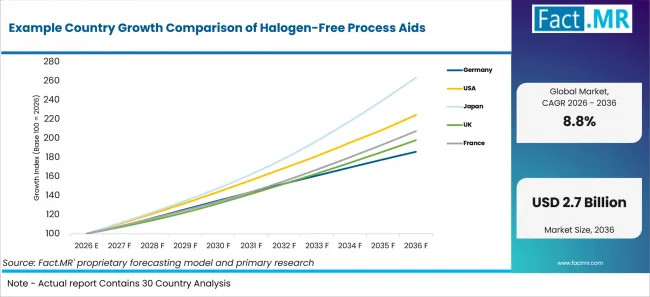
Example Country Growth Comparison Of Halogen Free Process Aids | Source: Fact.MR
| Country | CAGR |
|---|---|
| Japan | 10.2% |
| USA | 8.4% |
| France | 7.6% |
| UK | 7.1% |
| Germany | 6.4% |
Source: Fact.MR analysis. Updated Sep 4, 2026
How is Japan scaling demand?
10.2% CAGR, driven by construction orders and recycled-polymer processing.
Japan is forecast to post 10.2% CAGR through 2036 as cable and building-product compounders qualify aids for filled formulations. MLIT reported in April 2026 that private construction orders from the major 50 companies rose 13.7% in FY2025. This construction activity provides a demand base for wiring, profiles and related polymer systems that use filled formulations.
What supports USA adoption?
8.4% CAGR, supported by plastics investment and PFAS reporting pressure.
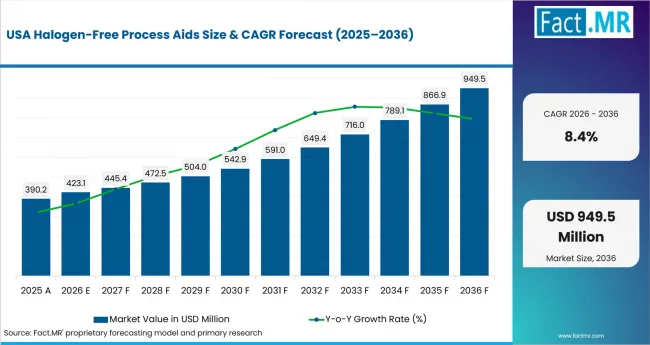
Halogen Free Process Aids Country Value Analysis | Source: Fact.MR
The USA is projected to record 8.4% CAGR through 2036 as converters reassess fluorinated PPAs. BEA reported in June 2026 that new foreign direct investment in plastics and rubber products manufacturing reached USD 19.0 billion in 2025. This figure provides scale context for U.S. plastics and rubber manufacturing activity, while converters continue to assess non-fluorinated PPAs for film applications.
How is France developing demand?
7.6% CAGR, driven by electric-car registrations and low-smoke compound applications.
France is anticipated to advance at 7.6% CAGR through 2036 as automotive users specify low-smoke and clean-additive compounds. SDES reported in February 2026 that 331,200 new electric cars were registered in 2025. That EV volume keeps cable insulation and technical plastics relevant application areas for compounders.
What supports the United Kingdom’s growth?
7.1% CAGR, backed by recycled-content rules and packaging economics.
The UK is estimated to reach 7.1% CAGR through 2036 as packaging converters work around recycled-content thresholds. HM Revenue & Customs lists the Plastic Packaging Tax rate at GBP 228.82 per tonne from 1 April 2026. The tax applies to finished plastic packaging components containing less than 30% recycled plastic, creating a direct cost consideration for converters balancing recycled-content levels with processing and performance requirements.
What is supporting Germany’s adoption?
6.4% CAGR, supported by housing activity and building-product compounds.
Germany is forecast to record 6.4% CAGR through 2036 as compounders serve building and cable accounts. Destatis reported in February 2026 that 238,500 dwellings were permitted in 2025, up 10.8% from 2024. The increase provides a larger construction activity base for wire, cable and building-product compounds that require stable extrusion.
Who leads the Halogen-Free Process Aids Market?
Clariant and Dow document current PFAS-free or non-fluoropolymer polymer-processing-aid offerings.
Clariant offers AddWorks™ PPA for polyolefin extrusion, with documented melt-fracture and die-build-up control, while Dow positions DOWSIL™ 5-1050 for film packaging manufactured without fluoropolymer-based PPAs, with benefits including melt-fracture mitigation and reduced die-lip buildup.
Arkema, Avient, Ampacet and Tosaf broaden the supplier set across polyamide processing aids, liquid additives and masterbatch-based PFAS-free extrusion solutions. Arkema states that its Orgasol® PA12 processing aid is produced without fluorinated raw materials, while Avient offers liquid Hiformer™ Non-PFAS grades. Ampacet and Tosaf also publish dedicated PFAS-free polymer-processing-aid portfolios. These first-party sources establish PFAS-free or non-fluorinated positioning; halogen-free status should be verified at the individual grade and formulation level.
Which companies are the key providers?
Key companies include Clariant, Dow, Arkema, Avient, Ampacet and Tosaf.
- Clariant
- Arkema
- Ampacet
- Avient
- Tosaf
- Dow
Bibliography
- Avient. (2026, January 30). Avient expands Hiformer™ Non-PFAS Process Aid portfolio to Asia with new liquid grades for polyolefin film applications.
- U.S. Bureau of Economic Analysis. (2026, June 10). New foreign direct investment in the United States, 2025.
- U.S. Bureau of Labor Statistics. (2026, January 30). Producer Price Indexes - December 2025.
- Clariant. (2025, June 5). Clariant launches innovative PFAS-free polymer processing aids for more sustainable polyolefin extrusion.
- Statistisches Bundesamt (Destatis). (2026, February 18). 10,8 % mehr Baugenehmigungen für Wohnungen im Jahr 2025.
- Dow. (2025, September 23). Dow unveils an alternative to fluoropolymer-based polymer processing aids for film packaging.
- European Commission, Directorate-General for Environment. (2026, August 11). New EU packaging rules start to apply, including restrictions on PFAS in food-contact packaging.
- European Parliament, & Council of the European Union. (2025, January 22). Regulation (EU) 2025/40 of the European Parliament and of the Council of 19 December 2024 on packaging and packaging waste, amending Regulation (EU) 2019/1020 and Directive (EU) 2019/904, and repealing Directive 94/62/EC. Official Journal of the European Union.
- HM Revenue & Customs. (2026, August 27). Plastic Packaging Tax (PPT) statistics background and references. GOV.UK.
- Service des données et études statistiques. (2026, February 11). Données 2025 sur les immatriculations des véhicules.
- U.S. Environmental Protection Agency. (2026, April 9). Update on reporting deadline for TSCA PFAS Reporting Rule.
This Report Addresses
- The report explains where halogen-free process aids are used across aid platform and target formulation.
- Segment analysis identifies silicone-based systems and HFFR cable compounds as the main 2026 subsegments.
- Country analysis reviews Japan, USA, France, UK and Germany with country-specific polymer-processing signals.
- Competitive analysis profiles Clariant, Arkema, Ampacet, Avient, Tosaf and Dow across product and format coverage.
- Application analysis assesses wire and cable, flexible packaging, building products, automotive and other extrusion demand.
- The forecast draws on official statistics, company product evidence, provider checks and process-aid application mapping.
What does the Halogen-Free Process Aids Market cover?
Silicone, polyamide, oleochemical, wax, acrylic and hybrid aids used for polymer extrusion and compounding.
The market covers halogen-free extrusion aids that improve melt flow, reduce die pressure, control surface defects and limit die build-up in polymer extrusion. PFAS-free or non-fluorinated aids are included within this category only where supplier documentation also confirms the broader halogen-free status required by the formulation.
The scope focuses on processing performance, not color, flame retardancy or stabilization alone. Related halogen-free polymer aids are included only when the product performs a defined extrusion-processing function inside the compound.
What is included in the scope?
Halogen-free process aids used in extrusion lines, cable compounds, films and filled polymer systems.
The scope includes silicone-based, polyamide-based, oleochemical and wax-based, acrylic and organic polymer, and hybrid non-halogen systems used to improve extrusion behavior. It covers HFFR cable compounds and polyolefin films where pressure control and surface quality are central to production. It also covers filled masterbatches, engineering plastics and recycled resin streams when the aid improves melt flow or die cleanliness.
What is excluded from the scope?
Fluoropolymer PPAs, flame-retardant-only additives and color masterbatches are outside the scope.
The scope excludes fluoropolymer-based PPAs because fluorine is a halogen and fluoropolymer-based PPAs therefore fall outside a halogen-free definition. Flame retardants, pigments, stabilizers and compatibilizers are excluded when they lack a defined extrusion-processing function. Polyolefin compounds, masterbatch applications, PCR-compatible masterbatches and polymer reactive-extrusion additives is adjacent when those products address compounding or formulation performance beyond process-aid function.
How Was the Analysis Built?
The analysis draws on 120+ sources, 35+ company portfolios, 25+ countries, and more than 20 industry interviews.
- Primary Research: Primary research includes discussions with manufacturers, service providers, technology developers, distributors, end users, and subject-matter experts. These conversations examine purchasing priorities, product adoption, operational challenges, approval requirements, competitive positioning, and the factors that influence wider market acceptance.
- Desk Research: Desk research covers government statistics, regulatory publications, company filings, trade data, technical studies, industry associations, standards, public policy, and other authoritative sources. Every source used in the analysis is documented in the bibliography.
- Market Sizing and Forecasting: Market estimates combine historical performance, demand indicators, pricing and volume trends, segment shares, company participation, country-level growth, adoption patterns, investment activity, and barriers to market expansion.
- Data Validation and Update Cycle: Findings are validated by comparing primary interviews with public data, company activity, regulatory changes, trade patterns, and industry developments. Regular updates review new product launches, capacity changes, partnerships, approvals, and shifts in commercial adoption.
Segmentation
What is the report's scope and coverage?
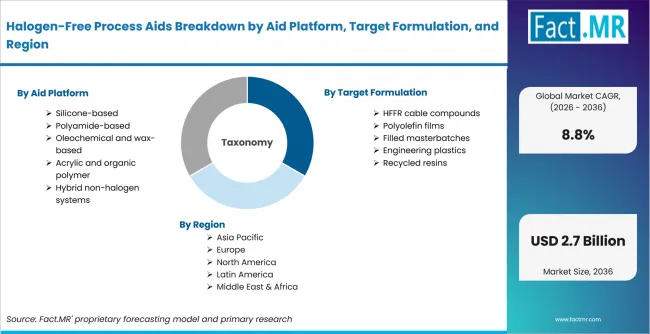
Halogen Free Process Aids Breakdown By Aid Platform, Target Formulation, And Region | Source: Fact.MR
| ATTRIBUTE | DETAILS |
|---|---|
| Quantitative Units | USD Billion |
| Market Definition | Halogen-free process aids used to improve melt flow, pressure control, surface quality and die cleanliness in polymer extrusion and compounding. |
| Aid Platform | Silicone-based; Polyamide-based; Oleochemical and wax-based; Acrylic and organic polymer; Hybrid non-halogen systems |
| Target Formulation | HFFR cable compounds; Polyolefin films; Filled masterbatches; Engineering plastics; Recycled resins |
| Process Benefit | Die pressure reduction; Surface defect reduction; Die build-up control; Throughput increase; Plate-out reduction |
| End-use | Wire & cable; Flexible packaging; Building products; Automotive; Other extrusion |
| Regions Covered | North America; Latin America; Western Europe; Eastern Europe; East Asia; South Asia & Pacific; Middle East & Africa |
| Countries Covered | Japan; USA; France; UK; Germany |
| Companies Profiled | Clariant; Arkema; Ampacet; Avient; Tosaf; Dow |
| Forecast Period | 2026 to 2036 |
| Approach | Hybrid top-down and bottom-up approach using extrusion applications, aid chemistry, formulation targets, country indicators and provider portfolio review. |
Source: Fact.MR analysis. Updated Sep 4, 2026
How is the market segmented?
-
By Aid Platform
- Silicone-based
- Polyamide-based
- Oleochemical and wax-based
- Acrylic and organic polymer
- Hybrid non-halogen systems
-
By Target Formulation
- HFFR cable compounds
- Polyolefin films
- Filled masterbatches
- Engineering plastics
- Recycled resins
-
By Process Benefit
- Die pressure reduction
- Surface defect reduction
- Die build-up control
- Throughput increase
- Plate-out reduction
-
By End-use
- Wire & cable
- Flexible packaging
- Building products
- Automotive
- Other extrusion
-
By Region
- North America
- Latin America
- Western Europe
- Eastern Europe
- East Asia
- South Asia & Pacific
- Middle East & Africa
Frequently Asked Questions
How big is the halogen-free process aids market in 2026?
What is the CAGR of the halogen-free process aids market from 2026 to 2036?
Which aid platform leads the halogen-free process aids market?
Which target formulation leads the halogen-free process aids market?
Who are the leading companies in the halogen-free process aids market?
Who worked on this report


Preview the report firsthand - request a free sample
Free SampleGet the brochure for pricing and purchase details
Download PDF