Photoaging Treatment Market (2026 - 2036)

Photoaging Treatment Market Size and Share Forecast Outlook 2026 to 2036

Core Findings

    Photoaging Treatment Market Forecast and Outlook 2026 to 2036

    Global photoaging treatment market stands positioned for robust expansion, valued at USD 7.4 billion in 2026 and projected to reach USD 14 billion by 2036, registering 6.6% CAGR throughout evaluation period.

    Key Takeaways from Photoaging Treatment Market

    • Photoaging Treatment Market Value (2026): USD 7.4 billion
    • Photoaging Treatment Market Forecast Value (2036): USD 14 billion
    • Photoaging Treatment Market Forecast CAGR (2026-2036): 6.6%
    • Leading Treatment Modality: Cosmeceuticals with antioxidants and peptides (32.0%)
    • Key Players: L'Oréal, Estée Lauder Companies, Galderma, AbbVie (Allergan Aesthetics), Candela Medical
    • Key Growth Regions: China, India, Brazil, United States, Germany, United Kingdom, France
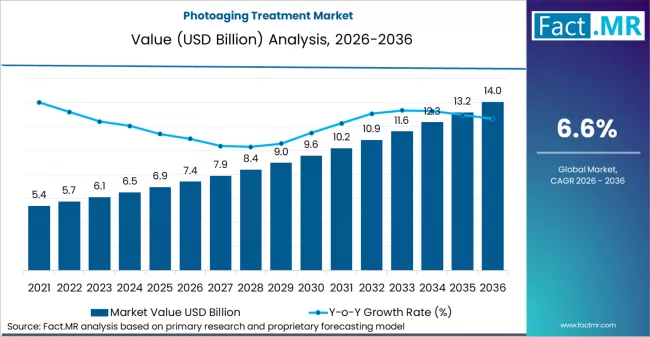
    Photoaging Treatment Market Market Value Analysis

    While broad-spectrum sun protection continues anchoring prevention narratives, repair technologies are establishing structural relevance within dermatological and aesthetic portfolios. Industry consolidation around evidence-backed modalities signals maturation beyond promotional claims toward clinically validated intervention systems. Dr. Harold Lancer, Beverly Hills-based dermatologist, notes that “Photoaging represents our most preventable form of skin deterioration, yet repair technologies have only recently caught up to demand intensity.”

    Photoaging correction operates at intersection of preventive dermatology, aesthetic medicine, and regenerative biology. Cellular mechanisms underlying chronic UV exposure are increasingly understood, enabling targeted therapeutic development. Product launches throughout 2025 reflect strategic emphasis on combination protocols, where topical actives synergize with energy-based platforms to address both epidermal and dermal photodamage layers. Beiersdorf's Epicelline Active epigenetic serum launch demonstrates industry commitment to next-generation cellular repair mechanisms rather than symptomatic coverage. Regulatory frameworks are evolving in parallel with technological advancement. Stricter NMPA regulations implemented in 2025 mandate comprehensive efficacy documentation for active ingredient transparency claims, forcing reformulation cycles across Asian markets while simultaneously elevating consumer trust in validated products.

    L'Oréal's December 2025 strategic stake increase in Galderma to 20% exemplifies convergence between pharmaceutical heritage and beauty technology, particularly in injectable aesthetics segment. This integration enables hybrid protocols combining laser resurfacing with injectable biostimulators, targeting deep dermal photo-repair beyond surface intervention capacity.

    Photoaging Treatment Market

    Metric  Value 
    Estimated Value in (2026E)  USD 7.4 billion
    Forecast Value in (2036F)  USD 14 billion
    Forecast CAGR (2026 to 2036)  6.6 % 

    Category 

    Category  Segments 
    Treatment Modality Rx topical retinoids & dermatology meds, Cosmeceuticals (antioxidants/peptides), Energy-based devices (laser/IPL), Injectable rejuvenation (clinical), Chemical peels & resurfacing, Sun protection & after-sun repair
    Target Concern / Indication Fine lines & wrinkles, Hyperpigmentation / melasma, Texture & enlarged pores, Actinic damage / roughness, Photo-induced skin laxity
    Sales Channel / Care Setting Retail & e-commerce (OTC), Dermatology clinics, Aesthetic centers / med-spas, Pharmacies, Hospital outpatient
    Region  North America; Europe; Asia Pacific; Latin America; Middle East & Africa 

    Segmental Analysis

    Why do cosmeceuticals with antioxidants and peptides command leading position in photoaging treatment modalities?
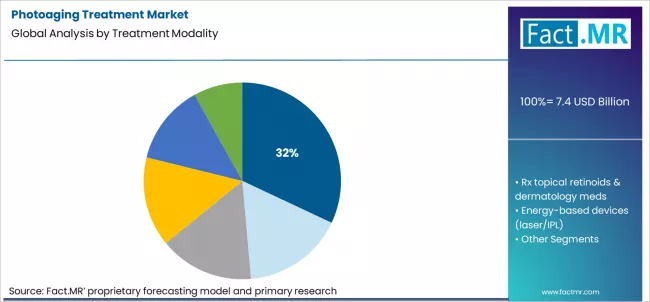
    Photoaging Treatment Market Analysis By Treatment Modality

    Cosmeceuticals account for 32% share because formulation science has converged clinical efficacy with consumer accessibility at price points supporting daily compliance. Peptide technology enables targeted collagen synthesis stimulation without procedural intervention, while antioxidant systems neutralize ongoing oxidative stress from environmental exposure. Corporate R&D investment reflects strategic positioning: brands deploy cosmeceutical platforms to capture value between basic skincare and medical procedures, establishing recurring revenue streams through morning and evening application rituals. Retail distribution advantages further reinforce dominance, enabling purchase without clinical gatekeeping while maintaining premium positioning through ingredient storytelling and clinical validation.

    How do fine lines and wrinkles establish dominance within photoaging treatment target concerns?
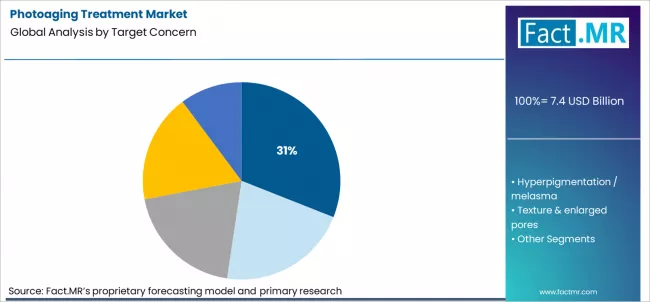
    Photoaging Treatment Market Analysis By Target Concern

    Fine lines and wrinkles capture 31% of treatment focus because visible texture changes represent primary motivation for intervention-seeking behavior across demographics. Unlike hyperpigmentation or pore concerns requiring specialized assessment, wrinkle visibility enables self-diagnosis and treatment urgency without professional consultation. Market research demonstrates that wrinkle reduction claims generate highest purchase intent and willingness to pay premium pricing compared to other photoaging indicators. Treatment availability spans full modality spectrum from topical retinoids through injectable fillers, creating multiple entry points matching consumer readiness and budget capacity.

    Market Dynamics

    • Drivers: Consumer awareness of photoaging mechanisms has intensified beyond surface-level sun protection messaging. Educational campaigns from dermatological societies and ingredient-focused beauty media have elevated understanding of cumulative UV damage, oxidative stress pathways, and collagen degradation processes. This knowledge expansion creates demand for targeted correction rather than generic anti-aging products. Simultaneously, device miniaturization and home-use regulatory approvals are democratizing access to energy-based treatments previously confined to clinical settings, expanding addressable market beyond procedural candidates to daily skincare users seeking professional-grade results. FDA Modernization Act 2.0 has accelerated investment in exosome-based treatments and bio-simulated repair serums in medical aesthetics, providing regulatory pathways that encourage innovation in human-derived regenerative technologies.
    • Restraints: Treatment efficacy timelines create consumer frustration and adherence challenges. Photoaging reversal requires consistent application over months to show measurable improvement, conflicting with instant-result expectations shaped by social media filtering and injectable immediacy. This temporal disconnect drives premature product abandonment before clinical benefit manifestation. Additionally, treatment complexity continues expanding with layering protocols and multi-step regimens requiring sophisticated consumer education and routine commitment that exceeds mainstream adoption capacity, limiting market expansion beyond skincare-engaged demographics.
    • Trend 1: Epigenetic Photoaging Correction Product development is shifting from symptomatic coverage toward cellular reprogramming approaches that address DNA methylation changes induced by chronic UV exposure. Beiersdorf's Epicelline Active launch exemplifies emerging epigenetic active category targeting gene expression modification rather than protein supplementation. These next-generation ingredients require extensive clinical validation but promise differentiation through mechanism-of-action superiority, positioning early adopters for premium market segments willing to invest in scientific advancement over established active categories.
    • Trend 2: Microbiome-Mediated Photo-Protection Shiseido's skin-gut axis positioning within Dr. Shiseido brand reflects growing scientific evidence linking microbial ecosystem balance to UV stress response and repair capacity. Probiotic and post biotic incorporation into photoaging protocols represents convergence between wellness narratives and dermatological science. Products supporting skin microbiome resilience are being positioned preventive and reparative interventions, appealing to consumers seeking holistic approaches that align with broader health-consciousness trends while maintaining clinical credibility through peer-reviewed research backing.

    Photoaging Treatment Market Analysis by Key Country
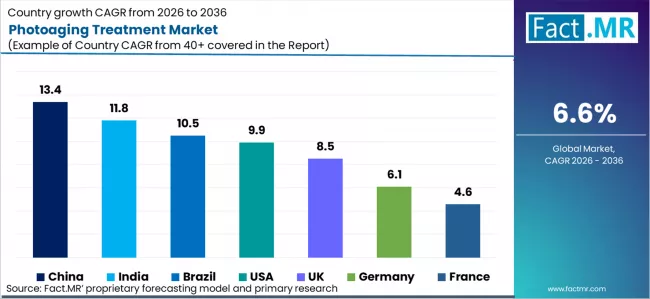
    Photoaging Treatment Market Cagr Analysis By Country

    Country  CAGR 2026 to 2036 
    China 13.4%
    India 11.8%
    Brazil 10.5%
    USA 9.9%
    UK 8.5
    Germany 6.1%
    France 4.1%

    How are stricter NMPA regulations and pre-aging routines accelerating photoaging treatment adoption in China?

    China demonstrates exceptional growth momentum at 13.4% CAGR, propelled by transformative regulatory evolution and demographic shifts. Stricter NMPA regulations implemented in 2025 mandate comprehensive active ingredient transparency and efficacy dossiers, eliminating questionable claims while elevating consumer trust in validated formulations. Proya and Pechoin launched Bio-Retinol and TCM-infused serums meeting these stringent standards, triggering industry-wide quality elevation. Concurrently, Generation Z adoption of pre-aging routines targeting urban pollution and digital UV damage has expanded market demographics beyond traditional aging cohorts. This convergence between regulatory rigor and preventive mindset positions China to dominate photoaging innovation, particularly in combining traditional Chinese medicine principles with evidence-based dermatological actives meeting international safety and efficacy benchmarks.

    Why is India experiencing rapid expansion in AI-driven photoaging diagnostics and personalized repair protocols?

    India advances at 11.8% CAGR, driven by middle-class expansion and technological leapfrogging in skincare delivery. Professional Beauty India highlighted longevity and cellular repair trend adoption in January 2026, reflecting consumer sophistication beyond traditional fairness narratives. Growing demand for AI-driven skin diagnostics enables hyper-personalized photo-repair routines based on individual damage assessment rather than generalized products. Aragen and domestic biotech companies are developing barrier-first formulations addressing India-specific challenges: intense UV exposure, high pollution levels, and humidity-related oxidative stress. This transition from mass-market fairness creams to biotech-backed photo-repair products represents fundamental market repositioning, where clinical validation and personalized protocols command premium pricing while addressing real dermatological needs created by environmental stressors unique to Indian urban environments.

    How does Brazil's tropical high-UV climate and body aesthetics culture drive photoaging treatment leadership?

    Brazil exhibits robust 10.5% CAGR, anchored in cultural body aesthetics prioritization within tropical high-UV environment. Natura & Co launched Dove Regenerative Line and Eucerin Epigenetic in April 2025, specifically targeting gluteal and thigh photo-damage correction reflecting Brazilian consumer focus on full-body treatment rather than facial-only approaches. Outdoor lifestyle prevalence creates year-round UV exposure patterns demanding continuous protection and repair cycles. Brazil leads globally in high-volume biostimulation for body-wide photo-damage correction, with aesthetic clinics integrating injectable protocols alongside topical regimens. Grand View Research documentation shows Brazilian consumers demonstrate highest willingness to invest in combination modalities, creating market environment where multimodal photo-repair protocols achieve mainstream adoption rather than remaining luxury treatments confined to facial applications in other geographies.

    What factors position United States for sustained photoaging treatment market expansion?

    United States market advances at 9.9% CAGR, shaped by regulatory modernization and technological innovation convergence. FDA Modernization Act 2.0 prioritizes human-derived in vitro data over animal models, accelerating exosome-based treatment approvals and bio-simulated repair serum development in medical aesthetics. Sino Biological and Crown Bioscience expansion of AI-driven monoclonal antibody platforms enables precision targeting of photoaging pathways at cellular level. Consumer sophistication regarding ingredient mechanisms drives demand for clinically validated actives backed by peer-reviewed research rather than marketing claims alone. Simultaneously, medical spa proliferation democratizes access to professional-grade treatments including fractional laser and radiofrequency procedures, creating hybrid consumption patterns where consumers layer clinical interventions with advanced home-care protocols, sustaining premium product demand alongside procedural growth trajectories.

    Why is United Kingdom concentrating market value in MDR-certified peptide protocols?

    United Kingdom demonstrates focused 8.5% CAGR driven by impending regulatory tightening and longevity aesthetics framework adoption. Hamilton Fraser and Epsilogen shift toward longevity-led aesthetics reflects January 2026 licensing regulations for non-surgical cosmetic procedures enhancing patient safety requirements. These regulations concentrate market value in MDR-certified peptide protocols and regenerative aesthetic platforms capable of meeting enhanced safety documentation standards. Institutional providers with regulatory compliance infrastructure gain competitive advantage over fragmented clinic operators lacking certification capacity. This regulatory consolidation elevates treatment quality while creating barriers to entry protecting established players.

    How does Germany's clinical validation emphasis shape photoaging treatment market?

    Germany advances at measured 6.1% CAGR reflecting rigorous clinical validation standards and clean medical positioning. Beiersdorf launched Epicelline Active epigenetic serum in 2025, exemplifying German dermocosmetics segment emphasis on cellular-level aging mechanisms rather than superficial symptom coverage. Merck KGaA contributions to epigenetic technology development demonstrate German pharmaceutical heritage merging with aesthetic applications. Societal shift toward ethical sourcing and animal-free testing aligns with German consumer values, creating receptive environment for next-generation actives developed through alternative validation methodologies. However, conservative adoption patterns and price sensitivity outside premium segments moderate growth velocity compared to emerging markets. German market serves innovation proving ground where scientific credibility must precede commercial scaling, creating slower but more sustainable growth trajectories based on clinical evidence rather than trend-driven consumption patterns characterizing other regions.

    What drives moderate photoaging treatment growth in French market?

    France exhibits conservative 4.1% CAGR despite pharmaceutical heritage and beauty industry leadership. L'Oréal increased Galderma stake to 20% in December 2025, enabling global expansion of multimodal hybrid protocols combining laser with injectable treatments for deep dermal photo-repair. French pharmaceutical expertise merging with beauty technology creates sophisticated product architectures, yet domestic market maturity limits expansion velocity. Consumer sophistication means French demographics already maintain advanced photoaging prevention routines, reducing crisis-intervention demand driving growth in emerging markets. Regulatory environment favoring medical aesthetic integration positions France for injectable aesthetics leadership but constrains OTC segment expansion. French market serves innovation hub exporting technologies globally while domestic growth remains tempered by established skincare culture already incorporating sun protection and active ingredients, leaving limited untapped addressable population requiring photoaging education or treatment adoption initiation compared to markets with nascent awareness levels.

    Competitive Landscape in Photoaging Treatment Market
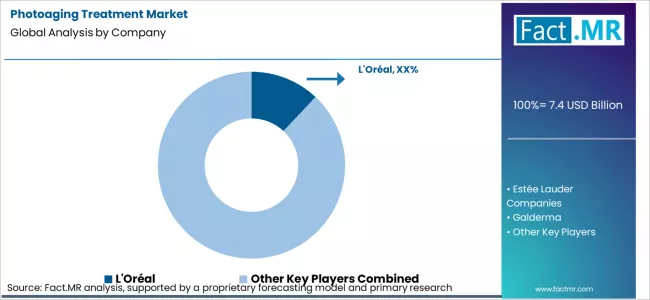
    Photoaging Treatment Market Analysis By Company

    Competition in photoaging treatment market has evolved from ingredient-focused differentiation toward integrated ecosystem positioning. In 2024, market participants competed primarily through active concentration claims and clinical study citations, with product efficacy representing primary battleground. Innovation centered on novel peptide sequences, antioxidant combinations, and delivery system enhancements targeting consumer segments through ingredient storytelling. Investment prioritized formulation development and influencer partnerships rather than clinical infrastructure or regulatory compliance capabilities.

    Competitive landscape began realigning toward multimodal treatment platforms and regulatory defensibility. Leading players started consolidating topical, injectable, and device-based modalities into integrated protocols rather than isolated product categories. L'Oréal's strategic Galderma stake increase exemplifies pharmaceutical-aesthetic convergence enabling hybrid laser-injectable treatments targeting deep dermal layers beyond topical intervention capacity. Simultaneously, regulatory tightening across key markets concentrated advantage among players with compliance infrastructure: NMPA transparency mandates in China favor established manufacturers capable of comprehensive efficacy documentation, while UK licensing requirements position MDR-certified providers over unregulated clinic operators. This creates structural competitive moats favoring institutional players with regulatory expertise, clinical validation capabilities, and manufacturing quality systems over pure-play cosmetic brands lacking medical heritage.

    Recent Developments

    • In December 2025, L'Oréal increased stake in Galderma to 20%, strengthening position in injectable aesthetics and enabling global expansion of hybrid laser-injectable protocols for deep dermal photo-repair combining pharmaceutical rigor with beauty technology innovation.
    • In April 2025, Natura & Co launched Dove Regenerative Line and Eucerin Epigenetic products targeting tropical high-UV markets, specifically addressing body-wide photo-damage correction with focus on gluteal and thigh areas reflecting Brazilian cultural body aesthetics priorities.

    Key Players in Photoaging Treatment Market

    • L'Oréal
    • Estée Lauder Companies
    • Galderma
    • AbbVie (Allergan Aesthetics)
    • Candela Medical

    Bibliography

    • International Organization for Standardization. 2023. Cosmetics and personal care products: Safety assessment standards for photoaging treatment formulations and energy-based devices. ISO Technical Report.
    • European Commission. 2022. Cosmetic products regulation: Active ingredient efficacy documentation and safety assessment for anti-photoaging claims.
    • International Federation of Societies of Cosmetic Chemists. 2024. Advances in photoaging treatment science: Epigenetic actives and cellular repair mechanisms.
    • Journal of Cosmetic Dermatology. 2024. Photoaging treatment innovations: Clinical efficacy studies on combination modality protocols.
    • National Medical Products Administration (NMPA). 2025. Regulatory guidelines for active ingredient transparency and efficacy dossiers in photoaging treatments.

    Scope of Report

    Items  Values 
    Quantitative Units (2026)  USD 7.4 Billion 
    Treatment Modality Rx topical retinoids & dermatology meds, Cosmeceuticals (antioxidants/peptides), Energy-based devices (laser/IPL), Injectable rejuvenation (clinical), Chemical peels & resurfacing, Sun protection & after-sun repair
    Target Concern / Indication Fine lines & wrinkles, Hyperpigmentation / melasma, Texture & enlarged pores, Actinic damage / roughness, Photo-induced skin laxity
    Sales Channel / Care Setting Retail & e-commerce (OTC), Dermatology clinics, Aesthetic centers / med-spas, Pharmacies, Hospital outpatient
    Regions Covered  North America, Europe, Asia Pacific, Latin America, Middle East & Africa 
    Countries Covered  U.S., Canada, Germany, Italy, UK, France, Japan, Australia, and other countries 
    Key Companies Profiled  L'Oréal, Estée Lauder Companies, Galderma, AbbVie (Allergan Aesthetics), Candela Medical
    Additional Attributes  Dollar revenue in the photoaging treatment market is segmented by treatment type, indication, end user, treatment modality, price tier, and region. Regional demand patterns are driven by rising awareness of UV induced skin aging, increasing preference for preventive and corrective dermatologic procedures, growing adoption of combination therapies including topicals, devices, and injectables, and continued premiumization of non-invasive and minimally invasive skin rejuvenation treatments.

    Photoaging Treatment Market by Segments

    • Treatment Modality :

      • Rx topical retinoids & dermatology meds
      • Cosmeceuticals (antioxidants/peptides)
      • Energy-based devices (laser/IPL)
      • Injectable rejuvenation (clinical)
      • Chemical peels & resurfacing
      • Sun protection & after-sun repair
      • Target Concern / Indication
    • Target Concern :

      • Fine lines & wrinkles
      • Hyperpigmentation / melasma
      • Texture & enlarged pores
      • Actinic damage / roughness
      • Photo-induced skin laxity
    • Sales Channel / Care Setting :

      • Retail & e-commerce (OTC)
      • Dermatology clinics
      • Aesthetic centers / med-spas
      • Pharmacies
      • Hospital outpatient
    • Region :

      • Asia Pacific
        • Japan
        • South Korea
        • China
        • India
        • Australia
        • New Zealand
        • Rest of Asia Pacific
      • North America
        • United States
        • Canada
        • Mexico
      • Europe
        • France
        • Italy
        • Spain
        • Germany
        • UK
        • Rest of Europe
      • Latin America
        • Brazil
        • Argentina
        • Chile
        • Rest of Latin America

    Table of Content

    1. Executive Summary
      • Global Market Outlook
      • Demand to side Trends
      • Supply to side Trends
      • Technology Roadmap Analysis
      • Analysis and Recommendations
    2. Market Overview
      • Market Coverage / Taxonomy
      • Market Definition / Scope / Limitations
    3. Research Methodology
      • Chapter Orientation
      • Analytical Lens and Working Hypotheses
        • Market Structure, Signals, and Trend Drivers
        • Benchmarking and Cross-market Comparability
        • Market Sizing, Forecasting, and Opportunity Mapping
      • Research Design and Evidence Framework
        • Desk Research Programme (Secondary Evidence)
          • Company Annual and Sustainability Reports
          • Peer-reviewed Journals and Academic Literature
          • Corporate Websites, Product Literature, and Technical Notes
          • Earnings Decks and Investor Briefings
          • Statutory Filings and Regulatory Disclosures
          • Technical White Papers and Standards Notes
          • Trade Journals, Industry Magazines, and Analyst Briefs
          • Conference Proceedings, Webinars, and Seminar Materials
          • Government Statistics Portals and Public Data Releases
          • Press Releases and Reputable Media Coverage
          • Specialist Newsletters and Curated Briefings
          • Sector Databases and Reference Repositories
          • FMR Internal Proprietary Databases and Historical Market Datasets
          • Subscription Datasets and Paid Sources
          • Social Channels, Communities, and Digital Listening Inputs
          • Additional Desk Sources
        • Expert Input and Fieldwork (Primary Evidence)
          • Primary Modes
            • Qualitative Interviews and Expert Elicitation
            • Quantitative Surveys and Structured Data Capture
            • Blended Approach
          • Why Primary Evidence is Used
          • Field Techniques
            • Interviews
            • Surveys
            • Focus Groups
            • Observational and In-context Research
            • Social and Community Interactions
          • Stakeholder Universe Engaged
            • C-suite Leaders
            • Board Members
            • Presidents and Vice Presidents
            • R&D and Innovation Heads
            • Technical Specialists
            • Domain Subject-matter Experts
            • Scientists
            • Physicians and Other Healthcare Professionals
          • Governance, Ethics, and Data Stewardship
            • Research Ethics
            • Data Integrity and Handling
        • Tooling, Models, and Reference Databases
      • Data Engineering and Model Build
        • Data Acquisition and Ingestion
        • Cleaning, Normalisation, and Verification
        • Synthesis, Triangulation, and Analysis
      • Quality Assurance and Audit Trail
    4. Market Background
      • Market Dynamics
        • Drivers
        • Restraints
        • Opportunity
        • Trends
      • Scenario Forecast
        • Demand in Optimistic Scenario
        • Demand in Likely Scenario
        • Demand in Conservative Scenario
      • Opportunity Map Analysis
      • Product Life Cycle Analysis
      • Supply Chain Analysis
      • Investment Feasibility Matrix
      • Value Chain Analysis
      • PESTLE and Porter’s Analysis
      • Regulatory Landscape
      • Regional Parent Market Outlook
      • Production and Consumption Statistics
      • Import and Export Statistics
    5. Global Market Analysis 2021 to 2025 and Forecast, 2026 to 2036
      • Historical Market Size Value (USD Million) Analysis, 2021 to 2025
      • Current and Future Market Size Value (USD Million) Projections, 2026 to 2036
        • Y to o to Y Growth Trend Analysis
        • Absolute $ Opportunity Analysis
    6. Global Market Pricing Analysis 2021 to 2025 and Forecast 2026 to 2036
    7. Global Market Analysis 2021 to 2025 and Forecast 2026 to 2036, By Treatment Modality
      • Introduction / Key Findings
      • Historical Market Size Value (USD Million) Analysis By Treatment Modality, 2021 to 2025
      • Current and Future Market Size Value (USD Million) Analysis and Forecast By Treatment Modality, 2026 to 2036
        • Cosmeceuticals (antioxidants/peptides)
        • Rx topical retinoids & dermatology meds
        • Energy-based devices (laser/IPL)
        • Injectable rejuvenation (clinical)
        • Chemical peels & resurfacing
        • Sun protection & after-sun repair
      • Y to o to Y Growth Trend Analysis By Treatment Modality, 2021 to 2025
      • Absolute $ Opportunity Analysis By Treatment Modality, 2026 to 2036
    8. Global Market Analysis 2021 to 2025 and Forecast 2026 to 2036, By Target Concern
      • Introduction / Key Findings
      • Historical Market Size Value (USD Million) Analysis By Target Concern, 2021 to 2025
      • Current and Future Market Size Value (USD Million) Analysis and Forecast By Target Concern, 2026 to 2036
        • Fine lines & wrinkles
        • Hyperpigmentation / melasma
        • Texture & enlarged pores
        • Actinic damage / roughness
        • Photo-induced skin laxity
      • Y to o to Y Growth Trend Analysis By Target Concern, 2021 to 2025
      • Absolute $ Opportunity Analysis By Target Concern, 2026 to 2036
    9. Global Market Analysis 2021 to 2025 and Forecast 2026 to 2036, By Sales Channel
      • Introduction / Key Findings
      • Historical Market Size Value (USD Million) Analysis By Sales Channel, 2021 to 2025
      • Current and Future Market Size Value (USD Million) Analysis and Forecast By Sales Channel, 2026 to 2036
        • Retail & e-commerce (OTC)
        • Dermatology clinics
        • Aesthetic centers / med-spas
        • Pharmacies
        • Hospital outpatient
      • Y to o to Y Growth Trend Analysis By Sales Channel, 2021 to 2025
      • Absolute $ Opportunity Analysis By Sales Channel, 2026 to 2036
    10. Global Market Analysis 2021 to 2025 and Forecast 2026 to 2036, By Region
      • Introduction
      • Historical Market Size Value (USD Million) Analysis By Region, 2021 to 2025
      • Current Market Size Value (USD Million) Analysis and Forecast By Region, 2026 to 2036
        • North America
        • Latin America
        • Western Europe
        • Eastern Europe
        • East Asia
        • South Asia and Pacific
        • Middle East & Africa
      • Market Attractiveness Analysis By Region
    11. North America Market Analysis 2021 to 2025 and Forecast 2026 to 2036, By Country
      • Historical Market Size Value (USD Million) Trend Analysis By Market Taxonomy, 2021 to 2025
      • Market Size Value (USD Million) Forecast By Market Taxonomy, 2026 to 2036
        • By Country
          • USA
          • Canada
          • Mexico
        • By Treatment Modality
        • By Target Concern
        • By Sales Channel
      • Market Attractiveness Analysis
        • By Country
        • By Treatment Modality
        • By Target Concern
        • By Sales Channel
      • Key Takeaways
    12. Latin America Market Analysis 2021 to 2025 and Forecast 2026 to 2036, By Country
      • Historical Market Size Value (USD Million) Trend Analysis By Market Taxonomy, 2021 to 2025
      • Market Size Value (USD Million) Forecast By Market Taxonomy, 2026 to 2036
        • By Country
          • Brazil
          • Chile
          • Rest of Latin America
        • By Treatment Modality
        • By Target Concern
        • By Sales Channel
      • Market Attractiveness Analysis
        • By Country
        • By Treatment Modality
        • By Target Concern
        • By Sales Channel
      • Key Takeaways
    13. Western Europe Market Analysis 2021 to 2025 and Forecast 2026 to 2036, By Country
      • Historical Market Size Value (USD Million) Trend Analysis By Market Taxonomy, 2021 to 2025
      • Market Size Value (USD Million) Forecast By Market Taxonomy, 2026 to 2036
        • By Country
          • Germany
          • UK
          • Italy
          • Spain
          • France
          • Nordic
          • BENELUX
          • Rest of Western Europe
        • By Treatment Modality
        • By Target Concern
        • By Sales Channel
      • Market Attractiveness Analysis
        • By Country
        • By Treatment Modality
        • By Target Concern
        • By Sales Channel
      • Key Takeaways
    14. Eastern Europe Market Analysis 2021 to 2025 and Forecast 2026 to 2036, By Country
      • Historical Market Size Value (USD Million) Trend Analysis By Market Taxonomy, 2021 to 2025
      • Market Size Value (USD Million) Forecast By Market Taxonomy, 2026 to 2036
        • By Country
          • Russia
          • Poland
          • Hungary
          • Balkan & Baltic
          • Rest of Eastern Europe
        • By Treatment Modality
        • By Target Concern
        • By Sales Channel
      • Market Attractiveness Analysis
        • By Country
        • By Treatment Modality
        • By Target Concern
        • By Sales Channel
      • Key Takeaways
    15. East Asia Market Analysis 2021 to 2025 and Forecast 2026 to 2036, By Country
      • Historical Market Size Value (USD Million) Trend Analysis By Market Taxonomy, 2021 to 2025
      • Market Size Value (USD Million) Forecast By Market Taxonomy, 2026 to 2036
        • By Country
          • China
          • Japan
          • South Korea
        • By Treatment Modality
        • By Target Concern
        • By Sales Channel
      • Market Attractiveness Analysis
        • By Country
        • By Treatment Modality
        • By Target Concern
        • By Sales Channel
      • Key Takeaways
    16. South Asia and Pacific Market Analysis 2021 to 2025 and Forecast 2026 to 2036, By Country
      • Historical Market Size Value (USD Million) Trend Analysis By Market Taxonomy, 2021 to 2025
      • Market Size Value (USD Million) Forecast By Market Taxonomy, 2026 to 2036
        • By Country
          • India
          • ASEAN
          • Australia & New Zealand
          • Rest of South Asia and Pacific
        • By Treatment Modality
        • By Target Concern
        • By Sales Channel
      • Market Attractiveness Analysis
        • By Country
        • By Treatment Modality
        • By Target Concern
        • By Sales Channel
      • Key Takeaways
    17. Middle East & Africa Market Analysis 2021 to 2025 and Forecast 2026 to 2036, By Country
      • Historical Market Size Value (USD Million) Trend Analysis By Market Taxonomy, 2021 to 2025
      • Market Size Value (USD Million) Forecast By Market Taxonomy, 2026 to 2036
        • By Country
          • Kingdom of Saudi Arabia
          • Other GCC Countries
          • Turkiye
          • South Africa
          • Other African Union
          • Rest of Middle East & Africa
        • By Treatment Modality
        • By Target Concern
        • By Sales Channel
      • Market Attractiveness Analysis
        • By Country
        • By Treatment Modality
        • By Target Concern
        • By Sales Channel
      • Key Takeaways
    18. Key Countries Market Analysis
      • USA
        • Pricing Analysis
        • Market Share Analysis, 2025
          • By Treatment Modality
          • By Target Concern
          • By Sales Channel
      • Canada
        • Pricing Analysis
        • Market Share Analysis, 2025
          • By Treatment Modality
          • By Target Concern
          • By Sales Channel
      • Mexico
        • Pricing Analysis
        • Market Share Analysis, 2025
          • By Treatment Modality
          • By Target Concern
          • By Sales Channel
      • Brazil
        • Pricing Analysis
        • Market Share Analysis, 2025
          • By Treatment Modality
          • By Target Concern
          • By Sales Channel
      • Chile
        • Pricing Analysis
        • Market Share Analysis, 2025
          • By Treatment Modality
          • By Target Concern
          • By Sales Channel
      • Germany
        • Pricing Analysis
        • Market Share Analysis, 2025
          • By Treatment Modality
          • By Target Concern
          • By Sales Channel
      • UK
        • Pricing Analysis
        • Market Share Analysis, 2025
          • By Treatment Modality
          • By Target Concern
          • By Sales Channel
      • Italy
        • Pricing Analysis
        • Market Share Analysis, 2025
          • By Treatment Modality
          • By Target Concern
          • By Sales Channel
      • Spain
        • Pricing Analysis
        • Market Share Analysis, 2025
          • By Treatment Modality
          • By Target Concern
          • By Sales Channel
      • France
        • Pricing Analysis
        • Market Share Analysis, 2025
          • By Treatment Modality
          • By Target Concern
          • By Sales Channel
      • India
        • Pricing Analysis
        • Market Share Analysis, 2025
          • By Treatment Modality
          • By Target Concern
          • By Sales Channel
      • ASEAN
        • Pricing Analysis
        • Market Share Analysis, 2025
          • By Treatment Modality
          • By Target Concern
          • By Sales Channel
      • Australia & New Zealand
        • Pricing Analysis
        • Market Share Analysis, 2025
          • By Treatment Modality
          • By Target Concern
          • By Sales Channel
      • China
        • Pricing Analysis
        • Market Share Analysis, 2025
          • By Treatment Modality
          • By Target Concern
          • By Sales Channel
      • Japan
        • Pricing Analysis
        • Market Share Analysis, 2025
          • By Treatment Modality
          • By Target Concern
          • By Sales Channel
      • South Korea
        • Pricing Analysis
        • Market Share Analysis, 2025
          • By Treatment Modality
          • By Target Concern
          • By Sales Channel
      • Russia
        • Pricing Analysis
        • Market Share Analysis, 2025
          • By Treatment Modality
          • By Target Concern
          • By Sales Channel
      • Poland
        • Pricing Analysis
        • Market Share Analysis, 2025
          • By Treatment Modality
          • By Target Concern
          • By Sales Channel
      • Hungary
        • Pricing Analysis
        • Market Share Analysis, 2025
          • By Treatment Modality
          • By Target Concern
          • By Sales Channel
      • Kingdom of Saudi Arabia
        • Pricing Analysis
        • Market Share Analysis, 2025
          • By Treatment Modality
          • By Target Concern
          • By Sales Channel
      • Turkiye
        • Pricing Analysis
        • Market Share Analysis, 2025
          • By Treatment Modality
          • By Target Concern
          • By Sales Channel
      • South Africa
        • Pricing Analysis
        • Market Share Analysis, 2025
          • By Treatment Modality
          • By Target Concern
          • By Sales Channel
    19. Market Structure Analysis
      • Competition Dashboard
      • Competition Benchmarking
      • Market Share Analysis of Top Players
        • By Regional
        • By Treatment Modality
        • By Target Concern
        • By Sales Channel
    20. Competition Analysis
      • Competition Deep Dive
        • L'Oréal
          • Overview
          • Product Portfolio
          • Profitability by Market Segments (Product/Age /Sales Channel/Region)
          • Sales Footprint
          • Strategy Overview
            • Marketing Strategy
            • Product Strategy
            • Channel Strategy
        • Estée Lauder Companies
        • Galderma
        • AbbVie (Allergan Aesthetics)
        • Candela Medical
    21. Assumptions & Acronyms Used

    List Of Table

    • Table 1: Global Market Value (USD Million) Forecast by Region, 2021 to 2036
    • Table 2: Global Market Value (USD Million) Forecast by Treatment Modality, 2021 to 2036
    • Table 3: Global Market Value (USD Million) Forecast by Target Concern, 2021 to 2036
    • Table 4: Global Market Value (USD Million) Forecast by Sales Channel, 2021 to 2036
    • Table 5: North America Market Value (USD Million) Forecast by Country, 2021 to 2036
    • Table 6: North America Market Value (USD Million) Forecast by Treatment Modality, 2021 to 2036
    • Table 7: North America Market Value (USD Million) Forecast by Target Concern, 2021 to 2036
    • Table 8: North America Market Value (USD Million) Forecast by Sales Channel, 2021 to 2036
    • Table 9: Latin America Market Value (USD Million) Forecast by Country, 2021 to 2036
    • Table 10: Latin America Market Value (USD Million) Forecast by Treatment Modality, 2021 to 2036
    • Table 11: Latin America Market Value (USD Million) Forecast by Target Concern, 2021 to 2036
    • Table 12: Latin America Market Value (USD Million) Forecast by Sales Channel, 2021 to 2036
    • Table 13: Western Europe Market Value (USD Million) Forecast by Country, 2021 to 2036
    • Table 14: Western Europe Market Value (USD Million) Forecast by Treatment Modality, 2021 to 2036
    • Table 15: Western Europe Market Value (USD Million) Forecast by Target Concern, 2021 to 2036
    • Table 16: Western Europe Market Value (USD Million) Forecast by Sales Channel, 2021 to 2036
    • Table 17: Eastern Europe Market Value (USD Million) Forecast by Country, 2021 to 2036
    • Table 18: Eastern Europe Market Value (USD Million) Forecast by Treatment Modality, 2021 to 2036
    • Table 19: Eastern Europe Market Value (USD Million) Forecast by Target Concern, 2021 to 2036
    • Table 20: Eastern Europe Market Value (USD Million) Forecast by Sales Channel, 2021 to 2036
    • Table 21: East Asia Market Value (USD Million) Forecast by Country, 2021 to 2036
    • Table 22: East Asia Market Value (USD Million) Forecast by Treatment Modality, 2021 to 2036
    • Table 23: East Asia Market Value (USD Million) Forecast by Target Concern, 2021 to 2036
    • Table 24: East Asia Market Value (USD Million) Forecast by Sales Channel, 2021 to 2036
    • Table 25: South Asia and Pacific Market Value (USD Million) Forecast by Country, 2021 to 2036
    • Table 26: South Asia and Pacific Market Value (USD Million) Forecast by Treatment Modality, 2021 to 2036
    • Table 27: South Asia and Pacific Market Value (USD Million) Forecast by Target Concern, 2021 to 2036
    • Table 28: South Asia and Pacific Market Value (USD Million) Forecast by Sales Channel, 2021 to 2036
    • Table 29: Middle East & Africa Market Value (USD Million) Forecast by Country, 2021 to 2036
    • Table 30: Middle East & Africa Market Value (USD Million) Forecast by Treatment Modality, 2021 to 2036
    • Table 31: Middle East & Africa Market Value (USD Million) Forecast by Target Concern, 2021 to 2036
    • Table 32: Middle East & Africa Market Value (USD Million) Forecast by Sales Channel, 2021 to 2036

    List Of Figures

    • Figure 1: Global Market Pricing Analysis
    • Figure 2: Global Market Value (USD Million) Forecast 2021 to 2036
    • Figure 3: Global Market Value Share and BPS Analysis by Treatment Modality, 2026 and 2036
    • Figure 4: Global Market Y to o to Y Growth Comparison by Treatment Modality, 2026 to 2036
    • Figure 5: Global Market Attractiveness Analysis by Treatment Modality
    • Figure 6: Global Market Value Share and BPS Analysis by Target Concern, 2026 and 2036
    • Figure 7: Global Market Y to o to Y Growth Comparison by Target Concern, 2026 to 2036
    • Figure 8: Global Market Attractiveness Analysis by Target Concern
    • Figure 9: Global Market Value Share and BPS Analysis by Sales Channel, 2026 and 2036
    • Figure 10: Global Market Y to o to Y Growth Comparison by Sales Channel, 2026 to 2036
    • Figure 11: Global Market Attractiveness Analysis by Sales Channel
    • Figure 12: Global Market Value (USD Million) Share and BPS Analysis by Region, 2026 and 2036
    • Figure 13: Global Market Y to o to Y Growth Comparison by Region, 2026 to 2036
    • Figure 14: Global Market Attractiveness Analysis by Region
    • Figure 15: North America Market Incremental Dollar Opportunity, 2026 to 2036
    • Figure 16: Latin America Market Incremental Dollar Opportunity, 2026 to 2036
    • Figure 17: Western Europe Market Incremental Dollar Opportunity, 2026 to 2036
    • Figure 18: Eastern Europe Market Incremental Dollar Opportunity, 2026 to 2036
    • Figure 19: East Asia Market Incremental Dollar Opportunity, 2026 to 2036
    • Figure 20: South Asia and Pacific Market Incremental Dollar Opportunity, 2026 to 2036
    • Figure 21: Middle East & Africa Market Incremental Dollar Opportunity, 2026 to 2036
    • Figure 22: North America Market Value Share and BPS Analysis by Country, 2026 and 2036
    • Figure 23: North America Market Value Share and BPS Analysis by Treatment Modality, 2026 and 2036
    • Figure 24: North America Market Y to o to Y Growth Comparison by Treatment Modality, 2026 to 2036
    • Figure 25: North America Market Attractiveness Analysis by Treatment Modality
    • Figure 26: North America Market Value Share and BPS Analysis by Target Concern, 2026 and 2036
    • Figure 27: North America Market Y to o to Y Growth Comparison by Target Concern, 2026 to 2036
    • Figure 28: North America Market Attractiveness Analysis by Target Concern
    • Figure 29: North America Market Value Share and BPS Analysis by Sales Channel, 2026 and 2036
    • Figure 30: North America Market Y to o to Y Growth Comparison by Sales Channel, 2026 to 2036
    • Figure 31: North America Market Attractiveness Analysis by Sales Channel
    • Figure 32: Latin America Market Value Share and BPS Analysis by Country, 2026 and 2036
    • Figure 33: Latin America Market Value Share and BPS Analysis by Treatment Modality, 2026 and 2036
    • Figure 34: Latin America Market Y to o to Y Growth Comparison by Treatment Modality, 2026 to 2036
    • Figure 35: Latin America Market Attractiveness Analysis by Treatment Modality
    • Figure 36: Latin America Market Value Share and BPS Analysis by Target Concern, 2026 and 2036
    • Figure 37: Latin America Market Y to o to Y Growth Comparison by Target Concern, 2026 to 2036
    • Figure 38: Latin America Market Attractiveness Analysis by Target Concern
    • Figure 39: Latin America Market Value Share and BPS Analysis by Sales Channel, 2026 and 2036
    • Figure 40: Latin America Market Y to o to Y Growth Comparison by Sales Channel, 2026 to 2036
    • Figure 41: Latin America Market Attractiveness Analysis by Sales Channel
    • Figure 42: Western Europe Market Value Share and BPS Analysis by Country, 2026 and 2036
    • Figure 43: Western Europe Market Value Share and BPS Analysis by Treatment Modality, 2026 and 2036
    • Figure 44: Western Europe Market Y to o to Y Growth Comparison by Treatment Modality, 2026 to 2036
    • Figure 45: Western Europe Market Attractiveness Analysis by Treatment Modality
    • Figure 46: Western Europe Market Value Share and BPS Analysis by Target Concern, 2026 and 2036
    • Figure 47: Western Europe Market Y to o to Y Growth Comparison by Target Concern, 2026 to 2036
    • Figure 48: Western Europe Market Attractiveness Analysis by Target Concern
    • Figure 49: Western Europe Market Value Share and BPS Analysis by Sales Channel, 2026 and 2036
    • Figure 50: Western Europe Market Y to o to Y Growth Comparison by Sales Channel, 2026 to 2036
    • Figure 51: Western Europe Market Attractiveness Analysis by Sales Channel
    • Figure 52: Eastern Europe Market Value Share and BPS Analysis by Country, 2026 and 2036
    • Figure 53: Eastern Europe Market Value Share and BPS Analysis by Treatment Modality, 2026 and 2036
    • Figure 54: Eastern Europe Market Y to o to Y Growth Comparison by Treatment Modality, 2026 to 2036
    • Figure 55: Eastern Europe Market Attractiveness Analysis by Treatment Modality
    • Figure 56: Eastern Europe Market Value Share and BPS Analysis by Target Concern, 2026 and 2036
    • Figure 57: Eastern Europe Market Y to o to Y Growth Comparison by Target Concern, 2026 to 2036
    • Figure 58: Eastern Europe Market Attractiveness Analysis by Target Concern
    • Figure 59: Eastern Europe Market Value Share and BPS Analysis by Sales Channel, 2026 and 2036
    • Figure 60: Eastern Europe Market Y to o to Y Growth Comparison by Sales Channel, 2026 to 2036
    • Figure 61: Eastern Europe Market Attractiveness Analysis by Sales Channel
    • Figure 62: East Asia Market Value Share and BPS Analysis by Country, 2026 and 2036
    • Figure 63: East Asia Market Value Share and BPS Analysis by Treatment Modality, 2026 and 2036
    • Figure 64: East Asia Market Y to o to Y Growth Comparison by Treatment Modality, 2026 to 2036
    • Figure 65: East Asia Market Attractiveness Analysis by Treatment Modality
    • Figure 66: East Asia Market Value Share and BPS Analysis by Target Concern, 2026 and 2036
    • Figure 67: East Asia Market Y to o to Y Growth Comparison by Target Concern, 2026 to 2036
    • Figure 68: East Asia Market Attractiveness Analysis by Target Concern
    • Figure 69: East Asia Market Value Share and BPS Analysis by Sales Channel, 2026 and 2036
    • Figure 70: East Asia Market Y to o to Y Growth Comparison by Sales Channel, 2026 to 2036
    • Figure 71: East Asia Market Attractiveness Analysis by Sales Channel
    • Figure 72: South Asia and Pacific Market Value Share and BPS Analysis by Country, 2026 and 2036
    • Figure 73: South Asia and Pacific Market Value Share and BPS Analysis by Treatment Modality, 2026 and 2036
    • Figure 74: South Asia and Pacific Market Y to o to Y Growth Comparison by Treatment Modality, 2026 to 2036
    • Figure 75: South Asia and Pacific Market Attractiveness Analysis by Treatment Modality
    • Figure 76: South Asia and Pacific Market Value Share and BPS Analysis by Target Concern, 2026 and 2036
    • Figure 77: South Asia and Pacific Market Y to o to Y Growth Comparison by Target Concern, 2026 to 2036
    • Figure 78: South Asia and Pacific Market Attractiveness Analysis by Target Concern
    • Figure 79: South Asia and Pacific Market Value Share and BPS Analysis by Sales Channel, 2026 and 2036
    • Figure 80: South Asia and Pacific Market Y to o to Y Growth Comparison by Sales Channel, 2026 to 2036
    • Figure 81: South Asia and Pacific Market Attractiveness Analysis by Sales Channel
    • Figure 82: Middle East & Africa Market Value Share and BPS Analysis by Country, 2026 and 2036
    • Figure 83: Middle East & Africa Market Value Share and BPS Analysis by Treatment Modality, 2026 and 2036
    • Figure 84: Middle East & Africa Market Y to o to Y Growth Comparison by Treatment Modality, 2026 to 2036
    • Figure 85: Middle East & Africa Market Attractiveness Analysis by Treatment Modality
    • Figure 86: Middle East & Africa Market Value Share and BPS Analysis by Target Concern, 2026 and 2036
    • Figure 87: Middle East & Africa Market Y to o to Y Growth Comparison by Target Concern, 2026 to 2036
    • Figure 88: Middle East & Africa Market Attractiveness Analysis by Target Concern
    • Figure 89: Middle East & Africa Market Value Share and BPS Analysis by Sales Channel, 2026 and 2036
    • Figure 90: Middle East & Africa Market Y to o to Y Growth Comparison by Sales Channel, 2026 to 2036
    • Figure 91: Middle East & Africa Market Attractiveness Analysis by Sales Channel
    • Figure 92: Global Market - Tier Structure Analysis
    • Figure 93: Global Market - Company Share Analysis

    Photoaging Treatment Market