Plastic Dielectric Films Market Size, Share, Growth and Forecast (2026 - 2036)
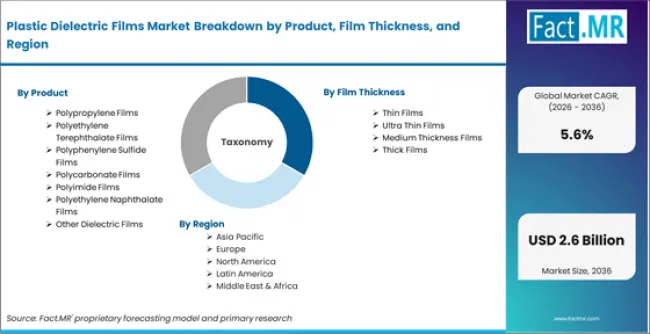
Plastic Dielectric Films Market is segmented by Product (Polypropylene Films, Polyethylene Terephthalate Films, Polyphenylene Sulfide Films, Polycarbonate Films, Polyimide Films, Polyethylene Naphthalate Films, Other Dielectric Films), Film Thickness (Thin Films, Ultra Thin Films, Medium Thickness Films, Thick Films), Technology (Film Orientation Technology, Extrusion Technology, Surface Treatment Technology, Metallization Technology), and Region, with forecasts covering the period from 2026 to 2036.
Plastic Dielectric Films Market Analysis and Forecast by Fact.MR
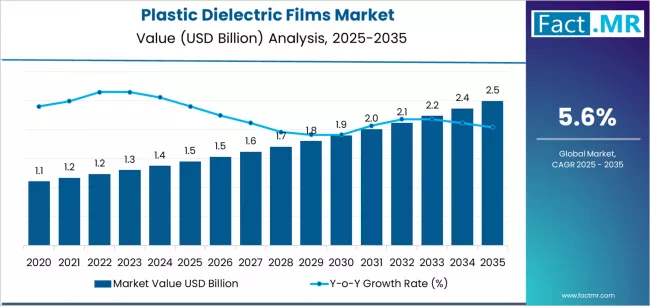
- The global plastic dielectric films market is estimated at US$ 1.4 billion in 2025 and has been forecast to expand at a CAGR of 5.6% to reach US$ 2.6 billion by 2036.
- Plastic dielectric films are thin polymer sheets used as insulating layers in capacitors, electrical insulation systems, and electronic components.
- Polypropylene films lead the product segment due to their low dielectric loss and high breakdown voltage, with capacitor manufacturing representing the dominant application.
- Thin films in the 2 to 10 micron range account for the largest thickness segment.
- The electronics, automotive, and energy industries form the primary end use base, with electric vehicle and renewable energy applications driving incremental demand.
Summary of Plastic Dielectric Films Market
- Market Snapshot
- In 2025, the global Plastic Dielectric Films Market was valued at approximately USD 1.4 billion.
- The market is estimated to reach USD 1.5 billion in 2026 and is projected to attain USD 2.6 billion by 2036.
- The plastic dielectric films market is likely to expand at a CAGR of 5.6% during the forecast period.
- The market is anticipated to create an absolute dollar opportunity of USD 1.1 billion between 2026 and 2036.
- Polypropylene Films accounts for 34.5% of product share in 2026.
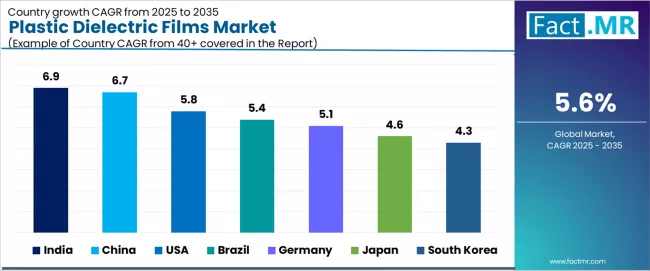
- India (6.9%) and China (6.7%) are the key growth markets during the forecast period.
- Demand and Growth Drivers
- Electric vehicle powertrain electrification is generating demand for film capacitors used in DC-link, inverter, and power conversion circuits.
- Renewable energy infrastructure expansion, including solar inverters and wind power converters, is creating sustained demand for high-voltage dielectric film capacitors.
- Capacitor miniaturization trends are driving demand for ultra-thin dielectric films below 2 microns that maintain dielectric strength at reduced thickness.
- Power electronics adoption in industrial automation, robotics, and grid infrastructure is expanding the capacitor application base for dielectric films.
- 5G base station power supply and data center UPS applications are creating new electronic capacitor demand channels for polypropylene and PET dielectric films.
- Product and Segment View
- Polypropylene Films accounts for 34.5% of the product segment in 2026, supported by strong installed base and continued procurement across primary end use channels.
- Thin Films accounts for 37.2% of the film thickness segment in 2026, reflecting concentrated demand across established application areas.
- Film Orientation Technology accounts for 31.8% of the technology segment in 2026, with adoption rising across both developed and emerging markets.
- Key segmentation includes:
- Product: Polypropylene Films, Polyethylene Terephthalate Films, Polyphenylene Sulfide Films
- Film Thickness: Thin Films, Ultra Thin Films, Medium Thickness Films
- Technology: Film Orientation Technology, Extrusion Technology, Surface Treatment Technology
- Application: Capacitors, Electrical Insulation, Electronics
- These systems enable:
- Targeted procurement and specification alignment across buyer segments
- Performance benchmarking across product and application categories
- Regional demand mapping across 30 plus countries
- Geography and Competitive Outlook
- North America accounts for a large share of global demand, supported by established procurement channels and a mature buyer base.
- Europe shows stable demand, with Germany (5.1%) contributing through regulatory compliance and institutional procurement for plastic dielectric films products.
- Asia Pacific demand is led by India (6.9%) and China (6.7%).
- India (6.9%) and China (6.7%) are the fastest growing country markets during the forecast period.
- Leading companies include DuPont Teijin Films, Steiner GmbH & Co. KG, Jindal Films, Tervakoski Film, Ganapathy Industries.
- Analyst Opinion
- Shambhu Nath Jha, Principal Consultant at Fact.MR, says 'The plastic dielectric films market is structurally linked to electrification trends across automotive, energy, and industrial electronics. EV powertrain and renewable energy inverter demand are the two growth vectors that will define the next decade. DuPont Teijin Films leads through material science depth and global manufacturing scale, while Steiner, Jindal, and Tervakoski compete on specific film types and regional positioning. The critical competitive differentiator is the ability to manufacture ultra-thin films at scale with the consistency required for high-reliability capacitor applications in automotive and energy infrastructure.'
Key Growth Drivers, Constraints, and Opportunities
Key Factors Driving Growth
- Electric vehicle powertrain electrification is generating demand for film capacitors used in DC-link, inverter, and power conversion circuits.
- Renewable energy infrastructure expansion, including solar inverters and wind power converters, is creating sustained demand for high-voltage dielectric film capacitors.
- Capacitor miniaturization trends are driving demand for ultra-thin dielectric films below 2 microns that maintain dielectric strength at reduced thickness.
Key Market Constraints
- Raw material price volatility in polypropylene and specialty polymer feedstocks creates cost uncertainty for dielectric film manufacturers.
- Competition from ceramic and electrolytic capacitor technologies limits film capacitor penetration in certain voltage and capacitance ranges.
- Manufacturing precision requirements for ultra-thin films below 2 microns create yield challenges and capital intensity that limit the number of capable suppliers.
Key Opportunity Areas
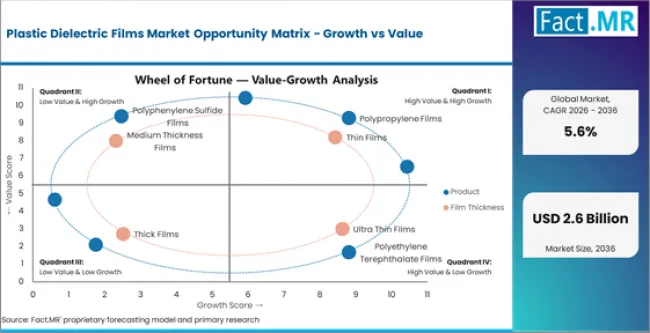
- High-temperature polymer films, including polyphenylene sulfide and polyimide, are opening application opportunities in automotive and aerospace electronics where conventional PP films cannot operate.
- Electric vehicle fast-charging infrastructure deployment is creating additional demand for high-voltage film capacitors in charging station power electronics.
- Energy storage system integration with film capacitors for power quality and grid stabilization applications is expanding the energy sector addressable market.
Segment-wise Analysis of the Plastic Dielectric Films Market
- Polypropylene Films holds 34.5% of the product segment in 2026, supported by established demand channels and continued procurement across primary end use applications.
- Thin Films holds 37.2% of the film thickness segment in 2026, supported by established demand channels and continued procurement across primary end use applications.
- Film Orientation Technology holds 31.8% of the technology segment in 2026, supported by established demand channels and continued procurement across primary end use applications.
The plastic dielectric films market is segmented by product, film thickness, technology, application, and region.
By product, the market covers Polypropylene Films, Polyethylene Terephthalate Films, Polyphenylene Sulfide Films.
By film thickness, coverage includes Thin Films, Ultra Thin Films, Medium Thickness Films.
Which Product Segment Dominates the Plastic Dielectric Films Market?
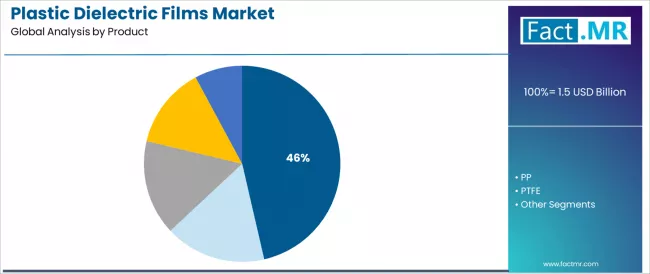
Polypropylene Films is expected to account for 34.5% of the product segment in 2026. Within this category, Biaxially Oriented Polypropylene Films, Cast Polypropylene Films represent the primary sub-segments generating procurement activity. The depth of the polypropylene films installed base across product applications sustains replacement demand and limits share erosion from newer alternatives in the plastic dielectric films market.
Polyethylene Terephthalate Films is the second largest category in the product segment, with demand concentrated in Biaxially Oriented Polyethylene Terephthalate Films and Heat Stabilized Polyethylene Terephthalate Films. Growth in polyethylene terephthalate films reflects shifting buyer requirements within the plastic dielectric films market toward this category.
Which Film Thickness Segment Dominates the Plastic Dielectric Films Market?
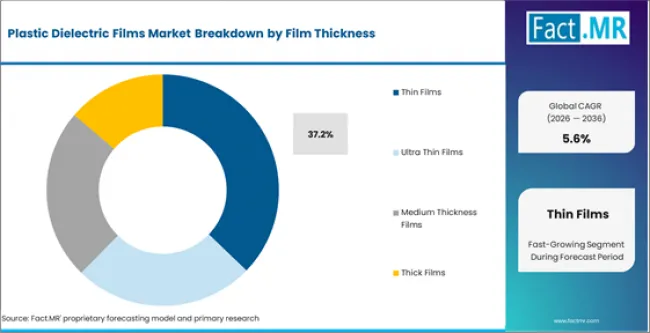
Thin Films is expected to account for 37.2% of the film thickness segment in 2026. Within this category, 2 to 10 Micron, General Purpose Capacitor Films represent the primary sub-segments generating procurement activity. The depth of the thin films installed base across film thickness applications sustains replacement demand and limits share erosion from newer alternatives in the plastic dielectric films market.
Ultra Thin Films is the second largest category in the film thickness segment, with demand concentrated in Below 2 Micron and High Precision Capacitor Films. Growth in ultra thin films reflects shifting buyer requirements within the plastic dielectric films market toward this category.
Which Technology Segment Dominates the Plastic Dielectric Films Market?
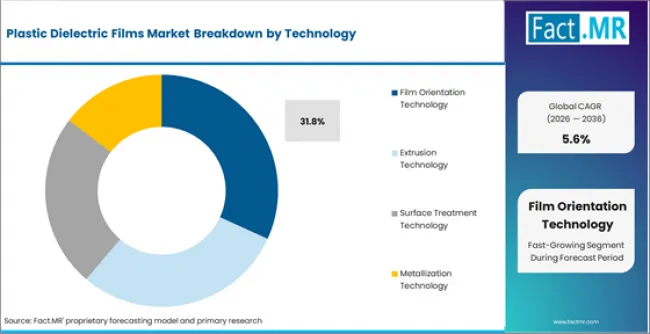
Film Orientation Technology is expected to account for 31.8% of the technology segment in 2026. Within this category, Biaxial Orientation, Uniaxial Orientation represent the primary sub-segments generating procurement activity. The depth of the film orientation technology installed base across technology applications sustains replacement demand and limits share erosion from newer alternatives in the plastic dielectric films market.
Extrusion Technology is the second largest category in the technology segment, with demand concentrated in Cast Film Extrusion and Blown Film Extrusion. Growth in extrusion technology reflects shifting buyer requirements within the plastic dielectric films market toward this category.
Which Product Trend is Shaping the Next Phase of Growth in the Plastic Dielectric Films Market?
Ultra-thin dielectric films below 2 microns are the technology frontier driving premium growth within the plastic dielectric films market. As power electronics and capacitor manufacturers push toward higher energy density and smaller form factors, the ability to produce films with consistent thickness, uniform dielectric strength, and low defect density at thicknesses approaching 1 micron becomes a critical manufacturing differentiator.
Production of ultra-thin films requires precision biaxial orientation equipment, clean-room manufacturing environments, and advanced quality inspection systems that represent substantial capital investment. DuPont Teijin Films, Steiner GmbH, and a small number of Japanese manufacturers possess the capability to produce films at these tolerances consistently. The supply base concentration at the ultra-thin tier creates both pricing power for capable suppliers and supply chain risk for capacitor manufacturers dependent on a limited number of qualified sources.
Regional Outlook Across Key Markets
.webp)
- India is growing at 6.9%, supported by power electronics expansion, EV component manufacturing, and renewable energy infrastructure.
- China is growing at 6.7%, supported by EV production dominance, domestic film manufacturing scale, and solar inverter demand.
- USA is growing at 5.8%, supported by IRA-incentivized EV manufacturing, defense electronics requirements, and renewable energy deployment.
- Brazil is growing at 5.4%, supported by renewable energy installation growth, industrial automation adoption, and capacity development potential.
CAGR Table
| Country | CAGR (%) |
|---|---|
| India | 6.9% |
| China | 6.7% |
| USA | 5.8% |
| Brazil | 5.4% |
| Germany | 5.1% |
| Japan | 4.6% |
| South Korea | 4.3% |
Source: Fact MR (FMR) analysis, based on proprietary forecasting model and primary research.
Market Outlook for Plastic Dielectric Films in India
The India Plastic Dielectric Films market is projected to grow at a CAGR of 6.9% through 2036. India is the fastest-growing plastic dielectric films market, driven by power electronics expansion, EV component manufacturing, and renewable energy infrastructure.
- Domestic capacitor manufacturing by Havells, EPCOS India, and others generates demand for PP and PET dielectric films.
- Renewable energy installation targets under National Solar Mission create sustained demand for inverter-grade film capacitors.
- Ganapathy Industries and domestic film producers are expanding capacity to serve growing domestic and export demand.
Plastic Dielectric Films Demand Trends in China
The China Plastic Dielectric Films market is projected to grow at a CAGR of 6.7% through 2036. Manufacturing scale and EV production dominance position China as a major plastic dielectric films market.
- EV production scale, with China accounting for over 60% of global EV output, generates proportionally large film capacitor demand.
- Domestic dielectric film manufacturers are expanding capacity and improving quality to compete with established global suppliers.
- Solar inverter and wind power converter manufacturing generates sustained demand for capacitor-grade dielectric films.
USA Plastic Dielectric Films Market Growth Outlook
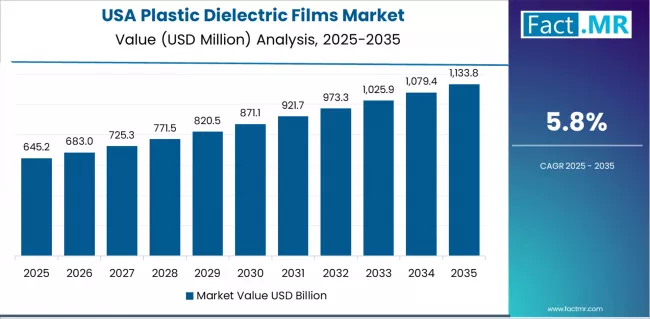
The USA Plastic Dielectric Films market is projected to grow at a CAGR of 5.8% through 2036. The U.S. plastic dielectric films market is driven by defense electronics, EV transition investment, and renewable energy deployment.
- IRA incentives for EV manufacturing and renewable energy are generating incremental demand for power electronics and film capacitors.
- Defense and aerospace electronics applications require MIL-spec qualified dielectric films with stringent performance requirements.
- DuPont Teijin Films maintains manufacturing presence in the U.S. serving domestic capacitor and electronics customers.
Brazil Plastic Dielectric Films Market Demand Analysis
The Brazil Plastic Dielectric Films market is projected to grow at a CAGR of 5.4% through 2036. Growing renewable energy installation and industrial electronics demand support dielectric films growth in Brazil.
- Solar and wind energy installation growth under national energy policy creates demand for inverter-grade film capacitors.
- Industrial automation adoption in manufacturing is generating incremental power electronics and capacitor demand.
- Import dependency for specialty dielectric films creates procurement challenges but also opportunity for domestic capacity development.
Plastic Dielectric Films Market Growth Assessment in Germany
The Germany Plastic Dielectric Films market is projected to grow at a CAGR of 5.1% through 2036. Automotive electrification and industrial electronics strength position Germany as a leading European dielectric films market.
- Automotive OEM and Tier 1 supplier demand for EV powertrain film capacitors generates direct dielectric film procurement.
- Steiner GmbH domestic manufacturing provides European-sourced specialty capacitor films for automotive and industrial applications.
- TDK and Vishay capacitor manufacturing operations in Europe source dielectric films for industrial and automotive products.
Plastic Dielectric Films Market Opportunity Outlook in Japan
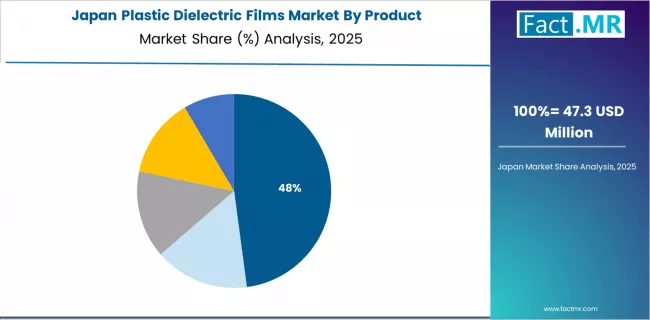
The Japan Plastic Dielectric Films market is projected to grow at a CAGR of 4.6% through 2036. Established electronics manufacturing and automotive industry support plastic dielectric films demand in Japan.
- Film capacitor manufacturers including Panasonic, TDK, and Nichicon source domestic and imported dielectric films.
- Automotive electronics content growth in hybrid and electric vehicles produced by Toyota, Honda, and Nissan generates demand.
- Japanese film manufacturers maintain leadership in ultra-thin film production capability for precision capacitor applications.
Demand Landscape for Plastic Dielectric Films in South Korea
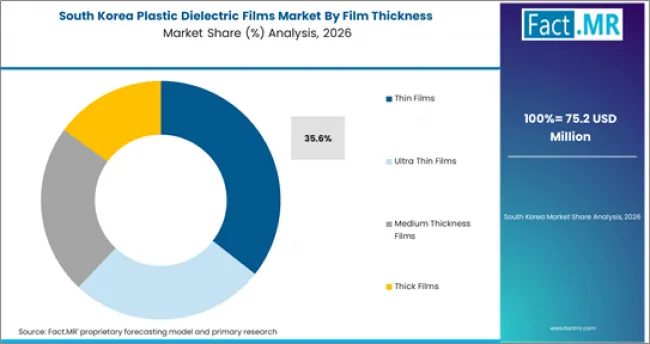
The South Korea Plastic Dielectric Films market is projected to grow at a CAGR of 4.3% through 2036. Electronics manufacturing concentration and EV battery ecosystem support dielectric films demand in South Korea.
- Samsung Electro-Mechanics and domestic capacitor manufacturers source dielectric films for consumer and automotive electronics.
- Hyundai and Kia EV production programs generate demand for powertrain film capacitors using PP dielectric films.
- Display and semiconductor electronics manufacturing creates additional demand for specialty dielectric and insulation films.
Competitive Benchmarking and Company Positioning
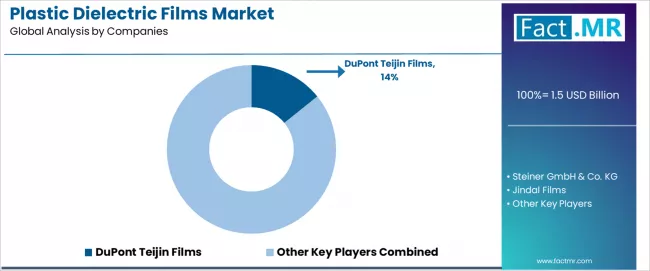
Plastic Dielectric Films Market Analysis By Company
- DuPont Teijin Films, Steiner GmbH & Co. KG, Jindal Films, Tervakoski Film hold established positions in the global plastic dielectric films market through broad product portfolios, geographic reach, and growing capabilities in higher specification categories.
- Ganapathy Industries, COVEME S.p.A., Jindal Poly Films Ltd., Bolloré Group participate across specific price tiers, end use segments, and regional channels, with competition shaped by product quality, service support, and distribution access.
- Film thickness uniformity at ultra-thin gauges, dielectric strength consistency, and automotive qualification portfolio are the primary competitive differentiators, with manufacturing precision and capacity scale creating barriers to entry.
DuPont Teijin Films leads the global plastic dielectric films market through its broad PP and PET film portfolio and manufacturing scale across multiple continents. Steiner GmbH and Co. KG competes with specialized high-performance capacitor films. Jindal Films serves cost-competitive segments with manufacturing in India and Europe. Tervakoski Film holds established positions in European capacitor film supply. Ganapathy Industries serves Indian and Asian markets.
The market is moderately concentrated, with DuPont Teijin Films holding the largest share through scale and material science capability. Competition is segmented between commodity-grade capacitor films where price is the primary factor and premium ultra-thin and high-temperature specialty films where manufacturing capability limits the competitive field. EV and renewable energy qualification requirements are raising the specification bar and favoring suppliers with automotive and energy sector certification.
Key Companies in the Plastic Dielectric Films Market
- DuPont Teijin Films, Steiner GmbH & Co. KG, Jindal Films, Tervakoski Film are among the leading players in the plastic dielectric films market globally, supported by strong brand visibility and broad product portfolios.
- Ganapathy Industries, COVEME S.p.A., Jindal Poly Films Ltd., Bolloré Group hold established positions across specific categories, supported by durable products and regional distribution.
Recent Industry Developments
- DuPont Teijin Films - Ultra-Thin Film Launch (January 2026)
- DuPont Teijin Films launched a 1.2-micron polypropylene dielectric film for next-generation film capacitors in EV powertrain applications, achieving the thinnest commercially available grade in its portfolio.
- Steiner GmbH & Co. KG - High-Temperature Film (2025)
- Steiner GmbH & Co. KG introduced a polyphenylene sulfide dielectric film rated for continuous operation at 150 degrees Celsius, targeting automotive under-hood and aerospace electronics applications.
- Jindal Films - Capacity Expansion (2025)
- Jindal Films completed a capacity expansion at its biaxial orientation film production facility, adding 30% output volume to serve growing EV and renewable energy capacitor demand.
- Tervakoski Film - EV Qualification (February 2026)
- Tervakoski Film received IATF 16949 automotive quality certification for its dielectric film manufacturing operations, qualifying its products for direct supply to automotive Tier 1 capacitor manufacturers.
Leading Companies Shaping the Plastic Dielectric Films Market
- DuPont Teijin Films
- Steiner GmbH & Co. KG
- Jindal Films
- Tervakoski Film
- Ganapathy Industries
- COVEME S.p.A.
- Jindal Poly Films Ltd.
- Bolloré Group
- SABIC
- Mitsubishi Chemical Corp.
Sources and Research References
- DuPont Teijin Films. Product portfolio and corporate announcements.
- Steiner GmbH & Co. KG. Product portfolio and corporate announcements.
- Jindal Films. Product portfolio and corporate announcements.
- Industry association statistics, regulatory publications, trade databases, and company product catalogs.
- Primary interviews with manufacturers, distributors, buyers, and institutional users.
This bibliography is provided for reader reference and is not exhaustive. The full report contains the complete reference list and detailed citations.
Key Questions This Report Addresses
- What is the current and future size of the Plastic Dielectric Films Market?
- How fast is the Plastic Dielectric Films Market expected to grow between 2026 and 2036?
- Which product is likely to lead the market by 2026?
- Which film thickness segment is expected to account for the highest demand by 2026?
- What factors are driving demand in this market globally?
- How is technology adoption influencing the market structure?
- Which countries are projected to show the fastest growth through 2036?
- What is driving market expansion in India and China?
- Who are the key companies active in the Plastic Dielectric Films Market?
- How does Fact.MR estimate and validate the market forecast?
Plastic Dielectric Films Market Definition
The plastic dielectric films market covers products, technologies, and services associated with product, film thickness, technology categories. The scope includes global and regional market size and forecasts for 2026 to 2036 across product, film thickness, technology, application, and region.
Plastic Dielectric Films Market Inclusions
- The scope covers global and regional market size and forecasts for 2026 to 2036 across product, film thickness, technology, application, and region.
- It includes regional demand analysis across major geographies, based on factors such as technology adoption, regulatory requirements, institutional spending, and commercial demand patterns.
- The report includes pricing and cost analysis across entry-level, mid-range, and premium categories, including hardware, software, and service components where applicable.
- It covers technology trends, market drivers and constraints, and the competitive landscape, including product portfolios, pricing strategy, geographic reach, and distribution expansion of leading players.
Plastic Dielectric Films Market Exclusions
- The scope excludes adjacent categories, general-purpose alternatives, and products not specifically classified under the plastic dielectric films market taxonomy.
- It excludes custom-built in-house solutions, informal unbranded products with low market visibility, and rental or leasing services without direct product sales.
- The report excludes military or defense-grade variants, industrial systems outside the defined scope, and non-commercial applications without market transaction data.
- It also excludes software-only platforms sold independently from hardware, unless they are part of the defined product or service taxonomy.
Plastic Dielectric Films Market Research Methodology
- The methodology combines secondary research, primary interviews, and forecast modelling.
- It draws on 120 plus secondary sources and benchmarks 65 plus company product portfolios.
- Market sizing covers 30 plus countries through a demand-side model, supported by top-down validation.
- Key inputs include end use adoption rates, technology penetration, pricing benchmarks, and regional procurement patterns.
- The model cross-checks demand with shipments, pricing trends, channel mix, and product launches.
- Primary validation includes 25 plus interviews across manufacturers, distributors, buyers, and institutional users.
- Final estimates go through trade-flow checks, sales-pattern review, and sensitivity testing.
Scope of Analysis

| Parameter | Details |
|---|---|
| Quantitative Units | USD 1.5 billion to USD 2.6 billion, at a CAGR of 5.6% |
| Market Definition | The Plastic Dielectric Films Market covers products, technologies, and services across product, film thickness, technology categories for commercial, institutional, and consumer applications. |
| Regions Covered | North America, Latin America, Europe, East Asia, South Asia and Pacific, Middle East and Africa |
| Countries Covered | USA, Canada, UK, Germany, China, India, 30 plus countries |
| Key Companies | DuPont Teijin Films, Steiner GmbH & Co. KG, Jindal Films, Tervakoski Film, Ganapathy Industries, COVEME S.p.A., Jindal Poly Films Ltd., Bolloré Group, SABIC, Mitsubishi Chemical Corp. |
| Forecast Period | 2026 to 2036 |
| Approach | Hybrid demand-side and top-down methodology built on country-level application demand, product benchmarking, pricing analysis, shipment validation, and primary interviews across manufacturers, distributors, and end users |
Plastic Dielectric Films Market Segmentation
-
Plastic Dielectric Films Market Segmented by Product:
- Polypropylene Films
- Biaxially Oriented Polypropylene Films
- Cast Polypropylene Films
- Polyethylene Terephthalate Films
- Biaxially Oriented Polyethylene Terephthalate Films
- Heat Stabilized Polyethylene Terephthalate Films
- Polyphenylene Sulfide Films
- High Temperature Polyphenylene Sulfide Films
- Reinforced Polyphenylene Sulfide Films
- Polycarbonate Films
- Standard Polycarbonate Films
- Optical Grade Polycarbonate Films
- Polyimide Films
- High Performance Polyimide Films
- Flexible Polyimide Films
- Polyethylene Naphthalate Films
- High Thermal Resistance Polyethylene Naphthalate Films
- Electrical Grade Polyethylene Naphthalate Films
- Other Dielectric Films
- Fluoropolymer Films
- Polystyrene Films
- Polypropylene Films
-
Plastic Dielectric Films Market Segmented by Film Thickness:
- Thin Films
- 2 to 10 Micron
- General Purpose Capacitor Films
- Ultra Thin Films
- Below 2 Micron
- High Precision Capacitor Films
- Medium Thickness Films
- 10 to 30 Micron
- Industrial Grade Films
- Thick Films
- Above 30 Micron
- High Voltage Applications
- Thin Films
-
Plastic Dielectric Films Market Segmented by Technology:
- Film Orientation Technology
- Biaxial Orientation
- Uniaxial Orientation
- Extrusion Technology
- Cast Film Extrusion
- Blown Film Extrusion
- Surface Treatment Technology
- Corona Treatment
- Plasma Treatment
- Metallization Technology
- Vacuum Metallization
- Aluminum Coated Films
- Film Orientation Technology
-
Plastic Dielectric Films Market Segmented by Application:
- Capacitors
- Power Capacitors
- Film Capacitors
- Pulse Capacitors
- Electrical Insulation
- Motor Insulation
- Transformer Insulation
- Cable Insulation
- Electronics
- Flexible Printed Circuits
- Display Components
- Power Electronics
- Energy Storage
- DC Link Capacitors
- Renewable Energy Systems
- Automotive Electronics
- Electric Vehicle Systems
- Advanced Driver Assistance Systems
- Capacitors
-
Plastic Dielectric Films Market Segmented by End Use:
- Electronics Industry
- Consumer Electronics Manufacturers
- Industrial Electronics Producers
- Automotive Industry
- Electric Vehicle Manufacturers
- Automotive Component Suppliers
- Energy and Power Industry
- Renewable Energy Companies
- Grid Infrastructure Providers
- Industrial Manufacturing
- Machinery Manufacturers
- Heavy Equipment Producers
- Electronics Industry
-
Plastic Dielectric Films Market by Region:
- North America
- USA
- Canada
- Mexico
- Latin America
- Brazil
- Chile
- Rest of Latin America
- Western Europe
- Germany
- UK
- Italy
- Spain
- France
- Nordic
- BENELUX
- Rest of Western Europe
- Eastern Europe
- Russia
- Poland
- Hungary
- Balkan & Baltic
- Rest of Eastern Europe
- East Asia
- China
- Japan
- South Korea
- South Asia and Pacific
- India
- ASEAN
- Australia & New Zealand
- Rest of South Asia and Pacific
- Middle East & Africa
- Kingdom of Saudi Arabia
- Other GCC Countries
- Turkiye
- South Africa
- Other African Union
- Rest of Middle East & Africa
- North America
- Frequently Asked Questions -
How big is the plastic dielectric films market in 2026?
The global plastic dielectric films market is estimated to be valued at USD 1.5 billion in 2026.
What will be the size of plastic dielectric films market in 2036?
The market size for the plastic dielectric films market is projected to reach USD 2.6 billion by 2036.
How much will be the plastic dielectric films market growth between 2026 and 2036?
The plastic dielectric films market is expected to grow at a 5.6% CAGR between 2026 and 2036.
What are the key product types in the plastic dielectric films market?
The key product types in plastic dielectric films market are polypropylene films, polyethylene terephthalate films, polyphenylene sulfide films, polycarbonate films, polyimide films, polyethylene naphthalate films and other dielectric films.
Which film thickness segment is expected to contribute significant share in the plastic dielectric films market in 2026?
In terms of film thickness, thin films segment is expected to command 37.2% share in the plastic dielectric films market in 2026.
Table of Content
- Executive Summary
- Global Market Outlook
- Demand to side Trends
- Supply to side Trends
- Technology Roadmap Analysis
- Analysis and Recommendations
- Market Overview
- Market Coverage / Taxonomy
- Market Definition / Scope / Limitations
- Research Methodology
- Chapter Orientation
- Analytical Lens and Working Hypotheses
- Market Structure, Signals, and Trend Drivers
- Benchmarking and Cross-market Comparability
- Market Sizing, Forecasting, and Opportunity Mapping
- Research Design and Evidence Framework
- Desk Research Programme (Secondary Evidence)
- Company Annual and Sustainability Reports
- Peer-reviewed Journals and Academic Literature
- Corporate Websites, Product Literature, and Technical Notes
- Earnings Decks and Investor Briefings
- Statutory Filings and Regulatory Disclosures
- Technical White Papers and Standards Notes
- Trade Journals, Industry Magazines, and Analyst Briefs
- Conference Proceedings, Webinars, and Seminar Materials
- Government Statistics Portals and Public Data Releases
- Press Releases and Reputable Media Coverage
- Specialist Newsletters and Curated Briefings
- Sector Databases and Reference Repositories
- Fact.MR Internal Proprietary Databases and Historical Market Datasets
- Subscription Datasets and Paid Sources
- Social Channels, Communities, and Digital Listening Inputs
- Additional Desk Sources
- Expert Input and Fieldwork (Primary Evidence)
- Primary Modes
- Qualitative Interviews and Expert Elicitation
- Quantitative Surveys and Structured Data Capture
- Blended Approach
- Why Primary Evidence is Used
- Field Techniques
- Interviews
- Surveys
- Focus Groups
- Observational and In-context Research
- Social and Community Interactions
- Stakeholder Universe Engaged
- C-suite Leaders
- Board Members
- Presidents and Vice Presidents
- R&D and Innovation Heads
- Technical Specialists
- Domain Subject-matter Experts
- Scientists
- Physicians and Other Healthcare Professionals
- Governance, Ethics, and Data Stewardship
- Research Ethics
- Data Integrity and Handling
- Primary Modes
- Tooling, Models, and Reference Databases
- Desk Research Programme (Secondary Evidence)
- Data Engineering and Model Build
- Data Acquisition and Ingestion
- Cleaning, Normalisation, and Verification
- Synthesis, Triangulation, and Analysis
- Quality Assurance and Audit Trail
- Market Background
- Market Dynamics
- Drivers
- Restraints
- Opportunity
- Trends
- Scenario Forecast
- Demand in Optimistic Scenario
- Demand in Likely Scenario
- Demand in Conservative Scenario
- Opportunity Map Analysis
- Product Life Cycle Analysis
- Supply Chain Analysis
- Investment Feasibility Matrix
- Value Chain Analysis
- PESTLE and Porter’s Analysis
- Regulatory Landscape
- Regional Parent Market Outlook
- Production and Consumption Statistics
- Import and Export Statistics
- Market Dynamics
- Global Market Analysis 2021 to 2025 and Forecast, 2026 to 2036
- Historical Market Size Value (USD Million) Analysis, 2021 to 2025
- Current and Future Market Size Value (USD Million) Projections, 2026 to 2036
- Y to o to Y Growth Trend Analysis
- Absolute $ Opportunity Analysis
- Global Market Pricing Analysis 2021 to 2025 and Forecast 2026 to 2036
- Global Market Analysis 2021 to 2025 and Forecast 2026 to 2036, By Product
- Introduction / Key Findings
- Historical Market Size Value (USD Million) Analysis By Product, 2021 to 2025
- Current and Future Market Size Value (USD Million) Analysis and Forecast By Product, 2026 to 2036
- Polypropylene Films
- Biaxially Oriented Polypropylene Films
- Cast Polypropylene Films
- Polyethylene Terephthalate Films
- Biaxially Oriented Polyethylene Terephthalate Films
- Heat Stabilized Polyethylene Terephthalate Films
- Polyphenylene Sulfide Films
- High Temperature Polyphenylene Sulfide Films
- Reinforced Polyphenylene Sulfide Films
- Polycarbonate Films
- Standard Polycarbonate Films
- Optical Grade Polycarbonate Films
- Polyimide Films
- High Performance Polyimide Films
- Flexible Polyimide Films
- Polyethylene Naphthalate Films
- High Thermal Resistance Polyethylene Naphthalate Films
- Electrical Grade Polyethylene Naphthalate Films
- Other Dielectric Films
- Fluoropolymer Films
- Polystyrene Films
- Polypropylene Films
- Y to o to Y Growth Trend Analysis By Product, 2021 to 2025
- Absolute $ Opportunity Analysis By Product, 2026 to 2036
- Global Market Analysis 2021 to 2025 and Forecast 2026 to 2036, By Film Thickness
- Introduction / Key Findings
- Historical Market Size Value (USD Million) Analysis By Film Thickness, 2021 to 2025
- Current and Future Market Size Value (USD Million) Analysis and Forecast By Film Thickness, 2026 to 2036
- Thin Films
- 2 to 10 Micron
- General Purpose Capacitor Films
- Ultra Thin Films
- Below 2 Micron
- High Precision Capacitor Films
- Medium Thickness Films
- 10 to 30 Micron
- Industrial Grade Films
- Thick Films
- Above 30 Micron
- High Voltage Applications
- Thin Films
- Y to o to Y Growth Trend Analysis By Film Thickness, 2021 to 2025
- Absolute $ Opportunity Analysis By Film Thickness, 2026 to 2036
- Global Market Analysis 2021 to 2025 and Forecast 2026 to 2036, By Technology
- Introduction / Key Findings
- Historical Market Size Value (USD Million) Analysis By Technology, 2021 to 2025
- Current and Future Market Size Value (USD Million) Analysis and Forecast By Technology, 2026 to 2036
- Film Orientation Technology
- Biaxial Orientation
- Uniaxial Orientation
- Extrusion Technology
- Cast Film Extrusion
- Blown Film Extrusion
- Surface Treatment Technology
- Corona Treatment
- Plasma Treatment
- Metallization Technology
- Vacuum Metallization
- Aluminum Coated Films
- Film Orientation Technology
- Y to o to Y Growth Trend Analysis By Technology, 2021 to 2025
- Absolute $ Opportunity Analysis By Technology, 2026 to 2036
- Global Market Analysis 2021 to 2025 and Forecast 2026 to 2036, By Application
- Introduction / Key Findings
- Historical Market Size Value (USD Million) Analysis By Application, 2021 to 2025
- Current and Future Market Size Value (USD Million) Analysis and Forecast By Application, 2026 to 2036
- Capacitors
- Power Capacitors
- Film Capacitors
- Pulse Capacitors
- Electrical Insulation
- Motor Insulation
- Transformer Insulation
- Cable Insulation
- Electronics
- Flexible Printed Circuits
- Display Components
- Power Electronics
- Energy Storage
- DC Link Capacitors
- Renewable Energy Systems
- Automotive Electronics
- Electric Vehicle Systems
- Advanced Driver Assistance Systems
- Capacitors
- Y to o to Y Growth Trend Analysis By Application, 2021 to 2025
- Absolute $ Opportunity Analysis By Application, 2026 to 2036
- Global Market Analysis 2021 to 2025 and Forecast 2026 to 2036, By End Use
- Introduction / Key Findings
- Historical Market Size Value (USD Million) Analysis By End Use, 2021 to 2025
- Current and Future Market Size Value (USD Million) Analysis and Forecast By End Use, 2026 to 2036
- Electronics Industry
- Consumer Electronics Manufacturers
- Industrial Electronics Producers
- Automotive Industry
- Electric Vehicle Manufacturers
- Automotive Component Suppliers
- Energy and Power Industry
- Renewable Energy Companies
- Grid Infrastructure Providers
- Industrial Manufacturing
- Machinery Manufacturers
- Heavy Equipment Producers
- Electronics Industry
- Y to o to Y Growth Trend Analysis By End Use, 2021 to 2025
- Absolute $ Opportunity Analysis By End Use, 2026 to 2036
- Global Market Analysis 2021 to 2025 and Forecast 2026 to 2036, By Region
- Introduction
- Historical Market Size Value (USD Million) Analysis By Region, 2021 to 2025
- Current Market Size Value (USD Million) Analysis and Forecast By Region, 2026 to 2036
- North America
- Latin America
- Western Europe
- Eastern Europe
- East Asia
- South Asia and Pacific
- Middle East & Africa
- Market Attractiveness Analysis By Region
- North America Market Analysis 2021 to 2025 and Forecast 2026 to 2036, By Country
- Historical Market Size Value (USD Million) Trend Analysis By Market Taxonomy, 2021 to 2025
- Market Size Value (USD Million) Forecast By Market Taxonomy, 2026 to 2036
- By Country
- USA
- Canada
- Mexico
- By Product
- By Film Thickness
- By Technology
- By Application
- By End Use
- By Country
- Market Attractiveness Analysis
- By Country
- By Product
- By Film Thickness
- By Technology
- By Application
- By End Use
- Key Takeaways
- Latin America Market Analysis 2021 to 2025 and Forecast 2026 to 2036, By Country
- Historical Market Size Value (USD Million) Trend Analysis By Market Taxonomy, 2021 to 2025
- Market Size Value (USD Million) Forecast By Market Taxonomy, 2026 to 2036
- By Country
- Brazil
- Chile
- Rest of Latin America
- By Product
- By Film Thickness
- By Technology
- By Application
- By End Use
- By Country
- Market Attractiveness Analysis
- By Country
- By Product
- By Film Thickness
- By Technology
- By Application
- By End Use
- Key Takeaways
- Western Europe Market Analysis 2021 to 2025 and Forecast 2026 to 2036, By Country
- Historical Market Size Value (USD Million) Trend Analysis By Market Taxonomy, 2021 to 2025
- Market Size Value (USD Million) Forecast By Market Taxonomy, 2026 to 2036
- By Country
- Germany
- UK
- Italy
- Spain
- France
- Nordic
- BENELUX
- Rest of Western Europe
- By Product
- By Film Thickness
- By Technology
- By Application
- By End Use
- By Country
- Market Attractiveness Analysis
- By Country
- By Product
- By Film Thickness
- By Technology
- By Application
- By End Use
- Key Takeaways
- Eastern Europe Market Analysis 2021 to 2025 and Forecast 2026 to 2036, By Country
- Historical Market Size Value (USD Million) Trend Analysis By Market Taxonomy, 2021 to 2025
- Market Size Value (USD Million) Forecast By Market Taxonomy, 2026 to 2036
- By Country
- Russia
- Poland
- Hungary
- Balkan & Baltic
- Rest of Eastern Europe
- By Product
- By Film Thickness
- By Technology
- By Application
- By End Use
- By Country
- Market Attractiveness Analysis
- By Country
- By Product
- By Film Thickness
- By Technology
- By Application
- By End Use
- Key Takeaways
- East Asia Market Analysis 2021 to 2025 and Forecast 2026 to 2036, By Country
- Historical Market Size Value (USD Million) Trend Analysis By Market Taxonomy, 2021 to 2025
- Market Size Value (USD Million) Forecast By Market Taxonomy, 2026 to 2036
- By Country
- China
- Japan
- South Korea
- By Product
- By Film Thickness
- By Technology
- By Application
- By End Use
- By Country
- Market Attractiveness Analysis
- By Country
- By Product
- By Film Thickness
- By Technology
- By Application
- By End Use
- Key Takeaways
- South Asia and Pacific Market Analysis 2021 to 2025 and Forecast 2026 to 2036, By Country
- Historical Market Size Value (USD Million) Trend Analysis By Market Taxonomy, 2021 to 2025
- Market Size Value (USD Million) Forecast By Market Taxonomy, 2026 to 2036
- By Country
- India
- ASEAN
- Australia & New Zealand
- Rest of South Asia and Pacific
- By Product
- By Film Thickness
- By Technology
- By Application
- By End Use
- By Country
- Market Attractiveness Analysis
- By Country
- By Product
- By Film Thickness
- By Technology
- By Application
- By End Use
- Key Takeaways
- Middle East & Africa Market Analysis 2021 to 2025 and Forecast 2026 to 2036, By Country
- Historical Market Size Value (USD Million) Trend Analysis By Market Taxonomy, 2021 to 2025
- Market Size Value (USD Million) Forecast By Market Taxonomy, 2026 to 2036
- By Country
- Kingdom of Saudi Arabia
- Other GCC Countries
- Turkiye
- South Africa
- Other African Union
- Rest of Middle East & Africa
- By Product
- By Film Thickness
- By Technology
- By Application
- By End Use
- By Country
- Market Attractiveness Analysis
- By Country
- By Product
- By Film Thickness
- By Technology
- By Application
- By End Use
- Key Takeaways
- Key Countries Market Analysis
- USA
- Pricing Analysis
- Market Share Analysis, 2025
- By Product
- By Film Thickness
- By Technology
- By Application
- By End Use
- Canada
- Pricing Analysis
- Market Share Analysis, 2025
- By Product
- By Film Thickness
- By Technology
- By Application
- By End Use
- Mexico
- Pricing Analysis
- Market Share Analysis, 2025
- By Product
- By Film Thickness
- By Technology
- By Application
- By End Use
- Brazil
- Pricing Analysis
- Market Share Analysis, 2025
- By Product
- By Film Thickness
- By Technology
- By Application
- By End Use
- Chile
- Pricing Analysis
- Market Share Analysis, 2025
- By Product
- By Film Thickness
- By Technology
- By Application
- By End Use
- Germany
- Pricing Analysis
- Market Share Analysis, 2025
- By Product
- By Film Thickness
- By Technology
- By Application
- By End Use
- UK
- Pricing Analysis
- Market Share Analysis, 2025
- By Product
- By Film Thickness
- By Technology
- By Application
- By End Use
- Italy
- Pricing Analysis
- Market Share Analysis, 2025
- By Product
- By Film Thickness
- By Technology
- By Application
- By End Use
- Spain
- Pricing Analysis
- Market Share Analysis, 2025
- By Product
- By Film Thickness
- By Technology
- By Application
- By End Use
- France
- Pricing Analysis
- Market Share Analysis, 2025
- By Product
- By Film Thickness
- By Technology
- By Application
- By End Use
- India
- Pricing Analysis
- Market Share Analysis, 2025
- By Product
- By Film Thickness
- By Technology
- By Application
- By End Use
- ASEAN
- Pricing Analysis
- Market Share Analysis, 2025
- By Product
- By Film Thickness
- By Technology
- By Application
- By End Use
- Australia & New Zealand
- Pricing Analysis
- Market Share Analysis, 2025
- By Product
- By Film Thickness
- By Technology
- By Application
- By End Use
- China
- Pricing Analysis
- Market Share Analysis, 2025
- By Product
- By Film Thickness
- By Technology
- By Application
- By End Use
- Japan
- Pricing Analysis
- Market Share Analysis, 2025
- By Product
- By Film Thickness
- By Technology
- By Application
- By End Use
- South Korea
- Pricing Analysis
- Market Share Analysis, 2025
- By Product
- By Film Thickness
- By Technology
- By Application
- By End Use
- Russia
- Pricing Analysis
- Market Share Analysis, 2025
- By Product
- By Film Thickness
- By Technology
- By Application
- By End Use
- Poland
- Pricing Analysis
- Market Share Analysis, 2025
- By Product
- By Film Thickness
- By Technology
- By Application
- By End Use
- Hungary
- Pricing Analysis
- Market Share Analysis, 2025
- By Product
- By Film Thickness
- By Technology
- By Application
- By End Use
- Kingdom of Saudi Arabia
- Pricing Analysis
- Market Share Analysis, 2025
- By Product
- By Film Thickness
- By Technology
- By Application
- By End Use
- Turkiye
- Pricing Analysis
- Market Share Analysis, 2025
- By Product
- By Film Thickness
- By Technology
- By Application
- By End Use
- South Africa
- Pricing Analysis
- Market Share Analysis, 2025
- By Product
- By Film Thickness
- By Technology
- By Application
- By End Use
- USA
- Market Structure Analysis
- Competition Dashboard
- Competition Benchmarking
- Market Share Analysis of Top Players
- By Regional
- By Product
- By Film Thickness
- By Technology
- By Application
- By End Use
- Competition Analysis
- Competition Deep Dive
- DuPont Teijin Films
- Overview
- Product Portfolio
- Profitability by Market Segments (Product/Age /Sales Channel/Region)
- Sales Footprint
- Strategy Overview
- Marketing Strategy
- Product Strategy
- Channel Strategy
- Steiner GmbH & Co. KG
- Jindal Films
- Tervakoski Film
- Ganapathy Industries
- COVEME S.p.A.
- Jindal Poly Films Ltd.
- Bolloré Group
- SABIC
- Mitsubishi Chemical Corp.
- Toray Industries, Inc.
- SK Geo-Centric
- Asahi Kasei Corp.
- Maruzen Petrochemical
- PPI Adhesive Products
- DuPont Teijin Films
- Competition Deep Dive
- Assumptions & Acronyms Used
List Of Table
- Table 1: Global Market Value (USD Million) Forecast by Region, 2021 to 2036
- Table 2: Global Market Value (USD Million) Forecast by Product, 2021 to 2036
- Table 3: Global Market Value (USD Million) Forecast by Film Thickness, 2021 to 2036
- Table 4: Global Market Value (USD Million) Forecast by Technology, 2021 to 2036
- Table 5: Global Market Value (USD Million) Forecast by Application, 2021 to 2036
- Table 6: Global Market Value (USD Million) Forecast by End Use, 2021 to 2036
- Table 7: North America Market Value (USD Million) Forecast by Country, 2021 to 2036
- Table 8: North America Market Value (USD Million) Forecast by Product, 2021 to 2036
- Table 9: North America Market Value (USD Million) Forecast by Film Thickness, 2021 to 2036
- Table 10: North America Market Value (USD Million) Forecast by Technology, 2021 to 2036
- Table 11: North America Market Value (USD Million) Forecast by Application, 2021 to 2036
- Table 12: North America Market Value (USD Million) Forecast by End Use, 2021 to 2036
- Table 13: Latin America Market Value (USD Million) Forecast by Country, 2021 to 2036
- Table 14: Latin America Market Value (USD Million) Forecast by Product, 2021 to 2036
- Table 15: Latin America Market Value (USD Million) Forecast by Film Thickness, 2021 to 2036
- Table 16: Latin America Market Value (USD Million) Forecast by Technology, 2021 to 2036
- Table 17: Latin America Market Value (USD Million) Forecast by Application, 2021 to 2036
- Table 18: Latin America Market Value (USD Million) Forecast by End Use, 2021 to 2036
- Table 19: Western Europe Market Value (USD Million) Forecast by Country, 2021 to 2036
- Table 20: Western Europe Market Value (USD Million) Forecast by Product, 2021 to 2036
- Table 21: Western Europe Market Value (USD Million) Forecast by Film Thickness, 2021 to 2036
- Table 22: Western Europe Market Value (USD Million) Forecast by Technology, 2021 to 2036
- Table 23: Western Europe Market Value (USD Million) Forecast by Application, 2021 to 2036
- Table 24: Western Europe Market Value (USD Million) Forecast by End Use, 2021 to 2036
- Table 25: Eastern Europe Market Value (USD Million) Forecast by Country, 2021 to 2036
- Table 26: Eastern Europe Market Value (USD Million) Forecast by Product, 2021 to 2036
- Table 27: Eastern Europe Market Value (USD Million) Forecast by Film Thickness, 2021 to 2036
- Table 28: Eastern Europe Market Value (USD Million) Forecast by Technology, 2021 to 2036
- Table 29: Eastern Europe Market Value (USD Million) Forecast by Application, 2021 to 2036
- Table 30: Eastern Europe Market Value (USD Million) Forecast by End Use, 2021 to 2036
- Table 31: East Asia Market Value (USD Million) Forecast by Country, 2021 to 2036
- Table 32: East Asia Market Value (USD Million) Forecast by Product, 2021 to 2036
- Table 33: East Asia Market Value (USD Million) Forecast by Film Thickness, 2021 to 2036
- Table 34: East Asia Market Value (USD Million) Forecast by Technology, 2021 to 2036
- Table 35: East Asia Market Value (USD Million) Forecast by Application, 2021 to 2036
- Table 36: East Asia Market Value (USD Million) Forecast by End Use, 2021 to 2036
- Table 37: South Asia and Pacific Market Value (USD Million) Forecast by Country, 2021 to 2036
- Table 38: South Asia and Pacific Market Value (USD Million) Forecast by Product, 2021 to 2036
- Table 39: South Asia and Pacific Market Value (USD Million) Forecast by Film Thickness, 2021 to 2036
- Table 40: South Asia and Pacific Market Value (USD Million) Forecast by Technology, 2021 to 2036
- Table 41: South Asia and Pacific Market Value (USD Million) Forecast by Application, 2021 to 2036
- Table 42: South Asia and Pacific Market Value (USD Million) Forecast by End Use, 2021 to 2036
- Table 43: Middle East & Africa Market Value (USD Million) Forecast by Country, 2021 to 2036
- Table 44: Middle East & Africa Market Value (USD Million) Forecast by Product, 2021 to 2036
- Table 45: Middle East & Africa Market Value (USD Million) Forecast by Film Thickness, 2021 to 2036
- Table 46: Middle East & Africa Market Value (USD Million) Forecast by Technology, 2021 to 2036
- Table 47: Middle East & Africa Market Value (USD Million) Forecast by Application, 2021 to 2036
- Table 48: Middle East & Africa Market Value (USD Million) Forecast by End Use, 2021 to 2036
List Of Figures
- Figure 1: Global Market Pricing Analysis
- Figure 2: Global Market Value (USD Million) Forecast 2021 to 2036
- Figure 3: Global Market Value Share and BPS Analysis by Product, 2026 and 2036
- Figure 4: Global Market Y-o-Y Growth Comparison by Product, 2026 to 2036
- Figure 5: Global Market Attractiveness Analysis by Product
- Figure 6: Global Market Value Share and BPS Analysis by Film Thickness, 2026 and 2036
- Figure 7: Global Market Y-o-Y Growth Comparison by Film Thickness, 2026 to 2036
- Figure 8: Global Market Attractiveness Analysis by Film Thickness
- Figure 9: Global Market Value Share and BPS Analysis by Technology, 2026 and 2036
- Figure 10: Global Market Y-o-Y Growth Comparison by Technology, 2026 to 2036
- Figure 11: Global Market Attractiveness Analysis by Technology
- Figure 12: Global Market Value Share and BPS Analysis by Application, 2026 and 2036
- Figure 13: Global Market Y-o-Y Growth Comparison by Application, 2026 to 2036
- Figure 14: Global Market Attractiveness Analysis by Application
- Figure 15: Global Market Value Share and BPS Analysis by End Use, 2026 and 2036
- Figure 16: Global Market Y-o-Y Growth Comparison by End Use, 2026 to 2036
- Figure 17: Global Market Attractiveness Analysis by End Use
- Figure 18: Global Market Value (USD Million) Share and BPS Analysis by Region, 2026 and 2036
- Figure 19: Global Market Y-o-Y Growth Comparison by Region, 2026 to 2036
- Figure 20: Global Market Attractiveness Analysis by Region
- Figure 21: North America Market Incremental Dollar Opportunity, 2026 to 2036
- Figure 22: Latin America Market Incremental Dollar Opportunity, 2026 to 2036
- Figure 23: Western Europe Market Incremental Dollar Opportunity, 2026 to 2036
- Figure 24: Eastern Europe Market Incremental Dollar Opportunity, 2026 to 2036
- Figure 25: East Asia Market Incremental Dollar Opportunity, 2026 to 2036
- Figure 26: South Asia and Pacific Market Incremental Dollar Opportunity, 2026 to 2036
- Figure 27: Middle East & Africa Market Incremental Dollar Opportunity, 2026 to 2036
- Figure 28: North America Market Value Share and BPS Analysis by Country, 2026 and 2036
- Figure 29: North America Market Value Share and BPS Analysis by Product, 2026 and 2036
- Figure 30: North America Market Y-o-Y Growth Comparison by Product, 2026 to 2036
- Figure 31: North America Market Attractiveness Analysis by Product
- Figure 32: North America Market Value Share and BPS Analysis by Film Thickness, 2026 and 2036
- Figure 33: North America Market Y-o-Y Growth Comparison by Film Thickness, 2026 to 2036
- Figure 34: North America Market Attractiveness Analysis by Film Thickness
- Figure 35: North America Market Value Share and BPS Analysis by Technology, 2026 and 2036
- Figure 36: North America Market Y-o-Y Growth Comparison by Technology, 2026 to 2036
- Figure 37: North America Market Attractiveness Analysis by Technology
- Figure 38: North America Market Value Share and BPS Analysis by Application, 2026 and 2036
- Figure 39: North America Market Y-o-Y Growth Comparison by Application, 2026 to 2036
- Figure 40: North America Market Attractiveness Analysis by Application
- Figure 41: North America Market Value Share and BPS Analysis by End Use, 2026 and 2036
- Figure 42: North America Market Y-o-Y Growth Comparison by End Use, 2026 to 2036
- Figure 43: North America Market Attractiveness Analysis by End Use
- Figure 44: Latin America Market Value Share and BPS Analysis by Country, 2026 and 2036
- Figure 45: Latin America Market Value Share and BPS Analysis by Product, 2026 and 2036
- Figure 46: Latin America Market Y-o-Y Growth Comparison by Product, 2026 to 2036
- Figure 47: Latin America Market Attractiveness Analysis by Product
- Figure 48: Latin America Market Value Share and BPS Analysis by Film Thickness, 2026 and 2036
- Figure 49: Latin America Market Y-o-Y Growth Comparison by Film Thickness, 2026 to 2036
- Figure 50: Latin America Market Attractiveness Analysis by Film Thickness
- Figure 51: Latin America Market Value Share and BPS Analysis by Technology, 2026 and 2036
- Figure 52: Latin America Market Y-o-Y Growth Comparison by Technology, 2026 to 2036
- Figure 53: Latin America Market Attractiveness Analysis by Technology
- Figure 54: Latin America Market Value Share and BPS Analysis by Application, 2026 and 2036
- Figure 55: Latin America Market Y-o-Y Growth Comparison by Application, 2026 to 2036
- Figure 56: Latin America Market Attractiveness Analysis by Application
- Figure 57: Latin America Market Value Share and BPS Analysis by End Use, 2026 and 2036
- Figure 58: Latin America Market Y-o-Y Growth Comparison by End Use, 2026 to 2036
- Figure 59: Latin America Market Attractiveness Analysis by End Use
- Figure 60: Western Europe Market Value Share and BPS Analysis by Country, 2026 and 2036
- Figure 61: Western Europe Market Value Share and BPS Analysis by Product, 2026 and 2036
- Figure 62: Western Europe Market Y-o-Y Growth Comparison by Product, 2026 to 2036
- Figure 63: Western Europe Market Attractiveness Analysis by Product
- Figure 64: Western Europe Market Value Share and BPS Analysis by Film Thickness, 2026 and 2036
- Figure 65: Western Europe Market Y-o-Y Growth Comparison by Film Thickness, 2026 to 2036
- Figure 66: Western Europe Market Attractiveness Analysis by Film Thickness
- Figure 67: Western Europe Market Value Share and BPS Analysis by Technology, 2026 and 2036
- Figure 68: Western Europe Market Y-o-Y Growth Comparison by Technology, 2026 to 2036
- Figure 69: Western Europe Market Attractiveness Analysis by Technology
- Figure 70: Western Europe Market Value Share and BPS Analysis by Application, 2026 and 2036
- Figure 71: Western Europe Market Y-o-Y Growth Comparison by Application, 2026 to 2036
- Figure 72: Western Europe Market Attractiveness Analysis by Application
- Figure 73: Western Europe Market Value Share and BPS Analysis by End Use, 2026 and 2036
- Figure 74: Western Europe Market Y-o-Y Growth Comparison by End Use, 2026 to 2036
- Figure 75: Western Europe Market Attractiveness Analysis by End Use
- Figure 76: Eastern Europe Market Value Share and BPS Analysis by Country, 2026 and 2036
- Figure 77: Eastern Europe Market Value Share and BPS Analysis by Product, 2026 and 2036
- Figure 78: Eastern Europe Market Y-o-Y Growth Comparison by Product, 2026 to 2036
- Figure 79: Eastern Europe Market Attractiveness Analysis by Product
- Figure 80: Eastern Europe Market Value Share and BPS Analysis by Film Thickness, 2026 and 2036
- Figure 81: Eastern Europe Market Y-o-Y Growth Comparison by Film Thickness, 2026 to 2036
- Figure 82: Eastern Europe Market Attractiveness Analysis by Film Thickness
- Figure 83: Eastern Europe Market Value Share and BPS Analysis by Technology, 2026 and 2036
- Figure 84: Eastern Europe Market Y-o-Y Growth Comparison by Technology, 2026 to 2036
- Figure 85: Eastern Europe Market Attractiveness Analysis by Technology
- Figure 86: Eastern Europe Market Value Share and BPS Analysis by Application, 2026 and 2036
- Figure 87: Eastern Europe Market Y-o-Y Growth Comparison by Application, 2026 to 2036
- Figure 88: Eastern Europe Market Attractiveness Analysis by Application
- Figure 89: Eastern Europe Market Value Share and BPS Analysis by End Use, 2026 and 2036
- Figure 90: Eastern Europe Market Y-o-Y Growth Comparison by End Use, 2026 to 2036
- Figure 91: Eastern Europe Market Attractiveness Analysis by End Use
- Figure 92: East Asia Market Value Share and BPS Analysis by Country, 2026 and 2036
- Figure 93: East Asia Market Value Share and BPS Analysis by Product, 2026 and 2036
- Figure 94: East Asia Market Y-o-Y Growth Comparison by Product, 2026 to 2036
- Figure 95: East Asia Market Attractiveness Analysis by Product
- Figure 96: East Asia Market Value Share and BPS Analysis by Film Thickness, 2026 and 2036
- Figure 97: East Asia Market Y-o-Y Growth Comparison by Film Thickness, 2026 to 2036
- Figure 98: East Asia Market Attractiveness Analysis by Film Thickness
- Figure 99: East Asia Market Value Share and BPS Analysis by Technology, 2026 and 2036
- Figure 100: East Asia Market Y-o-Y Growth Comparison by Technology, 2026 to 2036
- Figure 101: East Asia Market Attractiveness Analysis by Technology
- Figure 102: East Asia Market Value Share and BPS Analysis by Application, 2026 and 2036
- Figure 103: East Asia Market Y-o-Y Growth Comparison by Application, 2026 to 2036
- Figure 104: East Asia Market Attractiveness Analysis by Application
- Figure 105: East Asia Market Value Share and BPS Analysis by End Use, 2026 and 2036
- Figure 106: East Asia Market Y-o-Y Growth Comparison by End Use, 2026 to 2036
- Figure 107: East Asia Market Attractiveness Analysis by End Use
- Figure 108: South Asia and Pacific Market Value Share and BPS Analysis by Country, 2026 and 2036
- Figure 109: South Asia and Pacific Market Value Share and BPS Analysis by Product, 2026 and 2036
- Figure 110: South Asia and Pacific Market Y-o-Y Growth Comparison by Product, 2026 to 2036
- Figure 111: South Asia and Pacific Market Attractiveness Analysis by Product
- Figure 112: South Asia and Pacific Market Value Share and BPS Analysis by Film Thickness, 2026 and 2036
- Figure 113: South Asia and Pacific Market Y-o-Y Growth Comparison by Film Thickness, 2026 to 2036
- Figure 114: South Asia and Pacific Market Attractiveness Analysis by Film Thickness
- Figure 115: South Asia and Pacific Market Value Share and BPS Analysis by Technology, 2026 and 2036
- Figure 116: South Asia and Pacific Market Y-o-Y Growth Comparison by Technology, 2026 to 2036
- Figure 117: South Asia and Pacific Market Attractiveness Analysis by Technology
- Figure 118: South Asia and Pacific Market Value Share and BPS Analysis by Application, 2026 and 2036
- Figure 119: South Asia and Pacific Market Y-o-Y Growth Comparison by Application, 2026 to 2036
- Figure 120: South Asia and Pacific Market Attractiveness Analysis by Application
- Figure 121: South Asia and Pacific Market Value Share and BPS Analysis by End Use, 2026 and 2036
- Figure 122: South Asia and Pacific Market Y-o-Y Growth Comparison by End Use, 2026 to 2036
- Figure 123: South Asia and Pacific Market Attractiveness Analysis by End Use
- Figure 124: Middle East & Africa Market Value Share and BPS Analysis by Country, 2026 and 2036
- Figure 125: Middle East & Africa Market Value Share and BPS Analysis by Product, 2026 and 2036
- Figure 126: Middle East & Africa Market Y-o-Y Growth Comparison by Product, 2026 to 2036
- Figure 127: Middle East & Africa Market Attractiveness Analysis by Product
- Figure 128: Middle East & Africa Market Value Share and BPS Analysis by Film Thickness, 2026 and 2036
- Figure 129: Middle East & Africa Market Y-o-Y Growth Comparison by Film Thickness, 2026 to 2036
- Figure 130: Middle East & Africa Market Attractiveness Analysis by Film Thickness
- Figure 131: Middle East & Africa Market Value Share and BPS Analysis by Technology, 2026 and 2036
- Figure 132: Middle East & Africa Market Y-o-Y Growth Comparison by Technology, 2026 to 2036
- Figure 133: Middle East & Africa Market Attractiveness Analysis by Technology
- Figure 134: Middle East & Africa Market Value Share and BPS Analysis by Application, 2026 and 2036
- Figure 135: Middle East & Africa Market Y-o-Y Growth Comparison by Application, 2026 to 2036
- Figure 136: Middle East & Africa Market Attractiveness Analysis by Application
- Figure 137: Middle East & Africa Market Value Share and BPS Analysis by End Use, 2026 and 2036
- Figure 138: Middle East & Africa Market Y-o-Y Growth Comparison by End Use, 2026 to 2036
- Figure 139: Middle East & Africa Market Attractiveness Analysis by End Use
- Figure 140: Global Market - Tier Structure Analysis
- Figure 141: Global Market - Company Share Analysis