- Market Value (2025): USD 16.0 Bn
- Estimated Value (2026): USD 17.5 Bn
- Forecast Value (2036): USD 43.7 Bn
- CAGR (2026-2036): 9.6%
What is the Pre-Owned Medical Devices Market forecast to be worth by 2036?
USD 17.5 billion in 2026 to USD 43.7 billion by 2036, at a CAGR of 9.6%.
- As per the Fact.MR analysis, the market was valued at USD 16.0 billion in 2025.
- Demand is projected to rise from USD 17.5 billion in 2026 to USD 43.7 billion by 2036.
- The forecast represents a 9.6% CAGR from 2026 to 2036 as healthcare providers consider lower-cost equipment options and seek to extend the useful life of medical assets.
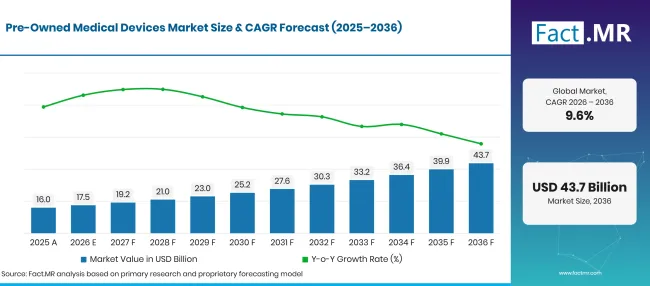
Pre Owned Medical Devices Market Forecast Global | Source: Fact.MR
| Year | Basis | Market Value (USD billion) |
|---|---|---|
| 2025 | Actual | 16.0 |
| 2026 | Estimate | 17.5 |
| 2036 | Forecast | 43.7 |
| CAGR 2026 to 2036 | Forecast period | 9.6% |
Source: Fact.MR analysis. Updated Nov 6, 2026
What are the defining numbers behind Pre-Owned Medical Devices Market growth?
USD 26.2 billion absolute opportunity between 2026 and 2036.
- Demand Drivers in the Market
- Healthcare providers seek lower-cost access to advanced equipment. Hospitals and diagnostic centres can use refurbished imaging systems to expand diagnostic capacity without making the full capital investment required for new equipment. GE HealthCare's GoldSeal portfolio and Philips Circular Equipment range demonstrate how OEM-refurbished systems are positioned as lower-cost alternatives to new equipment [1] [2].
- Growing interest in equipment lifecycle management supports resale activity. Healthcare facilities can recover value from equipment that remains functional but is no longer required at its original location. OEM trade-in and refurbishment programmes help return selected systems to use while supporting equipment reuse [3].
- Refurbishment quality influences purchasing decisions. Buyers need documented service histories and evidence of safety and performance checks before installing pre-owned devices. Canon Medical's Secondlife programme describes equipment selection and inspection processes that include safety and image-quality checks [4].
- Demand for equipment maintenance and reliable technical support encourages structured resale channels. The World Health Organization identifies incoming inspections, equipment inventories, training, maintenance and decommissioning as components of medical device lifecycle management [5].[5]
- Key Segments Analyzed
- By Product Type: Imaging Equipment is projected to account for 38.2% of the market in 2026, supported by demand for refurbished diagnostic imaging systems.
- By Application: Hospitals segment hold 46.3% of the market in 2026, reflecting their need to maintain diagnostic and treatment capacity while managing equipment budgets.
- By End User: Healthcare Providers are forecast to account for 78.4% of the market in 2026, as hospitals, clinics and other care facilities seek cost-effective equipment options.
- Analyst Opinion at Fact.MR
- Shambhu Nath Jha, Principal Consultant at Fact.MR, states, “The pre-owned medical devices market is expected to benefit from healthcare providers seeking to expand equipment access while managing capital expenditure. Refurbished imaging systems are an established part of this market, with major original equipment manufacturers offering dedicated programmes. However, buyers need to assess equipment history and refurbishment standards carefully. Service availability and the cost of future maintenance should also influence purchasing decisions.”
- Strategic Implications
- Manufacturers should strengthen trade-in and refurbishment programmes to recover equipment with a documented service history and return suitable systems to the market.
- Healthcare providers need to compare the total ownership cost of pre-owned equipment with new systems, including installation and ongoing service expenses.
- Refurbishment companies must provide clear inspection records and disclose replaced components and software status.
- Distributors can confirm that equipment meets applicable regulatory requirements and that technical support is available in the destination market.
- Hospitals should assess compatibility with existing clinical systems and infrastructure before purchasing used imaging or monitoring equipment.
Germany is projected to record a 6.9% CAGR through 2036. Brazil is expected to grow at 9.0%, followed by the USA at 12.3%. The UK is forecast to advance at 12.0%, while Japan is projected to register a 9.9% CAGR.
How does the Pre-Owned Medical Devices Market break down by segment?
Fact.MR's analysis indicate that Imaging Equipment leads Product Type with a 38.2% share. Hospitals lead Application with 46.3%, while Healthcare Providers account for 78.4% of the End-User segment in 2026.
Which Product Type dominates?
Imaging Equipment is set to hold a 38.2% share in 2026.
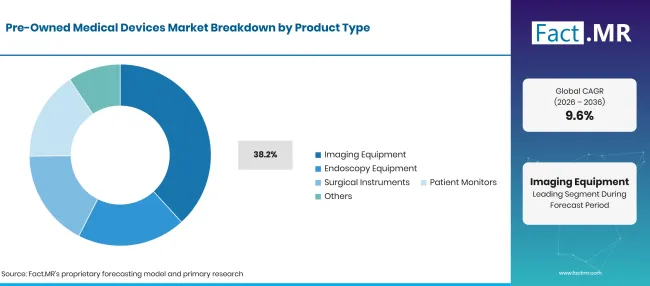
Pre Owned Medical Devices Market Breakdown Product Type | Source: Fact.MR
| Product Type | Share (2026) |
|---|---|
| Imaging Equipment (Leading segment) | 38.2% |
| Other segments combined | 61.8%* |
| Total | 100.0% |
Source: Fact.MR analysis. Updated Nov 6, 2026
Imaging equipment accounts for a significant share because systems such as MRI scanners and CT scanners require substantial capital investment. Pre-owned systems can help healthcare facilities expand diagnostic services at a lower initial cost. Buyers still need to check image quality and software compatibility along with the availability of replacement parts and service support.
What leads the Application segment?
Hospitals are set to represent 46.3% of the market in 2026.
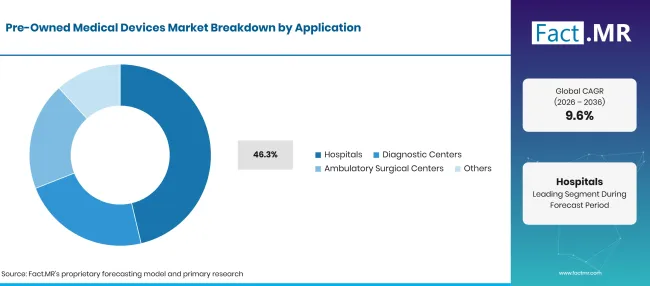
Pre Owned Medical Devices Market Breakdown Application | Source: Fact.MR
| Application | Share (2026) |
|---|---|
| Hospitals (Leading segment) | 46.3% |
| Other segments combined | 53.7%* |
| Total | 100.0% |
Source: Fact.MR analysis. Updated Nov 6, 2026
Hospitals require medical equipment across diagnostic and treatment departments. Pre-owned devices can help facilities add capacity or replace equipment without committing to the purchase price of a new system. Diagnostic centres may also consider used imaging equipment when expanding services. Their purchasing decisions depend on expected patient volumes and the availability of local maintenance support.
How does the End-User segment shape demand?
Healthcare Providers are likely to account for 78.4% of the market in 2026.
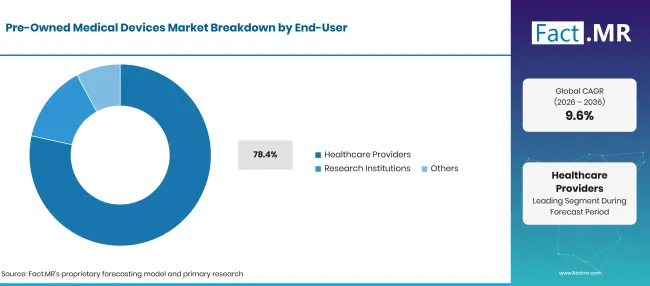
Pre Owned Medical Devices Market Breakdown End User | Source: Fact.MR
| End User | Share (2026) |
|---|---|
| Healthcare Providers (Leading segment) | 78.4% |
| Other segments combined | 21.6%* |
| Total | 100.0% |
Source: Fact.MR analysis. Updated Nov 6, 2026
Healthcare providers form the leading end-user category because they operate equipment directly for patient diagnosis and treatment. Hospitals and clinics can use pre-owned systems to expand service capacity or maintain essential equipment within available budgets. Research institutions and other users may also purchase pre-owned devices for testing and specialised applications. Equipment condition and the suitability of the device for its intended clinical use remain important selection criteria.
What is accelerating Pre-Owned Medical Devices Market adoption, and what is holding it back?
Lower initial equipment costs and growing refurbishment programmes support demand, while concerns about equipment condition and service availability can slow purchasing decisions.
Drivers Impact Analysis
| DRIVER | (~) % IMPACT ON CAGR | Geographic relevance | Impact timeline |
|---|---|---|---|
| Lower capital expenditure for healthcare providers | +1.1% | Global | Short term (≤ 2 years) |
| OEM-led refurbishment programmes | +0.9% | North America, Europe, Asia | Medium term (2–4 years) |
| Expansion of diagnostic capacity | +0.8% | Asia, Latin America | Medium term (2–4 years) |
| Equipment reuse and lifecycle management | +0.6% | Europe, North America | Long term (≥ 4 years) |
| Growth of independent resale channels | +0.5% | Global | Medium term (2–4 years) |
Source: Fact.MR analysis. Updated Nov 6, 2026
Opportunity Impact Analysis
| OPPORTUNITY | (~) % IMPACT ON CAGR | Geographic relevance | Impact timeline |
|---|---|---|---|
| Wider availability of certified refurbished systems | +0.9% | Global | Medium term (2–4 years) |
| Structured equipment trade-in programmes | +0.7% | North America, Europe | Medium term (2–4 years) |
| Improved access to spare parts and service networks | +0.6% | Asia, Latin America | Long term (≥ 4 years) |
| Digital equipment history and traceability | +0.5% | Global | Medium term (2–4 years) |
Source: Fact.MR analysis. Updated Nov 6, 2026
Restraints Impact Analysis
| RESTRAINT | (~) % IMPACT ON CAGR | Geographic relevance | Impact timeline |
|---|---|---|---|
| Uncertain equipment condition and service history | -0.9% | Global | Short term (≤ 2 years) |
| Limited availability of replacement parts | -0.7% | Emerging markets | Medium term (2–4 years) |
| Regulatory and import requirements | -0.6% | Global | Short term (≤ 2 years) |
| Software compatibility and cybersecurity concerns | -0.5% | Global | Medium term (2–4 years) |
| Limited access to OEM technical support | -0.4% | Global | Medium term (2–4 years) |
Source: Fact.MR analysis. Updated Nov 6, 2026
Which countries are scaling the Pre-Owned Medical Devices Market through 2036?
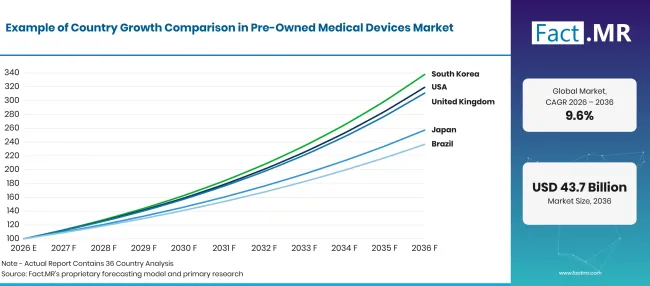
Pre Owned Medical Devices Market Growth Index | Source: Fact.MR
| Country | CAGR (2026–2036) |
|---|---|
| Germany | 6.9% |
| Brazil | 9.0% |
| USA | 12.3% |
| UK | 12.0% |
| Japan | 9.9% |
Source: Fact.MR analysis. Updated Nov 6, 2026
What supports Germany adoption?
6.9% CAGR, supported by demand for cost-conscious hospital equipment planning.
Germany's healthcare facilities need to balance investment in advanced diagnostic technology with operating costs. Refurbished imaging systems can provide an alternative for hospitals and diagnostic centres seeking to expand capacity or replace older equipment. The European Commission distinguishes reprocessing of single-use devices from the procedures required for reusable devices. Those requirements concern safe reuse and should be considered separately from refurbishment and resale of previously owned equipment [6]. [6]
What Supports Market Growth in the Brazil?
9.0% CAGR, driven by demand for affordable equipment and wider access to healthcare services.
Brazil's market can benefit from healthcare facilities seeking to expand diagnostic and treatment capacity while managing investment budgets. Pre-owned imaging equipment and patient monitors may offer lower-cost options when systems are appropriately inspected and supported. Brazil's health regulator, Anvisa, has previously published requirements for the importation and use of certain used intensive-care devices, including ventilators and patient monitors.
What supports United States adoption?
12.3% CAGR, supported by equipment replacement needs and established refurbishment channels.
The United States is projected to record the fastest growth among the listed countries. Hospitals and diagnostic centres can consider refurbished imaging equipment when expanding service lines or replacing older systems. GE HealthCare's GoldSeal programme offers refurbished MRI, CT, ultrasound and other imaging systems with refurbishment and service support. The U.S. Food and Drug Administration distinguishes routine servicing from remanufacturing when changes significantly affect a device's performance or safety specifications or intended use. This distinction makes regulatory compliance and clear documentation important for companies involved in refurbishment [7].
How is the United Kingdom advancing in the market?
12.0% CAGR, shaped by healthcare equipment reuse and lifecycle management.
The UK market can benefit from healthcare providers seeking to manage equipment costs and make better use of existing medical assets. Refurbished imaging equipment can help facilities add capacity when the system's condition and service requirements are clearly established. NHS England's guidance on equipment reuse describes collection and decontamination followed by inspection and refurbishment where practical [8]. These practices support the wider role of reuse in healthcare equipment management, although clinical devices must meet their relevant safety and regulatory requirements.
What supports Japan adoption in the market?
9.9% CAGR, driven by demand for reliable diagnostic equipment and equipment lifecycle management.
Japan's market is expected to benefit from healthcare facilities seeking reliable imaging systems while managing equipment replacement costs. Refurbished systems can support hospitals and diagnostic centres that need to maintain diagnostic capacity or add equipment for specific clinical requirements. Suppliers with established technical support and access to original parts can be better positioned to address buyer concerns about reliability and maintenance. Japan-based manufacturers with refurbishment capabilities can also support equipment reuse through structured service programmes.
Who leads the Pre-Owned Medical Devices Market?
Fact.MR identifies GE HealthCare Technologies, Philips Healthcare, Siemens Healthineers and Canon Medical Systems as companies with clearly documented original equipment manufacturer-led refurbishment programmes. Fujifilm Holdings Corporation participates in the wider medical equipment industry, but its position as a direct provider of pre-owned complete systems requires further product-level confirmation.
GE HealthCare offers GoldSeal refurbished imaging and ultrasound systems. Its programme includes equipment selection based on service history and refurbishment by trained technicians. Philips Healthcare offers Circular Edition refurbished systems and Select Edition serviced equipment through its Circular Equipment portfolio. Siemens Healthineers provides refurbished imaging systems through its ecoline portfolio and offers selected pre-owned systems through Circuline [9].
Canon Medical Systems operates the Secondlife refurbishment programme. It selects used systems with documented service histories and describes inspection procedures that cover equipment safety and performance. These programmes provide direct evidence of participation in the refurbished imaging equipment market.
Which companies are the key providers?
Key companies profiled include GE HealthCare Technologies Inc.; Philips Healthcare; Siemens Healthineers; Canon Medical Systems Corporation; and Fujifilm Holdings Corporation.
- GE HealthCare Technologies Inc.
- Philips Healthcare
- Siemens Healthineers
- Canon Medical Systems Corporation
- Fujifilm Holdings Corporation
Bibliography
- [1] GE HealthCare. (n.d.). GoldSeal™ refurbished systems.
- [2] Philips. (n.d.). Circular refurbished equipment.
- [3] Siemens Healthineers. (n.d.). Our ecoline portfolio – refurbished medical systems.
- [4] Canon Medical Systems Europe B.V. (n.d.). Secondlife refurbished equipment.
- [5] World Health Organization. (2025, June 4). Inventory and maintenance management information system for medical devices.
- [6] European Commission. (n.d.). Reprocessing of devices.
- [7] U.S. Food and Drug Administration. (2024, May). Remanufacturing of medical devices: Guidance for industry, entities that perform servicing or remanufacturing, and Food and Drug Administration staff.
- [8] NHS England. (n.d.). Reducing the environmental impact of equipment, medicines and resources.
- [9] Siemens Healthineers. (n.d.). Circuline – pre-owned imaging equipment.
This Report Answers
- The report examines demand for pre-owned medical devices across imaging equipment, endoscopy equipment, surgical instruments and patient monitors.
- Product analysis identifies Imaging Equipment as the leading category based on the 2026 share.
- Application analysis compares hospitals with diagnostic centres, research institutions and ambulatory surgical centres.
- End-user analysis evaluates the leading position of healthcare providers.
- Country analysis covers Germany, Brazil, the USA, the UK and Japan.
- The competitive overview examines OEM refurbishment activity and the positioning of the five named companies.
What does the Pre-Owned Medical Devices Market cover?
The market covers previously owned medical equipment sold for further use in healthcare facilities. It includes equipment that has been refurbished, reconditioned, inspected or serviced before resale. Product coverage includes imaging equipment, endoscopy equipment, surgical instruments and patient monitors.
What is included in the scope?
Included products are previously owned medical devices and equipment that are suitable for further use in healthcare settings.
The market includes refurbished and reconditioned systems as well as inspected pre-owned equipment sold through manufacturers, specialist refurbishment companies and distributors.
What is excluded from the scope?
The analysis excludes brand-new medical devices sold as new products. Consumables and disposable medical supplies are outside the defined equipment market.
Single-use devices that are reprocessed for reuse should be treated separately from the resale of pre-owned reusable equipment because their regulatory requirements and commercial models differ. Equipment sold solely for spare parts or scrap recovery is also excluded unless it forms part of a qualifying pre-owned equipment sale.
How Was the Analysis Built?
The analysis draws on 120+ sources, 35+ company portfolios, 25+ countries, and more than 20 industry interviews.
- Primary Research: Primary research includes discussions with manufacturers, service providers, technology developers, distributors, end users, and subject-matter experts. These conversations examine purchasing priorities, product adoption, operational challenges, approval requirements, competitive positioning, and the factors that influence wider market acceptance.
- Desk Research: Desk research covers government statistics, regulatory publications, company filings, trade data, technical studies, industry associations, standards, public policy, and other authoritative sources. Every source used in the analysis is documented in the bibliography.
- Market Sizing and Forecasting: Market estimates combine historical performance, demand indicators, pricing and volume trends, segment shares, company participation, country-level growth, adoption patterns, investment activity, and barriers to market expansion.
- Data Validation and Update Cycle: Findings are validated by comparing primary interviews with public data, company activity, regulatory changes, trade patterns, and industry developments. Regular updates review new product launches, capacity changes, partnerships, approvals, and shifts in commercial adoption.
Segmentation
What is the report's scope and coverage?
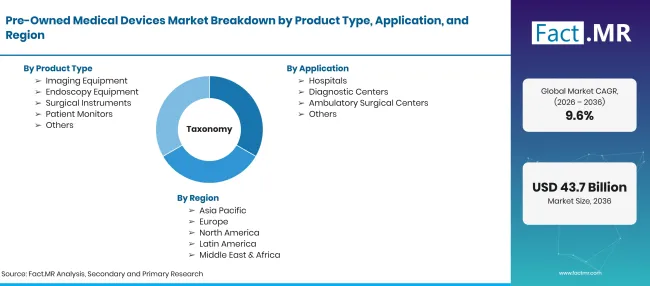
Pre Owned Medical Devices Market Taxonomy | Source: Fact.MR
| Attribute | Details |
|---|---|
| Quantitative Units | USD billion |
| Market Definition | Previously owned medical equipment that is inspected, refurbished, reconditioned or resold for further healthcare use |
| Product Type | Imaging Equipment; Endoscopy Equipment; Surgical Instruments; Patient Monitors; Others |
| Application | Hospitals; Diagnostic Centers; Research Institutions; Ambulatory Surgical Centers; Others |
| End User | Healthcare Providers; Others |
| Regions Covered | North America; Latin America; Western Europe; Eastern Europe; East Asia; South Asia & Pacific; Middle East & Africa |
| Countries Covered | Germany; Brazil; USA; UK; Japan |
| Companies Profiled | GE HealthCare Technologies; Philips Healthcare; Siemens Healthineers; Canon Medical Systems; Fujifilm Holdings |
| Forecast Period | 2026 to 2036 |
| Approach | Market segmentation and scenario-based forecasting supported by company portfolio reviews and regulatory research |
Source: Fact.MR analysis. Updated Nov 6, 2026
How is the market segmented?
-
By Product Type
- Imaging Equipment
- Endoscopy Equipment
- Surgical Instruments
- Patient Monitors
- Others
-
By Application
- Hospitals
- Diagnostic Centers
- Research Institutions
- Ambulatory Surgical Centers
- Others
-
By End User
- Healthcare Providers
- Others
-
By Region
- North America
- Latin America
- Western Europe
- Eastern Europe
- East Asia
- South Asia & Pacific
- Middle East & Africa
Frequently Asked Questions
How big is the Pre-Owned Medical Devices Market in 2026?
What is the CAGR from 2026 to 2036?
Which product type has the largest share?
Which application leads the market?
Which end-user category has the largest share?
Which companies are covered?
Who worked on this report


Preview the report firsthand - request a free sample
Free SampleGet the brochure for pricing and purchase details
Download PDF