- Market Value (2025): USD 11.8 Bn
- Estimated Value (2026): USD 12.8 Bn
- Forecast Value (2036): USD 28.9 Bn
- CAGR (2026-2036): 8.5%
What is the Healthcare and Medical Devices Testing Inspection and Certification Market forecast to be worth by 2036?
USD 12.8 billion in 2026 to USD 28.9 billion by 2036 at 8.5% CAGR.
- The healthcare and medical devices testing inspection and certification market reached USD 11.8 billion in 2025 as device firms used more outside validation before filing.
- Demand is projected to increase from USD 12.8 billion in 2026 to USD 28.9 billion by 2036.
- The market is forecast to record 8.5% CAGR from 2026 to 2036.
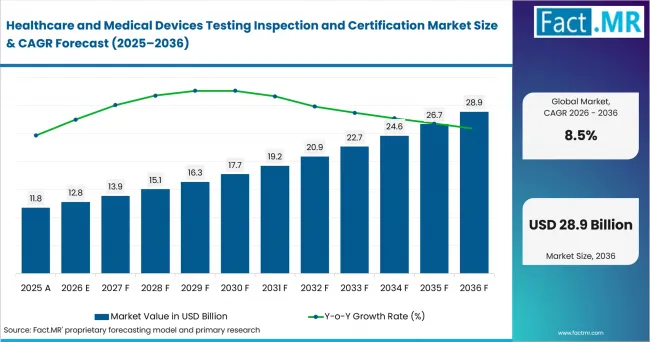
Healthcare And Medical Devices Testing Inspection And Certification Market Value Analysis | Source: Fact.MR
What are the defining numbers behind Healthcare and Medical Devices Testing Inspection and Certification Market growth?
USD 16.1 billion absolute opportunity is expected by 2036.
- Demand Drivers in the Market
- Regulatory review complexity is expected to keep testing services close to device design since evidence gaps can slow submissions.
- Medical device manufacturers need electrical and mechanical checks before market access work can move across regulated healthcare systems.
- Laboratory providers are expected to gain repeat work when manufacturers outsource test steps that need calibrated equipment.
- Connected devices and software-as-a-medical-device are expected to raise demand for cybersecurity review and performance evidence. FDA CDRH reported in its 2025 Annual Report that more than 1,300 AI-enabled medical devices had been authorized to date and 149 devices were designated as Breakthrough Devices in 2025.
- Key Segments Analyzed
- By Service Type: Testing Services is expected to hold 46.0% share in 2026 because testing usually starts before inspection or certification moves ahead.
- By Application: Medical Device Performance Testing is projected to account for 41.0% share in 2026 as safety and function remain central to approval work.
- By End User: Medical Device Manufacturers are anticipated to capture 44.0% share in 2026 since device makers carry the main duty for conformity evidence.
- By Service Delivery Model: Laboratory-based Services are estimated to represent 52.0% share in 2026 due to controlled equipment needs.
- By Testing Technology: Mechanical & Electrical Testing is forecast to hold 48.0% share in 2026 as device safety checks depend on repeatable power and load results.
- Analyst Opinion at Fact.MR
- Shambhu Nath Jha, Principal Consultant at Fact.MR, states, “Healthcare and medical device TIC providers are being judged less on test volume and more on early evidence support. Manufacturers want laboratories that can find evidence gaps before a submission reaches review. The next advantage is expected to come from providers that combine physical testing with software review and regulatory documentation support.”
- Strategic Implications
- Manufacturers should involve testing partners before design freeze so safety evidence can be built into product plans.
- TIC providers should pair laboratory work with documentation review to reduce repeat cycles during submission work.
- Investors should separate device-focused TIC exposure from broad healthcare compliance because buying triggers differ across laboratories and audits.
The USA leads at 9.3% CAGR through high device review activity and mature testing demand. Germany follows at 9.0% as medtech manufacturing keeps conformity services close to product development. The UK reaches 8.7% through clinical research depth. Japan records 8.3% through aging-care demand and precision device manufacturing. Canada posts 8.0%. France reaches 7.7% and South Korea reaches 7.3%.
How does the Healthcare and Medical Devices Testing Inspection and Certification Market break down by segment?
Testing Services are expected to lead Service Type at 46.0% share in 2026. Medical Device Performance Testing is projected to lead Application at 41.0% share in 2026.
Why does Testing Services lead Service Type?
Testing Services are projected to account for 46.0% share in 2026.
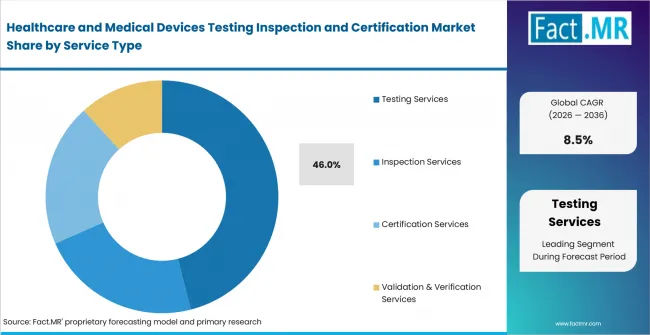
Healthcare And Medical Devices Testing Inspection And Certification Market Analysis By Service Type | Source: Fact.MR
Testing Services lead because device firms need proof that hardware and software work safely before submission. Physical checks often repeat when designs change. Certification work is easier when the test record is clear.
Why does Medical Device Performance Testing lead Application?
Medical Device Performance Testing is projected to account for 41.0% share in 2026.
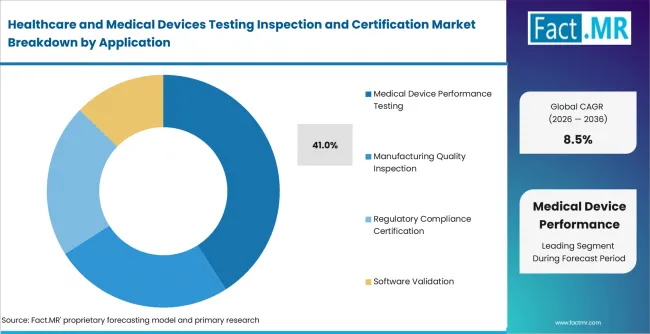
Healthcare And Medical Devices Testing Inspection And Certification Market Analysis By Application | Source: Fact.MR
Performance testing leads from the buyer side because users need evidence that a device works under intended use. Durability checks come before certification files. Product release work also creates demand for seal inspection equipment and pyrogen testing. FDA CDRH authorized 124 novel medical devices in the United States in 2025, one of its highest annual totals in more than 40 years.
Why do Medical Device Manufacturers lead End User?
Medical Device Manufacturers are projected to account for 44.0% share in 2026.
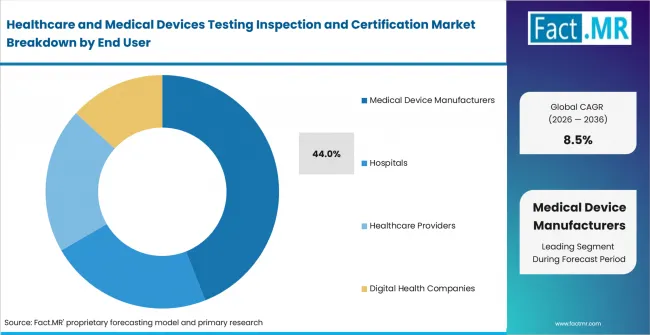
Healthcare And Medical Devices Testing Inspection And Certification Market Analysis By End User | Source: Fact.MR
Manufacturers lead demand since they carry product liability and submission duties. Outsourced TIC services help them record design-control evidence. Demand also extends to reprocessed medical devices because safety proof must stay clear after reuse pathways.
Why do Laboratory-based Services lead Service Delivery Model?
Laboratory-based Services are projected to account for 52.0% share in 2026.
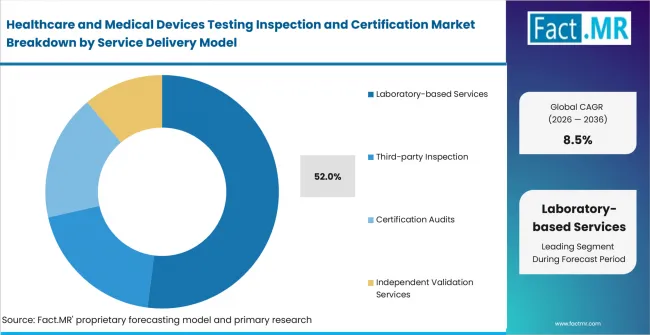
Healthcare And Medical Devices Testing Inspection And Certification Market Analysis By Service Delivery Model | Source: Fact.MR
Laboratory-based services lead when tests need calibrated equipment and controlled conditions. Device makers prefer documented lab workflows when evidence must be repeated for regulators. Service platforms using quality management software can improve traceability across test records.
Why does Mechanical & Electrical Testing lead Testing Technology?
Mechanical & Electrical Testing is projected to account for 48.0% share in 2026.
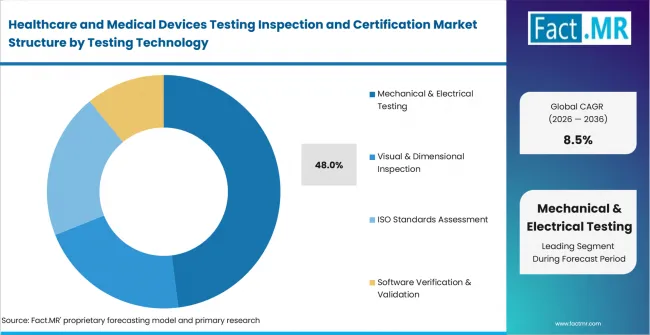
Healthcare And Medical Devices Testing Inspection And Certification Market Analysis By Testing Technology | Source: Fact.MR
Mechanical and electrical checks lead because devices must prove load tolerance and power safety. The segment also benefits from electrical safety analyzers. Non-destructive testing methods support proof when parts must remain usable after inspection. TÜV SÜD launched an IECEE Component Certification Programme for medical technology components on November 13, 2025, allowing safety-related components and assemblies for medical devices to be tested and certified under IEC 60601-1 before final integration.
What is accelerating Healthcare and Medical Devices Testing Inspection and Certification Market adoption, and what is holding it back?
Demand is expected to rise as evidence requirements become more detailed and device portfolios include more software-enabled products. Growth can slow when laboratory slots or skilled assessors are limited.
Drivers Impact Analysis
| DRIVER | (~) % IMPACT ON CAGR | GEOGRAPHIC RELEVANCE | IMPACT TIMELINE |
|---|---|---|---|
| Regulatory evidence burden | +2.2% | USA; Europe; Japan | Short term (<= 2 years) |
| Outsourced laboratory capacity | +1.8% | North America; Europe | Short term (<= 2 years) |
| Software and cybersecurity review | +1.5% | USA; UK; Germany | Medium term (2-4 years) |
| Electrical and mechanical safety testing | +1.4% | Global | Medium term (2-4 years) |
| Supplier audit requirements | +0.9% | Europe; East Asia | Long term (>= 4 years) |
Source: Fact.MR analysis. Updated Aug 10, 2026
- Regulatory evidence burden: More detailed review files are expected to raise demand for earlier test planning and cleaner documentation.
- Outsourced laboratory capacity: Device makers are expected to use external laboratories when internal equipment does not cover every protocol.
- Software and cybersecurity review: Connected products are expected to need TIC partners that understand hardware behavior and software risk together.
Opportunity Impact Analysis
| OPPORTUNITY | (~) % IMPACT ON CAGR | GEOGRAPHIC RELEVANCE | IMPACT TIMELINE |
|---|---|---|---|
| Early regulatory evidence planning | +1.0% | USA; Europe | Short term (<= 2 years) |
| Connected device review | +0.8% | USA; UK; South Korea | Medium term (2-4 years) |
| Home-use device testing | +0.6% | Canada; Japan; Europe | Medium term (2-4 years) |
| Sterility and packaging checks | +0.5% | Global device exporters | Long term (>= 4 years) |
Source: Fact.MR analysis. Updated Aug 10, 2026
- Early regulatory evidence planning: TIC firms can gain work before final submission. Similar planning can support AI Act conformity assessment for regulated software products.
- Connected device review: Demand is expected to expand when wireless portable devices need performance and software-risk evidence before launch.
- Home-use device testing: Services for home healthcare platforms are expected to need clearer usability and durability proof.
Restraints Impact Analysis
| RESTRAINT | (~) % IMPACT ON CAGR | GEOGRAPHIC RELEVANCE | IMPACT TIMELINE |
|---|---|---|---|
| Submission rework cost | -1.0% | Device exporters | Short term (<= 2 years) |
| Laboratory capacity bottlenecks | -0.8% | North America; Europe | Short term (<= 2 years) |
| Approval-route documentation | -0.6% | USA; UK; EU markets | Medium term (2-4 years) |
| Skilled assessor shortage | -0.5% | Developing markets | Long term (>= 4 years) |
Source: Fact.MR analysis. Updated Aug 10, 2026
- Submission rework cost: Missing evidence is expected to raise retesting expense and slow launch schedules for device manufacturers.
- Laboratory capacity bottlenecks: Specialized test slots can tighten when many manufacturers seek approval support at the same time.
- Approval-route documentation: Manufacturers can delay service decisions when evidence files must be adapted for several approval routes.
Which countries are scaling the Healthcare and Medical Devices Testing Inspection and Certification Market fastest?
- The country comparison spans 2.0 percentage points and forms three practical growth bands across the forecast period.
- The USA records the fastest listed pace and stays 0.3 percentage points above Germany through mature regulatory-service demand.
- Germany is forecast 0.3 percentage points above the UK because medtech manufacturing keeps testing close to product development.
- The UK tracks 0.4 percentage points above Japan as clinical research depth supports documentation and device review work.
- Japan is projected 0.3 percentage points above Canada through aging-care demand and precision device manufacturing.
- Canada stands 0.3 percentage points above France as exporters prepare evidence for domestic and overseas approval routes.
- France is forecast 0.4 percentage points above South Korea. South Korea completes the displayed range through medtech exports and electronics-based device production.
Comparable CAGRs can create different entry conditions due to device mix and local testing capacity. Full report coverage includes North America; Latin America; Europe; East Asia; South Asia and Pacific; Middle East and Africa.
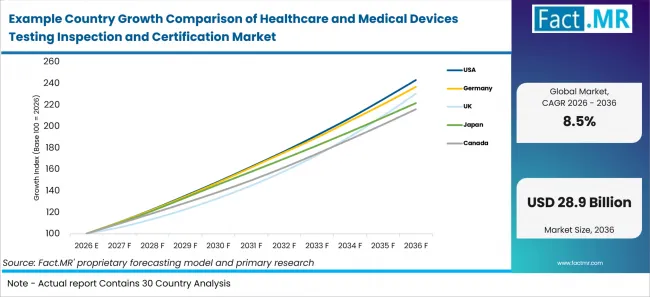
Example Country Growth Comparison Of Healthcare And Medical Devices Testing Inspection And Certification Market | Source: Fact.MR
| Country | CAGR (2026-2036) |
|---|---|
| USA | 9.3% |
| Germany | 9.0% |
| UK | 8.7% |
| Japan | 8.3% |
| Canada | 8.0% |
| France | 7.7% |
| South Korea | 7.3% |
Source: Fact.MR analysis. Updated Aug 10, 2026
What supports USA adoption?
9.3% CAGR, supported by mature review demand and broad device testing needs.
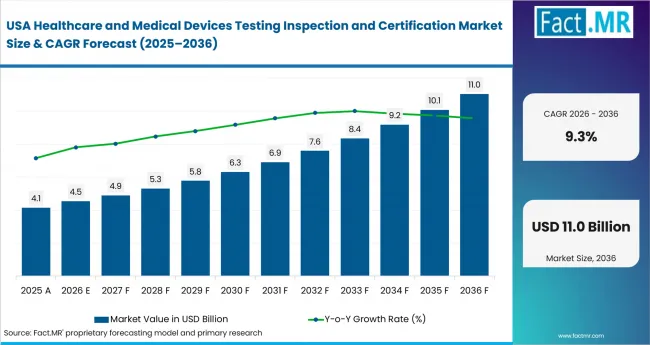
Healthcare And Medical Devices Testing Inspection And Certification Market Country Value Analysis | Source: Fact.MR
USA adoption reflects a buyer base that uses outside laboratories before filing. Manufacturers are expected to prefer TIC partners that can combine safety testing with clear documentation support.
How is Germany scaling demand?
9.0% CAGR, driven by medtech manufacturing depth and certification needs.
Germany’s growth comes from production teams that need conformity evidence close to engineering work. Testing partners are expected to gain work when device makers prepare files for European approval routes. The European Commission said Decision (EU) 2025/2371 made the first four EUDAMED modules mandatory from May 28, 2026, adding registration, UDI/device, notified-body certificate and market-surveillance data work to European files.
What is driving UK growth from 2026 to 2036?
8.7% CAGR, backed by clinical research depth and documentation work.
UK demand is shaped by research activity and product-file preparation. TIC providers are expected to see stronger interest when products combine hardware with software or home-use features. MHRA stated that Great Britain’s new post-market surveillance requirements apply to devices placed on the market or put into service from June 16, 2025, regardless of certification.
How is Japan developing demand?
8.3% CAGR, driven by aging-care demand and precision device manufacturing.
Japan’s demand reflects strict reliability needs for devices used in care settings. Local buyers are expected to value laboratories with electrical and mechanical test strength.
How does Canada perform?
8.0% CAGR, led by market access preparation and healthcare procurement needs.
Canada’s outlook reflects steady demand for evidence that supports regulated sales. Manufacturers are expected to use TIC services when approval files need domestic and export readiness.
What supports France growth?
7.7% CAGR, backed by European conformity work and product renewal needs.
France is expected to gain from device makers that maintain files for conformity and product updates. TIC providers can support testing plans and audit preparation.
How is South Korea positioned?
7.3% CAGR, supported by medtech exports and electronics-based device production.
South Korea’s demand is shaped by device production that uses electronics and sensors. TIC partners are expected to support safety checks and export documentation.
Who leads the Healthcare and Medical Devices Testing Inspection and Certification Market?
TÜV SÜD AG, SGS SA and Intertek Group plc show the clearest direct relevance through medical device testing and certification work.
Bureau Veritas S.A. and Dekra SE strengthen the provider field through medical electrical testing and conformity work. UL Solutions Inc. and Eurofins Scientific SE add product testing depth. BSI Group and Nemko Group AS expand the list through quality-system certification and medical equipment testing support. Intertek announced on July 15, 2025 that its Medical Notified Body designation under the EU MDR had expanded by 16 new MDR codes, broadening assessment and certification coverage across active, non-active and higher-risk device categories.
Which companies are the key providers?
Companies include TÜV SÜD AG; SGS SA; Intertek Group plc; Bureau Veritas S.A.; Dekra SE; UL Solutions Inc.; Eurofins Scientific SE; BSI Group; Nemko Group AS.
- TÜV SÜD AG
- SGS SA
- Intertek Group plc
- Bureau Veritas S.A.
- Dekra SE
- UL Solutions Inc.
- Eurofins Scientific SE
- BSI Group
- Nemko Group AS
Bibliography
- U.S. Food and Drug Administration. (n.d.). FDA-TRACK: Medical Device User Fee Amendments Annual Performance Dashboards – Medical Device Applications and Supplements historical performance.
- Center for Devices and Radiological Health. (2026). CDRH annual report 2025. U.S. Food and Drug Administration.
- Directorate-General for Health and Food Safety. (2025, November 27). The EUDAMED four first modules will be mandatory to use as from 28 May 2026. European Commission.
- Medicines and Healthcare products Regulatory Agency. (2025, June 16). First major overhaul of medical device regulation comes into force across Great Britain.
- TÜV SÜD. (2025, November 13). TÜV SÜD launches IECEE Component Certification Programme for medical technology components.
- Intertek Group plc. (2025, July 15). Intertek expands Medical Notified Body scope under EU MDR, offering unrivalled support to medical device manufacturers.
This Report Answers
- The report provides strategic intelligence on the Healthcare and Medical Devices Testing Inspection and Certification Market across service and application choices that shape device approval work.
- Segment analysis covers Testing Services and Medical Device Performance Testing as the share leaders within the 2026 market.
- Country outlook evaluates the USA and Germany alongside the UK and Japan. Canada and France are compared with South Korea.
- Competitive analysis profiles TÜV SÜD AG and SGS SA alongside Intertek Group plc and Bureau Veritas S.A. The remaining providers complete the TIC service set.
- Testing assessment covers Mechanical & Electrical Testing and Chemical and Biological Testing. Software Validation Tools complete the view with Packaging Integrity Testing.
What does the Healthcare and Medical Devices Testing Inspection and Certification Market cover?
The market covers third-party and related in-house TIC services that help medical device companies prove safety and conformity. It includes physical testing and electrical testing. Certification support and documentation review are included when they support device approval or renewal.
What is included in the scope?
The scope includes testing services and inspection services alongside certification support.
It covers device performance testing and sterility testing. Electrical safety and software review are included when they support a medical device or IVD pathway.
What is excluded from the scope?
The scope excludes direct device manufacturing revenue and hospital service revenue.
General consulting is excluded when it falls outside TIC activity. Pharmaceutical clinical-trial services are excluded unless they directly support a device or IVD pathway.
How Was the Analysis Built?
The analysis draws on 120+ sources and 35+ company portfolios. It reviews 25+ countries and more than 20 industry interviews.
- Primary Research: Primary research includes discussions with manufacturers and service providers. It includes technology developers and end users. These discussions review buying priorities. They also test the factors that affect wider market acceptance.
- Desk Research: Desk research covers government statistics and regulatory publications. It also reviews company filings, trade data and technical studies. Standards bodies are used when they directly support the market point.
- Market Sizing and Forecasting: Market estimates combine historical performance and demand indicators. Segment shares and company participation are reviewed with country-level growth. Adoption barriers are tested before the forecast is finalized.
- Data Validation and Update Cycle: Findings are validated by comparing primary interviews with public data. Company activity and regulatory changes are reviewed together. Updates check product launches and approvals before conclusions are refreshed.
Segmentation
What is the report's scope and coverage?
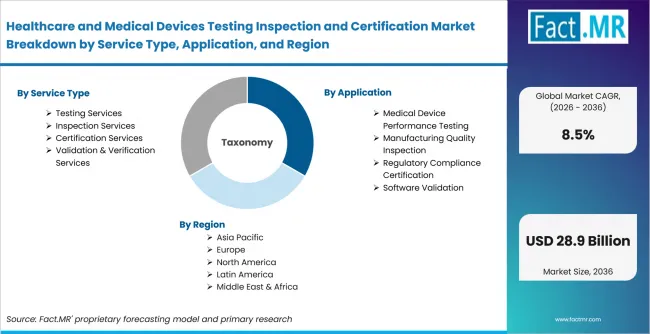
Healthcare And Medical Devices Testing Inspection And Certification Market Breakdown By Service Type, Application, And Region | Source: Fact.MR
| Attribute | Details |
|---|---|
| Quantitative Units | USD billion in 2026 to USD billion by 2036 at CAGR |
| Market Definition | Testing, inspection and certification services used to verify medical device safety, performance, quality-system conformity and market access readiness before and after commercialization |
| Service Type | Testing Services; Inspection Services; Certification Services; Advisory and Documentation Support; Post-market Surveillance Support |
| Application | Medical Device Performance Testing; Biocompatibility and Sterility Testing; Electrical Safety and EMC Testing; Software and Cybersecurity Assessment; Regulatory Documentation Review |
| End User | Medical Device Manufacturers; IVD Manufacturers; Contract Manufacturing Organizations; Hospitals and Procurement Bodies; Digital Health Developers |
| Service Delivery Model | Laboratory-based Services; On-site Inspection Services; Remote Documentation Review; Hybrid Audit Support; Managed Compliance Programs |
| Testing Technology | Mechanical & Electrical Testing; Chemical and Biological Testing; EMC and Wireless Testing; Software Validation Tools; Packaging Integrity Testing |
| Regions Covered | North America; Latin America; Europe; East Asia; South Asia and Pacific; Middle East and Africa |
| Countries Covered | USA; Germany; UK; Japan; Canada; France; South Korea |
| Key Companies Profiled | TÜV SÜD AG; SGS SA; Intertek Group plc; Bureau Veritas S.A.; Dekra SE; UL Solutions Inc.; Eurofins Scientific SE; BSI Group; Nemko Group AS |
| Forecast Period | 2026 to 2036 |
| Approach | Hybrid top-down and bottom-up approach using service demand; device testing needs; inspection work; certification activity; regulatory documentation review; service delivery models; testing technology; country adoption patterns and company portfolio review |
Source: Fact.MR analysis. Updated Aug 10, 2026
How is the market segmented?
-
By Service Type
- Testing Services
- Safety Testing
- Biocompatibility Testing
- Inspection Services
- Factory Inspection
- Supplier Quality Audits
- Certification Services
- CE Marking Certification
- ISO 13485 Certification
- Validation & Verification Services
- Clinical Evaluation Services
- Cybersecurity Assessment
- Testing Services
-
By Application
- Medical Device Performance Testing
- Implantable Device Testing
- In-vitro Diagnostic Testing
- Manufacturing Quality Inspection
- Process Validation
- Good Manufacturing Practice Audits
- Regulatory Compliance Certification
- European Market Approval
- Quality System Certification
- Software Validation
- Clinical Evidence Assessment
- Connected Device Security Testing
- Medical Device Performance Testing
-
By End User
- Medical Device Manufacturers
- Diagnostic Device Manufacturers
- Original Equipment Manufacturers
- Hospitals
- Contract Manufacturing Organizations
- Component Suppliers
- Healthcare Providers
- Regulatory Affairs Organizations
- Research Institutions
- Digital Health Companies
- Medical Software Developers
- Connected Medical Device Companies
- Medical Device Manufacturers
-
By Service Delivery Model
- Laboratory-based Services
- On-site Testing Services
- Hybrid Service Delivery
- Third-party Inspection
- Periodic Inspection Programs
- Remote Inspection Services
- Certification Audits
- Accredited Certification Bodies
- Compliance Assessment Programs
- Independent Validation Services
- Project-based Validation
- Ongoing Compliance Monitoring
- Laboratory-based Services
-
By Testing Technology
- Mechanical & Electrical Testing
- Biocompatibility Testing
- Electromagnetic Compatibility Testing
- Visual & Dimensional Inspection
- Non-destructive Testing
- Automated Optical Inspection
- ISO Standards Assessment
- Quality Management System Audits
- Risk Management Evaluation
- Software Verification & Validation
- Clinical Performance Evaluation
- Penetration & Vulnerability Testing
- Mechanical & Electrical Testing
-
By Region
- North America
- Latin America
- Western Europe
- Eastern Europe
- East Asia
- South Asia and Pacific
- Middle East & Africa
Frequently Asked Questions
How big is the healthcare and medical devices testing inspection and certification market in 2026?
What is the CAGR of the healthcare and medical devices testing inspection and certification market from 2026 to 2036?
Which service type leads the healthcare and medical devices testing inspection and certification market?
Which application leads the healthcare and medical devices testing inspection and certification market?
Who are the leading companies in the healthcare and medical devices testing inspection and certification market?
Who worked on this report


Preview the report firsthand - request a free sample
Free SampleGet the brochure for pricing and purchase details
Download PDF