- Market Value (2025): USD 3.8 Bn
- Estimated Value (2026): USD 4.3 Bn
- Forecast Value (2036): USD 13.9 Bn
- CAGR (2026-2036): 12.5%
What is the Medical Devices Electronic Data Interchange Market forecast to be worth by 2036?
USD 4.3 billion in 2026 and USD 14.0 billion by 2036 at a 12.5% CAGR.
- The Medical Devices Electronic Data Interchange Market reached USD 3.8 billion in 2025.
- Demand is projected to increase from USD 4.3 billion in 2026 to USD 14.0 billion by 2036.
- The market is valued at USD 4.3 billion in 2026 as medical device manufacturers, distributors and healthcare buyers automate recurring trading-partner transactions.
- Demand is projected to reach USD 14.0 billion by 2036 as cloud-based partner connectivity expands across order, shipment, inventory and compliance workflows.
- The market is forecast to record a 12.5% CAGR from 2026 to 2036 as organizations replace manual partner processes and connect EDI flows with ERP, warehouse and procurement applications.
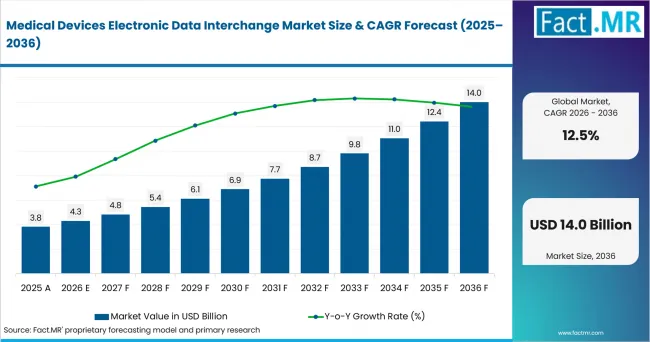
Medical Devices Electronic Data Interchange Market Value Analysis | Source: Fact.MR
Why does Software lead Component?
USD 9.6 billion absolute opportunity by 2036. Software holds 68% share in 2026, Cloud-Based deployment accounts for 72%, Supply Chain Transactions represent 38%, Medical Device Manufacturers contribute 45% and Large Enterprises account for 65%.
- What drives demand in the market?
- Purchase order, order confirmation, advance shipping notice and invoice automation reduces repetitive entry across manufacturers, distributors, logistics providers and hospital procurement teams.
- UDI and device master-data requirements increase the commercial cost of inconsistent identifiers, packaging hierarchies, lot fields and partner-specific product records.
- Cloud ERP and warehouse modernization creates new integration points, but buyers still need EDI support for partners that cannot move to APIs at the same pace.
- Recall readiness and inventory control increase the value of clean shipment, lot, serial and location data across the device supply chain.
- Why does Cloud-Based lead Deployment?
- By Component: Software is projected to hold 68% share in 2026 because mapping, validation, partner profiles, monitoring and document orchestration sit at the center of recurring EDI operations.
- By Deployment: Cloud-Based is anticipated to account for 72% share in 2026 because multi-enterprise connectivity benefits from scalable infrastructure, managed updates and faster partner onboarding.
- By Transaction Type: Supply Chain Transactions are forecast to represent 38% share in 2026 because purchase orders and order confirmations initiate the core device order cycle.
- By End User: Medical Device Manufacturers are expected to account for 45% share in 2026 because they must connect internal systems with distributors, logistics providers, hospitals and group purchasing organizations.
- By Enterprise Size: Large Enterprises are projected to hold 65% share in 2026 because global partner networks, multiple ERPs and jurisdiction-specific product data create broader integration requirements.
- What is the Fact.MR analyst opinion?
- Shambhu Nath Jha, Principal Consultant at Fact.MR, states, “Medical device EDI is not purchased as a document converter alone. Buyers are paying for partner governance, product-data accuracy, transaction visibility and exception control. Cloud deployment can accelerate onboarding, but regulated manufacturers still need disciplined change management and evidence that every mapped field reaches the correct ERP, warehouse and compliance workflow.” Fact.MR opines that providers will be assessed on transaction mapping, partner onboarding, and data integrity.
- What are the strategic implications?
- Medical device manufacturers should treat EDI mapping, item-master governance and UDI data as one operating model instead of separate IT and regulatory projects.
- Providers should support EDI and API coexistence because large buyers modernize at different speeds across hospitals, distributors, logistics partners and regional suppliers.
- Commercial teams should package partner onboarding, monitoring and managed operations around transaction outcomes rather than selling connection capacity alone.
South Korea is expected to record a 13.55% CAGR from 2026 to 2036, followed by the USA at 12.93% and Canada at 12.56%. The UK is forecast at 12.29%, Australia at 12.22%, Germany at 12.08% and Japan at 11.69%.
How does the Medical Drone Delivery Services Market break down by segment?
Why do Supply Chain Transactions lead Transaction Type?
Software holds 68% share in 2026. Cloud-Based deployment accounts for 72%. Supply Chain Transactions represent 38%. Medical Device Manufacturers contribute 45%, while Large Enterprises account for 65%.
Why do Medical Device Manufacturers lead End User?
Software is projected to account for 68% share in 2026.
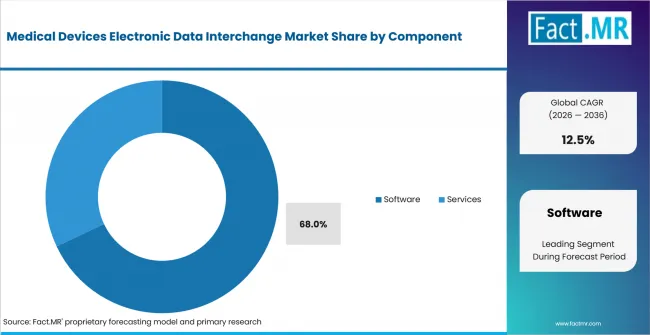
Medical Devices Electronic Data Interchange Market Analysis By Component | Source: Fact.MR
Software leads because every trading-partner exchange requires message translation, field validation, partner-specific rules, acknowledgments, routing and transaction monitoring. Medical device companies also need connectors to ERP, warehouse, transportation and procurement systems so that EDI messages create usable business records rather than isolated files. Services remain important for implementation and managed operations, but software carries the reusable control layer across each partner and document type.
Why do Large Enterprises lead Enterprise Size?
Cloud-Based deployment is anticipated to account for 72% share in 2026.
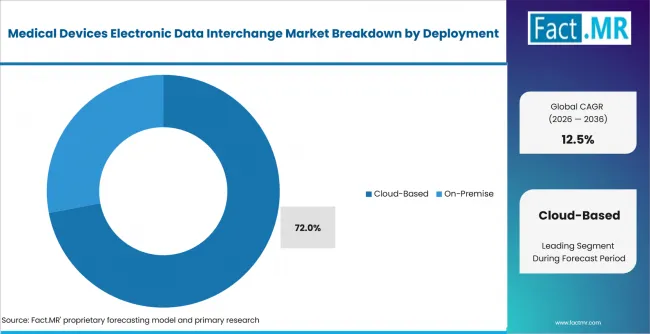
Medical Devices Electronic Data Interchange Market Analysis By Deployment | Source: Fact.MR
Cloud-based deployment leads because medical device trading networks extend beyond one company boundary. A shared service can onboard partners, update maps, monitor failures and scale message volumes without requiring each participant to maintain local infrastructure. Public cloud supports standardized use cases, while hybrid cloud allows enterprises to retain sensitive integrations or validated systems behind controlled interfaces. On-premise deployment remains relevant where local change control, private infrastructure and established enterprise systems outweigh migration speed.
Why do Supply Chain Transactions lead Transaction Type?
Supply Chain Transactions are forecast to represent 38% share in 2026.
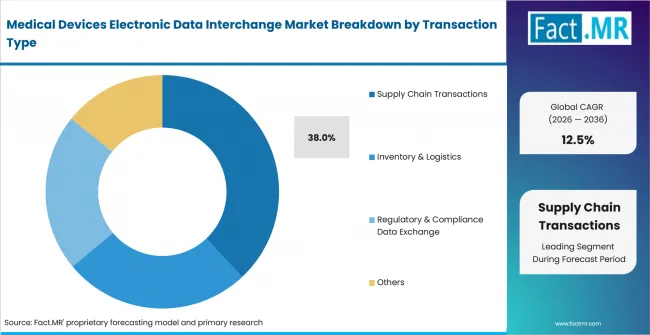
Medical Devices Electronic Data Interchange Market Analysis By Transaction Type | Source: Fact.MR
Supply chain transactions lead because purchase orders and order confirmations establish the commercial commitment between hospitals, distributors and device suppliers. These messages determine item, quantity, delivery location and timing before downstream shipment and payment records are created. Advance shipping notices and inventory synchronization expand visibility after the order is accepted, while UDI reporting and regulatory filings serve narrower compliance workflows. Invoicing and partner collaboration remain important, but they usually depend on an order record already being established.
Why do Medical Device Manufacturers lead End User?
Medical Device Manufacturers are expected to account for 45% share in 2026.
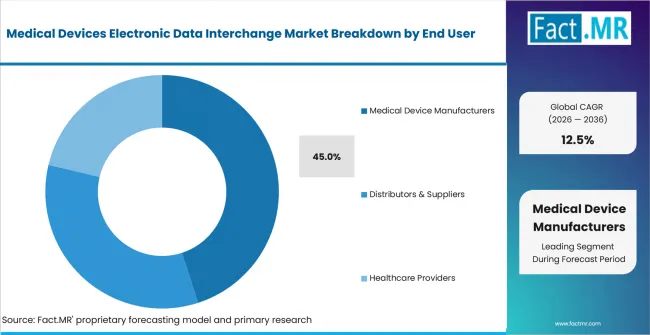
Medical Devices Electronic Data Interchange Market Analysis By End User | Source: Fact.MR
Manufacturers lead because they sit at the point where product master data, regulatory identifiers, available inventory and customer commitments must agree. Diagnostic and surgical device manufacturers exchange orders and shipment data with distributors, logistics providers, hospitals and group purchasing organizations. A mapping error can delay fulfillment, create receiving exceptions or separate the commercial record from the product identifier used for traceability. Distributors and healthcare providers are major participants, but manufacturers typically manage the widest set of outbound partner requirements.
Why do Large Enterprises lead Enterprise Size?
Large Enterprises are projected to hold 65% share in 2026.
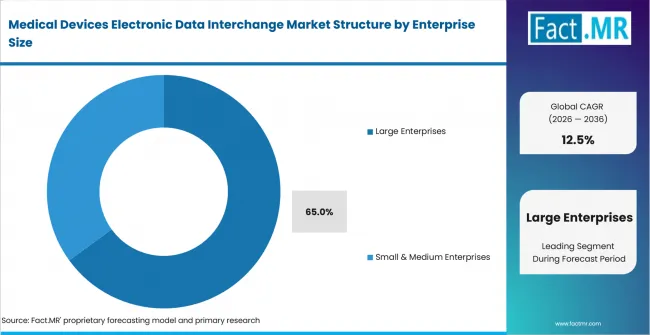
Medical Devices Electronic Data Interchange Market Analysis By Enterprise Size | Source: Fact.MR
Large enterprises lead because global device portfolios create high partner counts, multiple ERP instances, regional data rules and continuous onboarding work. Global medical device manufacturers and multinational healthcare companies also need centralized governance for certificates, protocols, mapping versions and service-level monitoring. Small and medium enterprises often use managed EDI services to meet buyer requirements, yet their lower transaction volumes and narrower partner networks keep their total market contribution below that of large organizations.
What is accelerating Medical Devices Electronic Data Interchange Market adoption, and what is holding it back?
Recurring order automation and product-data discipline are expected to support demand. Mapping inconsistency, legacy system change control and third-party cyber risk are expected to restrain adoption. The strongest opening lies in cloud-managed EDI that can orchestrate both traditional standards and API-based partner interactions.
How do the main drivers affect adoption?
| DRIVER | QUALITATIVE RELEVANCE | GEOGRAPHIC RELEVANCE | IMPACT TIMELINE |
|---|---|---|---|
| Order-to-cash and procure-to-pay automation | Recurring transaction processing | USA, UK and Germany | 2026-2036 |
| UDI-linked product master data governance | Product identity and traceability | South Korea, Australia, Germany and USA | 2026-2036 |
| ERP modernization and partner onboarding | System connectivity and network expansion | Canada, Japan and global manufacturers | 2026-2036 |
Source: Fact.MR analysis. Updated Aug 5, 2026
- Order-to-cash and procure-to-pay automation: EDI removes repeated manual entry between purchase order, acknowledgment, shipment and invoice records. The benefit is strongest when the transaction posts directly into ERP and warehouse workflows.
- UDI-linked product master data: Regulators maintain device identification systems, while hospitals and distributors need identifiers that match commercial item records. EDI adoption becomes more valuable when product codes, packaging levels, lot fields and partner catalogs are governed together.
- ERP modernization and partner onboarding: Cloud ERP programs expose integration gaps with smaller or older trading partners. EDI platforms protect continuity while new APIs are introduced for real-time status and exception use cases.
Where are the main opportunities?
| OPPORTUNITY | QUALITATIVE RELEVANCE | GEOGRAPHIC RELEVANCE | IMPACT TIMELINE |
|---|---|---|---|
| Managed cloud EDI for mixed partner maturity | Partner operations and exception management | USA, Canada and Australia | 2026-2036 |
| EDI and API orchestration | Hybrid transaction architecture | Germany, UK and Japan | 2026-2036 |
| Regulatory database connectors and data validation | Structured device-data exchange | South Korea, EU, USA and Australia | 2026-2036 |
Source: Fact.MR analysis. Updated Aug 5, 2026
- Managed cloud EDI for mixed partner maturity: Providers can operate maps, certificates, monitoring and exception queues for enterprises whose partners range from global distributors to regional suppliers.
- EDI and API orchestration: Buyers need one control plane for high-volume standardized documents and faster event-driven updates. Providers that preserve auditability across both methods can reduce duplicate integration work.
- Regulatory database connectors and data validation: UDI systems such as GUDID, EUDAMED, AusUDID and South Korea’s integrated device information environment create demand for accurate device records and controlled submission workflows.
What limits adoption?
| RESTRAINT | QUALITATIVE RELEVANCE | GEOGRAPHIC RELEVANCE | IMPACT TIMELINE |
|---|---|---|---|
| Mapping and master-data inconsistency | Transaction exceptions and receiving errors | All regions | 2026-2036 |
| Legacy ERP validation and change control | Longer implementation and upgrade cycles | Japan, Germany and large manufacturers | 2026-2036 |
| Third-party cybersecurity and service concentration | Continuity and supplier-risk review | Cloud deployments globally | 2026-2036 |
Source: Fact.MR analysis. Updated Aug 5, 2026
- Mapping and master-data inconsistency: The same device can appear under different catalog numbers, units of measure or packaging hierarchies across partners. Automation fails when the commercial and regulatory records cannot be reconciled.
- Legacy ERP validation and change control: Regulated manufacturers cannot alter production and quality-connected systems casually. Integration projects slow when each map or interface change requires formal testing and approval.
- Third-party cybersecurity and service concentration: Cloud EDI places critical order and shipment traffic on external integration infrastructure. Buyers therefore evaluate access control, encryption, resilience, incident response and supplier risk before consolidating partner traffic.
Which countries are scaling Medical Devices Electronic Data Interchange Market fastest?
- South Korea records the highest listed CAGR as UDI product data and distribution transaction reporting reinforce structured exchange across manufacturers and supply-chain participants.
- The USA grows through mature hospital, distributor and manufacturer trading networks supported by GUDID product records and extensive X12 transaction use.
- Canada advances through manufacturer digital submissions, establishment licensing and procurement modernization across provincial healthcare systems.
- The UK combines Great Britain registration requirements with EUDAMED obligations for Northern Ireland, increasing the need to manage jurisdiction-specific device and partner records.
- Australia gains momentum as phased UDI requirements and AusUDID data maintenance become part of higher-risk device operations.
- Germany develops demand through EU MDR and IVDR data obligations, EUDAMED use and cross-border distribution within European healthcare networks.
- Japan expands through mandatory device identification codes, local hospital traceability programs and careful integration with established enterprise systems.
The listed growth rates are close, but the buying triggers differ. South Korea and Australia emphasize UDI-linked transaction records. The USA emphasizes trading-network scale. Germany and the UK face multi-jurisdiction product-data requirements. Canada and Japan place greater weight on controlled system integration and local procurement practices.
The full report provides country-level CAGR analysis across North America; Latin America; Europe; East Asia; South Asia and Pacific; Middle East and Africa.
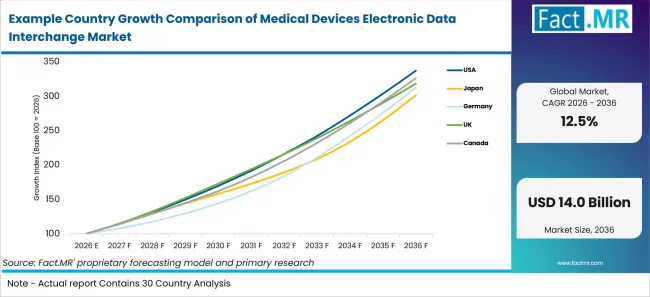
Example Country Growth Comparison Of Medical Devices Electronic Data Interchange Market | Source: Fact.MR
| Country | CAGR (2026-2036) |
|---|---|
| South Korea | 13.55% |
| USA | 12.93% |
| Canada | 12.56% |
| UK | 12.29% |
| Australia | 12.22% |
| Germany | 12.08% |
| Japan | 11.69% |
Source: Fact.MR analysis. Updated Aug 5, 2026
What is shaping South Korea’s outlook through 2036?
13.55% CAGR, supported by integrated UDI data and distribution transaction reporting.
South Korea’s outlook reflects an environment in which medical device identification and distribution records are managed through the Ministry of Food and Drug Safety’s UDI traceability system. Manufacturers and supply-chain participants need consistent product identifiers across regulatory records and commercial transactions. This favors EDI platforms that can maintain partner mappings, capture shipment and inventory events and connect local enterprise systems with the wider device information environment.
What supports USA adoption from 2026 to 2036?
12.93% CAGR, backed by mature trading networks and structured device identification.
The USA combines large medical device manufacturers, national distributors, hospital systems and group purchasing organizations in a high-volume trading environment. FDA’s GUDID provides a reference catalog for device identifiers, while X12 purchase order, acknowledgment and ship-notice transactions support commercial exchange. Adoption is expected to center on cloud network scale, ERP connectivity and exception visibility rather than basic document conversion alone.
How does Canada develop demand through 2036?
12.56% CAGR, supported by digital regulatory processes and provincial procurement modernization.
Canada’s growth is shaped by a mix of federal manufacturer requirements and provincial healthcare purchasing. Health Canada made the Common Electronic Submission Gateway and regulatory enrolment process mandatory for medical device manufacturers from April 2026, reinforcing structured electronic workflows for company, dossier and device information. Commercial EDI adoption still depends on distributor requirements, hospital procurement systems and the ability to connect regional partners without imposing large internal IT teams.
How does the UK’s regulatory split shape growth?
12.29% CAGR, driven by device registration, partner data control and separate market routes.
The UK market requires manufacturers to manage Great Britain registration with the MHRA while Northern Ireland follows EU requirements, including mandatory EUDAMED use for covered modules from May 2026. This split increases the need for controlled product records, partner identifiers and jurisdiction-specific workflows. EDI demand is likely to favor platforms that connect procurement and distribution data while preserving separate regulatory routing and audit trails.
What shapes Australia’s outlook by 2036?
12.22% CAGR, supported by phased UDI implementation and sponsor data requirements.
Australia introduced mandatory UDI requirements for higher-risk devices from July 2026 and operates the Australian UDI Database, which links device records with relevant ARTG inclusions. Sponsors and manufacturers therefore need accurate product identifiers and controlled updates alongside routine supply-chain transactions. EDI providers can create value by connecting local sponsors, distributors and healthcare buyers without separating UDI data quality from order and shipment execution.
What is shaping Germany’s outlook through 2036?
12.08% CAGR, supported by EUDAMED obligations and cross-border device distribution.
Germany’s outlook reflects EU MDR and IVDR requirements, the mandatory use of four EUDAMED modules from May 2026 and a large cross-border healthcare supply chain. Manufacturers must coordinate UDI and device records with distributors, hospitals and logistics partners operating across several European markets. Demand therefore favors integration platforms that support multilingual partner maps, ERP connections, certificate-based exchange and controlled changes across regional business units.
What defines Japan’s growth path through 2036?
11.69% CAGR, led by mandatory device identification codes and careful enterprise integration.
Japan requires identification codes on medical device packaging and continues to promote traceability through standardized barcodes and hospital use. The commercial environment includes established local enterprise systems, distributor relationships and detailed change-control expectations. EDI adoption is expected to remain measured but durable, with demand focused on reliable local mappings, managed operations and links between product, lot, shipment and hospital inventory records.
Who leads the Medical Devices Electronic Data Interchange Market?
OpenText Corporation is an active provider in the market. Its role is anchored in large-scale B2B network connectivity, EDI and API exchange, managed services and ERP integration.
The remaining providers address different buyer profiles across supplier onboarding, complex B2B gateways, ERP-linked integration and cloud-native partner management.
SPS Commerce and TrueCommerce focus on supplier-facing EDI and recurring purchase order, shipment and invoice workflows. IBM supports complex high-volume B2B operations through Sterling. Oracle and SAP connect partner exchange with broad enterprise application estates. Cleo and Boomi combine EDI with cloud integration and partner management. MuleSoft and Babelway support integration-led architectures where APIs, applications and trading-partner messages must be coordinated across heterogeneous systems.
Which companies are the key providers?
Key companies include OpenText Corporation; SPS Commerce, Inc.; TrueCommerce Inc.; IBM Corporation; Oracle Corporation; SAP SE; Cleo Communications US LLC; Boomi LP; MuleSoft (Salesforce); Babelway (Tradeshift).
- OpenText Corporation
- SPS Commerce, Inc.
- TrueCommerce Inc.
- IBM Corporation
- Oracle Corporation
- SAP SE
- Cleo Communications US LLC
- Boomi LP
- MuleSoft (Salesforce)
- Babelway (Tradeshift)
Bibliography
- International Medical Device Regulators Forum. (2013, December 18). UDI Guidance: Unique Device Identification of Medical Devices.
- International Medical Device Regulators Forum. (2017, March 16). Data Exchange Guidelines: Common Data Elements for Medical Device Identification.
- U.S. Food and Drug Administration. Global Unique Device Identification Database (GUDID).
- European Commission. (2026, May 28). Overview of the European Database on Medical Devices (EUDAMED).
- Therapeutic Goods Administration. (2026, July 1). New UDI Requirements for Medical Devices Commence 1 July 2026.
- Health Canada. (2026, April 24). Mandatory Use of the Regulatory Enrolment Process for Medical Device Transactions.
- Medicines and Healthcare products Regulatory Agency. Register Medical Devices to Place on the Market.
- Ministry of Health, Labour and Welfare, Japan. (2022, October 31). Labelling of Identification Codes on Medical Device Containers and Packaging.
- Ministry of Food and Drug Safety, Republic of Korea. Medical Device UDI Traceability Management System.
- X12. Transaction Sets for Purchase Order, Purchase Order Acknowledgment and Ship Notice or Manifest.
- National Institute of Standards and Technology. (2024, November 1). SP 800-161 Rev. 1: Cybersecurity Supply Chain Risk Management Practices for Systems and Organizations.
- OpenText Corporation. OpenText Trading Grid: EDI, API and B2B Integration.
- IBM Corporation. IBM Sterling B2B Integrator.
- Oracle Corporation. Business Protocols Supported in B2B for Oracle Integration.
- SAP SE. SAP Integration Suite: Business-to-Business Integration.
This Report Answers
- The report provides strategic intelligence on Component and Deployment choices that determine recurring software and service revenue.
- Segment analysis covers Software, Cloud-Based deployment, Supply Chain Transactions, Medical Device Manufacturers and Large Enterprises as the 2026 share leaders.
- Country outlook evaluates South Korea and the USA alongside Canada, the UK, Australia, Germany and Japan.
- Competitive analysis explains OpenText and the operating roles of SPS Commerce, TrueCommerce, IBM, Oracle, SAP, Cleo, Boomi, MuleSoft and Babelway.
- Adoption analysis covers partner onboarding, UDI-linked product data, ERP connectivity, transaction monitoring, mapping control and managed EDI operations.
What does the Medical Devices Electronic Data Interchange Market cover?
Medical devices electronic data interchange refers to the structured computer-to-computer exchange of business and compliance documents between medical device manufacturers, distributors, suppliers, logistics providers and healthcare organizations.
The market covers revenue from EDI software platforms, B2B integration software, implementation services and managed EDI services used within the stated Component, Deployment, Transaction Type, End User and Enterprise Size categories. It includes transaction translation, mapping, validation, routing, acknowledgments, partner onboarding, monitoring and integration with enterprise applications.
The market differs from general healthcare data exchange because the commercial boundary centers on medical device trading-partner and compliance workflows. Patient clinical records, claims-only transactions and general hospital interoperability platforms remain outside the boundary unless they are sold specifically as part of a medical device EDI solution.
What is included in the scope?
Commercial software subscriptions, licences, implementation projects and managed service fees are included when they support medical device EDI transactions within the stated segmentation universe.
The scope includes Component and Deployment alongside Transaction Type, End User and Enterprise Size. It covers purchase orders, order confirmations, advance shipping notices, inventory synchronization, UDI reporting, regulatory filings, invoicing and partner collaboration where these functions are delivered through medical device EDI software or services.
What is excluded from the scope?
Medical device sales, freight charges, barcode scanners, printers, RFID hardware and general ERP licences are outside the scope unless revenue is specifically attributable to the EDI software or service layer.
The scope excludes claims-only healthcare EDI, patient-record exchange, clinical interoperability platforms, regulatory database fees, stand-alone cybersecurity products and consulting that is not tied to EDI implementation or managed operations. Internal file transfers without an external trading-partner exchange are also excluded.
How Was the Analysis Built?
The analysis combines primary research, company portfolio review, regulatory evidence, standards documentation and country-level demand assessment.
- Primary Research: Primary research includes discussions with EDI platform providers, system integrators, medical device manufacturers, distributors, logistics providers, hospital procurement teams, group purchasing organizations and enterprise IT leaders. These conversations examine partner onboarding, transaction priorities, mapping complexity, deployment preferences, service requirements, buying criteria and implementation barriers.
- Desk Research: Desk research covers medical device regulations, UDI databases, standards publications, company documentation, public procurement material, cybersecurity guidance and other authoritative sources. The bibliography records the principal external sources used to support the market narrative.
- Market Sizing and Forecasting: Market estimates combine enterprise integration spending, trading-partner counts, transaction intensity, software and service mix, deployment patterns, end-user adoption, company participation, country-level growth and barriers to expansion.
- Data Validation and Update Cycle: The analysis combines primary interviews with structured review of public company disclosures, official statistics, regulatory material, and sector publications. Forecast interpretation considers market conditions, adoption requirements, competitive positioning, and regional operating context.
Segmentation
What is the report’s scope and coverage?
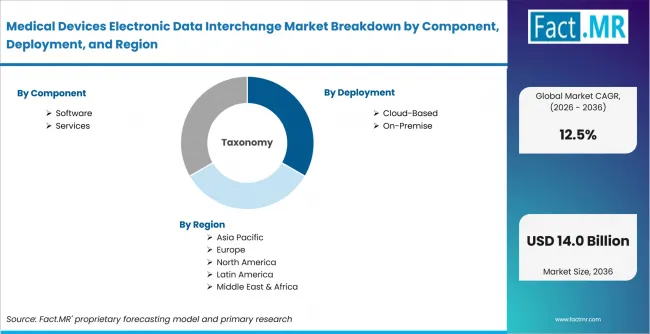
Medical Devices Electronic Data Interchange Market Breakdown By Component, Deployment, And Region | Source: Fact.MR
| Attribute | Details |
|---|---|
| Quantitative Units | USD billion |
| Market Definition | Revenue from medical-device-focused EDI software and implementation or managed services sold within the stated segmentation universe. |
| Component | Software; Services |
| Deployment | Cloud-Based; On-Premise |
| Transaction Type | Supply Chain Transactions; Inventory & Logistics; Regulatory & Compliance Data Exchange; Others |
| End User | Medical Device Manufacturers; Distributors & Suppliers; Healthcare Providers |
| Enterprise Size | Large Enterprises; Small & Medium Enterprises |
| Regions Covered | North America; Latin America; Europe; East Asia; South Asia and Pacific; Middle East and Africa |
| Countries Covered | USA; Japan; Germany; UK; Canada; Australia; South Korea |
| Key Companies Profiled | OpenText Corporation; SPS Commerce, Inc.; TrueCommerce Inc.; IBM Corporation; Oracle Corporation; SAP SE; Cleo Communications US LLC; Boomi LP; MuleSoft (Salesforce); Babelway (Tradeshift) |
| Forecast Period | 2026 to 2036 |
| Approach | Hybrid top-down and bottom-up approach using enterprise integration spend, trading-partner counts, transaction intensity, deployment mix, service adoption, country-level growth, regulatory requirements and company portfolio review |
Source: Fact.MR analysis. Updated Aug 5, 2026
How is the market segmented?
-
By Component:
- Software
- EDI Platforms
- B2B Integration Software
- Services
- Implementation Services
- Managed EDI Services
- Software
-
By Deployment:
- Cloud-Based
- Public Cloud
- Hybrid Cloud
- On-Premise
- Private Infrastructure
- Local Enterprise Systems
- By Transaction Type
- Supply Chain Transactions
- Purchase Orders
- Order Confirmations
- Inventory & Logistics
- Advance Shipping Notices
- Inventory Synchronization
- Regulatory & Compliance Data Exchange
- UDI Reporting
- Regulatory Filings
- Others
- Invoicing
- Partner Collaboration
- Cloud-Based
-
By End User:
- Medical Device Manufacturers
- Diagnostic Device Manufacturers
- Surgical Device Manufacturers
- Distributors & Suppliers
- Medical Equipment Distributors
- Logistics Providers
- Healthcare Providers
- Hospitals
- Group Purchasing Organizations
- Medical Device Manufacturers
-
By Enterprise Size:
- Large Enterprises
- Global Medical Device Manufacturers
- Multinational Healthcare Companies
- Small & Medium Enterprises
- Regional Manufacturers
- Specialty Medical Device Companies
- Large Enterprises
-
By Region:
- North America
- Latin America
- Europe
- East Asia
- South Asia and Pacific
- Middle East and Africa
Frequently Asked Questions
Which Component leads the market?
Which Deployment leads the market?
Which Transaction Type leads the market?
Which End User leads the market?
Which Enterprise Size leads the market?
Which country records the highest listed CAGR?
Which companies are active in the market?
What is the primary driver in this market?
What is the main restraint?
Who worked on this report


Preview the report firsthand - request a free sample
Free SampleGet the brochure for pricing and purchase details
Download PDF