- Market Value (2025): USD 491.3 Mn
- Estimated Value (2026): USD 525.7 Mn
- Forecast Value (2036): USD 1035.2 Mn
- CAGR (2026-2036): 7.0%
What is the Pre-Filled Heparin Lock Syringe Market forecast to be worth by 2036?
USD 525.7 million in 2026 to USD 1035.2 million by 2036 at a 7.0% CAGR.
- The pre-filled heparin lock syringe market was valued at USD 491.3 million in 2025.
- Market revenue is forecast to rise from USD 525.7 million in 2026 to USD 1035.2 million in 2036.
- The 7.0% CAGR describes revenue expansion over 2026 to 2036 as providers continue buying ready-to-use lock products for appropriate vascular access protocols.
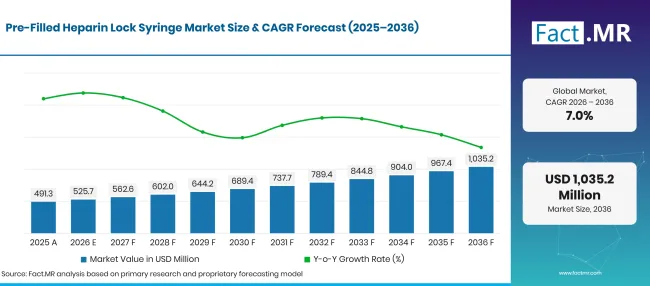
Pre Filled Heparin Lock Syringe Market Forecast Global | Source: Fact.MR
| Year | Basis | Market Value (USD million) |
|---|---|---|
| 2025 | Actual | 491.3 |
| 2026 | Estimate | 525.7 |
| 2036 | Forecast | 1035.2 |
| CAGR 2026 to 2036 | Forecast period | 7.0% |
Source: Fact.MR analysis. Updated Nov 5, 2026
What are the defining numbers behind Pre-Filled Heparin Lock Syringe Market growth?
According to Fact.MR analysis, the market is projected to gain USD 509.5 million between 2026 and 2036.
- Demand Drivers in the Market
- Vascular access teams use heparin lock solutions when the catheter instructions and local care protocol specify them. A pre-filled syringe removes the step of drawing up a solution at the bedside and gives staff a clearly labeled concentration and fill volume before use.
- Hospital pharmacy teams compare the cost of prepared syringes with the labor involved in drawing fluid from multi-dose containers. Purchasing decisions also account for individual packaging, storage conditions, expiry dates and medication error controls.
- Clinical teams need clear concentration and fill-volume options so they can match a syringe to the ordered protocol. BD lists heparin flush products at 10 and 100 USP units/mL, illustrating the importance of selecting the correct presentation for the vascular access device.
- Healthcare distributors need dependable stock availability for frequently repeated procedures. Product identification and sealed single-use packaging can simplify replenishment across wards and outpatient treatment areas without changing the clinical indication.
- Key Segments Analyzed
- By Product Type: Low-Dose Heparin Lock Syringes account for 62.4% of 2026 revenue, reflecting use where lower heparin concentrations are specified.
- By Material: Plastic is forecast to represent 58.7% of 2026 sales, with a light single-use format suited to routine supply.
- By End-User: Hospitals hold 47.3% of 2026 demand as vascular access maintenance forms part of inpatient care.
- By Distribution Channel: Hospital Pharmacies capture 53.1% of 2026 revenue, as these departments manage medicine-specific selection and distribution.
- Analyst Opinion at Fact.MR
- Shambhu Nath Jha, Principal Consultant at Fact.MR, states, “Hospitals compare the price of ready-filled heparin syringes with the labor and safeguards involved in local preparation. A commercially useful product must match the catheter protocol and remain consistently available in the required strength and volume.”
- Strategic Implications
- Manufacturers can keep concentration and fill-volume labels prominent so clinical teams can identify the ordered presentation before use.
- Hospital pharmacies need to assess storage life and carton configuration alongside the cost of an individual syringe.
- Distributors benefit from making product codes and substitution options easy to see when managing supply interruptions.
- Vascular access teams can evaluate heparin lock suitability separately from saline flushing and systemic anticoagulant injection.
Germany is forecast to register 7.6% CAGR, while Brazil follows at 6.9%. The United States is estimated at 6.3%; the United Kingdom at 5.6%; and Japan at 5.0%. Differences reflect forecast spending patterns for prepared vascular access supplies, rather than measured changes in catheter use.
How does the Pre-Filled Heparin Lock Syringe Market break down by segment?
Low-dose products account for 62.4%, plastic formats 58.7%, hospitals 47.3%, and hospital pharmacies 53.1% of the relevant 2026 segments.
Which Product Type dominates?
Low-Dose Heparin Lock Syringes hold 62.4% of the relevant 2026 segment.
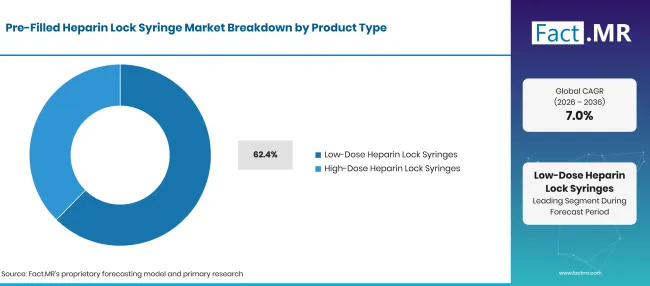
Pre Filled Heparin Lock Syringe Market Breakdown Product Type | Source: Fact.MR
| Product Type | Share (2026) |
|---|---|
| Low-Dose Heparin Lock Syringes (Leading segment) | 62.4% |
| Other segments combined | 37.6% |
| Total | 100.0% |
Source: Fact.MR analysis. Updated Nov 5, 2026
Low-dose heparin lock syringes are used where vascular-access protocols specify lower heparin concentrations and controlled fill volumes. Clinical teams need to distinguish between available strengths because the concentration and total amount delivered can vary by presentation. Product selection therefore depends on the catheter type, prescribed locking protocol, syringe volume and clear labeling that helps staff identify the correct formulation before use.
What leads the Material segment?
Plastic leads with 58.7% of the relevant 2026 segment.
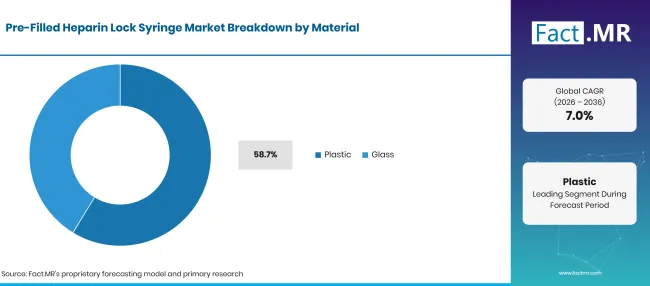
Pre Filled Heparin Lock Syringe Market Breakdown Material | Source: Fact.MR
| Material | Share (2026) |
|---|---|
| Plastic (Leading segment) | 58.7% |
| Other segments combined | 41.3% |
| Total | 100.0% |
Source: Fact.MR analysis. Updated Nov 5, 2026
Plastic remains widely used for pre-filled heparin lock syringes because it supports lightweight, single-use formats and allows clinicians to inspect the solution and volume markings easily. Material selection also depends on compatibility with the drug formulation, closure integrity and sterile storage requirements. Glass provides an alternative format where packaging performance and product stability requirements make it appropriate for the finished syringe.
How does End-User shape purchases?
Hospitals hold 47.3% of the relevant 2026 segment.
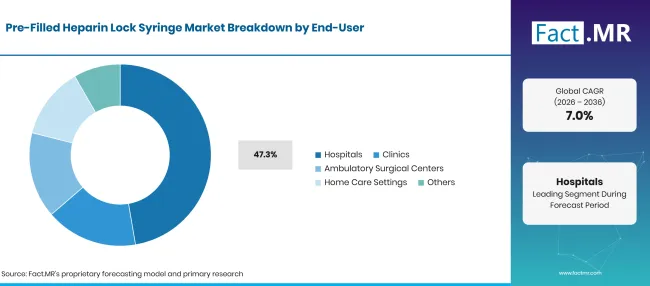
Pre Filled Heparin Lock Syringe Market Breakdown End User | Source: Fact.MR
| How does End-User shape purchases | Share (2026) |
|---|---|
| Hospitals (Leading segment) | 47.3% |
| Other segments combined | 52.7% |
| Total | 100.0% |
Source: Fact.MR analysis. Updated Nov 5, 2026
Hospitals represent an important user group because vascular-access devices are managed across inpatient wards, infusion services and other specialist treatment settings. Pharmacy and clinical teams maintain suitable locking products for devices that require heparin between uses. Clinics, ambulatory centers and home-care services follow different treatment schedules, making pack configuration, handling instructions and professional oversight important when selecting syringe presentations.
Which Distribution Channel leads?
Hospital Pharmacies account for 53.1% of the relevant 2026 segment.
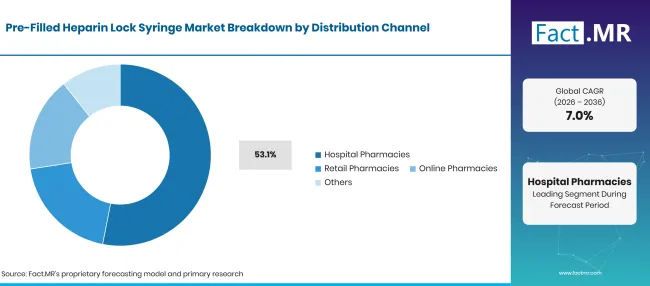
Pre Filled Heparin Lock Syringe Market Breakdown Distribution Channel | Source: Fact.MR
| Distribution Channel | Share (2026) |
|---|---|
| Hospital Pharmacies (Leading segment) | 53.1% |
| Other segments combined | 46.9% |
| Total | 100.0% |
Source: Fact.MR analysis. Updated Nov 5, 2026
Hospital pharmacies play a central role in managing pre-filled heparin lock syringes because they work directly with medication formularies, vascular-access protocols and institutional inventory systems. Pharmacy teams compare concentration, fill volume, manufacturer codes and storage requirements before adding products to stock. Retail pharmacies and authorized online channels serve selected settings, while distributors support hospitals by maintaining product availability and clearly identified alternatives.
What is accelerating Pre-Filled Heparin Lock Syringe Market adoption, and what is holding it back?
Prepared lock doses are expected to simplify bedside handling where a catheter protocol specifies heparin. Saline-only care pathways and medicine safety controls define the boundaries of use.
Drivers Impact Analysis
| DRIVER | (~) % IMPACT ON CAGR | GEOGRAPHIC RELEVANCE | IMPACT TIMELINE |
|---|---|---|---|
| Hospital preference for labeled ready-to-use doses | +1.2% | North America, Europe | Short term |
| Catheter maintenance in specialist care | +0.9% | Global | Medium term |
| Pharmacy preparation workload | +0.7% | North America, Europe | Medium term |
| Distributor stock continuity | +0.5% | Global | Short term |
| Home infusion support for eligible devices | +0.3% | Selected markets | Long term |
Source: Fact.MR analysis. Updated Nov 5, 2026
Opportunity Impact Analysis
| OPPORTUNITY | (~) % IMPACT ON CAGR | GEOGRAPHIC RELEVANCE | IMPACT TIMELINE |
|---|---|---|---|
| Standardized pharmacy inventory | +0.6% | North America, Europe | Medium term |
| Procedure-ready single-use packs | +0.4% | Global | Medium term |
| Distributor-supported hospital access | +0.3% | Latin America, Asia | Medium term |
| Device-specific product guidance | +0.2% | Global | Long term |
Source: Fact.MR analysis. Updated Nov 5, 2026
Restraints Impact Analysis
| RESTRAINT | (~) % IMPACT ON CAGR | GEOGRAPHIC RELEVANCE | IMPACT TIMELINE |
|---|---|---|---|
| Saline-only device care protocols | -0.8% | Global | Short term |
| Heparin-related patient safety precautions | -0.6% | Global | Short term |
| Sterile manufacturing and quality costs | -0.4% | Global | Medium term |
| Pressure on hospital pharmacy budgets | -0.3% | Global | Medium term |
Source: Fact.MR analysis. Updated Nov 5, 2026
Which countries are scaling the Pre-Filled Heparin Lock Syringe Market through 2036?
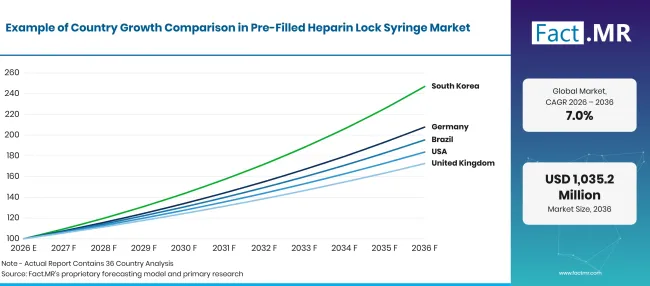
Pre Filled Heparin Lock Syringe Market Growth Index | Source: Fact.MR
| Country | CAGR (2026 to 2036) |
|---|---|
| Germany | 7.6% |
| Brazil | 6.9% |
| USA | 6.3% |
| UK | 5.6% |
| Japan | 5.0% |
Source: Fact.MR analysis. Updated Nov 5, 2026
What shapes Germany market performance?
7.6% CAGR, shaped by hospital pharmacy oversight and catheter-specific product selection in Germany.
Germany’s hospital pharmacies review lock preparations against catheter-specific instructions and product labeling. Destatis reported in October 2026 that Germany recorded 17.7 million inpatient hospital treatments during 2025 [2]. Individual packs allow clinical staff to check the prescribed concentration before administration.
What shapes Brazil market performance?
6.9% CAGR, supported by dependable hospital distribution and institutional care demand in Brazil.
Brazil’s mix of public and privately insured care makes dependable distribution an important factor for heparin lock products. The National Supplementary Health Agency reported in June 2026 that private health plans recorded 9.9 million hospital admissions in 2025 [3]. Hospital pharmacies are expected to compare ready-filled units against local preparation requirements where clinical protocols permit heparin.
What shapes USA market performance?
6.3% CAGR, linked to established vascular access procedures and hospital use in the USA.
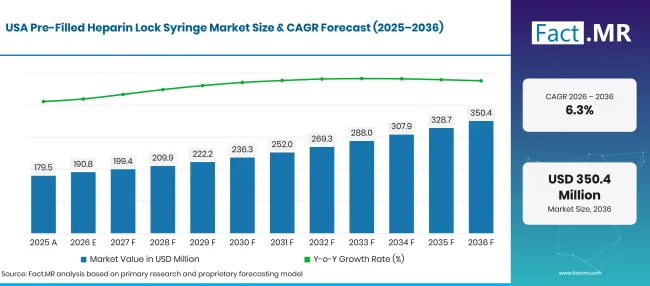
Pre Filled Heparin Lock Syringe Market Forecast Usa | Source: Fact.MR
US hospitals evaluate pre-filled heparin lock syringes within established vascular access care procedures. The Centers for Disease Control and Prevention reported in July 2026 that central-line bloodstream infection ratios in acute care hospitals declined 9% in 2024 compared with 2023 [1]. Medicine-specific bleeding precautions and the use of saline-based maintenance remain central to product selection.
What shapes UK market performance?
5.6% CAGR, supported by NHS vascular access practices and ready-to-use hospital pharmacy formats in the UK.
In the United Kingdom, hospital pharmacy teams assess heparin lock presentations alongside NHS vascular access procedures and medicine handling requirements. NHS England reported in September 2026 that England recorded 150.3 million outpatient appointments during financial year 2025–26 [4]. Ready-to-use packs can reduce preparation steps in approved settings.
What shapes Japan market performance?
5.0% CAGR, tied to Japan’s hospital network, sterile handling requirements and consistent product labeling.
Japan’s hospitals place attention on consistent labeling and accurate handling of medicine-filled devices. The Ministry of Health, Labour and Welfare reported in September 2026 that Japan had 1,450,322 hospital beds during 2025 [5]. Capacity across the hospital network creates a relevant setting for vascular access care and repeated supply decisions. Sterile product handling requirements and alternative locking methods continue to influence the range of appropriate use.
Who leads the Pre-Filled Heparin Lock Syringes Market?
Direct manufacturers and distributors occupy different positions in the supply chain. BD lists PosiFlush prefilled heparin lock flush syringes, while SPM Medicare identifies Easy Flush Heparin as a sterile prefilled solution for vascular access devices.
Medefil appears in the 2025 ASHP product availability listing. Medline sells BD products and also presents heparin variants within its own ZR flush range. Health Biotech lists a heparin flush syringe in its product portfolio.
Which companies are the key providers?
Key companies include Becton, Dickinson and Company, Medefil, Inc., Cardinal Health, Inc., Medline Industries, Inc., SPM Medicare Pvt. Ltd., and Health Biotech Limited.
- Becton, Dickinson and Company
- Medefil, Inc.
- Cardinal Health, Inc.
- Medline Industries, Inc.
- SPM Medicare Pvt. Ltd.
- Health Biotech Limited
Bibliography
- [1] Centers for Disease Control and Prevention. (2026, July 15). Current HAI progress report: 2024 National and State Healthcare-Associated Infections Progress Report.
- [2] Statistisches Bundesamt (Destatis). (2026, October 28). 1,2 % mehr Krankenhausbehandlungen im Jahr 2025.
- [3] Agência Nacional de Saúde Suplementar. (2026, June 30). Planos de saúde registram 2 bilhões de procedimentos em 2025.
- [4] NHS England. (2026, September 24). Hospital Outpatient Activity 2025-26.
- [5] Ministry of Health, Labour and Welfare. (2026, September 29). 令和7(2025)年「医療施設(動態)調査」、「病院報告」の結果 [Results of the 2025 Medical Institutions Survey and Hospital Report].
This Report Answers
- The report explains the difference between low-dose and high-dose heparin locking presentations and why concentration matters in treatment protocols.
- Segment analysis compares plastic and glass formats alongside their commercial handling requirements.
- End-user analysis discusses the distinct purchasing needs of hospitals and outpatient treatment settings.
- Country outlooks compare Germany, Brazil, USA, UK and Japan without treating national patient statistics as product sales.
- Competitive discussion separates direct manufacturers from distributors that list another company’s heparin lock syringe.
What does the Pre-Filled Heparin Lock Syringe Market cover?
The market covers syringes already filled with heparin lock flush solution for maintaining the patency of suitable vascular access devices. The relevant commercial unit includes the prefilled sterile container and the medicine within it. Revenue is assessed across institutional purchasing and authorized distribution channels.
What is included in the scope?
Low-dose and high-dose heparin lock solutions are counted when sold as prefilled syringes for device locking.
Plastic and glass containers are distinguished by packaging material. The analysis covers hospitals and smaller clinical settings where trained professionals use an appropriate heparin maintenance protocol.
What is excluded from the scope?
Plain saline flush syringes fall outside the heparin lock boundary.
Empty syringes and therapeutic anticoagulant injections are excluded even when they contain heparin or a related medicine. Catheters, needles and other vascular access accessories are outside the revenue count unless sold as part of the defined finished product.
How Was the Analysis Built?
The analysis draws on 120+ sources, 35+ company portfolios, 25+ countries, and more than 20 industry interviews.
- Primary Research: Primary research includes discussions with manufacturers, service providers, technology developers, distributors, end users, and subject-matter experts. These conversations examine purchasing priorities, product adoption, operational challenges, approval requirements, competitive positioning, and the factors that influence wider market acceptance.
- Desk Research: Desk research covers government statistics, regulatory publications, company filings, trade data, technical studies, industry associations, standards, public policy, and other authoritative sources. Every source used in the analysis is documented in the bibliography.
- Market Sizing and Forecasting: Market estimates combine historical performance, demand indicators, pricing and volume trends, segment shares, company participation, country-level growth, adoption patterns, investment activity, and barriers to market expansion.
- Data Validation and Update Cycle: Findings are validated by comparing primary interviews with public data, company activity, regulatory changes, trade patterns, and industry developments. Regular updates review new product launches, capacity changes, partnerships, approvals, and shifts in commercial adoption.
Segmentation
What is the report’s scope and coverage?
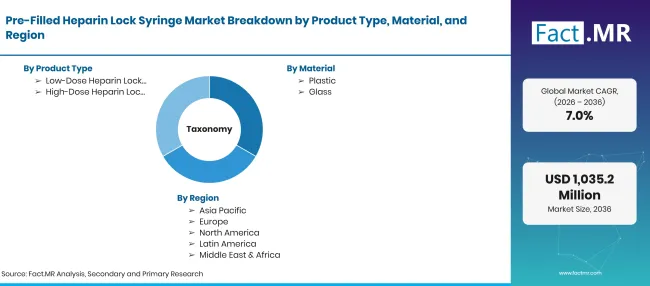
Pre Filled Heparin Lock Syringe Market Taxonomy | Source: Fact.MR
| Attribute | Details |
|---|---|
| Quantitative Units | USD million |
| Market Definition | Pre-filled heparin lock flush syringes for appropriate vascular access device maintenance. |
| Product Type | Low-Dose Heparin Lock Syringes; High-Dose Heparin Lock Syringes |
| Material | Plastic; Glass |
| End-User | Hospitals; Clinics; Ambulatory Surgical Centers; Home Care Settings; Others |
| Distribution Channel | Hospital Pharmacies; Retail Pharmacies; Online Pharmacies; Others |
| Regions Covered | North America; Latin America; Western Europe; Eastern Europe; East Asia; South Asia & Pacific; Middle East & Africa |
| Countries Covered | Germany; Brazil; USA; UK; Japan |
| Companies Profiled | Becton, Dickinson and Company, Medefil, Inc., Cardinal Health, Inc., Medline Industries, Inc., SPM Medicare Pvt. Ltd., and Health Biotech Limited |
| Forecast Period | 2026 to 2036 |
| Approach | Revenue forecasting based on product formats, treatment settings, purchasing channels and country outlooks. |
Source: Fact.MR analysis. Updated Nov 5, 2026
How is the market segmented?
-
By Product Type
- Low-Dose Heparin Lock Syringes
- High-Dose Heparin Lock Syringes
-
By Material
- Plastic
- Glass
-
By End-User
- Hospitals
- Clinics
- Ambulatory Surgical Centers
- Home Care Settings
- Others
-
By Distribution Channel
- Hospital Pharmacies
- Retail Pharmacies
- Online Pharmacies
- Others
-
By Region
- North America
- Latin America
- Western Europe
- Eastern Europe
- East Asia
- South Asia & Pacific
- Middle East & Africa
Frequently Asked Questions
How big is the Pre-Filled Heparin Lock Syringe Market in 2026?
What is the CAGR of the Pre-Filled Heparin Lock Syringe Market from 2026 to 2036?
Which product type leads the Pre-Filled Heparin Lock Syringe Market?
Which material leads the Pre-Filled Heparin Lock Syringe Market?
Who are the leading companies in the Pre-Filled Heparin Lock Syringe Market?
Who worked on this report


Preview the report firsthand - request a free sample
Free SampleGet the brochure for pricing and purchase details
Download PDF