- Base Value(2025): 173 Mn
- Forecast Value (2035): 315.7 Mn
- CAGR (2035): 4.2%
Primary Human Hepatocytes Market Outlook (2025 to 2035)
The global primary human hepatocytes market is expected to reach USD 315.7 million by 2035, up from USD 162.9 million in 2024. During the forecast period from 2025 to 2035, the industry is projected to register a CAGR of 6.2%.
The primary human hepatocytes market is growing due to their essential role in drug metabolism studies, driven by an increasing demand for predictive in vitro models. Advances in cryopreservation, a growing emphasis on personalized medicine, and the broadening scope of liver disease research further propel market expansion.
Quick Stats for Primary Human Hepatocytes Market
- Industry Value (2025): USD 173 Million
- Projected Value (2035): USD 316 Million
- Forecast CAGR (2025 to 2035): 6.2%
- Leading Segment (2025): Commercial Donor-Derived (41% Market Share)
- Country Growth Rate (2025 to 2035): China (7.7% CAGR)
- Top Key Players: ATCC, Thermo Fisher Scientific (Gibco), ScienCell Research Laboratories, Preci, LifeNet Health LifeSciences, iXCells Biotechnologies, Axol Bioscience, Primacyt, Fujifilm Cellular Dynamics, In Vitro ADMET Laboratories (IVAL), and BeCytes Biotechnologies
-2025-to-2035.webp)
Primary Human Hepatocytes Market Value (USD Million) 2025 To 2035 | Source: Fact.MR
What are the drivers of primary human hepatocytes market?
The primary human liver market is dominated by the growing need for physiologically relevant models in drug discovery, development and testing. These cells sufficiently replicate liver functions in vivo, a property that makes them significant in ADME and DMPK studies.
Increased regulatory pressure to enhance the safety of drugs, as well as limit animal testing, is accelerating their use in preclinical screening applications. Innovation in cryopreservation has improved cell culturing viability and availability, supporting the scalability of this technology in the pharmaceutical and biotech industries.
The demand for hepatocytes from genetically diverse donors is also increasing with the progress of personalized medicine. They are widely used in 3D liver models, bio-artificial liver devices, and regenerative medicine, offering a breakthrough for pharmaceutical companies, academic institutions, contract research organizations, and solution providers in the field.
What are the regional trends of primary human hepatocytes market?
North America, with the U.S. as its primary contributor, leads the market. This country has a well-established clinical research industry that requires the utilization of hepatocytes in drug screening. Key pharmaceutical companies and CROs, as well as academic laboratories, particularly in liver disease trials and metabolic studies, drive demand.
Europe has continued to play an important role with countries such as Germany and the UK investing in human-relevant in vitro models. Hepatocyte-based assays are also preferred in the region, considering its desire to minimize animal testing.
Technology-driven adoption is leading in the Asia Pacific, driven by Japan and South Korea, supported by advanced technologies. Meanwhile, the expanding biopharma sector in China offers significant growth potential. Life sciences and alternative testing methods are receiving government funding in these countries.
Latin America and the Middle East are gradually entering the hepatocytes research space through partnerships with international pharmaceutical and contract research organizations, involving imported solutions and cross-border expertise.
What are the challenges and restraining factors of primary human hepatocytes market?
One of the key setbacks in the primary human hepatocytes market is the limited availability of high-quality donor liver tissues. This often leads to cyclical variability, which influences the reproducibility of experiments involved in drug testing and toxicology.
Cryopreserved hepatocytes address supply issues; however, they may exhibit diminished viability or function, and are therefore limited in certain applications. The procurement, processing, and storage contribute to limited accessibility for smaller research initiatives.
Hepatocyte viability is a complex process that requires sophisticated infrastructural support and expertise, particularly in the in vitro maintenance of hepatocytes. Further, the market faces challenges from competing iPSC-derived hepatocytes and immortalized cell lines that are scalable and cost-effective.
Country-Wise Outlook
Precision Nutrition and Biotech Synergy Drive U.S. Leadership
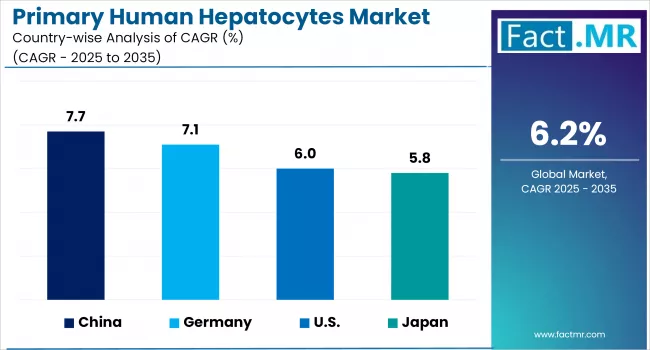
Primary Human Hepatocytes Market By Country | Source: Fact.MR
The primary human hepatocytes market is led by the United States, driven by pharmaceutical development, toxicology screening requirements, and the growth of biobanking infrastructure. The increased incidence of liver diseases, especially NASH and some cases of hepatitis C, supports the use of hepatocyte models to test new drugs at early stages of their development, as well as to perform metabolic investigations.
-2025-to-2035.webp)
US Primary Human Hepatocytes Market Value (USD Million) 2025 To 2035 | Source: Fact.MR
Federal funding sources, such as the NIH, and collaborations with commercial liver tissue banks ensure a wide phenotypic representation of liver tissue in in vitro modeling. The implementation of cryopreserved hepatocytes, liver spheroids, and high-throughput platforms for ADME-Tox testing reflects the progressive pace of biotechnology in the country.
Germany Champions Toxicology Reform through Cell Innovation
Germany is a leader in the European hepatocyte market, supported by a well-established toxicology framework and a requirement to evaluate safety without the use of animals. The REACH regulatory system continues to drive the demand for human-based liver models in drug, cosmetic, and chemical screening.
Challenges in the rapid development of enzyme-induction assays, liver-on-chip systems, and long-term hepatocyte cultures can be addressed through academic-industry synergy. Germany has a robust research infrastructure that is beneficial for innovations in transporter interaction studies and the profiling of phase I/II metabolism. This cell-based transformation, along with toxico-genomics and regulatory workflow, is being strengthened by supportive EU funding and the need for a CRO.
Japan Blends Regenerative Research with Hepatocyte Scale-Up
Japan has been accelerating its contributions to the hepatocyte market, with regenerative medicine being the primary driver and a strong promotion of biotech startups and stem cell initiatives. The increasing demand for scaffold-free 3D cultures, perfusion bioreactors, and disease-specific hepatocyte panels is redefining the path of ADME and virology research.
The stringent Japanese focus on predictive human models for antiviral and metabolic applications, in particular, enhances the relevance of cryopreserved and fresh hepatocytes. Access and innovation are being supported by public-private ecosystems in clinical and preclinical organizations.
Category-Wise Analysis
Cryopreserved Hepatocytes Enable Scalable, On-Demand Liver Cell Research
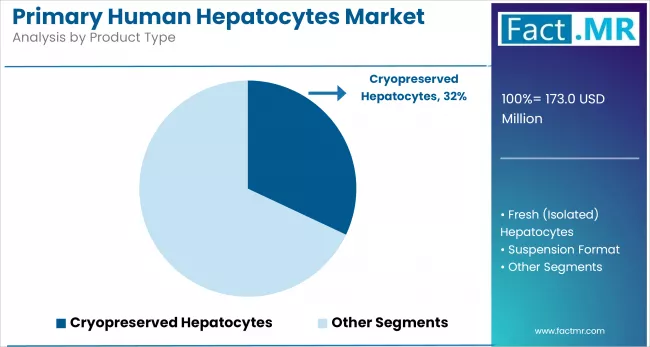
Primary Human Hepatocytes Market By Product Type | Source: Fact.MR
Cryopreserved hepatocytes provide a reliable and viable source of liver cells to use in the in vitro studies. These hepatic cells are rapidly frozen and stored at ultra-low temperatures to preserve their metabolic functions and activities for future applications.
They are valuable because they can be thawed and immediately used without the necessity of fresh donor tissue, supporting high-throughput screening, long-term experiments, and consistency between batches in studies of drug metabolism and toxicology. Cryopreservation enables international delivery and bio-banking, significantly enhancing accessibility to pharmaceutical and academic research facilities abroad.
Commercial Donor-Derived Sources Drive Quality and Standardization
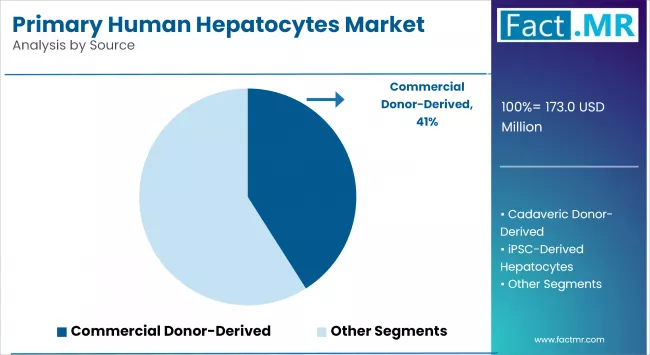
Primary Human Hepatocytes Market By Source | Source: Fact.MR
Human donor-derived hepatocytes are obtained through ethically consented patients and handled by an authorized supplier of tissue and cell division who is certified under the law. This source ensures the standardization, regulatory compliance, and scalability necessary for pharmaceutical research, development, and regulatory submissions.
The cells are thoroughly evaluated for viability, enzyme expression, and purity, allowing their use in FDA/EMA-compliant studies. Resource dependence on commercial sources enables research institutions to bypass the logistics and ethical concerns associated with establishing direct access to primary tissues, thereby speeding up preclinical development and safety testing schedules.
Drug Metabolism & Toxicity Testing Anchor Regulatory and Preclinical Workflows
Primary human hepatocytes are considered the gold standard for assessing drug metabolism, enzyme induction, and hepatotoxicity at the early stages of drug development. With their employment, physiologically relevant cytochrome P450 activation and phase I/II metabolism, as well as transporter interactions, can be assessed.
Such findings are essential for estimating human pharmacokinetics and drug-drug interactions as well as eliminating liver-related adverse consequences prior to clinical testing. With increased emphasis on human-relevant data by regulatory agencies, the role of hepatocyte-based assays in compound risk evaluation and preclinical safety assessment of new chemical entities is clearly established.
Competitive Analysis
Intense differentiation strategies characterize the primary human hepatocytes market as companies prioritize functional quality over scale. Innovations focus on increasing hepatocyte viability post-thaw and extending the timelines of metabolic activity, which are crucial for toxicology and drug metabolism studies.
Vendors compete by enhancing cryopreservation methods and optimizing isolation techniques to ensure high purity and consistent cell functionality.
Strategic collaborations with academic institutions and biotech research firms are shaping competitive momentum. These alliances allow for custom applications in disease modeling, especially for non-alcoholic fatty liver disease (NAFLD) and hepatitis. Licensing proprietary protocols and exclusive distribution networks further intensify the competition.
Regulatory compliance, particularly with FDA and EMA standards, acts as a competitive filter. Only suppliers that maintain stringent quality assurance for primary cells gain sustained access to preclinical and clinical research markets.
Key players in the primary human hepatocytes industry include ATCC, Thermo Fisher Scientific (Gibco), ScienCell Research Laboratories, Preci, LifeNet Health LifeSciences, iXCells Biotechnologies, Axol Bioscience, Primacyt, Fujifilm Cellular Dynamics, In Vitro ADMET Laboratories (IVAL), BeCytes Biotechnologies, and other notable companies.
Recent Development
- In June 2025, RenJi Hospital (China) launched a Phase I trial administering microencapsulated proliferating human hepatocytes (derived from PHHs) intraperitoneally to adult patients with liver failure, with safety as the primary endpoint.
- In March 2025, ATCC introduced HepatoXcell™, a high‑quality cryopreserved PHH product for liver disease research, drug metabolism, and toxicology, along with detailed protocols for isolation and culture.
Fact.MR has provided detailed information about the price points of key manufacturers of the Primary Human Hepatocytes Market positioned across regions, sales growth, production capacity, and speculative technological expansion, in the recently published report.
Segmentation
Segmentation of Primary human hepatocytes market
-
By Product Type :
- Cryopreserved Hepatocytes
- Fresh (Isolated) Hepatocytes
- Suspension Format
- Plateable Hepatocytes
- 3D Spheroid/Co-culture
-
By Source :
- Commercial Donor-Derived
- Cadaveric Donor-Derived
- iPSC-Derived Hepatocytes
-
By Application :
- Drug Metabolism & Toxicity Testing
- Disease Modeling
- Regenerative Medicine & Transplantation
- Viral Hepatitis Research
- Gene Therapy & Enzyme Induction Studies
-
By End User :
- Pharmaceutical & Biotech Companies
- Contract Research Organizations (CROs)
- Academic & Research Institutes
- Hospitals & Clinical Settings
-
By Region :
- North America
- Latin America
- Western Europe
- Eastern Europe
- East Asia
- South Asia & Pacific
- Middle East & Africa
Frequently Asked Questions
What was the global Primary human hepatocytes market size reported by Fact.MR for 2025?
Who are the major players operating in the primary human hepatocytes market?
What is the Estimated Valuation of the primary human hepatocytes market in 2035?
What value CAGR did the Primary human hepatocytes market exhibit over the last five years?
Who worked on this report


Preview the report firsthand - request a free sample
Free SampleGet the brochure for pricing and purchase details
Download PDF