- Market Value (2025): USD 1.2 Bn
- Estimated Value (2026): USD 1.3 Bn
- Forecast Value (2036): USD 3.9 Bn
- CAGR (2026-2036): 11.6%
What is the Probiotic Stability Excipients market forecast to be worth by 2036?
USD 1.3 billion in 2026 to USD 3.9 billion by 2036, at 11.6% CAGR.
- The Probiotic Stability Excipients Market reached USD 1.2 billion in 2025.
- Demand is projected to increase from USD 1.3 billion in 2026 to USD 3.9 billion by 2036.
- The market is forecast to record an 11.6% CAGR from 2026 to 2036 as supplement brands and contract manufacturers specify excipients that protect live cultures.
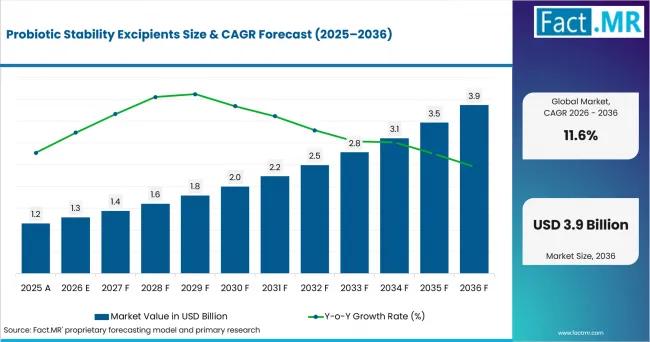
Probiotic Stability Excipients Value Analysis | Source: Fact.MR
What are the defining numbers behind Probiotic Stability Excipients market growth?
USD 2.6 billion absolute opportunity by 2036, led by protective sugars, freeze drying and capsule-based supplements.
- Demand Drivers in the Market
- Probiotic formulators need to manage viable-count loss during shelf life. NIH’s Office of Dietary Supplements notes that probiotic CFU counts can decline over time and that some products state CFUs through the expiration or use-by date. FDA regulations require live microbial dietary ingredients to be declared quantitatively by weight in the Supplement Facts panel, while CFUs may also be declared in addition to the required weight amount.
- Capsule developers need low-moisture carriers during filling, so production losses stay controlled when live cultures meet powders.
- CDC NCHS reported in May 2026 that 60.2% of U.S. adults used a dietary supplement in the past 30 days during August 2021 to August 2023.
- Food and beverage formulators need clean-taste protection systems as probiotics move into fortified drinks, sachets and chewable formats.
- Key Segments Analyzed
- By Excipient Type: Protective sugars are expected to hold 33.0% share in 2026 because trehalose and sucrose systems protect cells during drying.
- By Stabilization Stage: Freeze drying is projected to account for 34.0% share in 2026, supported by probiotic powder supply and recovery-rate testing.
- By Dosage Form: Capsules are anticipated to capture 37.0% share in 2026 owing to supplement-user familiarity and low-moisture filling compatibility.
- By Performance: Shelf-life CFU retention is estimated to represent 29.0% share in 2026 since brands need viable-count protection through storage.
- Analyst Opinion at Fact.MR
- Shambhu Nath Jha, Principal Consultant at Fact.MR, states, “The market is becoming a formulation-performance category. Brands are buying proof that a live culture survives drying, compression and storage. Suppliers are expected to gain preference when they combine moisture control, strain compatibility data and manufacturing support in one technical package.”
- Strategic Implications
- Excipient suppliers should publish water-activity, moisture and storage data for probiotic use cases before positioning materials for live-culture dosage forms.
- Roquette reported in September 2026 that PEARLITOL® ProTec had a measured water activity of 0.122 ± 0.006 and moisture content of 0.740 ± 0.068%, highlighting low water activity and moisture content as important considerations for probiotic formulation stability.
- Contract manufacturers should document CFU recovery after freeze drying and compression to reduce batch-release disputes for capsule and tablet programs.
- Supplement brands should align label claims with end-of-shelf-life counts and choose excipients that support the stated viable-cell commitment.
Japan is estimated to record 11.9% CAGR through 2036, supported by functional-food oversight and stable probiotic formats. China is projected to post 11.6% CAGR as health-food registration work brings probiotic strains into closer quality review. France is forecast to advance at 11.5% CAGR while supplement brands respond to aging-consumer demand and EU claim rules. The USA is anticipated to hold 11.1% CAGR owing to broad supplement use and end-of-shelf-life labeling expectations. Germany is expected to reach 10.9% CAGR due to older consumers and EU health-claim oversight.
How does the Probiotic Stability Excipients market break down by segment?
Protective sugars lead at 33.0%; freeze drying leads at 34.0%.
Which excipient type dominates?
Protective sugars hold 33.0% share in 2026.
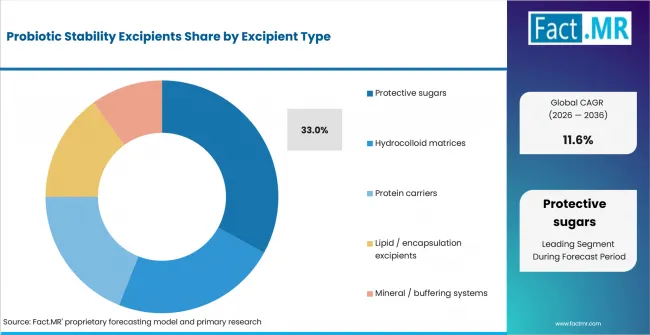
Probiotic Stability Excipients Analysis By Excipient Type | Source: Fact.MR
Protective sugars to lead the excipient-type segment. Trehalose, sucrose and related cryoprotectants can improve probiotic survival during drying, although the degree of protection depends on the strain, formulation, process conditions and storage environment. Their use fits sachets and capsules where taste, powder flow and live-cell protection must be balanced.
What leads the stabilization stage segment?
Freeze drying holds 34.0% share in 2026.
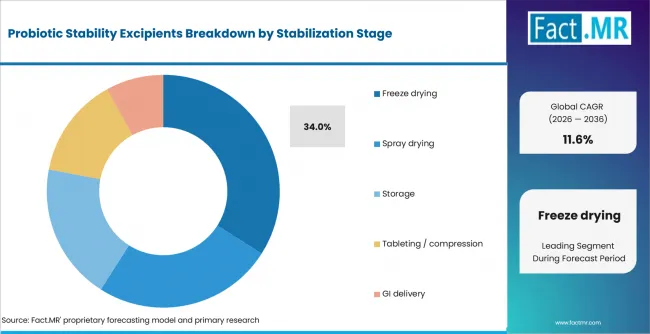
Probiotic Stability Excipients Analysis By Stabilization Stage | Source: Fact.MR
Freeze drying to lead the stabilization-stage segment. Freeze drying is widely used to produce dehydrated probiotic cultures, although survival depends on the strain, protective formulation and process conditions. Excipient choice is therefore linked to recovery rates, storage performance and final viable-count claims.
How does dosage form shape demand?
Capsules hold 37.0% share in 2026.
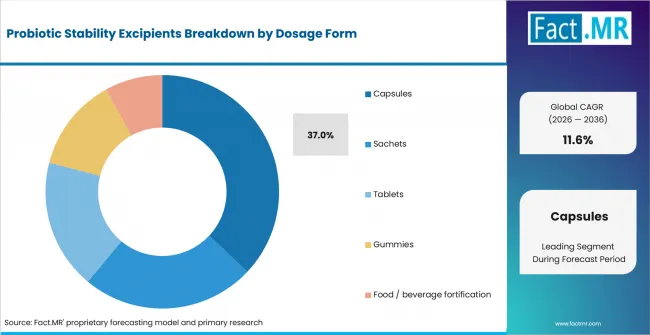
Probiotic Stability Excipients Analysis By Dosage Form | Source: Fact.MR
Capsules lead owing to supplement-user familiarity and the practical handling of moisture-sensitive probiotic powders. Extra-dry capsule systems and low-water fillers help formulators control viability loss during storage. Capsule-focused excipients therefore compete on moisture profile, fill compatibility and controlled gastric exposure.
What supports the performance segment?
Shelf-life CFU retention holds 29.0% share in 2026.
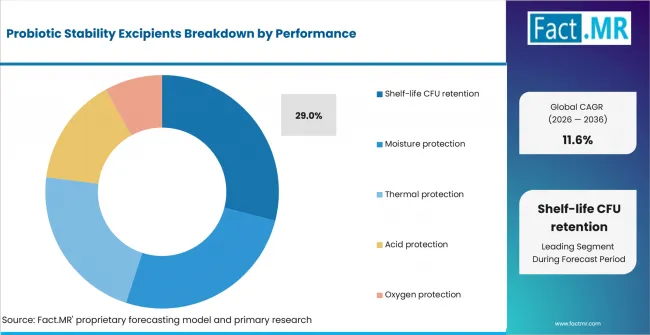
Probiotic Stability Excipients Analysis By Performance | Source: Fact.MR
Shelf-life CFU retention to lead the performance segment. Because viable counts can decline during shelf life, brands that declare CFUs through expiration need stability data supporting the declared count over the stated shelf life. Stability testing therefore becomes a commercial gate for sugars, starch carriers and encapsulation systems.
What is accelerating Probiotic Stability Excipients adoption, and what is holding it back?
Adoption is driven by CFU-retention claims and constrained by moisture sensitivity, claim rules and validation cost.
Drivers Impact Analysis
| DRIVER | (~) % IMPACT ON CAGR | GEOGRAPHIC RELEVANCE | IMPACT TIMELINE |
|---|---|---|---|
| End-of-shelf-life CFU claim support | +1.7% | North America, Europe, East Asia | Short term (<= 2 years) |
| Low-moisture excipient use in capsules and sachets | +1.4% | Global | Medium term (2-4 years) |
| Freeze-dried probiotic powder scale-up | +1.1% | USA, China, Germany | Medium term (2-4 years) |
| Functional-food and supplement claim discipline | +0.8% | Europe, Japan, China | Long term (>= 4 years) |
Source: Fact.MR analysis. Updated Sep 17, 2026
Opportunity Impact Analysis
| OPPORTUNITY | (~) % IMPACT ON CAGR | GEOGRAPHIC RELEVANCE | IMPACT TIMELINE |
|---|---|---|---|
| Extra-dry capsule and delayed-release formats | +1.2% | USA, Japan, Europe | Short term (<= 2 years) |
| Co-processed mannitol-starch systems | +1.0% | Global | Medium term (2-4 years) |
| Functional beverage and sachet stabilization | +0.7% | China, France, USA | Medium term (2-4 years) |
Source: Fact.MR analysis. Updated Sep 17, 2026
Restraints Impact Analysis
| RESTRAINT | (~) % IMPACT ON CAGR | GEOGRAPHIC RELEVANCE | IMPACT TIMELINE |
|---|---|---|---|
| Moisture and oxygen sensitivity across strains | -0.8% | Global | Short term (<= 2 years) |
| Excipient input-cost pressure | -0.6% | Global | Medium term (2-4 years) |
| Validation cost for each strain-format pairing | -0.4% | Global | Long term (>= 4 years) |
Source: Fact.MR analysis. Updated Sep 17, 2026
Which countries are scaling the Probiotic Stability Excipients market through 2036?
- The country comparison spans 1.0 percentage point and forms a tight growth range across mature supplement and functional-food systems.
- Japan remains 0.3 percentage point above China as functional-food oversight and stable delivery formats shape technical formulation work.
- China remains 0.1 percentage point above France because probiotic health-food registration supports more formal product documentation.
- France remains 0.4 percentage point above the USA as older consumers and EU claim discipline support stability-backed probiotic formats.
- The USA remains 0.2 percentage point above Germany owing to broad supplement use and label practices tied to viable-cell counts.
- Germany closes the displayed range as pharmacy-oriented supplement channels keep documentation and low-moisture formats commercially relevant.
Comparable CAGRs can create different entry conditions due to probiotic regulation, supplement habits, dosage preferences and excipient qualification practices. Full report coverage includes North America, Latin America, Western Europe, Eastern Europe, East Asia, South Asia & Pacific, Middle East & Africa.
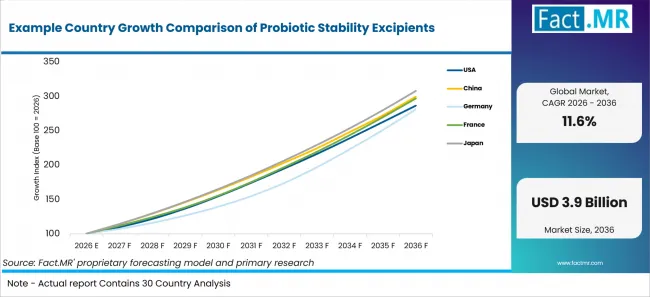
Example Country Growth Comparison Of Probiotic Stability Excipients | Source: Fact.MR
| Country | CAGR (2026-2036) |
|---|---|
| Japan | 11.9% |
| China | 11.6% |
| France | 11.5% |
| USA | 11.1% |
| Germany | 10.9% |
Source: Fact.MR analysis. Updated Sep 17, 2026
What supports Japan adoption?
11.9% CAGR, supported by functional-food oversight and stable probiotic delivery formats.
Japan’s functional-food system places probiotic formulations close to evidence checks and ingredient documentation. The Consumer Affairs Agency reported in October 2025 that it examined analytical-method materials for 98 Foods with Function Claims products and, based on the results, requested additional materials for 69. Probiotic excipient suppliers benefit when they provide stability data that helps brands connect viable cultures with finished-product quality.
How is China scaling demand?
11.6% CAGR, shaped by probiotic health-food registration and quality-control standardization.
China’s health-food framework is moving probiotic products toward clearer technical requirements for strain identity and viable counts. The State Administration for Market Regulation stated in August 2025 that, as of the end of June 2025, more than 120 registered health-food products used probiotics as health-food raw materials. This setting supports excipients that help capsules, sachets and tablets keep live-cell performance consistent.
What supports France growth?
11.5% CAGR, supported by aging consumers and EU claim-substantiation discipline.
France combines a mature supplement channel with EU claim oversight that rewards careful formulation evidence. INSEE reported that 22.2% of France’s population was aged 65 or over on January 1, 2026, based on provisional population estimates. That demographic base supports digestive-health and healthy-aging formats where probiotic stability must be proven through shelf life.
What supports USA adoption?
11.1% CAGR, supported by broad supplement use and CFU-through-expiration labeling needs.
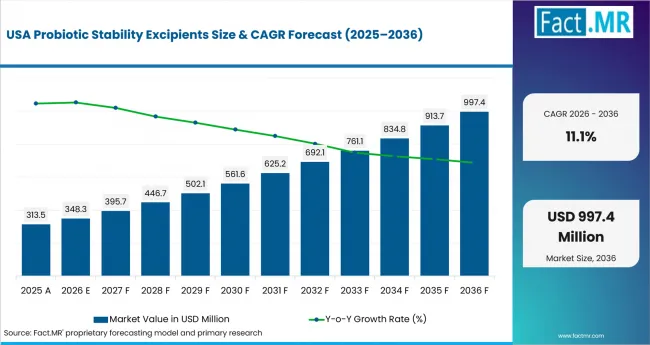
Probiotic Stability Excipients Country Value Analysis | Source: Fact.MR
U.S. probiotic brands operate in a supplement market where consumers compare strain names, CFU counts and storage instructions. CDC NCHS reported in May 2026 that 38.7% of U.S. adults used two or more dietary supplements during August 2021 to August 2023. This raises the value of excipients that protect viable counts in capsules and powders.
How does Germany perform?
10.9% CAGR, supported by older consumers and strict EU claim rules.
Germany’s pharmacy-oriented supplement channel gives stability documentation a direct role in probiotic product positioning. Destatis reported in August 2026 that the number of people aged 65 and older reached 19.3 million in 2025. Suppliers that combine low-moisture excipients with strain-specific test data are better aligned with German launch expectations.
Who leads the Probiotic Stability Excipients market?
Directly evidenced probiotic-stability excipient providers include Roquette, JRS Pharma and BENEO.
Roquette participates directly through PEARLITOL® ProTec, a co-processed mannitol-starch excipient designed for the direct compression of moisture-sensitive ingredients such as probiotics. Roquette has evaluated the excipient in a probiotic tablet formulation and reports low water activity together with direct-compression and stability performance.
JRS Pharma participates through PROSOLV® EASYtab Nutra. Its technical study on directly compressed probiotic tablets reported a post-compaction survival rate of 91.5% in the tested formulation, which JRS describes as an exceptionally high survival rate of over 90%.
BENEO participates through galenIQ™ 721, which the company positions as a highly functional filler-binder and carrier for probiotic tablets, stick-pack powders and capsule fillings. BENEO highlights low water activity for probiotic tablet applications and describes galenIQ™ 721 as very low hygroscopic, supporting formulations containing moisture-sensitive probiotic cultures.
Which companies are the active providers?
Directly evidenced providers include Roquette, JRS Pharma and BENEO.
- Roquette
- JRS Pharma
- BENEO
Bibliography
- BASF. (2026, March 30). BASF Pharma Solutions announces global price adjustment for pharmaceutical excipients and selected APIs.
- Stierman, B., Couch, C. A., Gahche, J. J., & Mishra, S. (2026, May 21). Dietary supplement use: United States, August 2021–August 2023 (NCHS Data Brief No. 561). National Center for Health Statistics.
- Office of Dietary Supplements. (2025, November 17). Probiotics: Fact sheet for consumers. National Institutes of Health.
- Siow, C., Ooi, L., Lam, K. H., Low, J., & Tan, B. X. (2026, September 16). Enabling stable and directly compressible probiotic tablet formulation. Roquette.
- Statistisches Bundesamt. (2026, August 18). Ältere Menschen.
- Thélot, H. (2026, January 13). Bilan démographique 2025 : En 2025, le solde naturel en France est négatif pour la première fois depuis la fin de la Seconde Guerre mondiale (Insee Première No. 2087). Institut national de la statistique et des études économiques.
This Report Answers
- The report explains where probiotic stability excipients are used across excipient type, stabilization stage, dosage form and performance need.
- Segment analysis identifies the leading subsegments and the formulation reasons brands prioritize those materials.
- Country analysis examines the listed markets and the regulatory or demographic mechanisms supporting probiotic delivery formats.
- Competitive analysis reviews active providers across probiotic cultures, excipient systems, capsule technologies and oral-dosage formulation support.
- Application analysis assesses how moisture, oxygen, heat and acid exposure influence supplier selection and finished-product claims.
What does the Probiotic Stability Excipients market cover?
The Probiotic Stability Excipients Market covers ingredients and formulation systems that help probiotic products survive manufacturing and shelf life. The scope is linked to dietary supplements because many probiotic formats are sold as capsules, powders and gummies.
Adjacent nutraceuticals are included only when probiotic viability protection is part of the formulation work. Food applications connect with functional foods when live cultures require protection during processing and storage. Demand from health and wellness foods is relevant where probiotic positioning depends on shelf-stable active content.
What is included in the scope?
The scope includes excipients used for probiotic capsules, sachets, tablets and fortified functional beverages where viability must be protected. It covers carrier and matrix systems linked to fermented ingredients when live-culture stability is part of the sold ingredient function.
Related microencapsulated food ingredients are included where the microcapsule protects probiotics as the active payload. Broader food ingredient encapsulation systems are treated as adjacent when the same delivery principle supports probiotic survival. Capsule-related coverage includes softgel capsules only when the commercial function is probiotic stabilization or controlled delivery.
What is excluded from the scope?
The scope excludes probiotic strains sold without an excipient or delivery-stabilization function. It also excludes general food additives, capsule shells, sweeteners and starches when they are sold without probiotic stability positioning.
Finished probiotic supplements fall outside the scope unless revenue is tied to a stabilization excipient, capsule system or formulation-support material sold into supplement manufacturing. Raw cultures, fermented dairy products and clinical probiotic products remain outside the scope when revenue is bundled with finished product revenue.
How Was the Analysis Built?
The analysis draws on 120+ sources, 35+ company portfolios, 25+ countries, and more than 20 industry interviews.
- Primary Research: Primary research includes discussions with manufacturers, service providers, technology developers, distributors, end users, and subject-matter experts. These conversations examine purchasing priorities, product adoption, operational challenges, approval requirements, competitive positioning, and the factors that influence wider market acceptance.
- Desk Research: Desk research covers government statistics, regulatory publications, company filings, trade data, technical studies, industry associations, standards, public policy, and other authoritative sources. Every source used in the analysis is documented in the bibliography.
- Market Sizing and Forecasting: Market estimates combine historical performance, demand indicators, pricing and volume trends, segment shares, company participation, country-level growth, adoption patterns, investment activity, and barriers to market expansion.
- Data Validation and Update Cycle: Findings are validated by comparing primary interviews with public data, company activity, regulatory changes, trade patterns, and industry developments. Regular updates review new product launches, capacity changes, partnerships, approvals, and shifts in commercial adoption.
Segmentation
What is the report's scope and coverage?
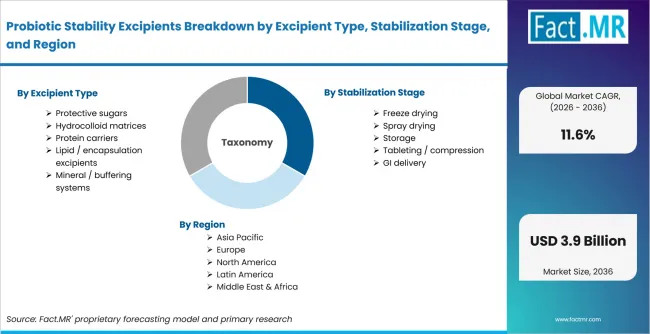
Probiotic Stability Excipients Breakdown By Excipient Type, Stabilization Stage, And Region | Source: Fact.MR
| Attribute | Details |
|---|---|
| Quantitative Units | USD billion |
| Market Definition | Excipients and delivery-support materials used to protect probiotic microorganisms during drying, compression, storage, encapsulation and gastrointestinal delivery. |
| Excipient Type | Protective sugars; Hydrocolloid matrices; Protein carriers; Lipid encapsulation excipients; Mineral buffering systems |
| Stabilization Stage | Freeze drying; Spray drying; Storage; Tableting / compression; GI delivery |
| Dosage Form | Capsules; Sachets; Tablets; Gummies; Food / beverage fortification |
| Performance | Shelf-life CFU retention; Moisture protection; Thermal protection; Acid protection; Oxygen protection |
| Regions Covered | North America; Latin America; Western Europe; Eastern Europe; East Asia; South Asia & Pacific; Middle East & Africa |
| Countries Covered | USA; China; Germany; France; Japan |
| Companies Profiled | Roquette; JRS Pharma; BENEO |
| Forecast Period | 2026 to 2036 |
| Approach | Hybrid top-down and bottom-up approach using probiotic supplement demand, dosage-form mix, stabilization stages, excipient function, country regulation and provider portfolio review. |
Source: Fact.MR analysis. Updated Sep 17, 2026
How is the market segmented?
-
By Excipient Type
- Protective sugars
- Hydrocolloid matrices
- Protein carriers
- Lipid / encapsulation excipients
- Mineral / buffering systems
-
By Stabilization Stage
- Freeze drying
- Spray drying
- Storage
- Tableting / compression
- GI delivery
-
By Dosage Form
- Capsules
- Sachets
- Tablets
- Gummies
- Food / beverage fortification
-
By Performance
- Shelf-life CFU retention
- Moisture protection
- Thermal protection
- Acid protection
- Oxygen protection
-
By Region
- North America
- Latin America
- Western Europe
- Eastern Europe
- East Asia
- South Asia & Pacific
- Middle East & Africa
Frequently Asked Questions
How big is the probiotic stability excipients market in 2026?
What is the CAGR of the probiotic stability excipients market from 2026 to 2036?
Which excipient type leads the probiotic stability excipients market?
Which stabilization stage leads the probiotic stability excipients market?
Who are the active providers in the probiotic stability excipients market?
Who worked on this report


Preview the report firsthand - request a free sample
Free SampleGet the brochure for pricing and purchase details
Download PDF