- Market Value (2025): USD 181.8 Mn
- Estimated Value (2026): USD 196.0 Mn
- Forecast Value (2036): USD 415.0 Mn
- CAGR (2026-2036): 7.8%
What is the Railcar Cryogenic Loading Arms Market forecast to be worth by 2036?
USD 196.0 million in 2026 to USD 415.0 million by 2036 at 7.8% CAGR.
- The railcar cryogenic loading arms market crossed a valuation of USD 181.8 million in 2025 after industrial gas and LNG transfer points upgraded low-temperature handling hardware.
- Demand is projected to increase from USD 196.0 million in 2026 to USD 415.0 million by 2036.
- The market is forecast to record 7.8% CAGR from 2026 to 2036 owing to LNG distributors and industrial gas producers replacing hose-heavy handling at rail racks.
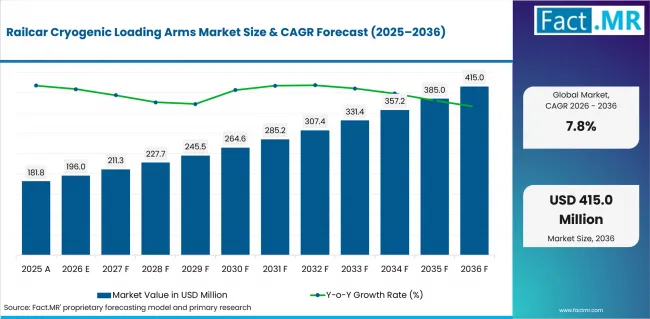
Railcar Cryogenic Loading Arms Market Value Analysis | Source: Fact.MR
What are the defining numbers behind Railcar Cryogenic Loading Arms Market growth?
USD 219.0 million absolute opportunity by 2036, led by LNG, manual coupling and industrial gas producers.
- Demand Drivers in the Market
- Industrial gas producers require low-temperature arm assemblies that keep seal integrity stable during liquid nitrogen and oxygen transfer.
- LNG distributors prioritize drained and insulated connections that place operators farther from cold liquid splash points.
- Chemical plants use fixed rail rack equipment to make ethylene and ethane transfer more controlled than hose-based handling.
- Rail terminal operators are expected to upgrade coupling systems where repeated loading cycles raise manual connection risk.
- Key Segments Analyzed
- By Fluid Handled: LNG is expected to hold 26.0% share in 2026 due to rail transfer demand for low-temperature fuel distribution.
- By Connection Type: Manual coupling is projected to account for 37.0% share in 2026 since many installed racks retain operator-controlled connection steps.
- By End User: Industrial gas producers are anticipated to capture 34.0% share in 2026 shaped by liquid nitrogen and oxygen shipments moving through filling networks.
- Analyst Opinion at Fact.MR
- Shambhu Nath Jha, Sr. Consultant at Fact.MR, states, “The commercial test for railcar cryogenic loading arms is not peak flow alone. Operators want proof that swivel joints, couplings and drain lines stay reliable during repeated low-temperature service. Demand is expected to move toward packages that combine safe access, predictable maintenance and clear retrofit fit at existing racks.”
- Strategic Implications
- Rail terminal operators benefit from rack surveys before connection upgrades. The transfer-safety reasoning appears in marine loading arms where reach, rotation and emergency release design shape fluid-transfer decisions.
- Industrial gas producers gain cleaner training records when nitrogen and oxygen racks use the same coupling steps.
- LNG distributors need documented cooldown and drain procedures before approving arms for satellite depots.
- Equipment providers need to separate standard loading-arm bids from cryogenic packages that require stainless steel and low-temperature sealing.
The USA is expected to lead the Railcar Cryogenic Loading Arms Market with a 9.4% CAGR from 2026 to 2036, supported by LNG distribution work and industrial gas transfer upgrades. Canada is projected to record 8.6% CAGR while rail-linked energy and gas corridors keep demand active. Japan is anticipated to grow at 8.2% through imported LNG handling and precise terminal engineering. The UK is estimated to post 7.8% CAGR through chemical terminals and industrial gas logistics. Germany is forecast at 7.5%, supported by chemical production sites and local loading-equipment expertise.
How does the Railcar Cryogenic Loading Arms Market break down by segment?
LNG is expected to lead Fluid Handled at 26.0% share in 2026. Manual coupling is projected to lead Connection Type at 37.0% share in 2026.
Which fluid handled dominates?
LNG is projected to account for 26.0% share in 2026.
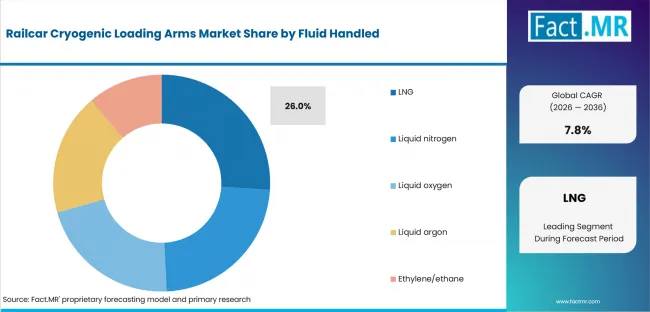
Railcar Cryogenic Loading Arms Market Analysis By Fluid Handled | Source: Fact.MR
LNG ranks first as rail loading depends on controlled cooldown, guided drainage and stable low-temperature transfer at distribution points. Secure connection control also affects purchasing decisions at terminals operating fixed loading racks. Liquid nitrogen supports industrial gas refilling across regional storage and merchant gas networks. Liquid oxygen serves medical and industrial backup applications where transfer safety records influence equipment selection. Liquid argon, ethylene and ethane represent smaller applications in which cryogenic compatibility matters more than loading volume.
What leads the Connection Type segment?
Manual coupling is expected to account for 37.0% share in 2026.
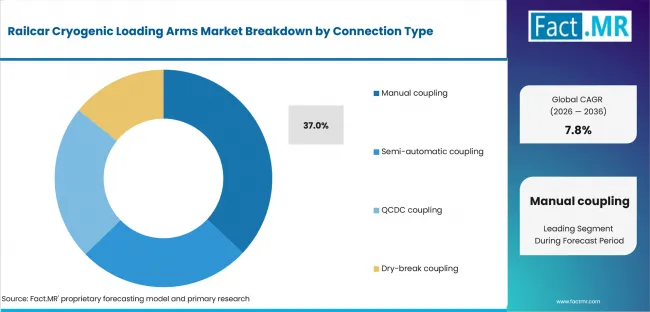
Railcar Cryogenic Loading Arms Market Analysis By Connection Type | Source: Fact.MR
Manual coupling remains widely used across existing rail racks with operator-controlled connection procedures and established work practices. Semi-automatic coupling is gaining attention at terminals seeking to reduce handling strain without replacing the complete rack system. QCDC coupling suits operations requiring faster connection and disconnection across multiple railcars per shift. Dry-break coupling is preferred where product loss and cold-vapor exposure create direct operational concerns.
How does End User shape demand?
Industrial gas producers are forecast to account for 34.0% share in 2026.
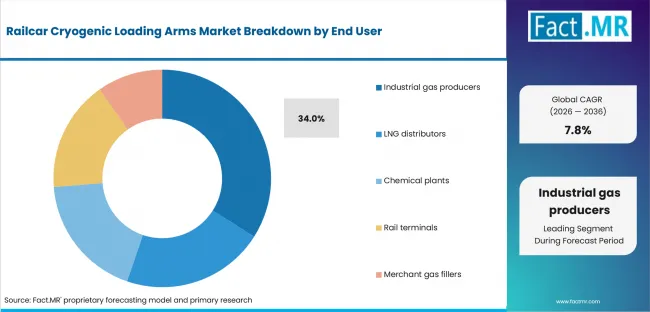
Railcar Cryogenic Loading Arms Market Analysis By End User | Source: Fact.MR
Industrial gas producers generate the largest demand through liquid nitrogen and liquid oxygen filling networks that depend on repeatable rack operation. LNG distributors provide another demand route as satellite supply chains expand smaller storage sites and local fuel delivery. Chemical plants use cryogenic loading arms for ethylene and ethane transfer, where material compatibility requires detailed review. Rail terminals and merchant gas fillers contribute through retrofit projects, maintenance programs and equipment replacement.
What is accelerating Railcar Cryogenic Loading Arms Market adoption, and what is holding it back?
LNG rail transfer drives it; site-specific rack geometry restrains it.
Drivers Impact Analysis
| DRIVER | (~) % IMPACT ON CAGR | GEOGRAPHIC RELEVANCE | IMPACT TIMELINE |
|---|---|---|---|
| LNG satellite distribution | +2.0% | USA, Japan, UK | Short term (<= 2 years) |
| Industrial gas refill networks | +1.7% | USA, Canada, Germany | Short term (<= 2 years) |
| Safer rail rack handling | +1.4% | North America and Europe | Medium term (2-4 years) |
| Cryogenic retrofit cycles | +1.1% | Established terminal clusters | Medium term (2-4 years) |
| Operator training repeatability | +0.9% | Global rail loading sites | Long term (>= 4 years) |
Source: Fact.MR analysis. Updated Jul 24, 2026
- LNG satellite distribution: Rail-linked LNG distribution is expected to increase the value of loading arms that handle cooldown and drainage in a controlled manner. Smaller depots still need hardware that keeps operators away from direct cold liquid exposure. Adoption is forecast to favor packages that combine arm reach with clear emergency release steps.
- Industrial gas refill networks: Regional filling sites move liquid nitrogen and oxygen through repeated transfer cycles. Standardized arm assemblies reduce variation between operators and shifts. Equipment providers are expected to show seal performance and maintenance intervals before order approval.
- Safer rail rack handling: Cryogenic liquid transfer creates splash and cold-burn risks when hoses are lifted or drained by hand. Fixed loading arms place more of the work into a guided movement path. Terminals are anticipated to connect safety reviews with retrofit budgets.
- Cryogenic retrofit cycles: Older racks often need new swivel joints and lower-temperature connection hardware. Retrofit projects allow operators to improve safety without changing the whole site. Demand is projected to grow where a new arm fits the existing rack envelope.
- Operator training repeatability: The same connection routine across several bays lowers the risk of missed drain or lock steps. Manual coupling remains common, so training clarity still shapes purchasing. Equipment choices are expected to reflect how easy the arm is to inspect and return to service.
Opportunity Impact Analysis
| OPPORTUNITY | (~) % IMPACT ON CAGR | GEOGRAPHIC RELEVANCE | IMPACT TIMELINE |
|---|---|---|---|
| Semi-automatic coupling upgrades | +1.2% | USA and Germany | Medium term (2-4 years) |
| QCDC retrofit packages | +1.0% | Canada and Japan | Medium term (2-4 years) |
| Prefabricated rack modules | +0.8% | New terminal projects | Long term (>= 4 years) |
| Aftermarket swivel programs | +0.7% | Installed rail racks | Long term (>= 4 years) |
Source: Fact.MR analysis. Updated Jul 24, 2026
- Semi-automatic coupling upgrades: Terminals that load higher-value cryogenic products are expected to look beyond fully manual connection work. Semi-automatic systems reduce hand movement near cold fittings while keeping the rack layout familiar. The route is more visible where retrofit budgets are easier to approve than full bay replacement.
- QCDC retrofit packages: Quick-connect and disconnect coupling packages help operators cut connection time while improving lock confirmation. Rail terminals with repeated loading windows are expected to examine these systems where downtime affects car turnaround. The primary opportunity is concentrated in packages that fit existing nozzle positions.
- Prefabricated rack modules: New cryogenic transfer points create room for prefabricated arm and access packages. These modules reduce field fit-up work and make documentation easier during commissioning. Project teams are forecast to value this option where a terminal has limited shutdown time.
- Aftermarket swivel programs: Installed loading arms require swivel-joint checks and counterbalance adjustment over time. Service contracts give manufacturers recurring revenue after the first equipment sale. Operators are expected to favor providers that keep replacement parts available for older arm designs.
Restraints Impact Analysis
| RESTRAINT | (~) % IMPACT ON CAGR | GEOGRAPHIC RELEVANCE | IMPACT TIMELINE |
|---|---|---|---|
| High engineered order cost | -1.0% | Global | Short term (<= 2 years) |
| Site-specific rack geometry | -0.8% | Older rail terminals | Short term (<= 2 years) |
| Cryogenic seal qualification | -0.7% | LNG and industrial gas racks | Medium term (2-4 years) |
| Maintenance training burden | -0.5% | Smaller filling sites | Long term (>= 4 years) |
Source: Fact.MR analysis. Updated Jul 24, 2026
- High engineered order cost: Cryogenic loading arms are not simple catalog items when low-temperature seals and coupling choices are included. Engineering hours raise the purchase price before installation begins. Smaller facilities are expected to defer orders when hose-based systems still pass internal safety reviews.
- Site-specific rack geometry: Railcar nozzle height and platform access differ from one location to another. A poor fit reduces arm reach and makes the connection procedure harder. This slows purchase decisions when the site survey finds structural work beyond the arm package.
- Cryogenic seal qualification: Seal behavior at low temperature becomes a direct approval point for LNG and liquid gas transfer. Operators want proof that fittings stay tight after repeated cooldown cycles. Qualification time is projected to hold back adoption when railcar interfaces vary across the site.
- Maintenance training burden: A loading arm improves control only when operators know how to inspect and drain it correctly. Smaller filling sites have less room for dedicated rack specialists. Training effort therefore slows deployment where staff turnover is high or maintenance support is distant.
Which countries are scaling Railcar Cryogenic Loading Arms Market fastest?
Country growth ranges from 7.5% in Germany to 9.4% in the USA. The difference reflects the timing of rail-rack upgrades and the mix of LNG and industrial-gas transfer work. Country-level demand should be assessed against each terminal's operating conditions and retrofit schedule.
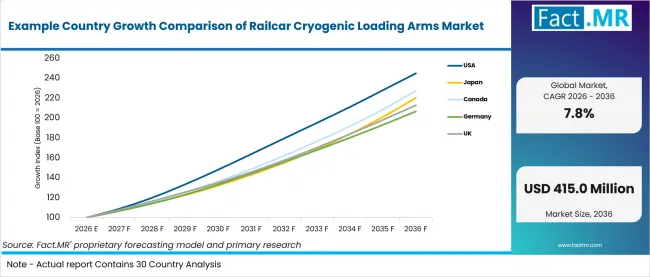
Example Country Growth Comparison Of Railcar Cryogenic Loading Arms Market | Source: Fact.MR
| Country | CAGR (2026-2036) |
|---|---|
| USA | 9.4% |
| Canada | 8.6% |
| Japan | 8.2% |
| UK | 7.8% |
| Germany | 7.5% |
Source: Fact.MR analysis. Updated Jul 24, 2026
What supports USA adoption?
9.4% CAGR, supported by LNG distribution and industrial gas rack upgrades.
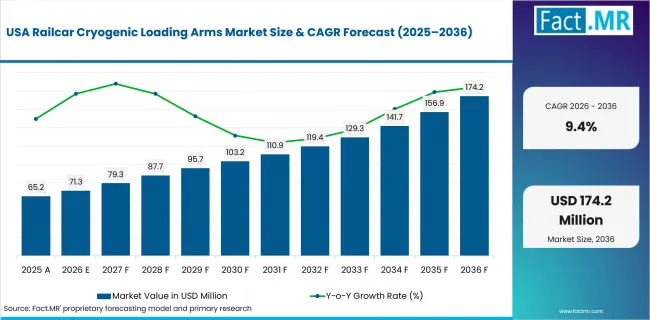
Railcar Cryogenic Loading Arms Market Country Value Analysis | Source: Fact.MR
The USA’s growth reflects a market where LNG distributors and industrial gas producers operate rail-linked transfer points. Demand is expected to advance at 9.4% CAGR from 2026 to 2036 while operators upgrade racks that handle repeated low-temperature loading. OPW and Emco Wheaton give the country a visible equipment base for loading arms, couplers and maintenance support.
How is Canada scaling demand?
8.6% CAGR, driven by rail-linked gas corridors and cold-service terminal needs.
Canada’s outlook is supported by long rail corridors and energy logistics that require dependable transfer hardware in harsh operating conditions. The country is projected to record 8.6% CAGR while terminals review arm reach and safe disconnection for cryogenic service. Operators are expected to favor rugged packages that reduce manual strain during winter loading work.
What is driving Japan’s growth from 2026 to 2036?
8.2% CAGR, backed by LNG handling and compact terminal engineering.
Japan’s demand reflects imported LNG handling and industrial gas distribution across compact terminal sites. The market is anticipated to grow at 8.2% CAGR where precise movement and clear connection steps are valued during rack upgrades. Local engineering teams are expected to place weight on tested swivel behavior and clean documentation before approving new arms.
How is the UK developing demand?
7.8% CAGR, led by chemical terminals and industrial gas transfer work.
The UK’s growth is shaped by chemical clusters and industrial gas networks that depend on safe transfer across rail and road interfaces. Demand is estimated to post 7.8% CAGR when existing racks move through inspection-led replacement cycles. Emco Wheaton’s UK presence supports local service conversations for loading systems and accessories.
What underpins Germany’s growth?
7.5% CAGR, supported by chemical production and loading-equipment expertise.
Germany’s growth reflects a mature chemical and industrial gas base where reliability carries more weight than first-time installation volume. The country is forecast at 7.5% CAGR when operators replace older rack hardware with cryogenic-ready fittings and better access layouts. SVT GmbH and Emco Wheaton GmbH support the local equipment field through land loading-arm and fluid-transfer expertise.
Who leads the Railcar Cryogenic Loading Arms Market?
OPW, Emco Wheaton and Kanon Loading Equipment appear among the most directly relevant suppliers, while SVT GmbH broaden the competitive field through specialized loading-arm and fluid-transfer portfolios.
OPW participates through engineered loading arms, couplers and rail-rack equipment designed for bulk liquid transfer. Emco Wheaton supplies land-based loading and unloading systems for railcars and supports installations through related accessories and service capabilities. Kanon Loading Equipment adds cryogenic-compatible loading-arm designs for rail and road tanker applications. SVT GmbH contributes railway loading systems developed for liquid and gas handling. These companies are identified in the report as the principal providers serving the market.
From 2026 to 2036, supplier selection is expected to focus on seal performance during repeated cooldown cycles, dependable swivel movement and accurate fit with existing rail-rack layouts. Buyers are also likely to examine drainage design, emergency disconnection procedures, inspection access and the availability of replacement components. Companies that combine cryogenic engineering with retrofit flexibility, operator-friendly handling and responsive maintenance support may secure stronger positions among LNG distributors, industrial gas producers, chemical plants and rail-terminal operators.
Which companies are the key providers?
Key companies include OPW Engineered Systems, a Dover company, Emco Wheaton, an Ingersoll Rand brand, Kanon Loading Equipment, SVT GmbH.
- OPW Engineered Systems, a Dover company
- Emco Wheaton, an Ingersoll Rand brand
- Kanon Loading Equipment
- SVT GmbH
Bibliography
- U.S. Energy Information Administration. (2026, February 24). Ten years after first Sabine Pass cargo, U.S. LNG exports are still on the rise.
- OPW Engineered Systems. (2025, January 16). OPW Engineered Systems introduces Loading Arm Central microsite.
- Ministry of Land, Infrastructure, Transport and Tourism. (2026, March 25). Monthly railway transport statistics: December 2025.
- Statistics Canada. (2026, April 8). Natural gas in 2025: Record production, rising consumption and expanding exports.
- U.S. Department of Energy. (2026, February 24). Natural gas imports and exports monthly 2025.
This Report Answers
- The report provides strategic intelligence on the Railcar Cryogenic Loading Arms Market across Fluid Handled and Connection Type choices that shape cold-service rail transfer programs.
- Segment analysis covers LNG and manual coupling, the share leaders within the 2026 market.
- Country outlook evaluates the USA and Canada alongside Japan. The UK and Germany complete the growth comparison across the profiled markets.
- Competitive analysis profiles OPW and Emco Wheaton alongside Kanon Loading Equipment and SVT GmbH.
- End-user assessment covers industrial gas producers and LNG distributors. Chemical plants, rail terminals and merchant gas fillers complete the end-user view.
What does the Railcar Cryogenic Loading Arms Market cover?
Cryogenic loading arm systems are used at rail racks where cold-service transfer safety and connection control determine equipment acceptance.
The Railcar Cryogenic Loading Arms Market covers equipment used to load and unload LNG, liquid nitrogen, liquid oxygen, liquid argon and ethylene or ethane between rail tank cars and fixed terminals. Coverage includes arm assemblies, swivel joints, couplings and counterbalance systems. It extends to insulation packages and drain-related accessories when those parts are sold with the arm system.
The market differs from general loading arms because commercial value comes from low-temperature sealing and safe disconnection at rail racks. General petroleum loading arms are excluded unless the application is designed for cryogenic liquid transfer. Marine arms are outside the boundary except where design reasoning directly informs railcar cryogenic transfer systems.
What is included in the scope?
Railcar cryogenic transfer arms are used across industrial gas producers, LNG distributors, chemical plants, rail terminals and merchant gas fillers.
The scope includes Fluid Handled, Connection Type and End User. Coverage spans LNG and commonly handled industrial gases in liquid form. Ethylene and ethane are included where rail transfer requires low-temperature equipment. Connection coverage includes manual, semi-automatic, QCDC and dry-break formats. End-user coverage includes producers, distributors and terminal operators that own or operate railcar transfer points.
What is excluded from the scope?
General loading arms, hoses and marine transfer systems remain outside the scope unless they are built for railcar cryogenic service.
The scope excludes non-cryogenic loading arms used for petroleum, water, food-grade liquids or ambient-temperature chemicals. Standalone hoses are excluded when no rigid arm assembly is used. Cryogenic storage tanks, pumps and vaporizers are excluded unless they are sold as part of the loading-arm package. Company revenue without a clear connection to railcar cryogenic transfer is excluded.
How Was the Analysis Built?
The analysis draws on 120+ sources, 35+ company portfolios, 25+ countries, and more than 20 industry interviews.
- Primary Research: Primary research includes discussions with manufacturers, service providers, technology developers, distributors, end users, procurement teams, and subject-matter experts. These conversations examine purchasing priorities, product adoption, operational challenges, approval requirements, competitive positioning, and the factors that influence wider market acceptance.
- Desk Research: Desk research covers government statistics, regulatory publications, company filings, trade data, technical studies, industry associations, standards, public policy, and other authoritative sources. Every source used in the analysis is documented in the bibliography.
- Market Sizing and Forecasting: Market estimates combine historical performance, demand indicators, pricing and volume trends, segment shares, company participation, country-level growth, adoption patterns, investment activity, and barriers to market expansion.
- Data Validation and Update Cycle: Findings are validated by comparing primary interviews with public data, company activity, regulatory changes, trade patterns, and industry developments. Regular updates review new product launches, capacity changes, partnerships, approvals, procurement trends, and shifts in commercial adoption.
Segmentation
What is the report’s scope and coverage?
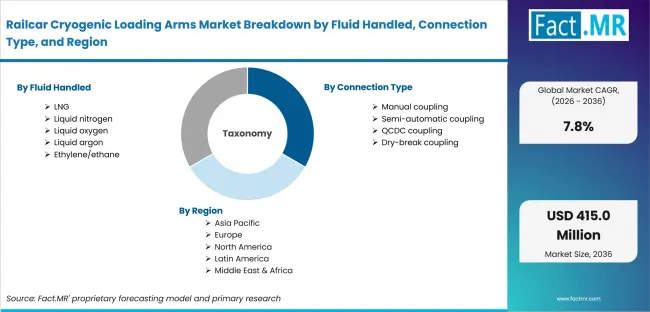
Railcar Cryogenic Loading Arms Market Breakdown By Fluid Handled, Connection Type, And Region | Source: Fact.MR
| Attribute | Details |
|---|---|
| Quantitative Units | USD million in 2026 to USD million by 2036 at a CAGR |
| Market Definition | Railcar cryogenic loading arm systems used to transfer LNG, liquid nitrogen, liquid oxygen, liquid argon and ethylene or ethane between rail tank cars and fixed racks where cold-service sealing, reach, drain logic and operator safety shape equipment acceptance |
| Fluid Handled | LNG; Liquid nitrogen; Liquid oxygen; Liquid argon; Ethylene/ethane |
| Connection Type | Manual coupling; Semi-automatic coupling; QCDC coupling; Dry-break coupling |
| End User | Industrial gas producers; LNG distributors; Chemical plants; Rail terminals; Merchant gas fillers |
| Regions Covered | North America; Latin America; Europe; East Asia; South Asia and Pacific; Middle East and Africa |
| Countries Covered | USA; Canada; Japan; UK; Germany |
| Key Companies Profiled | OPW Engineered Systems, a Dover company; Emco Wheaton, an Ingersoll Rand brand; Kanon Loading Equipment; SVT GmbH |
| Forecast Period | 2026 to 2036 |
| Approach | Hybrid top-down and bottom-up approach using cryogenic equipment demand; railcar loading rack replacement; LNG distribution activity; industrial gas filling networks; connection-type preferences; installed arm base; site-specific retrofit requirements; country adoption patterns and company portfolio review |
Source: Fact.MR analysis. Updated Jul 24, 2026
How is the market segmented?
-
By Fluid Handled:
- LNG
- Liquid nitrogen
- Liquid oxygen
- Liquid argon
- Ethylene/ethane
-
By Connection Type:
- Manual coupling
- Semi-automatic coupling
- QCDC coupling
- Dry-break coupling
-
By End User:
- Industrial gas producers
- LNG distributors
- Chemical plants
- Rail terminals
- Merchant gas fillers
-
By Region:
- North America
- Europe
- East Asia
- Latin America
- South Asia & Pacific
- Middle East & Africa
Frequently Asked Questions
Which Fluid Handled category leads the market?
Which Connection Type leads the market?
Which End User leads the market?
Which country records the upper listed CAGR?
What is the primary driver in this market?
What is the main restraint?
Why does manual coupling lead demand?
Who worked on this report


Preview the report firsthand - request a free sample
Free SampleGet the brochure for pricing and purchase details
Download PDF