- Market Value (2025): USD 3.4 Bn
- Estimated Value (2026): USD 3.7 Bn
- Forecast Value (2036): USD 7.4 Bn
- CAGR (2026-2036): 7.3%
What is the Rapid-Start Liquid Thrusters Market forecast to be worth by 2036?
USD 3.7 billion in 2026 to USD 7.4 billion by 2036, at 7.3% CAGR.
- The Rapid-Start Liquid Thrusters Market reached USD 3.4 billion in 2025.
- Demand is projected to increase from USD 3.7 billion in 2026 to USD 7.4 billion by 2036.
- The market is forecast to record a 7.3% CAGR from 2026 to 2036 as spacecraft builders place greater value on fast pulse response and controlled orbital maneuvering.
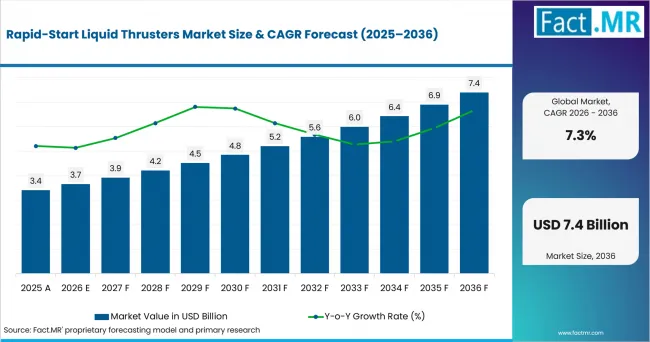
Rapid Start Liquid Thrusters Market Value Analysis | Source: Fact.MR
What are the defining numbers behind Rapid-Start Liquid Thrusters Market growth?
USD 3.7 billion absolute opportunity between 2026 and 2036, led by green monopropellant, sub-25 ms response, and sub-1 N thrust.
- Demand Drivers in the Market
- Satellite platform teams need steady short impulses for attitude correction and station keeping. A clean pulse is expected to keep payload pointing stable during repeated turns. Fast response also gives the flight computer a clear link between each command and each burn. This favors thrusters that can repeat small pulses while keeping thrust output stable through the mission.
- Space safety teams need fast maneuver authority as orbital traffic becomes harder to manage. ESA reported in August 2025 that more than 1.2 million debris objects larger than 1 cm were estimated in orbit. A liquid thruster can give prompt force when a flight team approves a collision-avoidance move. The need is greatest when the time left for a safe orbit change is short and the spacecraft must respond on command.
- Propulsion teams need easier fuel handling when a qualified green formula fits the mission. Lower-toxicity chemical systems are expected to widen design choice for craft that still need fast impulse. Teams still need proof that seals and valves work well with the selected fuel through the full flight life.
- Defence space programs need low command delay for time-sensitive moves. Liquid chemical systems are forecast to keep a role where quick force carries more value than fuel efficiency alone. Mission teams are expected to judge response time together with pulse size and restart behavior for each planned move.
- Small-spacecraft teams need compact maneuver hardware that fits strict mass and volume limits. Integrated tanks and feed parts are expected to ease package design for short chemical pulses. The layout must still leave room for payload and flight electronics while keeping the fluid path easy to test.
- Key Segments Analyzed
- By Liquid Propellant: Green monopropellant is expected to hold 31.0% share in 2026 owing to lower handling burden and compact storage where spacecraft programs accept qualified alternative formulations.
- By Ignition Response: <25 ms is projected to account for 38.0% share in 2026 since rapid valve and ignition response supports short corrective pulses and time-sensitive maneuver commands.
- By Thrust Class: <1 N is anticipated to capture 34.0% share in 2026 because fine pointing and compact spacecraft control favor a small impulse from each command.
- By Duty: Attitude control is estimated to represent 30.0% share in 2026 reflecting repeated orientation corrections throughout the spacecraft operating life.
- Analyst Opinion at Fact.MR
- Shambhu Nath Jha, Principal Consultant at Fact.MR, states, “Rapid-start liquid thrusters are differentiated by repeatable pulse behavior as much as maximum thrust. Spacecraft programs are expected to place greater weight on response time and minimum impulse control. Suppliers that pair stable ignition behavior with flight-ready integration support are better aligned with responsive maneuvering missions.”
- Strategic Implications
- Thruster makers should publish response-time and minimum-on-time data under useful pressure and heat ranges. Clear test results help spacecraft teams compare how each unit starts and repeats a short burn. That proof is expected to carry more weight for missions that depend on fine pointing or a quick orbit change.
- System teams should test valves and feed hardware with the thruster as one working set because fluid flow can change a commanded pulse. Early tests help find pressure loss and valve lag before spacecraft design is fixed. They also give flight teams a clearer view of expected impulse from each command.
- Satellite prime contractors should match thrust class to pointing and orbit needs before the platform design is fixed. Early choice is forecast to cut rework around tanks and mounts. It also lets guidance teams tune commands around a known pulse range before the craft enters final test.
The USA is forecast to record 8.4% CAGR through 2036, supported by a broad spacecraft base and a large pool of mission teams. Germany is projected at 8.1% owing to steady European space spend. France is anticipated at 7.8% as state missions sustain flight work. The UK is estimated at 7.5% reflecting public support for space programs. Japan is forecast at 6.2% since domestic missions keep demand for tested thruster hardware.
How does the Rapid-Start Liquid Thrusters Market break down by segment?
Ignition response below 25 ms leads at 38.0%; thrust below 1 N leads at 34.0%.
Which Liquid Propellant segment leads?
Green monopropellant is expected to hold 31.0% share in 2026.
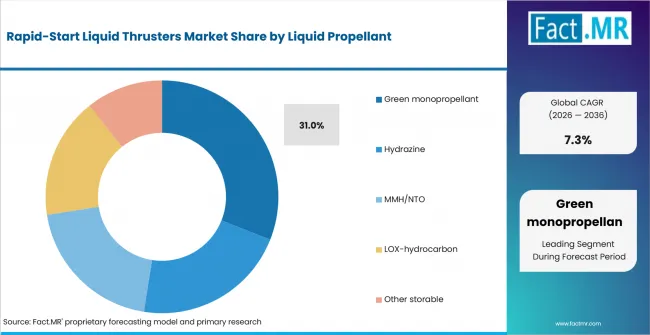
Rapid Start Liquid Thrusters Market Analysis By Liquid Propellant | Source: Fact.MR
Green monopropellant is expected to lead where spacecraft teams want quick chemical thrust with easier ground handling. Hydrazine remains common in designs that rely on long flight history. MMH/NTO and LOX-hydrocarbon systems are expected to serve missions that need more stored energy or a larger impulse. Each fuel path changes tank choice and test work before flight.
The segment overlaps with green propellant systems used in compact spacecraft. Test depth and material fit are expected to remain central when teams move from hydrazine to another liquid chemistry. A new fuel must work with the valve and tank set across the planned heat range while still giving a steady pulse after storage.
What leads the Ignition Response segment?
<25 ms is projected to account for 38.0% share in 2026.
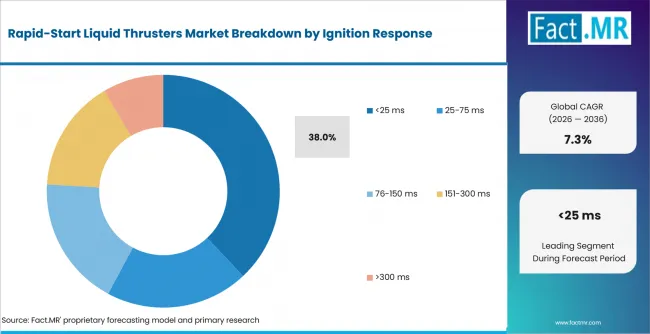
Rapid Start Liquid Thrusters Market Analysis By Ignition Response | Source: Fact.MR
Sub-25 ms response is projected to lead because a short command delay gives guidance systems tighter impulse timing. Longer response bands remain useful for moves that allow wider timing margins and longer burns. Teams are expected to pair response time with minimum burn length so each command gives a known change in motion.
L3Harris described its ISE family in April 2025 as lightweight, pressure-fed bipropellant engines for in-space transport. The company said the engines support fast-acting maneuvers such as landing and proximity operations. This development supports rapid chemical thrust when spacecraft need a quick response.
How does Thrust Class shape demand?
<1 N is anticipated to capture 34.0% share in 2026.
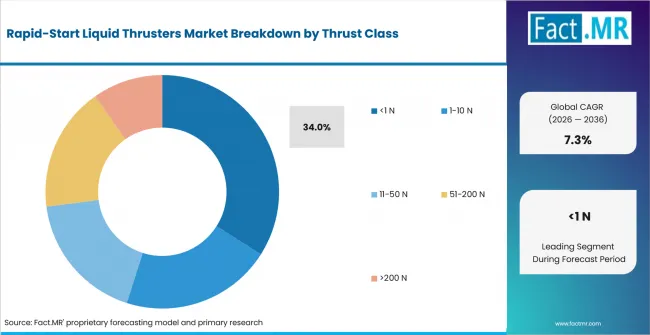
Rapid Start Liquid Thrusters Market Analysis By Thrust Class | Source: Fact.MR
Thrust below 1 N is anticipated to lead because small impulse levels suit fine pointing and compact spacecraft control. Higher classes are expected to support heavier platforms where a larger velocity change calls for more force. The best class still depends on craft mass and the size of each planned orbit change.
Mission teams are expected to match thrust class with spacecraft mass and the disturbance allowed during each burn. Compact platforms tend to favor smaller impulses while larger craft need more force for a quick orbit change. The chosen level must meet the main move without making fine control harder than necessary.
What supports Attitude Control within Duty?
Attitude control is estimated to represent 30.0% share in 2026.
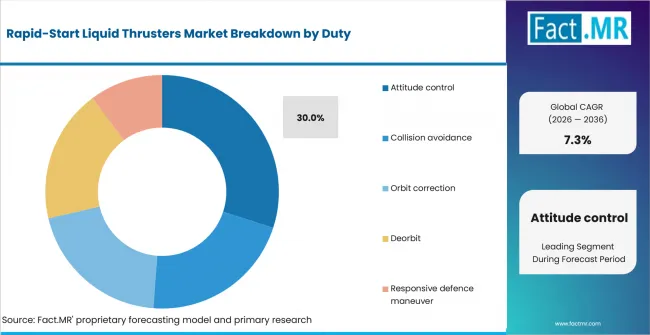
Rapid Start Liquid Thrusters Market Analysis By Duty | Source: Fact.MR
Attitude control is estimated to lead because spacecraft make repeated orientation changes for pointing and power management. Collision avoidance is expected to create less frequent but more time-sensitive use. Orbit correction and deorbit need more total impulse over the flight life. The duty mix therefore depends on turn rate and the size of each planned move.
The duty mix is expected to vary by orbit and spacecraft class. Low Earth orbit platforms show why lower altitude can raise the need for orbit correction and repeat burns. A rapid-start liquid thruster can support both pointing work and planned path changes when one craft needs more than one duty.
What is accelerating Rapid-Start Liquid Thrusters Market adoption, and what is holding it back?
Responsive maneuvering drives demand; qualification burden and hazardous-propellant handling restrain adoption.
Drivers Impact Analysis
| DRIVER | (~) % IMPACT ON CAGR | GEOGRAPHIC RELEVANCE | IMPACT TIMELINE |
|---|---|---|---|
| Collision-avoidance and conjunction-response needs | +1.4% | North America, Europe, East Asia | Short term (<= 2 years) |
| Small-satellite attitude and orbit control | +1.1% | Global | Medium term (2-4 years) |
| Green monopropellant qualification | +0.8% | North America, Europe | Medium term (2-4 years) |
| Responsive defence-space maneuvering | +0.6% | USA, Europe | Long term (>= 4 years) |
Opportunity Impact Analysis
| OPPORTUNITY | (~) % IMPACT ON CAGR | GEOGRAPHIC RELEVANCE | IMPACT TIMELINE |
|---|---|---|---|
| Sub-25 ms valve and ignition packages | +0.9% | Global | Short term (<= 2 years) |
| Green monopropellant conversion | +0.7% | North America, Europe | Medium term (2-4 years) |
| Integrated propulsion modules | +0.5% | USA, Europe, Japan | Medium term (2-4 years) |
Restraints Impact Analysis
| RESTRAINT | (~) % IMPACT ON CAGR | GEOGRAPHIC RELEVANCE | IMPACT TIMELINE |
|---|---|---|---|
| Hazardous-propellant handling and ground safety | -0.6% | Global | Short term (<= 2 years) |
| Pulse-life and minimum-impulse qualification | -0.5% | Global | Medium term (2-4 years) |
| Platform integration and thermal constraints | -0.4% | Global | Medium term (2-4 years) |
Which countries are scaling the Rapid-Start Liquid Thrusters Market through 2036?
- The country comparison spans 2.2 percentage points across the forecast period.
- The USA remains 0.3 percentage point above Germany as spacecraft programs support responsive maneuvering demand.
- Germany remains 0.3 percentage point above France owing to sustained European space investment and propulsion engineering activity.
- France remains 0.3 percentage point above the UK reflecting sovereign missions and an established spacecraft engineering base.
- The UK remains 1.3 percentage points above Japan as public investment supports satellite development and in-orbit capability.
Comparable CAGRs can still create different entry conditions because mission mix and test depth vary by country. The USA has the widest stated lead in this set while Germany and France remain close behind. The UK follows and Japan closes the group. Full report coverage includes North America, Latin America, Western Europe, Eastern Europe, East Asia, South Asia & Pacific, Middle East & Africa.
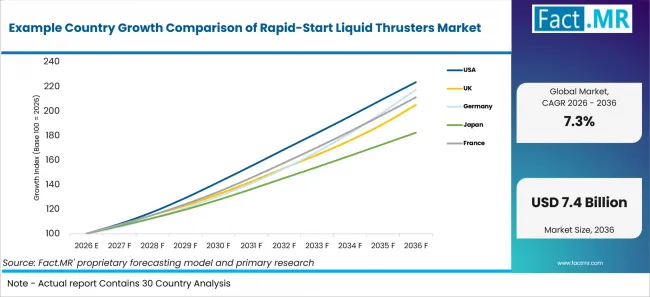
Example Country Growth Comparison Of Rapid Start Liquid Thrusters Market | Source: Fact.MR
| Country | CAGR (2026-2036) |
|---|---|
| United States | 8.4% |
| United Kingdom | 7.5% |
| Germany | 8.1% |
| Japan | 6.2% |
| France | 7.8% |
What supports USA adoption?
8.4% CAGR, supported by spacecraft activity and responsive-maneuver requirements.
United States spacecraft integrators are expected to check response time and flight history before they approve a new liquid thruster. The Bureau of Economic Analysis reported in March 2025 that the U.S. space economy produced USD 240.9 billion in gross output during 2023. That broad base supports design and test work. Rapid-start systems are forecast to gain use where a time-sensitive orbit move calls for prompt chemical force.
What supports the United Kingdom’s growth?
7.5% CAGR, backed by space-sector investment and expanding orbital capability.
UK spacecraft teams are expected to benefit from a wider home space base as more firms take part in satellite and in-orbit work. In August 2025, the UK Space Agency reported that the UK space industry comprised 1,907 organizations. That base supports work on fluid control and full spacecraft design. Rapid-start liquid thrusters are forecast to fit missions where short response time has high mission value.
What is supporting Germany’s adoption?
8.1% CAGR, supported by European space investment and launcher participation.
German propulsion and spacecraft firms are expected to benefit from steady European space spending and a deep test base. DLR reported in November 2025 that Germany committed about EUR 5.4 billion to ESA programs. The funding supports new missions and the test work needed before hardware can fly. Liquid thrusters are forecast to keep a role where a craft needs quick force after deployment.
How does Japan perform?
6.2% CAGR, supported by H3 missions and domestic spacecraft development.
Japan’s spacecraft programs are expected to keep demand for tested maneuver hardware across navigation and observation missions. JAXA’s August 2026 Launch Records page lists five mission-launch entries dated in 2025. Continued flight work supports system design around real mission needs. Rapid-start liquid thrusters are forecast to fit craft that need stored fuel and prompt impulse for pointing or orbit trim.
How is France developing demand?
7.8% CAGR, reinforced by sovereign missions and Ariane-linked space activity.
French spacecraft programs are expected to sustain liquid-thruster work through state missions and European launch programs. CNES reported in March 2025 that Ariane 6 placed CSO-3 into a sun-synchronous orbit at about 800 km. The mission shows continued national work in satellite build and flight support. Rapid-start thrusters are forecast to serve craft that need a controlled chemical pulse for a quick orbit move.
Who leads the Rapid-Start Liquid Thrusters Market?
ArianeGroup and L3Harris are active in liquid chemical spacecraft propulsion across monopropellant and bipropellant technologies. Busek adds green monopropellant propulsion based on ASCENT, while SITAEL develops green monopropellant and bipropellant propulsion technologies using hydrogen peroxide. Nammo supplies chemical spacecraft thrusters spanning monopropellant and bipropellant designs. Moog provides spacecraft thrusters together with valves, regulators, and other propulsion flow-control hardware. Competitive differentiation is expected to depend on thrust and pulse performance, propellant architecture, system integration, mission-life requirements, and supporting fluid-control hardware.
In September 2025, Moog broke ground on a new propulsion clean room at its Niagara Falls site that is planned to increase clean-room capacity by more than 80%. The facility supports monopropellant, bipropellant, green, and multimode propulsion solutions for space and defense applications. Moog stated that the expansion will increase production capacity and support more efficient manufacturing of technologies including its MONARC monopropellant engine line and propulsion systems.
Competitive differentiation is also expected to involve ignition and pulse performance, minimum impulse capability, flight heritage, and compatibility with the wider propulsion system. Suppliers can support qualification by documenting performance across relevant operating conditions and by integrating thrusters with valves, regulators, tanks, and feed-system components. These capabilities can help spacecraft developers evaluate propulsion performance at both the component and system levels.
Which companies are the key providers?
Key companies include ArianeGroup; Busek; SITAEL; Moog; L3Harris; and Nammo.
- ArianeGroup
- Busek
- SITAEL
- Moog
- L3Harris
- Nammo
Bibliography
- European Space Agency. (2025, August 12). CREAM: Avoiding collisions in space through automation.
- Moog Inc. (2025, May 28). Air Force Research Laboratory awards Moog contract to develop new multimode propulsion system to enhance dynamic space operations.
- Aerojet Rocketdyne. (2025, April 8). Mission flexibility enabled with new L3Harris family of in-space engines. L3Harris Technologies.
- Georgi, P., & Surfield, C. (2025, March 31). New and revised statistics for the U.S. space economy, 2012–2023. U.S. Bureau of Economic Analysis.
- UK Space Agency. (2025, August 22). Factsheet: The UK Space Sector.
- German Aerospace Center (DLR). (2025, November 28). Germany invests 5.4 billion euros in the future of European space.
- Japan Aerospace Exploration Agency. (2026, August 11). Launch records.
- Centre National d’Études Spatiales. (2025, March 6). Ariane 6 successfully orbits CSO-3 military satellite on first commercial mission.
- Moog Inc. (2025, September 22). Moog breaks ground on new propulsion clean room to support satellite and missile growth.
This Report Answers
- The report explains where rapid-start liquid thrusters fit across fuel choice, ignition response, thrust class and spacecraft duty. Related green propellants give added context for lower-toxicity liquid fuel options used in chemical spacecraft systems.
- Segment analysis identifies the main subsegments and explains why spacecraft teams choose them. Related all-electric satellites provide a useful contrast with rapid chemical thrust when mission teams compare response and long-burn efficiency.
- Country analysis compares the United States, United Kingdom, Germany, Japan, and France using the forecast CAGRs and current official space-program evidence.
- Competitive analysis reviews active providers across monopropellant, bipropellant, and green-propellant spacecraft thrusters with emphasis on portfolio fit and current activity.
- Application analysis considers response time and minimum impulse together with fuel handling and system fit. Adjacent 3D printed satellite platforms add context for compact craft where mass, space and part count shape propulsion design.
What does the Rapid-Start Liquid Thrusters Market cover?
The Rapid-Start Liquid Thrusters Market covers liquid chemical thrusters used on spacecraft where short command-to-thrust response has direct mission value. Related in-space propulsion components provide hardware context for valves and feed systems used around the thruster.
The assessment covers the four stated segment dimensions across the listed regions. Demand is assessed around fast chemical impulse and spacecraft control needs.
What is included in the scope?
The scope includes thrusters and integrated liquid-propulsion hardware used for attitude control and orbit correction. ADN propulsion modules provide an adjacent view of modular green chemical systems. VLEO satellite platforms add context for craft that need repeat orbit correction at low altitude.
Coverage includes green and conventional storable liquids across the stated thrust and response bands. It covers the listed duties where short chemical impulse supports flight control.
What is excluded from the scope?
The scope places stand-alone electric propulsion systems and launch-vehicle main engines outside the transaction boundary. high-thrust electric propulsion covers a separate drive type. air-breathing electric propulsion provides another adjacent view for lower-orbit craft.
Launch-vehicle main propulsion and stand-alone electric thrusters remain outside this boundary. The assessment focuses on liquid chemical spacecraft thrusters where response time shapes in-orbit control.
How Was the Analysis Built?
The analysis draws on 120+ sources, 35+ company portfolios, 25+ countries, and more than 20 industry interviews.
- Primary Research: Primary research includes discussions with manufacturers, service providers, technology developers, distributors, end users, and subject-matter experts. These conversations examine purchasing priorities, product adoption, operational challenges, approval requirements, competitive positioning, and the factors that influence wider market acceptance.
- Desk Research: Desk research covers government statistics, regulatory publications, company filings, trade data, technical studies, industry associations, standards, public policy, and other authoritative sources. Every source used in the analysis is documented in the bibliography.
- Market Sizing and Forecasting: Market estimates combine historical performance, demand indicators, pricing and volume trends, segment shares, company participation, country-level growth, adoption patterns, investment activity, and barriers to market expansion.
- Data Validation and Update Cycle: Findings are validated by comparing primary interviews with public data, company activity, regulatory changes, trade patterns, and industry developments. Regular updates review new product launches, capacity changes, partnerships, approvals, and shifts in commercial adoption.
What is the report’s scope and coverage?
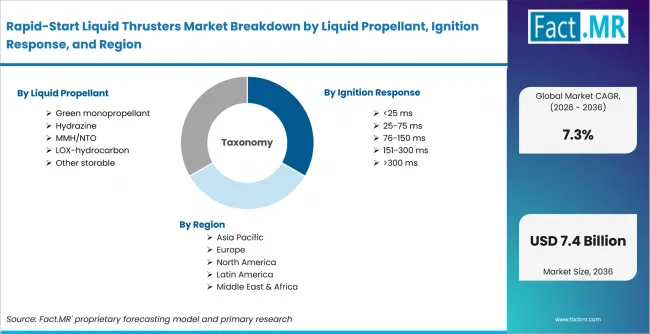
Rapid Start Liquid Thrusters Market Breakdown By Liquid Propellant, Ignition Response, And Region | Source: Fact.MR
| Attribute | Details |
|---|---|
| Quantitative Units | USD Billion |
| Market Definition | Liquid chemical spacecraft thrusters designed for short command-to-thrust response in attitude control, collision avoidance, orbit correction, deorbit, and responsive manoeuvring duties. |
| Liquid Propellant | Green monopropellant; Hydrazine; MMH/NTO; LOX-hydrocarbon; Other storable |
| Ignition Response | <25 ms; 25-75 ms; 76-150 ms; 151-300 ms; >300 ms |
| Thrust Class | <1 N; 1-10 N; 11-50 N; 51-200 N; >200 N |
| Duty | Attitude control; Collision avoidance; Orbit correction; Deorbit; Responsive defence maneuver |
| Regions Covered | North America; Latin America; Western Europe; Eastern Europe; East Asia; South Asia & Pacific; Middle East & Africa |
| Countries Covered | United States; United Kingdom; Germany; Japan; France |
| Key Companies Profiled | ArianeGroup; Busek; SITAEL; Moog; L3Harris; Nammo |
| Forecast Period | 2026 to 2036 |
| Approach | Hybrid top-down and bottom-up approach using spacecraft mission activity; propulsion architecture; propellant choice; response specification; thrust class; duty cycle; country programs; and provider portfolio review. |
How is the market segmented?
-
By Liquid Propellant:
- Green monopropellant
- Hydrazine
- MMH/NTO
- LOX-hydrocarbon
- Other storable
-
By Ignition Response:
- <25 ms
- 25-75 ms
- 76-150 ms
- 151-300 ms
- >300 ms
-
By Thrust Class:
- <1 N
- 1-10 N
- 11-50 N
- 51-200 N
- >200 N
-
By Duty:
- Attitude control
- Collision avoidance
- Orbit correction
- Deorbit
- Responsive defence maneuver
-
By Region:
- North America
- Latin America
- Western Europe
- Eastern Europe
- East Asia
- South Asia & Pacific
- Middle East & Africa