- Market Value (2025): USD 642.9 Mn
- Estimated Value (2026): USD 740.0 Mn
- Forecast Value (2036): USD 3019.8 Mn
- CAGR (2026-2036): 15.1%
What is the ADN Propulsion Modules Market forecast to be worth by 2036?
USD 740.0 million in 2026 to USD 3.0 billion by 2036, at a 15.1% CAGR.
- The market was valued at USD 642.9 million in 2025.
- Revenue is estimated at USD 740.0 million in 2026 and is forecast to reach USD 3019.8 million by 2036.
- The 15.1% CAGR reflects the shift toward lower-toxicity chemical propulsion, higher manoeuvring demand on small spacecraft and wider use of modular propulsion packages that can be qualified once and integrated across multiple bus families.
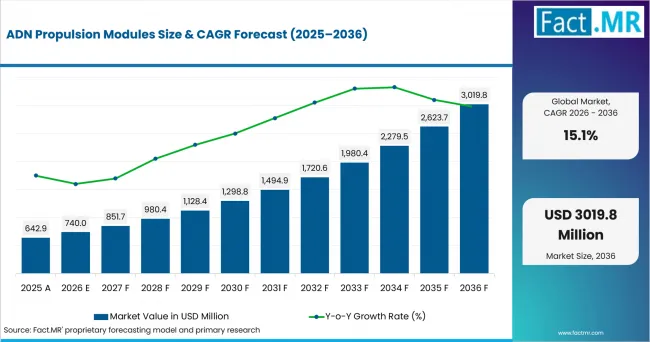
Adn Propulsion Modules Value Analysis | Source: Fact.MR
What are the defining numbers behind ADN Propulsion Modules Market growth?
The market is projected to create about USD 2.3 billion in absolute dollar opportunity between 2026 and 2036.
- Demand Drivers in the Market
- ADN-based systems reduce the handling burden associated with hydrazine. ESA has documented LMP-103S as a lower-toxicity alternative that can simplify transport and ground operations while providing competitive propulsion performance.
- Flight heritage has moved ADN propulsion beyond laboratory validation. ECAPS technology has flown on PRISMA, SkySat, ELSA-d and ArgoMoon, while current ECAPS materials list additional operational programmes and an expanding range of propulsion modules.
- Small spacecraft increasingly need active orbit control, collision avoidance and end-of-life disposal. These missions favour compact chemical modules when high-thrust response is more important than the propellant efficiency of electric propulsion.
- Module integration is becoming more valuable than stand-alone thruster supply because spacecraft manufacturers want qualified tanks, valves, feed hardware and controls that reduce recurring engineering and integration effort.
- Key Segments Analyzed
- By Propellant Form: ADN monopropellant holds 49.0% share in 2026, followed by ADN-water blends at 21.0%.
- By Thrust: 1-10 N accounts for 31.0% share in 2026, ahead of 11-50 N at 28.0%.
- By Module: Thruster + valve modules represent 32.0% share in 2026, while integrated tank-feed modules account for 24.0%.
- By Mission: Attitude control leads with 31.0% share in 2026, followed by orbit maintenance at 25.0%.
- Analyst Opinion at Fact.MR
- Shambhu Nath Jha, Senior Consultant, Fact.MR, notes that ADN propulsion is moving from a propellant-selection decision to a subsystem-integration decision. The winning suppliers will not be those that simply demonstrate good specific impulse. They will be those that can qualify the catalyst bed, valves, tank, feed system, thermal management and control logic as one repeatable module. That is especially important for satellite platforms that must perform collision avoidance or deorbit burns on demand, where response certainty matters as much as propellant efficiency.
- Strategic Implications
- Propulsion suppliers should develop repeatable module families around common thrust classes instead of treating each spacecraft as a clean-sheet integration project.
- Satellite OEMs should compare total integration and ground-handling cost with hydrazine, not propellant price alone. Qualification effort, protective-equipment requirements and launch-site procedures materially affect lifecycle economics.
- The 1-10 N and 11-50 N classes together account for 59.0% of 2026 demand, making them the centre of the addressable market for small and medium spacecraft chemical manoeuvring.
- Collision avoidance and deorbit requirements create a durable second use case beyond routine attitude and station-keeping, particularly as operators face denser orbital environments and tighter disposal expectations.
Country growth is concentrated in established European propulsion ecosystems and the United States. Sweden leads the listed set at 16.6% CAGR, followed by Germany at 16.2%, the USA at 15.8%, France at 15.4% and the UK at 14.1%.
How does the ADN Propulsion Modules Market break down by segment?
The ADN Propulsion Modules Market is segmented by Propellant Form into ADN monopropellant, ADN-water blends, ADN energetic blends, catalyst-optimized formulations and other green monopropellants; by Thrust into <1 N, 1-10 N, 11-50 N, 51-200 N and >200 N; by Module into thruster + valve module, integrated tank-feed module, clustered thruster module, propulsion pod and CubeSat module; by Mission into attitude control, orbit maintenance, collision avoidance, deorbit and responsive manoeuvre; and by Region into North America, Latin America, Western Europe, Eastern Europe, East Asia, South Asia & Pacific, and Middle East & Africa.
Why does ADN monopropellant lead demand within Propellant Form?
ADN monopropellant holds 49.0% share in 2026.
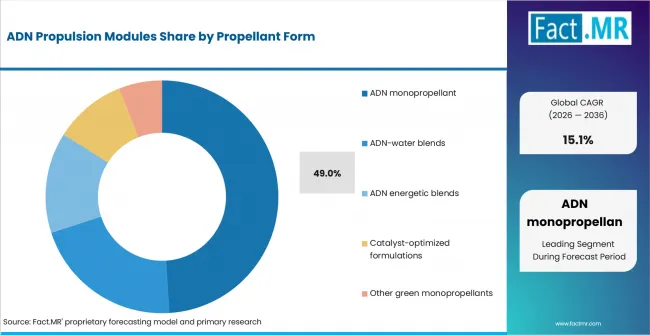
Adn Propulsion Modules Analysis By Propellant Form | Source: Fact.MR
The segment leads because the best-known flight-qualified ADN chemistry, LMP-103S, is an energetic liquid monopropellant designed to replace hydrazine in conventional chemical-propulsion architectures. ESA and NASA documentation both cite the flight heritage of ECAPS HPGP thrusters, while ECAPS now markets LMP-103S across multiple engine and module classes. This gives spacecraft designers a clearer qualification path than less mature ADN variants.
The chemistry trend also connects directly with the Green Propellants Market, where LMP-103S and other lower-toxicity formulations are gaining attention as operators reduce dependence on hydrazine.
ADN-water blends account for 21.0% share, ADN energetic blends 14.0%, catalyst-optimized formulations 10.0% and other green monopropellants 6.0%. The smaller shares reflect the additional materials, catalyst and qualification work required when formulation changes move away from the most established flight baseline.
Why does 1-10 N lead demand within Thrust?
The 1-10 N thrust class accounts for 17.0% share in 2026.
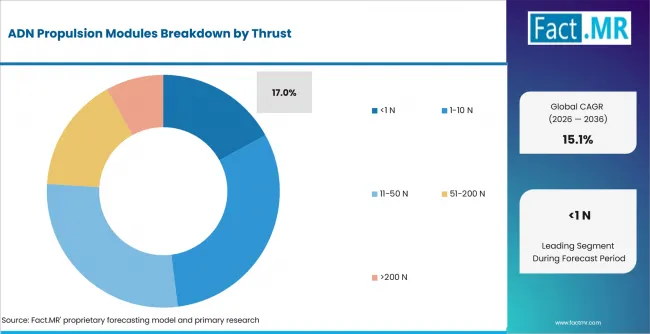
Adn Propulsion Modules Analysis By Thrust | Source: Fact.MR
This range aligns well with small and medium spacecraft that need decisive chemical impulse for orbit correction and attitude recovery without the mass of larger propulsion hardware. NASA's 2026 small-spacecraft propulsion review lists ECAPS HPGP hardware across 0.1 N, 1 N, 5 N and 22 N classes, showing how the technology family spans both fine-control and higher-impulse manoeuvres. Bradford Space also states that its green monopropellant systems can be configured from 1 N to 22 N.
Qualification demand around these systems supports the adjacent Small Satellite Environmental Test Systems Market, because propulsion modules require thermal-vacuum, vibration, leak, materials and hot-fire validation before flight acceptance.
The 11-50 N class follows at 28.0%, <1 N represents 17.0%, 51-200 N accounts for 16.0%, and >200 N holds 8.0%. The distribution shows that the market is centred on spacecraft manoeuvring rather than large main-engine applications.
Why do Thruster + valve modules lead demand within Module?
Thruster + valve modules hold 32.0% share in 2026.
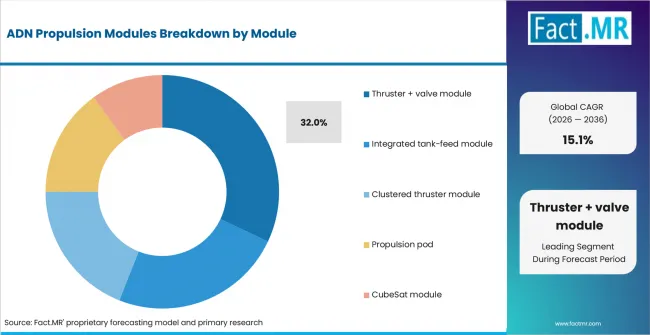
Adn Propulsion Modules Analysis By Module | Source: Fact.MR
The configuration offers a practical balance between standardization and spacecraft-level design freedom. The supplier can qualify the hot section, valve response and local feed interface as one assembly, while the integrator retains control of tank sizing and vehicle plumbing. Moog and VACCO both maintain extensive flight-qualified valve portfolios for spacecraft propulsion, and Bradford offers configurable green monopropellant systems with feed hardware and optional control electronics.
The value of compact and consolidated hardware also overlaps with the 3D Printed Satellite Market, where propulsion components are among the satellite parts being redesigned for lower mass and higher part consolidation.
Integrated tank-feed modules account for 24.0%, clustered thruster modules 19.0%, propulsion pods 15.0% and CubeSat modules 10.0%. Integrated packages gain importance as satellite manufacturers move toward faster production cycles and more repeatable bus architectures.
Why does Attitude control lead demand within Mission?
Attitude control accounts for 31.0% share in 2026.
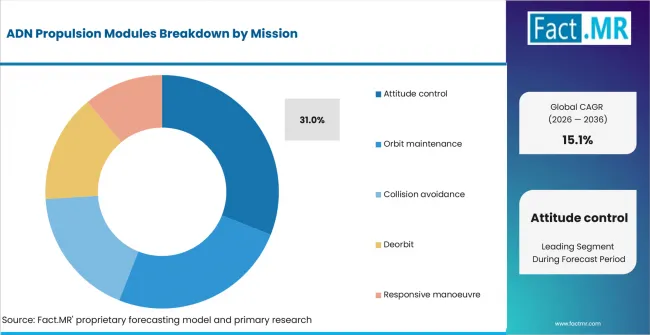
Adn Propulsion Modules Analysis By Mission | Source: Fact.MR
Attitude control creates frequent, mission-critical demand for responsive impulse and precise pointing recovery. The PRISMA demonstration established ADN-based HPGP flight heritage in small-satellite manoeuvring, and later systems extended the technology into Earth-observation and rendezvous missions. Chemical propulsion remains valuable when a spacecraft needs thrust immediately rather than after the longer firing periods associated with low-thrust electric systems.
Collision avoidance and end-of-life manoeuvring also connect with the Space Debris Reusable Orbital Vehicles Market, as orbital operators place greater value on active manoeuvring and disposal capability.
Orbit maintenance represents 25.0% share, collision avoidance 18.0%, deorbit 15.0% and responsive manoeuvre 11.0%. The latter three uses expand the module value proposition beyond routine station keeping into mission assurance and orbital sustainability.
What is accelerating ADN Propulsion Modules Market adoption, and what is holding it back?
Adoption is being accelerated by lower-toxicity ground operations, growing small-satellite manoeuvring demand, maturing flight heritage and pressure to integrate deorbit capability. The main constraints are qualification cost, high combustion temperature, catalyst and materials requirements, preheat power and the still-limited supplier base for fully integrated ADN systems.
The impact values below are directional analytical estimates used to compare market mechanisms. They are not additive components of the 15.1% market CAGR.
Drivers Impact Analysis
| DRIVER | (~) % IMPACT ON CAGR | GEOGRAPHIC RELEVANCE | IMPACT TIMELINE |
|---|---|---|---|
| Hydrazine handling and regulatory burden | +2.7% | Europe, USA | 2026 to 2036 |
| Flight heritage of ADN/LMP-103S propulsion | +2.4% | Sweden, USA, Europe | 2026 to 2034 |
| Small-satellite manoeuvring and collision avoidance | +2.2% | Global | 2026 to 2036 |
| Shift toward qualified modular propulsion assemblies | +1.8% | Europe, USA | 2027 to 2036 |
Source: Fact.MR analysis. Updated Sep 15, 2026
Opportunities Impact Analysis
| OPPORTUNITY | (~) % IMPACT ON CAGR | GEOGRAPHIC RELEVANCE | IMPACT TIMELINE |
|---|---|---|---|
| 1-50 N modular chemical propulsion families | +2.5% | Europe, USA | 2026 to 2036 |
| Collision-avoidance and deorbit packages | +2.1% | Global | 2027 to 2036 |
| Responsive defence and sovereign-space missions | +1.8% | USA, France, UK, Sweden | 2027 to 2036 |
| Pre-qualified tank-feed and propulsion-pod integration | +1.6% | Europe, USA | 2026 to 2034 |
Source: Fact.MR analysis. Updated Sep 15, 2026
Restraints Impact Analysis
| RESTRAINT | (~) % IMPACT ON CAGR | GEOGRAPHIC RELEVANCE | IMPACT TIMELINE |
|---|---|---|---|
| High-temperature catalyst and materials qualification | -2.2% | Global | 2026 to 2034 |
| Preheat power and thermal-management burden | -1.7% | Small spacecraft | 2026 to 2032 |
| Concentrated supplier and propellant supply base | -1.5% | Europe, USA | 2026 to 2036 |
| Long spacecraft qualification cycles | -1.3% | Global | 2026 to 2034 |
Source: Fact.MR analysis. Updated Sep 15, 2026
How is demand developing across key countries?
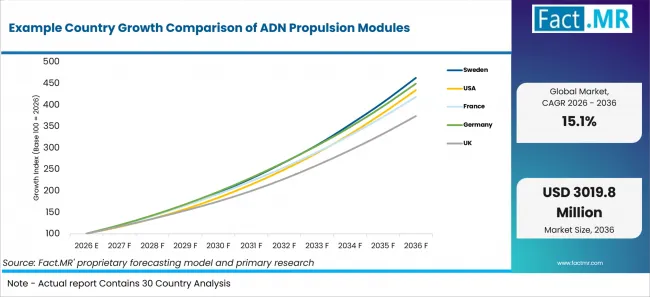
Example Country Growth Comparison Of Adn Propulsion Modules | Source: Fact.MR
| Country | CAGR (2026-2036) |
|---|---|
| Sweden | 16.6% |
| USA | 15.8% |
| France | 15.4% |
| Germany | 16.2% |
| UK | 14.1% |
Source: Fact.MR analysis. Updated Sep 15, 2026
Why is Sweden the fastest-growing market?
Sweden is forecast to expand at 16.6% CAGR from 2026 to 2036.
The country has unusual depth in ADN propulsion because ECAPS developed LMP-103S and continues to manufacture propulsion hardware in Sweden. ECAPS currently operates under Oak Universe ownership and lists propulsion-module, engine and propellant activities across its Swedish industrial sites. This local combination of chemistry, hot-fire capability and flight heritage gives Sweden a stronger starting position than a market that only imports finished modules.
What supports ADN propulsion demand in Germany?
Germany is projected to grow at 16.2% CAGR.
Demand is supported by the wider European spacecraft and propulsion qualification ecosystem, including ESA programmes and ArianeGroup activities across France and Germany. German spacecraft engineering places a high premium on qualified components and repeatable subsystem performance, which favours modular propulsion architectures once their catalyst, materials and thermal behaviour have been validated.
Why does the USA remain a major validation market?
The USA is forecast to grow at 15.8% CAGR.
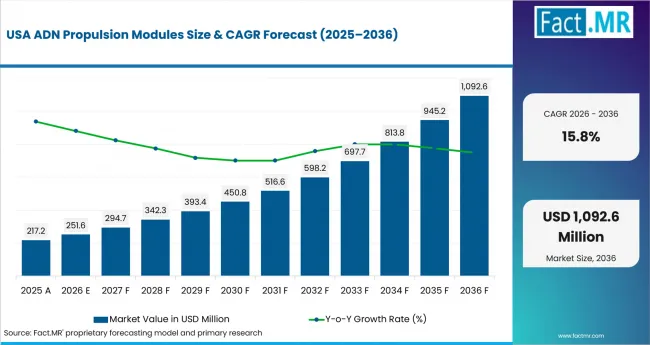
Adn Propulsion Modules Country Value Analysis | Source: Fact.MR
NASA's 2026 small-spacecraft propulsion state-of-the-art review includes ECAPS LMP-103S systems and the VACCO hybrid propulsion package flown on ArgoMoon. Moog and VACCO also maintain active green-propulsion hardware portfolios. The US market therefore combines mission demand with component suppliers, government qualification capability and commercial spacecraft manufacturing.
ADN modules also depend on reliable control electronics and power interfaces, making the Radiation Hardened Electronics Market relevant to high-assurance propulsion control architectures used in space and defence programmes.
What is driving the France market?
France is projected to expand at 15.4% CAGR.
ArianeGroup supplies complete spacecraft propulsion systems and is actively developing alternative propellants that meet tighter safety and environmental requirements. CNES-linked spacecraft programmes and the country's dense satellite engineering base create a route for lower-toxicity propulsion to move from technology demonstration into recurring platform integration.
How is the UK market developing?
The UK is forecast to grow at 14.1% CAGR.
Nammo Westcott operates small-thruster hot-fire infrastructure and the UK Space Agency national propulsion test facility. Nammo also reports delivery of an LMP-103S chemical propulsion system for Astroscale's ADRAS-J mission, launched in 2024. That combination of test capability and current mission use supports continued demand for compact green-propulsion modules.
Competitive Landscape
Competition in the ADN propulsion modules market is shaped by specialist propulsion developers and established spacecraft-component suppliers. Suppliers compete on flight heritage, propulsion-system qualification, propellant compatibility, reliability, and the ability to deliver integrated hardware spanning tanks, valves, feed systems and thrusters.
ECAPS holds a strong position in ADN-based green propulsion through its established High Performance Green Propulsion technology. Nammo operates independently as a propulsion supplier with capabilities across spacecraft propulsion systems, while Bradford Space offers green monopropellant propulsion solutions for small satellites and other space platforms.
ArianeGroup contributes broader chemical-propulsion expertise and work on lower-toxicity propulsion technologies. Moog and VACCO strengthen the competitive field through thrusters, valves, fluid-control hardware and integrated propulsion modules. As adoption expands, competitive advantage is likely to depend increasingly on proven in-orbit performance, system integration capability and the ability to support repeatable spacecraft production.
What is changing in supplier strategy?
- ECAPS is broadening from individual HPGP thrusters toward an end-to-end propulsion stack with propellant, multiple engine classes and named module families.
- Bradford Space continues to offer configurable green monopropellant systems, including ADN-based options, alongside other in-space propulsion technologies.
- Moog and VACCO compete strongly at the component and integrated-module level, where valves, tanks and compact propulsion assemblies can be used across more than one green-propellant chemistry.
- ArianeGroup benefits from complete-system capability and long spacecraft propulsion heritage, which matters for larger institutional and exploration programmes.
What is the report's scope and coverage?
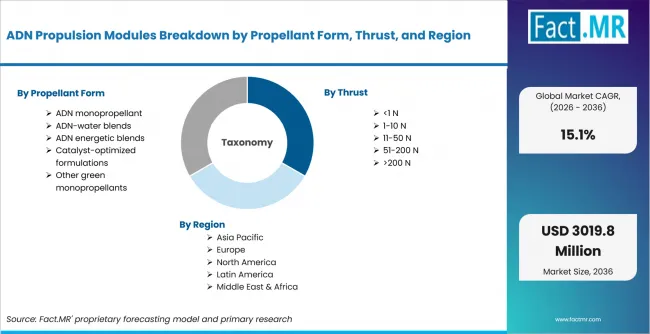
Adn Propulsion Modules Breakdown By Propellant Form, Thrust, And Region | Source: Fact.MR
| Attribute | Details |
|---|---|
| Quantitative Units | USD million |
| Market Definition | Integrated spacecraft chemical-propulsion modules built around ADN-based or directly related low-toxicity propellant architectures. |
| Propellant Form | ADN monopropellant; ADN-water blends; ADN energetic blends; Catalyst-optimized formulations; Other green monopropellants |
| Thrust | <1 N; 1-10 N; 11-50 N; 51-200 N; >200 N |
| Module | Thruster + valve module; Integrated tank-feed module; Clustered thruster module; Propulsion pod; CubeSat module |
| Mission | Attitude control; Orbit maintenance; Collision avoidance; Deorbit; Responsive manoeuvre |
| Regions Covered | North America; Latin America; Western Europe; Eastern Europe; East Asia; South Asia & Pacific; Middle East & Africa |
| Countries Highlighted | Sweden; USA; France; Germany; UK |
| Competitive Benchmark | ECAPS / Nammo; ArianeGroup; Bradford Space; Moog; VACCO Industries |
| Forecast Period | 2026 to 2036 |
| Base Year | 2025 |
Source: Fact.MR analysis. Updated Sep 15, 2026
How is the market segmented?
-
By Propellant Form
- ADN monopropellant - 49.0%
- ADN-water blends - 21.0%
- ADN energetic blends - 14.0%
- Catalyst-optimized formulations - 10.0%
- Other green monopropellants - 6.0%
-
By Thrust
- <1 N - 17.0%
- 1-10 N - 31.0%
- 11-50 N - 28.0%
- 51-200 N - 16.0%
- >200 N - 8.0%
-
By Module
- Thruster + valve module - 32.0%
- Integrated tank-feed module - 24.0%
- Clustered thruster module - 19.0%
- Propulsion pod - 15.0%
- CubeSat module - 10.0%
-
By Mission
- Attitude control - 31.0%
- Orbit maintenance - 25.0%
- Collision avoidance - 18.0%
- Deorbit - 15.0%
- Responsive manoeuvre - 11.0%
-
By Region
- North America
- Latin America
- Western Europe
- Eastern Europe
- East Asia
- South Asia & Pacific
- Middle East & Africa
Bibliography
- European Space Agency (ESA). Green satellite fuel and hydrazine-free propulsion materials covering LMP-103S, ADN chemistry, materials compatibility and spacecraft qualification.
- NASA Small Spacecraft Systems Virtual Institute. 2026 State of the Art: In-Space Propulsion, including ECAPS HPGP thrust classes, PRISMA, SkySat, ELSA-d, ArgoMoon and other green-propulsion systems.
- ECAPS. Current company, LMP-103S, engine, module and programme information, including 2026 programme updates.
- Oak Universe. Current ownership information for ECAPS AB and the 2023 acquisition record.
- Nammo. Westcott propulsion-test capability and ADRAS-J LMP-103S chemical propulsion system information.
- Bradford Space. Current monopropellant system portfolio, including low-toxicity ADN-based options and 1 N to 22 N green propulsion capability.
- ArianeGroup. Orbital propulsion systems and corporate materials on alternative, lower-toxicity spacecraft propellants.
- Moog. Spacecraft propulsion, monopropellant thruster-valve and green-propellant development materials.
- VACCO Industries. Space propulsion valves, micro-propulsion systems and green-monopropellant CubeSat capability.
This Report Answers
- How large is the ADN Propulsion Modules Market in 2025, 2026 and 2036?
- Why do ADN monopropellant, the 1-10 N thrust class, thruster + valve modules and attitude control lead their categories?
- How do hydrazine replacement, qualification requirements and orbital-manoeuvring demand affect adoption?
- Which countries are growing fastest through 2036, and why does Sweden lead the listed set?
- Which suppliers participate in the competitive benchmark, and where do current corporate or technology boundaries require clarification?
What does the ADN Propulsion Modules Market cover?
The market covers integrated propulsion modules in which ADN-based or ADN-related low-toxicity chemical propulsion is a defining technology. Revenue can include the thruster, valve, tank, pressure or feed hardware, local control electronics and integration work when these elements are supplied as a propulsion module or pod.
Covered missions include attitude control, orbit maintenance, collision avoidance, deorbit and responsive manoeuvre. The market spans small satellites, larger spacecraft and mission-specific vehicles where chemical impulse is required for fast response or meaningful delta-v within a compact system.
What is included in the scope?
Included products comprise ADN monopropellant thruster assemblies, integrated tank-feed modules, clustered thruster modules, propulsion pods and CubeSat-scale units. Hardware using LMP-103S and other ADN formulations is included when it is sold as part of an integrated propulsion solution.
Associated valves, tanks, feed hardware and electronics are included when they are delivered within the covered module. Module revenue is attributed to the finished propulsion assembly rather than double-counting every component as a separate market.
What is excluded from the scope?
Raw ADN chemical sales without propulsion hardware are excluded. Hydrazine-only systems, hydrogen-peroxide-only systems, HAN-only systems and iodine electric propulsion are outside the core ADN module market unless they form part of a mixed or directly comparable integrated system specifically counted within the defined market boundary.
Standalone launch-vehicle engines, solid rocket motors, unrelated electric thrusters, propellant-ground-support equipment and spacecraft bus revenue are also excluded. Adjacent suppliers can appear in the competitive benchmark where their integrated propulsion capability affects procurement decisions, but that does not make every product in their portfolio an ADN module.
How Was the Analysis Built?
- Primary Research: The analysis considers spacecraft propulsion architecture, thrust class, propellant handling, catalyst and thermal requirements, module integration, mission duty cycle and customer qualification criteria.
- Desk Research: Public evidence includes ESA and NASA technical material, official company product information, current corporate-ownership records and mission announcements used to validate technology and supplier status.
- Market Sizing and Forecasting: Revenue progression is anchored to the 2025, 2026 and 2036 market values, with segment shares, supplier benchmark shares and country growth rates applied across the 2026 to 2036 forecast period.
- Data Validation and Update Cycle: Current company ownership and product portfolios are checked before publication so historical relationships are not presented as current corporate structure.
Frequently Asked Questions
How big is the ADN Propulsion Modules Market in 2026?
What was the ADN Propulsion Modules Market worth in 2025?
What is the CAGR of the ADN Propulsion Modules Market from 2026 to 2036?
What is the absolute dollar opportunity from 2026 to 2036?
Which Propellant Form leads the market in 2026?
Which Thrust class leads the market in 2026?
Which Module type leads the market in 2026?
Which Mission leads the market in 2026?
Which listed country grows fastest through 2036?
Who are the principal suppliers in the competitive benchmark?
Who worked on this report


Preview the report firsthand - request a free sample
Free SampleGet the brochure for pricing and purchase details
Download PDF