- Market Value (2025): USD 3.5 Bn
- Estimated Value (2026): USD 3.9 Bn
- Forecast Value (2036): USD 11.9 Bn
- CAGR (2026-2036): 11.8%
What is the In-Space Propulsion Components Market forecast to be worth by 2036?
USD 3.9 billion in 2026 to USD 11.9 billion by 2036 at a 11.8% CAGR.
- The In-Space Propulsion Components Market crossed a valuation of USD 3.5 billion in 2025.
- Demand is projected to increase from USD 3.9 billion in 2026 to USD 11.9 billion by 2036.
- The market is forecast to record 11.8% CAGR from 2026 to 2036 as spacecraft manufacturers select propulsion hardware for maneuverable satellites and longer mission life.
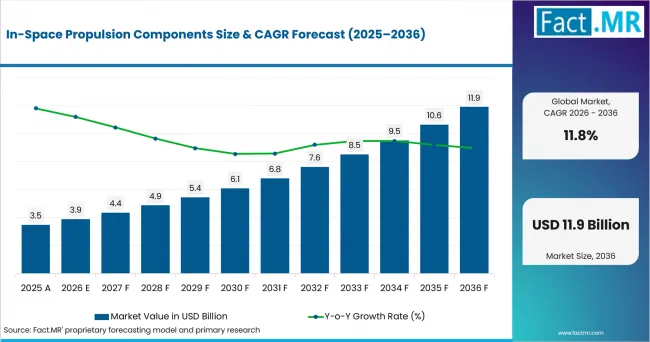
In Space Propulsion Components Value Analysis | Source: Fact.MR
What are the defining numbers behind In-Space Propulsion Components Market growth?
An absolute opportunity of USD 7.9982 Billion is expected between 2026 and 2036.
- Demand Drivers in the Market
- Satellite prime contractors need thruster heads that match tighter mass budgets, since propulsion affects orbit control from launch separation through disposal.
- Debris-mitigation planning raises demand for maneuvering hardware. The European Space Agency reported in July 2026 an estimated 68,450 space objects greater than 10 cm in orbit.
- Exploration mission teams need PPUs and feed systems that align thrust output with spacecraft power limits during deep-space operations.
- Constellation operators need valves that keep propellant delivery repeatable during orbit raising, spacing and stationkeeping.
- National security users need propulsion architectures that combine responsive maneuvers with efficient orbit control in maneuverable satellites.
- Key Segments Analyzed
- By Component: Thruster heads are expected to hold 28.0% share in 2026 because they convert propellant and power into controlled spacecraft motion.
- By Propulsion Type: Electric propulsion is projected to account for 39.0% share in 2026 due to its fit with stationkeeping and orbit raising.
- By Spacecraft: Small satellites are anticipated to capture 31.0% share in 2026 since operators need compact hardware for post-launch control.
- By Mission Function: Stationkeeping is estimated to represent 29.0% share in 2026 owing to recurring orbit-control needs across spacecraft classes.
- Analyst Opinion at Fact.MR
- Shambhu Nath Jha, Principal Consultant at Fact.MR, states, "Propulsion components are drawing buyer attention because satellites now need planned mobility across the full mission. Operators are expected to evaluate thruster output, valve reliability and electronics qualification before platform freeze. Suppliers with flight heritage, clean manufacturing capacity and component-level documentation have the clearest route to approval."
- Strategic Implications
- Component manufacturers should document qualification history by mission class and propellant type for earlier spacecraft-team approval.
- Spacecraft integrators should align propulsion design with disposal planning during preliminary reviews.
- Investors should track test infrastructure depth. UK Space Agency annual reporting in July 2026 identified GBP 48 million across 13 SCIF projects including electric propulsion and in-orbit servicing.
- Mission operators should compare lifetime maneuvering budgets with stationkeeping and collision-avoidance needs.
The UK is projected to record 12.8% CAGR through propulsion innovation funding and in-orbit servicing activity. The USA is expected to post 12.4% CAGR through commercial space operations and NASA technology demonstrations. France is forecast to advance at 11.9% CAGR due to electric satellite heritage and national space commitments. Japan is anticipated to register 11.5% CAGR as smallsat deployments support compact propulsion testing. Germany is estimated to record 11.1% CAGR owing to ESA commitments and platform demonstration work.
How does the In-Space Propulsion Components Market break down by segment?
Thruster heads lead Component at 28.0%; Electric propulsion leads Propulsion Type at 39.0%.
Which Component dominates?
Thruster heads are expected to hold 28.0% share in 2026.
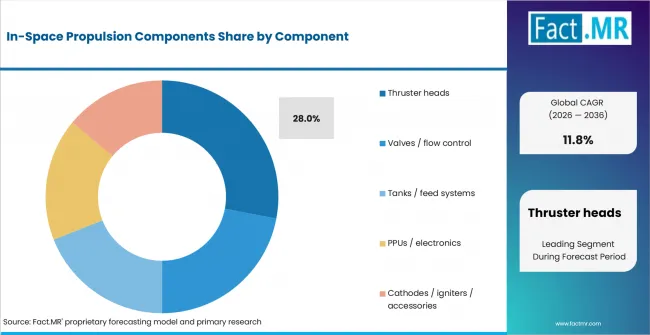
In Space Propulsion Components Analysis By Component | Source: Fact.MR
Thruster heads lead because they create the final maneuvering output in a propulsion assembly. Their design affects thrust level and mission duty cycle. Satellite teams evaluate nozzle geometry, plume behavior and operating life before finalizing the spacecraft propulsion layout.
Busek lists the BHT-6000 as a 2–6 kW Hall effect thruster and references a September 2025 technical presentation covering its qualification and production status. The product example fits the share lead because thruster heads carry the visible performance role in electric propulsion assemblies.
What leads the Propulsion Type segment?
Electric propulsion is projected to account for 39.0% share in 2026.
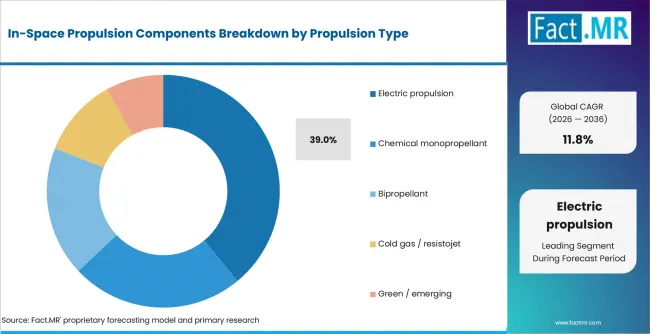
In Space Propulsion Components Analysis By Propulsion Type | Source: Fact.MR
Electric propulsion leads because it gives spacecraft teams more orbit-control work from a smaller propellant mass. The same architecture supports orbit raising when operators accept a longer transfer period for lower launch mass.
CNES states that its electric-satellite work uses Hall-effect plasma thrusters and cites a 30% satellite mass saving over chemical propulsion; Eutelsat 172B achieved a launch-mass gain of more than 30% compared with a satellite carrying an equivalent payload. That heritage explains why electric propulsion is expected to retain the leading share within propulsion type.
How does Spacecraft shape demand?
Small satellites are anticipated to capture 31.0% share in 2026.
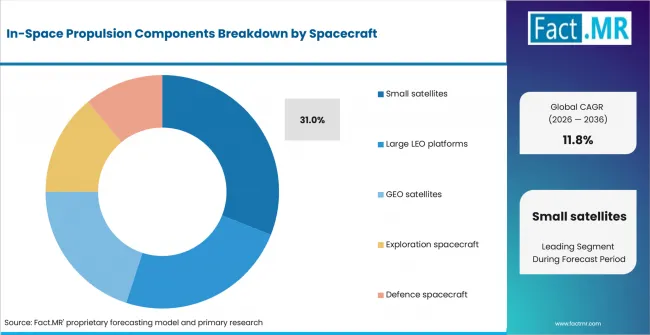
In Space Propulsion Components Analysis By Spacecraft | Source: Fact.MR
Small satellites lead because they have limited mass and volume for propulsion hardware. Operators still need orbit raising, spacing and disposal capability. Compact tanks, thruster modules and electronics become central when spacecraft size is constrained.
NASA reported in December 2025 that the DUPLEX CubeSat began an in-space test with two micropropulsion technologies after deployment from the International Space Station. That mission links smallsat growth with demand for components that fit low-volume spacecraft designs.
What supports Stationkeeping within Mission Function?
Stationkeeping is estimated to represent 29.0% share in 2026.
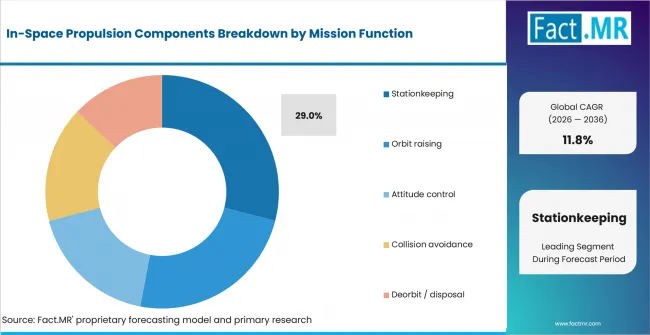
In Space Propulsion Components Analysis By Mission Function | Source: Fact.MR
Stationkeeping leads because satellites need repeated small maneuvers to maintain assigned orbital positions. GEO spacecraft use it to preserve service coverage. LEO platforms use it to manage spacing and drag effects.
L3Harris reported in December 2025 that it completed testing and delivery of three 12-kilowatt AEPS thrusters for NASA Gateway. The program shows how high-power electric propulsion supports stationkeeping in a lunar operating orbit.
What is accelerating In-Space Propulsion Components Market adoption, and what is holding it back?
Demand is expected to rise through satellite maneuvering needs and electric propulsion qualification. Growth is constrained by testing cost, integration complexity and mission-risk review.
Drivers Impact Analysis
| DRIVER | (~) % IMPACT ON CAGR | GEOGRAPHIC RELEVANCE | IMPACT TIMELINE |
|---|---|---|---|
| Small satellite maneuvering and constellation replenishment | +1.7% | Global | Short term (<= 2 years) |
| Electric propulsion for stationkeeping and orbit raising | +1.5% | North America, Europe, East Asia | Medium term (2-4 years) |
| Debris avoidance and disposal planning | +1.1% | Global | Medium term (2-4 years) |
| National security mobility requirements | +0.8% | USA, Europe, Japan | Long term (>= 4 years) |
Source: Fact.MR analysis. Updated Sep 16, 2026
Opportunity Impact Analysis
| OPPORTUNITY | (~) % IMPACT ON CAGR | GEOGRAPHIC RELEVANCE | IMPACT TIMELINE |
|---|---|---|---|
| Multimode propulsion for responsive satellites | +1.3% | USA, UK, Europe | Medium term (2-4 years) |
| Refuellable and serviceable electric platforms | +1.0% | UK, USA, France | Long term (>= 4 years) |
| Smallsat propulsion modules with integrated electronics | +0.9% | Global | Short term (<= 2 years) |
Source: Fact.MR analysis. Updated Sep 16, 2026
Restraints Impact Analysis
| RESTRAINT | (~) % IMPACT ON CAGR | GEOGRAPHIC RELEVANCE | IMPACT TIMELINE |
|---|---|---|---|
| Mission qualification and flight-heritage requirements | -0.6% | Global | Short term (<= 2 years) |
| Power and thermal limits in small spacecraft | -0.5% | East Asia, Europe, North America | Medium term (2-4 years) |
| Hazardous propellant handling and launch-site rules | -0.4% | Global | Long term (>= 4 years) |
Source: Fact.MR analysis. Updated Sep 16, 2026
Which countries are scaling the In-Space Propulsion Components Market through 2036?
- The country comparison spans 1.7 percentage points and forms three practical growth bands across the forecast period.
- The UK remains 0.4 percentage point above the USA through propulsion innovation funding and in-orbit servicing activity.
- The USA remains 0.5 percentage point above France through commercial space operations and NASA propulsion demonstrations.
- France remains 0.4 percentage point above Japan due to electric satellite heritage and national space commitments.
- Japan remains 0.4 percentage point above Germany as smallsat deployments and lunar programs raise demand for compact maneuvering hardware.
Comparable CAGRs create different entry conditions due to mission type, test infrastructure, public funding and platform maturity. Coverage includes North America, Latin America, Western Europe, Eastern Europe, East Asia, South Asia & Pacific, Middle East & Africa.
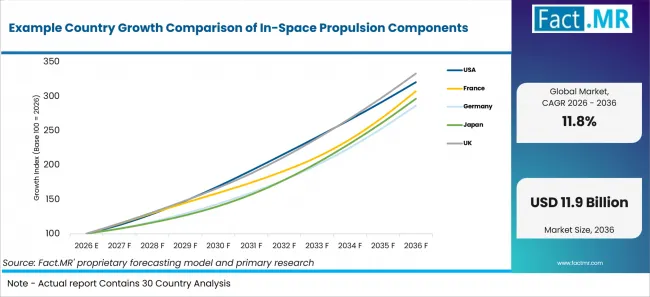
Example Country Growth Comparison Of In Space Propulsion Components | Source: Fact.MR
| Country | CAGR |
|---|---|
| United Kingdom | 12.8% |
| United States | 12.4% |
| France | 11.9% |
| Japan | 11.5% |
| Germany | 11.1% |
Source: Fact.MR analysis. Updated Sep 16, 2026
What supports the United Kingdom’s growth?
12.8% CAGR, supported by propulsion innovation funding and in-orbit servicing.
UK growth is shaped by propulsion-focused innovation funding. The UK Space Agency announced GBP 17 million for 17 National Space Innovation Programme projects in December 2025. The awards included GBP 1 million for a Protolaunch-led water-based propulsion project and GBP 340,000 for an Orbit Fab-led refuellable electric propulsion project; Magdrive participated separately in an in-orbit servicing project led by Lodestar Space. Suppliers serving UK missions are expected to benefit where components support in-orbit servicing, water-based propulsion and refuellable electric architectures.
What supports USA adoption?
12.4% CAGR, supported by commercial space operations and NASA propulsion testing.
U.S. demand is tied to a large commercial launch base and active government demonstrations. The Federal Aviation Administration marked its 1,000th licensed or permitted commercial space operation in August 2025. The rising cadence of commercial space activity can expand the addressable mission base for in-space propulsion used in orbit raising, stationkeeping and spacecraft maneuvering.
How is France scaling demand?
11.9% CAGR, supported by electric satellite heritage and national space commitments.
French demand is supported by CNES heritage in electric satellite programs and national funding commitments. The French Presidency stated in December 2025 that France will devote more than EUR 16 billion to civil and dual-use space by 2030, in addition to the defence-space budget under the military programming law. That spending path is expected to support qualified propulsion subsystems for civil, dual-use and European missions.
How does Japan perform?
11.5% CAGR, led by smallsat deployments and compact propulsion testing.
Japan’s country case is linked to CubeSat deployment routes and small spacecraft testing. JAXA reported that five CubeSats were successfully deployed from the Kibo module in September 2025. That activity supports demand for compact propulsion modules that help small satellites manage orbit control and end-of-life duties.
What is supporting Germany’s adoption?
11.1% CAGR, supported by ESA commitments and space-platform demonstration work.
Germany’s participation in European space programmes provides a substantial institutional demand base. DLR reported that Germany is contributing approximately EUR 5.4 billion, valued at current economic conditions, to ESA programmes following the 2025 Bremen ministerial meeting. That funding base is expected to support qualified spacecraft subsystems across exploration, communications and safety-related programs.
Who leads the In-Space Propulsion Components Market?
Moog is active through spacecraft thrusters, tanks, valves and integrated propulsion systems. In September 2025, the company announced that its Niagara Falls expansion would increase clean-room capacity by more than 80%, supporting higher propulsion-production capacity. The expansion includes dedicated production cells for MONARC monopropellant engines, propulsion systems and classified projects.
VACCO Industries competes through flight-qualified fluid-control components used in chemical, electric and cold-gas space propulsion applications. Its portfolio includes isolation valves, fill-and-drain valves, pressure regulators and filters, along with xenon flow-control and pressure-regulation modules for spacecraft propulsion systems.
Aerojet Rocketdyne, L3Harris, is active across electric propulsion, chemical in-space thrusters and space-power technologies. Its Advanced Electric Propulsion System work for NASA's Gateway includes three 12-kW electric thrusters for the Power and Propulsion Element. ArianeGroup adds European capability through complete orbital propulsion systems and individual thrusters, while Safran Spacecraft Propulsion supplies Hall-effect thrusters for orbital transfer, stationkeeping and other spacecraft applications.
Busek adds depth in Hall thrusters, electrospray propulsion and small spacecraft propulsion hardware. Competition centers on flight heritage, test evidence, clean-room capacity and mission fit. Suppliers with documented qualification data are expected to gain earlier design-in positions.
Which companies are the key providers?
Key companies include Moog; VACCO Industries; Aerojet Rocketdyne / L3Harris; ArianeGroup; Safran; and Busek.
- Moog
- VACCO Industries
- Aerojet Rocketdyne / L3Harris
- ArianeGroup
- Safran
- Busek
Bibliography
- Mullins, C. R., Hohman, K., Paintal, S. S., Corey, R., & Johnson, I. (2025, September 14–19). BHT-6000 Hall thruster qualification and production status [Conference presentation]. 39th International Electric Propulsion Conference, Imperial College London, London, United Kingdom.
- Federal Aviation Administration. (2025, August 14). U.S. Transportation Secretary Duffy, FAA celebrate milestone of 1,000th commercial space operation.
- German Aerospace Center (DLR). (2025, November 28). Germany invests 5.4 billion euros in the future of European space.
- Japan Aerospace Exploration Agency. (2025, September 22). Five CubeSats successfully deployed from “Kibo”!
- L3Harris Technologies. (2025, December 16) .L3Harris delivers most powerful thrusters for NASA’s Lunar Gateway.
- Moog Inc. (2025a, May 28). Air Force Research Laboratory awards Moog contract to develop new multimode propulsion system to enhance dynamic space operations.
- Moog Inc. (2025b, September 22). Moog breaks ground on new propulsion clean room to support satellite and missile growth.
- Friesen, T. (2025, December 17). NASA’s two-in-one satellite propulsion demo begins in-space test. National Aeronautics and Space Administration.
- Figliozzi, G. (2025, December 18). NASA’s DiskSat technology demo launches to low Earth orbit. National Aeronautics and Space Administration.
- Présidence de la République. (2025, December 2). Compte rendu du conseil des ministres du 2 Décembre 2025.
- UK Space Agency. (2025a, November 21). UK backs next-generation satellite communications with £6.9 million investment. GOV.UK.
- UK Space Agency. (2025b, December 3). UK Space Agency invests £17 million to drive next wave of space innovation. GOV.UK.
- UK Space Agency. (2026, July 14). UK Space Agency Annual Report and Accounts 2025-2026. GOV.UK.
This Report Answers
- The report explains where in-space propulsion components are used across component type, propulsion architecture, spacecraft class and mission function.
- Segment analysis identifies the leading subsegments and the operational reasons spacecraft teams prioritize each option.
- Country analysis examines the listed markets and the funding mechanisms supporting component use.
- Competitive analysis reviews current providers across thrusters, valves and tanks. The review covers electronics and integrated propulsion systems.
- Application analysis assesses how stationkeeping and orbit raising influence supplier choice. The analysis covers attitude control, collision avoidance and disposal duties.
What does the In-Space Propulsion Components Market cover?
The In-Space Propulsion Components Market covers hardware and electronics that help spacecraft maneuver after launch. It includes thruster heads, valves and tanks. Feed systems, PPUs, cathodes and igniters are used across all-electric satellites, chemical systems and mixed propulsion architectures.
The assessment includes propulsion components linked to green propellants and liquid propellants when these materials require compatible hardware. Demand is assessed across spacecraft class and mission function without adding launch-vehicle engine hardware outside the article boundary.
What is included in the scope?
The scope includes flight-qualified or qualification-stage propulsion components sold to satellite manufacturers, platform integrators and mission operators. It includes components that overlap with aerospace parts manufacturing where the part is designed for in-space thrust control.
It includes components used in compact spacecraft designs, including hardware discussed in 3D printed satellites. Electronics are included when they process power or control propulsion functions, including parts adjacent to radiation hardened electronics.
What is excluded from the scope?
The scope excludes launch-vehicle main engines, aircraft propulsion systems and ground-test services. Raw propellant sales and spacecraft bus manufacturing are excluded when propulsion components lack separate commercial visibility.
General payloads, communication transponders and navigation equipment are excluded unless they directly control or support propulsion operation. The scope centers on hardware that regulates or powers thrust in space.
How Was the Analysis Built?
The analysis draws on 120+ sources, 35+ company portfolios and more than 20 industry interviews.
- Primary Research: Primary research includes discussions with manufacturers, service providers and technology developers. Distributors, end users and subject-matter experts are included. These conversations examine purchase priorities, product adoption and operational challenges. The interviews review approval requirements and competitive positioning.
- Desk Research: Desk research covers government statistics, regulatory publications and company filings. The review covers trade data, technical studies, industry associations, standards and public policy.
- Market Sizing and Forecasting: Market estimates combine historical performance, demand indicators and pricing trends. The estimates assess segment shares, company participation, country-level growth, adoption patterns and investment activity.
- Data Validation and Update Cycle: Findings are validated by comparing primary interviews with public data, company activity, regulatory changes and trade patterns. Updates review product launches, capacity changes, partnerships and approvals.
Segmentation
What is the report’s scope and coverage?
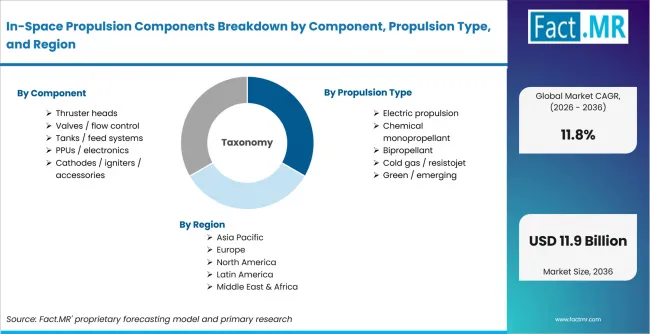
In Space Propulsion Components Breakdown By Component, Propulsion Type, And Region | Source: Fact.MR
| Attribute | Details |
|---|---|
| Quantitative Units | USD Billion |
| Market Definition | Propulsion components used to create, regulate, store, process or control spacecraft thrust after launch. The scope includes thruster heads, valves, tanks, feed systems, PPUs, electronics and accessories. |
| Component | Thruster heads; Valves and flow control; Tanks and feed systems; PPUs and electronics; Cathodes, igniters and accessories |
| Propulsion Type | Electric propulsion; Chemical monopropellant; Bipropellant; Cold gas and resistojet; Green and emerging |
| Spacecraft | Small satellites; Large LEO platforms; GEO satellites; Exploration spacecraft; Defence spacecraft |
| Mission Function | Stationkeeping; Orbit raising; Attitude control; Collision avoidance; Deorbit and disposal |
| Regions Covered | North America; Latin America; Western Europe; Eastern Europe; East Asia; South Asia & Pacific; Middle East & Africa |
| Countries Covered | United Kingdom; United States; France; Japan; Germany |
| Key Companies Profiled | Moog; VACCO Industries; Aerojet Rocketdyne / L3Harris; ArianeGroup; Safran; Busek |
| Forecast Period | 2026 to 2036 |
| Approach | Hybrid top-down and bottom-up approach using spacecraft program activity, propulsion portfolios, mission-function demand, country funding, satellite-class mix and supplier validation. |
Source: Fact.MR analysis. Updated Sep 16, 2026
How is the market segmented?
-
By Component:
- Thruster heads
- Valves and flow control
- Tanks and feed systems
- PPUs and electronics
- Cathodes, igniters and accessories
-
By Propulsion Type:
- Electric propulsion
- Chemical monopropellant
- Bipropellant
- Cold gas and resistojet
- Green and emerging
-
By Spacecraft:
- Small satellites
- Large LEO platforms
- GEO satellites
- Exploration spacecraft
- Defence spacecraft
-
By Mission Function:
- Stationkeeping
- Orbit raising
- Attitude control
- Collision avoidance
- Deorbit and disposal
-
By Region:
- North America
- Latin America
- Western Europe
- Eastern Europe
- East Asia
- South Asia & Pacific
- Middle East & Africa
Frequently Asked Questions
How big is the in-space propulsion components market in 2026?
What is the CAGR of the in-space propulsion components market from 2026 to 2036?
Which propulsion type leads the in-space propulsion components market?
Which spacecraft type leads the in-space propulsion components market?
Who are the leading companies in the in-space propulsion components market?
Who worked on this report


Preview the report firsthand - request a free sample
Free SampleGet the brochure for pricing and purchase details
Download PDF