- Market Value (2025): USD 545.4 Mn
- Estimated Value (2026): USD 585.0 Mn
- Forecast Value (2036): USD 1180.0 Mn
- CAGR (2026-2036): 7.3%
What is the Reactive Extrusion Lines Market forecast to be worth by 2036?
USD 585.0 million in 2026 to USD 1,180.0 million by 2036 at a 7.3% CAGR.
- The Reactive Extrusion Lines Market surpassed a value of USD 545.4 million in 2025, driven by steady demand across extruder type and end user applications.
- Demand is projected to increase from USD 585.0 million in 2026 to USD 1,180.0 million by 2036.
- The market is forecast to record a 7.3% CAGR from 2026 to 2036 as polymer circularity strengthens alongside adoption across core end-use segments.
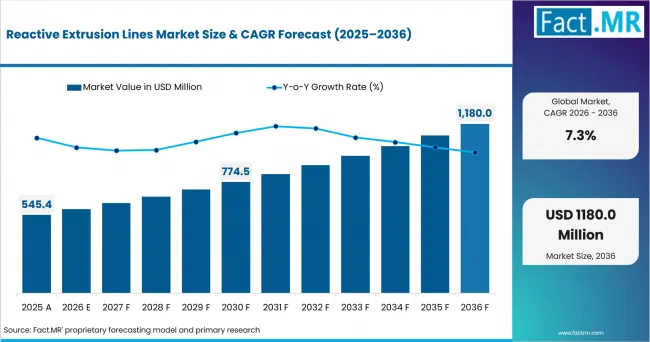
Reactive Extrusion Lines Market Value Analysis | Source: Fact.MR
What are the defining numbers behind Reactive Extrusion Lines Market growth?
A USD 595.0 million absolute opportunity is expected by 2036, led by co-rotating twin-screw systems and reactive compounding demand.
- Demand Drivers in the Market
- Reactive processing can help mixed plastics work better together and restore some of the strength lost during earlier use. This makes recycled material more suitable for higher-value products.
- Carrying out the reaction and shaping steps on one continuous line reduces extra handling and storage. In some cases, it also lowers the use of solvents.
- Grafting and chain-extension work allows companies to adjust strength and processing performance close to the final production stage. This gives them more control over the material before it is made into a finished product.
- Similar screw designs can be used from laboratory trials through full production. This helps companies move new materials into plant testing without redesigning the entire machine at each stage.
- Key Segments Analyzed
- By Extruder Type: Co-rotating twin-screw is expected to hold 42.0% share in 2026 supported by close control over mixing, venting and residence time.
- By Reaction Type: Reactive compounding is projected to account for 30.0% share in 2026 owing to its ability to modify polymer properties and produce the final compound in one pass.
- By Throughput: Lab/pilot lines are anticipated to capture 22.0% share in 2026 due to the need to test new reactive chemistries at a manageable scale before commercial investment.
- By Polymer System: Polyolefins are estimated to represent 31.0% share in 2026 attributable to their high-volume use and strong response to compatibilization, chain extension and functionalization.
- By End User: Polymer producers are forecast to hold 32.0% share in 2026 driven by the use of reactive extrusion to adjust resin performance within the production process.
- Analyst Opinion at Fact.MR
- Shambhu Nath Jha, Senior Analyst at Fact.MR, states, “Screw design flexibility and feeder accuracy decide whether a line can run a given chemistry at production rates. The real commercial test is whether a supplier can run the customer’s material through a trial line before the order is placed.”
- Strategic Implications
- Polymer producers benefit from testing their own material before approving a full production line. Running the feed and reaction steps together shows whether the process meets the required output and product quality.
- Equipment companies gain an advantage by offering screw systems that move from small trials to full production. This approach lowers scale-up risk and leaves room for later capacity growth.
- Compounders improve results by building stronger knowledge of recycled and mixed plastics. Understanding changes in material quality, contamination and reaction behavior helps reduce setup errors and production delays.
- Sales and service companies strengthen support by keeping key wear parts, feeders and vent parts close to major operating sites. Fast access to parts and repair help reduces downtime when a line slows or stops.
The U.S. Department of Energy reports that the country produces more than 35 million tons of plastic waste each year, but recycles less than 10% of it. This shows why better processing lines are needed to improve the quality of recycled plastics rather than just collect more waste.
UAE is projected to post an 8.0% CAGR as petrochemical companies expand into higher-value plastic processing. The USA is anticipated to grow at a 7.3% CAGR through recycling projects and demand for special plastic materials. Japan is estimated to reach a 7.2% CAGR through automotive and electronics uses that require carefully controlled plastic properties. The UK is forecast at 7.0%, while Germany is projected to record a 6.7% CAGR through automotive material development and wider use of recycled plastics.
How does the Reactive Extrusion Lines Market break down by segment?
Co-rotating twin-screw is expected to lead Extruder Type at 42.0%, and Reactive compounding is projected to lead Reaction Type at 30.0% share in 2026.
Why does Co-rotating twin-screw lead Extruder Type?
Co-rotating twin-screw holds 42.0% share in 2026.
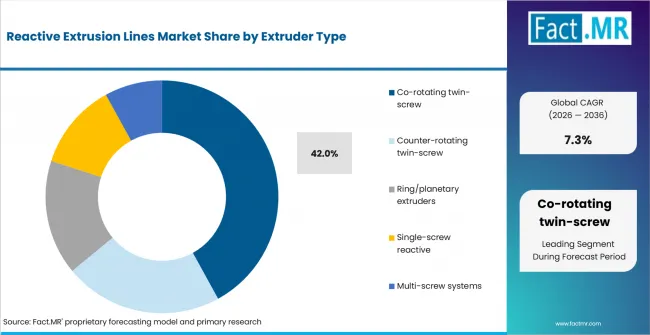
Reactive Extrusion Lines Market Analysis By Extruder Type | Source: Fact.MR
The two screws move the material forward while mixing it again and again. This gives engineers better control over mixing, heat, air removal and the time available for the reaction. The screw movement also helps stop material from building up inside the barrel. This is useful when the polymer or additives may be damaged by heat. These benefits make the system suitable for continuous production even when feed rates change.
Why does Reactive compounding lead Reaction Type?
Reactive compounding lead with 30.0% share in 2026.
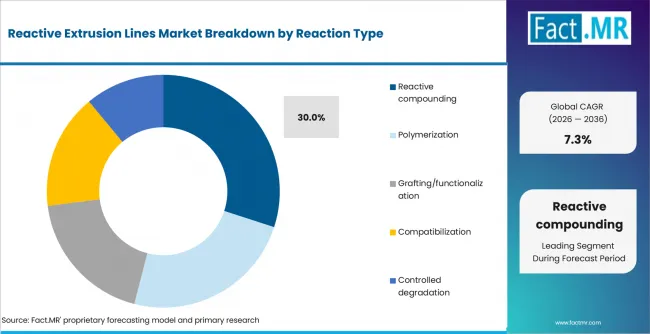
Reactive Extrusion Lines Market Analysis By Reaction Type | Source: Fact.MR
Reactive compounding changes the polymer while the final material is being mixed and shaped. Additives and other materials are added during the same process. In many cases, this removes the need for a separate reaction step. The method improves bonding, melt strength, impact resistance and the way different polymers work together. Its use across several material needs gives it a wider role than methods made for only one type of polymer change.
Why do Lab/pilot lines lead Throughput?
Lab/pilot lines account for 22.0% share in 2026.
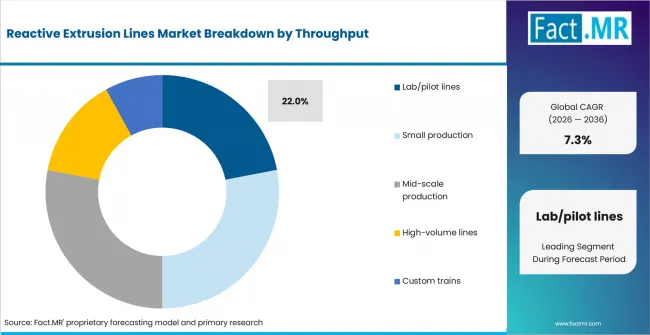
Reactive Extrusion Lines Market Analysis By Throughput | Source: Fact.MR
Companies usually test reactive extrusion on a smaller line before investing in full production equipment. Pilot units help engineers compare screw designs, feed rates, heat settings and air removal without using large amounts of material. They also show whether the reaction stays steady during continuous operation. This reduces the risk of moving to a larger line and provides the information needed to plan the full system.
Why do Polyolefins lead Polymer System?
Polyolefins lead with 31.0% share in 2026.
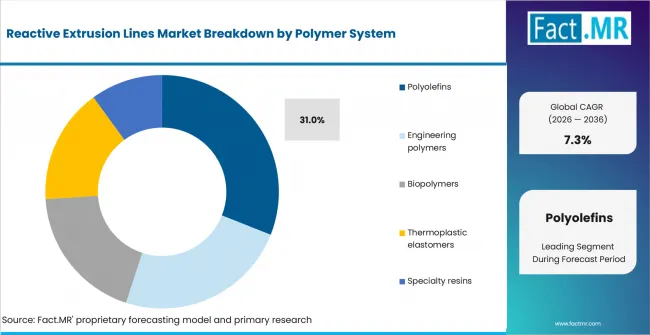
Reactive Extrusion Lines Market Analysis By Polymer System | Source: Fact.MR
Polyolefins are widely used in packaging, vehicle parts, household products and industrial goods. Reactive extrusion helps them mix better with other plastics. It also restores strength in recycled material and adds new features for selected uses. Their large production volume creates more room for improvement than lower-volume special plastics. Existing experience with these materials also makes testing and approval easier.
Why do Polymer producers lead End User?
Polymer producers hold 32.0% share in 2026.
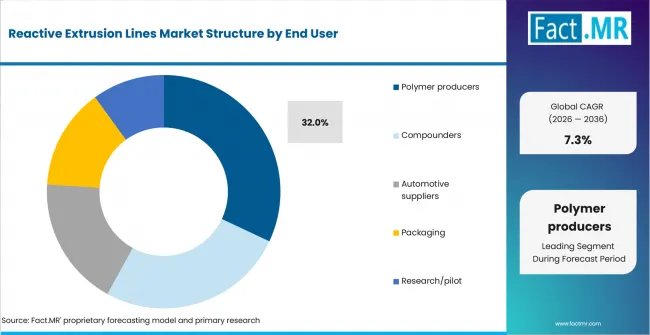
Reactive Extrusion Lines Market Analysis By End User | Source: Fact.MR
Polymer producers use reactive extrusion while the resin is being made and its main properties are being set. This allows them to adjust flow, strength, bonding and surface performance before the material reaches other manufacturers. Large production volumes also make the investment easier to support through repeat orders. Making these changes in-house helps companies offer higher-value grades instead of relying only on standard resins.
What is accelerating Reactive Extrusion Lines Market adoption, and what is holding it back?
Polymer circularity is anticipated to expand Reactive Extrusion Lines Market demand. Process-development burden is expected to restrain faster adoption because every chemistry needs careful setup work.
Drivers Impact Analysis
| DRIVER | (~) % IMPACT ON CAGR | GEOGRAPHIC RELEVANCE | IMPACT TIMELINE |
|---|---|---|---|
| Polymer circularity | +2.1% | Europe and USA; Japan | Short term (<=2 years) |
| Integrated reaction and shaping | +1.5% | Polymer producers | Medium term (2-4 years) |
| Material customization | +1.1% | Automotive and packaging | Short term (<=2 years) |
| Pilot-to-production platforms | +0.7% | Research and compounders | Medium term (2-4 years) |
Source: Fact.MR analysis. Updated Jul 22, 2026
- Polymer circularity: Reactive processing is expected to help mixed and recycled polymers move into applications that need stable properties. It is most relevant where recycling rules and brand requirements push producers beyond low-grade reuse.
- Integrated reaction and shaping: A single line is expected to reduce material transfers and process steps. Polymer producers benefit when the reaction and final compound are controlled inside the same production flow.
- Material customization: Reactive extrusion is anticipated to help automotive and packaging users tune impact strength, melt flow and compatibility. This is useful when a standard resin grade does not meet the converter’s processing window.
- Pilot-to-production platforms: Scalable screw and barrel platforms are expected to reduce risk in technical scale-up. Research teams and compounders benefit when lab trials point clearly toward a production configuration.
Opportunity Impact Analysis
| OPPORTUNITY | (~) % IMPACT ON CAGR | GEOGRAPHIC RELEVANCE | IMPACT TIMELINE |
|---|---|---|---|
| Recycling-specific line packages | +1.3% | China and UAE | Short term (<=2 years) |
| Digital screw and reaction models | +0.9% | China and UAE | Medium term (2-4 years) |
| Bio-based resin processing | +0.7% | China and UAE | Medium term (2-4 years) |
Source: Fact.MR analysis. Updated Jul 22, 2026
- Recycling-specific line packages: Feed conditioning, filtration and devolatilization around the reactive section are expected to address contamination and variable melt quality. This creates room for integrated packages built for recycled feedstock.
- Digital screw and reaction models: Simulation tools are expected to reduce physical trial-and-error work during scale-up. The highest value sits in projects where reaction kinetics and melt flow have to be tuned together.
- Bio-based resin processing: Moisture-sensitive and heat-sensitive bio-based polymers are expected to need gentler residence-time control. That opens a route for line designs built around lower thermal stress.
Restraints Impact Analysis
| RESTRAINT | (~) % IMPACT ON CAGR | GEOGRAPHIC RELEVANCE | IMPACT TIMELINE |
|---|---|---|---|
| Process-development burden | -1.6% | Global | Short term (<=2 years) |
| Capital intensity | -1.2% | Global | Short term (<=2 years) |
| Feed variability | -0.9% | Global | Medium term (2-4 years) |
Source: Fact.MR analysis. Updated Jul 22, 2026
- Process-development burden: Every chemistry needs its own screw profile, temperature window and feed-rate plan. That slows ordering decisions when plant teams do not have enough trial data.
- Capital intensity: High-torque extruders need feeding and venting systems around them. Filtration and downstream equipment add further cost.
- Feed variability: Recycled and mixed-source inputs are expected to create unstable reactions and inconsistent melt quality. This risk raises the need for testing before a line is run at commercial scale.
Which countries are scaling Reactive Extrusion Lines Market fastest?
A global growth rate represents the weighted average of all countries included in the analysis. The worldwide 7.3% CAGR sits between the rates recorded across the full coverage set. UAE remain above this figure while the USA is closely aligned with it. Japan, the United Kingdom and Germany remain below the global rate. The six countries shown are illustrative examples, and their comparison with the worldwide figure makes these differences visible.
- The countries are distinguished less by their CAGRs and more by the type of reactive extrusion investment supporting demand.
- UAE form a compact upper group, although their development routes differ. The UAE follows a downstream petrochemical route where companies use reactive processing to produce higher-value compounds from local resin streams.
- The USA and Japan are closely aligned near the global rate. USA demand is linked to recycling projects that improve mixed-plastic quality or rebuild polymer performance. Japan places more weight on carefully adjusted materials for automotive and electronics applications.
- The United Kingdom and Germany form a measured lower group within the comparison. UK projects depend on specialist compounding and proof that recycled-content materials perform consistently. Germany focuses more on qualified automotive materials, where trial capability and technical service influence equipment approval.
- Markets with broadly similar CAGRs can therefore follow considerably different development paths. Feedstock quality, material trials, application approval and access to technical service shape when projects move from pilot testing to commercial production.
The full report examines these dynamics for every market included in the study. It provides country-level CAGR analysis across North America, Latin America, Europe, East Asia, South Asia, Oceania, and the Middle East and Africa.
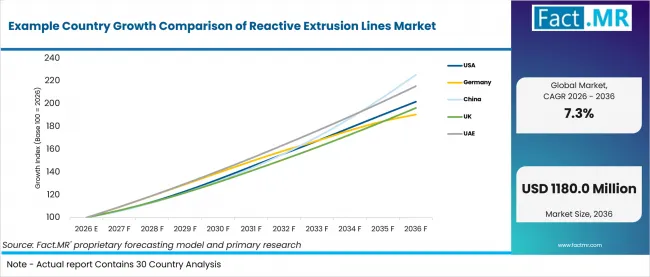
Example Country Growth Comparison Of Reactive Extrusion Lines Market | Source: Fact.MR
| COUNTRY | CAGR (2026 to 2036) |
|---|---|
| UAE | 8.0% |
| USA | 7.3% |
| Japan | 7.2% |
| UK | 7.0% |
| Germany | 6.7% |
Source: Fact.MR analysis. Updated Jul 22, 2026
How is the UAE scaling demand?
8.0% CAGR, driven by local recycling capacity and greater use of recovered materials in industry.
The UAE is building a stronger local system that turns collected plastic waste into raw material for factories. Government policies also encourage wider use of recovered materials in manufacturing. This creates demand for equipment that cleans and improves recycled plastics for higher-value products.
What supports USA adoption?
7.3% CAGR, linked to research spending on plastic reuse and material repair.
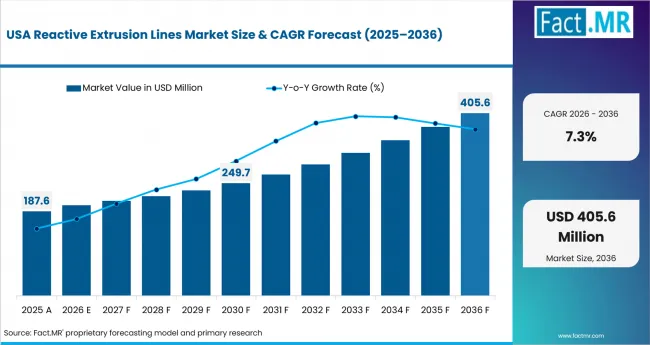
Reactive Extrusion Lines Market Country Value Analysis | Source: Fact.MR
In the USA, growth is supported by new technology development instead of one nationwide rule on recycled content. The Department of Energy continues to support better material design, recycling methods and reuse systems. Reactive extrusion helps move these developments into production by restoring plastic properties and preparing harder-to-process waste for new products.
How is Japan developing demand?
7.2% CAGR, shaped by separate recycling systems for vehicles and electrical equipment.
Japan’s market is growing through recycling programs for vehicles and electrical equipment. Government efforts encourage better recovery and reuse of these materials. Reactive extrusion helps processors reuse engineering plastics when heat exposure, contamination or mixed resin types make simple remelting difficult.
What shapes UK growth?
7.0% CAGR, supported by clear recycled-content rules for plastic packaging.
UK demand is linked to rules that encourage the use of recycled plastic in packaging. Companies also need clear records to support recycled-content claims. These requirements give manufacturers a strong reason to improve recycled plastic quality and keep material performance consistent during production.
How does Germany perform?
6.7% CAGR, backed by strict testing of recycled plastics used in technical products.
Germany’s market is shaped by the challenge of using recycled plastics in high-performance products. Strict quality requirements mean recycled materials must meet demanding standards before use. Reactive extrusion is expected to support this work by improving recycled plastics so they are suitable for automotive and electrical applications.
Who leads the Reactive Extrusion Lines Market?
Coperion and Leistritz have the strongest position in twin-screw reactive extrusion. KraussMaffei, The Japan Steel Works Ltd. and Shibaura Machine Co., Ltd. also have a strong role in full-scale production equipment.
Coperion offers ZSK co-rotating twin-screw systems and complete lines for polymer mixing and processing. Leistritz provides twin-screw systems that are used to change polymer properties, remove unwanted gases and support chemical reactions during processing. KraussMaffei adds extrusion equipment for recycling and more demanding plastic compounds. The Japan Steel Works Ltd. offers TEX twin-screw extruders and test facilities where companies can check their materials before investing in a full line. Shibaura Machine Co., Ltd. provides TEM extrusion systems and trial support for polymer mixing and reaction work.
From 2026 to 2036, companies are expected to compete on screw design flexibility and the quality of material trials carried out before final approval. Polymer producers are also likely to compare feed accuracy, gas removal and how easily the process moves from a pilot line to full production. Equipment makers that offer reliable machines, fast technical help and nearby spare parts are likely to win more difficult projects.
Which companies are the key providers?
Key companies include Coperion; Leistritz; KraussMaffei; The Japan Steel Works Ltd.; Shibaura Machine Co., Ltd.
- Coperion
- Leistritz
- KraussMaffei
- The Japan Steel Works Ltd.
- Shibaura Machine Co., Ltd.
Bibliography
- U.S. Department of Energy. (2026, March 11). CX-270942: Washington University in St. Louis - Kg-scale, solvent-free upcycling of pure and mixed polyolefin waste. U.S. Department of Energy.
- U.S. Environmental Protection Agency. (2024, November 21). Biden-Harris Administration announces national strategy to prevent plastic pollution. U.S. Environmental Protection Agency.
- European Parliament and Council of the European Union. (2025, January 22). Regulation (EU) 2025/40 on packaging and packaging waste. EUR-Lex.
- Ministry of Economy, Trade and Industry. (2025, February 25). Cabinet decision on the bill for the Act for Partially Amending the Act on the Promoting Transition to the Decarbonized Growth Economic Structure and the Act on the Promotion of Effective Utilization of Resources. Ministry of Economy, Trade and Industry.
- KraussMaffei. (2026, April 15). Turning ideas into circular economies: KraussMaffei Extrusion showcases the full spectrum of recycling at PRSE. KraussMaffei.
This Report Addresses
- The report provides strategic intelligence on Reactive Extrusion Lines Market across Extruder Type and Reaction Type choices that shape purchasing decisions.
- Segment analysis covers Co-rotating twin-screw as the share leader within the 2026 market structure.
- Regional outlook evaluates UAE alongside USA and Japan, while UK and Germany complete the growth comparison.
- Competitive analysis profiles Coperion and Leistritz alongside KraussMaffei and other active providers.
- Use-case assessment covers the categories and applications that shape reactive extrusion lines market demand across the forecast period.
What does the Reactive Extrusion Lines Market cover?
Reactive extrusion lines are used to shape polymers while carrying out a controlled chemical change within the same continuous process.
The Reactive Extrusion Lines Market covers coordinated equipment used for reactive compounding, polymerization, grafting, functionalization, compatibilization and controlled degradation. Coverage includes co-rotating and counter-rotating twin-screw extruders alongside ring or planetary, single-screw reactive and multi-screw systems. Lab or pilot units, small and mid-scale production lines, high-volume systems and custom trains are included.
The market differs from standard polymer compounding because commercial value comes from carrying out a chemical reaction during extrusion. Ordinary mixing that does not change the polymer structure remains outside the boundary. The scope focuses on lines where feeding, reaction control, venting and shaping operate together to modify material performance.
What is included in the scope?
Reactive extrusion lines are used by polymer producers, compounders, automotive material companies, packaging manufacturers and research facilities.
The scope includes Extruder Type and Reaction Type alongside Throughput, Polymer System and End User. Polymer coverage spans polyolefins, engineering polymers, biopolymers, thermoplastic elastomers and specialty resins. The equipment boundary includes reactive extruders, gravimetric feeders, liquid-injection units and venting systems when they form one coordinated line. Melt filtration, pelletizing equipment and process controls are also included when delivered as part of the reactive extrusion system.
What is excluded from the scope?
Standard compounding equipment and unrelated downstream machinery remain outside the scope of this market.
The scope excludes polymer mixing lines that do not include a controlled reaction step. Standalone pelletizers and separate material-handling equipment are excluded when they are not part of the reactive line. Finished packaging machinery and polymer chemistry licensing also remain outside the boundary. General resin production spending is excluded unless it is directly tied to the purchase or operation of reactive extrusion equipment.
How Was the Analysis Built?
The analysis draws on 120+ sources, 35+ company portfolios, 25+ countries, and more than 20 industry interviews.
- Primary Research: Primary research includes discussions with manufacturers, service providers, technology developers, distributors, end users, procurement teams, and subject-matter experts. These conversations examine purchasing priorities, product adoption, operational challenges, approval requirements, competitive positioning, and the factors that influence wider market acceptance.
- Desk Research: Desk research covers government statistics, regulatory publications, company filings, trade data, technical studies, industry associations, standards, public policy, and other authoritative sources. Every source used in the analysis is documented in the bibliography.
- Market Sizing and Forecasting: Market estimates combine historical performance, demand indicators, pricing and volume trends, segment shares, company participation, country-level growth, adoption patterns, investment activity, and barriers to market expansion.
- Data Validation and Update Cycle: Findings are validated by comparing primary interviews with public data, company activity, regulatory changes, trade patterns, and industry developments. Regular updates review new product launches, capacity changes, partnerships, approvals, procurement trends, and shifts in commercial adoption.
Segmentation
What is the report's scope and coverage?
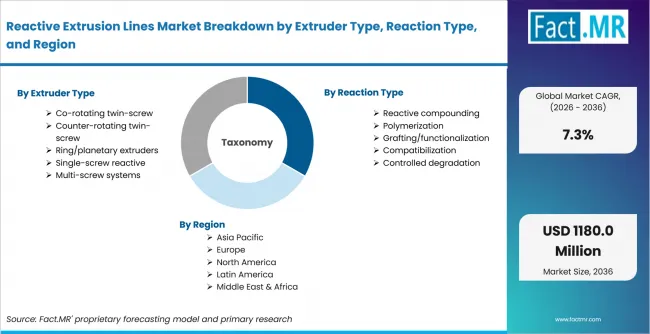
Reactive Extrusion Lines Market Breakdown By Extruder Type, Reaction Type, And Region | Source: Fact.MR
| Attribute | Details |
|---|---|
| Quantitative Units | USD million in 2026 to USD million by 2036 at a CAGR |
| Market Definition | A reactive extrusion line shapes polymer material and chemically transforms it inside the same controlled processing line. |
| Extruder Type | Co-rotating twin-screw; Counter-rotating twin-screw; Ring/planetary extruders; Single-screw reactive; Multi-screw systems |
| Reaction Type | Reactive compounding; Polymerization; Grafting/functionalization; Compatibilization; Controlled degradation |
| Throughput | Lab/pilot lines; Small production; Mid-scale production; High-volume lines; Custom trains |
| Polymer System | Polyolefins; Engineering polymers; Biopolymers; Thermoplastic elastomers; Specialty resins |
| End User | Polymer producers; Compounders; Automotive suppliers; Packaging; Research/pilot |
| Regions Covered | North America; Latin America; Europe; East Asia; South Asia & Oceania; Middle East & Africa |
| Countries Covered | USA; Canada; Brazil; Mexico; Germany; U.K.; France; Italy; Spain; South Korea; Japan;Australia & New Zealand; GCC Countries; South Africa; UAE |
| Key Companies Profiled | Coperion; Leistritz; KraussMaffei; The Japan Steel Works Ltd.; Shibaura Machine Co., Ltd. |
| Forecast Period | 2026 to 2036 |
| Approach | Hybrid top-down and bottom-up approach using demand indicators across Extruder Type, Reaction Type, Throughput, Polymer System and End User. The approach also reviews country-level growth and company participation. |
Source: Fact.MR analysis. Updated Jul 22, 2026
How is the market segmented?
-
By Extruder Type:
- Co-rotating twin-screw
- Counter-rotating twin-screw
- Ring/planetary extruders
- Single-screw reactive
- Multi-screw systems
-
By Reaction Type:
- Reactive compounding
- Polymerization
- Grafting/functionalization
- Compatibilization
- Controlled degradation
-
By Throughput:
- Lab/pilot lines
- Small production
- Mid-scale production
- High-volume lines
- Custom trains
-
By Polymer System:
- Polyolefins
- Engineering polymers
- Biopolymers
- Thermoplastic elastomers
- Specialty resins
-
By End User:
- Polymer producers
- Compounders
- Automotive suppliers
- Packaging
- Research/pilot
-
By Region:
- North America
- USA
- Canada
- Latin America
- Brazil
- Mexico
- Rest of Latin America
- Europe
- Germany
- U.K.
- France
- Italy
- Spain
- Rest of Europe
- East Asia
- South Korea
- Japan
- China
- South Asia & Oceania
- India
- Australia & New Zealand
- Rest of South Asia & Oceania
- Middle East & Africa
- GCC Countries
- South Africa
- UAE
- Rest of Middle East & Africa
- North America
Frequently Asked Questions
Which Extruder Type leads the Reactive Extrusion Lines Market?
Which Reaction Type leads the Reactive Extrusion Lines Market?
Which Throughput leads the Reactive Extrusion Lines Market?
Which Polymer System leads the Reactive Extrusion Lines Market?
Which End User leads the Reactive Extrusion Lines Market?
How does UAE perform in the Reactive Extrusion Lines Market?
How does USA perform in the Reactive Extrusion Lines Market?
What is the primary driver in the Reactive Extrusion Lines Market?
What is the main restraint in the Reactive Extrusion Lines Market?
Who worked on this report


Preview the report firsthand - request a free sample
Free SampleGet the brochure for pricing and purchase details
Download PDF