- Market Value (2025): USD 113.5 Mn
- Estimated Value (2026): USD 118.3 Mn
- Forecast Value (2036): USD 179.8 Mn
- CAGR (2026-2036): 4.3%
Real-Time Transport-Stream Analyzer Market Forecast and Outlook 2026 to 2036
The real-time transport-stream analyzer market is valued at USD 118.3 million in 2026. By 2036, revenue is forecast to reach USD 179.8 million, with a CAGR of 4.3% over the ten-year period.
Broadcasters must identify packet loss, timing errors and signaling problems before they affect live services. That requirement creates a role for stream analyzers in broadcast centers, distribution networks and remote transmission sites. Software probes provide additional flexibility when media operations move onto shared servers. The growth of IP delivery changes where signals are inspected and which protocols each monitoring system must understand.
Market Highlights for the Real-Time Transport-Stream Analyzer Market
- Sales of real-time transport-stream analyzers stood at USD 113.5 million in 2025
- Real-Time Transport-Stream Analyzer Market Value (2026): USD 118.3 million
- Real-Time Transport-Stream Analyzer Market Forecast Value (2036): USD 179.8 million
- Real-Time Transport-Stream Analyzer Market Forecast CAGR (2026-2036): 4.3%
- Leading Component: Software (48.3%)
- Companies Profiled: Rohde & Schwarz GmbH & Co. KG, Bridge Technologies Co AS, Interra Systems Inc., Telestream LLC, Sencore Inc., Triveni Digital Inc.
- Countries Analyzed: Germany, United States, United Kingdom, Brazil, Japan
Brazil issued Decree No. 12,595 on August 27, 2025, selecting the ATSC 3.0 physical-layer standard for TV 3.0. The decree also establishes a route for further technical specifications and phased introduction. Broadcasters currently use dedicated instruments alongside software probes. Buyers assess whether a system can identify faults as signals move between encoding, distribution and transmission. Suppliers are adding remote dashboards to help engineers monitor several sites from one location.
Real-Time Transport-Stream Analyzer Market
| Metric | Value |
|---|---|
| Estimated Value in (2026) | USD 118.3 million |
| Forecast Value in (2036) | USD 179.8 million |
| Forecast CAGR (2026 to 2036) | 4.3% |
Source: Fact.MR analysis. Updated Nov 20, 2026
Source: Fact.MR analysis.
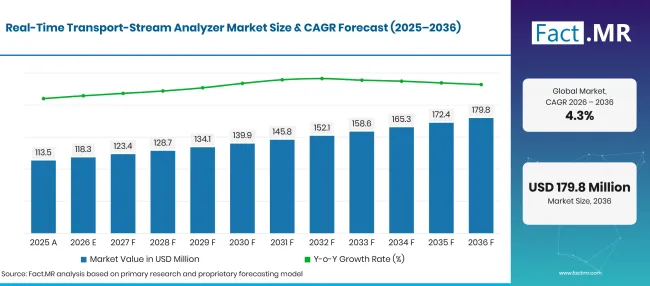
Real Time Transport Stream Analyzer Market Forecast Global | Source: Fact.MR
Category
| Category | Segments |
|---|---|
| Component | Software, Hardware, Services |
| Application | Broadcasting, Cable Television, Satellite Television, IPTV, Others |
| Deployment Mode | On-Premises, Cloud |
| End-User | Broadcasting Companies, Network Operators, Content Providers, Others |
| Region | Germany; United States; United Kingdom; Brazil; Japan |
Source: Fact.MR analysis. Updated Nov 20, 2026
Source: Fact.MR analysis.
Segmental Analysis
Why does software lead component demand in the Real-Time Transport-Stream Analyzer Market?
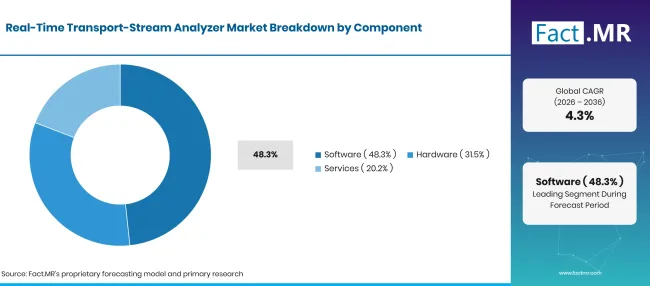
Real Time Transport Stream Analyzer Market Breakdown Component | Source: Fact.MR
Software generates 48.3% of market revenue in 2026, equivalent to about USD 57.2 million. Virtual probes can run on standard computing hardware and monitor multiple streams without requiring a dedicated physical instrument at every location. Broadcast engineers value software that reports continuity faults, transport errors and service information from a single interface. Hardware remains important for laboratory measurements and dedicated signal monitoring, while support services help operators maintain complex installations.
Why does broadcasting lead application demand in the Real-Time Transport-Stream Analyzer Market?
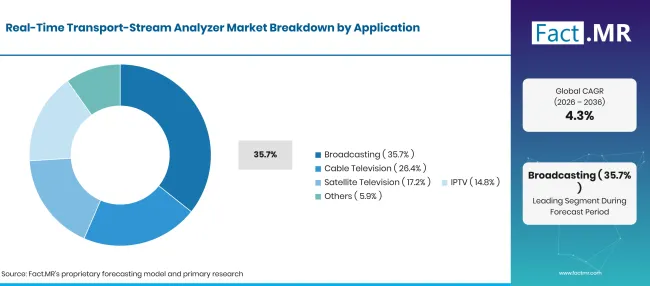
Real Time Transport Stream Analyzer Market Breakdown Application | Source: Fact.MR
Broadcasting accounts for 35.7% of application revenue in 2026, or around USD 42.2 million. Terrestrial broadcasters monitor outgoing services so faults can be corrected before reaching regional transmitters. Cable, satellite and IPTV operators also inspect transport streams, with different delivery paths and signaling requirements. Support for the operator’s DVB or ATSC workflow therefore matters when equipment is selected.
Why does on-premises deployment lead the Real-Time Transport-Stream Analyzer Market?
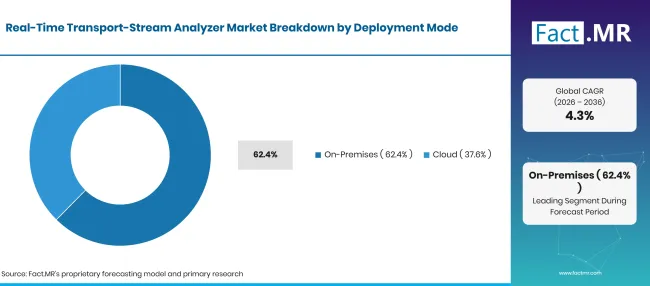
Real Time Transport Stream Analyzer Market Breakdown Deployment Mode | Source: Fact.MR
On-premises installations lead with 62.4% of revenue in 2026, approximately USD 73.8 million. Broadcasters locate monitoring equipment at headends, playout centers and transmission facilities where engineers need direct signal access. Cloud services can inspect remotely hosted media workflows. Hybrid installations link local measurements to central alerts. Engineers can then investigate reported faults without traveling to every site.
Why do broadcasting companies lead end-user demand in the Real-Time Transport-Stream Analyzer Market?
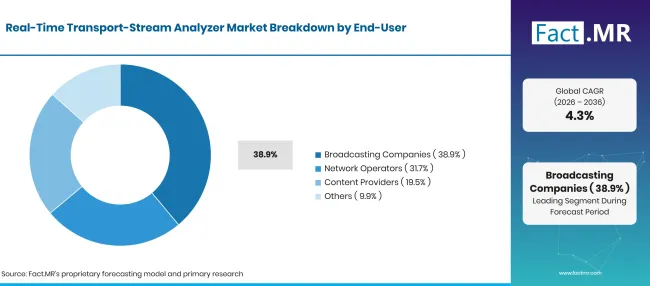
Real Time Transport Stream Analyzer Market Breakdown End User | Source: Fact.MR
Broadcasting companies represent 38.9% of revenue in 2026, about USD 46.0 million. They monitor outgoing programs to meet service requirements and reduce interruptions. Network operators focus on distribution reliability, while content providers need confidence that their feeds reach downstream partners intact. Purchasing therefore depends on the fault types that must be detected and the number of services under continuous observation.
Real-Time Transport-Stream Analyzer Market-Drivers, Restraints & Trends
Drivers:
The movement of broadcast contribution and playout onto IP networks increases the number of points where signal quality must be checked. Transport-stream analyzers help engineers identify continuity counter errors, missing service information and disruptions during transmission. Equipment covering both packet-level faults and broadcast signaling can simplify troubleshooting across mixed networks. Spending will depend on how much visibility operators require across their facilities and distribution partners.
Restraints:
Broadcasters face pressure to control monitoring costs as viewing habits shift toward streaming. Some encoders and network devices include basic alarms, which can reduce demand for separate tools at smaller sites. Dedicated analyzers must justify their expense through deeper diagnostics, broader standards coverage and reliable fault histories. Customers may delay a rollout when existing equipment meets the needs of a limited service lineup.
Trend: Cloud-Native Monitoring.
Software-based monitoring is being adapted for playout workloads hosted in cloud infrastructure. Operators can consolidate alarms from several regions and inspect live services through remote dashboards. Telestream and Bridge Technologies are among the suppliers active in software monitoring. Performance depends on whether the monitoring system can inspect the actual media path, including errors that a dashboard may not reveal.
Trend: New Broadcast Standards.
ATSC 3.0, DVB-T2 and Brazil’s TV 3.0 create additional testing requirements for receiver compatibility, service signaling and distribution. ATSC 3.0 supports IP-based service delivery; its A/330 link-layer protocol also provides mechanisms for carrying MPEG-2 transport-stream packets. Monitoring vendors therefore need tools suited to each standard and protocol. This technical distinction will influence broadcaster upgrades and test-equipment selection.
Real-Time Transport-Stream Analyzer Market by Analysis by Key Country
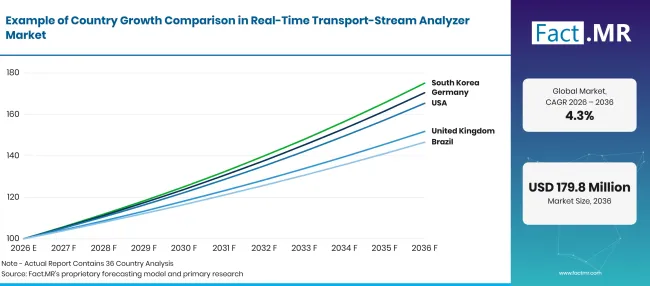
Real Time Transport Stream Analyzer Market Growth Index | Source: Fact.MR
| Country | CAGR (2026-2036) |
|---|---|
| Germany | 5.5% |
| United States | 5.2% |
| United Kingdom | 4.3% |
| Brazil | 3.9% |
| Japan | 3.1% |
Source: Fact.MR analysis. Updated Nov 20, 2026
Source: Fact.MR analysis.
Why is Germany the fastest-growing market for transport-stream analyzers?
Germany is forecast to record a 5.5% CAGR through 2036, the fastest rate among the five countries reviewed.
ARD, ZDF and their distribution partners operate broadcast infrastructure that requires consistent service monitoring during network changes. As IP-based production and DVB-T2 services coexist, engineers need to inspect signals at several stages. Munich-based Rohde & Schwarz is among the established suppliers of broadcast test technology. Equipment that supports both current transmission systems and new workflows should have a practical role in replacement plans.
How is ATSC 3.0 supporting transport-stream analyzer sales in the United States?
In the United States, transport-stream analyzer revenue is projected to increase at a 5.2% CAGR. ATSC 3.0 deployments give broadcasters additional work in checking service signaling, IP transport and receiver-facing performance.
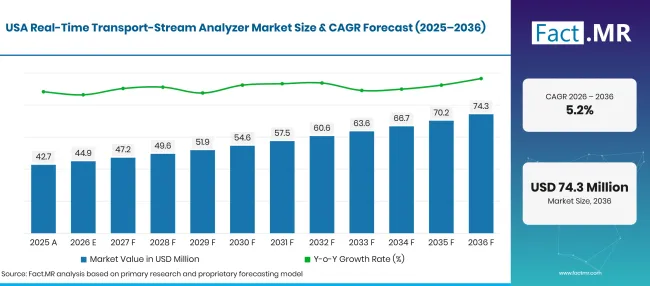
Real Time Transport Stream Analyzer Market Forecast Usa | Source: Fact.MR
Established MPEG transport streams remain relevant in other parts of the delivery chain, so a single network may require more than one set of test functions. Domestic vendors such as Sencore and Triveni Digital serve operators that need fault diagnostics and standards-aware monitoring.
What is shaping transport-stream analyzer demand in the United Kingdom?
The United Kingdom market is forecast to rise at a 4.3% CAGR between 2026 and 2036.
Broadcasters must continue supporting terrestrial television while evaluating future IP distribution. Equipment orders will vary by playout, contribution and network project because existing monitoring installations have different replacement schedules. Systems that bring alarms from mixed delivery paths into one view can reduce the time engineers spend tracing interruptions.
What is shaping transport-stream analyzer demand in Brazil?
Brazil is expected to register a 3.9% CAGR over the forecast period.
Preparations for TV 3.0 will require broadcast engineers to evaluate new signaling, service delivery and equipment interoperability. Operators may need to test traditional signals alongside systems designed for the next-generation platform. Suppliers able to demonstrate support for Brazil’s chosen technical specifications can better address this transition.
Why is transport-stream analyzer growth slower in Japan?
Japan’s market is projected to expand at a 3.1% CAGR through 2036.
Existing digital television and advanced satellite infrastructure creates an established base of monitoring equipment. Sales opportunities are therefore likely to arise from targeted updates, maintenance and changes within individual facilities. Broadcasters will continue to evaluate diagnostic precision and compatibility before replacing working systems.
Competitive Assessment of Real-Time Transport-Stream Analyzer Market
The competitive field brings together broad test-equipment suppliers and companies focused on video monitoring. Rohde & Schwarz offers established measurement capabilities, while Bridge Technologies, Interra Systems, Telestream, Sencore, DekTec, Pixelmetrix and Triveni Digital serve different parts of broadcast analysis and monitoring. Buyers compare supported protocols, real-time alarms, integration effort and the ability to monitor large service portfolios. Tektronix remains a historical brand in video testing, while Telestream competes in modern monitoring and quality-control workflows.
Competition increasingly centers on software deployment and the ability to combine IP-network diagnostics with media-layer analysis. Broadcasters moving selected workloads into shared computing environments need monitoring that follows those workloads. Suppliers with clear fault reporting, flexible deployment and support for both established and emerging standards are positioned to address varied engineering budgets.
Recent Developments
- In March 2025, Triveni Digital introduced its StreamScope MT-70 MPEG analyzer, featuring web-based remote monitoring, SCTE-35 logging and continuous transport-stream recording to improve broadcast signal analysis, troubleshooting and quality monitoring across television networks.
- In March 2026, Telestream introduced UP.Lens, a cloud-based monitoring platform offering real-time stream analysis, automated alerts and video rewind capabilities to help broadcasters identify signal problems across distributed live production environments.
Key Players in Real-Time Transport-Stream Analyzer Market
Key companies operating in the market include Rohde & Schwarz GmbH & Co. KG, Bridge Technologies Co AS, Interra Systems Inc., Telestream LLC, Sencore Inc., DekTec Digital Video B.V., Pixelmetrix Corporation, and Triveni Digital Inc.
- Rohde & Schwarz GmbH & Co. KG
- Bridge Technologies Co AS
- Interra Systems Inc.
- Telestream LLC
- Sencore Inc.
- DekTec Digital Video B.V.
- Pixelmetrix Corporation
- Triveni Digital Inc.
Bibliography
- Agência Nacional de Telecomunicações. (2026, February 24). Ato nº 2705, de 24 de fevereiro de 2026.
- Agência Nacional de Telecomunicações. (2026, July 6). Resolução Anatel nº 789, de 6 de julho de 2026.
- Advanced Television Systems Committee. (2026, April 14). A/300:2026-04, ATSC 3.0 system.
- Advanced Television Systems Committee. (2026, June 11). A/322:2026-06, Physical layer protocol.
- Associação Brasileira de Normas Técnicas. (2025, November 18). ABNT NBR 25603:2025—TV 3.0: Codificação de vídeo.
- Advanced Television Systems Committee. (2026, August 13). A/327:2026-08, Guidelines for the physical layer protocol.
- Advanced Television Systems Committee. (2026, August 11). A/360:2026-08, ATSC 3.0 security and service protection.
- Empresa Brasil de Comunicação. (2026, April 14). EBC começa implantação da TV 3.0 com nova estação de testes. Agência Brasil.
- Ministério das Comunicações. (2026). Televisão 3.0. Government of Brazil.
- Presidência da República. (2025, August 27). Decreto nº 12.595, de 27 de agosto de 2025.
- Triveni Digital. (2025, March 13). Triveni Digital introduces next evolution of StreamScope MPEG analyzer at 2025 NAB Show.
- Telestream. (2026, March 31). Telestream UP.Lens closes the observability gap in live & remote production workflows.
Segmentation
Scope of Report
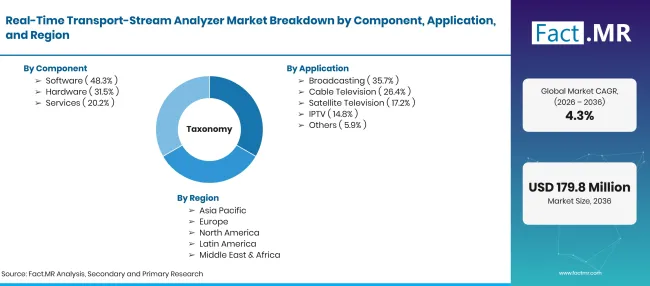
Real Time Transport Stream Analyzer Market Taxonomy | Source: Fact.MR
| Items | Values |
|---|---|
| Quantitative Units (2026) | USD 118.3 Million |
| Component | Software, Hardware, Services |
| Application | Broadcasting, Cable Television, Satellite Television, IPTV, Others |
| Deployment Mode | On-Premises, Cloud |
| End-User | Broadcasting Companies, Network Operators, Content Providers, Others |
| Regions Covered | North America, Latin America, Europe, East Asia, South Asia and Pacific, Middle East & Africa |
| Countries Covered | United States, Germany, Japan, United Kingdom, Brazil, and other countries |
| Key Companies Profiled | Rohde & Schwarz GmbH & Co. KG, Bridge Technologies Co AS, Interra Systems Inc., Telestream LLC, Sencore Inc., DekTec Digital Video B.V., Pixelmetrix Corporation, Triveni Digital Inc. |
| Additional Attributes | Dollar revenue in the Real-Time Transport-Stream Analyzer Market is segmented by component (software, hardware, services); application (broadcasting, cable television, satellite television, IPTV); deployment mode (on-premises, cloud); end-user (broadcasting companies, network operators, content providers) and region. |
Source: Fact.MR analysis. Updated Nov 20, 2026
Source: Fact.MR analysis.
Real-Time Transport-Stream Analyzer Market by Segments
-
Component
- Software
- Hardware
- Services
-
Application
- Broadcasting
- Cable Television
- Satellite Television
- IPTV
- Others
-
Deployment Mode
- On-Premises
- Cloud
-
End-User
- Broadcasting Companies
- Network Operators
- Content Providers
- Others
-
Region:
- North America
- United States
- Canada
- Mexico
- Europe
- Germany
- United Kingdom
- France
- Italy
- Spain
- Rest of Europe
- Asia Pacific
- China
- India
- Japan
- South Korea
- Australia
- Rest of Asia Pacifica
- Latin America
- Brazil
- Mexico
- Argentina
- Rest of Latin America
- Middle East & Africa
- GCC Countries
- South Africa
- Rest of Middle East & Africa
- North America
Frequently Asked Questions
How big is the global Real-Time Transport-Stream Analyzer Market in 2026?
What will be the size of the Real-Time Transport-Stream Analyzer Market by 2036?
How fast will the Real-Time Transport-Stream Analyzer Market grow during the forecast period?
Which component segment holds the largest share of the Real-Time Transport-Stream Analyzer Market?
Who worked on this report


Preview the report firsthand - request a free sample
Free SampleGet the brochure for pricing and purchase details
Download PDF