- Market Value (2025): USD 4.56 Bn
- Estimated Value (2026): USD 4.87 Bn
- Forecast Value (2036): USD 9.37 Bn
- CAGR (2026-2036): 6.8%
Self-adhered SA Membranes Market Forecast and Outlook 2026 to 2036
Fact.MR studies, the self-adhered membranes market surpassed a value of USD 4.56 billion in 2025 and is projected to grow from USD 4.87 billion in 2026 to USD 9.37 billion by 2036. Demand for self-adhered membranes is likely to grow at a CAGR of 6.8% over the forecast period.
Demand for self-adhered membranes is rising as builders seek waterproofing and air barriers that install without torches or hot asphalt. Manufacturers of self-adhered membranes are offering peel-and-stick sheets for roofs, walls and foundations. For example, the US Census Bureau reported about 1.37 million housing starts in 2024, each requiring roof underlayment and wall barriers. Similar construction volumes are projected to drive sales of self-adhered membranes through 2036.
Key Takeaways from the Self-adhered SA Membranes Market
- Self-adhered SA Membranes Market Value (2025): USD 4.56 billion
- Self-adhered SA Membranes Market Value (2026): USD 4.87 billion
- Self-adhered SA Membranes Market Forecast Value (2036): USD 9.37 billion
- Self-adhered SA Membranes Market Forecast CAGR (2026-2036): 6.8%
- Leading Product Type: Bituminous (58.3%)
- Key Market Participants: Sika AG, Carlisle Companies Inc., GAF Materials Corporation, Soprema Group, Firestone Building Products, Johns Manville
- Key Growth Regions: United States, Brazil, United Kingdom, Germany, Japan
In June 2025, Holcim completed the spin-off of its North American business as Amrize, which includes the former Firestone Building Products roofing and waterproofing brands. Demand for self-adhered membranes is growing as building-envelope suppliers focus on North American roofing. Manufacturers of self-adhered membranes are expanding peel-and-stick lines and contractor training. Similar restructuring is projected to shape sales of self-adhered membranes across North America and Europe.
Self-adhered SA Membranes Market
| Metric | Value |
|---|---|
| Estimated Value in (2026) | USD 4.87 billion |
| Forecast Value in (2036) | USD 9.37 billion |
| Forecast CAGR (2026 to 2036) | 6.8% |
Source: Fact.MR analysis. Updated Nov 20, 2026
Source: Fact.MR analysis.
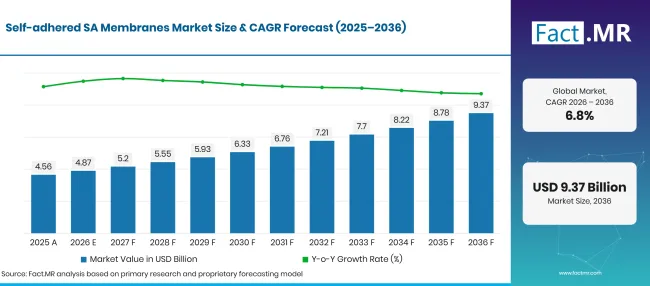
Self Adhered Sa Membranes Market Forecast Global | Source: Fact.MR
Category
| Category | Segments |
|---|---|
| Product Type | Bituminous, Non-bituminous |
| Application | Roofing, Walls, Flooring, Others |
| End-User | Residential, Commercial, Industrial |
| Sales Channel | Direct Sales, Distributors, Online Sales |
| Region | United States; Brazil; United Kingdom; Germany; Japan |
Source: Fact.MR analysis. Updated Nov 20, 2026
Segmental Analysis
WHAT keeps bituminous membranes ahead in the Self-adhered SA Membranes Market?
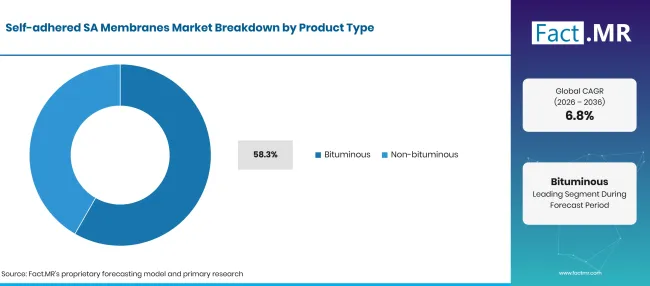
Self Adhered Sa Membranes Market Breakdown Product Type | Source: Fact.MR
Demand for bituminous membranes account for 58.3% of revenue in 2026, about USD 2.8 billion, as SBS-modified bitumen gives strong adhesion, self-sealing around fasteners and a long track record. Roof underlayment and below-grade waterproofing rely on these sheets. Manufacturers of self-adhered membranes are adding low-temperature adhesives for winter installation. Similar proven performance is projected to keep bituminous membranes in the lead. In September 2026, U.S. housing starts reached an annualized 1.221 million units, indicating continued construction activity and demand for waterproofing materials. Manufacturers are also developing low-temperature adhesive formulations to support installation in colder conditions.
Why does roofing lead application demand in the Self-adhered SA Membranes Market?
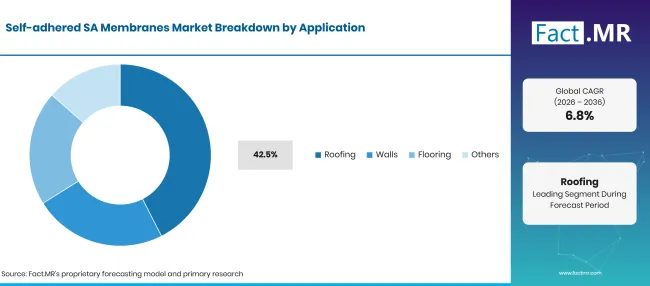
Self Adhered Sa Membranes Market Breakdown Application | Source: Fact.MR
Roofing leads with 42.5% of self-adhered membrane application revenue in 2026, about USD 2.1 billion, as ice and water shields and underlayments are required in many building codes. Re-roofing after storms adds replacement demand. Manufacturers of self-adhered membranes such as GAF, IKO and CertainTeed sell underlayments with shingle systems. Similar code requirements are projected to keep roofing the leading application. The U.S. Census Bureau and HUD reported 1.4 million annualized building permits in September 2026, reflecting continued demand for new residential construction. Manufacturers such as GAF, IKO and CertainTeed are positioning self-adhered roofing membranes alongside broader roofing systems.
HOW is residential construction sustaining demand for self-adhered SA membranes?
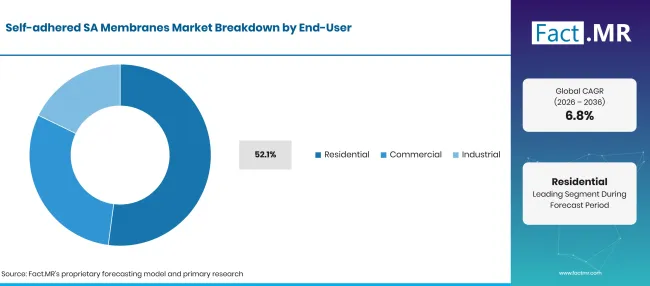
Self Adhered Sa Membranes Market Breakdown End User | Source: Fact.MR
Adoption by residential construction holds 52.1% of revenue in 2026, about USD 2.5 billion, as homes use membranes for roof decks, window flashing and foundations. Housing construction and renovation projects generate recurring material requirements across different building stages. Canada's federal housing and infrastructure department reported that 307,303 residential building units received permits in 2025, a 6% increase over 2024, in its May 2026 update. This construction pipeline supports procurement opportunities for residential waterproofing membranes.
WHAT is reinforcing direct sales as the leading distribution channel for self-adhered SA membranes?
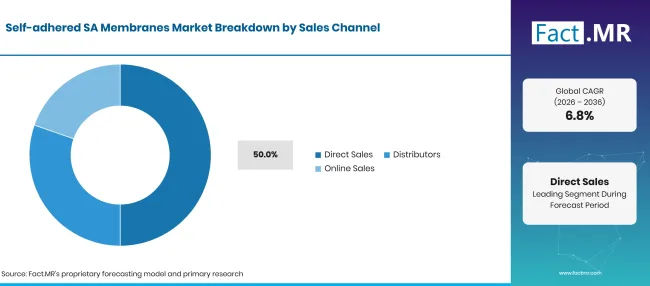
Self Adhered Sa Membranes Market Breakdown Sales Channel | Source: Fact.MR
Direct sales account for 50.0% of revenue in 2026, about USD 2.4 billion, as large contractors and builders buy on project specifications and warranty programs. Distributors serve smaller roofers and repair work. Manufacturers of self-adhered membranes are offering system warranties tied to direct accounts. Similar specification-led buying is projected to keep direct sales in the lead. The U.S. Census Bureau reported that retail e-commerce sales reached USD 340.2 billion in the second quarter of 2026, increasing 12.2% year over year and representing 17.1% of total retail sales.
Self-adhered SA Membranes Market-Drivers, Restraints & Trends
Drivers – Energy-Efficient Building Envelopes and Air Barriers
Demand for self-adhered membranes is increasing as building regulations emphasize energy efficiency, insulation and continuous air barriers. The European Commission reported in May 2026 that approximately 75% of EU buildings have poor energy performance, while the annual energy renovation rate remains around 1%. The revised Energy Performance of Buildings Directive entered into force on May 30, 2026, strengthening the policy framework for building renovation and energy improvements. These requirements create opportunities for vapor-permeable self-adhered membranes that control air leakage and moisture while supporting insulated wall assemblies. Manufacturers offering integrated air and water barriers are positioned to benefit from renovation and new-construction projects.
Restraints – Construction Cycles and Bitumen Price Volatility
Sales of self-adhered membranes remain exposed to fluctuations in construction activity and bitumen-based raw-material costs. Germany's Federal Statistical Office reported that residential building permits declined 14.8% year over year in September 2026, despite an 8.4% increase during the first nine months of the year. Such monthly fluctuations demonstrate the uneven nature of construction demand. In addition, India's Office of the Economic Adviser publishes monthly wholesale price indices covering industrial commodities, including bitumen, allowing manufacturers to track changes in input costs. Variations in building activity and petroleum-derived material prices can pressure procurement budgets, inventory planning and membrane manufacturers' margins.
Opportunity– Fluid-Free Air and Water Barriers
Demand for self-adhered wall membranes that provide combined air and water resistance is gaining attention as building-envelope specifications place greater emphasis on moisture management and airtightness. The U.S. Department of Energy's 2026 federal building standards include requirements for continuous air-barrier systems and sealing penetrations in building envelopes. Separately, the European Commission requires EU countries to renovate 3% of public-sector building floor area annually under the revised energy-efficiency framework. These measures support the adoption of integrated membrane systems in new construction and renovation. Manufacturers such as Henry and Carlisle are addressing this requirement with self-adhered, vapor-permeable barrier products.
Trend – Torch-Free Roofing for Improved Installation Safety
Demand for self-adhered roofing membranes is gaining traction as building owners and contractors seek installation methods that reduce dependence on open flames. The U.S. Occupational Safety and Health Administration (OSHA) identifies torch-applied roofing as a fire hazard because improperly applied heat can ignite combustible roof decks and concealed materials. Its roofing safety guidance recommends fire watches and inspections for at least two hours after torch work ends. Self-adhered cap sheets and base sheets offer an alternative installation method that avoids torch application during membrane installation. Manufacturers are therefore emphasizing cold-applied roofing systems for re-roofing and projects with stricter site-safety requirements.
Self-adhered SA Membranes Market by Analysis by Key Country
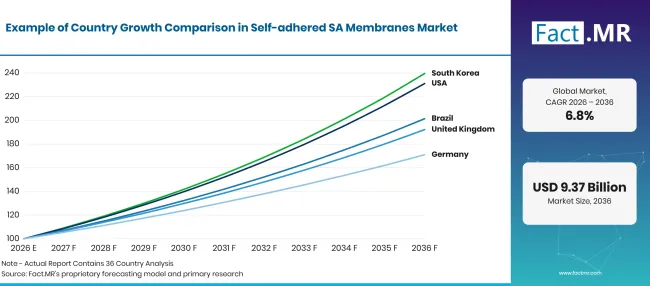
Self Adhered Sa Membranes Market Growth Index | Source: Fact.MR
| Country | CAGR (2026-2036) |
|---|---|
| United States | 8.7% |
| Brazil | 7.2% |
| United Kingdom | 6.8% |
| Germany | 5.5% |
| Japan | 5.0% |
Source: Fact.MR analysis. Updated Nov 20, 2026
Source: Fact.MR analysis.
Why is the United States the fastest-growing market for self-adhered membranes?
Sales of self-adhered membranes in the United States are projected to grow at a 8.7% CAGR, the fastest among the five key countries, as housing starts and storm-related re-roofing support demand.
Building codes require ice-barrier underlayment in cold regions. Manufacturers of self-adhered membranes such as GAF, Carlisle and Amrize serve US contractors. Similar construction activity is projected to drive sales in the United States. The U.S. Census Bureau and Department of Housing and Urban Development reported 1.221 million housing starts at a seasonally adjusted annual rate in September 2026. Although this was 7.4% below September 2025, the substantial construction pipeline continues to create opportunities for roofing underlayments and waterproofing products. Building-code requirements for ice barriers in designated cold-weather regions also support the use of self-adhered membranes beneath roof coverings. Manufacturers such as GAF, Carlisle and Amrize are positioned to serve contractors requiring self-adhered roofing and waterproofing solutions.
How is housing policy supporting self-adhered membranes in Brazil?
Sales of self-adhered membranes in Brazil are projected to grow at a 7.2% CAGR as the Minha Casa, Minha Vida program, relaunched in 2023, targets 2 million homes by 2026. Builders are shifting from cementitious coatings to sheet membranes. Manufacturers of self-adhered membranes are entering through local partners.
Similar housing programs are projected to drive sales in Brazil. The Minha Casa, Minha Vida programme had recorded approximately 2.7 million housing contracts across 5,330 municipalities by October 2026, according to Brazil's Ministry of Cities. The programme's expansion is creating opportunities for waterproofing materials in roofs, foundations, balconies and wet areas. Self-adhered membranes offer contractors an alternative to liquid-applied systems where consistent sheet coverage and faster installation are required. Continued housing investment is expected to strengthen procurement of waterproofing products across residential construction projects.
What is shaping self-adhered membrane demand in the United Kingdom?
Demand for self-adhered membranes in the United Kingdom is projected to grow at a 6.8% CAGR as the Building Safety Act and Future Homes Standard raise envelope and fire requirements. Torch-free roofing is preferred on occupied buildings.
Manufacturers of self-adhered membranes are offering certified systems. Similar regulation is projected to drive sales in the United Kingdom. The UK government's housing supply statistics recorded 35,910 new-build housing starts in England during the second quarter of 2026, representing a 20% increase compared with the same quarter of 2025. The Future Homes and Buildings Standards, announced in March 2026, are also updating building regulations in England. These developments are encouraging contractors to consider reliable waterproofing solutions for roofs, walls and below-ground structures. Torch-free self-adhered systems offer practical installation advantages, particularly in occupied buildings where hot-work restrictions apply.
Why is self-adhered membrane growth moderate in Germany?
Demand for self-adhered membranes in Germany is projected to grow at a 5.5% CAGR as residential construction recovers from a slump in 2023 and 2024.
Renovation of older buildings under energy rules supports roofing work. Manufacturers of self-adhered membranes such as Sika and Soprema serve German contractors. Similar recovery is projected to support sales in Germany. Destatis reported that 190,200 residential building permits were issued during January–September 2026, representing an 8.4% increase compared with the corresponding period in 2025. New-build residential permits increased by 8.0%, while permits for apartments created through conversions and alterations also contributed to the total. These developments create opportunities for roof waterproofing, basement protection and building-envelope refurbishment. Manufacturers such as Sika and Soprema are positioned to serve contractors seeking self-adhered waterproofing systems for new construction and renovation projects.
Why is self-adhered membrane growth slower in Japan?
Demand for self-adhered membranes in Japan is projected to grow at a 5.0% CAGR, the slowest among the five key countries, as new housing starts trend down with a shrinking population.
Renovation of aging buildings provides some demand. Manufacturers of self-adhered membranes are targeting repair projects. Similar housing trends are projected to keep growth slower in Japan. Japan's Ministry of Land, Infrastructure, Transport and Tourism reported that new housing starts declined by 2.7% year over year in September 2026. The seasonally adjusted annualized rate also decreased by 5.2% from the previous month. This weaker construction activity is moderating demand for new-build waterproofing materials. Nevertheless, roof repairs, balcony refurbishment and waterproofing upgrades in existing buildings are expected to sustain membrane purchases.
Competitive Landscape for Self-adhered SA Membranes Market
Competition in the self-adhered membranes market is divided between global building-envelope groups and regional roofing manufacturers. Sika, Carlisle, GAF, Soprema and Owens Corning compete on system breadth and warranties, while IKO, Henry, Johns Manville and CertainTeed compete on roofing and wall membranes. Buyers select suppliers on adhesion, temperature range, code approvals and warranty.
From 2024 onward, competition shifted toward consolidation and envelope systems. Sika bought MBCC, and Holcim spun off Amrize with its North American roofing business. Manufacturers with complete roof and wall systems are best placed to grow.
Recent Developments
- In June 2025, Holcim completed the spin-off of Amrize, its North American building materials business.
- In January 2025, Sika AG Introduced Sarnafil Self-Adhered Feltback membrane, expanding its PVC roofing membrane portfolio with factory-applied adhesive.
- In October 2026, Henry Company launched Blueskin SA HPX, a primerless self-adhered air, vapor and water-resistive barrier designed for demanding installation conditions.
Key Players in Self-adhered SA Membranes Market
Key companies profiled include Sika AG; Carlisle Companies Inc.; GAF Materials Corporation; Soprema Group; Firestone Building Products; Johns Manville; IKO Industries Ltd.; Henry Company; CertainTeed Corporation; and Owens Corning.
- Sika AG
- Carlisle Companies Inc.
- GAF Materials Corporation
- Soprema Group
- Firestone Building Products
- Johns Manville
- IKO Industries Ltd.
- Henry Company
- CertainTeed Corporation
- Owens Corning
Bibliography
- Brazilian Ministry of Cities. (2026, October 27). Um em cada três financiamentos do Minha Casa, Minha Vida é para a Faixa 1.
- Coesia S.p.A. (2025). Annual report 2024.
- Destatis. (2025). Building permits, 2024.
- Destatis. (2026, November 18). Baugenehmigungen für Wohnungen im September 2026: −14,8 % zum Vorjahresmonat.
- European Commission. (2026, May 29). Improving energy efficiency of buildings to reduce bills and save energy.
- European Commission. (n.d.). Energy renovation of buildings.
- European Commission. (n.d.). Public buildings.
- European Parliament and Council of the European Union. (2025). Regulation (EU) 2025/40 of the European Parliament and of the Council of 19 December 2024 on packaging and packaging waste.
- French Ministry for Ecological Transition. (2020, June 5). La loi anti-gaspillage pour une économie circulaire.
- Henry Company. (n.d.). Primerless self-adhered air barrier: Next-generation benefits.
- Holcim Ltd. (2025, June 23). Holcim completes spin-off of North America business.
- Housing, Infrastructure and Communities Canada. (2026). Housing data.
- Henry Company. (n.d.). Blueskin SA HPX: A high-performance self-adhered air and water barrier for demanding applications.
- Japan Ministry of Land, Infrastructure, Transport and Tourism. (2026, October 30).[Building construction starts statistics, September 2026].
- Ministério das Cidades. (2023). Programa Minha Casa, Minha Vida.
- Ministry of Climate, Energy and Environment, Republic of Korea. (2026, May 18). Domestic ultra pure water demonstration plant technology transferred to private sector.
- Ministry of Food Processing Industries, Government of India. (2026). Annual report 2025–26.
- Ministry of Statistics and Programme Implementation, Government of India. (2026, October 28). Quick estimates of Index of Industrial Production for September 2026.
- Office of the Economic Adviser, Department for Promotion of Industry and Internal Trade. (2026). Wholesale Price Index (WPI), base year 2022–23.
- Office for National Statistics. (2026, July 24). UK manufacturers' sales by product: 2025.
- Occupational Safety and Health Administration. (2015). Torch applied roofing. U.S. Department of Labor.
- Press Information Bureau, Government of India. (2026, October 28). Index of industrial production – September 2026.
- Sika Corporation. (2025, January 10). Self-adhered roofing membrane with feltbacking first of its kind!
- Sika Corporation. (n.d.). Sarnafil G 410-60 SA Feltback.
- Statistisches Bundesamt. (2026, November 18). Baugenehmigungen für Wohnungen im September 2026: −14,8 % zum Vorjahresmonat.
- U.S. Bureau of Labor Statistics. (n.d.). Employment and output by industry.
- U.S. Census Bureau. (2025). New residential construction, December 2024.
- U.S. Census Bureau. (2026). Quarterly retail e-commerce sales: Second quarter 2026.
- U.S. Census Bureau. (2026). Construction spending: September 2026.
- U.S. Census Bureau. (2026, October 20). Monthly new residential construction, September 2026.
- U.S. Department of Energy. (2026). 10 CFR § 434.402: Building envelope assemblies and materials. U.S. Government Publishing Office.
- UK Ministry of Housing, Communities and Local Government. (2026, March 24). The Future Homes and Buildings Standards: Building Circular 01/2026.
- UK Ministry of Housing, Communities and Local Government. (2026, September 24). Housing supply: Indicators of new supply, England, April to June 2026.
Segmentation
Scope of Report
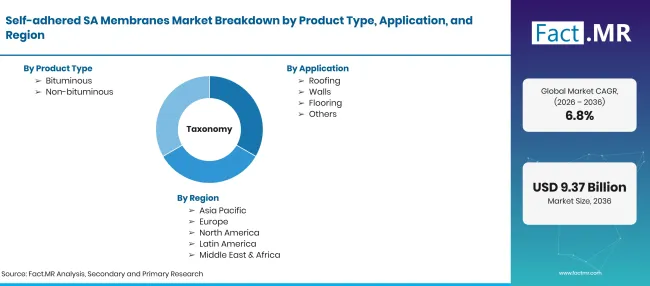
Self Adhered Sa Membranes Market Taxonomy | Source: Fact.MR
| Items | Values |
|---|---|
| Quantitative Units (2026) | USD 4.87 Billion |
| Product Type | Bituminous, Non-bituminous |
| Application | Roofing, Walls, Flooring, Others |
| End-User | Residential, Commercial, Industrial |
| Sales Channel | Direct Sales, Distributors, Online Sales |
| Regions Covered | North America, Latin America, Europe, East Asia, South Asia and Pacific, Middle East & Africa |
| Countries Covered | United States, Germany, Japan, United Kingdom, Brazil, and other countries |
| Key Companies Profiled | Sika AG, Carlisle Companies Inc., GAF Materials Corporation, Soprema Group, Firestone Building Products, Johns Manville, IKO Industries Ltd., Henry Company, CertainTeed Corporation, Owens Corning |
| Additional Attributes | Dollar revenue in the Self-adhered SA Membranes Market is segmented by product type (bituminous, non-bituminous); application (roofing, walls, flooring); end-user (residential, commercial, industrial); sales channel (direct sales, distributors, online sales) and region. |
Source: Fact.MR analysis. Updated Nov 20, 2026
Self-adhered SA Membranes Market by Segments
-
Product Type
- Bituminous
- Non-bituminous
-
Application
- Roofing
- Walls
- Flooring
- Others
-
End-User
- Residential
- Commercial
- Industrial
-
Sales Channel
- Direct Sales
- Distributors
- Online Sales
-
Region:
- North America
- United States
- Canada
- Mexico
- Europe
- Germany
- United Kingdom
- France
- Italy
- Spain
- Rest of Europe
- Asia Pacific
- China
- India
- Japan
- South Korea
- Australia
- Rest of Asia Pacific
- Latin America
- Brazil
- Mexico
- Argentina
- Rest of Latin America
- Middle East & Africa
- GCC Countries
- South Africa
- Rest of Middle East & Africa
- North America
Frequently Asked Questions
How big is the global Self-adhered SA Membranes Market in 2026?
What will be the size of the Self-adhered SA Membranes Market by 2036?
How fast will the Self-adhered SA Membranes Market grow during the forecast period?
Which product type segment holds the largest share of the Self-adhered SA Membranes Market?
Who worked on this report


Preview the report firsthand - request a free sample
Free SampleGet the brochure for pricing and purchase details
Download PDF