- Market Value (2025): USD 682.0 Mn
- Estimated Value (2026): USD 773.0 Mn
- Forecast Value (2036): USD 2704.0 Mn
- CAGR (2026-2036): 13.3%
What is the Recycled-Content Enhanced Film Masterbatches Market forecast to be worth by 2036?
USD 773.0 million in 2026 to USD 2704.0 million by 2036 at a 13.3% CAGR.
- The Recycled-Content Enhanced Film Masterbatches Market was valued at USD 682.0 million in 2025.
- Demand is set to rise from USD 773.0 million in 2026. It is forecast to reach USD 2704.0 million by 2036.
- The market is forecast to grow at a 13.3% CAGR from 2026 to 2036. Film makers are using PCR resin with additives that help packs run well and protect food.
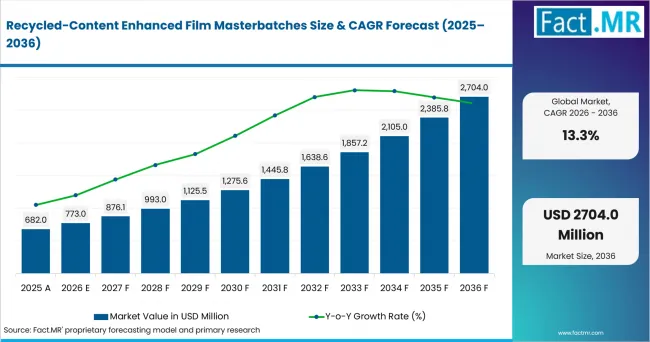
Recycled Content Enhanced Film Masterbatches Value Analysis | Source: Fact.MR
What are the defining numbers behind Recycled-Content Enhanced Film Masterbatches Market growth?
An absolute opportunity of USD 1931.0 million is expected between 2026 and 2036.
- Demand Drivers in the Market
- Film makers need PCR films that resist punctures and run well. Strength and stabilizer aids can help as PCR use rises.
- Food packers need stable barriers and shelf life. Additive mixes compete on oxygen control, moisture control, and resin fit.
- Brands want more PCR content without losing looks or line speed. Ampacet offers PCR-carrier blends for packs. Avient sells Rejoin PCR colorants that use PCR as the carrier resin.
- New pack rules make recycled results more key. Film makers need additives that help PCR resin meet line, barrier, and visual needs.
- Key Segments Analyzed
- By Nanomaterial Platform: Nanoclay is expected to hold a 32.0% share in 2026. Small doses can improve barrier strength and film stiffness.
- By Shelf-Life Mechanism: Oxygen barrier is projected to hold a 28.0% share in 2026. Oxygen control helps protect packed food.
- By Recycled-Content Performance Target: Flexible film is expected to hold a 34.0% share in 2026. Additives help thin films handle heat and changes in recycled resin.
- By Food Application: Fresh produce is expected to hold a 29.0% share in 2026. Clear packs need good clarity, anti-fog action, and gas flow.
- Analyst Opinion at Fact.MR
- Shambhu Nath Jha, Principal Consultant at Fact.MR, states, “The key test is simple. A PCR film must run well and protect the food. Buyers will favor additives that fix a clear weakness and show firm results. Suppliers should also show resin fit, use tests, and food-contact data where needed.”
- Strategic Implications
- Film makers should test each additive mix with the real PCR resin. Heat history and dirt can change from one lot to the next.
- Food-pack teams should link barrier claims to the full film. Oxygen and moisture results depend on resin, layer design, and additive dose.
- Additive makers should show working ranges for blown, cast, and oriented films. Buyers can then check line speed, gels, and visual effects before scale-up.
- Brands should match recycled goals with food-contact rules and pack design. In February 2025, the European Commission said the Packaging and Packaging Waste Regulation had entered into force. The rules promote recycling, reuse, and more circular packs.
South Korea is forecast at 14.5% through 2036 as PCR material rules expand. The USA follows at 14.1% as food packs support PCR film tests. Japan is forecast at 12.5%. Germany is expected at 11.7%. The UK is forecast at 9.6%.
How does the Recycled-Content Enhanced Film Masterbatches Market break down by segment?
Flexible film leads Recycled-Content Performance Target at 34.0% in 2026. Nanoclay leads Nanomaterial Platform at 32.0%.
Which Nanomaterial Platform dominates?
Nanoclay is set to hold 32.0% share in 2026.
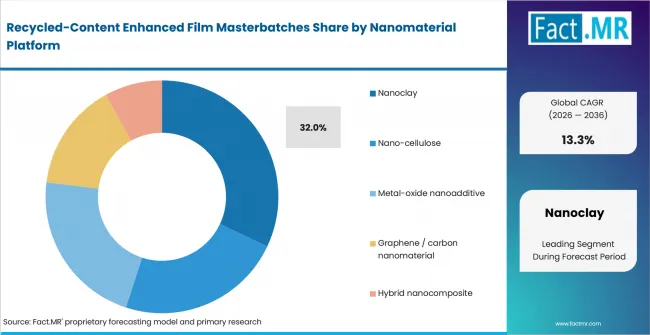
Recycled Content Enhanced Film Masterbatches Analysis By Nanomaterial Platform | Source: Fact.MR
Nanoclay is set to lead. Small amounts can improve gas barrier and stiffness. Nano-cellulose offers plant-based strength. Metal-oxide additives can support barrier or light control. Graphene and carbon materials can add strength at low dose. Hybrid systems combine more than one function.
What leads the Shelf-Life Mechanism segment?
Oxygen barrier is set to account for 28.0% share in 2026.
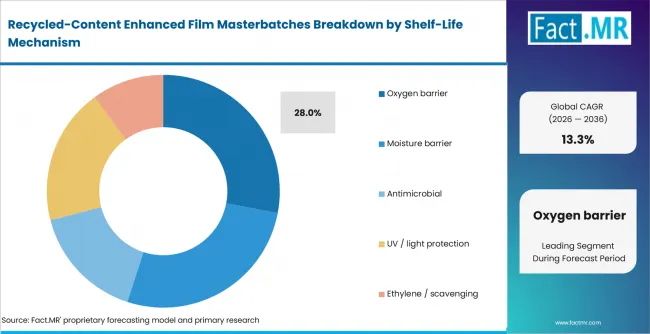
Recycled Content Enhanced Film Masterbatches Analysis By Shelf Life Mechanism | Source: Fact.MR
Oxygen control is set to lead. Oxidation can shorten food shelf life. Moisture barriers help dry foods keep texture. Germ-control systems target microbes. UV systems protect light-sensitive food. Capture systems serve active packs when the function fits the food and film.
How does Recycled-Content Performance Target shape demand?
Flexible film is set to hold 34.0% share in 2026.
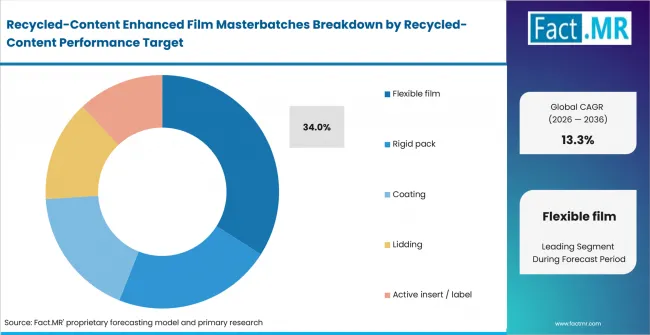
Recycled Content Enhanced Film Masterbatches Analysis By Recycled Content Performance Target | Source: Fact.MR
Flexible film is set to lead. Thin films quickly show gels, odor, and weak strength. PCR resin must also pass through extrusion and sealing with steady output. In June 2025, Clariant launched AddWorks PPA aids for plastic extrusion, including blown and cast PE film. Rigid packs, coatings, lidding, and active inserts follow other test paths.
What supports Fresh produce within Food Application?
Fresh produce is set to represent 29.0% share in 2026.
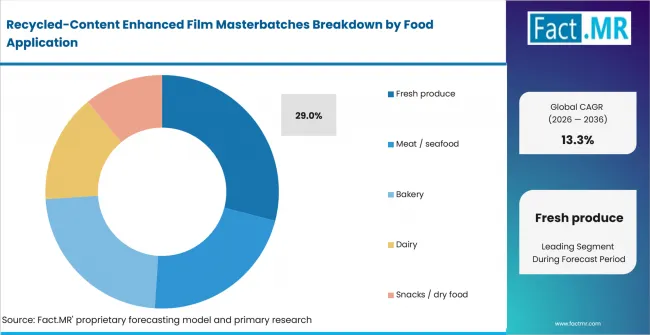
Recycled Content Enhanced Film Masterbatches Analysis By Food Application | Source: Fact.MR
Fresh produce is set to lead. Clarity and water drops are easy to see at retail. Film must balance gas flow with strength during packing and delivery. Meat and seafood need more oxygen control and puncture strength. Bakery packs focus on moisture control. Dairy packs need strong seals. Snack films need good line use at thin gauges.
What is accelerating Recycled-Content Enhanced Film Masterbatches Market adoption, and what is holding it back?
Recycled-content rules and film needs support demand. Changes in resin quality, food-contact tests, and additive cost can slow use.
Drivers Impact Analysis
| DRIVER | (~) % IMPACT ON CAGR | GEOGRAPHIC RELEVANCE | IMPACT TIMELINE |
|---|---|---|---|
| Recycled-content pack rules | +1.8% | Europe, South Korea, UK | Medium term (2-4 years) |
| Restore film strength and line results | +1.4% | Global | Short term (<= 2 years) |
| Food shelf-life and barrier needs | +1.1% | Global | Medium term (2-4 years) |
| PCR carrier and compatibilizer use | +0.8% | North America, Europe, East Asia | Long term (>= 4 years) |
Opportunity Impact Analysis
| OPPORTUNITY | (~) % IMPACT ON CAGR | GEOGRAPHIC RELEVANCE | IMPACT TIMELINE |
|---|---|---|---|
| High-PCR flexible food film | +1.2% | Europe, North America | Medium term (2-4 years) |
| Graphene and hybrid support for thinner film | +0.9% | North America, East Asia | Long term (>= 4 years) |
| Food-contact PCR plastic systems | +0.7% | USA, Europe, Japan | Medium term (2-4 years) |
Restraints Impact Analysis
| RESTRAINT | (~) % IMPACT ON CAGR | GEOGRAPHIC RELEVANCE | IMPACT TIMELINE |
|---|---|---|---|
| Changes in PCR quality | -0.8% | Global | Short term (<= 2 years) |
| Food-contact and migration tests | -0.6% | USA, Europe, East Asia | Medium term (2-4 years) |
| Additive cost and dosing | -0.4% | Global | Long term (>= 4 years) |
Which countries are scaling the Recycled-Content Enhanced Film Masterbatches Market through 2036?
- The country CAGR range is 4.9 percentage points.
- South Korea is 0.4 percentage point above the USA. Recycled-material rules support pack demand.
- The USA is 1.6 percentage points above Japan. Food-pack demand supports PCR film tests.
- Japan is 0.8 percentage point above Germany. Collection programs are widening PCR plastic supply.
- Germany is 2.1 percentage points above the UK. EU pack rules add support to its recovery system.
Similar CAGRs can still reflect different market conditions. Recycled-resin supply, food-contact rules, and pack policy vary by country. The report covers North America, Latin America, Western Europe, and Eastern Europe. It also covers East Asia, South Asia & Pacific, and Middle East & Africa.
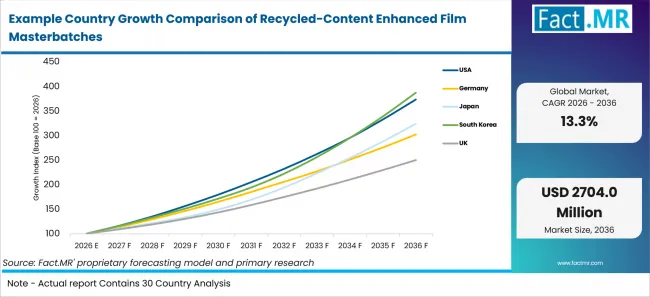
Example Country Growth Comparison Of Recycled Content Enhanced Film Masterbatches | Source: Fact.MR
| Country | CAGR (2026-2036) |
|---|---|
| South Korea | 14.5% |
| United States | 14.1% |
| Japan | 12.5% |
| Germany | 11.7% |
| United Kingdom | 9.6% |
What supports South Korea adoption?
14.5% CAGR, supported by PCR material obligations in packs.
South Korea is expected to expand as pack rules raise demand for PCR content. In September 2025, the Ministry of Environment announced a PCR material rule. It applies to large users of clear PET bottles. The rule supports more PCR resin and related film additives.
What supports United States adoption?
14.1% CAGR, backed by food-packs scale and PCR testing activity.
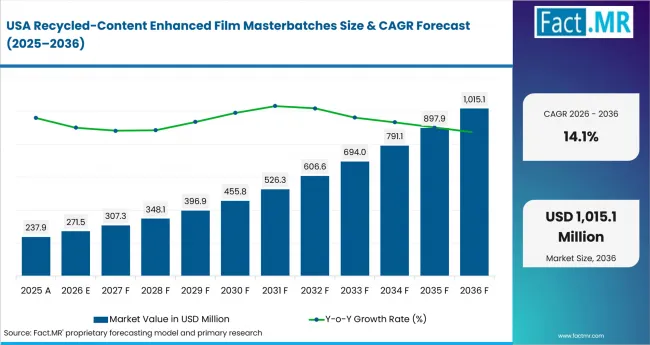
Recycled Content Enhanced Film Masterbatches Country Value Analysis | Source: Fact.MR
U.S. food and pack firms are set to value additives that pair PCR content with stable film results. In June 2026, the USDA Economic Research Service reported U.S. food spending of USD 2.51 trillion in 2025. This large food market supports demand for reliable flexible packs.
What supports Japan adoption?
12.5% CAGR, driven by packs collection and recycling programs.
Japan is set to gain from wider collection and recycling of plastic packs. In March 2026, the Ministry of the Environment projected 773 thousand tonnes of separately collected plastic-pack waste. More recovered plastic can support higher-value film uses.
What supports Germany adoption?
11.7% CAGR, shaped by established packs recovery and EU circularity rules.
Germany has mature pack recovery and rules that support more PCR content. In January 2026, the German Environment Agency and the Central Agency Packaging Register reported new data. About 5.5 million tonnes of dual-system pack waste were recycled in 2024. This supports PCR material supply.
What supports United Kingdom adoption?
9.6% CAGR, led by recycled economics in plastic packs.
The UK Plastic Packaging Tax gives firms a reason to use more PCR plastic. Qualifying packs need at least 30% PCR plastic to avoid the tax. In August 2026, HM Revenue & Customs reported that 37% of declared plastic-pack tonnage met that level. This supports demand for additives that help PCR films work well.
Who leads the Recycled-Content Enhanced Film Masterbatches Market?
Avient, Ampacet, Tosaf, BASF, Clariant, and NanoXplore offer relevant film and additive tech. Avient sells Rejoin PCR Colorants. Ampacet offers PCR-carrier blends. Tosaf supplies film additives. Clariant supplies process aids. NanoXplore offers graphene-based additives.
In August 2025, BASF highlighted a VALERAS use with Cleanfarms and McKenzie/Snyder. The work used Irgastab in a closed-loop agricultural pack. Suppliers compete on resin fit, line results, food-contact support, and proof of results.
Which companies are the key providers?
Companies profiled include Avient; Ampacet; Tosaf; BASF; Clariant; and NanoXplore.
- Avient
- Ampacet
- Tosaf
- BASF
- Clariant
- NanoXplore
Bibliography
- European Commission, Directorate-General for Environment. (2025, February 11). New rules enter into force for a more sustainable and competitive packaging economy.
- NanoXplore Inc. (2026, June 15). NanoXplore and Techmer PM launch revolutionary GrapheneBlack xGnP™ masterbatch for high-performance plastic films.
- Clariant. (2025, June 5). Clariant launches innovative PFAS-free polymer processing aids for more sustainable polyolefin extrusion.
- Zeballos, E., & Sinclair, W. (2026, June 11). Total U.S. food spending reached $2.51 trillion in 2025. U.S. Department of Agriculture, Economic Research Service.
- German Environment Agency, & Central Agency Packaging Register. (2026, January 27). Facts against myths: Packaging waste recycling in Germany is working.
- HM Revenue & Customs. (2026, August 27). Plastic Packaging Tax (PPT) statistics commentary.
- BASF. (2025, August 27). BASF continues its VALERAS® journey with new additive solutions at K 2025.
This Report Answers
- The report covers nano platform, shelf-life function, film target, and food use.
- Segment analysis shows the leading groups and why they matter in 2026.
- Country analysis compares five CAGRs and the pack conditions behind demand.
- Competitive analysis reviews the listed firms and their current film and additive work.
What does the Recycled-Content Enhanced Film Masterbatches Market cover?
The market covers additive mixes used in recycled film. It focuses on products that help restore strength, barrier, clarity, or line use.
The study focuses on food and flexible films. It includes fresh-food and high-barrier uses where shelf life and line use guide material choice.
What is included in the scope?
The scope includes the five listed nano platforms when used to improve recycled film. Barrier, UV, germ-control, and capture functions are included when supplied through a qualifying additive mix.
The scope includes flexible film, rigid packs, coatings, lidding, and active inserts or labels. Food uses include fresh produce, meat or seafood, bakery, dairy, and snacks or dry food.
What is excluded from the scope?
The scope excludes recycled resin sold alone. It also excludes finished film and recycling machines. Standard color mixes with no added function are also outside the scope.
General nano materials are excluded unless made for film use. Food-preservation systems outside the pack material are also excluded.
How Was the Analysis Built?
The analysis draws on 120+ sources, 35+ company portfolios, 25+ countries, and more than 20 industry interviews.
- Primary Research: Primary research includes discussions with manufacturers, service providers, technology developers, distributors, end users, and subject-matter experts. These conversations examine purchasing priorities, product adoption, operational challenges, approval requirements, competitive positioning, and the factors that influence wider market acceptance.
- Desk Research: Desk research covers government statistics, regulatory publications, company filings, trade data, technical studies, industry associations, standards, public policy, and other authoritative sources. Every source used in the analysis is documented in the bibliography.
- Market Sizing and Forecasting: Market estimates combine historical performance, demand indicators, pricing and volume trends, segment shares, company participation, country-level growth, adoption patterns, investment activity, and barriers to market expansion.
- Data Validation and Update Cycle: Findings are validated by comparing primary interviews with public data, company activity, regulatory changes, trade patterns, and industry developments. Regular updates review new product launches, capacity changes, partnerships, approvals, and shifts in commercial adoption.
What is the report’s scope and coverage?
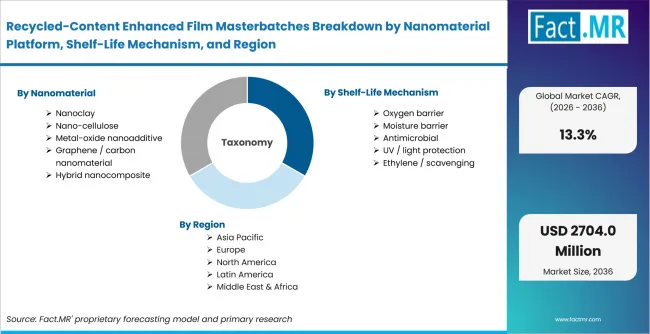
Recycled Content Enhanced Film Masterbatches Breakdown By Nanomaterial Platform, Shelf Life Mechanism, And Region | Source: Fact.MR
| Attribute | Details |
|---|---|
| Quantitative Units | USD million in 2026 to USD million by 2036 at a CAGR |
| Market Definition | Useful and nano blend systems used to help PCR plastic films retain strength, barrier, optical, line use or shelf-life results, with emphasis on food and flexible packs uses. |
| Nanomaterial Platform | Nanoclay; Nano-cellulose; Metal-oxide additive; Graphene / carbon material; Hybrid system |
| Shelf-Life Mechanism | Oxygen barrier; Moisture barrier; Antimicrobial; UV / light protection; Ethylene / scavenging |
| Recycled-Content Performance Target | Flexible film; Rigid pack; Coating; Lidding; Active insert / label |
| Food Application | Fresh produce; Meat / seafood; Bakery; Dairy; Snacks / dry food |
| Regions Covered | North America; Latin America; Western Europe; Eastern Europe; East Asia; South Asia & Pacific; Middle East & Africa |
| Countries Covered | United States; Germany; Japan; South Korea; United Kingdom |
| Key Companies Profiled | Avient; Ampacet; Tosaf; BASF; Clariant; NanoXplore |
| Forecast Period | 2026 to 2036 |
| Approach | Hybrid top-down and bottom-up approach using recycled packs policy, film-converting needs, food-contact constraints, firm product validation, country adoption indicators and segment-share review. |
How is the market segmented?
-
By Nanomaterial Platform
- Nanoclay
- Nano-cellulose
- Metal-oxide nanoadditive
- Graphene / carbon nanomaterial
- Hybrid nanocomposite
-
By Shelf-Life Mechanism
- Oxygen barrier
- Moisture barrier
- Antimicrobial
- UV / light protection
- Ethylene / scavenging
-
By Recycled-Content Performance Target
- Flexible film
- Rigid pack
- Coating
- Lidding
- Active insert / label
-
By Food Application
- Fresh produce
- Meat / seafood
- Bakery
- Dairy
- Snacks / dry food
-
By Region
- North America
- Latin America
- Western Europe
- Eastern Europe
- East Asia
- South Asia & Pacific
- Middle East & Africa