- Market Value (2025): USD 693.7 Mn
- Estimated Value (2026): USD 819.0 Mn
- Forecast Value (2036): USD 4308.4 Mn
- CAGR (2026-2036): 18.1%
What is the Graphene-Enhanced Film Masterbatches Market forecast to be worth by 2036?
USD 819.0 million in 2026 to USD 4,308.4 million by 2036 at an 18.1% CAGR.
- The Graphene-Enhanced Film Masterbatches Market was valued at USD 693.7 million in 2025.
- Demand is projected to increase from USD 819.0 million in 2026 to USD 4,308.4 million by 2036.
- The market is forecast to record an 18.1% CAGR from 2026 to 2036 as film converters qualify graphene concentrates for strength and thinner structures. Functional film performance is expected to widen the application base.
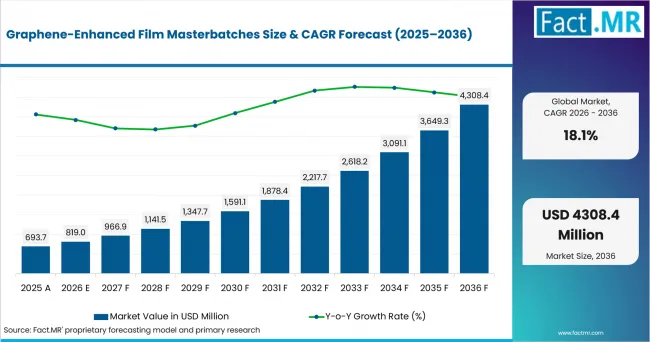
Graphene Enhanced Film Masterbatches Value Analysis | Source: Fact.MR
What are the defining numbers behind Graphene-Enhanced Film Masterbatches Market growth?
An absolute opportunity of USD 3,489.4 million is expected between 2026 and 2036. Graphene nanoplatelets, PE carriers and flexible film define the leading supplied segments.
- Demand Drivers in the Market
- Flexible-film converters need measurable reinforcement at low loading. NanoXplore and Techmer PM announced the commercial launch of GrapheneBlack xGnP™ Masterbatch on June 15, 2026 for high-performance plastic film applications. The companies reported that the product demonstrated more than 70% improvement in mechanical strength.
- Recycled-resin users need formulations that preserve film performance as feedstock properties vary. A concentrated graphene carrier gives converters a familiar dosing route during trials and helps isolate additive performance from base-resin variation.
- Film producers are expected to value downgauging when puncture and tensile performance remain within the required operating window. The commercial case therefore depends on line-level evidence rather than a material claim alone.
- Compounders need scalable dispersion across polymer families. Graphene concentrates are expected to gain acceptance where the carrier resin matches the production polymer and the let-down ratio remains stable across repeat runs.
- Key Segments Analyzed
- By Graphene Form: Graphene nanoplatelets are expected to hold 42.0% share in 2026 because platelet geometry supports reinforcement and longer diffusion paths in film structures.
- By Host Polymer: PE is projected to account for 35.0% share in 2026 since polyethylene is widely processed through blown and cast film lines.
- By Performance Target: Tensile / puncture strength is anticipated to capture 33.0% share in 2026 owing to qualification needs around thinner film structures.
- By Application: Flexible film is estimated to represent 39.0% share in 2026 reflecting direct masterbatch dosing through extrusion-based film production.
- Analyst Opinion at Fact.MR
- Fact.MR Principal Consultant Shambhu Nath Jha states, “The commercial test is whether a converter can dose a consistent concentrate and reproduce the gain on a film line. Polymer-specific dispersion support is expected to shorten qualification. Film converters are expected to favor suppliers that connect additive loading with measurable changes in strength, thickness and processing stability.”
- Strategic Implications
- Film converters should compare graphene loading with gauge reduction and puncture retention under their own extrusion conditions.
- Masterbatch formulators should document dispersion consistency for each host polymer before extending performance claims across resin families. Technical files should connect the recommended let-down ratio with film-line conditions so converters can reproduce the targeted result during scale-up.
- Packaging teams should test graphene with recycled resin because PCR variability is expected to change strength and process stability across film runs. Qualification plans should separate resin variation from additive performance so the graphene contribution remains measurable across repeat batches.
The USA is forecast to record 18.6% CAGR through 2036. South Korea follows at 18.3% and the UK at 17.2%. Germany is forecast at 15.9% while Denmark reaches 14.3%. The spread reflects different manufacturing bases and qualification conditions.
How does the Graphene-Enhanced Film Masterbatches Market break down by segment?
Graphene nanoplatelets are projected to lead Graphene Form at 42.0% share in 2026; flexible film is estimated to lead Application at 39.0% share.
Which Graphene Form dominates?
Graphene nanoplatelets are expected to hold 42.0% share in 2026.
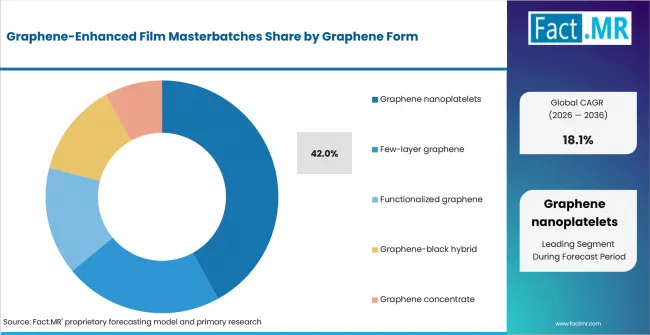
Graphene Enhanced Film Masterbatches Analysis By Graphene Form | Source: Fact.MR
Graphene nanoplatelets fit masterbatch processing when dispersion is controlled. Their platelet geometry is expected to support mechanical reinforcement and longer diffusion paths. Few-layer and functionalized grades address narrower conductivity or interface requirements. The preferred form is therefore expected to depend on the film property being qualified and the carrier-resin processing window.
What leads the Host Polymer segment?
PE is projected to account for 35.0% share in 2026.
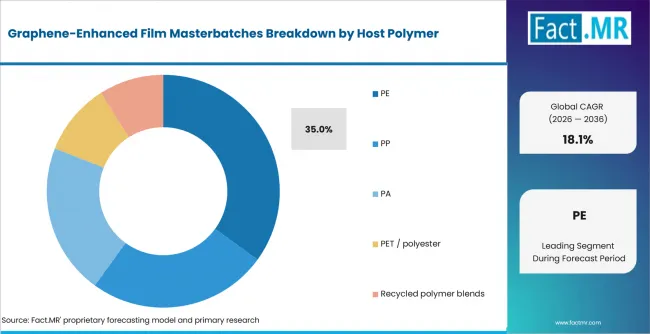
Graphene Enhanced Film Masterbatches Analysis By Host Polymer | Source: Fact.MR
PE leads because polyethylene is widely used in flexible packaging and industrial film. Matching the carrier to the production resin is expected to reduce compatibility risk during let-down. PP and PA serve other processing windows while PET / polyester and recycled blends extend the addressable resin base.
U.S. Federal Reserve data published on January 16, 2026 placed plastics and rubber products capacity utilization at 73.2% in December 2025. The operating base supports converter trials across common film polymers. Carrier selection also connects with the wider masterbatch market where dosing consistency and resin compatibility shape qualification.
How does Performance Target shape demand?
Tensile / puncture strength is anticipated to capture 33.0% share in 2026.
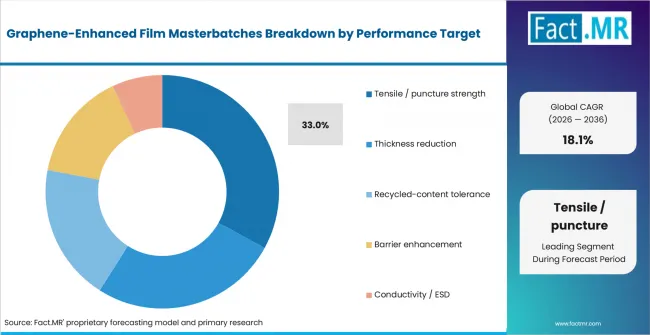
Graphene Enhanced Film Masterbatches Analysis By Performance Target | Source: Fact.MR
Mechanical reinforcement is central when downgauging raises tear or puncture risk. Tensile / puncture strength therefore leads the performance target as converters compare a measurable film property before evaluating secondary barrier or conductive functions.
What supports Flexible Film within Application?
Flexible film is estimated to represent 39.0% share in 2026.
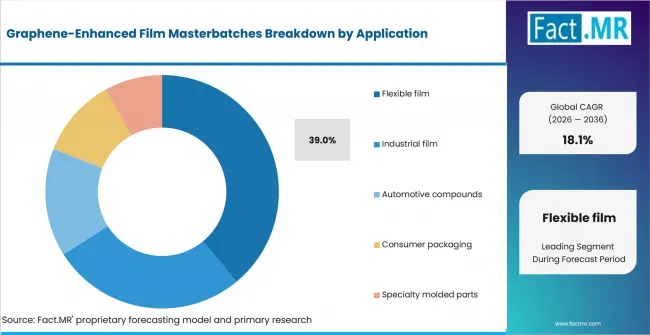
Graphene Enhanced Film Masterbatches Analysis By Application | Source: Fact.MR
Flexible film lets converters test graphene through normal masterbatch dosing on blown or cast lines. Trials can measure puncture retention and gauge reduction before repeat production. The broader plastic film market provides adjacent context for substrate and application requirements.
What is accelerating Graphene-Enhanced Film Masterbatches Market adoption, and what is holding it back?
Adoption is expected to rise where graphene produces a measurable film benefit. Dispersion control and qualification time remain material commercial limits. Cost comparison with established additive packages is expected to shape wider conversion.
Drivers Impact Analysis
| DRIVER | (~) % IMPACT ON CAGR | GEOGRAPHIC RELEVANCE | IMPACT TIMELINE |
|---|---|---|---|
| Film downgauging with retained strength | +2.0% | North America, Europe | Short term (<= 2 years) |
| Higher recycled-content tolerance | +1.6% | Europe, North America | Medium term (2-4 years) |
| Barrier and ESD functionality | +1.2% | Global | Medium term (2-4 years) |
| Commercial compounding partnerships | +0.9% | North America, Europe | Long term (>= 4 years) |
Source: Fact.MR analysis. Updated Sep 21, 2026
Opportunity Impact Analysis
| OPPORTUNITY | (~) % IMPACT ON CAGR | GEOGRAPHIC RELEVANCE | IMPACT TIMELINE |
|---|---|---|---|
| PCR-compatible high-performance films | +1.3% | Europe, North America | Short term (<= 2 years) |
| Industrial stretch and protective films | +1.0% | Global | Medium term (2-4 years) |
| Conductive and ESD film structures | +0.8% | East Asia, North America | Long term (>= 4 years) |
Source: Fact.MR analysis. Updated Sep 21, 2026
Restraints Impact Analysis
| RESTRAINT | (~) % IMPACT ON CAGR | GEOGRAPHIC RELEVANCE | IMPACT TIMELINE |
|---|---|---|---|
| Dispersion sensitivity at low loading | -0.8% | Global | Short term (<= 2 years) |
| Long converter qualification cycles | -0.6% | North America, Europe, East Asia | Medium term (2-4 years) |
| Cost justification against established additives | -0.5% | Global | Long term (>= 4 years) |
Source: Fact.MR analysis. Updated Sep 21, 2026
Which countries are scaling the Graphene-Enhanced Film Masterbatches Market through 2036?
- The country comparison spans 4.3 percentage points and forms three practical growth bands across the forecast period.
- The USA remains 0.3 percentage point above South Korea as its large polymer-processing base and active materials investment support commercial graphene-film trials.
- South Korea remains 1.1 percentage points above the United Kingdom through export-oriented manufacturing and specialty polymer processing across automotive, electronics and packaging supply chains.
- The United Kingdom remains 1.3 percentage points above Germany as manufacturing scale and packaging-material efficiency support qualification of thinner, reinforced film structures.
- Germany remains 1.6 percentage points above Denmark through its broader polymer-conversion base, packaging-recycling requirements and industrial film qualification activity.
- Denmark closes the displayed range as specialty manufacturing and circular-packaging requirements support selective use of graphene concentrates where lower material consumption or added functionality provides measurable value.
Comparable CAGRs can create different entry conditions due to film-line scale, resin mix, dispersion capability, qualification depth and packaging requirements. Full report coverage includes North America, Latin America, Western Europe, Eastern Europe, East Asia, South Asia & Pacific, Middle East & Africa.
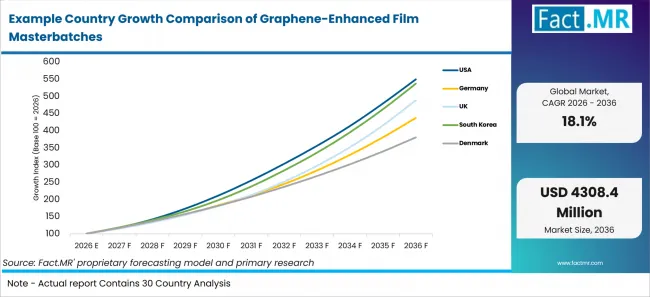
Example Country Growth Comparison Of Graphene Enhanced Film Masterbatches | Source: Fact.MR
| Country | CAGR (2026-2036) |
|---|---|
| United States | 18.6% |
| South Korea | 18.3% |
| United Kingdom | 17.2% |
| Germany | 15.9% |
| Denmark | 14.3% |
Source: Fact.MR analysis. Updated Sep 21, 2026
What supports USA adoption?
18.6% CAGR, supported by plastics investment and film-conversion qualification.
The United States combines a large resin-processing base with active materials investment. The Bureau of Economic Analysis reported on June 10, 2026 that expenditures for new foreign direct investment in U.S. plastics and rubber products manufacturing reached USD 19.0 billion in 2025. That manufacturing depth gives film converters more routes for controlled masterbatch trials. Graphene-enhanced concentrates are expected to progress where PE compatibility, dispersion consistency and line-speed behavior are demonstrated on production equipment.
How is South Korea developing demand?
18.3% CAGR, backed by export manufacturing and specialty polymer processing.
South Korea links specialty polymer development with a large export manufacturing base. Korea Customs Service reported on January 26, 2026 that national exports exceeded USD 700 billion in 2025. Export-oriented production raises the value of repeatable material quality across converters serving automotive, electronics and packaging supply chains. Graphene film masterbatches are expected to gain attention where a concentrated additive can be qualified through existing extrusion and compounding routes.
What supports the United Kingdom’s growth?
17.2% CAGR, led by manufacturing scale and packaging-material efficiency.
The United Kingdom offers a broad manufacturing base for film and polymer applications. The Office for National Statistics reported on July 24, 2026 that UK manufacturers’ product sales reached GBP 452.0 billion in 2025. Packaging and consumer-goods production give material developers a route to evaluate strength retention and thinner film structures. Commercial uptake is expected to depend on stable graphene dosing across the selected resin and film process. Converters are expected to favor formulations that can move from laboratory screening into repeat line trials with a clear property target.
What is supporting Germany’s adoption?
15.9% CAGR, reinforced by packaging recycling and industrial film qualification.
Germany combines industrial polymer processing with detailed packaging-recycling requirements. The German Environment Agency reported on January 27, 2026 that around 5.5 million tonnes of packaging waste collected by Germany’s dual systems were recovered in 2024 and that, for the first time, more than 70% of plastic packaging was sent for material recycling. These material flows keep recyclability and material efficiency visible during formulation work. Graphene masterbatches are expected to progress where mechanical reinforcement fits film-processing requirements and recycling compatibility remains clear for the target structure.
How does Denmark perform?
14.3% CAGR, shaped by specialty manufacturing and circular-packaging requirements.
Denmark has a smaller polymer-processing base than the larger European manufacturing markets but retains specialty conversion activity. On May 13, 2026, Statistics Denmark reported DKK 51.5 billion in 2025 turnover for the combined rubber, plastic, glass and concrete industry group. Film-grade graphene concentrates are expected to find selective use where lower material consumption or added function creates a measurable operating benefit. Qualification depth remains central to repeat orders.
Who leads the Graphene-Enhanced Film Masterbatches Market?
NanoXplore and Techmer PM provide a direct commercial film-masterbatch reference through their 2026 GrapheneBlack xGnP™ launch. First Graphene offers pelletized PureGRAPH® MB-LDPE masterbatch designed primarily for polyolefin systems, including polyethylene and polypropylene. Gerdau Graphene offers its Poly-G graphene-enhanced polymer masterbatch for plastic applications including films, profiles and sheets. Competitive development focuses on graphene dispersion, polymer-carrier compatibility and consistent performance during commercial-scale processing.
The competitive set overlaps with graphene polymer masterbatches where dispersion, carrier compatibility and repeatable processing define commercial usability. Film formulations can also be compared with polymer nanocomposites when converters assess how nanoscale fillers change strength, barrier behavior or conductivity.
Which companies are the key providers?
Companies profiled include NanoXplore; Techmer PM; First Graphene; and Gerdau Graphene.
- NanoXplore
- Techmer PM
- First Graphene
- Gerdau Graphene
Bibliography
- NanoXplore Inc. (2026, June 15). NanoXplore and Techmer PM launch revolutionary GrapheneBlack xGnP™ masterbatch for high-performance plastic films.
- Board of Governors of the Federal Reserve System. (2026, January 16). Industrial production and capacity utilization: G.17.
- U.S. Bureau of Economic Analysis. (2026, June 10). New foreign direct investment in the United States, 2025.
- Office for National Statistics. (2026, July 24). UK manufacturers’ sales by product: 2025.
- German Environment Agency, & Central Agency Packaging Register. (2026, January 27). Facts against myths: Packaging waste recycling in Germany is working.
- Statistics Denmark. (2026, May 13). Væksten i dansk industri fortsatte i 2025 [Growth in Danish industry continued in 2025].
- Gerdau. (2025, March 24). Gerdau Graphene lança novas versões em sua linha de masterbatches com grafeno durante a Feira Plástico Brasil [Gerdau Graphene launches new versions of its graphene masterbatch line at Plástico Brasil].
This Report Answers
- The report explains where graphene-enhanced film masterbatches are used across graphene form, host polymer, performance target, and application.
- Segment analysis identifies the leading subsegments and the processing reasons converters prioritize them.
- Country analysis examines manufacturing, packaging, and recycled-content conditions across the five profiled countries.
- Competitive analysis reviews current graphene producers and masterbatch providers relevant to film-grade polymer processing.
- Application analysis assesses strength retention, gauge reduction, recycled-content tolerance, barrier performance, and conductivity.
What does the Graphene-Enhanced Film Masterbatches Market cover?
The market covers graphene concentrates supplied in a polymer carrier for dilution into film-grade resin. It includes graphene nanoplatelets and few-layer graphene. Functionalized graphene and graphene-black hybrids extend the range used in film extrusion.
Coverage is positioned within polymer nanocomposites where nanoscale fillers are evaluated for changes in polymer performance. Recycled-resin formulations connect with PCR-compatible masterbatches when additive compatibility affects film quality and property retention.
What is included in the scope?
The scope includes graphene concentrates for PE and PP. PA and PET / polyester are included when the formulation is designed for film or closely related polymer processing. Recycled polymer blends are included where the masterbatch is used to restore or extend a defined film property.
Barrier-focused development can be compared with graphene-based coating additives when converters compare bulk modification with surface functionality.
What is excluded from the scope?
The scope excludes loose graphene powder sold as a standalone material. Base resin sold alone and finished film sold as a converted product fall outside market sizing. Non-graphene filler masterbatches and finished molded parts are treated as adjacent categories.
Flexible-film context can be compared with high-recyclability mono-material flexible packaging where material efficiency and recycling compatibility shape film design.
How Was the Analysis Built?
The analysis draws on 120+ sources, 35+ company portfolios, 25+ countries, and more than 20 industry interviews.
- Primary Research: Primary research includes discussions with manufacturers, service providers, technology developers, distributors, end users, and subject-matter experts. These conversations examine purchasing priorities, product adoption, operational challenges, approval requirements, competitive positioning, and the factors that influence wider market acceptance.
- Desk Research: Desk research covers government statistics, regulatory publications, company filings, trade data, technical studies, industry associations, standards, public policy, and other authoritative sources. Every source used in the analysis is documented in the bibliography.
- Market Sizing and Forecasting: Market estimates combine historical performance, demand indicators, pricing and volume trends, segment shares, company participation, country-level growth, adoption patterns, investment activity, and barriers to market expansion.
- Data Validation and Update Cycle: Findings are validated by comparing primary interviews with public data, company activity, regulatory changes, trade patterns, and industry developments. Regular updates review new product launches, capacity changes, partnerships, approvals, and shifts in commercial adoption.
Segmentation
What is the report’s scope and coverage?
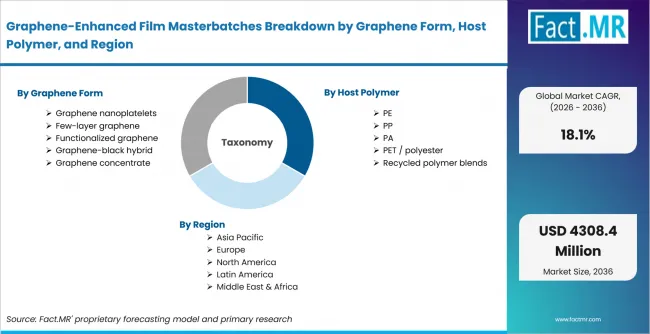
Graphene Enhanced Film Masterbatches Breakdown By Graphene Form, Host Polymer, And Region | Source: Fact.MR
| Attribute | Details |
|---|---|
| Quantitative Units | USD million |
| Market Definition | Concentrated graphene-polymer formulations designed for dilution into film-grade resins to improve mechanical, barrier, recycled-content, or conductive performance. |
| Graphene Form | Graphene nanoplatelets; Few-layer graphene; Functionalized graphene; Graphene-black hybrid; Graphene concentrate |
| Host Polymer | PE; PP; PA; PET / polyester; Recycled polymer blends |
| Performance Target | Tensile / puncture strength; Thickness reduction; Recycled-content tolerance; Barrier enhancement; Conductivity / ESD |
| Application | Flexible film; Industrial film; Automotive compounds; Consumer packaging; Specialty molded parts |
| Regions Covered | North America; Latin America; Western Europe; Eastern Europe; East Asia; South Asia & Pacific; Middle East & Africa |
| Countries Covered | United States; Germany; United Kingdom; South Korea; Denmark |
| Key Companies Profiled | NanoXplore; Techmer PM; First Graphene; Gerdau Graphene |
| Forecast Period | 2026 to 2036 |
| Approach | Hybrid top-down and bottom-up review using film demand, host resin, graphene form, qualification factors, country manufacturing signals, and provider portfolios. |
Source: Fact.MR analysis. Updated Sep 21, 2026
How is the market segmented?
-
By Graphene Form
- Graphene nanoplatelets
- Few-layer graphene
- Functionalized graphene
- Graphene-black hybrid
- Graphene concentrate
-
By Host Polymer
- PE
- PP
- PA
- PET / polyester
- Recycled polymer blends
-
By Performance Target
- Tensile / puncture strength
- Thickness reduction
- Recycled-content tolerance
- Barrier enhancement
- Conductivity / ESD
-
By Application
- Flexible film
- Industrial film
- Automotive compounds
- Consumer packaging
- Specialty molded parts
-
By Region
- North America
- Latin America
- Western Europe
- Eastern Europe
- East Asia
- South Asia & Pacific
- Middle East & Africa
Frequently Asked Questions
How big is the Graphene-Enhanced Film Masterbatches Market in 2026?
What is the CAGR of the Graphene-Enhanced Film Masterbatches Market from 2026 to 2036?
Which graphene form leads the Graphene-Enhanced Film Masterbatches Market?
Which application leads the Graphene-Enhanced Film Masterbatches Market?
Who are the leading companies in the Graphene-Enhanced Film Masterbatches Market?
Who worked on this report


Preview the report firsthand - request a free sample
Free SampleGet the brochure for pricing and purchase details
Download PDF