The Nano-Enhanced PCR Composite Materials Market is analyzed across its key product, application and end-use segments, with the study covering market dynamics, regional trends and demand outlook, forecast 2026 to 2036.
By Fact.MR Chemical & Materials DeskLead analyst:
S.N. JhaPublished :
Updated :
10 min read
Fact-checked under the Fact.MR editorial process
Nano-Enhanced PCR Composite Materials Market Forecast and Outlook 2026 to 2036
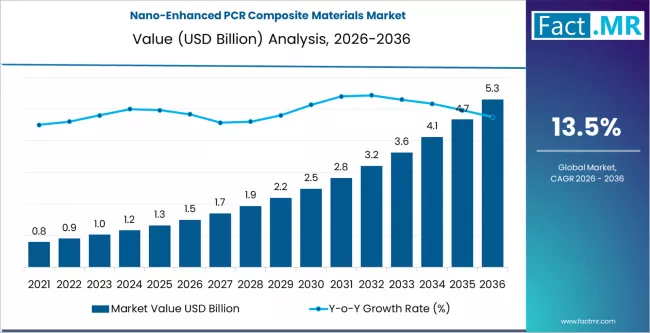
The nano-enhanced PCR composite materials market is likely to be valued at USD 1.5 billion in 2026 and is expected to grow to USD 5.3 billion by 2036, expanding at a CAGR of 13.5%.
This market presents significant commercial potential as industries seek to enhance material performance while maintaining sustainability objectives.
Summary of Nano-EnhancedPCRComposite Materials Market
Market Snapshot
Globalnano-enhancedPCRcomposite materials market revenue stood atUSD 1.5 billion in 2026and is forecast to reachUSD 5.3 billion by 2036.
At a13.5%CAGRfrom 2026 to 2036, this market is set to expand~3.5x in value, addingUSD 3.8 billion in absolute opportunity.
Growth is being driven by increasing demand forhigh-performance sustainable composite materials, particularly across automotive, aerospace, and construction applications.
Nano-enhancedPCRcomposites areemergingas a strategic material platform, enablingimproved mechanical performance,lightweighting, and sustainability compliancesimultaneously.
Demand and Growth Drivers
Industries are increasingly prioritizinghigh-strength, lightweight, and environmentally sustainable materialsto meet performance and regulatory requirements.
Growing use of advanced composites inautomotivelightweightingand aerospace applicationsis accelerating adoption ofnano-enhancedPCRmaterials.
Rising pressure to improveproduct lifecycle sustainability and recycled-contentutilizationis reinforcing market demand.
Product and Segment View
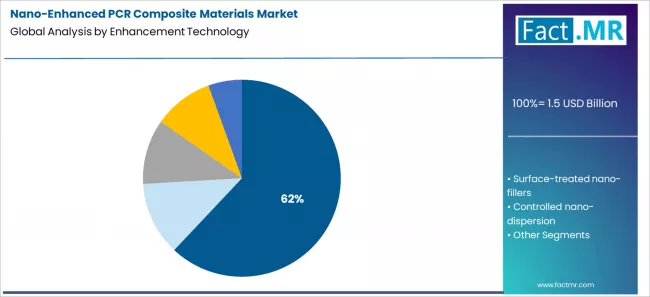
Nano-dispersion andcompatibilisationholds 62% of processing and technology segment share in 2026,emergingas the leading segment due to its critical role in enhancing material uniformity and composite performance.
Key end-use sectors include:
Automotive
Aerospace
Construction
Consumer goods
Industrial applications
Material systems include:
PCRthermoplastics withnano-fillers
Reinforced recycled polymer composites
Hybridnano-composite structures
Product development is increasingly focused on:
Lightweighting
Durability enhancement
Sustainability optimization
Regulatory compliance
Geography and Competitive Outlook
Asia Pacificis identified as the leading growth region, supported by strong manufacturing growth, industrialization, and increasing investment in advanced materials.
North America, Latin America, Western Europe, Eastern Europe, East Asia, South Asia & Pacific, Middle East & Africa
Source: Fact.MR analysis. Updated May 8, 2026
Buyers are increasingly prioritizing high-performance materials that offer both cost efficiency and reduced environmental impact. Decision-making will be heavily influenced by the growing demand for composites in sectors like automotive, aerospace, and construction, where durability and weight reduction are critical. The commercial relevance of nano-enhanced composites lies in their ability to meet evolving regulatory standards and consumer preferences for eco-friendly solutions. As businesses continue to face pressure to innovate sustainably, the adoption of these materials will influence cost structures, product lifecycle management, and competitive positioning. Companies that adapt quickly to this shift are poised to capture substantial value in the evolving market landscape.
Category
Category
Segments
End-Use
Automotive and packaging; Electronics and industrial parts; Precision engineering; Mass-market applications; Electronics housings; Industrial components
In the nano-enhanced PCR composite materials market, nano-additives are a critical factor in enhancing the material properties for various industrial applications. Nano-clays, CNTs, and graphene lead the market with a 60% share, offering significant improvements in strength, conductivity, and thermal stability. These nano-additives are widely used to create high-performance composites with enhanced mechanical and electrical properties. As industries seek materials with better durability and functionality, the demand for nano-enhanced PCR composites featuring these advanced additives is expected to increase, helping manufacturers meet more stringent performance standards while contributing to sustainable material use.
How Does Enhancement Technology Influence the Nano-Enhanced PCR Composite Materials Market?
Enhancement technology plays a central role in optimizing the performance of nano-enhanced PCR composite materials, with nano-dispersion and compatibilization leading this segment at a 62% share. These technologies improve the uniform distribution of nano-additives within the polymer matrix, ensuring consistent material properties across the entire composite. By enhancing compatibility between the nano-fillers and the polymer matrix, nano-dispersion technology allows for the creation of composites with superior mechanical properties and stability. As demand for advanced materials continues to rise, the adoption of these enhancement technologies is expected to drive further growth, enabling manufacturers to produce high-performance, cost-efficient PCR composite materials for various applications.
What are the Principal Drivers, Constraints, and Evolving Dynamics of the NanoEnhanced PCR Composite Materials Market?
Demand for nanoenhanced postconsumer recycled (PCR) composite materials has been influenced by requirements for improved mechanical and thermal properties in automotive, consumer electronics, and industrial applications. Material developers and manufacturers have tested nanoscale fillers such as nanoclay and carbon nanofibers to reinforce recycled polymer matrices. Performance targets that include stiffness and impact resistance have supported selective adoption where PCR materials must meet specific engineering criteria.
Availability of consistent nanoenhanced PCR feedstock has been limited because of variability in recycled streams. Some fabrication processes have shown sensitivity to dispersion quality of nano additives. Research has focused on standardizing nano additive integration and evaluating longterm durability of nanomodified PCR composites. Collaborative work between material scientists and enduse manufacturers is ongoing to define testing protocols and application guidelines.
Analysis of the Nano-Enhanced PCR Composite Materials Market by Key Country
Nano Enhanced Pcr Composite Materials Market Cagr Analysis By Country | Source: Fact.MR
Country
CAGR (2026–2036)
Germany
12.6%
USA
13%
Japan
11.2%
China
14.8%
Korea
10.4%
India
15.6%
Source: Fact.MR analysis. Updated May 8, 2026
The report covers an in-depth analysis of 40+ countries; top-performing countries are highlighted below.
What is the Growth Outlook for Nano-Enhanced PCR Composite Materials in Germany?
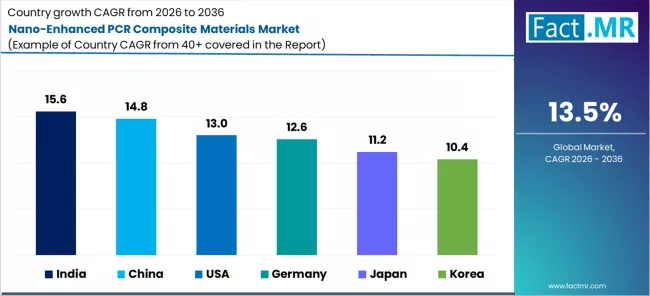
Germany’s nano-enhanced PCR composite materials market is projected to grow at a CAGR of 12.6% from 2026 to 2036. As a leading hub for industrial innovation and sustainability, Germany’s focus on advanced manufacturing and eco-friendly solutions drives the demand for nano-enhanced PCR composite materials. With increased application in industries such as automotive, aerospace, and electronics, these materials are gaining traction. Germany’s strong commitment to sustainability and its advanced recycling infrastructure provide a solid foundation for the continued adoption of PCR composites, supporting robust market growth.
How is the Nano-Enhanced PCR Composite Materials Market Performing in the USA?
The USA’s nano-enhanced PCR composite materials market is expected to grow at a CAGR of 13% from 2026 to 2036. The country’s demand for high-performance, environmentally sustainable materials in manufacturing is propelling the adoption of nano-enhanced PCR composites. Industries such as automotive, construction, and consumer electronics are increasingly turning to these materials to reduce weight, improve performance, and enhance recyclability. The USA’s technological innovation and focus on sustainable manufacturing solutions will continue to drive the market for nano-enhanced PCR composite materials in the coming years.
What is the Market Outlook for Nano-Enhanced PCR Composite Materials in Japan?
Japan’s nano-enhanced PCR composite materials market is forecast to grow at a CAGR of 11.2% from 2026 to 2036. Japan’s commitment to sustainability and innovation in manufacturing technologies supports the demand for advanced, eco-friendly materials. Nano-enhanced PCR composites are becoming increasingly important in sectors such as automotive and electronics, where weight reduction and performance improvement are crucial. Despite a more modest growth rate compared to other regions, Japan’s strong emphasis on technological advancement and green manufacturing ensures steady market expansion for these materials.
What is the Growth Potential for Nano-Enhanced PCR Composite Materials in China?
China is expected to experience significant growth in the nano-enhanced PCR composite materials market, with a projected CAGR of 14.8% from 2026 to 2036. As the country’s manufacturing sector continues to grow and modernize, the demand for high-performance, sustainable materials is increasing. Nano-enhanced PCR composites provide an ideal solution for industries such as automotive, aerospace, and electronics, where performance and recyclability are key considerations. China’s focus on environmental sustainability and green manufacturing is expected to drive the widespread adoption of these materials, fueling market growth.
What is the Demand for Nano-Enhanced PCR Composite Materials in Korea?
Korea’s nano-enhanced PCR composite materials market is projected to grow at a CAGR of 10.4% from 2026 to 2036. Korea’s advanced industrial base and emphasis on sustainability in manufacturing are driving the adoption of nano-enhanced PCR composites. As industries such as automotive, electronics, and construction seek materials that offer better performance and recyclability, the demand for these composites is expected to rise. While the growth rate may be slightly slower compared to other regions, Korea’s focus on technological innovation and eco-friendly manufacturing processes will support steady market expansion.
What is the Market Expansion Outlook for Nano-Enhanced PCR Composite Materials in India?
India’s nano-enhanced PCR composite materials market is set to grow at a robust CAGR of 15.6% from 2026 to 2036. With rapid industrialization and an increasing focus on sustainability, India’s demand for advanced, eco-friendly materials in manufacturing is rising. The automotive, construction, and electronics industries are driving the adoption of nano-enhanced PCR composites due to their enhanced performance and recyclability. India’s growing awareness of environmental issues, combined with favorable government policies supporting green technologies, positions the country as a key market for nano-enhanced PCR composites.
How is Competition Structured in the NanoEnhanced PCR Composite Materials Market?
Competition in the nano enhanced PCR composite materials market is driven by material performance, integration of nanofillers, and application suitability. BASF and Evonik leverage broad chemical portfolios and experience with polymer additives to offer composite resins with improved mechanical properties. Toray and Mitsubishi Chemical focus on high strength fiber and matrix systems that incorporate nano scale reinforcement for aerospace, automotive, and industrial uses.
Cabot and Kingfa compete by supplying carbonbased nanomaterials that enhance stiffness and conductivity in recycled polymer matrices. Wanhua and Avient emphasize tailored formulations that balance performance with processability for injection molding and extrusion. Differentiation arises from the ability to deliver consistent nano dispersion, validated property gains, and compliance with industry specifications. Buyers assess suppliers on technical data support, qualification history, and the capacity to scale production for commercial volumes.
Key Players in the NanoEnhanced PCR Composite Materials Market
BASF
Cabot
Toray
Kingfa
Evonik
Mitsubishi Chemical
Wanhua
Avient
Bibliographies
International Organization for Standardization. (2023).ISO 14021: Environmental labels and declarations-Self-declared environmental claims (including recycled content). ISO.
Organisation for Economic Co-operation and Development. (2023).Advanced materials and nanotechnology for circular plastics and composites. OECD Publishing.
United Nations Environment Programme. (2024).Plastics, additives, and nanomaterials in circular economy transitions. UNEP.
Polymers. (2023).Mechanical, thermal, and barrier performance of nano-reinforced recycled polymer composites. Polymers.
Journal of Cleaner Production. (2024).Life-cycle assessment of nano-enhanced recycled polymer composites for industrial and consumer applications. Journal of Cleaner Production.
Market Breakdown
Segmentation
Scope of the Report
Items
Values
Quantitative Units (2026)
USD Billion
End-use
Automotive and packaging, Electronics and industrial parts, Precision engineering, Mass-market applications, Electronics housings
Dollar revenue by end-use, composite type, nano-additive, and enhancement technology; regional demand trends, competitive landscape, technological advancements in nano-enhanced PCR composites, and innovations in material compounding strategies
How big is the nano-enhanced pcr composite materials market in 2026?
The global nano-enhanced pcr composite materials market is estimated to be valued at USD 1.5 billion in 2026.
What will be the size of nano-enhanced pcr composite materials market in 2036?
The market size for the nano-enhanced pcr composite materials market is projected to reach USD 5.3 billion by 2036.
How much will be the nano-enhanced pcr composite materials market growth between 2026 and 2036?
The nano-enhanced pcr composite materials market is expected to grow at a 13.5% CAGR between 2026 and 2036.
What are the key product types in the nano-enhanced pcr composite materials market?
The key product types in nano-enhanced pcr composite materials market are automotive and packaging, electronics and industrial parts, precision engineering, mass-market applications, electronics housings and industrial components.
Which composite type segment to contribute significant share in the nano-enhanced pcr composite materials market in 2026?
In terms of composite type, reinforced pcr composites segment to command 46.0% share in the nano-enhanced pcr composite materials market in 2026.