- Base Value(2025): 0.3 Bn
- Estimated Value(2026): 0.4 Bn
- Forecast Value (2036): 1.3 Bn
- CAGR (2026 - 2036): 17.1%
Enzymatic-Recycled PET Intermediates Market Forecast and Outlook 2026 to 2036
In 2025, the enzymatic-recycled PET intermediates market was valued at USD 0.3 billion. Based on Fact.MR analysis, demand for enzymatic-recycled PET intermediates is estimated to grow to USD 0.4 billion in 2026 and USD 1.3 billion by 2036. Fact.MR projects a CAGR of 17.1% during the forecast period.
The absolute dollar growth from 2026 to 2036 represents an incremental gain of USD 0.9 billion, a transformational expansion given the early-stage commercial base from which this market is scaling. Growth is sustained by the unique ability of enzymatic depolymerization to recover near-virgin-quality TPA and BHET monomers from mixed-color and contaminated PET waste streams that mechanical recycling cannot process to food-contact specification, directly addressing the quality ceiling that has historically limited recycled PET content in premium packaging and fiber applications.
Enzymatic recycling has attracted significant strategic attention from major PET producers and brand owners. Indorama Ventures and major global beverage companies have disclosed partnership or offtake interest in enzymatic recycling capacity, reflecting the commercial reality that voluntary recycled content targets and regulatory mandates in Europe and North America cannot be fully satisfied by mechanical recycling supply alone at the purity and volume required for food-contact and beverage packaging applications through the forecast period.
Growth rates vary significantly by regulatory environment and technology deployment maturity. France leads with an 18.2% CAGR, driven by Carbios S.A.'s commercial facility scale-up at its Longlaville site and France's advanced implementation of the EU SUP Directive through national legislation requiring recycled PET content in beverage bottles. The United States follows at 15.5%, anchored by major beverage brand voluntary recycled content commitments and EPA interest in advanced recycling under the TSCA framework. Germany records 14.8%, driven by REACH-aligned plastic packaging recycled content obligations and the concentration of European PET processing and packaging manufacturing infrastructure. Japan posts 13.2%, supported by its Extended Producer Responsibility framework for plastic packaging and the active investment of domestic chemical companies in enzymatic recycling technology licensing. Mature markets including Germany and Japan generate structured compliance-driven demand rather than incremental volume growth, constrained primarily by the pace at which licensed enzymatic recycling capacity can be commissioned relative to regulatory off-take demand timelines.
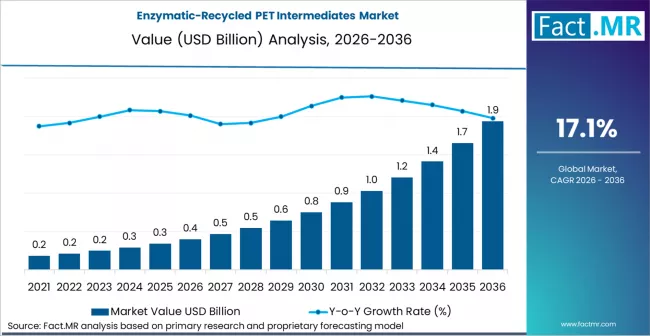
Enzymatic Recycled Pet Intermediates Market Market Value Analysis | Source: Fact.MR
Market Definition
The enzymatic-recycled PET intermediates market covers purified terephthalic acid, bis-hydroxyethyl terephthalate, and related monomers recovered through the enzymatic depolymerization of post-consumer polyethylene terephthalate waste using engineered biological catalysts. Unlike mechanical recycling, enzymatic processes break PET polymer chains down to their constituent monomer building blocks, enabling production of intermediates that are chemically identical to virgin PET monomers and suitable for direct use in food-contact packaging, high-tenacity textile fiber, and film manufacturing.
Market Inclusions
The report covers global and regional enzymatic-recycled PET intermediates market size forecasts from 2026 to 2036, segmented by grade, application, and end-use industry. It evaluates enzymatic depolymerization technology platforms, post-consumer PET feedstock availability and sorting infrastructure by geography, certified recycled content verification frameworks, comparative pricing of enzymatic intermediates versus mechanical rPET and virgin PET, and competitive positioning of leading enzymatic technology licensors and intermediate producers.
Market Exclusions
The scope excludes mechanically recycled PET flake, pellet, and fiber products, virgin PET monomers produced from petrochemical paraxylene oxidation, chemically recycled PET intermediates produced through glycolysis or methanolysis rather than enzymatic depolymerization, and downstream finished goods incorporating enzymatic-recycled PET content such as beverage bottles, polyester garments, and packaging films. It focuses strictly on the enzymatic-recycled monomer intermediate and its immediate supply chain to PET resin producers and compounders.
Research Methodology
- Primary Research: Primary research involved structured interviews with enzymatic recycling process development engineers at Carbios, Samsara Eco, and Eastman Chemical, PET procurement managers at major beverage packaging and polyester fiber manufacturers, sustainability and circular economy directors at European and U.S. apparel and packaging brands, and regulatory affairs specialists at plastic packaging industry associations tracking EU SUP Directive implementation and EPA advanced recycling policy development.
- Desk Research: Desk research synthesized data from European Commission Single-Use Plastics Directive implementation reports and recycled content obligation dossiers, EPA advanced recycling policy development publications, corporate sustainability and circularity disclosures from Carbios S.A., Indorama Ventures, Eastman Chemical Company, and DuPont Teijin Films, and national plastic waste management agency PET collection rate and quality statistics in France, Germany, the United States, and Japan.
- Market-Sizing and Forecasting: Market sizing employed a hybrid top-down and bottom-up approach, combining total addressable post-consumer PET waste volumes sortable to enzymatic recycling specification by geography with commercial enzymatic facility capacity investment timelines and average enzymatic intermediate pricing relative to mechanical rPET and virgin PET, validated against disclosed corporate enzymatic recycling program milestones and benchmarked against EU SUP Directive recycled content obligation timelines for PET beverage packaging.
- Data Validation and Update Cycle: Outputs were cross-validated against disclosed enzymatic recycling capacity investment milestones from Carbios S.A., Eastman Chemical, and Samsara Eco, reconciled semi-annually with European Commission SUP Directive implementation reports and EPA advanced recycling regulatory update publications, and updated annually with commercial enzymatic plant commissioning announcements, brand owner recycled content procurement commitment disclosures, and national PET collection infrastructure improvement program progress reports.
Summary
- Market Definition
- The enzymatic-recycled PET intermediates market encompasses bio-catalytically produced TPA, BHET, and related PET monomers recovered through engineered enzyme depolymerization of post-consumer PET waste streams, supplied as certified food-contact-grade circular intermediates for fiber-grade, bottle-grade, and film-grade PET resin production across packaging, textiles, electronics, and automotive manufacturing sectors.
- Demand Drivers
- The EU Single-Use Plastics Directive's mandatory recycled content obligations require PET beverage bottles placed on the European market to contain minimum recycled PET content thresholds rising from 25% in 2025 to 30% by 2030, creating a statutory demand pipeline for food-contact-grade recycled PET intermediates that mechanical recycling supply alone cannot satisfy at the required purity and volume in major European markets.
- Major global beverage brands including leading soft drink and water companies have disclosed voluntary recycled PET content targets of 50 percent or more in their global packaging portfolios by 2030, requiring certified food-contact-grade enzymatic recycled intermediates that can be integrated into bottle-grade PET resin without compromising transparency, odor, or safety compliance in regulated markets.
- European and U.S. apparel brands implementing Scope 3 emissions reduction programs are requiring increasing shares of certified recycled PET fiber content in their polyester garment supply chains, driving fiber-grade enzymatic intermediate demand as mechanical rPET fiber quality and traceability limitations restrict the ability of apparel procurement managers to verify and report circular content to their sustainability-reporting stakeholders.
- Key Segments Analyzed
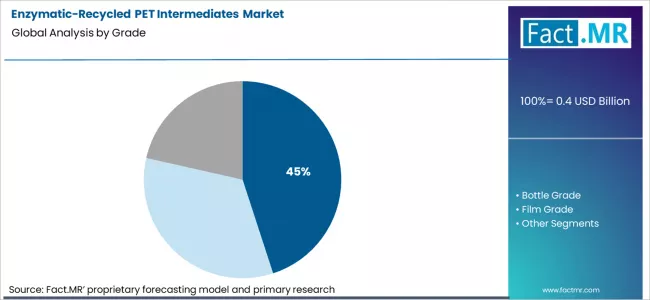
- By grade, fiber grade holds the leading 45% share, reflecting the high volume of polyester textile fiber production globally and the strong demand from apparel brands for certified recycled content PET intermediates that meet both performance specifications and chain-of-custody documentation requirements for sustainability reporting programs.
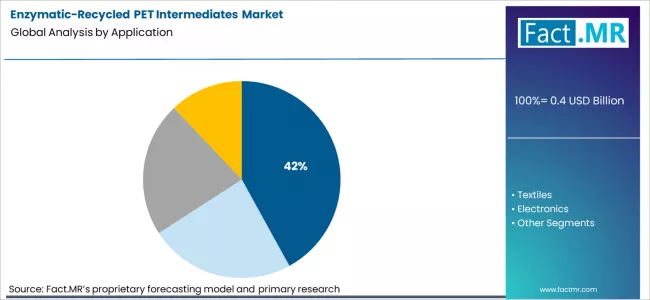
- By application, packaging accounts for the dominant 42% share, driven by EU SUP Directive mandatory recycled content requirements for PET beverage bottles and the voluntary recycled content commitments of major global beverage and consumer packaged goods brands requiring food-contact-grade certified circular intermediates at scale.
- By end-use industry, packaging accounts for the leading 40% share, driven by mandatory recycled content requirements under the EU SUP Directive for PET beverage bottles and large-scale procurement commitments from global beverage and consumer goods brands seeking certified food-contact-grade circular PET intermediates.
- By geography, Europe contributes the highest regulatory-driven conversion demand, with France recording the fastest country-level CAGR at 18.2% anchored by Carbios commercial facility commissioning, while the United States generates the largest volume of voluntary brand-driven enzymatic intermediate demand supported by major beverage and apparel OEM sustainability procurement programs.
- Analyst Opinion at FACT.MR
- Shambhu Nath Jha, Principal Consultant at Fact.MR, notes that CXOs will find this report critical for understanding how enzymatic depolymerization of PET waste is building a certified, food-contact-grade circular supply chain. The report highlights which grade segments, applications, and regions present the strongest first-mover opportunities for companies that commission licensed enzymatic capacity ahead of the EU SUP Directive and the expected recycled content demand surge between 2026 and 2029.
- Strategic Implications / Executive Takeaways
- PET resin producers considering enzymatic recycling should secure Carbios or similar technology licenses before 2027. Proven platforms are limited, and plant construction takes several years. Delays could mean missing the peak EU SUP Directive demand window between 2028 and 2032.
- Packaging manufacturers serving European beverage brands should qualify enzymatic recycled PET from at least two certified suppliers per grade. Commercial-scale capacity will remain tight through 2028, creating supply concentration risk for brands with fixed recycled content commitments.
- Apparel brands rolling out recycled fiber programs should form co-development agreements with enzymatic PET producers. These agreements should include verified chain-of-custody documentation. Traceability is becoming essential for EU Green Claims Directive compliance and broader sustainability reporting requirements.
- Methodology
- Market size estimates were based on addressable post-consumer PET waste volumes by region combined with enzymatic facility capacity investment timelines, cross-checked against disclosed commercial recycling program milestones from Carbios, Eastman Chemical, and Samsara Eco.
- Segment analysis used EU SUP Directive implementation reports, EPA advanced recycling policy documentation, and apparel and packaging brand voluntary recycled content commitment disclosures by market.
- Country forecasts were validated using national plastic packaging collection rate data, government circular economy policy implementation timelines, and corporate enzymatic plant commissioning announcements across key producing and consuming geographies.
Segmental Analysis
Enzymatic-Recycled PET Intermediates Market Analysis by Grade
Enzymatic Recycled Pet Intermediates Market Analysis By Grade | Source: Fact.MR
Based on FACT.MR’s report, fiber grade intermediates are projected to hold 45% share in 2026. Polyester fiber remains the largest PET application globally, and apparel brands are early adopters of certified recycled content. Enzymatic recycling offers consistent monomer quality from mixed waste, which supports stable yarn production and improves manufacturing yield.
- Indorama Ventures Enzymatic Partnership: Indorama Ventures has partnered with Carbios to develop the first commercial enzymatic PET recycling plant in France, targeting both fiber-grade and bottle-grade production for European customers. [1]
- Eastman Molecular Recycling Technology: Eastman has invested over USD 1 billion in its Kingsport facility, producing certified recycled PET intermediates for packaging and specialty fibers. [3]
- Bottle Grade Demand Acceleration: Bottle-grade intermediates, holding 32% share, are growing fastest due to EU food-contact mandates. Enzymatic recycling consistently meets purity standards required for beverage applications, supporting higher margins. [2]
Enzymatic-Recycled PET Intermediates Market Analysis by Application
Enzymatic Recycled Pet Intermediates Market Analysis By Application | Source: Fact.MR
According to FACT.MR, packaging accounts for 42% share in 2026. The EU SUP Directive creates mandatory recycled content demand in beverage bottles, making enzymatic intermediates a compliance-driven procurement decision rather than a discretionary sustainability upgrade.
- Carbios Brand Partner Off-take: Carbios has secured off-take agreements with L’Oreal S.A. and Nestle S.A. for enzymatic-recycled PET packaging, confirming brand willingness to pay a premium for certified circular content. [1]
- Samsara Eco Technology Deployment: Samsara Eco has advanced its enzymatic recycling platform in Australia and is engaging with global apparel and packaging brands for commercial deployment. [4]
- Textiles Application Growth Trajectory: Textiles, at 30% share, are expanding through EU Textile Strategy requirements and voluntary brand programs. Enzymatic recycling provides traceable, high-purity intermediates that meet third-party certification and audit standards. [5]
Drivers, Restraints, and Opportunities
Fact.MR analysis indicates that the enzymatic-recycled PET intermediates market, valued at around USD 0.3 billion, has emerged from early commercial breakthroughs led by Carbios in France and Eastman Chemical in the United States. Their technology validation and brand-backed off-take agreements have demonstrated that bio-catalytic PET depolymerization can operate at commercial scale. Unlike other advanced recycling routes, enzymatic PET recycling benefits from a single, well-understood polymer stream and a clear end market in packaging and textiles, giving it stronger demand visibility than most circular chemistry innovations.
The main challenge is timing. Regulatory deadlines, especially in Europe, are moving faster than plant construction cycles. Commercial enzymatic facilities require three to six years to build and commission. As EU recycled content requirements rise toward 2030, early producers are likely to benefit from supply tightness and premium pricing.
- EU SUP Directive Recycled Content Mandates: The EU Single-Use Plastics Directive 2019/904 requires 25% recycled PET in beverage bottles by 2025 and 30% by 2030. Enzymatic recycling can deliver food-contact-grade intermediates from mixed and contaminated PET streams that mechanical recycling cannot reliably process. [2]
- Carbios Commercial Scale-Up Leadership: France leads due to Carbios S.A. and its LEAF enzyme platform. The company began construction of its first commercial plant in Longlaville in partnership with Indorama Ventures, targeting certified TPA supply for European packaging markets. [1]
- U.S. Brand Owner Demand Pull: In the United States, demand is largely voluntary. Major beverage brands have set recycled content targets that exceed current mechanical supply. Eastman’s Kingsport molecular recycling facility, operational since late 2023, supplies certified recycled intermediates to premium packaging and fiber customers. [3]
Regional Analysis
The enzymatic-recycled PET intermediates market is analyzed across North America, Europe, Asia Pacific, Latin America, and Middle East and Africa. Regional demand patterns reflect the pace of enzymatic recycling technology commercialization, the maturity of post-consumer PET waste collection and sorting infrastructure, mandatory recycled content obligation timelines under national and supranational plastic packaging legislation, and the depth of brand owner voluntary recycled content commitments in each market. The full report offers detailed market attractiveness analysis comparing regulatory mandate timelines, feedstock availability, technology deployment status, and competitive intensity by region.
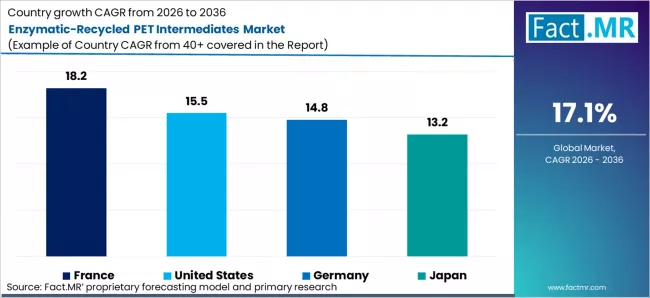
Enzymatic Recycled Pet Intermediates Market Cagr Analysis By Country | Source: Fact.MR
| Country | CAGR% |
|---|---|
| France | 18.2% |
| United States | 15.5% |
| Germany | 14.8% |
| Japan | 13.2% |
Source: Fact.MR analysis. Updated Feb 20, 2026
Source: Fact.MR (FACT.MR) analysis, based on proprietary forecasting model and primary research
Europe Enzymatic-Recycled PET Intermediates Market Analysis
Europe is the global regulatory mandate epicenter for enzymatic-recycled PET intermediates, defined by the EU Single-Use Plastics Directive creating the world's most comprehensive statutory recycled content framework for PET packaging and the concentration of early commercial enzymatic recycling capacity in France. Carbios S.A. holds the dominant competitive position through its LEAF enzyme technology platform and its partnership with Indorama Ventures for the first commercial facility.
- France: Demand for enzymatic-recycled PET intermediates in France is projected to rise at 18.2% CAGR through 2036. France's uniquely high CAGR reflects its dual role as the home of Carbios S.A. and as the first major European market to implement national legislation going beyond the baseline EU SUP Directive requirements for recycled PET packaging content. The French Anti-Waste for a Circular Economy Law enacted in 2020 introduced national provisions accelerating PET bottle recycling targets and creating domestic market obligations that directly benefit local enzymatic intermediate supply.
- Germany: Demand for enzymatic-recycled PET intermediates in Germany is projected to rise at 14.8% CAGR through 2036. Germany's growth is anchored by the concentration of European PET resin processing and packaging manufacturing infrastructure within its borders and the rigorous implementation of EU SUP Directive obligations through the German Packaging Act.
FACT.MR's analysis of the enzymatic-recycled PET intermediates market in Europe includes country-level assessment covering France, Germany, the United Kingdom, the Netherlands, and Nordic markets. Readers can find EU SUP Directive compliance timeline analysis, Carbios commercial facility ramp-up impacts, brand owner off-take program details, and national plastic packaging regulation implementation data by country.
North America Enzymatic-Recycled PET Intermediates Market Analysis
North America is the voluntary brand-driven adoption market for enzymatic-recycled PET intermediates, where the absence of statutory recycled content mandates equivalent to the EU SUP Directive is offset by the voluntary commitments of major beverage, apparel, and consumer packaged goods companies whose global recycled content targets require certified enzymatic intermediate supply at volumes beyond what domestic mechanical recycling can provide.
- United States: Demand for enzymatic-recycled PET intermediates in the United States is projected to rise at 15.5% CAGR through 2036. U.S. growth is driven by major beverage brand voluntary recycled PET content commitments of 50 percent or more in packaging portfolios by 2030, which exceed what U.S. mechanical recycling infrastructure can supply at food-contact grade at the required scale.
FACT.MR's analysis of the enzymatic-recycled PET intermediates market in North America includes country-level assessment covering the United States and Canada. Readers can find Eastman molecular recycling capacity analysis, major beverage and apparel brand recycled content commitment timelines, EPA advanced recycling policy development impacts, and PET collection infrastructure improvement program analysis.
Asia Pacific Enzymatic-Recycled PET Intermediates Market Analysis
Asia Pacific is the scale-production and emerging-regulation market for enzymatic-recycled PET intermediates, where the world's largest concentrations of PET fiber and packaging production create both the largest feedstock volumes and the largest potential end-use demand base.
- Japan: Demand for enzymatic-recycled PET intermediates in Japan is projected to rise at 13.2% CAGR through 2036. Japan's growth is grounded in the Plastic Resource Circulation Act, which expanded plastic recycling obligations for manufacturers and retailers and elevated chemical recycling including enzymatic depolymerization to an explicitly recognized and promoted recycling pathway within Japan's national polymer waste management framework.
FACT.MR's analysis of the enzymatic-recycled PET intermediates market in Asia Pacific includes country-level assessment covering Japan, China, South Korea, India, Australia, and ASEAN markets. Readers can find Japan Plastic Resource Circulation Act implementation analysis, Chinese circular economy policy impacts on PET recycling investment, and Samsara Eco technology deployment timelines across the region.
Competitive Aligners for Market Players
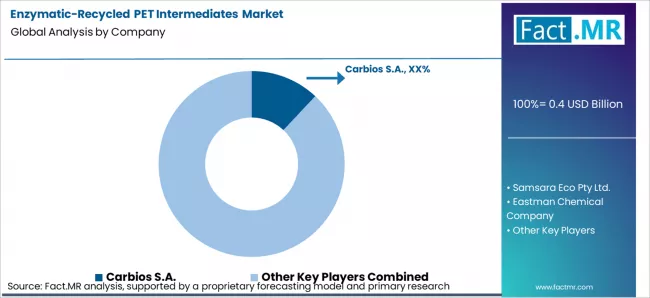
Enzymatic Recycled Pet Intermediates Market Analysis By Company | Source: Fact.MR
The global enzymatic-recycled PET intermediates market is highly concentrated at the technology level. Carbios S.A., Eastman Chemical, and Samsara Eco control the main commercially validated enzymatic and molecular recycling platforms. Competition is driven less by price and more by technology access and the speed of plant commissioning. With only a few proven licenses available and construction timelines of three to six years, early movers hold a clear structural advantage.
Carbios has a strong position through its LEAF thermophilic enzyme platform, already validated at pilot scale and licensed to Indorama Ventures for the first commercial plant. This creates a meaningful technology barrier for new entrants. Eastman benefits from financial scale and vertical integration across the PET value chain, allowing it to fund large facilities and manage ramp-up risk internally. Samsara Eco differentiates itself through multi-polymer enzyme capability, positioning it for future expansion beyond PET into nylon and blended textile waste.
Major brand owners are qualifying supply from both Carbios-linked and Eastman-linked producers to diversify risk. Because certified food-contact recycled content is critical to sustainability reporting and regulatory compliance, buyers are accepting prices above mechanical rPET levels. This supply scarcity supports premium pricing for enzymatic intermediates through the early commercialization phase.
Recent Development
- In December 2025, Carbios and Wankai New Materials signed a definitive agreement to launch Asia’s first large-scale PET biorecycling plant in Zhejiang province, China.
- In September 2025, Carbios S.A. reported its 2025 half-year results and reconfirmed progress toward building its commercial PET biorecycling plant in Longlaville, France, with construction expected to restart by the end of 2025 and commissioning planned for 2027.
Key Players
- Carbios S.A.
- Samsara Eco Pty Ltd.
- Eastman Chemical Company
- Indorama Ventures PCL
- DuPont Teijin Films LLC
- Loop Industries Inc.
Bibliography
- [1] Carbios S.A., Annual Report 2023 and Commercial Facility Groundbreaking Press Release, October 2023.
- [2] European Commission, Directive 2019/904 on the Reduction of the Impact of Certain Plastic Products on the Environment (Single-Use Plastics Directive), June 2019.
- [3] Eastman Chemical Company, Fiscal Year 2023 Annual Report and Earnings Communications, February 2024.
- [4] Samsara Eco Pty Ltd., Corporate Technology Development and Partnership Announcement, September 2023.
- [5] European Commission, EU Strategy for Sustainable and Circular Textiles, March 2022.
- [6] DuPont Teijin Films, Sustainability and Circular Economy Product Strategy Disclosure, 2023.
- [7] European Automobile Manufacturers Association, Sustainability and Circular Economy in Automotive Materials Report, January 2024.
This Report Addresses
- Market intelligence for strategic planning with analysis of enzymatic-recycled PET intermediates market evolution from technology pilot demonstration toward commercial-scale bio-catalytic depolymerization supply chains serving packaging, textiles, electronics, and automotive sectors globally.
- Market size and forecast showing global valuation of USD 0.4 billion in 2026 and projected USD 1.3 billion by 2036 at a CAGR of 17.1%.
- Growth opportunity mapping across bottle-grade enzymatic TPA supply for EU SUP Directive compliant beverage packaging, fiber-grade certified circular PET intermediates for apparel brand recycled content programs, and film-grade enzymatic intermediates for electronics and specialty packaging applications.
- Segment and regional forecasts covering all major countries with grade, application, and end-use industry breakdowns including packaging, textiles, electronics, and automotive sector enzymatic intermediate demand analysis.
- Competition strategy assessment of leading enzymatic recycling technology developers and commercial producers including technology license access, commercial-scale plant commissioning timelines, grade certification status, and brand owner off-take agreement pipeline for Carbios, Eastman Chemical, Samsara Eco, Indorama Ventures, and DuPont Teijin Films.
- Regulatory compliance tracking of EU Single-Use Plastics Directive recycled content obligation implementation timelines, EU Textile Strategy circular content requirements, French Anti-Waste Law national provisions, EPA advanced recycling policy development status, and Japan Plastic Resource Circulation Act implementation milestones.
- Technology adoption analysis covering LEAF enzyme platform commercial scale-up milestones, molecular recycling versus enzymatic depolymerization comparative assessment, certified recycled content chain-of-custody verification scheme developments, and post-consumer PET feedstock collection and sorting infrastructure capacity by geography.
- Report delivery in Excel, PowerPoint, and PDF formats with fully validated data, primary research evidence, and verified regulatory and company source documentation.
Segmentation
Scope of Report
| Items | Values |
|---|---|
| Quantitative Units | USD 0.4 billion (2026) to USD 1.3 billion (2036), at a CAGR of 17.1% |
| Market Definition | The enzymatic-recycled PET intermediates market covers bio-catalytically produced TPA, BHET, and PTA monomers recovered through enzymatic depolymerization of post-consumer PET waste, supplied as certified circular drop-in intermediates for fiber-grade, bottle-grade, and film-grade PET resin production across packaging, textiles, electronics, and automotive sectors. |
| By Grade | Fiber Grade, Bottle Grade, Film Grade |
| By Application | Packaging, Textiles, Electronics, Others |
| By End-Use Industry | Packaging, Textiles, Automotive, Others |
| Regions Covered | Asia Pacific, Europe, North America, Latin America, Middle East & Africa |
| Countries Covered | China, Japan, South Korea, Australia & New Zealand, India, ASEAN, Rest of Asia Pacific, Norway, Germany, United Kingdom, France, Spain, Netherlands, Nordics, Rest of Europe, United States, Canada, Mexico, Brazil, Chile, Ecuador, Rest of Latin America, Kingdom of Saudi Arabia, United Arab Emirates, South Africa, Turkey, Rest of Middle East & Africa |
| Key Companies Profiled | Carbios S.A., Samsara Eco Pty Ltd., Eastman Chemical Company, Indorama Ventures PCL, DuPont Teijin Films LLC, Loop Industries Inc., CARBIOS S.A., Gr3n Sagl, PureCycle Technologies Inc. |
| Forecast Period | 2026 to 2036 |
| Approach | Hybrid top-down and bottom-up market modeling validated through primary interviews with enzymatic recycling process engineers, PET resin procurement managers, packaging and textile OEM sustainability directors, and chemical industry regulatory affairs specialists, supported by national plastic waste management agency data, EU Single-Use Plastics Directive implementation reports, and corporate circular economy program disclosures. |
Source: Fact.MR analysis. Updated Feb 20, 2026
Enzymatic-Recycled PET Intermediates Market by Segment
-
By Grade
- Fiber Grade
- Bottle Grade
- Film Grade
-
By Application
- Packaging
- Textiles
- Electronics
- Others
-
By End-Use Industry
- Packaging
- Textiles
- Automotive
- Others
-
Region
- Asia Pacific
- China
- Japan
- South Korea
- Australia & New Zealand
- India
- ASEAN
- Rest of Asia Pacific
- Europe
- Norway
- Germany
- United Kingdom
- France
- Spain
- Netherlands
- Nordics
- Rest of Europe
- North America
- United States
- Canada
- Mexico
- Latin America
- Brazil
- Chile
- Ecuador
- Rest of Latin America
- Middle East & Africa
- Kingdom of Saudi Arabia
- United Arab Emirates
- South Africa
- Turkey
- Rest of Middle East & Africa
- Asia Pacific
Frequently Asked Questions
How large is the enzymatic-recycled PET intermediates market in 2025?
What will the market size be in 2026?
What is the projected market size by 2036?
What is the expected CAGR for the forecast period 2026 to 2036?
Which Grade segment holds the largest share?
Which Application segment dominates in 2026?
Which country shows the fastest CAGR?
What is the absolute dollar growth from 2026 to 2036?
How significant is the packaging end-use industry?
Who worked on this report


Preview the report firsthand - request a free sample
Free SampleGet the brochure for pricing and purchase details
Download PDF