- Base Value(2025): 1001.1 Bn
- Estimated Value(2026): 1058.9 Bn
- Forecast Value (2036): 1880.6 Bn
- CAGR (2026 - 2036): 5.9%
Red Meat Market Size, Share and Forecast By FACT.MR
In 2025, the red meat market was valued at USD 1001.1 billion. Fact MR analysis indicates demand for red meat is expected to reach USD 1058.9 billion in 2026 and USD 1880.6 billion by 2036. FMR estimates the market will expand at a CAGR of 5.9% across the forecast period.
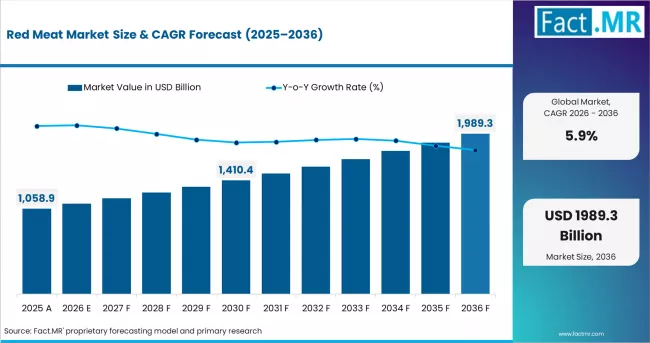
Red Meat Market Value Analysis | Source: Fact.MR
Summary of Red Meat Market
- Market Definition
- The red meat market refers to the production, processing, and distribution of meat derived from mammals such as cattle, pigs, sheep, and goats. These products are supplied in fresh, frozen, and processed formats and are utilized across household consumption, foodservice preparation, and processed food manufacturing. Red meat provides protein, iron, zinc, and essential nutrients supporting dietary consumption across global food supply chains.
- Demand Drivers
- Increasing global protein consumption supported by population growth and urban dietary patterns favoring animal-based protein intake.
- Expansion of foodservice sector procurement requiring stable supply of standardized meat cuts for restaurants and catering operations.
- Growth in processed meat product consumption including sausages, cured meat, and ready-to-cook formats supporting retail demand.
- Increasing cold chain logistics capability improving distribution efficiency of fresh and frozen meat products.
- Rising demand from quick service restaurant chains requiring consistent supply volumes across global procurement networks.
- Expansion of international meat trade supporting availability of pork, beef, and lamb across regional consumption markets.
- Key Segments Analyzed
- Type: Pork accounts for 55.1% share supported by strong utilization across processed meat products and foodservice preparation formats.
- Distribution Channel: B2B and foodservice represent 71.3% share supported by bulk procurement across restaurants, hotels, and catering providers.
- Form: Fresh and processed meat formats demonstrate strong demand supported by retail consumption and packaged meat product availability.
- End Use: Household consumption and restaurant preparation represent primary demand sources supported by stable dietary protein requirements.
- Geography: China and India demonstrate strongest growth supported by increasing protein consumption, while the USA, Brazil, and Germany reflect established livestock production and processing infrastructure.
- Analyst Opinion at Fact MR
- Shambhu Nath Jha, Principal Consultant at Fact MR, opines, "Red meat remains a structurally significant protein category supported by established livestock production systems and integrated cold chain infrastructure. Market expansion reflects stable global consumption patterns across retail and foodservice channels, while value growth is influenced by processed meat formats and supply chain efficiency improvements. Producers focusing on traceability, processing efficiency, and supply continuity will maintain competitive positioning through 2036."
- Strategic Implications
- Strengthen supply chain efficiency supporting stable availability of livestock and processed meat products across regional markets.
- Expand processing capability supporting development of portion-controlled and ready-to-cook meat formats.
- Improve cold chain logistics supporting quality preservation across fresh and frozen distribution channels.
- Strengthen procurement partnerships with foodservice operators supporting long-term volume agreements.
- Expand traceability capability supporting compliance with food safety and livestock monitoring requirements.
- Improve operational efficiency across slaughtering and meat processing facilities supporting consistent supply output.
- Methodology
- Developed using primary interviews with livestock producers, meat processors, distributors, and foodservice procurement specialists.
- Supported through review of agricultural databases, trade flow statistics, and industry publications addressing protein consumption patterns.
- Market estimation applied hybrid modeling combining livestock production benchmarking with evaluation of global protein consumption demand.
- Data validated through triangulation using supply chain statistics, processing capacity data, and expert consultation inputs.
- Periodic updates incorporate changes in livestock production trends, feed cost dynamics, and consumption shifts influencing global meat demand.
Red Meat Market
| Metric | Details |
|---|---|
| Industry Size (2026E) | USD 1,058.9 billion |
| Industry Value (2036F) | USD 1,880.6 billion |
| CAGR (2026 to 2036) | 5.9% |
Source: Fact.MR analysis. Updated Apr 28, 2026
The increase from USD 1058.9 billion in 2026 to USD 1880.6 billion in 2036 reflects solid 10-year growth, indicating sustained demand across retail and foodservice channels. Expansion is supported by protein consumption patterns and supply chain scale efficiencies, while moderated by livestock feed cost volatility, environmental compliance pressures, and substitution from plant-based or alternative protein sources.
China records the fastest growth at 6.8%, supported by increasing protein consumption across urban retail and foodservice supply chains. India follows at 6.5%, driven by rising demand for processed meat products in organized retail channels. The USA shows 6.3% growth, linked to stable consumption across packaged meat and quick service restaurant procurement volumes. Brazil at 6.2% and Germany at 6.1% represent relatively mature markets where demand is largely replacement-driven due to established per capita consumption levels. A structural constraint across mature markets is livestock production efficiency limits, which restrict rapid supply expansion without significant capital investment.
Segmental Analysis
Red Meat Market Analysis by Distribution Channel
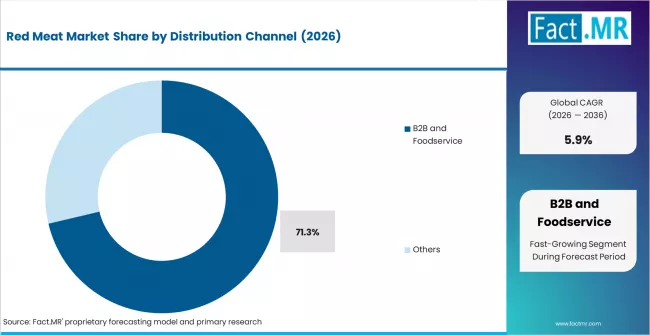
Red Meat Market Analysis By Distribution Channel | Source: Fact.MR
- Market Overview: B2B and foodservice channels are projected to hold 71.3% share of the red meat market in 2026. Demand concentration reflects bulk procurement patterns from restaurants, institutional kitchens, catering providers, and food processing companies requiring consistent supply volumes aligned with standardized menu and product preparation requirements. Supply agreements prioritize continuity of meat quality, portion uniformity, and logistics reliability across large-scale food preparation operations.
- Demand Drivers:
- Bulk Procurement Requirements: Foodservice operators purchase red meat in high volumes to maintain consistent supply across restaurants, hotels, and institutional catering environments.
- Processing Industry Demand: Meat processors utilize red meat inputs for production of processed foods including sausages, cured products, and ready-to-cook meal formats.
- Supply Chain Standardization: B2B distribution frameworks support predictable delivery schedules and quality specifications required by commercial food preparation businesses.
Red Meat Market Analysis by Type
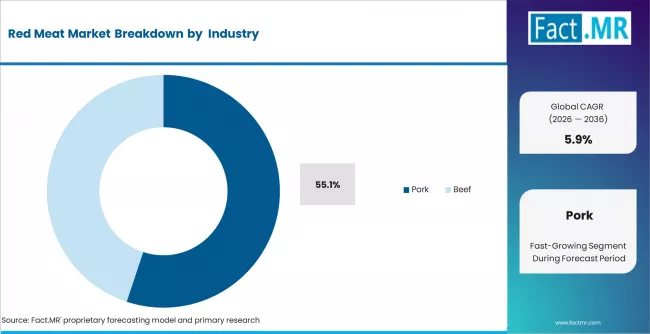
Red Meat Market Analysis By Type | Source: Fact.MR
- Market Overview: Pork is estimated to account for 55.1% share in 2026, supported by widespread consumption across processed meat products and fresh meat applications requiring balanced fat composition and versatile culinary functionality. Production systems support availability of multiple cuts suitable for diverse cooking methods across retail and foodservice environments.
- Demand Drivers:
- Processing Versatility: Pork is widely utilized in processed meat categories including sausages, bacon, and cured products requiring consistent fat-to-lean ratios.
- Supply Availability: Established livestock production systems support steady supply of pork across domestic and international meat trade channels.
- Culinary Adaptability: Pork supports varied preparation techniques including roasting, grilling, and slow cooking across commercial and household food preparation applications.
Red Meat Market Drivers, Restraints, and Opportunities
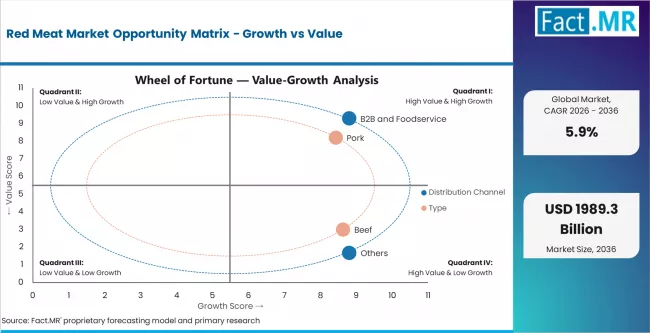
Red Meat Market Opportunity Matrix Growth Vs Value | Source: Fact.MR
Fact MR analysis indicates the market reflects a mature, high-volume global protein industry structurally anchored in livestock agriculture, cold-chain logistics, and standardized meat processing infrastructure. Market size exists because red meat remains a culturally embedded dietary protein across beef, pork, lamb, and goat consumption systems supported by large-scale farming economics and long-established trade networks. Historical growth has tracked population expansion, income growth, and urban dietary shifts toward protein-rich foods, creating stable baseline demand despite periodic price volatility linked to feed costs and supply cycles.
Current market dynamics show modest volume pressure in developed economies due to health and environmental concerns, while value growth is supported by premiumization through grass-fed, organic, traceable, and processed meat formats. Higher-margin value-added products such as portion-controlled cuts and ready-to-cook formats increase revenue intensity even when consumption frequency stabilizes. Structural transition reflects balancing forces between sustainability scrutiny and persistent demand for high-protein diets across foodservice and retail supply chains.
- Protein Demand Base: Rising incomes and urban diets in Asia and Latin America sustain long-term demand for beef and pork as core protein sources in household and foodservice consumption systems.
- Traceability Regulation: USDA Food Safety and Inspection Service traceability rules require improved recordkeeping and monitoring across slaughtering and processing facilities, increasing compliance costs but improving supply transparency.
- Dietary Diversification Shift: Europe shows gradual volume moderation as consumers partially substitute poultry and plant proteins, while premium organic and grass-fed red meat maintains higher price-per-kilogram realization.
Regional Analysis
The red meat market is assessed across Asia Pacific, North America, Europe, and Latin America, segmented by country-level demand for beef, pork, lamb, and processed red meat products used in retail consumption, foodservice preparation, and packaged protein distribution. Geographic variation reflects livestock production capacity, dietary protein consumption patterns, and cold chain distribution infrastructure. The full report offers market attractiveness analysis.
.webp "Top Country Growth Comparison Red Meat Market Cagr (2026 2036)")
Top Country Growth Comparison Red Meat Market Cagr (2026 2036) | Source: Fact.MR
CAGR Table
| Country | CAGR (2026–2036) |
|---|---|
| China | 6.8% |
| India | 6.5% |
| USA | 6.3% |
| Brazil | 6.2% |
| Germany | 6.1% |
Source: Fact.MR analysis. Updated Apr 28, 2026
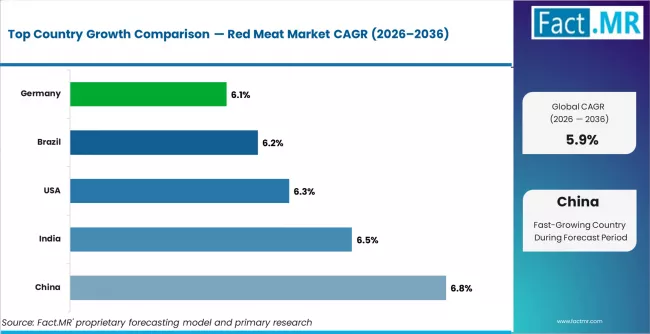
Red Meat Market Cagr Analysis By Country | Source: Fact.MR
Source: Fact MR analysis, based on proprietary forecasting model and primary research
Asia Pacific
Asia Pacific functions as the high-volume protein consumption hub supported by expanding cold chain infrastructure and increasing demand for processed meat products across urban retail channels. WH Group Limited strengthens pork processing capacity. BRF S.A. expands packaged meat distribution capability. JBS S.A. supports integrated meat supply chain operations.
- China: China is projected to record 6.8% CAGR in red meat through 2036. National Agricultural Modernization Plan update (Ministry of Agriculture and Rural Affairs, January 2023) supports livestock production efficiency improvement. WH Group Limited expanded pork processing capacity (June 2023).
- India: India is expected to observe 6.5% CAGR in red meat through 2036. National Livestock Mission update (Department of Animal Husbandry and Dairying, March 2023) supports meat processing infrastructure development. JBS S.A. expanded meat processing collaboration initiatives (July 2023).
North America
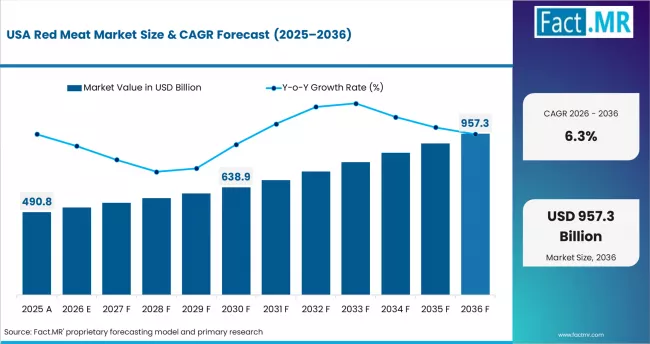
Red Meat Market Country Value Analysis | Source: Fact.MR
North America operates as the commercial meat processing center supported by strong packaged protein demand and large-scale livestock production infrastructure. Tyson Foods, Inc. strengthens processed meat production capability. Cargill, Incorporated expands cold chain distribution network depth. JBS USA supports integrated protein supply operations.
- USA: The USA is anticipated to expand at 6.3% CAGR in red meat through 2036. USDA Meat and Poultry Processing Expansion Program update (February 2023) supports meat processing capacity growth. Tyson Foods, Inc. expanded protein processing infrastructure (August 2023).
Latin America
Latin America functions as the global meat export production corridor supported by strong livestock farming capacity and expanding international protein trade networks. JBS S.A. strengthens global beef export capability. BRF S.A. expands processed meat production capacity. Marfrig Global Foods supports integrated livestock processing operations.
- Brazil: Brazil is forecast to grow at 6.2% CAGR in red meat through 2036. National Livestock Development Plan update (Ministry of Agriculture, February 2023) supports beef production efficiency improvement. JBS S.A. expanded export-oriented meat processing capacity (May 2023).
Europe
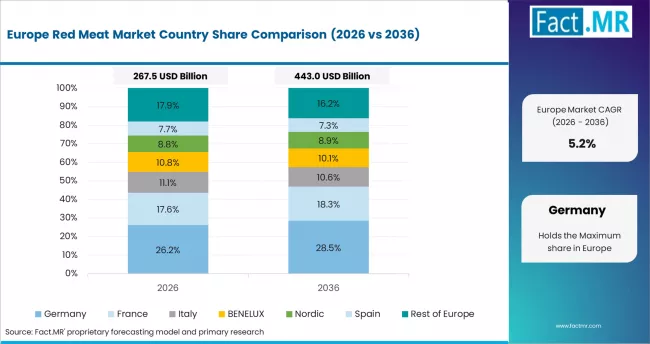
Red Meat Market Europe Country Market Share Analysis 2026 & 2036 | Source: Fact.MR
Europe operates as the regulated meat quality compliance laboratory supported by strict food safety frameworks and structured livestock production standards. Tönnies Group strengthens processed meat supply capability. Danish Crown expands integrated meat processing operations. Vion Food Group supports protein distribution networks.
- Germany: Germany is projected to register 6.1% CAGR in red meat through 2036. EU Farm to Fork Strategy implementation update (European Commission, January 2023) supports regulated meat production standards. Tönnies Group expanded meat processing facility capability (June 2023).
Fact MR's analysis of red meat market in global regions consists of country-wise assessment that includes China, India, USA, Brazil, and Germany. Readers can find livestock production trends, processed meat demand developments, regulatory positioning frameworks, and competitive protein supply chain insights.
Competitive Landscape
What is the Competitive Structure of the Red Meat Market?
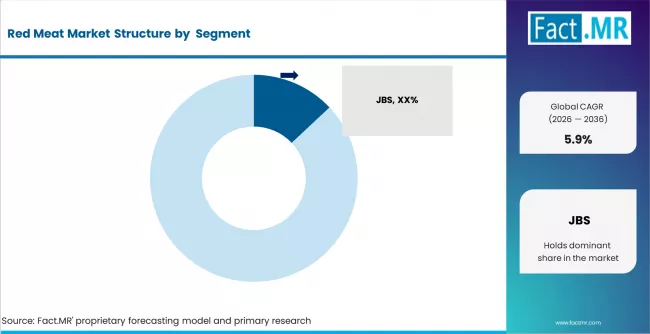
Red Meat Market Analysis By Company | Source: Fact.MR
The Red Meat Market demonstrates a moderately concentrated competitive structure, supported by large vertically integrated meat processors with extensive livestock sourcing and processing infrastructure. Leading companies including JBS, Tyson Foods, Cargill, WH Group, Marfrig, Minerva Foods, Hormel Foods, BRF, Perdue Farms, and OSI Group collectively account for nearly 60–70% of global processed red meat supply, particularly in beef and pork processing segments serving retail and foodservice channels. Competitive positioning is primarily determined by processing scale, supply chain efficiency, cold storage capacity, and compliance with food safety standards governing meat production. Large-scale slaughtering and distribution infrastructure creates entry barriers, reinforcing the dominance of established multinational processors with strong procurement and logistics capabilities.
Structural advantages are observed among companies maintaining vertically integrated livestock sourcing, feed supply operations, and global distribution networks supporting consistent raw material availability. JBS and Tyson Foods benefit from long-term supplier relationships with livestock producers and established contracts with large retail chains and foodservice operators. Buyers including supermarket chains and quick service restaurant operators typically manage supplier dependency through multi-supplier sourcing strategies and long-term procurement agreements ensuring consistent supply volumes. Procurement decisions often consider product consistency, pricing stability, and compliance with food safety certification requirements. Pricing power remains relatively balanced, though large processors retain moderate leverage due to scale efficiencies and established distribution networks supporting continuous supply across regional markets.
Key Players of the Red Meat Market
- JBS
- Tyson Foods
- Cargill
- WH Group
- Marfrig
- Minerva Foods
- Hormel Foods
- BRF
- Perdue Farms
- OSI Group
Bibliographies
- [1] Ministry of Agriculture and Rural Affairs (China). (2023, January). National Agricultural Modernization Plan update.
- [2] Department of Animal Husbandry and Dairying (India). (2023, March). National Livestock Mission update.
- [3] U.S. Department of Agriculture. (2023, February). Meat and Poultry Processing Expansion Program update.
- [4] Ministry of Agriculture (Brazil). (2023, February). National Livestock Development Plan update.
- [5] European Commission. (2023, January). EU Farm to Fork Strategy implementation update.
- [6] WH Group Limited. (2023, June). Pork processing capacity expansion.
- [7] JBS S.A. (2023, July). Meat processing collaboration initiatives expansion.
- [8] Tyson Foods, Inc. (2023, August). Protein processing infrastructure expansion.
- [9] Marfrig Global Foods. (2023). Integrated livestock processing operations expansion.
- [10] Tönnies Group. (2023, June). Meat processing facility capability expansion.
This Report Addresses
- Market size estimation and revenue forecasts from 2026 to 2036, supported by validated capacity and trade benchmarks.
- Growth opportunity mapping across gummy, extruded, and strip functional variants.
- Segment and regional revenue forecasts covering berry, citrus, and mixed fruit applications.
- Competition strategy assessment including integration models and compliance capability benchmarking.
- Regulatory impact analysis covering ingredient mandates and clean-label specification upgrades.
- Market report delivery in PDF, Excel, PPT, and interactive dashboard formats for executive and operational use.
- Supply chain vulnerability assessments identifying regional purification concentration risks.
Red Meat Market Definition
The red meat market refers to the production, processing, and trade of meat obtained from mammals such as cattle, pigs, sheep, and goats. These products provide protein and essential nutrients and are widely used in retail consumption, foodservice, and processed food manufacturing due to their flavor, texture, and nutritional value.
Red Meat Market Inclusions
The report covers global and regional market size evaluation and forecast outlook across the defined study period. It includes segmentation by product type such as beef, pork, lamb, and goat, product forms including fresh, frozen, and processed meat, applications in retail and foodservice, and analysis of pricing trends and international trade flows.
Red Meat Market Exclusions
The scope excludes poultry, seafood, and plant-based meat alternatives not derived from mammalian livestock. It does not include ready-to-eat meals, packaged prepared foods, or foodservice menu items containing red meat as an ingredient. The analysis focuses strictly on raw, processed, and intermediate red meat products within the supply chain.
Red Meat Market Research Methodology
- Primary Research
- Interviews were conducted with livestock producers, meat processors, distributors, foodservice suppliers, and procurement specialists involved in meat supply chain operations.
- Desk Research
- Public sources including agricultural databases, trade statistics, industry publications, and company reports were reviewed to evaluate consumption patterns and production trends.
- Market-Sizing and Forecasting
- A hybrid model combining bottom-up production volume assessment and top-down evaluation of protein consumption demand was applied to estimate market size and growth outlook.
- Data Validation and Update Cycle
- Outputs were validated through triangulation of trade statistics, supply chain data, and expert consultations. Periodic updates incorporate changes in livestock production, pricing trends, and evolving consumption preferences.
Segmentation
Report Scope
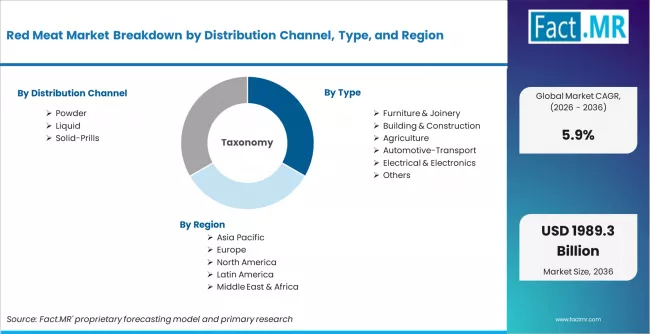
Red Meat Market Breakdown By Distribution Channel Type And Region | Source: Fact.MR
| Metric | Value |
|---|---|
| Quantitative Units | USD 1058.9 billion (2026) to USD 1880.6 billion (2036), at a CAGR of 5.9% |
| Market Definition | The red meat market includes production, processing, distribution, and retail sale of meat derived from livestock species such as cattle, pigs, sheep, and goats. These products are supplied in fresh, frozen, and processed formats for household consumption and foodservice applications, supported by integrated supply chains involving livestock farming, meat processing facilities, cold storage logistics, and retail distribution networks. |
| Type Segmentation | Beef, Pork, Lamb, Mutton, Goat, Veal |
| Form Segmentation | Fresh, Frozen, Processed |
| Distribution Channel Segmentation | Supermarkets & hypermarkets, Butcher shops, Online retail, Convenience stores, Foodservice |
| End Use Segmentation | Household consumption, Restaurants, Hotels, Catering |
| Regions Covered | North America, Latin America, Europe, East Asia, South Asia, Oceania, Middle East and Africa |
| Countries Covered | United States, Canada, Mexico, Brazil, Argentina, Germany, France, United Kingdom, Italy, Spain, China, India, Japan, South Korea, Indonesia, Australia, and 40+ countries |
| Key Companies Profiled | JBS, Tyson Foods, Cargill, WH Group, Marfrig, Minerva Foods, Hormel Foods, BRF, Perdue Farms, OSI Group |
| Forecast Period | 2026 to 2036 |
| Approach | Hybrid top-down and bottom-up market estimation validated through primary interviews with meat processors, livestock producers, cold chain distributors, and foodservice suppliers, supported by production volume benchmarking, trade flow assessment, and evaluation of consumption patterns across retail and commercial food supply channels |
Source: Fact.MR analysis. Updated Apr 28, 2026
Red Meat Market Key Segments
-
Type:
- Beef
- Pork
- Lamb
- Mutton
- Goat
- Veal
-
Form:
- Fresh
- Frozen
- Processed
-
Distribution Channel:
- Supermarkets and Hypermarkets
- Butcher Shops
- Online Retail
- Convenience Stores
- Foodservice
-
End Use:
- Household Consumption
- Restaurants
- Hotels
- Catering
-
Region:
- North America
- USA
- Canada
- Mexico
- Europe
- Germany
- UK
- France
- Italy
- Spain
- Nordic Countries
- BENELUX
- Rest of Europe
- Asia Pacific
- China
- Japan
- South Korea
- India
- Australia
- Rest of Asia Pacific
- Latin America
- Brazil
- Argentina
- Rest of Latin America
- Middle East and Africa
- Kingdom of Saudi Arabia
- United Arab Emirates
- South Africa
- Rest of Middle East and Africa
- Other Regions
- Oceania
- Central Asia
- Other Markets
- North America
Frequently Asked Questions
How large is the demand for Red Meat in the global market in 2026?
What will be the market size of Red Meat in the global market by 2036?
What is the expected demand growth for Red Meat in the global market between 2026 and 2036?
Which Distribution Channel is poised to lead global demand by 2026?
What is Driving Red Meat Demand in China?
What is the China Growth Outlook in this Report?
What is Driving Red Meat Demand in India?
What is the India Growth Outlook in this Report?
What is Driving Red Meat Demand in the United States?
What is the United States Growth Outlook in this Report?
What is Driving Red Meat Demand in Brazil?
What is the Brazil Growth Outlook in this Report?
What is Driving Red Meat Demand in Germany?
What is the Germany Growth Outlook in this Report?
Which Companies are Identified as Leading Participants in the Red Meat Market?
What is Red Meat and What is It Mainly Used For?
What does Red Meat Market Mean in this Report?
What is Included in the Scope of this Red Meat Market Report?
What is Excluded from the Scope of this Report?
What does Market Forecast Mean on this Page?
How is the Red Meat Market Forecast Developed in this Report?
What does Data Validation Approach Mean in this Report?
Who worked on this report


Preview the report firsthand - request a free sample
Free SampleGet the brochure for pricing and purchase details
Download PDF