- Base Value(2025): 44.8 Bn
- Estimated Value(2026): 47.6 Bn
- Forecast Value (2036): 78.2 Bn
- CAGR (2026 - 2036): 5.1%
Refillable and Reusable Food Packaging Systems Market Forecast and Outlook By Fact.MR
In 2025, the refillable and reusable food packaging systems market was valued at USD 44.8 billion. Based on Fact MR analysis, demand for refillable and reusable food packaging systems is estimated to grow to USD 47.6 billion in 2026 and USD 78.2 billion by 2036. FMR projects a CAGR of 5.1% during the forecast period.
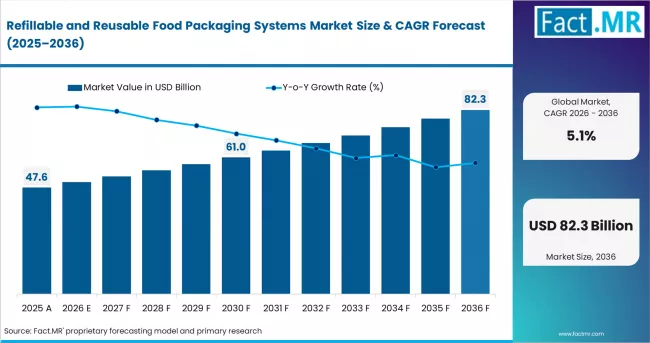
Refillable And Reusable Food Packaging Systems Market Market Value Analysis | Source: Fact.MR
Refillable and Reusable Food Packaging Systems Market
| Metric | Details |
|---|---|
| Industry Size (2026E) | USD 47.6 billion |
| Industry Value (2036F) | USD 78.2 billion |
| CAGR (2026 to 2036) | 5.1% |
Source: Fact.MR analysis. Updated Apr 18, 2026
Summary of the Refillable and Reusable Food Packaging Systems Market
- Market Definition
- The market includes durable packaging formats designed for repeated use cycles across food retail, foodservice, and supply chain distribution systems. Refillable and reusable packaging solutions include bottles, jars, takeaway containers, storage containers, crates, bins, and refill pouches structured for collection, sanitation, refilling, and redistribution. These systems operate within closed loop logistics models where containers circulate multiple times before material replacement.
- Demand Drivers
- Expansion of circular packaging models across retail and foodservice distribution environments
- Increasing implementation of deposit return and refill station infrastructure across packaged food supply chains
- Growing adoption of durable packaging materials designed for repeated cleaning and handling cycles
- Integration of standardized container formats supporting stackability and logistics efficiency across transport networks
- Key Segments Analyzed
- Material Type: High durability plastic polymers account for approximately 43% share supported by structural stability and repeated wash resistance
- Distribution Channel: Foodservice operators represent nearly 38% share due to structured container return workflows
- Product Type: Reusable takeaway containers, refillable beverage containers, and transport packaging demonstrate consistent demand
- Geography: Europe demonstrates relatively strong adoption supported by regulatory packaging reuse frameworks
- Analyst Opinion at Fact MR
- Shambhu Nath Jha, Principal Consultant, Fact MR, opines, "In this updated edition of the Refillable and Reusable Food Packaging Systems Market report, industry participants will observe steady adoption of closed loop packaging models supporting repeated container circulation across food supply chains. Durable packaging materials enable multiple reuse cycles aligned with standardized sanitation and logistics workflows. Companies that strengthen reverse logistics infrastructure and material durability performance are expected to maintain competitive positioning through 2036."
- Strategic Implications Executive Takeaways
- Strengthen container durability specifications supporting repeated washing and handling cycles across distribution networks
- Improve reverse logistics coordination enabling efficient collection, cleaning, and redistribution of reusable packaging assets
- Expand compatibility of standardized container formats with automated storage, stacking, and transport handling systems
- Monitor regulatory developments influencing adoption of reuse targets across food packaging supply chains
- Methodology
- Primary interviews conducted with packaging manufacturers, reuse platform providers, foodservice operators, and logistics service companies
- Desk research based on packaging industry documentation, regulatory publications, company disclosures, and circular packaging studies
- Market sizing derived using a hybrid approach combining top down packaging demand evaluation with bottom up reuse cycle adoption assessment
- Data validation performed through cross verification with packaging lifecycle datasets and internal peer review aligned with Fact MR standards
An increase of USD 30.6 billion indicates incremental but structurally durable expansion, reflecting gradual transition toward circular packaging models within retail and foodservice supply chains. Growth remains supported by extended producer responsibility frameworks and cost optimization in high-frequency product categories, while moderated by reverse logistics complexity, sanitation compliance costs, and operational friction linked to consumer return participation rates.
Germany leads with a projected CAGR of 6.4%, supported by established return logistics infrastructure and increasing adoption of standardized container reuse formats across retail networks. The United Kingdom follows with a CAGR of 6.1%, driven by expansion of refill stations across grocery and specialty food outlets. France records a CAGR of 5.8%, reflecting gradual integration of reusable packaging formats across packaged food distribution channels. The United States shows a CAGR of 5.6%, supported by increasing adoption of container return models across meal delivery and beverage segments. Japan records the slowest growth at 5.2%, reflecting a mature market where demand is largely tied to replacement cycles within established packaging collection systems. Mature markets generate a significant share of replacement demand as packaging durability standards and logistics efficiency improvements shape reuse cycle optimization across food distribution systems.
Segmental Analysis
Refillable and Reusable Food Packaging Systems Market Analysis by Material Type
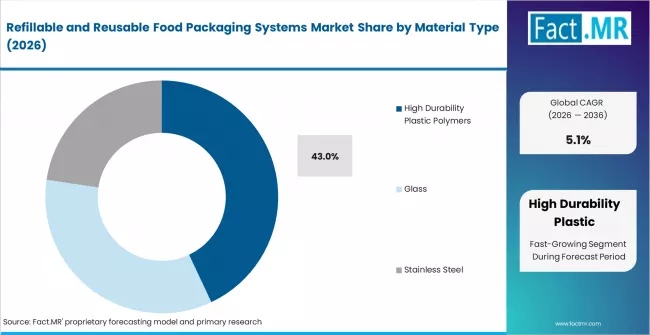
Refillable And Reusable Food Packaging Systems Market Analysis By Material Type | Source: Fact.MR
- Market Overview: Based on Fact MR assessment, high durability plastic polymers are projected to account for 43% share of the refillable and reusable food packaging systems market in 2026. Polypropylene, high density polyethylene, and polyethylene terephthalate materials are incorporated into reusable containers designed for repeated filling cycles across prepared food distribution systems. Polymer structures demonstrate resistance to deformation, chemical interaction, and mechanical stress during repeated washing and handling processes. Food grade polymer compositions are specified to maintain barrier performance, structural integrity, and dimensional stability across multiple reuse cycles aligned with packaging durability requirements applied in closed loop distribution models.
- Demand Drivers:
- Material Performance Requirements: High durability polymers demonstrate resistance to impact stress and thermal exposure during repeated cleaning and refilling cycles across reusable container systems.
- Barrier Stability Characteristics: Polymer packaging materials maintain resistance to moisture transfer, grease interaction, and odor absorption across repeated food contact applications.
- Manufacturing Standardization: Injection molded polymer containers support uniform dimensional consistency required for stackability, transport efficiency, and automated handling compatibility.
Refillable and Reusable Food Packaging Systems Market Analysis by Distribution Channel
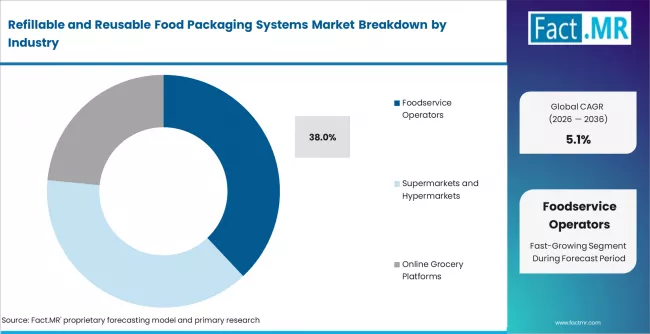
Refillable And Reusable Food Packaging Systems Market Analysis By Distribution Channel | Source: Fact.MR
- Market Overview: Foodservice operators are estimated to hold 38% share of the refillable and reusable food packaging systems market in 2026, supported by structured packaging return workflows implemented across quick service restaurants, institutional catering providers, and prepared meal distribution platforms. Closed loop container systems are deployed across takeaway meal distribution channels requiring standardized packaging collection, cleaning, and redistribution procedures. Foodservice providers implement reusable packaging programs structured around deposit return models and container tracking systems enabling repeated circulation of food grade packaging assets across controlled distribution networks.
- Demand Drivers:
- Operational Workflow Integration: Foodservice operators implement container return logistics aligned with centralized cleaning processes supporting repeated packaging utilization cycles.
- Cost Control Requirements: Reusable packaging systems enable reduction in recurring procurement of single use packaging materials across high volume prepared food distribution environments.
- Packaging Standardization: Uniform container dimensions support compatibility with stacking systems, transport crates, and automated dishwashing equipment used across commercial foodservice facilities.
Key Dynamics
Refillable and Reusable Food Packaging Systems Market Drivers, Restraints, and Opportunities
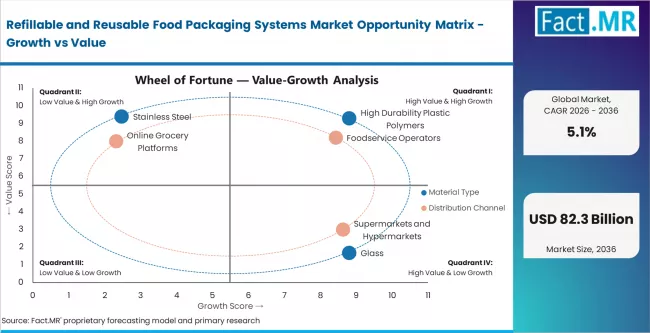
Refillable And Reusable Food Packaging Systems Market Opportunity Matrix Growth Vs Value | Source: Fact.MR
Fact MR analysis indicates that the refillable and reusable food packaging systems market developed from deposit-return packaging models historically used for glass bottles in beverage distribution. Early reuse systems relied on standardized containers collected, cleaned, and refilled within localized supply chains. The current market valuation reflects renewed deployment of refillable containers, returnable packaging logistics, and dispensing systems used across grocery retail, food service, and direct-to-consumer distribution. Demand persists because reusable packaging systems reduce single-use material consumption and support closed-loop distribution models within controlled supply chains.
A structural shift is occurring as conventional single-use packaging formats face operational comparison with returnable container systems that require reverse logistics infrastructure. Disposable packaging remains widely used due to convenience, lower upfront costs, and compatibility with high-speed filling lines. Refillable packaging systems involve container tracking, sanitation processes, and logistics coordination that increase operational complexity and infrastructure investment. These systems require durable packaging materials designed for multiple use cycles, increasing per-unit container cost. Even with gradual adoption across selected product categories, higher system costs and service-based models contribute to steady market value expansion.
- Closed Loop Distribution: Retailers and food producers implement returnable container programs supported by collection, cleaning, and redistribution logistics systems.
- Packaging Compliance Policies: Regulations such as European Union Packaging and Packaging Waste Directive influence reuse targets and packaging material recovery requirements.
- Europe Retail Pilots: Germany, France, and the Netherlands maintain active pilot programs for reusable packaging systems across grocery and food service distribution channels.
Regional Analysis
The refillable and reusable food packaging systems market is assessed across North America, Europe, Asia Pacific, Latin America, and Middle East & Africa, segmented by country-level adoption of circular packaging models, deposit return systems, and reusable container logistics. Regional demand reflects regulatory packaging targets, retail participation, and supply chain adaptation. The full report offers market attractiveness analysis.
.webp "Top Country Growth Comparison Refillable And Reusable Food Packaging Systems Market Cagr (2026 2036)")
Top Country Growth Comparison Refillable And Reusable Food Packaging Systems Market Cagr (2026 2036) | Source: Fact.MR
| Country | CAGR (2026–2036) |
|---|---|
| Germany | 6.4% |
| United Kingdom | 6.1% |
| France | 5.8% |
| United States | 5.6% |
| Japan | 5.2% |
Source: Fact.MR analysis. Updated Apr 18, 2026
Source: Fact MR analysis, based on proprietary forecasting model and primary research
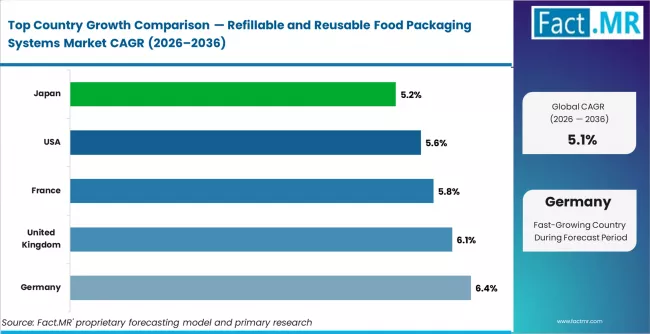
Refillable And Reusable Food Packaging Systems Market Cagr Analysis By Country | Source: Fact.MR
Europe
< Refillable And Reusable Food Packaging Systems Market Europe Country Market Share Analysis, 2026 & 2036 | Source: Fact.MR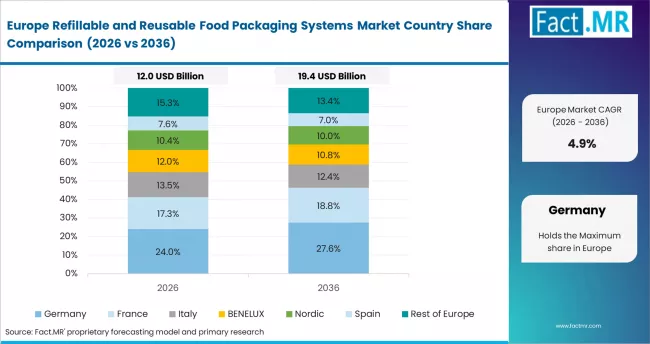
Europe functions as the global circular packaging regulatory laboratory, supported by structured reuse mandates and packaging waste reduction frameworks. Loop Industries, Inc. supports reusable packaging system deployment. DS Smith plc strengthens recyclable and reusable packaging development. Tetra Pak International S.A. advances circular packaging system integration.
- Germany: Demand for refillable and reusable food packaging systems in Germany is projected to rise at 6.4% CAGR through 2036. The German Packaging Act update (Federal Ministry for the Environment, July 2021) supports reusable packaging adoption. DS Smith plc expanded reusable packaging product lines (March 2023), supporting market growth.
- United Kingdom: Demand for refillable and reusable food packaging systems in United Kingdom is projected to rise at 6.1% CAGR through 2036. The UK Plastic Packaging Tax implementation (HM Revenue & Customs, April 2022) supports reusable packaging adoption. Tetra Pak International S.A. expanded reusable carton packaging initiatives (February 2023), supporting adoption.
- France: Demand for refillable and reusable food packaging systems in France is projected to rise at 5.8% CAGR through 2036. The Anti-Waste for a Circular Economy Law update (French Government, February 2020) supports packaging reuse initiatives. Loop Industries, Inc. expanded reusable packaging system partnerships (January 2023), supporting market development.
North America
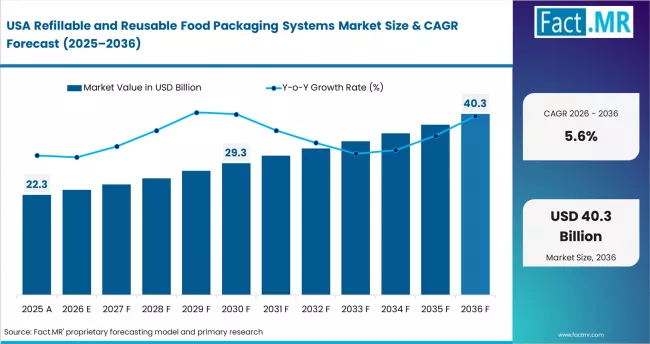
Refillable And Reusable Food Packaging Systems Market Country Value Analysis | Source: Fact.MR
North America functions as the retail-driven packaging reuse innovation hub, supported by voluntary corporate commitments and packaging waste reduction programmes. Ball Corporation strengthens reusable aluminum packaging solutions. Berry Global Group, Inc. expands reusable plastic container systems. Amcor plc supports recyclable and reusable packaging product development.
- United States: Demand for refillable and reusable food packaging systems in United States is projected to rise at 5.6% CAGR through 2036. The U.S. National Recycling Strategy (Environmental Protection Agency, November 2021) supports circular packaging initiatives. Amcor plc expanded reusable packaging formats for food products (April 2023), supporting adoption.
Asia Pacific
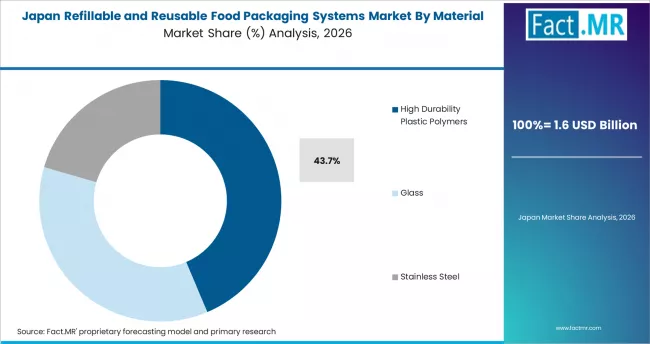
Refillable And Reusable Food Packaging Systems Market Japan Market Share Analysis By Material Type | Source: Fact.MR
Asia Pacific serves as the structured packaging recovery and reuse system development market, supported by waste reduction initiatives and packaging material innovation. Toyo Seikan Group Holdings, Ltd. strengthens reusable container technologies. Nippon Closures Co., Ltd. supports refillable packaging closures. Sealed Air Corporation expands reusable packaging solutions.
- Japan: Demand for refillable and reusable food packaging systems in Japan is projected to rise at 5.2% CAGR through 2036. The Plastic Resource Circulation Act (Ministry of the Environment, April 2022) supports packaging reuse frameworks. Toyo Seikan Group Holdings, Ltd. expanded reusable container solutions (March 2023), supporting market adoption.
Fact MR's analysis of refillable and reusable food packaging systems market in global regions consists of country-wise assessment that includes Germany, United Kingdom, France, United States, and Japan. Readers can find circular packaging adoption trends, regulatory developments, material innovation patterns, and competitive positioning across key markets.
Competitive Landscape
Competitive Structure and Buyer Dynamics in the Refillable and Reusable Food Packaging Systems Market
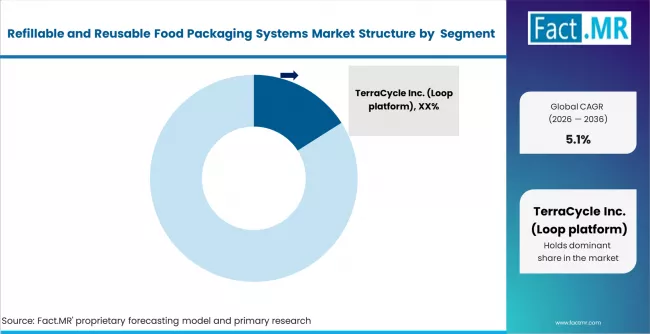
Refillable And Reusable Food Packaging Systems Market Analysis By Company | Source: Fact.MR
The competitive structure of the Refillable and Reusable Food Packaging Systems Market is moderately fragmented, with packaging innovators, circular economy platforms, and material manufacturers participating across product design and logistics systems. Companies such as TerraCycle Inc., Ball Corporation, and DS Smith Plc maintain strong positions through established packaging expertise and infrastructure supporting reusable container programs. Platform providers including Algramo Ltd., RePack Oy, Muuse ApS, Vytal Global GmbH, CupClub Ltd., GoBox PBC, and Returnity Innovations LLC contribute through return logistics systems, container tracking technologies, and reuse service models used by food retailers and foodservice providers. Competition is primarily influenced by packaging durability, logistics efficiency, cost effectiveness of reuse cycles, and integration with retail distribution systems.
Several companies maintain structural advantages through proprietary return logistics infrastructure and established relationships with food retailers and consumer brands. Firms such as TerraCycle Inc. and Ball Corporation benefit from strong packaging engineering capabilities and partnerships supporting large scale reuse programs. DS Smith Plc maintains advantages through packaging material development and supply chain expertise. Platform providers such as RePack Oy and Vytal Global GmbH maintain differentiation through container tracking systems and reuse logistics coordination. Food retailers and restaurant operators often evaluate multiple reuse solution providers to ensure operational flexibility and cost efficiency. Procurement decisions assess packaging durability, cleaning processes, and return system efficiency. This purchasing behavior moderates supplier pricing leverage across the market, while providers with scalable logistics networks and durable packaging solutions retain moderate negotiating influence.
Key Players of the Refillable and Reusable Food Packaging Systems Market
- TerraCycle Inc. (Loop platform)
- Algramo Ltd.
- RePack Oy
- Muuse ApS
- Vytal Global GmbH
- Returnity Innovations LLC
- GoBox PBC
- CupClub Ltd.
- DS Smith Plc
- Ball Corporation
Refillable and Reusable Food Packaging Systems Market Key Segments
-
Product Type:
- Refillable Beverage Containers
- Reusable Takeaway Containers
- Refillable Jars and Bottles
- Reusable Food Storage Containers
- Reusable Transport Packaging such as Crates and Bins
- Refillable Pouches
-
Material Type
- Plastic High Durability Polymers
- Glass
- Stainless Steel
- Silicone
- Fiber Based Materials
-
Distribution Channel:
- Foodservice Operators
- Supermarkets and Hypermarkets
- Online Grocery Platforms
- Zero Waste and Refill Stores
-
Region:
-
North America
- USA
- Canada
- Mexico
- Europe
- Germany
- UK
- France
- Italy
- Spain
- Nordic Countries
- BENELUX
- Rest of Europe
- Asia Pacific
- China
- Japan
- South Korea
- India
- Australia
- Rest of Asia Pacific
- Latin America
- Brazil
- Argentina
- Rest of Latin America
- Middle East and Africa
- Kingdom of Saudi Arabia
- United Arab Emirates
- South Africa
- Rest of Middle East and Africa
- Other Regions
- Oceania
- Central Asia
- Other Markets
-
Bibliographies
- [1] European Commission. (2019). Packaging and Packaging Waste Directive (Directive 94/62/EC), Recast Proposal: Extended producer responsibility and reuse targets. European Commission. Retrieved March 25, 2026.
- [2] Federal Ministry for the Environment, Nature Conservation, Nuclear Safety and Consumer Protection (Germany). (2021, July). Update to the German Packaging Act (VerpackG)—Reusable packaging and return-system obligations. Federal Ministry for the Environment. Retrieved March 25, 2026.
- [3] HM Revenue and Customs (United Kingdom). (2022, April). Plastic Packaging Tax technical guidance: Charging on plastic packaging with less than 30% recycled content. HMRC. Retrieved March 25, 2026.
- [4] Agence de l’environnement et de la maîtrise de l’énergie (ADEME) / INRAE. (2020). RE-USE-PACC: Re-use packaging and closed-loop systems for food and beverage distribution—Policy and technical report on reusable food packaging pilots in Europe. ADEME and INRAE. Retrieved March 25, 2026.
- [5] Muuse ApS / Ellen MacArthur Foundation. (2023). City-scale reusable packaging systems: Case studies on foodservice container reuse in Copenhagen, London, and Amsterdam. Ellen MacArthur Foundation. Retrieved March 25, 2026.
This Report Addresses
- Market size estimation and revenue forecasts for the Refillable and Reusable Food Packaging Systems Market from 2026 to 2036, supported by adoption trends across circular packaging models and return logistics systems in food distribution networks.
- Growth opportunity mapping across refillable beverage containers, reusable takeaway containers, refillable jars and bottles, reusable food storage containers, reusable transport packaging, and refillable pouches, reflecting expansion of multi-cycle packaging formats across retail and foodservice environments.
- Segment and regional revenue forecasts covering material categories, distribution channels, and key adoption markets including Germany, United Kingdom, France, United States, and Japan.
- Competition strategy assessment of major companies such as TerraCycle (Loop platform), DS Smith Plc, Ball Corporation, RePack Oy, and Vytal Global GmbH, including reverse logistics capability benchmarking and packaging durability lifecycle evaluation.
- Regulatory impact analysis covering European Union Packaging and Packaging Waste Directive, UK Plastic Packaging Tax framework, and circular packaging policy initiatives influencing reuse adoption across food supply chains.
- Market report delivery in PDF, Excel, PPT, and interactive dashboard formats designed for circular packaging strategy development, reuse system evaluation, and logistics infrastructure planning across food manufacturers and retailers.
- Supply chain vulnerability assessments examining reverse logistics complexity, sanitation compliance costs, consumer return participation variability, container tracking requirements, and material durability performance influencing reuse cycle efficiency and operational scalability.
Refillable and Reusable Food Packaging Systems Market Definition
The Refillable and Reusable Food Packaging Systems Market includes durable containers, bottles, jars, trays, crates, and dispensing formats designed to be returned, cleaned, refilled, and repeatedly used for storing, transporting, and delivering food products across retail, foodservice, and supply chain operations.
Refillable and Reusable Food Packaging Systems Market Inclusions
The report includes global and regional market size estimates, forecast analysis, and segmentation by packaging format, material type, application, end user, reuse model, pricing structure, and supply chain circulation systems.
Refillable and Reusable Food Packaging Systems Market Exclusions
The scope excludes single use food packaging, compostable disposable packaging, recycling technologies, packaging machinery, and reusable packaging applications outside food and beverage sectors such as industrial transit packaging.
Refillable and Reusable Food Packaging Systems Market Research Methodology
- Primary Research: Interviews were conducted with packaging manufacturers, food producers, logistics providers, retailers, and reuse system operators.
- Desk Research: Public data sources included regulatory publications, company disclosures, packaging industry documentation, and academic research on circular packaging systems.
- Market-Sizing and Forecasting: A hybrid model combining top-down packaging demand evaluation and bottom-up adoption analysis of refillable systems was applied.
- Data Validation and Update Cycle: Results were validated through cross source comparison, expert review, and periodic updates aligned with regulatory and industry developments.
Segmentation
Report Scope
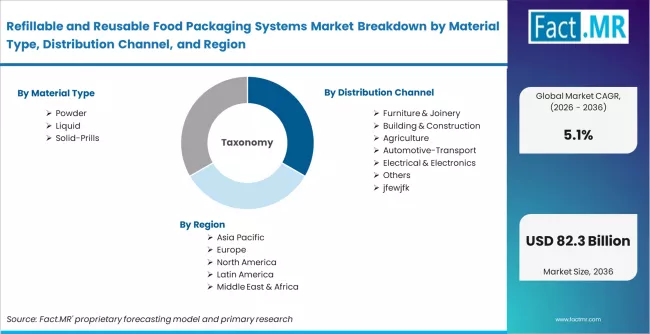
Refillable And Reusable Food Packaging Systems Market Breakdown By Material Type, Distribution Channel, And Region | Source: Fact.MR
| Metric | Value |
|---|---|
| Quantitative Units | USD 47.6 billion (2026) to USD 78.2 billion (2036), at a CAGR of 5.1% |
| Market Definition | The refillable and reusable food packaging systems market includes packaging solutions designed for multiple usage cycles, enabling reduced single-use material consumption through refill infrastructure, return logistics systems, and durable container materials across retail and foodservice supply chains. |
| Product Type Segmentation | Refillable beverage containers, Reusable takeaway containers, Refillable jars and bottles, Reusable food storage containers, Reusable transport packaging such as crates and bins, Refillable pouches |
| Material Type Segmentation | Plastic high durability polymers, Glass, Stainless steel, Silicone, Fiber based materials |
| Distribution Channel Segmentation | Foodservice operators, Supermarkets and hypermarkets, Online grocery platforms, Zero waste and refill stores |
| Regions Covered | North America, Latin America, Europe, East Asia, South Asia, Oceania, Middle East and Africa |
| Countries Covered | United States, Canada, Mexico, Brazil, Argentina, Germany, France, United Kingdom, Netherlands, Sweden, China, Japan, South Korea, India, Australia, New Zealand, United Arab Emirates, and 40+ countries |
| Key Companies Profiled | TerraCycle Inc. (Loop platform), Algramo Ltd., RePack Oy, Muuse ApS, Vytal Global GmbH, Returnity Innovations LLC, GoBox PBC, CupClub Ltd., DS Smith Plc, Ball Corporation |
| Forecast Period | 2026 to 2036 |
| Approach | Hybrid top-down and bottom-up market estimation based on packaging reuse cycle adoption rates, reverse logistics infrastructure deployment, foodservice packaging consumption benchmarks, material durability lifecycle analysis, and validation through primary interviews with packaging manufacturers, reuse platform operators, and retail distribution partners. |
Source: Fact.MR analysis. Updated Apr 18, 2026
Frequently Asked Questions
How large is the demand for Refillable and Reusable Food Packaging Systems in the global market in 2026?
What will be the market size of Refillable and Reusable Food Packaging Systems in the global market by 2036?
What is the expected demand growth for Refillable and Reusable Food Packaging Systems in the global market between 2026 and 2036?
Which company is identified as a leading participant in the Refillable and Reusable Food Packaging Systems market?
Which material type is projected to dominate Refillable and Reusable Food Packaging Systems by 2026?
Why are high durability polymers widely used in refillable and reusable food packaging systems?
What is driving demand for refillable and reusable food packaging systems in Germany?
What is the growth outlook for the Refillable and Reusable Food Packaging Systems market in Germany?
Why is the United Kingdom an important market for reusable food packaging systems?
What is the growth outlook for the Refillable and Reusable Food Packaging Systems market in the United Kingdom?
How is demand for refillable and reusable food packaging systems evolving in France?
What is the growth outlook for the Refillable and Reusable Food Packaging Systems market in France?
What is the growth outlook for the Refillable and Reusable Food Packaging Systems market in the United States?
How is Japan positioned in the Refillable and Reusable Food Packaging Systems market?
What is the growth outlook for the Refillable and Reusable Food Packaging Systems market in Japan?
What are refillable and reusable food packaging systems and what are they mainly used for?
What does the Refillable and Reusable Food Packaging Systems market include in this report?
What applications are included in the scope of the Refillable and Reusable Food Packaging Systems market?
What is excluded from the scope of the Refillable and Reusable Food Packaging Systems market report?
What does market forecast mean in the Refillable and Reusable Food Packaging Systems market report?
How is the Refillable and Reusable Food Packaging Systems market forecast developed in this report?
What does primary validation indicate in the Refillable and Reusable Food Packaging Systems market analysis?
Who worked on this report


Preview the report firsthand - request a free sample
Free SampleGet the brochure for pricing and purchase details
Download PDF