- Market Value (2025): USD 28.6 Bn
- Estimated Value (2026): USD 30.2 Bn
- Forecast Value (2036): USD 52.6 Bn
- CAGR (2026-2036): 5.7%
What is the Refrigeration Packaging Market forecast to be worth by 2036?
USD 30.2 billion in 2026 to USD 52.6 billion by 2036 at a 5.7% CAGR.
- The refrigeration packaging market reached USD 28.6 billion in 2025.
- Sales are projected to increase from USD 30.2 billion in 2026 to USD 52.6 billion by 2036 as more products require protective packaging during refrigerated distribution.
- The projected 5.7% CAGR from 2026 to 2036 reflects demand from food processors, commercial cold stores and manufacturers of temperature-sensitive medicines.
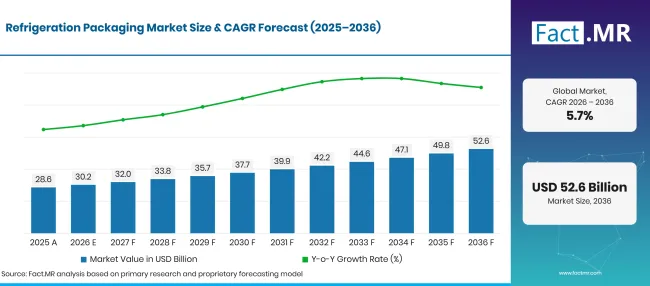
Refrigeration Packaging Market Forecast Global | Source: Fact.MR
| Year | Basis | Market Value (USD billion) |
|---|---|---|
| 2025 | Actual | 28.6 |
| 2026 | Estimate | 30.2 |
| 2036 | Forecast | 52.6 |
| CAGR 2026 to 2036 | Forecast period | 5.7% |
Source: Fact.MR analysis. Updated Nov 3, 2026
What are the defining numbers behind Refrigeration Packaging Market growth?
USD 22.4 billion in additional market value by 2036, with plastic and rigid formats accounting for major shares in 2026.
- Demand Drivers in the Market
- Food processors need packs that tolerate condensation and repeated handling in refrigerated distribution. Sealed Air described the role of CRYOVAC vacuum packaging in meat processing and food service in January 2026 [1].
- Packaging designers now face tighter recycling requirements alongside food-contact obligations.
- Cold-storage operators need consistent pack dimensions for stacking and warehouse handling.
- Food exporters select packaging that survives long journeys and frequent transfers. Brazil recorded 3,090.3 thousand tonnes of beef exports in 2025 in official trade data [4].
- Fresh-food packaging specifications also respond to losses along the chain. Eurostat reported 57.9 million tonnes of food waste in the EU in 2024 in a September 2026 release [5].
- Key Segments Analyzed
- By Material Type: Plastic is expected to account for 38.4% in 2026 because moisture resistance and sealability suit chilled food applications.
- By Packaging Type: Rigid Packaging is projected to represent 58.3% in 2026 as transport containers and protective trays face repeated handling.
- By Application: Food & Beverages is estimated to generate 54.2% in 2026 through refrigerated meat, dairy and prepared food distribution.
- By End-User: Commercial is forecast to account for 47.6% in 2026 as retailers and food-service distributors purchase products in standardized packs.
- Analyst Opinion at Fact.MR
- Shambhu Nath Jha, Principal Consultant at Fact.MR, states, “Refrigeration packaging demand depends on how well a pack performs across filling, cold storage, transport and retail handling. Food processors and distributors need materials that maintain seal integrity while fitting existing equipment and storage layouts.”
- Strategic Implications
- Food processors can test seal integrity after repeated cold-room and loading cycles before introducing a new material into regular production.
- Packaging converters benefit from comparing transport damage rates and line compatibility when proposing lighter refrigerated packs to existing customers.
- Distributors need to align rigid pack dimensions with storage layouts and pallet requirements to avoid wasted space.
- Retail groups can request clear disposal guidance and packaging evidence as new European requirements apply to food-contact materials.
Germany is projected to record a 6.6% CAGR through 2036 as packaging producers adapt to European material rules. Brazil follows at 6.0% with an established meat-export supply chain. The USA is estimated at 5.4% where refrigerated warehouse flows support repeat purchases. The UK is forecast at 4.8%, while Japan is projected at 4.3% as businesses maintain demanding handling specifications.
How does the Refrigeration Packaging Market break down by segment?
Plastic holds 38.4%; Rigid Packaging 58.3%; Food & Beverages 54.2%; Commercial 47.6% in 2026.
Which Material Type dominates?
Plastic is expected to account for 38.4% of 2026 value.
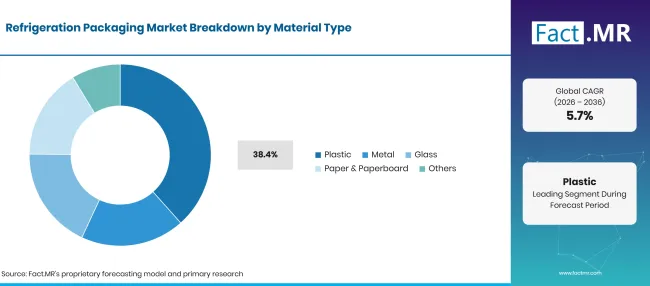
Refrigeration Packaging Market Breakdown Material Type | Source: Fact.MR
| Material Type | Share (2026) |
|---|---|
| Plastic (Leading segment) | 38.4% |
| Other segments combined | 61.6% |
| Total | 100.0% |
Source: Fact.MR analysis. Updated Nov 3, 2026
Plastic packs suit chilled and frozen goods because they can be sealed against moisture and formed into sizes that work with automated filling lines. Metal containers remain useful for certain product formats where strength and long service life carry weight. Glass has a role in selected food and pharmaceutical applications where its inert surface is useful. Paper and paperboard provide outer protection and display surfaces, including corrugated cases surrounding sealed primary packs. Material choice depends on the product and the full transport route. Eurostat reported that 42.4% of plastic packaging waste generated in the EU in 2024 was recycled [6].
What leads the Packaging Type segment?
Rigid Packaging is projected to represent 58.3% of 2026 value.
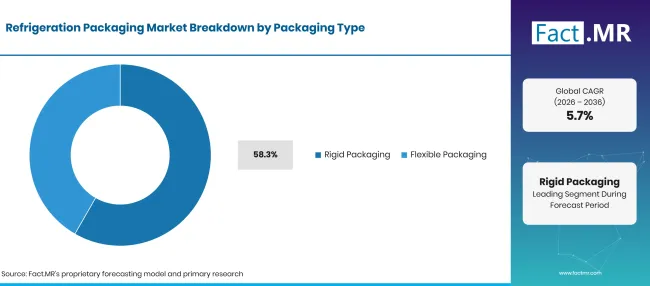
Refrigeration Packaging Market Breakdown Packaging Type | Source: Fact.MR
| Packaging Type | Share (2026) |
|---|---|
| Rigid Packaging (Leading segment) | 58.3% |
| Other segments combined | 41.7% |
| Total | 100.0% |
Source: Fact.MR analysis. Updated Nov 3, 2026
Rigid trays and containers protect food against crushing during stacking and frequent transfers. They also give food-service operators familiar units for moving goods between chillers and preparation areas. Flexible films consume less storage space before filling and suit vacuum sealing around irregular cuts of meat. Flexible pouches also allow smaller portions and simpler case packing when product specifications permit. Decisions often begin with the packaging line and the forces encountered during transport.
How does Application shape demand?
Food & Beverages are expected to account for 54.2% in 2026.
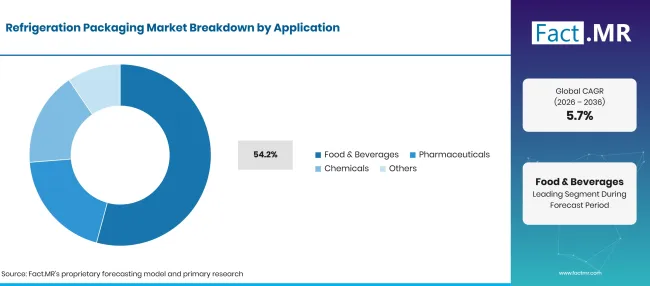
Refrigeration Packaging Market Breakdown Application | Source: Fact.MR
| Application | Share (2026) |
|---|---|
| Food & Beverages (Leading segment) | 54.2% |
| Other segments combined | 45.8% |
| Total | 100.0% |
Source: Fact.MR analysis. Updated Nov 3, 2026
Food packs move through several refrigerated stages before sale. Fresh meat needs seals that protect against leakage while frozen prepared meals need containers that tolerate handling at low temperatures. Pharmaceutical packs differ because the temperature range may be narrow and documented performance may be part of the shipping specification. Chemical users place greater weight on compatibility between the material and the substance contained.
Which End-User group accounts for the largest share?
Commercial is forecast to account for 47.6% in 2026.
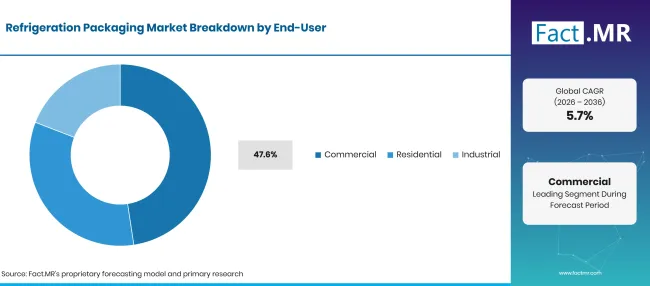
Refrigeration Packaging Market Breakdown End User | Source: Fact.MR
| End-User | Share (2026) |
|---|---|
| Commercial (Leading segment) | 47.6% |
| Other segments combined | 52.4% |
| Total | 100.0% |
Source: Fact.MR analysis. Updated Nov 3, 2026
Commercial customers include food retailers and food-service distributors that need predictable pack sizes and easy identification during receiving. Their purchases often emphasize dependable availability because packaging failures can interrupt daily deliveries. Residential use includes smaller insulated packs and consumer-facing chilled products. Industrial customers may specify larger protective containers or repeat-use systems for production transfers. These segments place different demands on reuse and pack strength. For commercial shipments, a packaging choice must account for how employees load a case and how it is displayed when it reaches the selling point.
What is accelerating Refrigeration Packaging Market adoption, and what is holding it back?
Chilled-food distribution and sealed pack performance support sales, while material expenses and recycling rules influence product choices.
Drivers Impact Analysis
| DRIVER | CAGR REFERENCE / IMPACT | GEOGRAPHIC RELEVANCE | IMPACT TIMELINE |
|---|---|---|---|
| Cold-food distribution and repeat ordering | 5.7% | Global | Short term |
| Food-contact performance and seal reliability | 5.7% | North America; Europe | Short term |
| Frozen and prepared-food packing needs | 5.7% | Global | Medium term |
| Cold-store handling and warehouse fit | 5.7% | North America; Asia | Medium term |
| Temperature-sensitive medicine distribution | 5.7% | Global | Long term |
Source: Fact.MR analysis. Updated Nov 3, 2026
Opportunity Impact Analysis
| OPPORTUNIT | CAGR REFERENCE / IMPACT | GEOGRAPHIC RELEVANCE | IMPACT TIMELINE |
|---|---|---|---|
| Recyclable refrigerated food packaging | 5.7% | Europe | Medium term |
| Lighter rigid tray designs | 5.7% | Global | Medium term |
| Returnable commercial shipping containers | 5.7% | North America; Europe | Long term |
| Flexible films for portion control | 5.7% | Global | Medium term |
Source: Fact.MR analysis. Updated Nov 3, 2026
Restraints Impact Analysis
| RESTRAINT | CAGR REFERENCE / IMPACT | GEOGRAPHIC RELEVANCE | IMPACT TIMELINE |
|---|---|---|---|
| Cost of performance-grade packaging materials | 5.7% | Global | Short term |
| Qualification of new food-contact structures | 5.7% | Europe; North America | Medium term |
| Transport damage from poor pack selection | 5.7% | Global | Short term |
| Difficult recycling of mixed-material packs | 5.7% | Europe | Long term |
Source: Fact.MR analysis. Updated Nov 3, 2026
Which countries are scaling the Refrigeration Packaging Market through 2036?
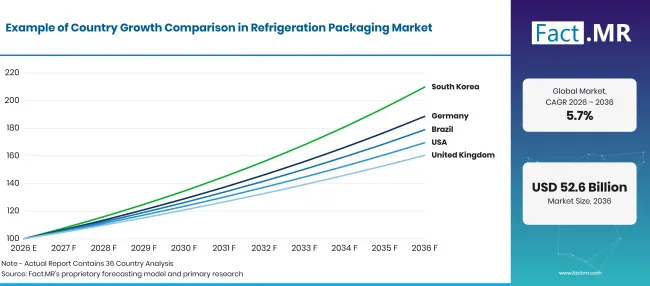
Refrigeration Packaging Market Growth Index | Source: Fact.MR
| Country | CAGR (2026 to 2036) |
|---|---|
| Germany | 6.6% |
| Brazil | 6.0% |
| United States | 5.4% |
| United Kingdom | 4.8% |
| Japan | 4.3% |
Source: Fact.MR analysis. Updated Nov 3, 2026
What supports Germany refrigeration packaging demand?
6.6% CAGR, shaped by European packaging rules and chilled-food distribution.
Germany’s packaging converters are expected to adjust refrigerated-food formats to the EU’s new packaging framework. The European Commission announced in August 2026 that Regulation (EU) 2025/40 had entered into application [2]. The change makes material selection a practical consideration for chilled-food producers that need dependable seals and clear recovery instructions. Rigid trays and outer cases also have to fit warehouse handling and supermarket delivery requirements.
What supports Brazil refrigeration packaging demand?
6.0% CAGR, linked to export packing and refrigerated meat logistics.
Brazil’s refrigerated export chain creates recurring orders for sealed food packs that withstand long transport journeys. The Ministry of Agriculture and Livestock reported in May 2026 that agribusiness exports reached USD 169.2 billion during 2025 [8]. Meat processors depend on suitable primary packaging during chilled transport, while distribution companies need outer cases that retain their shape during loading.
What supports United States refrigeration packaging demand?
5.4% CAGR, supported by large refrigerated product flows.
In the United States, refrigerated warehouse networks move packaged meat and other chilled food through commercial storage and retail distribution. The U.S. Department of Agriculture released its Cold Storage Annual Summary in February 2026 [3]. The report tracks commodity inventories across refrigerated facilities, giving packaging manufacturers a view of the product categories that need sealed or protective handling.
What supports United Kingdom refrigeration packaging demand?
4.8% CAGR, influenced by chilled food production and retail handling.
The United Kingdom has a substantial food-processing base that relies on sealed packaging for chilled distribution. The Office for National Statistics reported in July 2026 that sales of fresh or chilled beef and veal cuts reached GBP 7.3 billion in 2025 [7]. These products need protective packaging suited to filling lines and delivery through grocery supply chains.
What supports Japan refrigeration packaging demand?
4.3% CAGR, shaped by compact packs and demanding presentation standards.
Japan’s food exporters need protective packs that preserve product presentation during international deliveries. The Ministry of Agriculture, Forestry and Fisheries reported in February 2026 that food and agricultural exports reached JPY 1.7005 trillion in 2025 [9]. Export orders create a practical need for suitable chilled and frozen packaging when products require temperature-controlled transport.
Who leads the Refrigeration Packaging Market?
Packaging businesses compete by serving different parts of the refrigerated product chain. Sealed Air offers CRYOVAC food packaging for proteins and related food processing needs.
Amcor supplies rigid and flexible packaging products, while Mondi and Smurfit Westrock contribute paper-based packaging options suitable for outer protection and distribution. International Paper supplies corrugated and related packaging. Huhtamaki offers food packaging products. These portfolios overlap with refrigeration packaging to different degrees, so competitive position depends on product specifications and the target customer.
Which companies are the key providers?
Key companies include Amcor plc; Sealed Air Corporation; Mondi plc; Smurfit Westrock plc; International Paper Company; Huhtamaki Oyj.
- Amcor plc
- Sealed Air Corporation
- Mondi plc
- Smurfit Westrock plc
- International Paper Company
- Huhtamaki Oyj
Bibliography
- [1] Sealed Air Corporation. (2026, January 7). CRYOVAC® brand food packaging marks 85 years of innovation, performance and customer service
- [2] European Commission. (2026, August 11). New EU rules on packaging enter into application.
- [3] U.S. Department of Agriculture, National Agricultural Statistics Service. (2026, February 27). Cold Storage Annual Summary
- [4] Ministry of Development, Industry, Trade and Services. (2026, October 6). Resultados do Comércio Exterior Brasileiro - Dados Consolidados
- [5] Eurostat. (2026, September 29). Food waste in the EU: 129 kg per person in 2024
- [6] Eurostat. (2026, October 22). Plastic packaging waste in the EU: 35.9 kg per person
- [7] Office for National Statistics. (2026, July 24). UK manufacturers’ sales by product: 2025
- [8] Ministério da Agricultura e Pecuária. (2026, May 27). Agronegócio brasileiro fecha 2025 com recorde em exportações de US$ 169 bilhões e superávit de US$ 149,07 bilhões
- [9] Ministry of Agriculture, Forestry and Fisheries. (2026, February 3).[Results of agricultural, forestry and food exports in 2025]
This Report Answers
- How refrigerated and frozen food supply chains select moisture-resistant primary and outer packaging.
- Why rigid packages account for a greater value share than flexible formats in 2026.
- How commercial distribution needs differ from household and industrial packing requirements.
- Which country growth rates and national industry conditions shape the 2026 to 2036 outlook.
- How material rules affect the choices available to packaging converters serving refrigerated goods.
What does the Refrigeration Packaging Market cover?
The market covers packaging used to protect products that need controlled low-temperature handling. Its boundaries include primary packs that contact food and protective secondary packaging used in cold storage or transportation. The analysis considers packaging value, excluding the cost of refrigeration machinery and transport services.
What is included in the scope?
Plastic films and trays used in refrigerated food are covered alongside glass and metal containers used for suitable applications. Paper-based outer cases, insulated protection where relevant to refrigeration packaging, and commercial distribution formats are also within scope.
What is excluded from the scope?
Refrigeration equipment and warehouse operating revenue fall outside packaging sales. General household containers without a defined refrigerated product use are excluded. Refrigerant gases and insulation fitted permanently to buildings or vehicles are treated as equipment inputs rather than shipped packaging.
How Was the Analysis Built?
The analysis draws on 120+ sources, 35+ company portfolios, 25+ countries, and more than 20 industry interviews.
- Primary Research: Primary research includes discussions with manufacturers, service providers, technology developers, distributors, end users, and subject-matter experts. These conversations examine purchasing priorities, product adoption, operational challenges, approval requirements, competitive positioning, and the factors that influence wider market acceptance.
- Desk Research: Desk research covers government statistics, regulatory publications, company filings, trade data, technical studies, industry associations, standards, public policy, and other authoritative sources. Every source used in the analysis is documented in the bibliography.
- Market Sizing and Forecasting: Market estimates combine historical performance, demand indicators, pricing and volume trends, segment shares, company participation, country-level growth, adoption patterns, investment activity, and barriers to market expansion.
- Data Validation and Update Cycle: Findings are validated by comparing primary interviews with public data, company activity, regulatory changes, trade patterns, and industry developments. Regular updates review new product launches, capacity changes, partnerships, approvals, and shifts in commercial adoption.
Segmentation
What is the report’s scope and coverage?
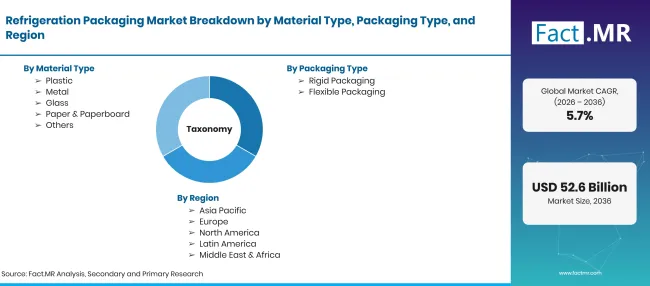
Factmr Refrigeration Packaging Market Taxonomy | Source: Fact.MR
| Attribute | Details |
| Quantitative Units | USD billion |
| Market Definition | Packaging used to protect products handled under refrigerated or frozen conditions, including primary food-contact packs and protective secondary packaging used during cold storage and transportation. |
| Material Type | Plastic; Metal; Glass; Paper & Paperboard; Others |
| Packaging Type | Rigid Packaging; Flexible Packaging; Others |
| Application | Food & Beverages; Pharmaceuticals; Chemicals |
| End-User | Commercial; Residential; Industrial |
| Regions Covered | North America; Latin America; Western Europe; Eastern Europe; East Asia; South Asia & Pacific; Middle East & Africa |
| Countries Covered | Germany; Brazil; United States; United Kingdom; Japan |
| Companies Profiled | Amcor plc; Sealed Air Corporation; Mondi plc; Smurfit Westrock plc; International Paper Company; Huhtamaki Oyj |
| Forecast Period | 2026 to 2036 |
| Approach | Market sizing and segmentation based on refrigerated distribution needs, packaging material performance, cold-storage handling, application demand, country growth, supplier activity and packaging regulations. |
Source: Fact.MR analysis. Updated Nov 3, 2026
How is the market segmented?
-
By Material Type
- Plastic
- Metal
- Glass
- Paper & Paperboard
- Others
-
By Packaging Type
- Rigid Packaging
- Flexible Packaging
- Others
-
By Application
- Food & Beverages
- Pharmaceuticals
- Chemicals
-
By End-User
- Commercial
- Residential
- Industrial
-
By Region
- North America
- Latin America
- Western Europe
- Eastern Europe
- East Asia
- South Asia & Pacific
- Middle East & Africa
Frequently Asked Questions
How big is the Refrigeration Packaging Market in 2026?
What is the CAGR of the Refrigeration Packaging Market from 2026 to 2036?
Which material type leads the Refrigeration Packaging Market?
Which packaging type leads the Refrigeration Packaging Market?
Who are the leading companies in the Refrigeration Packaging Market?
Who worked on this report


Preview the report firsthand - request a free sample
Free SampleGet the brochure for pricing and purchase details
Download PDF