- Base Value(2026): 1.3 Bn
- Estimated Value(2026): 1.3 Bn
- Forecast Value (2036): 2.3 Bn
- CAGR (2026 - 2036): 5.8%
Packaging Testing Services Market Forecast and Outlook 2026 to 2036
The period opens with the packaging testing services market at USD 1.3 billion in 2026 and closes near USD 2.3 billion by 2036, which reflects a 5.80% CAGR.
Key Takeaways from Packaging Testing Services Market
- Packaging Testing Services Market Value (2026): USD 1.3 billion
- Packaging Testing Services Market Forecast Value (2036): USD 2.3 billion
- Packaging Testing Services Market Forecast CAGR 2026 to 2036: 5.8%
- Leading Service Type in Packaging Testing Services Market: Physical testing
- Key Growth Regions in Packaging Testing Services Market: Asia Pacific, North America, Europe, Latin America, Middle East & Africa
- Top Players in Packaging Testing Services Market: SGS SA, Bureau Veritas S.A., Intertek Group plc, Eurofins Scientific SE, TÜV SÜD AG, ALS Limited, Element Materials Technology, NSF International
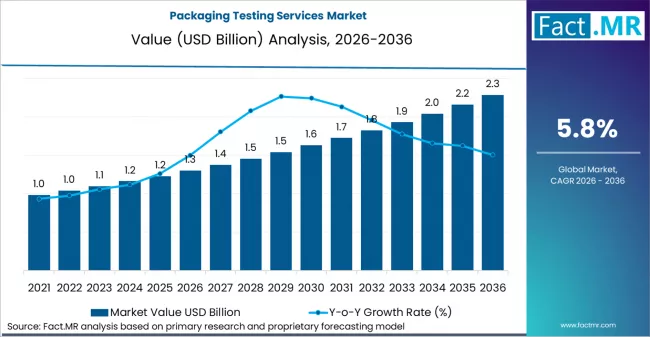
Packaging Testing Services Market Market Value Analysis | Source: Fact.MR
This segment supports packaging development and qualification work rather than mass production. Companies use testing services to confirm strength, seal integrity, transport resistance, and shelf life behavior before a pack format is released or changed.
The work is tied to specification control, audit preparation, and customer acceptance files, which makes service continuity important. Many programs run on repeat cycles linked to product refreshes, supplier changes, or line modifications. Buyers value short turnaround times, consistent methods, and reports that can be used directly in approval and compliance processes. Demand grows as portfolios become broader, materials become more complex, and documentation requirements become more detailed, not from frequent redesign of test methods themselves.
Packaging Testing Services Market
| Metric | Value |
|---|---|
| Market Value (2026) | USD 1.3 billion |
| Forecast Value (2036) | USD 2.3 billion |
| Forecast CAGR 2026 to 2036 | 5.8% |
Source: Fact.MR analysis. Updated Jan 27, 2026
Category
| Category | Segments |
|---|---|
| Service Type | Physical testing; Chemical testing; Microbiological testing; Others |
| End-Use | Food and beverage; Pharmaceutical; Personal care and cosmetics; Electronics; Others |
| Region | North America; Europe; Asia Pacific; Latin America; Middle East & Africa |
Source: Fact.MR analysis. Updated Jan 27, 2026
Segmental Analysis
Why Does Physical Testing Account for The Largest Share of Packaging Testing Activity?
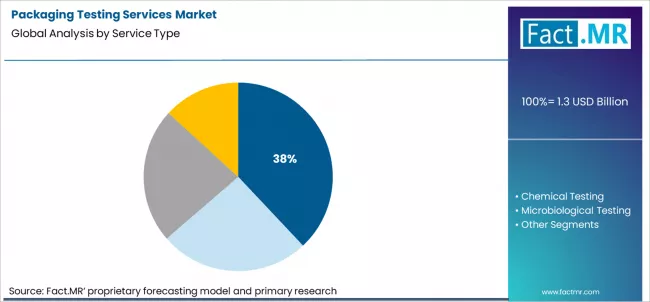
Packaging Testing Services Market Analysis By Service Type | Source: Fact.MR
Physical testing represents 38.0% of service type usage in the packaging testing services market. This category covers compression, drop, vibration, and seal strength checks that apply to nearly every pack format. Packaging teams rely on these tests during design validation, line changeovers, and routine quality audits. Results link directly to handling performance in warehouses and transport networks. Test methods remain standardized across many materials, which allows laboratories to run high volumes with consistent procedures. Brand owners also request these checks during supplier qualification and periodic reapproval cycles. Chemical and microbiological work address specific risks. Day to day packaging release decisions still depend most often on physical performance results.
Why Does Food and Beverage Generate the Highest Demand for Packaging Testing Services?
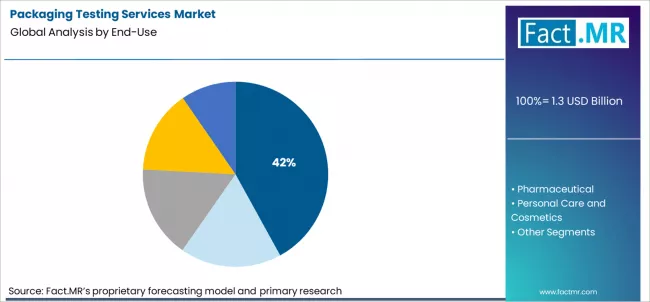
Packaging Testing Services Market Analysis By End Use | Source: Fact.MR
Food and beverage accounts for 42.00% of end-use demand in this market. This segment moves large volumes of packaged goods with short shelf cycles and frequent product updates. Each change in material, supplier, or format triggers new validation work. Quality systems in this sector place strong emphasis on barrier performance, seal integrity, and transport durability. Retail distribution adds further pressure through handling intensity and return controls. Audit programs also run on fixed schedules that repeat across product families. Pharmaceuticals, personal care, and electronics require targeted testing. The scale and frequency of packaging change in food and beverage keeps this segment as the main source of testing workloads.
What are the Drivers, Restraints, and Key Trends of the Packaging Testing Services Market?
- Drivers: Regulatory requirements for safety and compliance across food, pharmaceutical, and consumer goods packaging, coupled with buyer demands for performance validation and material quality assurance, are supporting use of specialized packaging testing services by converters and brand owners.
- Restraint: Cost pressures on manufacturers and tight quality budgets restrict frequency of comprehensive testing and may delay adoption of advanced analytical protocols in price-sensitive segments.
- Trend 1: Expansion of testing portfolios that integrate physical, chemical, and shelf-life assessments to provide holistic performance insights for complex packaging systems.
- Trend 2: Increased use of tailored test packages designed to align with specific regulatory frameworks and retailer compliance criteria.
Country
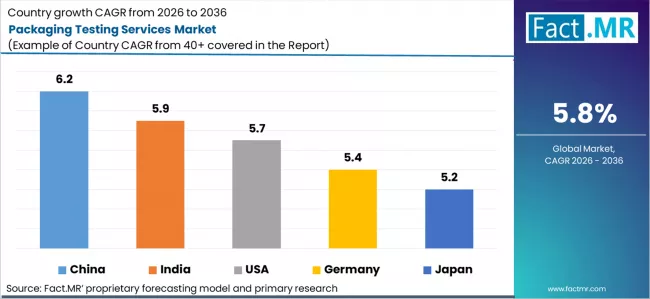
Packaging Testing Services Market Cagr Analysis By Country | Source: Fact.MR
| Country | CAGR 2026 to 2036 |
|---|---|
| China | 6.2% |
| India | 5.9% |
| USA | 5.7% |
| Germany | 5.4% |
| Japan | 5.2% |
Source: Fact.MR analysis. Updated Jan 27, 2026
The report covers an in-depth analysis of 40+ countries; top-performing countries are highlighted below.
How Is Industrial Scale and Export Compliance Shaping Packaging Testing Services in China?
Export manufacturing and domestic brand expansion are setting the pace for packaging testing services in China. The market grows near 6.2% per year through 2036 as producers face tighter quality and safety requirements. Testing demand concentrates on transport simulation, material compliance, and performance under automated handling. Large factories integrate testing into qualification and audit routines. Procurement decisions emphasize turnaround time and capacity to handle large sample volumes. Volume growth follows expansion of export categories and organized retail. Service providers invest in automation and multi-site networks. Market development is driven by manufacturing scale and compliance pressure rather than premium positioning.
Why Is Process Standardization Driving Packaging Testing Services in India?
Formalization of packaging practices is reshaping demand for testing services in India. With growth near 5.9% per year through 2036, usage expands as brands move into national distribution and modern retail. Testing focuses on drop resistance, seal integrity, and basic material compliance. Many companies use testing to qualify new suppliers and reduce transit damage. Procurement decisions emphasize cost, accessibility, and report acceptance by customers. Volume growth follows expansion of packaged food, personal care, and pharmaceuticals. Service providers build regional labs to improve coverage. Market development depends more on process discipline and scale than advanced technical specialization.
How Are Risk Management and Retail Requirements Influencing Packaging Testing in USA?
Retail standards and liability management shape how packaging testing services are used in USA. The market advances around 5.7% per year through 2036 as brands seek to reduce returns and transit losses. Testing demand centers on performance validation, shelf life simulation, and compliance documentation. Procurement teams rely on testing to support supplier approvals and contract negotiations. Volume growth follows portfolio refresh cycles and expansion of direct to consumer shipping. Large labs compete on turnaround speed and reporting quality. Market development remains tied to risk control and retail acceptance rather than regulatory enforcement alone.
What Is Sustaining Demand for Packaging Testing Services in Germany?
Quality assurance culture and export exposure keep packaging testing relevant in Germany. Growth runs near 5.4% per year through 2036 as manufacturers maintain strict performance and compliance standards. Testing is used to validate transport resistance, material consistency, and regulatory conformity. Engineering teams integrate results into packaging design and line approval processes. Procurement decisions emphasize technical depth and accreditation status. Volume increases track gradual product line updates and export programs. Service providers focus on precision and documentation reliability. Market development remains incremental and process driven rather than volume driven or campaign oriented.
How Do Approval Discipline and Process Control Shape Packaging Testing in Japan?
Packaging qualification practices in Japan rely heavily on documented testing and repeatability. The market grows near 5.2% per year through 2036 as companies maintain strict defect avoidance policies. Testing is used to confirm performance stability, material behavior, and transport safety. Approval cycles involve multiple internal reviews and validation steps. Procurement decisions prioritize trusted laboratories and consistent methodologies. Volume growth follows slow, structured product updates rather than rapid launches. Service providers compete on reliability and technical credibility. Market development is governed more by internal control systems than by regulatory pressure or cost driven outsourcing.
How Do Standard Coverage and Turnaround Commitments Shape Competition in the Packaging Testing Services Market?
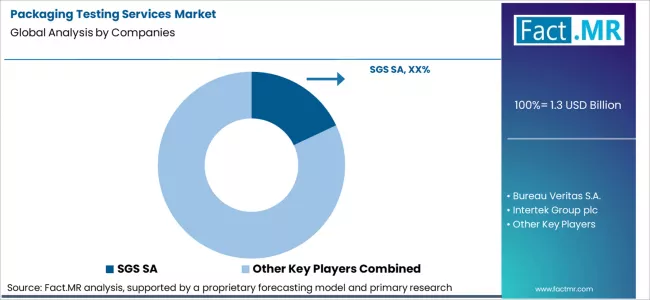
Packaging Testing Services Market Analysis By Company | Source: Fact.MR
Access to large brand programs in the packaging testing services market is governed by standard coverage, accreditation scope, and report acceptance across regions rather than by test pricing. Packaging owners first map required migration, performance, and transport tests, then select providers that can issue results accepted by regulators and retailers. SGS, Bureau Veritas, Intertek, Eurofins, TÜV SÜD, ALS, Element, and NSF compete through laboratory networks and method breadth.
Buyers compare providers using turnaround time, repeatability of results, and clarity of reporting. Procurement teams also weigh capacity during peak compliance cycles. Once a provider is embedded in qualification workflows, volumes follow product launch schedules and regulatory refresh cycles. Supplier changes usually occur after scope expansions, service quality reviews, or consolidation of testing panels.
Key Players in Packaging Testing Services Market
- SGS SA
- Bureau Veritas S.A.
- Intertek Group plc
- Eurofins Scientific SE
- TÜV SÜD AG
- ALS Limited
- Element Materials Technology
- NSF International
References
- International Organization for Standardization. (2020). ISO 4180: Packaging - Complete, filled transport packages - General rules for the compilation of performance test schedules. ISO.
- International Organization for Standardization. (2023). ISO 2248: Packaging - Complete, filled transport packages - Vertical impact test by dropping. ISO.
- International Organization for Standardization. (2024). ISO 2872: Packaging - Complete, filled transport packages - Pressure test. ISO.
- ASTM International. (2023). ASTM D4169-23: Standard practice for performance testing of shipping containers and systems. ASTM International.
- ASTM International. (2024). ASTM D5276-24: Standard test method for drop test of loaded containers by free fall. ASTM International.
Segmentation
Scope of the Report
| Items | Values |
|---|---|
| Quantitative Units (2026) | USD billion |
| Service Type | Physical testing, chemical testing, microbiological testing, others |
| End-use | Food and beverage, pharmaceutical, personal care and cosmetics, electronics, others |
| Regions Covered | Asia Pacific, Europe, North America, Latin America, Middle East & Africa |
| Countries Covered | United States, Canada, Mexico, Germany, United Kingdom, France, Italy, Spain, Nordics, BENELUX, China, Japan, South Korea, India, Australia & New Zealand, ASEAN, Brazil, Chile, Saudi Arabia, Turkey, South Africa, and other regional markets |
| Key Companies Profiled | SGS SA, Bureau Veritas, Intertek Group, Eurofins Scientific, TÜV SÜD, ALS Limited, Element Materials Technology, NSF International |
| Additional Attributes | Dollar value by service type and end-use; focus on performance validation, compliance documentation, and audit readiness; demand driven by portfolio expansion, material complexity, and regulatory requirements |
Source: Fact.MR analysis. Updated Jan 27, 2026
Packaging Testing Services Market Segmentation
-
Service Type :
- Physical Testing
- Chemical Testing
- Microbiological Testing
- Others
-
End-Use :
- Food & Beverage
- Pharmaceutical
- Personal Care & Cosmetics
- Electronics
- Others
-
Region :
- Asia Pacific
- China
- Japan
- South Korea
- India
- Australia & New Zealand
- ASEAN
- Rest of Asia Pacific
- Europe
- Germany
- United Kingdom
- France
- Italy
- Spain
- Nordic
- BENELUX
- Rest of Europe
- North America
- United States
- Canada
- Mexico
- Latin America
- Brazil
- Chile
- Rest of Latin America
- Middle East & Africa
- Kingdom of Saudi Arabia
- Other GCC Countries
- Turkey
- South Africa
- Other African Union
- Rest of Middle East & Africa
- Asia Pacific
Frequently Asked Questions
How big is the packaging testing services market in 2026?
What will be the size of packaging testing services market in 2036?
How much will be the packaging testing services market growth between 2026 and 2036?
What are the key product types in the packaging testing services market?
Which end-use segment to contribute significant share in the packaging testing services market in 2026?
Who worked on this report


Preview the report firsthand - request a free sample
Free SampleGet the brochure for pricing and purchase details
Download PDF