Residential Microgrid LFP Battery Systems Market
Residential Microgrid LFP Battery Systems Market Size and Share Forecast Outlook 2026 to 2036
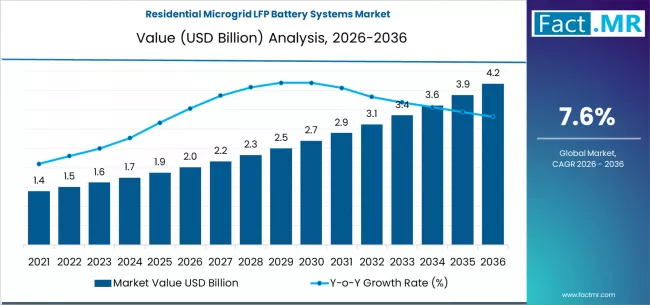
Residential microgrid lfp battery systems market is projected to grow from USD 2.0 billion in 2026 to USD 4.2 billion by 2036, at a CAGR of 7.6%. <10 kWh will dominate with a 32.0% market share, while backup power will lead the application segment with a 43.1% share.
Residential Microgrid LFP Battery Systems Market Forecast and Outlook 2026 to 2036
The global residential microgrid LFP battery systems market is projected to total USD 2.01 billion in 2026, advancing to USD 4.17 billion by 2036. A 7.6% CAGR is anticipated for the period from 2026 to 2036. Expansion is underpinned by the convergence of three powerful trends: the democratization of energy independence, the mainstreaming of residential solar, and the proven safety and longevity advantages of LFP battery chemistry.
Key Takeaways from the Residential Microgrid LFP Battery Systems Market
- Market Value for 2026: USD 2.01 Billion
- Market Value for 2036: USD 4.17 Billion
- Forecast CAGR 2026 to 2036: 7.6%
- Leading System Size Segment (2026): <10 kWh (32%)
- Leading Application Segment (2026): Backup Power (43%)
- Leading Sales Channel Segment (2026): Installer-led (57%)
- Key Growth Countries: USA (8.4% CAGR), China (8.1% CAGR), Australia (7.9% CAGR), Germany (7.4% CAGR)
- Key Players in the Market: BYD, CATL, Tesla Energy, LG Energy Solution, Sonnen, Enphase Energy
Homeowners are increasingly seeking to build personal energy resilience against grid instability, extreme weather, and rising electricity tariffs. While various battery chemistries exist, LFP has emerged as the preferred foundation for these behind-the-meter systems due to its inherent thermal stability, extended cycle life, and declining cost curve. These systems are no longer just backup devices; they are becoming intelligent energy management hubs that optimize solar self-consumption, support electric vehicle charging, and can even participate in virtual power plants.
The market's growth is a direct product of supportive regulatory frameworks, technological standardization, and heightened consumer awareness. This landscape, encompassing everything from single-home setups to clustered neighborhood resilience, positions the LFP-based residential microgrid as a cornerstone of the decentralized, clean energy transition.
Metric
| Metric | Value |
|---|---|
| Market Value (2026) | USD 2.01 Billion |
| Market Forecast Value (2036) | USD 4.17 Billion |
| Forecast CAGR 2026 to 2036 | 7.6% |
Category
| Category | Segments |
|---|---|
| System Size | <10 kWh, 10-20 kWh, >20 kWh, Modular Expansions |
| Application | Backup Power, Solar Self-consumption, EV Charging Support, Energy Trading/VPP |
| Sales Channel | Installer-led, Utility Programs, Direct-to-Consumer, EPC Partners |
| Region | North America, Latin America, Western Europe, Eastern Europe, East Asia, South Asia & Pacific, MEA |
Segmental Analysis
By System Size, Which Capacity Range is Most Accessible to Homeowners?
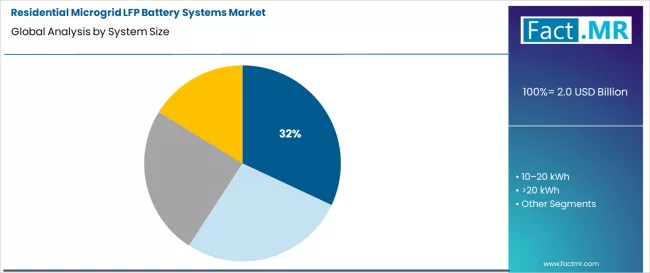
Systems under 10 kWh command a leading 32% share. This segment's dominance reflects the entry-level point for most residential battery installations, offering a balance between cost and capability sufficient for essential backup during short outages and meaningful solar self-consumption.
Its popularity is driven by its affordability and suitability for a wide range of average household energy profiles, making it the gateway product for initial adoption and a common first step before modular expansion.
By Application, What is the Primary Consumer Motivation for Purchase?
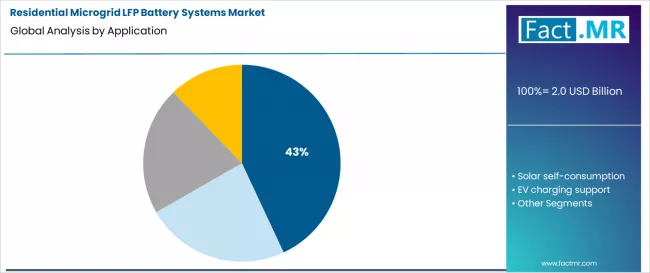
Backup power is the leading application with a 43% share. This underscores that, despite growing interest in energy management, the fundamental and most compelling value proposition for homeowners remains resilience against power outages.
The increasing frequency and severity of grid disruptions due to climate events have made reliable backup electricity a primary purchase driver, with LFP's safety and deep-cycle capability being key selling points for this critical use case.
By Sales Channel, Who is the Most Trusted Advisor for Homeowners?

The installer-led channel dominates with a 57% share. This highlights the critical role of local, certified solar and storage installers as the trusted intermediaries. Homeowners rely on these experts for system design, permitting, installation, and long-term service.
This channel’s strength is built on personalized consultation and the ability to integrate the battery seamlessly with existing or new solar PV systems, making it the most effective route to market for these complex, site-specific products.
What are the Principal Drivers, Constraints, and Evolving Dynamics of this Market?
| DROT Element | Analysis |
|---|---|
| Driver | Rising grid instability from extreme weather and aging infrastructure drives demand for home energy resilience, with LFP chemistry favored for its safety and long lifespan in daily cycling applications. |
| Restraint | High upfront capital cost remains a significant barrier for many homeowners, despite falling prices, and is exacerbated by complex interconnection rules and permitting delays that slow adoption. |
| Opportunity | Integration with electric vehicle charging and virtual power plant programs creates new revenue streams for homeowners, transforming batteries from cost-centers into grid-service assets. |
| Trend | The dominant trend is the shift from standalone backup to integrated energy management systems, where AI software optimizes solar usage, storage, and grid interactions autonomously. |
Analysis of the Residential Microgrid LFP Battery Systems Market by Key Countries

| Country | CAGR 2026 to 2036 |
|---|---|
| USA | 8.4% |
| China | 8.1% |
| Australia | 7.9% |
| Germany | 7.4% |
How do Policy Incentives and Grid Challenges Shape USA’s Market?
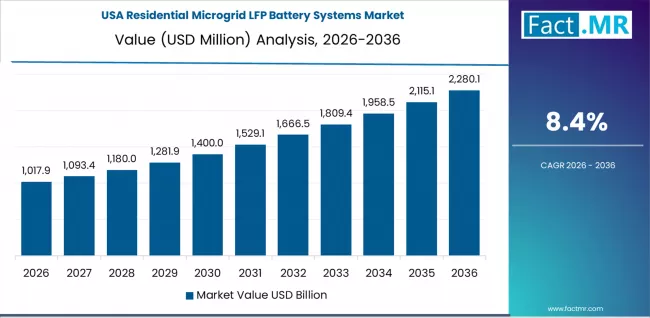
The USA's leading growth rate of 8.4% CAGR is fueled by a powerful combination of federal investment tax credits, state-level storage mandates, and a pressing need to mitigate wildfire-related grid outages, particularly in Western states. Increasing awareness and a mature network of solar installers who have rapidly added storage to their offerings characterize the market.
Utility-led programs that offer rebates for systems that can provide grid services, creating a multi-faceted value proposition that extends beyond the homeowner’s meter and encourages participation in aggregated virtual power plants, further propel growth.
What drives China's Domestic Market Scale and Manufacturing Dominance?
China's robust growth at 8.1% CAGR is anchored in its unparalleled position as the global manufacturer of LFP battery cells, giving domestic system integrators a significant cost advantage. Domestically, growth is driven by national carbon neutrality goals and substantial government support for distributed energy resources, including subsidies and favorable regulations for solar-plus-storage installations in both urban and rural settings.
The market is characterized by the dominance of vertically integrated giants like BYD and CATL, which control the supply chain from cell to complete system, enabling rapid deployment and standardization within the world's largest domestic clean energy market.
Why is Australia a Leading Adopter Per Capita Despite Policy Shifts?
Australia's significant growth at 7.9% CAGR is sustained by exceptionally high retail electricity prices, abundant solar resources, and a history of grid reliability concerns, which together create a compelling economic case for storage. Even as direct subsidy programs have evolved, market growth continues driven by pure self-interest.
The market is notably sophisticated, with consumers highly educated on product specifications and a strong preference for integrated energy management software that maximizes self-consumption of rooftop solar. This environment has made the country a key testing ground for advanced VPP and peer-to-peer energy trading platforms.
How does Germany's Energiewende and Regulatory Framework Guide Growth?
Germany's growth, forecast at 7.4% CAGR, operates within the country's meticulous Energiewende framework. Demand is driven by the phase-out of nuclear and coal, coupled with high electricity costs, making solar self-consumption economically vital.
Strict technical certification standards and a regulatory environment that increasingly encourages prosumer participation in grid balancing shape the market. Growth is methodical, relying on certified installer networks and bankable products with long warranties, with a strong focus on system integration quality and cybersecurity in preparation for widespread participation in the European energy market.
Competitive Landscape of the Residential Microgrid LFP Battery Systems Market

The competitive landscape is bifurcated between vertically integrated giants that manufacture their own LFP cells like BYD, CATL, and Tesla and branded system integrators that assemble packaged solutions using purchased cells like Sonnen and Enphase. Competition revolves around product performance, the sophistication of energy management software, and the strength of installer channel partnerships.
While cell manufacturing benefits from scale, success at the system level depends on software intelligence, user experience, and reliable service networks. New entrants must compete on niche software capabilities or unique financing models to gain traction.
Key Players in the Residential Microgrid LFP Battery Systems Market
- BYD
- CATL
- Tesla Energy
- LG Energy Solution
- Sonnen
- Enphase Energy
Scope of Report
| Items | Values |
|---|---|
| Quantitative Units | USD Billion |
| System Size | <10 kWh, 10-20 kWh, >20 kWh, Modular Expansions |
| Application | Backup Power, Solar Self-consumption, EV Charging Support, Energy Trading/VPP |
| Sales Channel | Installer-led, Utility Programs, Direct-to-Consumer, EPC Partners |
| Key Countries | USA, China, Australia, Germany |
| Key Companies | BYD, CATL, Tesla Energy, LG Energy Solution, Sonnen, Enphase Energy |
| Additional Analysis | Comparative levelized cost of storage analysis for different system sizes; study of warranty structures and degradation guarantees; impact of smart inverter and communications standards (e.g., IEEE 2030.5) on interoperability; total home energy management system integration analysis; assessment of fire codes and insurance implications for indoor vs. outdoor battery installations. |
Market by Segments
-
System Size :
- <10 kWh
- 10-20 kWh
- 20 kWh
- Modular Expansions
-
Application :
- Backup Power
- Solar Self-consumption
- EV Charging Support
- Energy Trading/VPP
-
Sales Channel :
- Installer-led
- Utility Programs
- Direct-to-Consumer
- EPC Partners
-
Region :
- North America
- USA
- Canada
- Latin America
- Brazil
- Mexico
- Argentina
- Rest of Latin America
- Western Europe
- Germany
- France
- Italy
- Spain
- UK
- BENELUX
- Rest of Western Europe
- Eastern Europe
- Russia
- Poland
- Czech Republic
- Rest of Eastern Europe
- East Asia
- China
- Japan
- South Korea
- Rest of East Asia
- South Asia & Pacific
- India
- ASEAN
- Australia
- Rest of South Asia & Pacific
- MEA
- GCC Countries
- South Africa
- Turkiye
- Rest of MEA
- North America
References
- International Electrotechnical Commission. (2025). IEC 62619: Secondary cells and batteries containing alkaline or other non-acid electrolytes - Safety requirements for secondary lithium cells and batteries for use in industrial applications. IEC.
- International Energy Agency. (2025). Special Report on Batteries and Secure Energy Transitions. IEA.
- Larcher, D., & Tarascon, J.-M. (2024). Towards greener and more sustainable batteries for electrical energy storage. Nature Chemistry, 16(2), 115-129.
- Rocky Mountain Institute. (2025). The Economics of Battery Storage in Homes and Businesses. RMI.
- U.S. Department of Energy. (2024). Energy Storage Grand Challenge: Roadmap. DOE/EE-2041.
Table of Content
- Executive Summary
- Global Market Outlook
- Demand to side Trends
- Supply to side Trends
- Technology Roadmap Analysis
- Analysis and Recommendations
- Market Overview
- Market Coverage / Taxonomy
- Market Definition / Scope / Limitations
- Market Background
- Market Dynamics
- Drivers
- Restraints
- Opportunity
- Trends
- Scenario Forecast
- Demand in Optimistic Scenario
- Demand in Likely Scenario
- Demand in Conservative Scenario
- Opportunity Map Analysis
- Product Life Cycle Analysis
- Supply Chain Analysis
- Investment Feasibility Matrix
- Value Chain Analysis
- PESTLE and Porter’s Analysis
- Regulatory Landscape
- Regional Parent Market Outlook
- Production and Consumption Statistics
- Import and Export Statistics
- Market Dynamics
- Global Market Analysis 2021 to 2025 and Forecast, 2026 to 2036
- Historical Market Size Value (USD Million) Analysis, 2021 to 2025
- Current and Future Market Size Value (USD Million) Projections, 2026 to 2036
- Y to o to Y Growth Trend Analysis
- Absolute $ Opportunity Analysis
- Global Market Pricing Analysis 2021 to 2025 and Forecast 2026 to 2036
- Global Market Analysis 2021 to 2025 and Forecast 2026 to 2036, By System Size
- Introduction / Key Findings
- Historical Market Size Value (USD Million) Analysis By System Size, 2021 to 2025
- Current and Future Market Size Value (USD Million) Analysis and Forecast By System Size, 2026 to 2036
- <10 kWh
- 10–20 kWh
- >20 kWh
- Modular expansions
- <10 kWh
- Y to o to Y Growth Trend Analysis By System Size, 2021 to 2025
- Absolute $ Opportunity Analysis By System Size, 2026 to 2036
- Global Market Analysis 2021 to 2025 and Forecast 2026 to 2036, By Application
- Introduction / Key Findings
- Historical Market Size Value (USD Million) Analysis By Application, 2021 to 2025
- Current and Future Market Size Value (USD Million) Analysis and Forecast By Application, 2026 to 2036
- Backup power
- Solar self-consumption
- EV charging support
- Energy trading/VPP
- Backup power
- Y to o to Y Growth Trend Analysis By Application, 2021 to 2025
- Absolute $ Opportunity Analysis By Application, 2026 to 2036
- Global Market Analysis 2021 to 2025 and Forecast 2026 to 2036, By Sales Channel
- Introduction / Key Findings
- Historical Market Size Value (USD Million) Analysis By Sales Channel, 2021 to 2025
- Current and Future Market Size Value (USD Million) Analysis and Forecast By Sales Channel, 2026 to 2036
- Installer-led
- Utility programs
- Direct-to-consumer
- EPC partners
- Installer-led
- Y to o to Y Growth Trend Analysis By Sales Channel, 2021 to 2025
- Absolute $ Opportunity Analysis By Sales Channel, 2026 to 2036
- Global Market Analysis 2021 to 2025 and Forecast 2026 to 2036, By Region
- Introduction
- Historical Market Size Value (USD Million) Analysis By Region, 2021 to 2025
- Current Market Size Value (USD Million) Analysis and Forecast By Region, 2026 to 2036
- North America
- Latin America
- Western Europe
- Eastern Europe
- East Asia
- South Asia and Pacific
- Middle East & Africa
- Market Attractiveness Analysis By Region
- North America Market Analysis 2021 to 2025 and Forecast 2026 to 2036, By Country
- Historical Market Size Value (USD Million) Trend Analysis By Market Taxonomy, 2021 to 2025
- Market Size Value (USD Million) Forecast By Market Taxonomy, 2026 to 2036
- By Country
- USA
- Canada
- Mexico
- By System Size
- By Application
- By Sales Channel
- By Country
- Market Attractiveness Analysis
- By Country
- By System Size
- By Application
- By Sales Channel
- Key Takeaways
- Latin America Market Analysis 2021 to 2025 and Forecast 2026 to 2036, By Country
- Historical Market Size Value (USD Million) Trend Analysis By Market Taxonomy, 2021 to 2025
- Market Size Value (USD Million) Forecast By Market Taxonomy, 2026 to 2036
- By Country
- Brazil
- Chile
- Rest of Latin America
- By System Size
- By Application
- By Sales Channel
- By Country
- Market Attractiveness Analysis
- By Country
- By System Size
- By Application
- By Sales Channel
- Key Takeaways
- Western Europe Market Analysis 2021 to 2025 and Forecast 2026 to 2036, By Country
- Historical Market Size Value (USD Million) Trend Analysis By Market Taxonomy, 2021 to 2025
- Market Size Value (USD Million) Forecast By Market Taxonomy, 2026 to 2036
- By Country
- Germany
- UK
- Italy
- Spain
- France
- Nordic
- BENELUX
- Rest of Western Europe
- By System Size
- By Application
- By Sales Channel
- By Country
- Market Attractiveness Analysis
- By Country
- By System Size
- By Application
- By Sales Channel
- Key Takeaways
- Eastern Europe Market Analysis 2021 to 2025 and Forecast 2026 to 2036, By Country
- Historical Market Size Value (USD Million) Trend Analysis By Market Taxonomy, 2021 to 2025
- Market Size Value (USD Million) Forecast By Market Taxonomy, 2026 to 2036
- By Country
- Russia
- Poland
- Hungary
- Balkan & Baltic
- Rest of Eastern Europe
- By System Size
- By Application
- By Sales Channel
- By Country
- Market Attractiveness Analysis
- By Country
- By System Size
- By Application
- By Sales Channel
- Key Takeaways
- East Asia Market Analysis 2021 to 2025 and Forecast 2026 to 2036, By Country
- Historical Market Size Value (USD Million) Trend Analysis By Market Taxonomy, 2021 to 2025
- Market Size Value (USD Million) Forecast By Market Taxonomy, 2026 to 2036
- By Country
- China
- Japan
- South Korea
- By System Size
- By Application
- By Sales Channel
- By Country
- Market Attractiveness Analysis
- By Country
- By System Size
- By Application
- By Sales Channel
- Key Takeaways
- South Asia and Pacific Market Analysis 2021 to 2025 and Forecast 2026 to 2036, By Country
- Historical Market Size Value (USD Million) Trend Analysis By Market Taxonomy, 2021 to 2025
- Market Size Value (USD Million) Forecast By Market Taxonomy, 2026 to 2036
- By Country
- India
- ASEAN
- Australia & New Zealand
- Rest of South Asia and Pacific
- By System Size
- By Application
- By Sales Channel
- By Country
- Market Attractiveness Analysis
- By Country
- By System Size
- By Application
- By Sales Channel
- Key Takeaways
- Middle East & Africa Market Analysis 2021 to 2025 and Forecast 2026 to 2036, By Country
- Historical Market Size Value (USD Million) Trend Analysis By Market Taxonomy, 2021 to 2025
- Market Size Value (USD Million) Forecast By Market Taxonomy, 2026 to 2036
- By Country
- Kingdom of Saudi Arabia
- Other GCC Countries
- Turkiye
- South Africa
- Other African Union
- Rest of Middle East & Africa
- By System Size
- By Application
- By Sales Channel
- By Country
- Market Attractiveness Analysis
- By Country
- By System Size
- By Application
- By Sales Channel
- Key Takeaways
- Key Countries Market Analysis
- USA
- Pricing Analysis
- Market Share Analysis, 2025
- By System Size
- By Application
- By Sales Channel
- Canada
- Pricing Analysis
- Market Share Analysis, 2025
- By System Size
- By Application
- By Sales Channel
- Mexico
- Pricing Analysis
- Market Share Analysis, 2025
- By System Size
- By Application
- By Sales Channel
- Brazil
- Pricing Analysis
- Market Share Analysis, 2025
- By System Size
- By Application
- By Sales Channel
- Chile
- Pricing Analysis
- Market Share Analysis, 2025
- By System Size
- By Application
- By Sales Channel
- Germany
- Pricing Analysis
- Market Share Analysis, 2025
- By System Size
- By Application
- By Sales Channel
- UK
- Pricing Analysis
- Market Share Analysis, 2025
- By System Size
- By Application
- By Sales Channel
- Italy
- Pricing Analysis
- Market Share Analysis, 2025
- By System Size
- By Application
- By Sales Channel
- Spain
- Pricing Analysis
- Market Share Analysis, 2025
- By System Size
- By Application
- By Sales Channel
- France
- Pricing Analysis
- Market Share Analysis, 2025
- By System Size
- By Application
- By Sales Channel
- India
- Pricing Analysis
- Market Share Analysis, 2025
- By System Size
- By Application
- By Sales Channel
- ASEAN
- Pricing Analysis
- Market Share Analysis, 2025
- By System Size
- By Application
- By Sales Channel
- Australia & New Zealand
- Pricing Analysis
- Market Share Analysis, 2025
- By System Size
- By Application
- By Sales Channel
- China
- Pricing Analysis
- Market Share Analysis, 2025
- By System Size
- By Application
- By Sales Channel
- Japan
- Pricing Analysis
- Market Share Analysis, 2025
- By System Size
- By Application
- By Sales Channel
- South Korea
- Pricing Analysis
- Market Share Analysis, 2025
- By System Size
- By Application
- By Sales Channel
- Russia
- Pricing Analysis
- Market Share Analysis, 2025
- By System Size
- By Application
- By Sales Channel
- Poland
- Pricing Analysis
- Market Share Analysis, 2025
- By System Size
- By Application
- By Sales Channel
- Hungary
- Pricing Analysis
- Market Share Analysis, 2025
- By System Size
- By Application
- By Sales Channel
- Kingdom of Saudi Arabia
- Pricing Analysis
- Market Share Analysis, 2025
- By System Size
- By Application
- By Sales Channel
- Turkiye
- Pricing Analysis
- Market Share Analysis, 2025
- By System Size
- By Application
- By Sales Channel
- South Africa
- Pricing Analysis
- Market Share Analysis, 2025
- By System Size
- By Application
- By Sales Channel
- USA
- Market Structure Analysis
- Competition Dashboard
- Competition Benchmarking
- Market Share Analysis of Top Players
- By Regional
- By System Size
- By Application
- By Sales Channel
- Competition Analysis
- Competition Deep Dive
- BYD
- Overview
- Product Portfolio
- Profitability by Market Segments (Product/Age /Sales Channel/Region)
- Sales Footprint
- Strategy Overview
- Marketing Strategy
- Product Strategy
- Channel Strategy
- CATL
- Tesla Energy
- LG Energy Solution
- Sonnen
- Enphase Energy
- BYD
- Competition Deep Dive
- Assumptions & Acronyms Used
- Research Methodology
List Of Table
- Table 1: Global Market Value (USD Million) Forecast by Region, 2021 to 2036
- Table 2: Global Market Value (USD Million) Forecast by System Size, 2021 to 2036
- Table 3: Global Market Value (USD Million) Forecast by Application, 2021 to 2036
- Table 4: Global Market Value (USD Million) Forecast by Sales Channel, 2021 to 2036
- Table 5: North America Market Value (USD Million) Forecast by Country, 2021 to 2036
- Table 6: North America Market Value (USD Million) Forecast by System Size, 2021 to 2036
- Table 7: North America Market Value (USD Million) Forecast by Application, 2021 to 2036
- Table 8: North America Market Value (USD Million) Forecast by Sales Channel, 2021 to 2036
- Table 9: Latin America Market Value (USD Million) Forecast by Country, 2021 to 2036
- Table 10: Latin America Market Value (USD Million) Forecast by System Size, 2021 to 2036
- Table 11: Latin America Market Value (USD Million) Forecast by Application, 2021 to 2036
- Table 12: Latin America Market Value (USD Million) Forecast by Sales Channel, 2021 to 2036
- Table 13: Western Europe Market Value (USD Million) Forecast by Country, 2021 to 2036
- Table 14: Western Europe Market Value (USD Million) Forecast by System Size, 2021 to 2036
- Table 15: Western Europe Market Value (USD Million) Forecast by Application, 2021 to 2036
- Table 16: Western Europe Market Value (USD Million) Forecast by Sales Channel, 2021 to 2036
- Table 17: Eastern Europe Market Value (USD Million) Forecast by Country, 2021 to 2036
- Table 18: Eastern Europe Market Value (USD Million) Forecast by System Size, 2021 to 2036
- Table 19: Eastern Europe Market Value (USD Million) Forecast by Application, 2021 to 2036
- Table 20: Eastern Europe Market Value (USD Million) Forecast by Sales Channel, 2021 to 2036
- Table 21: East Asia Market Value (USD Million) Forecast by Country, 2021 to 2036
- Table 22: East Asia Market Value (USD Million) Forecast by System Size, 2021 to 2036
- Table 23: East Asia Market Value (USD Million) Forecast by Application, 2021 to 2036
- Table 24: East Asia Market Value (USD Million) Forecast by Sales Channel, 2021 to 2036
- Table 25: South Asia and Pacific Market Value (USD Million) Forecast by Country, 2021 to 2036
- Table 26: South Asia and Pacific Market Value (USD Million) Forecast by System Size, 2021 to 2036
- Table 27: South Asia and Pacific Market Value (USD Million) Forecast by Application, 2021 to 2036
- Table 28: South Asia and Pacific Market Value (USD Million) Forecast by Sales Channel, 2021 to 2036
- Table 29: Middle East & Africa Market Value (USD Million) Forecast by Country, 2021 to 2036
- Table 30: Middle East & Africa Market Value (USD Million) Forecast by System Size, 2021 to 2036
- Table 31: Middle East & Africa Market Value (USD Million) Forecast by Application, 2021 to 2036
- Table 32: Middle East & Africa Market Value (USD Million) Forecast by Sales Channel, 2021 to 2036
List Of Figures
- Figure 1: Global Market Pricing Analysis
- Figure 2: Global Market Value (USD Million) Forecast 2021 to 2036
- Figure 3: Global Market Value Share and BPS Analysis by System Size, 2026 and 2036
- Figure 4: Global Market Y to o to Y Growth Comparison by System Size, 2026 to 2036
- Figure 5: Global Market Attractiveness Analysis by System Size
- Figure 6: Global Market Value Share and BPS Analysis by Application, 2026 and 2036
- Figure 7: Global Market Y to o to Y Growth Comparison by Application, 2026 to 2036
- Figure 8: Global Market Attractiveness Analysis by Application
- Figure 9: Global Market Value Share and BPS Analysis by Sales Channel, 2026 and 2036
- Figure 10: Global Market Y to o to Y Growth Comparison by Sales Channel, 2026 to 2036
- Figure 11: Global Market Attractiveness Analysis by Sales Channel
- Figure 12: Global Market Value (USD Million) Share and BPS Analysis by Region, 2026 and 2036
- Figure 13: Global Market Y to o to Y Growth Comparison by Region, 2026 to 2036
- Figure 14: Global Market Attractiveness Analysis by Region
- Figure 15: North America Market Incremental Dollar Opportunity, 2026 to 2036
- Figure 16: Latin America Market Incremental Dollar Opportunity, 2026 to 2036
- Figure 17: Western Europe Market Incremental Dollar Opportunity, 2026 to 2036
- Figure 18: Eastern Europe Market Incremental Dollar Opportunity, 2026 to 2036
- Figure 19: East Asia Market Incremental Dollar Opportunity, 2026 to 2036
- Figure 20: South Asia and Pacific Market Incremental Dollar Opportunity, 2026 to 2036
- Figure 21: Middle East & Africa Market Incremental Dollar Opportunity, 2026 to 2036
- Figure 22: North America Market Value Share and BPS Analysis by Country, 2026 and 2036
- Figure 23: North America Market Value Share and BPS Analysis by System Size, 2026 and 2036
- Figure 24: North America Market Y to o to Y Growth Comparison by System Size, 2026 to 2036
- Figure 25: North America Market Attractiveness Analysis by System Size
- Figure 26: North America Market Value Share and BPS Analysis by Application, 2026 and 2036
- Figure 27: North America Market Y to o to Y Growth Comparison by Application, 2026 to 2036
- Figure 28: North America Market Attractiveness Analysis by Application
- Figure 29: North America Market Value Share and BPS Analysis by Sales Channel, 2026 and 2036
- Figure 30: North America Market Y to o to Y Growth Comparison by Sales Channel, 2026 to 2036
- Figure 31: North America Market Attractiveness Analysis by Sales Channel
- Figure 32: Latin America Market Value Share and BPS Analysis by Country, 2026 and 2036
- Figure 33: Latin America Market Value Share and BPS Analysis by System Size, 2026 and 2036
- Figure 34: Latin America Market Y to o to Y Growth Comparison by System Size, 2026 to 2036
- Figure 35: Latin America Market Attractiveness Analysis by System Size
- Figure 36: Latin America Market Value Share and BPS Analysis by Application, 2026 and 2036
- Figure 37: Latin America Market Y to o to Y Growth Comparison by Application, 2026 to 2036
- Figure 38: Latin America Market Attractiveness Analysis by Application
- Figure 39: Latin America Market Value Share and BPS Analysis by Sales Channel, 2026 and 2036
- Figure 40: Latin America Market Y to o to Y Growth Comparison by Sales Channel, 2026 to 2036
- Figure 41: Latin America Market Attractiveness Analysis by Sales Channel
- Figure 42: Western Europe Market Value Share and BPS Analysis by Country, 2026 and 2036
- Figure 43: Western Europe Market Value Share and BPS Analysis by System Size, 2026 and 2036
- Figure 44: Western Europe Market Y to o to Y Growth Comparison by System Size, 2026 to 2036
- Figure 45: Western Europe Market Attractiveness Analysis by System Size
- Figure 46: Western Europe Market Value Share and BPS Analysis by Application, 2026 and 2036
- Figure 47: Western Europe Market Y to o to Y Growth Comparison by Application, 2026 to 2036
- Figure 48: Western Europe Market Attractiveness Analysis by Application
- Figure 49: Western Europe Market Value Share and BPS Analysis by Sales Channel, 2026 and 2036
- Figure 50: Western Europe Market Y to o to Y Growth Comparison by Sales Channel, 2026 to 2036
- Figure 51: Western Europe Market Attractiveness Analysis by Sales Channel
- Figure 52: Eastern Europe Market Value Share and BPS Analysis by Country, 2026 and 2036
- Figure 53: Eastern Europe Market Value Share and BPS Analysis by System Size, 2026 and 2036
- Figure 54: Eastern Europe Market Y to o to Y Growth Comparison by System Size, 2026 to 2036
- Figure 55: Eastern Europe Market Attractiveness Analysis by System Size
- Figure 56: Eastern Europe Market Value Share and BPS Analysis by Application, 2026 and 2036
- Figure 57: Eastern Europe Market Y to o to Y Growth Comparison by Application, 2026 to 2036
- Figure 58: Eastern Europe Market Attractiveness Analysis by Application
- Figure 59: Eastern Europe Market Value Share and BPS Analysis by Sales Channel, 2026 and 2036
- Figure 60: Eastern Europe Market Y to o to Y Growth Comparison by Sales Channel, 2026 to 2036
- Figure 61: Eastern Europe Market Attractiveness Analysis by Sales Channel
- Figure 62: East Asia Market Value Share and BPS Analysis by Country, 2026 and 2036
- Figure 63: East Asia Market Value Share and BPS Analysis by System Size, 2026 and 2036
- Figure 64: East Asia Market Y to o to Y Growth Comparison by System Size, 2026 to 2036
- Figure 65: East Asia Market Attractiveness Analysis by System Size
- Figure 66: East Asia Market Value Share and BPS Analysis by Application, 2026 and 2036
- Figure 67: East Asia Market Y to o to Y Growth Comparison by Application, 2026 to 2036
- Figure 68: East Asia Market Attractiveness Analysis by Application
- Figure 69: East Asia Market Value Share and BPS Analysis by Sales Channel, 2026 and 2036
- Figure 70: East Asia Market Y to o to Y Growth Comparison by Sales Channel, 2026 to 2036
- Figure 71: East Asia Market Attractiveness Analysis by Sales Channel
- Figure 72: South Asia and Pacific Market Value Share and BPS Analysis by Country, 2026 and 2036
- Figure 73: South Asia and Pacific Market Value Share and BPS Analysis by System Size, 2026 and 2036
- Figure 74: South Asia and Pacific Market Y to o to Y Growth Comparison by System Size, 2026 to 2036
- Figure 75: South Asia and Pacific Market Attractiveness Analysis by System Size
- Figure 76: South Asia and Pacific Market Value Share and BPS Analysis by Application, 2026 and 2036
- Figure 77: South Asia and Pacific Market Y to o to Y Growth Comparison by Application, 2026 to 2036
- Figure 78: South Asia and Pacific Market Attractiveness Analysis by Application
- Figure 79: South Asia and Pacific Market Value Share and BPS Analysis by Sales Channel, 2026 and 2036
- Figure 80: South Asia and Pacific Market Y to o to Y Growth Comparison by Sales Channel, 2026 to 2036
- Figure 81: South Asia and Pacific Market Attractiveness Analysis by Sales Channel
- Figure 82: Middle East & Africa Market Value Share and BPS Analysis by Country, 2026 and 2036
- Figure 83: Middle East & Africa Market Value Share and BPS Analysis by System Size, 2026 and 2036
- Figure 84: Middle East & Africa Market Y to o to Y Growth Comparison by System Size, 2026 to 2036
- Figure 85: Middle East & Africa Market Attractiveness Analysis by System Size
- Figure 86: Middle East & Africa Market Value Share and BPS Analysis by Application, 2026 and 2036
- Figure 87: Middle East & Africa Market Y to o to Y Growth Comparison by Application, 2026 to 2036
- Figure 88: Middle East & Africa Market Attractiveness Analysis by Application
- Figure 89: Middle East & Africa Market Value Share and BPS Analysis by Sales Channel, 2026 and 2036
- Figure 90: Middle East & Africa Market Y to o to Y Growth Comparison by Sales Channel, 2026 to 2036
- Figure 91: Middle East & Africa Market Attractiveness Analysis by Sales Channel
- Figure 92: Global Market - Tier Structure Analysis
- Figure 93: Global Market - Company Share Analysis
- FAQs -
How big is the residential microgrid lfp battery systems market in 2026?
The global residential microgrid lfp battery systems market is estimated to be valued at USD 2.0 billion in 2026.
What will be the size of residential microgrid lfp battery systems market in 2036?
The market size for the residential microgrid lfp battery systems market is projected to reach USD 4.2 billion by 2036.
How much will be the residential microgrid lfp battery systems market growth between 2026 and 2036?
The residential microgrid lfp battery systems market is expected to grow at a 7.6% CAGR between 2026 and 2036.
What are the key product types in the residential microgrid lfp battery systems market?
The key product types in residential microgrid lfp battery systems market are <10 kwh, 10–20 kwh, >20 kwh and modular expansions.
Which application segment to contribute significant share in the residential microgrid lfp battery systems market in 2026?
In terms of application, backup power segment to command 43.1% share in the residential microgrid lfp battery systems market in 2026.