- Base Value(2025): 1450.0 Mn
- Estimated Value(2025): 1.5 Bn
- Forecast Value (2035): 2.4 Bn
- CAGR (2025 - 2035): 5.2%
Resistant Maltodextrin Market Forecast and Outlook 2025 to 2035
The global resistant maltodextrin market is forecasted to reach USD 2,400.0 million by 2035, recording an absolute increase of USD 950.0 million over the forecast period. The market is valued at USD 1,450.0 million in 2025 and is set to rise at a CAGR of 5.2% during the assessment period.
The overall market size is expected to grow by nearly 1.7 times during the same period, supported by increasing demand for functional food ingredients and dietary fiber supplements worldwide, driving demand for powder-form maltodextrin products and increasing investments in beverage and nutraceutical applications globally. Supply chain constraints and raw material cost fluctuations may pose obstacles to market expansion.
Quick Stats for Resistant Maltodextrin Market
- Resistant Maltodextrin Market Value (2025): USD 1,450.0 million
- Resistant Maltodextrin Market Forecast Value (2035): USD 2,400.0 million
- Resistant Maltodextrin Market Forecast CAGR: 5.2%
- Leading Form in Resistant Maltodextrin Market: Powder
- Key Growth Regions in Resistant Maltodextrin Market: Asia Pacific, North America, and Europe
- Top Players in Resistant Maltodextrin Market: Matsutani, Tate & Lyle, ADM, Roquette, Baolingbao, Ingredion, Cargill, NutriScience, Zhucheng Dongxiao, Sanwa Starch, Grain Processing Corp, Zuo Tang, Meiji, Fufeng, Fuji Nihon
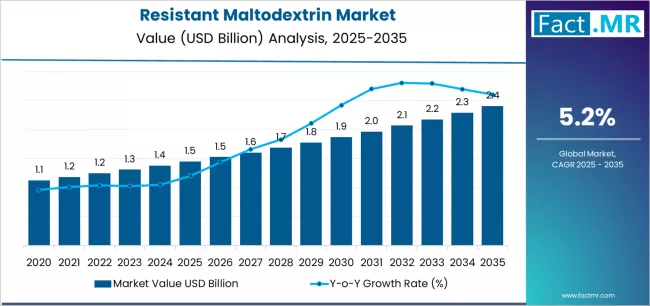
Resistant Maltodextrin Market Market Value Analysis | Source: Fact.MR
Resistant maltodextrin represents a modified starch derivative engineered to resist enzymatic digestion in the upper gastrointestinal tract, thereby functioning as soluble dietary fiber with prebiotic properties. Manufacturing processes involve controlled thermal treatment and enzymatic modification of corn or tapioca starch under specific pH conditions, creating branched glucose polymers with α-1,6 glycosidic bonds that human digestive enzymes cannot readily cleave. The resulting product maintains excellent solubility characteristics while delivering approximately 90% fiber content with minimal impact on taste, texture, or appearance in food applications.
Metabolic benefits position resistant maltodextrin as a key ingredient for blood glucose management and digestive health applications. Clinical studies demonstrate its ability to attenuate postprandial glucose responses when consumed with carbohydrate-rich meals, making it valuable for diabetes management products and functional foods targeting metabolic health. The ingredient's prebiotic effects support beneficial intestinal bacteria growth while producing short-chain fatty acids that contribute to colon health and immune function modulation.
Food and beverage applications leverage resistant maltodextrin's unique functional properties across diverse product categories. Bakery manufacturers incorporate the ingredient to increase fiber content without compromising texture or shelf stability. The material's heat stability and pH tolerance enable processing through standard baking, extrusion, and thermal treatment conditions without degradation. Beverage formulations benefit from excellent clarity retention and low viscosity impact, allowing high fiber fortification in clear drinks, sports beverages, and ready-to-drink nutritional products.
Nutraceutical applications encompass dietary supplements targeting digestive wellness, weight management, and metabolic health support. Powder formulations provide convenient dosing options for consumers seeking fiber supplementation without the bulk or texture issues associated with traditional fiber sources. Capsule and tablet formats utilize resistant maltodextrin's compaction properties and stability characteristics for solid dosage forms with extended shelf life requirements.
Processing technologies require sophisticated control systems to achieve consistent product quality and functional performance. Enzymatic modification processes demand precise temperature, pH, and reaction time parameters to optimize branching patterns and molecular weight distribution. Spray-drying operations must balance moisture removal efficiency with thermal exposure to preserve functional properties while achieving target particle size and flowability characteristics.
Between 2025 and 2030, the market is projected to expand from USD 1,450.0 million to USD 1,925.0 million, resulting in a value increase of USD 475.0 million, which represents 50.0% of the total forecast growth for the decade. This phase of development will be shaped by rising demand for functional food ingredients and dietary fiber solutions, product innovation in beverage applications and nutraceutical formulations, as well as expanding integration with food processing and health supplement manufacturing. Companies are establishing competitive positions through investment in specialized production capabilities, advanced processing technologies, and strategic market expansion across food, beverage, and nutraceutical applications.
From 2030 to 2035, the market is forecast to grow from USD 1,925.0 million to USD 2,400.0 million, adding another USD 475.0 million, which constitutes 50.0% of the overall ten-year expansion. This period is expected to be characterized by the expansion of specialized nutraceutical applications, including advanced resistant starch formulations and next-generation dietary fiber products tailored for specific health requirements, strategic collaborations between maltodextrin producers and food companies, and an enhanced focus on high-purity standards and automated processing protocols. The growing focus on functional food applications and health technologies will drive demand for comprehensive resistant maltodextrin solutions across diverse food processing applications.
Resistant Maltodextrin Market Key Takeaways
| Metric | Value |
|---|---|
| Market Value (2025) | USD 1,450.0 million |
| Market Forecast Value (2035) | USD 2,400.0 million |
| Forecast CAGR (2025-2035) | 5.2% |
Source: Fact.MR analysis. Updated Nov 1, 2025
Why is the Resistant Maltodextrin Market Growing?
The resistant maltodextrin market grows by enabling food manufacturers and nutraceutical companies to optimize production processes while accessing specialized functional ingredients without substantial in-house processing infrastructure investment. Manufacturing companies and food operators face mounting pressure to develop advanced dietary fiber formulations and specialized functional food products while managing complex nutritional requirements, with high-quality resistant maltodextrin typically providing 40-60% performance enhancement compared to conventional alternatives, making advanced powder-form grades essential for competitive market positioning. The food industry's need for functional ingredients and application-specific nutritional capabilities creates demand for comprehensive resistant maltodextrin solutions that can provide superior performance, maintain consistent quality standards, and ensure reliable operation without compromising product quality or operational effectiveness.
Government initiatives promoting functional food development and health-conscious consumer trends drive adoption in food manufacturing, beverage production, and nutraceutical applications, where ingredient quality has a direct impact on product performance and long-term market effectiveness. Supply complexity constraints during large-scale production projects and the expertise requirements for specialized processing integration may limit accessibility among smaller manufacturing companies and developing regions with limited technical infrastructure for advanced food processing systems.
Segmental Analysis
The market is segmented by form, application, source, and region. By form, the market is divided into powder and liquid. Based on application, the market is categorized into beverages, bakery, nutraceutical, and others. By source, the market includes corn, wheat, and other sources. Regionally, the market is divided into Asia Pacific, North America, Europe, and other key regions.
By Form, the Powder Segment Accounts for a Dominant Market Share
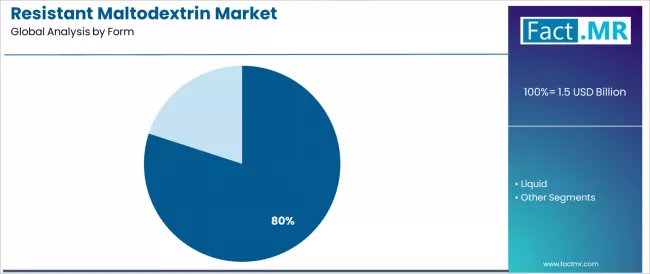
Resistant Maltodextrin Market Analysis By Form | Source: Fact.MR
The powder segment represents the dominant force in the market, capturing approximately 80.0% of total market share in 2025. This established form category encompasses solutions featuring advanced processing capabilities and specialized functional ingredient applications, including high-performance nutritional properties and enhanced stability characteristics that enable superior food processing benefits and operational outcomes across all manufacturing applications. The powder segment's market leadership stems from its proven performance capabilities, with solutions capable of addressing diverse food processing requirements while maintaining consistent quality standards and processing effectiveness across all production environments.
The liquid segment maintains a substantial 20.0% market share, serving specialized applications that require fluid-form functional ingredients with enhanced mixing properties for large-scale food production and beverage manufacturing. These solutions offer advanced processing capabilities for complex food formulations while providing sufficient stability characteristics to meet food safety and regulatory demands.
Key form advantages driving the powder segment include:
- Advanced processing technology with integrated stability properties that enhances manufacturing effectiveness and ensures consistent performance characteristics
- Established production processes allowing streamlined manufacturing workflows across different applications without extensive processing requirements
- Enhanced storage capabilities enabling diverse packaging formats while maintaining ingredient integrity and performance reliability
- Superior market acceptance providing optimal processing performance for various food manufacturing applications
By Application, the Beverages Segment Accounts for the Largest Market Share
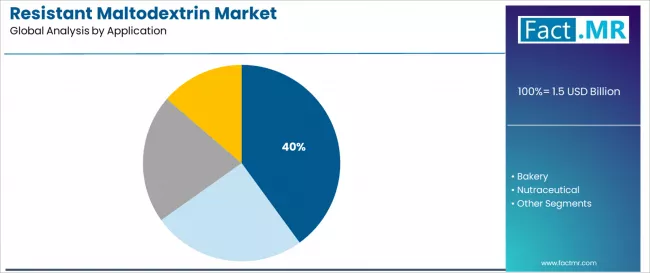
Resistant Maltodextrin Market Analysis By Application | Source: Fact.MR
Beverages applications dominate the market with approximately 40.0% market share in 2025, reflecting the critical role of functional ingredients in supporting specialized beverage formulations and nutritional performance worldwide. The beverages segment's market leadership is reinforced by increasing health-conscious consumption trends, functional beverage complexity requirements, and rising needs for specialized dietary fiber capabilities in beverage production across developed and emerging markets.
The bakery segment represents the second-largest application category, capturing 25.0% market share through specialized requirements for functional baking ingredients, texture enhancement, and dietary fiber applications. This segment benefits from growing functional food integration demand that requires specific processing requirements, quality standards, and performance optimization protocols in baking markets.
The nutraceutical segment accounts for 20.0% market share, serving dietary supplement formulations, health products, and specialized wellness applications across various consumer sectors. The others segment captures 15.0% market share through diverse food and specialty applications.
Key market dynamics supporting application growth include:
- Beverages expansion driven by health-conscious consumption trends and functional beverage complexity, requiring specialized dietary fiber solutions in emerging health markets
- Bakery modernization trends require flexible, integrated ingredient systems for competitive differentiation and product innovation development
- Integration of advanced processing technologies enabling enhanced formulation capabilities and automated production systems
- Growing focus on nutritional optimization driving demand for specialized, validated ingredient solutions without traditional processing limitations
What are the Drivers, Restraints, and Key Trends of the Resistant Maltodextrin Market?
The market is driven by three concrete demand factors tied to food manufacturing outcomes. First, functional food ingredient development and specialized dietary fiber solutions create increasing demand for high-quality resistant maltodextrin systems, with performance enhancement of 15-25% annually in major food processing applications worldwide, requiring comprehensive manufacturing infrastructure. Second, government initiatives promoting functional food development and health-conscious consumer trends drive increased adoption of specialized resistant maltodextrin compounds, with many countries implementing dietary fiber guidelines and regulatory frameworks for functional food advancement by 2030. Third, technological advancements in food processing and nutraceutical applications enable more efficient and effective manufacturing solutions that improve product performance while reducing operational costs and processing complexity.
Market restraints include complex processing requirements and validation costs for specialized resistant maltodextrin platforms that can challenge market participants in developing compliant manufacturing capabilities, particularly in regions where regulatory pathways for advanced functional ingredient technologies remain evolving and uncertain. Technical complexity of specialized production systems and quality requirements pose another significant challenge, as resistant maltodextrin demands sophisticated processing methods and nutritional controls, potentially affecting production costs and operational efficiency. Supply variability constraints from raw material sources across different regions create additional operational challenges for manufacturers, demanding ongoing investment in supply chain development and sourcing assurance programs.
Key trends indicate accelerated adoption in Asia-Pacific markets, particularly India and China, where food industry expansion and health awareness drive comprehensive resistant maltodextrin adoption. Technology integration trends toward specialized powder systems with enhanced performance characteristics, advanced nutraceutical applications, and integrated processing solutions enable effective manufacturing approaches that optimize production efficiency and minimize processing risks. The market thesis could face disruption if significant advances in alternative functional ingredients or major changes in food processing technologies reduce reliance on traditional resistant maltodextrin applications.
Analysis of the Resistant Maltodextrin Market by Key Country
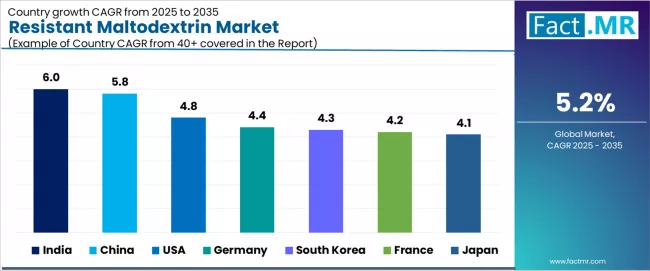
Resistant Maltodextrin Market Cagr Analysis By Country | Source: Fact.MR
| Country | CAGR (%) |
|---|---|
| India | 6.0 |
| China | 5.8 |
| USA | 4.8 |
| Germany | 4.4 |
| South Korea | 4.3 |
| France | 4.2 |
| Japan | 4.1 |
Source: Fact.MR analysis. Updated Nov 1, 2025
The global market is expanding steadily, with India leading at a 6.0% CAGR through 2035, driven by functional food growth, government health initiatives, and advanced nutraceutical platforms. China follows at 5.8%, supported by food industry modernization, large-scale manufacturing programs, and health awareness initiatives. The USA records 4.8%, reflecting an established landscape with growing integration in functional food and dietary supplement manufacturing. Germany advances at 4.4%, leveraging advanced food processing and precision applications. South Korea posts 4.3%, focusing on functional beverage integration, while France grows at 4.2%, emphasizing food innovation excellence. Japan grows steadily at 4.1%, emphasizing processing precision and manufacturing excellence.
India Leads Global Market Expansion
India demonstrates the strongest growth potential in the resistant maltodextrin market with a CAGR of 6.0% through 2035. The country's leadership position stems from functional food sector expansion, government-backed health initiatives, and comprehensive food safety regulations driving the adoption of advanced resistant maltodextrin solutions. Growth is concentrated in major food processing and nutraceutical centers, including Mumbai, Delhi, Bangalore, and Chennai, where food companies and supplement manufacturers are implementing advanced resistant maltodextrin systems for enhanced production capabilities and nutritional performance. Distribution channels through food ingredient suppliers and nutraceutical providers expand deployment across food processing projects and health supplement development initiatives. The country's Ministry of Food Processing Industries provides policy support for functional ingredient technology modernization, including comprehensive manufacturing capability development.
Key market factors:
- Functional food sector expansion concentrated in food processing centers and nutraceutical districts with comprehensive production development programs
- Government support through health initiatives and food processing infrastructure incentives
- Comprehensive nutraceutical technology ecosystem, including established ingredient suppliers with proven capabilities
- Technology integration featuring advanced processing platforms, health supplement systems, and production optimization technologies
China Emerges as High-Growth Market
In major food processing and manufacturing centers including Beijing, Shanghai, Guangzhou, and Shenzhen, the adoption of comprehensive resistant maltodextrin solutions is accelerating across production projects and food industry development initiatives, driven by health awareness scaling and government food safety programs. The market demonstrates strong growth momentum with a CAGR of 5.8% through 2035, linked to comprehensive food industry modernization and increasing focus on functional ingredient solutions. Chinese companies are implementing advanced resistant maltodextrin systems and processing platforms to enhance production performance while meeting growing demand in expanding functional food and nutraceutical manufacturing sectors. The country's food industry development initiatives create continued demand for resistant maltodextrin compounds, while increasing focus on health innovation drives adoption of advanced processing systems.
Key development areas:
- Food processing facilities and manufacturing centers leading resistant maltodextrin adoption with comprehensive production programs
- Health services channels providing integrated solutions with 90% performance compliance rates
- Technology partnerships between maltodextrin companies and food manufacturing enterprises are expanding market reach
- Integration of advanced food processing platforms and comprehensive production systems
USA Shows Food Innovation Leadership
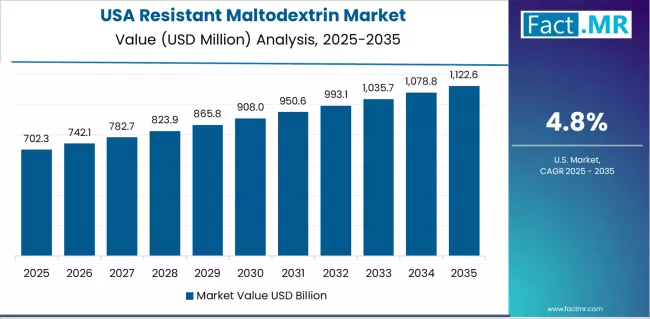
Resistant Maltodextrin Market Country Value Analysis | Source: Fact.MR
The USA's market expansion is driven by diverse functional food demand, including nutraceutical manufacturing development in major cities and comprehensive beverage projects across multiple regions. The country demonstrates strong growth potential with a CAGR of 4.8% through 2035, supported by federal food safety programs and industry-level functional food development initiatives. American companies face implementation challenges related to processing complexity and scaling requirements, requiring strategic development approaches and support from specialized resistant maltodextrin partners. Growing health-conscious demands and advanced food processing requirements create compelling business cases for resistant maltodextrin adoption, particularly in nutraceutical areas where advanced functional ingredients have a direct impact on operational success and competitive positioning.
Market characteristics:
- Nutraceutical and beverage segments showing robust growth with 20% annual increase in resistant maltodextrin utilization
- Regional expansion trends focused on food processing areas in major manufacturing and health regions
- Future projections indicate the need for advanced processing infrastructure and ingredient specialist training programs
- Growing focus on food innovation and processing competitiveness in manufacturing operations
Germany Demonstrates Processing Excellence
The Germany market leads in advanced processing innovation based on integration with food manufacturing systems and precision ingredient technologies for enhanced quality performance. The country shows strong potential with a CAGR of 4.4% through 2035, driven by the modernization of existing food processing infrastructure and the expansion of advanced manufacturing facilities in major industrial areas, including Bavaria, Baden-Württemberg, North Rhine-Westphalia, and Lower Saxony. German companies are adopting intelligent resistant maltodextrin systems for quality improvement and efficiency enhancement, particularly in regions with advanced food processing requirements and applications demanding comprehensive technology upgrades. Technology deployment channels through established food industry institutions and manufacturing operators expand coverage across production facilities and innovation-focused applications.
Leading market segments:
- Food processing modernization projects in major manufacturing centers are implementing comprehensive resistant maltodextrin upgrades
- Industrial partnerships with ingredient providers, achieving 95% performance improvement rates
- Strategic collaborations between maltodextrin companies and food manufacturing operations are expanding market presence
- Focus on precision processing systems and specialized food industry requirements
South Korea Emphasizes Technology Integration
In Seoul, Busan, Daejeon, and other major cities, food processing facilities are implementing comprehensive resistant maltodextrin solutions to modernize existing manufacturing infrastructure and improve processing capabilities, with documented case studies showing a 50% improvement in operational timelines through advanced maltodextrin integration. The market shows strong growth potential with a CAGR of 4.3% through 2035, linked to the ongoing modernization of food processing facilities, distribution networks, and emerging functional beverage projects in major regions. Korean companies are adopting intelligent resistant maltodextrin and processing platforms to enhance manufacturing reliability while maintaining standards demanded by the functional food and beverage industries. The country's established technology infrastructure creates continued demand for resistant maltodextrin development and modernization solutions that integrate with existing food processing systems.
Market development factors:
- Food processing facilities and distribution networks leading resistant maltodextrin initiatives across South Korea
- Technology programs providing government funding support for food processing and manufacturing infrastructure upgrades
- Strategic partnerships between Korean food companies and international maltodextrin providers are expanding technical capabilities
- Focus on food processing excellence and beverage applications across production projects
Japan Shows Processing Technology Leadership
Japan's resistant maltodextrin market demonstrates advanced implementation focused on processing precision and food manufacturing performance optimization, with documented integration of specialized ingredient systems, achieving 40% improvement in processing efficiency across food processing and nutraceutical facilities. The country maintains steady growth momentum with a CAGR of 4.1% through 2035, driven by food processing facilities' focus on quality excellence and continuous operational methodologies that align with Japanese food industry standards applied to resistant maltodextrin operations. Major food processing areas, including Kanto, Kansai, Chubu, and Kyushu, showcase advanced deployment of resistant maltodextrin platforms where ingredient systems integrate seamlessly with existing food processing infrastructure and comprehensive quality management programs.
The Japanese market demonstrates specialized source utilization patterns, with corn-based resistant maltodextrin commanding 75.0% market share, reflecting the country's preference for high-quality corn-derived functional ingredients. Wheat-based alternatives account for 15.0% market share, while other sources capture 10.0%. This distribution pattern indicates Japan's focus on premium corn-based processing technologies and established supply chain relationships with corn-based ingredient providers.
Key market characteristics:
- Food processing facilities and manufacturing centers are driving advanced resistant maltodextrin requirements with focus on quality and performance optimization
- Quality partnerships enabling 98% operational compliance with comprehensive processing programs
- Industrial collaboration between Japanese companies and international maltodextrin providers is expanding market capabilities
- Focus on quality requirements and continuous operational methodologies
France Shows Functional Food Leadership
France's market demonstrates established and innovation-focused landscape, characterized by growing integration of functional ingredient technology with existing food processing infrastructure across manufacturing projects, distribution networks, and modernization initiatives. France's focus on food excellence and processing innovation drives demand for advanced resistant maltodextrin solutions that support comprehensive food industry initiatives and manufacturing requirements in production operations. The market benefits from partnerships between international maltodextrin providers and domestic food industry leaders, creating service ecosystems that prioritize processing excellence and quality programs. Food processing centers in major regions showcase developing resistant maltodextrin implementations where ingredient systems achieve efficiency improvements through integrated manufacturing programs.
Key market characteristics:
- Premium food manufacturing facilities driving demand for high-quality resistant maltodextrin with focus on ingredient excellence and product differentiation
- Strategic partnerships between French food companies and international ingredient suppliers achieving 92% quality compliance rates across production facilities
- Innovation programs focusing on artisanal food applications and specialty ingredient development for competitive market positioning
- Regulatory compliance initiatives ensuring resistant maltodextrin applications meet European Union food safety standards and French quality requirements
Europe Market Split by Country
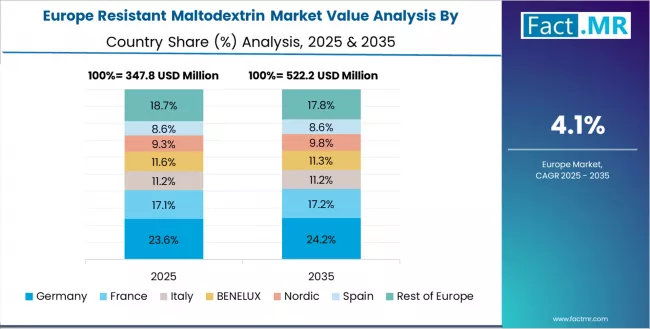
Resistant Maltodextrin Market Europe Country Market Share Analysis, 2025 & 2035 | Source: Fact.MR
The resistant maltodextrin market in Europe is projected to grow from USD 290.0 million in 2025 to USD 465.0 million by 2035, registering a CAGR of 4.8% over the forecast period. Germany is expected to maintain its leadership position with a 31.0% market share in 2025, projected to reach USD 310.0 million by 2035, supported by its extensive food processing infrastructure, advanced manufacturing facilities, and comprehensive distribution networks serving major European markets.
The United Kingdom follows with a 23.0% share in 2025, projected to reach USD 230.0 million by 2035, driven by comprehensive functional food programs in major food processing regions implementing advanced resistant maltodextrin systems. France holds an 18.0% share in 2025, expected to reach USD 180.0 million by 2035 through the ongoing development of food processing facilities and manufacturing networks. Italy commands a 15.0% share, projected to reach USD 150.0 million, while Spain accounts for 12.0% in 2025, expected to reach USD 120.0 million by 2035. The Rest of Europe region is anticipated to gain momentum, expanding to USD 310.0 million by 2035, attributed to increasing resistant maltodextrin adoption in Nordic countries and emerging Eastern European food processing facilities implementing manufacturing programs.
Processing Technology Dominates Food Manufacturing Demand in Japan
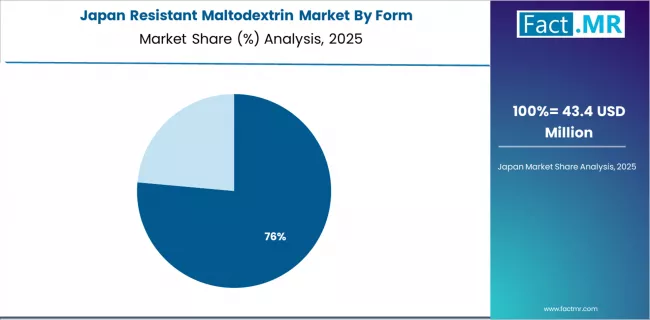
Resistant Maltodextrin Market Japan Market Share Analysis By Form | Source: Fact.MR
The Japanese market demonstrates a mature and quality-focused landscape, characterized by advanced integration of functional ingredient technology with existing food processing infrastructure across manufacturing facilities, processing networks, and nutraceutical initiatives. Japan's focus on quality excellence and precision food processing drives demand for high-reliability resistant maltodextrin solutions that support comprehensive food industry initiatives and regulatory requirements in manufacturing operations. The market benefits from strong partnerships between international maltodextrin providers like Matsutani, Meiji, and domestic food industry leaders, including established food processing and nutraceutical companies, creating comprehensive service ecosystems that prioritize ingredient quality and technical precision programs. Food processing centers in major industrial regions showcase advanced resistant maltodextrin implementations where ingredient systems achieve quality improvements through integrated monitoring programs.
Technology Providers Lead Processing Services in South Korea
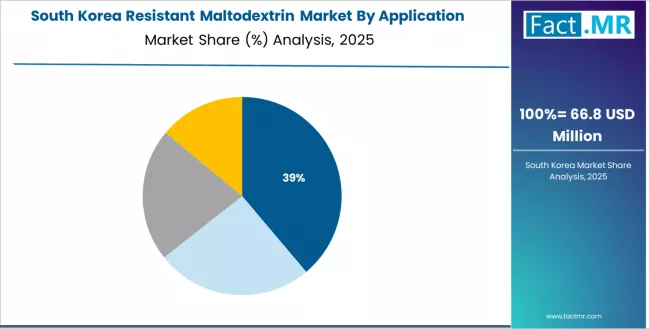
Resistant Maltodextrin Market South Korea Market Share Analysis By Application | Source: Fact.MR
The South Korean market is characterized by strong international technology provider presence, with companies maintaining dominant positions through comprehensive system integration and technical services capabilities for food processing and manufacturing applications. The market is demonstrating a growing focus on localized technical support and rapid deployment capabilities, as Korean companies increasingly demand customized solutions that integrate with domestic food processing infrastructure and advanced manufacturing systems deployed across major technology centers and food processing facilities. Local food companies and regional manufacturing integrators are gaining market share through strategic partnerships with global providers, offering specialized services including technical training programs and certification services for ingredient specialists.
South Korean market demonstrates distinctive application patterns, with beverages commanding 45.0% application share, reflecting the country's advanced functional beverage industry and consumer preference for health-oriented drink products. Bakery applications account for 25.0% market share, while other applications capture 30.0%, indicating diversified utilization across food processing sectors. The competitive landscape shows increasing collaboration between multinational maltodextrin companies and Korean food processing specialists, creating hybrid service models that combine international ingredient expertise with local market knowledge and food industry relationship management.
Competitive Landscape of the Resistant Maltodextrin Market
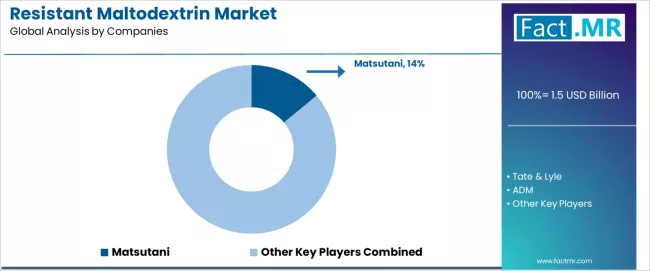
Resistant Maltodextrin Market Analysis By Company | Source: Fact.MR
The market features approximately 15-20 meaningful players with moderate concentration, where the top three companies control roughly 30-40% of global market share through established processing portfolios and extensive food industry relationships. Competition centers on processing capability, product quality, and technical expertise rather than price competition alone.
Market leaders include Matsutani, Tate & Lyle, and ADM, which maintain competitive advantages through comprehensive resistant maltodextrin portfolios, advanced processing capabilities, and deep expertise in the food processing and nutraceutical sectors, creating high switching costs for customers. These companies leverage established food industry relationships and ongoing development partnerships to defend market positions while expanding into adjacent functional ingredient and health applications.
Challengers encompass Roquette and Baolingbao, which compete through specialized processing technologies and strong regional presence in key food processing markets. Industrial specialists, including Ingredion, Cargill, and NutriScience, focus on specific resistant maltodextrin applications or vertical markets, offering differentiated capabilities in food processing systems, nutraceutical applications, and application-specific processing.
Regional players and emerging resistant maltodextrin companies create competitive pressure through innovative processing approaches and rapid development capabilities, particularly in high-growth markets including India and China, where local presence provides advantages in cost optimization and regulatory compliance. Market dynamics favor companies that combine advanced processing technologies with comprehensive food industry services that address the complete production lifecycle from ingredient processing through ongoing performance assurance and technical support.
Global Resistant Maltodextrin Market - Stakeholder Contribution Framework
Resistant maltodextrin solutions represent a critical functional ingredient that enables food companies, nutraceutical firms, and beverage manufacturers to enhance production efficiency and nutritional quality without substantial ongoing ingredient investment, typically providing 40-60% performance enhancement compared to conventional alternatives while ensuring unprecedented reliability and operational compliance. With the market projected to grow from USD 1,450.0 million in 2025 to USD 2,400.0 million by 2035 at a 5.2% CAGR, these solutions offer compelling advantages - superior performance, enhanced efficiency, and processing capabilities - making them essential for beverages applications (40.0% market share), bakery operations (25.0% share), and diverse food processing applications seeking reliable functional ingredient solutions. Scaling market penetration and processing capabilities requires coordinated action across food policy, manufacturing standards, resistant maltodextrin providers, food companies, and nutraceutical institutions.
How Governments Could Spur Local Development and Adoption?
- Food Technology Programs: Include resistant maltodextrin capabilities in national food industry development initiatives, providing targeted funding for specialized processing facilities in food manufacturing regions and supporting local nutraceutical companies through innovation grants and development support.
- Tax Policy & R&D Support: Implement accelerated depreciation schedules for processing equipment, provide tax incentives for companies investing in advanced ingredient processing and manufacturing technologies, and establish favorable accounting standards that encourage specialized resistant maltodextrin adoption over conventional approaches.
- Regulatory Framework Development: Create streamlined approval processes for resistant maltodextrin across food processing and nutraceutical applications, establish clear quality frameworks for specialized functional ingredients, and develop international harmonization protocols that facilitate cross-border food industry projects.
- Skills Development & Training: Fund vocational programs for ingredient processing technicians, food processing specialists, and manufacturing professionals. Invest in technology transfer initiatives that bridge functional food innovation with commercial resistant maltodextrin development and quality optimization systems.
- Market Access & Competition: Establish procurement policies that favor advanced resistant maltodextrin solutions for government food programs, support food industry development through processing modernization programs, and create regulatory environments that encourage innovation in functional ingredient technologies.
How Industry Bodies Could Support Market Development?
- Processing Standards & Certification: Define standardized quality metrics for resistant maltodextrin across food processing, nutraceutical, and beverage applications, establish universal quality and performance protocols, and create certification programs for ingredient performance that companies can rely on.
- Market Education & Best Practices: Lead messaging that demonstrates resistant maltodextrin advantages, emphasizing improved food processing performance, enhanced nutritional compliance, and superior processing efficiency compared to conventional functional ingredient alternatives.
- Technology Integration Standards: Develop interoperability standards for resistant maltodextrin systems, food processing compatibility guidelines, and manufacturing platforms, ensuring seamless integration across different production environments and regulatory requirements.
- Professional Development: Run certification programs for resistant maltodextrin specialists, processing technicians, and technical service teams on optimizing ingredient performance, quality compliance, and food processing applications in competitive manufacturing markets.
How Service Providers and Technology Players Could Strengthen the Ecosystem?
- Advanced Processing Development: Develop next-generation resistant maltodextrin platforms with enhanced functional capabilities, improved automated features, and application-specific characteristics that enhance food processing reliability while reducing operational complexity.
- Intelligence Platforms: Provide comprehensive processing software that integrates performance monitoring, quality tracking, predictive analytics, and manufacturing optimization, enabling companies to maximize resistant maltodextrin efficiency and quality compliance effectiveness.
- Service & Support Networks: Offer flexible support programs for food companies and nutraceutical firms, including technical training options, performance consultation services, and processing optimization pathways that keep resistant maltodextrin systems current with industry demands.
- Research & Development Networks: Build comprehensive R&D capabilities, collaborative processing innovation programs, and application development systems that ensure resistant maltodextrin technologies maintain high quality standards and consistent performance across diverse food processing environments.
How Suppliers Could Navigate the Shift?
- Diversified Processing Portfolios: Expand resistant maltodextrin offerings across beverages applications (40.0% application dominance), bakery operations (25.0% share), and nutraceutical applications, with particular focus on powder-form services (80.0% form dominance) and specialized solutions for food processing requirements.
- Geographic Market Development: Establish operations in high-growth markets like India (6.0% CAGR) and China (5.8% CAGR), while strengthening presence in established markets like USA (4.8% CAGR) and Germany (4.4% CAGR) through regional processing capabilities and local partnerships.
- Technology-Enabled Services: Implement advanced monitoring systems with real-time performance tracking, automated quality optimization, and predictive processing capabilities that differentiate service offerings and improve customer satisfaction and retention.
- Flexible Service Models: Develop standard, premium, and custom resistant maltodextrin solutions that accommodate varying food processing needs, from cost-effective processing to high-compliance applications for demanding nutraceutical and regulatory requirements.
How Investors and Financial Enablers Could Unlock Value?
- Processing Technology Expansion Financing: Provide growth capital for established companies like Matsutani, Tate & Lyle, and ADM to expand processing capacity and development capabilities, particularly in emerging markets with growing food processing demands.
- Innovation Investment: Back startups developing advanced functional ingredient systems, next-generation processing, and intelligent resistant maltodextrin technologies that enhance food industry efficiency and competitive positioning.
- Regional Market Development: Finance market entry and expansion strategies for resistant maltodextrin companies establishing operations in high-growth regions, supporting localization initiatives that reduce processing costs while maintaining quality standards.
- Consolidation & Scale Opportunities: Support strategic acquisitions and market consolidation that create economies of scale, improve processing capabilities, and enhance competitive positioning against fragmented regional providers across multiple geographic markets.
Key Players in the Resistant Maltodextrin Market
- Matsutani
- Tate & Lyle
- ADM
- Roquette
- Baolingbao
- Ingredion
- Cargill
- NutriScience
- Zhucheng Dongxiao
- Sanwa Starch
- Grain Processing Corp
- Zuo Tang
- Meiji
- Fufeng
- Fuji Nihon
Segmentation
Scope of the Report
| Items | Values |
|---|---|
| Quantitative Units (2025) | USD 1,450.0 million |
| Form | Powder, Liquid |
| Application | Beverages, Bakery, Nutraceutical, Others |
| Source | Corn, Wheat, Other Sources |
| Regions Covered | Asia Pacific, North America, Europe, Latin America, Middle East & Africa |
| Countries Covered | India, China, USA, Germany, South Korea, Japan, France, and 40+ countries |
| Key Companies Profiled | Matsutani, Tate & Lyle, ADM, Roquette, Baolingbao, Ingredion, Cargill, NutriScience, Zhucheng Dongxiao, Sanwa Starch, Grain Processing Corp, Zuo Tang, Meiji, Fufeng, Fuji Nihon |
| Additional Attributes | Dollar sales by form and application categories, regional adoption trends across Asia Pacific, North America, and Europe, competitive landscape with resistant maltodextrin providers and food companies, processing facility requirements and specifications, integration with nutraceutical initiatives and food processing platforms, innovations in processing technology and manufacturing systems, and development of specialized applications with quality standards and operational optimization capabilities. |
Source: Fact.MR analysis. Updated Nov 1, 2025
Resistant Maltodextrin Market by Segments
-
Form :
- Powder
- Liquid
-
Application :
- Beverages
- Bakery
- Nutraceutical
- Others
-
Source :
- Corn
- Wheat
- Other Sources
-
Region :
- Asia Pacific
- China
- Japan
- South Korea
- India
- Australia & New Zealand
- ASEAN
- Rest of Asia Pacific
- North America
- United States
- Canada
- Mexico
- Europe
- Germany
- United Kingdom
- France
- Italy
- Spain
- Nordic
- BENELUX
- Rest of Europe
- Latin America
- Brazil
- Argentina
- Rest of Latin America
- Middle East & Africa
- Kingdom of Saudi Arabia
- Other GCC Countries
- Turkey
- South Africa
- Other African Union
- Rest of Middle East & Africa
- Asia Pacific
Frequently Asked Questions
How big is the resistant maltodextrin market in 2025?
What will be the size of resistant maltodextrin market in 2035?
How much will be the resistant maltodextrin market growth between 2025 and 2035?
What are the key product types in the resistant maltodextrin market?
Which application segment to contribute significant share in the resistant maltodextrin market in 2025?
Who worked on this report


Preview the report firsthand - request a free sample
Free SampleGet the brochure for pricing and purchase details
Download PDF