- Market Value (2025): USD 5520.5 Mn
- Estimated Value (2026): USD 6602.5 Mn
- Forecast Value (2036): USD 39538.5 Mn
- CAGR (2026-2036): 19.6%
What is the Retail Audience Measurement Solutions Market forecast to be worth by 2036?
USD 6,602.5 million in 2026 to USD 39,538.5 million by 2036, at 19.6% CAGR.
- The Retail Audience Measurement Solutions Market crossed a valuation of USD 5,520.5 million in 2025 as audience data entered wider planning and attribution workflows.
- Demand is projected to increase from USD 6,602.5 million in 2026 to USD 39,538.5 million by 2036 as measurement expands across channels.
- The market is forecast to record a 19.6% CAGR from 2026 to 2036 as retailers and financial institutions connect audience signals with commercial outcomes.
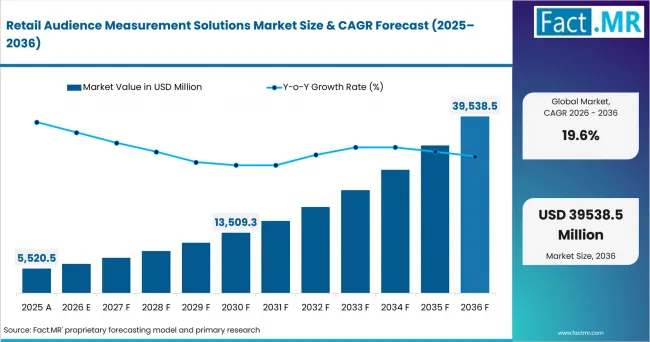
Retail Audience Measurement Solutions Market Market Value Analysis | Source: Fact.MR
What are the defining numbers behind Retail Audience Measurement Solutions Market growth?
USD 32,936.0 million absolute opportunity by 2036 led by Software and Cloud alongside SME accounts.
- Demand Drivers in the Market
- Retail insight teams need consistent audience definitions because transaction panels and media records lose value when identifiers differ across channels and providers.
- Bank marketing teams need privacy-safe audience segmentation supported by clear governance so campaign analysis remains usable across regulated customer acquisition workflows.
- Retail media planners need purchase-linked attribution driven by pressure to compare campaign reach and sales outcomes across networks using consistent measurement logic.
- Data integration teams need stable APIs owing to the requirement for audience signals from panels and transactions to enter existing planning systems.
- Key Segments Analyzed
- By Component: Software is expected to account for 43.0% share in 2026, driven by recurring demand for audience dashboards and attribution workflows.
- By Deployment: Cloud is projected to garner 44.7% share in 2026, supported by centralized access to distributed audience and transaction datasets.
- By Organization Size: SME is anticipated to record 50.5% share in 2026, attributable to packaged subscriptions and simpler remote administration.
- By Application: Workflow Automation is estimated to hold 41.0% share in 2026, owing to repeatable audience planning and reporting tasks.
- By End Use: BFSI is forecast to capture 36.3% share in 2026, shaped by regulated customer acquisition and campaign accountability needs.
- Analyst Opinion at Fact.MR
- Shambhu Nath Jha, Senior Analyst at Fact.MR states: "The commercial test is whether audience records remain comparable across panels and platforms. Adoption is expected to favor providers that combine identity discipline with transparent methodology and clean integration. Stronger suppliers should join purchase evidence with media exposure and location context so commercial teams can act on one consistent audience view."
- Strategic Implications
- Retail insight teams should define audience and outcome metrics before vendor trials so results remain comparable across channels and business units.
- BFSI marketing teams should test consent logic and identity matching before linking campaign exposure with acquisition or branch-service outcomes.
- Brand media teams should align audience definitions with campaign objectives before comparing retail media performance across networks and measurement providers.
- Data integration teams should verify API schemas and identifier logic before connecting panel data with transactions and campaign reporting platforms.
NIQ and Unlimitail announced a collaboration in June 2026 to deliver omnichannel retail media insights and measurement across retailers and countries. The work connects audience planning with campaign measurement where inconsistent network definitions limit reliable comparison across markets. The development reflects demand for interoperable measurement that links retail audiences with sales outcomes under a consistent commercial framework.
India is projected to record 21.4% CAGR during the forecast period, driven by digital commerce expansion and measurable customer acquisition workflows. China is estimated to post 20.7% CAGR between 2026 and 2036, supported by hybrid retail behavior and expanding cross-channel audience datasets. Australia is anticipated to advance at 19.4% CAGR by 2036, attributable to retailers comparing physical visits with digital shopping behavior. The United Kingdom is forecast to register 19.1% CAGR across the forecast horizon, shaped by retail media accountability and changing store traffic patterns. The United States is expected to expand at 18.9% CAGR over the assessment period, reinforced by purchase-linked media measurement and location intelligence adoption.
How does the Retail Audience Measurement Solutions Market break down by segment?
Software is projected to account for 43.0% share; Cloud is estimated to garner 44.7% share.
Which Component dominates?
Software is anticipated to hold 43.0% share in 2026
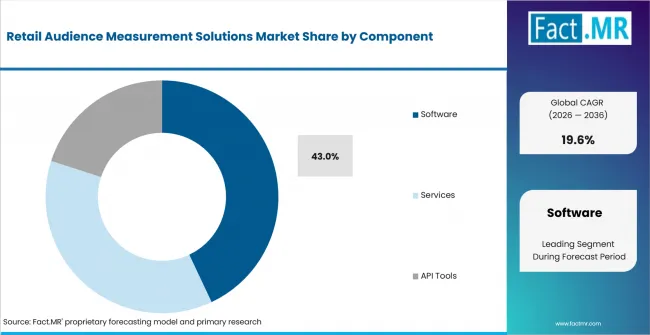
Retail Audience Measurement Solutions Market Analysis By Component | Source: Fact.MR
Software is expected to represent 43.0% share in 2026 as enterprises need reporting layers that combine audience reach with transaction and media signals. Services remain relevant for panel design and methodology review across markets that use different data sources. API Tools support exchange where enterprises need audience feeds inside existing retail analytics platforms and campaign workflows. In December 2025 Eurostat reported that 19.95% of EU enterprises used artificial intelligence technologies during 2025. The wider enterprise software base supports more capable audience analytics inside retail planning and measurement programs.
What leads the Deployment segment?
Cloud is estimated to garner 44.7% share in 2026
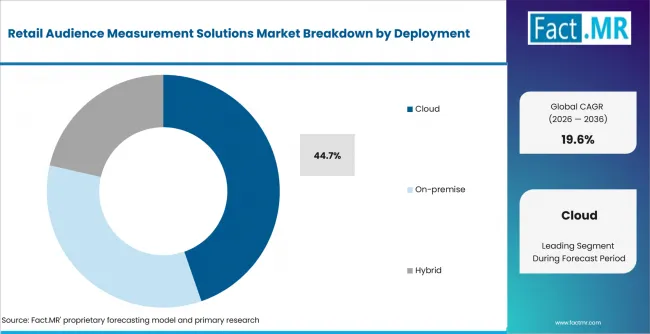
Retail Audience Measurement Solutions Market Analysis By Deployment | Source: Fact.MR
Cloud is anticipated to capture 44.7% share in 2026 because multi-market teams need one reporting environment across distributed datasets. On-premise deployments remain relevant where control requirements shape architecture decisions across regulated enterprise accounts and sensitive datasets. Hybrid systems support local data handling while central platforms manage audience comparison and campaign reporting. Related cloud analytics platforms help teams coordinate measurement without rebuilding local reporting stacks for every market. In January 2026 Eurostat reported that 52.74% of EU enterprises used paid cloud services during 2025. That installed base reduces deployment friction for centralized audience reporting across organizations already using hosted business software.
How does Organization Size shape demand?
SME is forecast to capture 50.5% share in 2026
SME accounts are projected to record 50.5% share in 2026 as packaged subscriptions reduce the need for dedicated research infrastructure. Large enterprises continue to demand wider data coverage and deeper integration across complex planning systems. Public Sector Buyers use audience measurement where service communication and visitor outreach require structured evidence. In January 2026 Eurostat reported that 49.3% of small EU enterprises used paid cloud services during 2025. That base supports hosted administration for smaller organizations that lack dedicated infrastructure teams and internal data engineering resources.
What supports Workflow Automation within Application?
Workflow Automation is anticipated to record 41.0% share in 2026
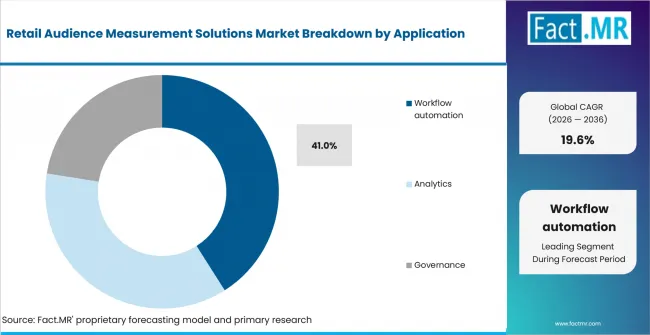
Retail Audience Measurement Solutions Market Analysis By Application | Source: Fact.MR
Workflow Automation is estimated to hold 41.0% share in 2026 as audience data becomes more useful when routine reporting and targeting tasks are standardized. Analytics supports audience comparison while Governance tools define metric rules and control access across teams. Wider use of customer data platforms is expected to deepen automated audience preparation across retail and media workflows. In June 2026 Eurostat reported that 16.28% of EU enterprises used business intelligence software during 2025. That software base gives commercial teams a clearer route from audience evidence to repeatable planning actions.
Which End Use category has the primary share?
BFSI is expected to represent 36.3% share in 2026
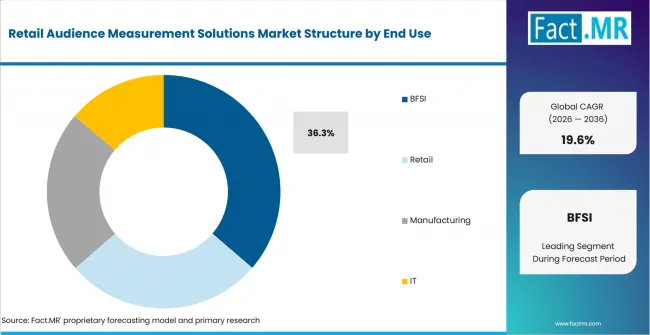
Retail Audience Measurement Solutions Market Analysis By End Use | Source: Fact.MR
BFSI is forecast to capture 36.3% share in 2026 as financial institutions compare campaign reach with acquisition and service outcomes. Retail follows where operators combine shopper behavior with media and transaction evidence across digital and physical commerce channels. Manufacturing uses audience intelligence for brand planning while IT providers support measurement infrastructure and integration. In March 2026 the Press Information Bureau reported that UPI accounted for 81% of retail digital payment transactions in FY2024-25. The payment shift increases the need to understand audiences across digital acquisition and physical advisory journeys.
What is accelerating Retail Audience Measurement Solutions Market adoption, and what is holding it back?
Omnichannel audience and outcome measurement drives adoption while privacy controls and data integration burdens restrain wider deployment across complex organizations.
Drivers Impact Analysis
| Driver | (~) % Impact on CAGR | Geographic Relevance | Impact Timeline |
|---|---|---|---|
| Omnichannel audience and outcome measurement | +1.3% | North America and Europe | Medium term (2-4 years) |
| Retail media measurement and attribution | +1.0% | North America and United Kingdom | Medium term (2-4 years) |
| Cloud integration across audience datasets | +0.8% | Global enterprise accounts | Medium term (2-4 years) |
| Automated audience planning and reporting | +0.7% | Europe and Asia Pacific | Medium term (2-4 years) |
| BFSI acquisition and campaign accountability | +0.5% | India and China alongside United States | Long term (>= 4 years) |
Source: Fact.MR analysis. Updated Jul 10, 2026
- Omnichannel audience measurement: Commercial teams increasingly compare purchase behavior with media exposure and digital activity across the same planning cycle. Joined measurement reduces disputes between channel teams that otherwise use separate reach and outcome definitions. Providers gain commercial value when identity logic and methodology remain transparent across every contributing audience dataset. Adoption is expected to deepen where audience evidence enters routine budget reviews and recurring campaign performance decisions.
- Retail media measurement: Retail media investment creates demand for clearer proof that campaigns reach intended shoppers and change purchase outcomes. In January 2025 the Interactive Advertising Bureau projected retail media ad spending to rise 15.6% during 2025. Brand teams therefore need comparable definitions before combining network reports with wider campaign measurement and attribution frameworks. Demand is projected to expand where retailers standardize audience and attribution logic across networks at meaningful operating scale.
- Cloud-based data integration: Distributed commercial teams need a common reporting layer because local extracts create inconsistent audience definitions and slow comparison. Central platforms let panel and transaction signals be reviewed without rebuilding analysis for every market. Hosted administration also reduces the burden of updating reporting logic across many business units and regional teams. Cloud adoption is anticipated to support faster deployment where organizations already manage business analytics centrally.
- Automated audience workflows: Manual audience preparation slows campaign planning when analysts must repeatedly clean identifiers and rebuild segment logic. Workflow tools reduce repeated handling by applying approved definitions across recurring planning and reporting cycles. Automation is estimated to gain more relevance where teams connect audience selection with campaign measurement under common governance. Clear review controls remain central because commercial decisions still depend on traceable data lineage and documented methodology.
- BFSI campaign accountability: Financial institutions need evidence that customer acquisition spending reaches suitable audiences across regulated channels. Digital applications and branch advisory journeys create different signals that must be compared under consistent privacy rules. Audience measurement helps marketers separate reach problems from conversion problems across campaigns with different service objectives. Demand is forecast to broaden where financial institutions connect media exposure with acquisition and service outcomes.
Opportunity Impact Analysis
| Opportunity | (~) % Impact on CAGR | Geographic Relevance | Impact Timeline |
|---|---|---|---|
| Cross-retailer audience and outcome measurement | +0.9% | North America and Europe | Medium term (2-4 years) |
| Privacy-safe audience matching | +0.7% | Europe and United States | Short term (<= 2 years) |
| Packaged measurement tools for smaller organizations | +0.6% | India and Australia | Medium term (2-4 years) |
| API integration across panel and transaction data | +0.5% | Global enterprise accounts | Long term (>= 4 years) |
Source: Fact.MR analysis. Updated Jul 10, 2026
- Cross-retailer measurement: Commerce media teams need common audience and outcome measures that can be compared across different retail networks. The Interactive Advertising Bureau published in-store retail media definitions and measurement standards in December 2024. Shared measurement logic reduces disagreement between brands and networks about what counts as exposure or conversion. Opportunity is expected to widen where reporting connects campaign reach with purchase outcomes under comparable rules.
- Privacy-safe audience matching: Providers have room to improve identity resolution while limiting unnecessary use of personal data. The Federal Trade Commission began a surveillance pricing inquiry in July 2024 covering detailed consumer data used online and in person. Providers are projected to gain credibility where they explain data use and retention in clear operational terms. Transparent architecture is expected to become part of enterprise qualification before wider audience matching deployments.
- Packaged deployments for smaller organizations: Smaller brands and agencies need audience evidence but often lack dedicated research and data engineering teams. Bundled software and standardized datasets reduce project coordination demands when definitions remain clear across reports. Subscription access also gives teams a route to begin with planning and campaign measurement before adding deeper attribution. Demand is anticipated to expand where providers simplify onboarding without weakening methodology transparency or measurement consistency.
- Operational API integration: Audience data becomes more valuable when identifiers and timestamps align with campaign and transaction systems. Open interfaces allow panel and media signals to enter existing dashboards without creating another isolated reporting destination. Integration work also exposes mismatched master data that must be corrected before automation becomes dependable. Opportunity is estimated to concentrate among providers that document schemas and maintain stable integration behavior across releases.
Restraints Impact Analysis
| Restraint | (~) % Impact on CAGR | Geographic Relevance | Impact Timeline |
|---|---|---|---|
| Privacy and data-use compliance burden | -0.8% | Europe and North America | Short term (<= 2 years) |
| Panel representativeness and data calibration | -0.6% | Global measurement programs | Medium term (2-4 years) |
| Disconnected identifiers and system integration | -0.5% | Global enterprise accounts | Medium term (2-4 years) |
| Inconsistent cross-network measurement standards | -0.4% | Retail media markets | Long term (>= 4 years) |
Source: Fact.MR analysis. Updated Jul 10, 2026
- Privacy compliance burden: Audience measurement faces scrutiny when identity and location signals are combined across channels. The European Union AI Act entered into force in August 2024 and added obligations around specified artificial intelligence uses. Enterprise reviews therefore examine consent logic and data retention before approving richer profiling workflows across customer and campaign datasets. Adoption is expected to slow where providers cannot describe data flows in plain operational terms.
- Panel representativeness and calibration: Audience estimates weaken when panels and observed datasets underrepresent important shopper groups or changing channel behavior. Providers must combine observed signals with careful weighting and transparent methodology across every published audience estimate. Rollouts are projected to move more slowly when users cannot reconcile differences between panel evidence and transactional data.
- Identifier and system integration: Audience datasets often use household and device identifiers that do not align with transaction or campaign systems. Integration teams then spend time resolving identity rules before commercial users trust attribution results and audience comparisons. Legacy middleware also raises maintenance work when APIs change or ownership shifts between departments during platform upgrades. Demand is anticipated to remain selective where the business case depends on several difficult data connections.
- Inconsistent cross-network standards: Retail media networks often report reach and conversion under different definitions that limit direct comparison. Commercial teams then spend time normalizing reports before allocating budgets across campaigns and competing retail networks. Providers need clearer methodology notes that explain attribution windows and audience construction across every measurement product. Adoption is forecast to favor solutions that reduce comparison work without hiding methodological differences between networks.
Which countries are scaling Retail Audience Measurement Solutions Market fastest?
India 21.4%; China 20.7%; Australia 19.4%; United Kingdom 19.1%; United States 18.9%.
.webp "Top Country Growth Comparison Retail Audience Measurement Solutions Market Cagr (2026 2036)")
Top Country Growth Comparison Retail Audience Measurement Solutions Market Cagr (2026 2036) | Source: Fact.MR
Retail Audience Measurement Solutions Market is segmented into North America; Europe; Asia Pacific; Latin America; and the Middle East & Africa.
| Country | CAGR |
|---|---|
| India | 21.4% |
| China | 20.7% |
| Australia | 19.4% |
| United Kingdom | 19.1% |
| United States | 18.9% |
Source: Fact.MR analysis. Updated Jul 10, 2026
What is powering India's lead?
21.4% CAGR, driven by digital commerce expansion and measurable customer acquisition workflows.
India combines high-frequency digital payments with expanding commerce channels that create more customer signals for audience analysis. The market is projected to record a 21.4% CAGR during the forecast period as financial institutions and retailers compare acquisition performance across channels. In April 2026 the Press Information Bureau reported 703 banks live on UPI by FY2025-26 while audience measurement needs widened across digital customer journeys.
How is China scaling audience measurement demand?
20.7% CAGR, supported by hybrid retail behavior and expanding cross-channel audience datasets.
China offers large retail ecosystems where commercial teams increasingly compare digital behavior with store and marketplace performance. In February 2026 the National Bureau of Statistics reported that online sales of physical goods represented 26.1% of total retail sales during 2025. Demand is estimated to post a 20.7% CAGR between 2026 and 2036 as organizations seek consistent audience views across channels.
What supports the Australia outlook?
19.4% CAGR, attributable to omnichannel comparison needs across widely distributed retail markets.
Australian retailers operate across dispersed markets where centralized audience reporting reduces repeated local analysis and manual market comparison. The market is anticipated to advance at a 19.4% CAGR by 2036 as brands compare digital shopping behavior with physical retail outcomes. In May 2025 the Australian Bureau of Statistics reported online sales at 11.6% of total retailing for March 2025. That channel mix supports broader demand for joined audience measurement across digital and physical retail environments.
What underpins United Kingdom growth?
19.1% CAGR, shaped by retail media accountability and changing store traffic patterns.
United Kingdom brands need clearer audience evidence as commerce media expands while physical retail traffic remains uneven. The British Retail Consortium reported in January 2026 that total UK footfall declined 0.8% during 2025. The market is forecast to register a 19.1% CAGR across the forecast horizon as teams compare audience reach with commercial outcomes across channels.
How is the United States market developing?
18.9% CAGR, reinforced by purchase-linked media measurement and location intelligence adoption.
United States organizations increasingly need one view of how digital commerce and physical visits shape audience behavior. The market is expected to expand at an 18.9% CAGR over the assessment period as purchase-linked measurement supports media planning and attribution. In May 2026 the U.S. Census Bureau reported that e-commerce represented 16.9% of first-quarter retail sales. That channel balance supports joined measurement across digital commerce and physical retail activity in major consumer markets.
Who leads the Retail Audience Measurement Solutions Market?
Numerator and Comscore are some key players focusing on strengthening retail and consumer measurement coverage.
Companies such as Comscore are competition with broad audience measurement and media intelligence coverage. Nielsen introduced Predictive Sales Lift in April 2026 to estimate campaign sales outcomes inside Nielsen ONE Ads. NielsenIQ competes through retail and consumer measurement while Numerator adds purchase behavior and shopper panel evidence. In January 2025 Numerator announced its combination with Worldpanel to create a broader global consumer data company under the Numerator name.
Circana competes through purchase-linked audience and retail media measurement while Comscore adds digital and cross-platform audience coverage. Circana expanded Liquid Testing in June 2026 with new media measurement and campaign experimentation capabilities for commercial users. Comscore announced Unified Content Measurement in January 2025 to provide deduplicated audience reach across major screens and platforms. Competition is expected to favor providers that combine transparent methodology with interoperable data and privacy controls.
Which companies are the key providers?
Some of the key players profiled include Comscore, NielsenIQ, Numerator, Circana (IRI + NPD), and Placer.ai.
- NielsenIQ
- Numerator
- Circana (IRI + NPD)
- Comscore
- Placer.ai
Bibliography
- Australian Bureau of Statistics. (2025, May 2). Retail Trade, Australia, March 2025. Australian Bureau of Statistics.
- British Retail Consortium. (2026, January 9). Footfall falters as shoppers hold out for sales. British Retail Consortium.
- European Commission. (2024, August 1). AI Act enters into force. European Commission.
- Eurostat. (2025, December 11). 20% of EU enterprises use AI technologies. European Commission.
- Eurostat. (2026, January 13). Cloud computing - statistics on the use by enterprises. European Commission.
- Eurostat. (2026, June 2). E-business integration. European Commission.
- Federal Trade Commission. (2024, July 23). Behind the FTC’s inquiry into surveillance pricing practices. Federal Trade Commission.
- Nielsen. (2026, April 27). Nielsen introduces Predictive Sales Lift, a new capability to help advertisers and agencies gain better insights into media campaign outcomes. Nielsen.
- Interactive Advertising Bureau. (2024, December 3). In-store retail media: Definitions and measurement standards. IAB.
- Interactive Advertising Bureau. (2025, January 16). 2025 outlook study. IAB.
- National Bureau of Statistics of China. (2026, February 28). Statistical communiqué of the People’s Republic of China on the 2025 national economic and social development. National Bureau of Statistics of China.
- Press Information Bureau. (2026, March 16). Coordinated efforts of Government, RBI and NPCI accelerate growth in digital payments. Government of India.
- Press Information Bureau. (2026, April 30). UPI completes 10 glorious years and emerges as the world’s largest real-time payment system. Government of India.
- NIQ. (2026, June 16). NIQ and Unlimitail collaborate to deliver the next generation of omnichannel retail media insights and measurement across retailers and countries. NIQ.
- Circana. (2026, June 2). Circana expands Liquid Testing solution to include media measurement and campaign experimentation. Circana.
- Comscore. (2025, January 16). Comscore announces unified content measurement. Comscore.
- U.S. Census Bureau. (2026, May 18). Quarterly retail e-commerce sales, 1st quarter 2026. U.S. Department of Commerce.
This Report Addresses
- The report provides strategic intelligence on the Retail Audience Measurement Solutions market across solution categories, deployment models, technologies, and end-user requirements shaping customer analytics strategies.
- Segment analysis covers Software and Services as the primary solution categories supporting audience tracking, shopper behavior analysis, and retail performance optimization.
- Regional outlook evaluates North America and Europe alongside Asia-Pacific. The assessment also covers Latin America and the Middle East & Africa, with key country analysis including the United States, Canada, Germany, the United Kingdom, China, Japan, and India.
- Competitive analysis profiles NielsenIQ and Ipsos alongside GfK. The competitive landscape also covers RetailNext, Sensormatic Solutions, Dunnhumby, ShopperTrak, Xiaomi, and other retail analytics technology providers.
- Solution assessment covers Audience Measurement Software and Analytics Platforms alongside Data Management, Reporting Tools, and Consulting & Support Services.
- Technology assessment covers Computer Vision and Artificial Intelligence alongside IoT Sensors, Wi-Fi Analytics, Bluetooth Tracking, Video Analytics, and Advanced Data Analytics technologies.
- Deployment assessment covers Cloud-Based and On-Premises solutions, evaluating adoption trends, scalability requirements, and operational benefits.
- Application assessment covers Customer Behavior Analytics and Footfall Measurement alongside Audience Segmentation, Campaign Performance Analysis, Store Optimization, and Real-Time Shopper Insights.
- End User assessment covers Supermarkets & Hypermarkets and Department Stores alongside Specialty Retailers, Convenience Stores, Shopping Malls, and E-commerce Integrated Retail Operations.
- Market dynamics analysis evaluates growth drivers, emerging technologies, privacy and compliance considerations, investment trends, competitive developments, and strategic opportunities influencing future market expansion.
- The report examines opportunities arising from AI-powered retail intelligence, omnichannel analytics integration, personalized customer engagement, and real-time audience measurement solutions.
What does the Retail Audience Measurement Solutions Market cover?
Audience measurement software and services that combine retail purchase signals with media exposure and shopper behavior across digital and physical channels.
The Retail Audience Measurement Solutions Market covers software and services that measure or profile audiences connected with retail activity. Coverage includes consumer panels and transaction measurement alongside media exposure and digital behavior across multiple commercial channels. Location visitation is included where it contributes directly to shopper understanding or measurable campaign evaluation outcomes.
The market differs from generic web analytics because commercial value depends on structured audience measurement linked to retail behavior or outcomes. Standalone transaction systems remain outside scope unless they contribute directly to audience analysis or attribution workflows.
What is included in the scope?
Retail audience measurement systems used for shopper understanding and campaign planning alongside attribution and cross-channel audience comparison within the defined scope.
The scope includes Software and Services alongside API Tools that collect or operationalize audience signals. Deployment coverage spans Cloud and On-premise systems while Hybrid architectures support controlled data handling with centralized analysis. Organization coverage includes SME and Large Enterprise accounts alongside Public Sector Buyers where audience analysis supports communication planning. Applications cover Workflow Automation and Analytics with Governance tools included where they control metric definitions or access. End-use coverage includes BFSI and Retail where audience measurement supports acquisition and campaign decisions across regulated customer channels. Manufacturing and IT are included where brand planning or measurement infrastructure depends on retail audience evidence.
What is excluded from the scope?
Generic web analytics and standalone transaction systems remain outside scope unless they support structured retail audience measurement or attribution workflows.
The scope excludes advertising delivery platforms that do not provide audience measurement or analytical evidence. Standalone point-of-sale systems are excluded unless their data is used inside a defined audience measurement workflow. Pure workplace occupancy analytics also remains outside the market boundary unless the measured audience is connected to retail or customer-facing service activity.
How was the analysis built?
110+ sources and 35+ company portfolios alongside 25+ countries and 18+ interviews support the analysis.
- Primary Research
- Primary research includes interviews with retail insights directors and media measurement heads alongside BFSI marketing leaders and data integration partners. Discussions test purchasing criteria around methodology and privacy controls while examining integration needs across transaction and campaign systems. Interview feedback also checks whether audience outputs translate into repeatable planning decisions across business units and channels.
- Desk Research
- Desk research reviews official retail statistics and enterprise technology adoption data alongside regulator guidance and measurement standards. Company product pages and dated release archives are checked for active portfolio evidence and current market participation. Product documentation is compared across audience methods and reporting functions to confirm the market boundary before sizing.
- Market-Sizing and Forecasting
- Forecasting uses audience measurement adoption and software attachment patterns alongside deployment mix and workflow adoption. The model also tests integration depth and replacement behavior while comparing country commerce conditions with demand for audience evidence. Scenario ranges are checked against provider coverage and the pace at which measurement enters routine planning and attribution workflows.
- Data Validation and Update Cycle
- Forecasts are validated through technical interviews and official source review. Updates test whether company offerings remain active and whether market claims still align with documented measurement capabilities and regulatory conditions. Country assumptions are reviewed again when official retail or technology adoption statistics materially change the operating context.
Segmentation
What is the report’s scope and coverage?
| Attribute | Details |
|---|---|
| Quantitative Units | USD Million |
| Market Definition | Software and services that measure or profile retail audiences using transaction and shopper data alongside media exposure and digital or location behavior |
| Component | Software; Services; API Tools |
| Deployment | Cloud; On-premise; Hybrid |
| Organization Size | SME; Large Enterprise; Public Sector Buyers |
| Application | Workflow Automation; Analytics; Governance |
| End Use | BFSI; Retail; Manufacturing; IT |
| Regions Covered | North America; Europe; Asia Pacific; Latin America; Middle East and Africa |
| Countries Covered | India; China; Australia; United Kingdom; United States |
| Key Companies Profiled | NielsenIQ; Numerator; Circana (IRI + NPD); Comscore; Placer.ai |
| Forecast Period | 2026 to 2036 |
| Approach | Hybrid top-down and bottom-up approach using retail and media activity; audience measurement adoption; software attachment rates; deployment patterns; application mix; integration depth |
Source: Fact.MR analysis. Updated Jul 10, 2026
How is the market segmented?
-
By Component
- Software
- Services
- API Tools
-
By Deployment
- Cloud
- On-premise
- Hybrid
-
By Organization Size
- SME
- Large Enterprise
- Public Sector Buyers
-
By Application
- Workflow Automation
- Analytics
- Governance
-
By End Use
- BFSI
- Retail
- Manufacturing
- IT
-
By Region
- North America
- United States
- Canada
- Europe
- United Kingdom
- Germany
- France
- Italy
- Spain
- Asia Pacific
- India
- China
- Japan
- South Korea
- Australia
- Latin America
- Brazil
- Mexico
- Argentina
- Middle East & Africa
- UAE
- Saudi Arabia
- South Africa
- North America
Frequently Asked Questions
How is Software positioned within the Retail Audience Measurement Solutions Market?
What role does Cloud play in the Retail Audience Measurement Solutions Market?
How prominent are SMEs in the Retail Audience Measurement Solutions Market?
What contribution does Workflow Automation make to application demand?
How are BFSI organizations represented in the Retail Audience Measurement Solutions Market?
Which country shows strong growth potential in the Retail Audience Measurement Solutions Market?
How is the Retail Audience Measurement Solutions Market expected to develop in China?
What outlook is anticipated for Australia in the Retail Audience Measurement Solutions Market?
How is demand projected to evolve in the United Kingdom?
What trend characterizes the United States Retail Audience Measurement Solutions Market?
What factor primarily supports market adoption?
Which challenge continues to influence enterprise deployment?
Why does Software remain important in the Retail Audience Measurement Solutions Market?
What supports BFSI participation in the Retail Audience Measurement Solutions Market?
Who worked on this report


Preview the report firsthand - request a free sample
Free SampleGet the brochure for pricing and purchase details
Download PDF