- Base Value(2025): 37.2 Bn
- Estimated Value(2026): 46.4 Bn
- Forecast Value (2036): 425.3 Bn
- CAGR (2026 - 2036): 24.8%
Alternative Retailing Technologies Market Forecast and Outlook By Fact.MR
In 2025, the alternative retailing technologies market was valued at USD 37.2 billion. Based on Fact.MR analysis, demand for alternative retailing technologies is estimated to grow to USD 46.4 billion in 2026 and USD 425.3 billion by 2036. FACT.MR projects a CAGR of 24.8% during the forecast period.
Between 2026-2036, the market is projected to create an absolute dollar opportunity of USD 378.9 billion between 2026 and 2036, reflecting transformational growth. Expansion is driven by large-scale deployment of autonomous checkout systems, increasing adoption of AI-powered in-store intelligence, and the global scaling of omnichannel retail infrastructure. Growth is further supported by rising retail labor costs and strong consumer demand for frictionless shopping experiences. However, high implementation costs and interoperability challenges with legacy retail IT systems continue to act as key constraints, slowing broader adoption.
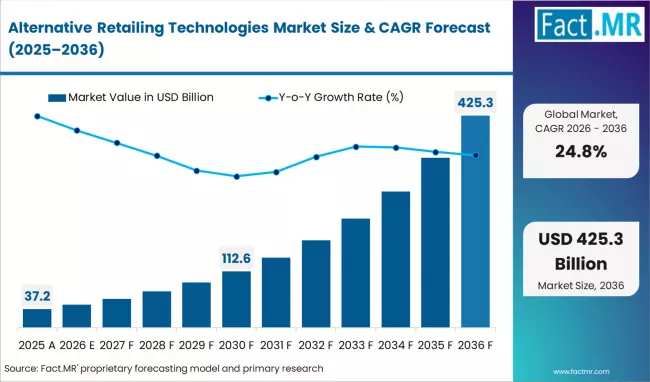
Alternative Retailing Technologies Market Market Value Analysis | Source: Fact.MR
| Metric | Value |
|---|---|
| Estimated Value in 2026 | USD 46.4 billion |
| Forecast Value in 2036 | USD 425.3 billion |
| Forecast CAGR (2026 to 2036) | 24.8% |
Source: Fact.MR analysis. Updated Mar 24, 2026
Country growth reflects digital retail infrastructure maturity and consumer technology adoption rates. The USA leads at 24.6% CAGR, driven by large-scale deployments of autonomous checkout by major grocery and convenience store chains. Japan follows at 19.6%, supported by strong government digitization policies and high consumer acceptance of cashierless retail. South Korea records 15.3% due to rapid smart retail expansion in urban centers. The European Union posts 14.0% growth led by omnichannel retail investment and regulatory alignment. The UK records 13.8%, reflecting mature e-commerce infrastructure and continued in-store technology adoption.
Summary of Alternative Retailing Technologies Market
- Market Definition
- The market includes digital tools enabling frictionless checkout, smart engagement, and virtual shopping across retail channels.
- Demand Drivers
- Retailers are adopting autonomous checkout to reduce labor costs and shrinkage.
- Consumer demand for speed and personalization is driving AI kiosks and smart assistants.
- Omnichannel strategies are increasing demand for integrated virtual platforms and real-time data systems.
- Key Segments Analysed
- By Online Technologies: Online shopping sites lead with ~53% share in 2026 due to large-scale e-commerce adoption.
- By In-Store Technologies: In-store kiosks hold ~28% share in 2026 driven by self-service deployment across retail formats.
- By Region: North America leads in value, while Asia Pacific grows fastest due to retail digitization programs.
- Analyst Opinion at FACT.MR
- Shambhu Nath Jha, Senior Consultant at Fact.MR, opines, 'Retailers that fail to integrate autonomous checkout and AI-driven in-store intelligence by 2028 will face structurally higher operating costs versus digitally transformed peers, making technology adoption a competitive necessity rather than an option.'
- Strategic Implications
- Retail technology vendors should prioritize modular, interoperable solutions that integrate with legacy POS environments to reduce retailer switching friction.
- Grocery and convenience store operators should accelerate pilot deployments of autonomous checkout to lock in cost structures before labor rate escalations compound.
- Investors and strategic acquirers should monitor AI-native retail platform startups with proven shrinkage reduction metrics as consolidation targets.
- Methodology
- Market sizing based on deployment volumes, contract values, and retail digitization adoption rates by format and region.
- Consumer adoption data and retailer capital expenditure disclosures used for demand forecasting.
- Validation through vendor earnings, industry association reports, and primary interviews with retail operators.
Segmental Analysis
Alternative Retailing Technologies Market Analysis by Online Technologies
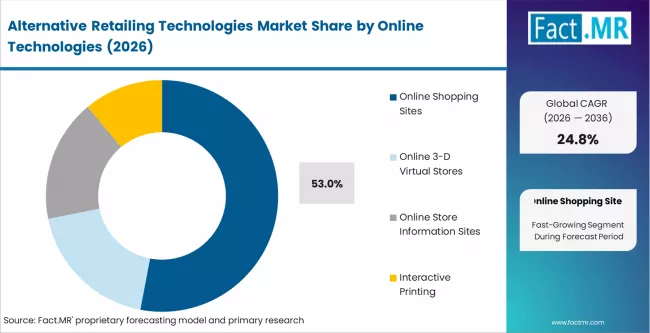
Alternative Retailing Technologies Market Analysis By Online Technologies | Source: Fact.MR
Based on FACT.MR's alternative retailing technologies market report, consumption of online shopping sites is estimated to hold approximately 53% share in 2026 due to their ubiquitous adoption across all retail verticals, high transaction volumes, and the ongoing shift of consumer purchasing behavior toward digital-first interactions.
- Alibaba Virtual Commerce Expansion: Alibaba Group expanded its 3D virtual store capabilities through its Tmall platform in 2024, deploying virtual showroom technology for over 50,000 brand storefronts ahead of the 11.11 Global Shopping Festival, driving measurable conversion gains versus static product pages. [4]
- Interactive Retail Platform Development: Shopify launched its augmented reality and 3D product visualization suite for enterprise merchants in 2025, enabling online retailers to deploy interactive virtual stores without custom development, accelerating adoption among mid-market retailers. [5]
- E-Commerce AI Personalization Trend: According to Salesforce's State of Commerce report (2025), 72% of consumers expect personalized online shopping experiences, with AI-driven recommendation engines and virtual store personalization now standard requirements for tier-one e-commerce deployments. [6]
Alternative Retailing Technologies Market Analysis by In-Store Technologies
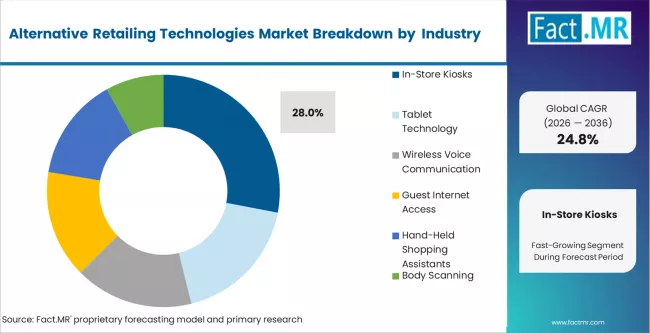
Alternative Retailing Technologies Market Analysis By In Store Technologies | Source: Fact.MR
Based on FACT.MR's alternative retailing technologies market report, consumption of in-store kiosks is estimated to hold approximately 28% share in 2026 due to widespread deployment across QSR, grocery, and department store formats for self-service checkout, loyalty program engagement, and product information delivery.
- NCR Autonomous Checkout Deployment: NCR Corporation expanded its self-checkout and autonomous retail platform deployments with major US grocery chains in 2024, including a large-scale rollout targeting over 1,500 store locations, reinforcing its position as the leading in-store technology integrator. [7]
- Standard AI Smart Cart Innovation: Standard AI launched its next-generation AI-powered shopping cart system in early 2025, incorporating computer vision for real-time product recognition without requiring shelf sensors, reducing total deployment cost for grocery retailers by approximately 30%. [8]
- Body Scanning and Smart Fitting Trend: Fit:Match and similar body scanning platform providers reported in 2025 that apparel retailers deploying in-store body scanning technology recorded a 40% reduction in return rates, making the technology a measurable ROI driver for fashion format retailers. [9]
Drivers, Restraints, and Opportunities
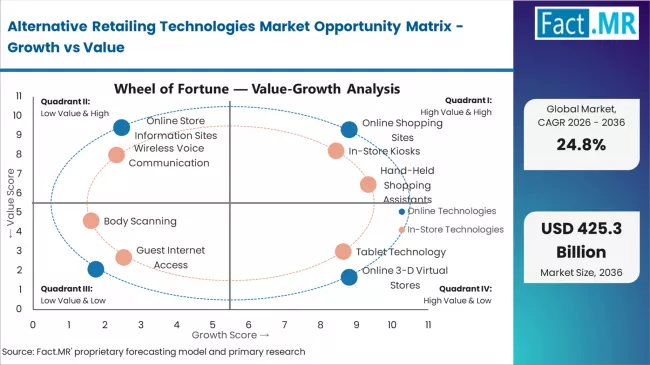
Alternative Retailing Technologies Market Opportunity Matrix Growth Vs Value | Source: Fact.MR
FACT.MR analysts observe that the alternative retailing technologies market has shifted from experimental pilots to scaled commercial deployment. Market expansion is tied directly to the structural transformation of retail operations, where labor cost pressures, theft reduction imperatives, and consumer experience expectations are converging to make autonomous and AI-enabled retail tools economically essential rather than discretionary.
The market is transitioning from hardware-led deployments toward integrated platform models. Basic self-checkout terminals face commoditization pressure, while AI-powered autonomous checkout, virtual try-on, and smart cart systems command significantly higher contract values. These advanced deployments sustain revenue growth even as unit volumes normalize post-pandemic retail tech investment cycles.
- Autonomous Checkout Scaling: Amazon's Just Walk Out technology expanded to over 200 third-party retail deployments globally through 2024 and 2025, including airport retailers and sports venues, validating the commercial scalability of frictionless checkout beyond Amazon's own Go stores. [1]
- AI Regulation and Standards: The EU AI Act, which came into force in August 2024, classifies certain in-store AI monitoring systems under transparency obligations, requiring retailers in European markets to disclose the use of automated customer profiling systems, shaping vendor product roadmaps. [2]
- Asia Pacific Policy Acceleration: Japan's Ministry of Economy, Trade and Industry (METI) advanced its cashless and smart retail roadmap in fiscal 2025, targeting 80% cashless transaction penetration and supporting deployment of kiosk and autonomous checkout infrastructure across convenience and grocery formats. [3]
Regional Analysis
The alternative retailing technologies market is assessed across North America, Europe, Asia Pacific, Latin America, and the Middle East and Africa. The market is further segmented by country within each region. The full report provides market attractiveness analysis by region and country.
.webp "Top Country Growth Comparison Alternative Retailing Technologies Market Cagr (2026 2036)")
Top Country Growth Comparison Alternative Retailing Technologies Market Cagr (2026 2036) | Source: Fact.MR
| Country | CAGR (2026 to 2036) |
|---|---|
| USA | 24.6% |
| Japan | 19.6% |
| South Korea | 15.3% |
| European Union | 14.0% |
| UK | 13.8% |
Source: Fact.MR analysis. Updated Mar 24, 2026
Source: Fact.MR (FACT.MR) analysis, based on proprietary forecasting model and primary research
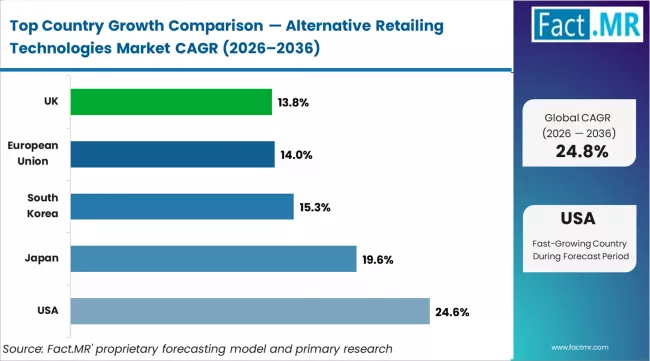
Alternative Retailing Technologies Market Cagr Analysis By Country | Source: Fact.MR
Asia Pacific Alternative Retailing Technologies Market Analysis
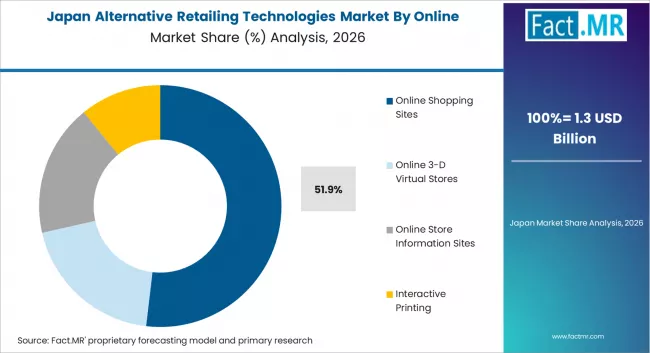
Alternative Retailing Technologies Market Japan Market Share Analysis By Online Technologies | Source: Fact.MR
Asia Pacific is the fastest-growing region, underpinned by government-mandated retail digitization programs, high smartphone and QR payment penetration, and large-scale retail format modernization. Regional players such as Alibaba Group and Caper AI's Asia deployments are driving both consumer adoption and B2B technology supply chain development.
- Japan: The alternative retailing technologies market in Japan is projected to rise at 19.6% CAGR through 2036. METI's cashless promotion policy, with a target of 80% cashless retail penetration by 2025, has driven mass deployment of kiosk and self-checkout systems across convenience store chains including Seven-Eleven Japan and FamilyMart. In fiscal 2025, the Ministry of Economy extended digital retail subsidy programs to small-format grocery operators, broadening the addressable deployment base beyond large chains.
- South Korea: The market in South Korea is projected to rise at 15.3% CAGR through 2036. South Korea's Ministry of SMEs and Startups funded smart store upgrade programs for independent retailers through 2024 and 2025, enabling deployment of tablet-based POS, AI kiosks, and wireless communication tools across over 30,000 small retail locations. Kakao and Naver-affiliated retail tech platforms have additionally expanded their AI-powered shopping assistant integrations into physical retail environments.
FACT.MR's analysis of the alternative retailing technologies market in Asia Pacific consists of country-wise assessment including Japan, South Korea, China, India, ASEAN, and Australia and New Zealand. Readers can find government policy impact, cashless retail adoption, and smart store deployment trends across each country.
North America Alternative Retailing Technologies Market Analysis
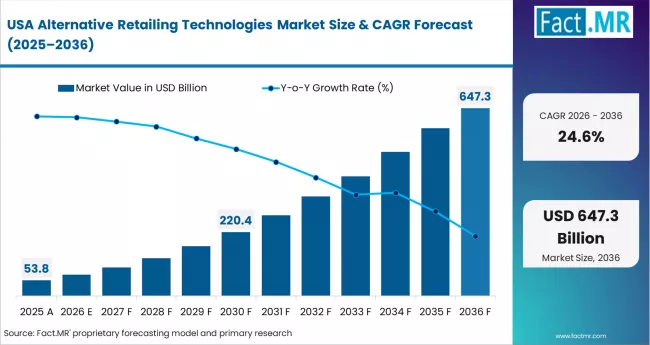
Alternative Retailing Technologies Market Country Value Analysis | Source: Fact.MR
North America is the highest absolute value region, with the United States accounting for the dominant share. Amazon, Standard AI, Zippin, and Grabango lead deployment of frictionless checkout solutions, while NCR Corporation and Toshiba Global Commerce anchor the enterprise in-store technology segment across grocery, convenience, and specialty retail formats.
- United States: The market in the United States is projected to rise at 24.6% CAGR through 2036. In 2024, Amazon accelerated expansion of its Just Walk Out technology to sports stadiums and airport terminals, with over 200 third-party locations active by year-end. In 2025, the National Retail Federation's digital retail investment survey indicated that 68% of US grocery operators planned to increase autonomous checkout capital expenditure within two years, reflecting broad sector-level commitment to frictionless retail infrastructure.
FACT.MR's analysis of the alternative retailing technologies market in North America consists of country-wise assessment including the United States, Canada, and Mexico. Readers can find autonomous checkout adoption rates, retail labor cost dynamics, and vendor deployment trends across each market.
Europe Alternative Retailing Technologies Market Analysis
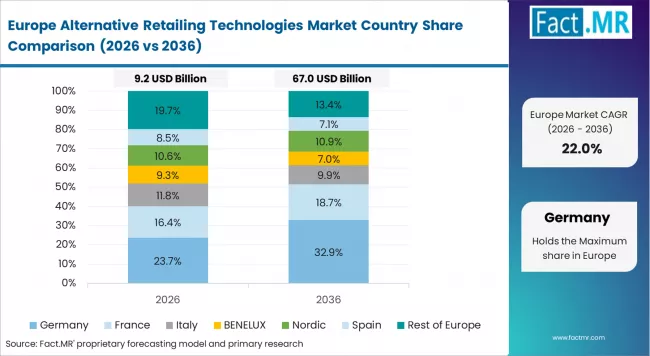
Alternative Retailing Technologies Market Europe Country Market Share Analysis, 2026 & 2036 | Source: Fact.MR
Europe's market is shaped by the dual forces of stringent AI regulation and high omnichannel retail investment. IKEA, Zalando, and Decathlon are among the leading retail operators investing in in-store and virtual store technologies, while regulatory requirements under the EU AI Act are standardizing transparency requirements for in-store AI systems.
- European Union: The market in the European Union is projected to rise at 14.0% CAGR through 2036. The EU AI Act, effective August 2024, introduced transparency and disclosure obligations for retail AI systems including in-store surveillance, automated customer profiling, and AI-assisted checkout, requiring vendors to adapt product architectures for compliance. In 2025, Decathlon expanded deployment of RFID-enabled self-checkout across its European store network, targeting 100% self-checkout penetration in key markets by 2026.
- United Kingdom: The market in the United Kingdom is projected to rise at 13.8% CAGR through 2036. Tesco expanded its Scan as You Shop program to over 900 UK stores through 2024, integrating hand-held shopping assistants and loyalty-linked checkout tools that reduced cashier labor requirements. In early 2025, the British Retail Consortium published updated digital retail guidelines encouraging adoption of smart store technologies, providing retailers with a compliance framework for AI-enabled in-store deployments.
FACT.MR's analysis of the alternative retailing technologies market in Europe consists of country-wise assessment including Germany, France, the United Kingdom, Italy, Spain, and Rest of Western Europe. Readers can find AI regulatory impact, omnichannel deployment trends, and country-level investment data.
Competitive Aligners for Market Players
Alternative Retailing Technologies Market Analysis By Company | Source: Fact.MR
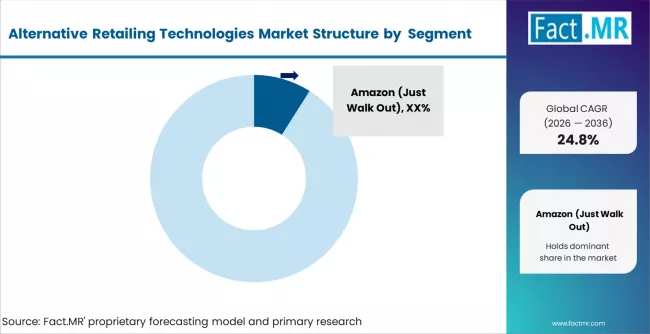
The alternative retailing technologies market sits in an interesting middle ground. At the platform level, it is fairly concentrated, with companies like Amazon, NCR Corporation, and Toshiba Global Commerce holding strong positions in enterprise retail deployments. At the same time, the AI-driven segment is much more fragmented. Startups such as Zippin, Grabango, Standard AI, and Caper AI compete intensely, not on scale alone, but on how accurate, cost-effective, and easy to integrate their solutions are.
What really sets vendors apart is proven success. Companies that have already deployed their technologies with large grocery or convenience chains gain a clear edge. These relationships not only generate recurring software revenue but also serve as strong references when entering new markets. Amazon’s Just Walk Out stands out because of its tightly integrated system combining sensors, computer vision, and cloud infrastructure, something competitors still find difficult to match at the same cost level. Meanwhile, NCR and Toshiba benefit from long-standing contracts that secure repeat business.
Retailers, however, are cautious about over-reliance on any single vendor. Large players like Walmart and Kroger are investing in their own technology capabilities while also testing multiple vendors. This approach keeps pricing competitive and favors flexible, modular solutions over large, disruptive system replacements.
Key Players Of Alternative Retailing Technologies Market
- Amazon (Just Walk Out)
- Alibaba Group
- NCR Corporation
- Toshiba Global Commerce
- Standard AI
- Caper AI
- Zippin
- Focal Systems
- Grabango
- Mashgin
Bibliography
- [1] Amazon.com Inc., Just Walk Out Technology Expansion Update, Press Release, 2024
- [2] European Union, Regulation (EU) 2024/1689-Artificial Intelligence Act, Official Journal of the European Union, August 2024
- [3] Ministry of Economy, Trade and Industry (Japan), Cashless Vision and Smart Retail Policy Update, Fiscal Year 2025
- [4] Alibaba Group Holding Ltd., Tmall 11.11 Shopping Festival Virtual Store Technology Deployment, Press Release, November 2024
- [5] Shopify Inc., Enterprise 3D and AR Product Visualization Suite Launch, Press Release, 2025
- [6] Salesforce Inc., State of Commerce Report, 2025
- [7] NCR Corporation, Grocery Self-Checkout Platform Expansion Announcement, 2024
- [8] Standard AI, Next-Generation AI Smart Cart System Launch, Press Release, January 2025
- [9] Fit:Match, Apparel Return Rate Impact Study-Body Scanning Retail Deployments, 2025
This Report Addresses
- Strategic insights on alternative retailing technology demand across grocery, convenience, fashion, QSR, and specialty retail formats globally.
- Market forecast from USD 46.4 billion in 2026 to USD 425.3 billion by 2036 at a CAGR of 24.8%.
- Growth opportunity mapping across autonomous checkout, AI-powered kiosks, virtual store platforms, smart shopping assistants, and body scanning technologies.
- Segment-wise analysis by online technologies (online shopping sites, virtual stores, interactive printing) and in-store technologies (kiosks, tablet technology, hand-held assistants, body scanning).
- Regional outlook covering North America autonomous checkout leadership, Asia Pacific government-driven digitization, and Europe regulatory-shaped omnichannel investment trends.
- Competitive landscape analysis of leading players including Amazon, Alibaba Group, NCR Corporation, Toshiba Global Commerce, Standard AI, Zippin, and Grabango.
- Technology tracking including computer vision checkout, AI-driven product recognition, virtual try-on, smart cart systems, and body scanning developments from 2024 through 2036.
- Report delivery in PDF, Excel datasets, and presentation formats supported by primary interviews with retail operators and technology vendor disclosures.
Alternative Retailing Technologies Market Definition
The alternative retailing technologies market includes digital and automated tools used by retailers to enhance or replace traditional sales processes. This covers autonomous checkout, AI kiosks, virtual stores, smart assistants, and in-store communication systems. Applications span grocery, fashion, specialty retail, and food service.
Alternative Retailing Technologies Market Inclusions
Includes global and regional forecasts from 2026 to 2036 by online and in-store technologies. Covers autonomous checkout systems, AI shopping tools, virtual platforms, kiosks, and wireless communication across retail environments.
Alternative Retailing Technologies Market Exclusions
Excludes traditional POS systems without AI or automation. Excludes general enterprise IT infrastructure and pure e-commerce platforms without in-store integration. Also excludes warehouse automation not used in retail sales environments.
Alternative Retailing Technologies Market Research Methodology
- Primary Research: Interviews with retail tech leaders, store managers, vendors, and digital transformation executives across key retail sectors.
- Desk Research: Analysis of company reports, industry publications, government policies, and technology patent filings.
- Market-Sizing and Forecasting: Hybrid approach based on deployment volumes, contract values per site, and retail digitization rates by region and channel.
- Data Validation and Update Cycle: Validated through vendor revenues, retail shipment data, and expert inputs with regular updates.
Segmentation
Scope of Report
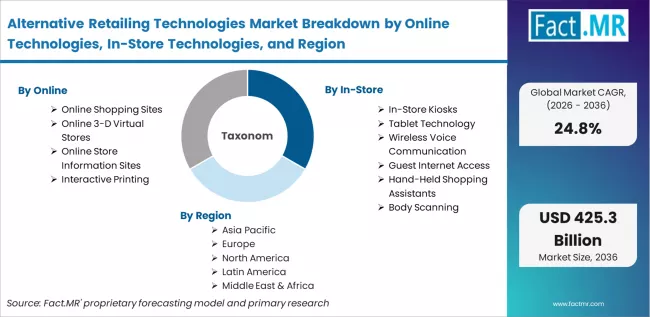
Alternative Retailing Technologies Market Breakdown By Online Technologies, In Store Technologies, And Region | Source: Fact.MR
| Quantitative Units | USD 46.4 billion (2026) to USD 425.3 billion (2036), at a CAGR of 24.8% |
|---|---|
| Market Definition | Digital and automated tools deployed in retail environments to replace or supplement traditional sales processes, including autonomous checkout, AI-powered kiosks, virtual store platforms, smart shopping assistants, and in-store wireless communication systems serving grocery, specialty, fashion, and food service retail. |
| Online Technologies Segmentation | Online 3-D Virtual Stores, Online Shopping Sites, Online Store Information Sites, Interactive Printing |
| In-Store Technologies Segmentation | Tablet Technology, Wireless Voice Communication, Guest Internet Access, In-Store Kiosks, Hand-Held Shopping Assistants, Body Scanning |
| Application Coverage | Grocery and convenience store checkout automation, QSR and food service kiosk ordering, fashion and apparel virtual try-on, department store self-service, sports and entertainment venue checkout, corporate and institutional food service. |
| Regions Covered | North America, Europe, Asia Pacific, Latin America, Middle East and Africa |
| Countries Covered | USA, Canada, Mexico, Germany, UK, France, Italy, Spain, Nordic, BENELUX, China, Japan, South Korea, India, ASEAN, Australia and New Zealand, Brazil, Argentina, Chile, Saudi Arabia, GCC, Turkey, South Africa, Rest of MEA |
| Key Companies Profiled | Amazon (Just Walk Out), Alibaba Group, NCR Corporation, Toshiba Global Commerce, Standard AI, Caper AI, Zippin, Focal Systems, Grabango, Mashgin |
| Forecast Period | 2026 to 2036 |
| Approach | Hybrid top-down and bottom-up model using technology deployment volumes, average contract values per retail site, retail digitization adoption rates by format and geography, and primary interviews with retail operators, technology vendors, and industry analysts. |
Source: Fact.MR analysis. Updated Mar 24, 2026
Alternative Retailing Technologies Market by Segments
-
By Online Technologies :
- Online 3-D Virtual Stores
- Online Shopping Sites
- Online Store Information Sites
- Interactive Printing
-
By In-Store Technologies :
- Tablet Technology
- Wireless Voice Communication
- Guest Internet Access
- In-Store Kiosks
- Hand-Held Shopping Assistants
- Body Scanning
-
By Region :
- North America
- United States
- Canada
- Mexico
- Latin America
- Brazil
- Mexico
- Argentina
- Chile
- Rest of Latin America
- Western Europe
- Germany
- United Kingdom
- France
- Italy
- Spain
- Nordic Countries
- BENELUX
- Rest of Western Europe
- Eastern Europe
- Russia
- Poland
- Hungary
- Balkan and Baltic
- Rest of Eastern Europe
- East Asia
- China
- Japan
- South Korea
- South Asia and Pacific
- India
- ASEAN
- Australia and New Zealand
- Rest of South Asia and Pacific
- Middle East and Africa
- Kingdom of Saudi Arabia
- Other GCC Countries
- Turkey
- South Africa
- Rest of Middle East and Africa
- North America
Frequently Asked Questions
How large is the alternative retailing technologies market in 2025?
What will the market size be in 2026?
What is the projected market size by 2036?
What is the expected CAGR of the alternative retailing technologies market?
What is the absolute dollar opportunity in this market?
Which online technology segment leads the market?
Which in-store technology segment holds the largest share?
Which region dominates the alternative retailing technologies market?
Which country shows the fastest growth?
What factors are driving market growth?
What are the major restraints in the market?
Who worked on this report


Preview the report firsthand - request a free sample
Free SampleGet the brochure for pricing and purchase details
Download PDF