The Reusable Silicone Closures Market is analyzed across its key product, application and end-use segments, with the study covering market dynamics, regional trends and demand outlook, forecast 2026 to 2036.
By Fact.MR Consumer Goods DeskFact-checked under the Fact.MR editorial processUpdated
11 min read
Reusable Silicone Closures Market Forecast and Outlook 2026 to 2036
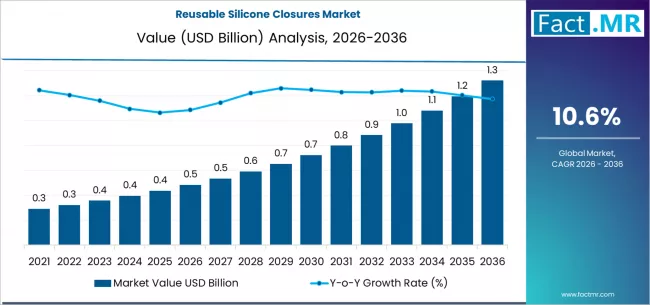
The global reusable silicone closures market is projected to total USD 0.48 billion in 2026, and reach USD 1.32 billion by 2036, advancing at a 10.6% CAGR.
This expansion is underpinned by a decisive consumer shift away from single-use plastics and disposable packaging in domestic kitchens.
Reusable Silicone Closures Market Market Value Analysis | Source: Fact.MR
Summary of Reusable Silicone Closures Market
Market Snapshot
Global reusable silicone closures market revenue stood at USD 0.48 billion in 2026 and is forecast treach USD 1.32 billion by 2036.
At a 10.6% CAGR from 2026 t2036, this market is set texpand ~2.75x in value, adding USD 0.84 billion in absolute opportunity.
Growth is being driven by a decisive consumer shift away from single-use plastics and disposable packaging in domestic kitchens.
Silicone closures offer a durable, non-plastic alternative for food storage, aligning with growing sustainability awareness and demand for versatile, leak-proof solutions.
Food-grade silicone’s freezer-to-oven compatibility and long lifecycle durability are reinforcing adoption across household storage applications.
Demand and Growth Drivers
Increasing consumer preference for reusable and eco-friendly kitchenware solutions
Rising awareness regarding reduction of single-use plastic waste
Growing adoption of premium and durable food storage products
Expansion of sustainable household and kitchen organization trends
Need for solutions that provide:
Leak-proof sealing performance
Freezer-to-oven usability
Long-term reusability and elasticity
Reduction in disposable packaging waste
Product and Segment View
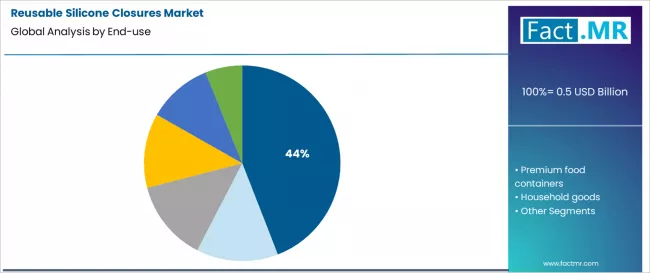
Beverage & food storage hold 44.1% of end-use share in 2026, emerging as the leading segment.
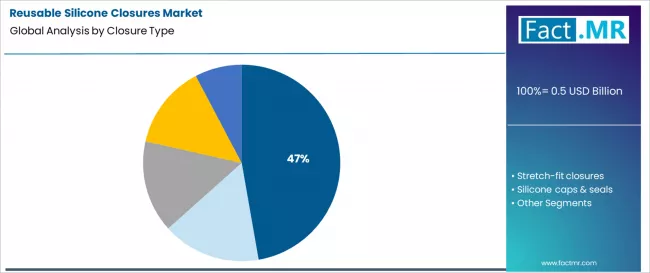
Reusable lids & caps account for 47.3% of closure type share in 2026, positioning them as the dominant segment.
Food-grade silicone represents 40.0% of material share in 2026, reflecting primary material adoption.
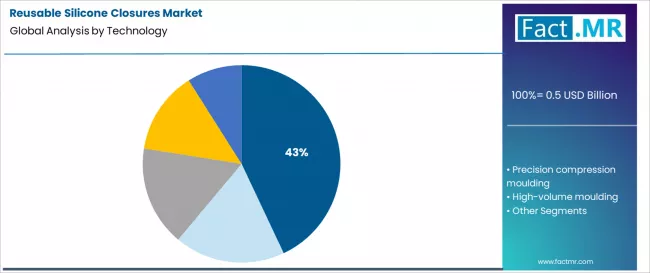
High-cycle moulding & durability design hold 43.0% of technology share in 2026, indicating leading technology adoption.
Key product categories include:
Beverage & food storage
Premium food containers
Household goods
Kitchenware
Consumer storage
Precision kitchenware
Geography and Competitive Outlook
Growth is supported across North America, Latin America, Western Europe, Eastern Europe, East Asia, South Asia & Pacific, Middle East & Africa.
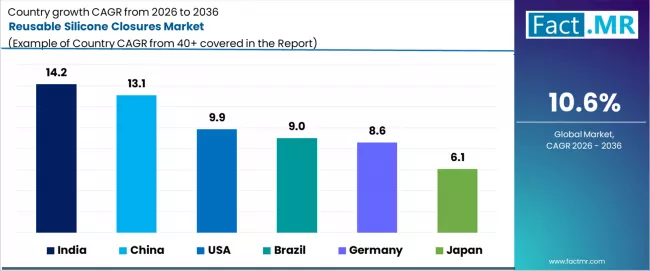
Key growth markets and CAGR: India 14.2%, China 13.1%, USA 9.9%, Brazil 9.0%, Germany 8.6%, Japan 6.1%
Market expansion is closely tied to:
Rising sustainability awareness among consumers
Increasing replacement of disposable plastic wraps and lids
Growth in reusable kitchenware adoption
Key companies active in this marketinclude:Tupperware Brands Corporation, Weck, Silgan Holdings Inc., KAI Group Ltd.
Reusable Silicone Closures Market — At a Glance
Attribute
Details
Market Value 2026
USD 0.48 billion
Market Value 2036
USD 1.32 billion
Absolute Dollar Opportunity 2026–2036
USD 0.84 billion
Total Growth 2026–2036
175.00%
CAGR 2026–2036
10.6%
Growth Multiple
~2.75x
Key Demand Theme
Increasing adoption of reusable and eco-friendly food storage solutions
Leading Segment by End-Use (2026)
Beverage & Food Storage
Segment Share (2026)
44.1%
Leading Segment by Closure Type (2026)
Reusable Lids & Caps
Segment Share (2026)
47.3%
Leading Segment by Material (2026)
Food-Grade Silicone
Segment Share (2026)
40.0%
Leading Segment by Technology (2026)
High-Cycle Moulding & Durability Design
Segment Share (2026)
43.0%
Key Growth Regions
North America, Latin America, Western Europe, Eastern Europe, East Asia, South Asia & Pacific, Middle East & Africa
Country CAGRs
India 14.2%, China 13.1%, USA 9.9%, Brazil 9.0%, Germany 8.6%, Japan 6.1%
Top Companies
Tupperware Brands Corporation, Weck, Silgan Holdings Inc., KAI Group Ltd.
North America, Latin America, Western Europe, Eastern Europe, East Asia, South Asia & Pacific, Middle East & Africa
Silicone closures offer a durable, non-plastic alternative for food storage, aligning with growing sustainability awareness and the practical demand for versatile, leak-proof solutions that extend the life of perishables and reduce household waste. Growth is further catalyzed by the material's intrinsic properties: food-grade silicone is inert, freezer-to-oven safe, and retains elasticity over hundreds of uses. This positions reusable closures not as mere replacements for plastic wrap, but as premium, functional upgrades within the modern kitchen ecosystem. The market's trajectory is thus tied tthe convergence of environmental consciousness, the premiumization of home organization, and the material innovation that makes silicone a preferred choice for health-conscious and eco-aware consumers.
North America, Latin America, Western Europe, Eastern Europe, East Asia, South Asia & Pacific, Middle East & Africa
Industry Dynamics- From Replacement to Reinvention
The market is shaped by deeper consumer trends that transcend basic utility. The growth of direct-to-consumer kitchenware brands leverages silicone closures as high-margin, frequently purchased accessories to build brand loyalty.
Regulatory scrutiny on green claims such as the EU's Green Claims Directive, is forcing brands to substantiate the durability and lifecycle advantages of reusable silicone over plastic alternatives. This shifts marketing from vague eco-friendliness to demonstrable product longevity and material safety.
Trend
Impact
Circular Economy & Anti-Plastic Sentiment
Drives primary demand, positioning silicone closures as a tangible, affordable step consumers can take to reduce kitchen plastic waste.
Rise of DTC & Subscription Kitchen Brands
Creates new channels for sales, often bundling silicone lids with container systems and using them as low-cost entry products to acquire customers.
Premiumization of Home Organization
Supports higher price points for aesthetically designed, color-coordinated closure sets that are marketed as kitchen upgrades.
Increased Scrutiny on Material Safety & Claims
Advantages platinum-cured silicone, pushing brands to highlight non-toxic, odorless properties to meet discerning consumer standards.
Segmental Analysis
By Technology, Which Manufacturing Advance is Key to Meeting Consumer Durability Expectations?
Reusable Silicone Closures Market Analysis By Technology | Source: Fact.MR
High-cycle moulding and durability design commands a leading 43.0% share. This technology focuses on engineering moulds and material formulations that ensure the silicone lid or cap maintains its sealing integrity, shape, and elasticity through repeated use, dishwashing, and temperature cycling.
It addresses the core consumer pain point of flimsy reusable products that fail quickly, undermining the sustainability promise. Advanced design incorporates uniform wall thickness, reinforced edges, and material grades resistant to tearing and permanent deformation, which are critical for brand reputation and repeat purchases.
By End-Use, Which Application is the Central Hub for Consumer Adoption?
Reusable Silicone Closures Market Analysis By End Use | Source: Fact.MR
Beverage and food storage constitutes the primary end-use segment at 44.1%. This universal need spans covering bowls, sealing cans, and closing beverage containers, representing the highest-frequency use case in the kitchen.
The shift from disposable plastic wrap or aluminum foil to reusable silicone closures here offers the most immediate and visible reduction in single-use waste, making it the entry point for most consumers. The variety of container sizes in this segment also drives demand for multi-pack sets of universal or stretch-fit lids.
By Closure Type, Which Design Balances Versatility and User-Friendliness for Mass Adoption?
Reusable Silicone Closures Market Analysis By Closure Type | Source: Fact.MR
Reusable lids and caps hold a 47.3% share. This category includes both solid, snap-on lids for specific containers and flexible, stretch-to-fit designs. Their dominance stems from offering a direct, intuitive replacement for traditional lids and covers.
Consumers understand their function immediately, lowering the barrier to adoption. The design challenge lies in creating a seal secure enough for liquid storage and leftovers, yet easy enough for daily access, making it the most commercially significant and competitive product category.
What are the Principal Drivers, Constraints, and Evolving Dynamics of the Reusable Silicone Closures Market?
Attribute
Impact
Driver
Intensifying regulatory bans on single-use plastics and consumer preference for non-plastic kitchenware.
Restraint
Competition from lower-cost, disposable alternatives and cheaper plastic reusable options.
Opportunity
Partnerships with food brands (e.g., coffee, yogurt) to co-brand closures for their product packaging.
Trend
Development of "smart" silicone lids with built-in freshness indicators or vacuum-seal valves.
Analysis of the Reusable Silicone Closures Market by Key Countries
Reusable Silicone Closures Market Cagr Analysis By Country | Source: Fact.MR
Country
CAGR 2026 to 2036
USA
9.9%
Germany
8.6%
China
13.1%
India
14.2%
Brazil
9.0%
Japan
6.1%
How does Consumer Sentiment and DTC Brand Proliferation Shape the Landscape in USA?
A 9.9% CAGR reflects a market driven by strong environmental awareness and a vibrant ecosystem of direct-to-consumer brands. Demand is concentrated in the beverage and food storage segment, where consumers actively seek plastic-free alternatives.
The retail strategy is dual-track, mass-market penetration through large retail chains and premiumization via DTC brands that emphasize design and material purity. Strategic partnerships, such as silicone closure brands with subscription meal kits or coffee companies, are emerging as a key growth tactic to embed products into existing consumer routines.
What characterizes Germany's Regulatory-Influenced and Quality-Conscious Demand?
An 8.6% CAGR underscores a market where EU-wide plastic reduction directives and a cultural emphasis on product quality and durability converge. German consumers show high willingness to pay for premium, certified products like platinum-cured silicone.
The presence of established heritage brands in jars and storage, such as Weck, influences demand for compatible, high-quality silicone seals and lids that align with a culture of long-term ownership and waste reduction, moving beyond novelty to standard kitchen inventory.
What underpins China's Rapid Adoption in Urban Centers and Premium Segments?
China’s 13.1% CAGR is fueled by the rapid growth of its urban middle class and the concurrent rise of premium domestic kitchenware brands. The demand driver is twofold: a burgeoning market for aesthetically designed, high-quality home organization products and growing health consciousness that favors non-plastic food contact materials.
Domestic manufacturing prowess supports high-volume moulding of silicone blends, enabling rapid scaling to meet demand through both e-commerce platforms and brick-and-mortar retail expansions.
How is India's Household Market Expansion and Price Sensitivity Defining Growth?
The sheer scale of its household goods sector and rising adoption of organized storage solutions propels India’s leading 14.2% CAGR. The primary demand driver is value-conscious urban households seeking affordable upgrades from traditional storage methods.
This fosters intense competition and innovation in cost-efficient moulding technologies and silicone blends to achieve acceptable durability at accessible price points. Growth is heavily reliant on general trade and mass-market retail channels, with products often sold in multi-packs to maximize perceived value.
Why is Brazil's Market Growth Linked to Economic Factors and Brand Accessibility?
A 9.0% CAGR is closely tied to economic recovery phases that boost discretionary spending on home goods and the strategic focus of global kitchenware brands on expanding in Latin America. Demand centers on the kitchenware segment, where silicone closures are often marketed as part of larger food storage solution sets.
Success hinges on balancing quality with affordability and ensuring wide distribution through both hypermarkets and online marketplaces to reach a geographically dispersed consumer base.
What defines Japan's Niche for Space Optimization and High-Fidelity Design?
Japan’s 6.1% CAGR represents a mature, sophisticated market where space constraints and a culture of meticulous care define demand. Consumers in the precision kitchenware segment seek closures that offer perfect seals for odor prevention and are designed for specific, space-saving storage containers. The market favors minimalist, highly functional designs from specialized manufacturers, with an emphasis on easy cleaning and long-term performance in small, efficient kitchens.
Competitive Landscape of the Reusable Silicone Closures Market
The competitive arena is segmented between legacy food storage brands and agile, design-focused newcomers. Established players like Tupperware leverage their dominant retail relationships and brand trust to introduce silicone lines as natural extensions of their core products. Material specialists and OEMs, such as Silgan, compete through high-volume manufacturing efficiency and supplying private-label products to retailers.
The landscape sees increased vertical integration, with brands controlling silicone compounding and mould design to ensure quality and cost.
Strategic moves include expanding into adjacent categories like silicone baking mats and utensils to increase basket size, and developing subscription models for replacement seals or limited-edition colors to drive recurring engagement. Partnerships with celebrity chefs or sustainable lifestyle influencers are becoming a key marketing channel to reach target demographics.
Key Players in the Reusable Silicone Closures Market
Tupperware Brands Corporation
Weck
Silgan Holdings Inc.
KAI Group Ltd.
References
Ellen MacArthur Foundation. (2025). Upstream Innovation: A guide to designing reusable consumer products.
European Commission. (2024). Commission Directive on the Enforcement of the Green Claims Directive.
Journal of Cleaner Production. (2025). Life cycle assessment of reusable silicone food storage products.
The Hartman Group. (2024). Sustainability 2024: Consumer Perspectives on Home and Kitchen.
U.S. Environmental Protection Agency (EPA). (2024). National Overview: Facts and Figures on Materials, Wastes and Recycling.
World Economic Forum. (2025). The Future of Consumption: How Consumers are Driving Sustainability.
Comparative lifecycle assessment vs. single-use plastics and other reusable materials; analysis of colorant and additive safety standards; study of consumer replacement cycles and brand loyalty drivers; impact of retail merchandising strategies on impulse purchases.
Market by Segments
End-Use :
Beverage & Food Storage
Premium Food Containers
Household Goods
Kitchenware
Consumer Storage
Precision Kitchenware
Closure Type :
Reusable Lids & Caps
Stretch-Fit Closures
Silicone Caps & Seals
Universal Lids
Others
Material :
Food-Grade Silicone
Platinum-Cured Silicone
Silicone Blends
Silicone
Others
Technology :
High-Cycle Moulding & Durability Design
Precision Compression Moulding
High-Volume Moulding
Cost-Efficient Moulding
Others
Region :
North America
USA
Canada
Latin America
Brazil
Mexico
Argentina
Rest of Latin America
Western Europe
Germany
France
Italy
Spain
UK
BENELUX
Rest of Western Europe
Eastern Europe
Russia
Poland
Czech Republic
Rest of Eastern Europe
East Asia
China
Japan
South Korea
Rest of East Asia
South Asia & Pacific
India
ASEAN
Australia
Rest of South Asia & Pacific
MEA
GCC Countries
South Africa
Turkiye
Rest of MEA
Frequently Asked Questions
How big is the reusable silicone closures market in 2026?
The global reusable silicone closures market is estimated to be valued at USD 0.5 billion in 2026.
What will be the size of reusable silicone closures market in 2036?
The market size for the reusable silicone closures market is projected to reach USD 1.3 billion by 2036.
How much will be the reusable silicone closures market growth between 2026 and 2036?
The reusable silicone closures market is expected to grow at a 10.6% CAGR between 2026 and 2036.
What are the key product types in the reusable silicone closures market?
The key product types in reusable silicone closures market are beverage & food storage, premium food containers, household goods, kitchenware, consumer storage and precision kitchenware.
Which closure type segment to contribute significant share in the reusable silicone closures market in 2026?
In terms of closure type, reusable lids & caps segment to command 47.3% share in the reusable silicone closures market in 2026.