- Market Value (2025): USD 247.2 Mn
- Estimated Value (2026): USD 260.0 Mn
- Forecast Value (2036): USD 430.0 Mn
- CAGR (2026-2036): 5.2%
What is the Reusable Booth Flooring Market forecast to be worth by 2036?
USD 260.0 million in 2026 to USD 430.0 million by 2036 at 5.2% CAGR.
- The reusable booth flooring market reached USD 247.2 million in 2025 as event teams increased spending on waste reduction targets and faster booth installation.
- Demand is projected to increase from USD 260.0 million in 2026 to USD 430.0 million by 2036.
- The market is forecast to record 5.2% CAGR from 2026 to 2036. Waste reduction targets and brand-consistent floor finishes are expected to guide purchasing.
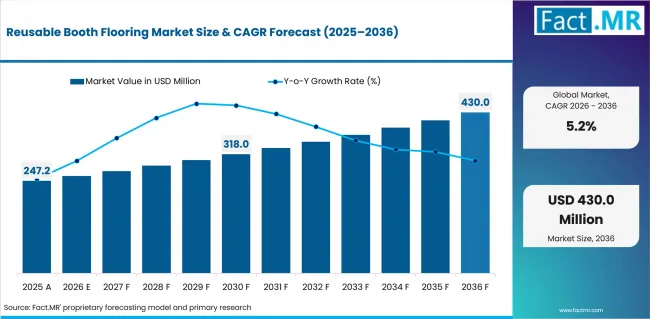
Reusable Booth Flooring Market Value Analysis | Source: Fact.MR
What are the defining numbers behind Reusable Booth Flooring Market growth?
USD 170.0 million absolute opportunity by 2036. Interlocking tiles and Carpet finish lead the segment view alongside Exhibit houses and Reusable sustainability claims.
- Demand Drivers in the Market
- Waste reduction targets are expected to give reusable booth flooring a practical buying reason. Event teams value floors that keep appearance and edge condition after cleaning and transport.
- Faster booth installation is anticipated to support adoption because show schedules leave little room for floor correction. Providers that document panel sequence and ramp placement give contractors a clearer setup routine.
- Brand-consistent floor finishes are projected to move the category into formal booth specifications. Repeatable carpet and vinyl finishes help exhibitors protect booth appearance between events.
- Lower cost across repeated shows is expected to matter when customers compare reuse cost with single-use flooring spend. The case improves when cleaning rules are agreed before installation.
- Key Segments Analyzed
- By Flooring Type: Interlocking tiles are anticipated to capture 31.0% share in 2026 because they give crews a simple repeatable installation format.
- By Surface Finish: Carpet finish is forecast to represent 33.0% share in 2026 as exhibitors prefer a familiar booth surface for visual consistency.
- By Reuse Cycle: 2-3 uses are estimated to command 16.0% share in 2026. Short cycles let teams test condition recovery before longer commitments.
- By Buyer: Exhibit houses are projected to hold 32.0% share in 2026 as they manage flooring decisions across many booth briefs.
- By Sustainability Claim: Reusable is expected to account for 36.0% share in 2026. Repeat installation is the clearest sustainability claim customers verify on site.
- Analyst Opinion at Fact.MR
- Shambhu Nath Jha, Senior Analyst at Fact.MR, states, “Reusable booth flooring providers must prove that panels and finishes hold up after transport and cleaning. The category is expected to gain more approval when event teams receive condition checks and storage rules before the show opens.”
- Strategic Implications
- Event teams can check floor level and panel edges before opening the booth. Clear standards help avoid uneven or unsafe surfaces.
- Providers must explain which interlocking and raised flooring systems are included. This makes purchasing decisions easier and separates booth flooring from regular maintenance.
- Flooring choices depend on dismantling time and available storage space. Early coordination helps venues and agencies reuse the same system across multiple events.
The UAE follows at 5.9%, supported by frequent events and faster flooring changes. The USA is projected to grow at 5.2% as exhibitors focus on accurate measurements. Japan is forecast at 5.1%, driven by compact and reusable booth systems. The UK is estimated to grow at 4.9%, while Germany is expected to record a 4.6% CAGR due to strict trade-fair requirements.
How does the Reusable Booth Flooring Market break down by segment?
Interlocking tiles are expected to lead Flooring Type at 31.0% share. Carpet finish is projected to lead Surface Finish at 33.0% share in 2026.
Why do Interlocking tiles lead Flooring Type?
Interlocking tiles hold 31.0% share in 2026.
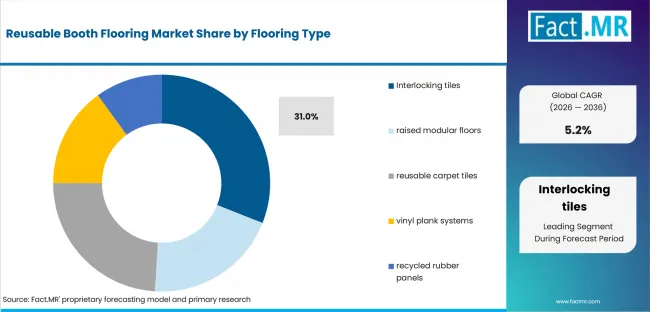
Reusable Booth Flooring Market Analysis By Flooring Type | Source: Fact.MR
Their advantage comes from a simple fitting process that avoids permanent adhesives. Crews can connect separate units, change the layout, and replace one damaged piece without lifting the entire surface. The design also makes cable access easier beneath the booth floor. These practical features support repeated use across venues where installation speed, repair flexibility, and layout changes play an important role in flooring selection.
Why does Carpet finish lead Surface Finish?
Carpet finish accounts for 33.0% share in 2026.
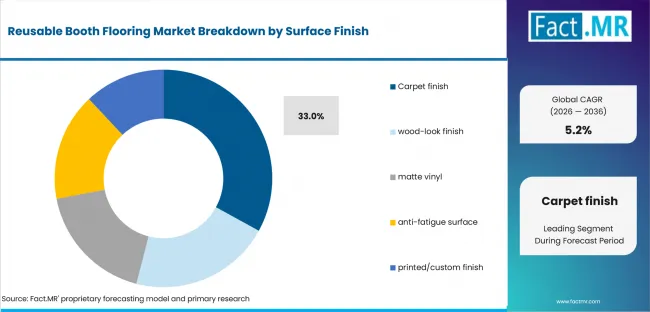
Reusable Booth Flooring Market Analysis By Surface Finish | Source: Fact.MR
Its strong position reflects the need for comfort and a polished booth appearance. Carpet reduces footstep noise, improves underfoot feel, and helps hide light marks during busy events. Reusable carpet tiles also allow worn areas to be replaced separately. This makes the finish suitable for exhibitors that value visitor comfort, visual consistency, and a softer environment during long exhibition hours.
Why do 2-3 uses lead Reuse Cycle?
2-3 uses lead with 16.0% share in 2026.
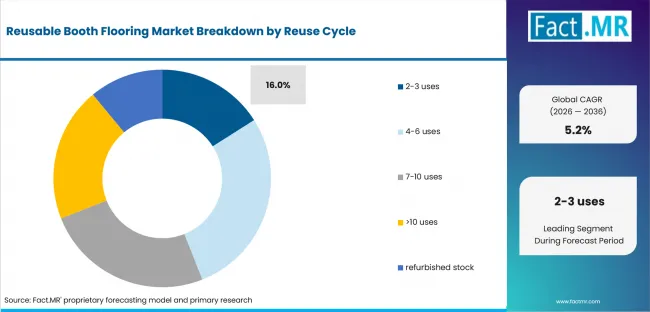
Reusable Booth Flooring Market Analysis By Reuse Cycle | Source: Fact.MR
This category offers a practical balance between cost recovery and product condition. Buyers can reuse the same flooring across a few planned events without depending on a long service life. The option fits seasonal campaigns and temporary booth concepts that may change later. It also gives contractors enough time to review cleaning results, storage needs, and surface wear before choosing products designed for extended reuse.
Why do Exhibit houses lead Buyer?
Exhibit houses are projected to account for 32.0% share in 2026.
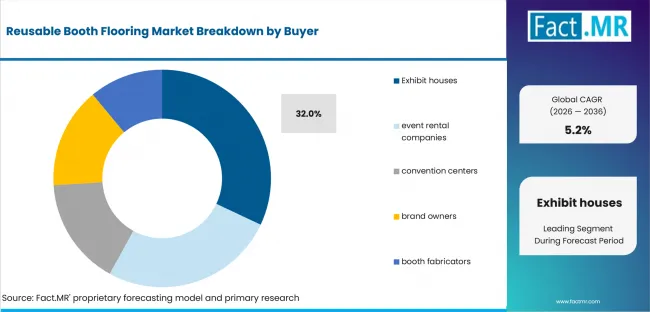
Reusable Booth Flooring Market Analysis By Buyer | Source: Fact.MR
Their market position is supported by frequent purchases across multiple booth projects. These firms manage design, installation, dismantling, and storage for several clients. Standard flooring systems help reduce labor variation and simplify work across different venues. Regular project volumes also create stronger purchasing demand than individual exhibitors, which may only need flooring for a limited number of events.
Why does Reusable lead Sustainability Claim?
Reusable hold 36.0% share in 2026.
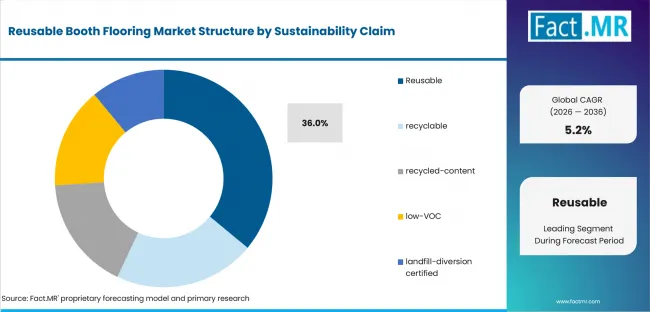
Reusable Booth Flooring Market Analysis By Sustainability Claim | Source: Fact.MR
Demand is supported by the need to reduce flooring waste after each event. Customers can clearly verify the claim when the same tiles or panels return across several shows. Reuse also lowers replacement demand and improves the value of stored materials. The claim remains credible when providers track redeployment, maintain cleaning standards, replace damaged sections, and define when worn flooring should be removed from service.
What is accelerating Reusable Booth Flooring Market adoption, and what is holding it back?
Demand is growing as event teams aim to reduce waste and install booths more quickly. Growth may be limited by damaged joints and the cost of storing flooring between events.
Drivers Impact Analysis
| DRIVER | (~) % IMPACT ON CAGR | GEOGRAPHIC RELEVANCE | IMPACT TIMELINE |
|---|---|---|---|
| Waste reduction targets | +1.4% | Global | Short term (<=2 years) |
| Faster booth installation | +1.1% | North America and Europe | Short term (<=2 years) |
| Brand-consistent floor finishes | +0.8% | China and UAE | Medium term (2-4 years) |
| Lower cost across repeated shows | +0.6% | Mature exhibition markets | Medium term (2-4 years) |
Source: Fact.MR analysis. Updated Jul 28, 2026
- Waste reduction targets: Reuse goals are expected to increase the value of floors that stay usable after several show cycles. Customers need proof that appearance remains acceptable after cleaning and transport.
- Faster booth installation: Short setup windows are anticipated to support adoption where booth crews need repeatable methods. The value is strongest when panels and ramps follow a standard routine.
- Brand-consistent floor finishes: Repeatable finishes are projected to strengthen demand when exhibitors want the same booth look across locations. Carpet and vinyl formats protect visual quality between events.
- Lower cost across repeated shows: Reuse economics are expected to support repeat purchase decisions. Customers need cleaning rules before savings are accepted.
Opportunity Impact Analysis
| OPPORTUNITY | (~) % IMPACT ON CAGR | GEOGRAPHIC RELEVANCE | IMPACT TIMELINE |
|---|---|---|---|
| Refurbished rental inventories | +0.9% | China and UAE | Short term (<=2 years) |
| Verified recycled-content lines | +0.7% | USA and UK | Medium term (2-4 years) |
| Integrated cable-management floors | +0.5% | Germany and Japan | Medium term (2-4 years) |
Source: Fact.MR analysis. Updated Jul 28, 2026
- Refurbished rental inventories: Refurbished stock is expected to create opportunity where providers inspect and repair floors before the next event. This extends asset use without weakening floor condition.
- Verified recycled-content lines: Product records are anticipated to widen customer interest where sustainability claims need proof. The offer works best when recycled content does not add surface recovery risk.
- Integrated cable-management floors: Cable-ready floors are projected to add value where booth layouts need cleaner routing. The extension must preserve installation speed and edge safety.
Restraints Impact Analysis
| RESTRAINT | (~) % IMPACT ON CAGR | GEOGRAPHIC RELEVANCE | IMPACT TIMELINE |
|---|---|---|---|
| Wear at joints and edges | -1.0% | Global | Short term (<=2 years) |
| Storage volume and cleaning cost | -0.7% | Cost-sensitive regional markets | Medium term (2-4 years) |
| Trip-risk from poor installation | -0.5% | Highly regulated venues | Short term (<=2 years) |
Source: Fact.MR analysis. Updated Jul 28, 2026
- Wear at joints and edges: Edge wear is expected to restrain adoption when damaged units remain in circulation. Providers need retirement rules so a reusable claim does not create visual or safety problems.
- Storage volume and cleaning cost: Logistics costs are anticipated to slow purchases where storage erases reuse savings. This separates temporary booth systems from industrial floor coatings that stay fixed after installation.
- Trip-risk from poor installation: Uneven transitions are projected to restrain adoption because venues and exhibitors see the fault immediately. This issue differs from concrete floor repair because the problem appears during temporary setup.
Which countries are scaling Reusable Booth Flooring Market fastest?
The country comparison is shaped by the spread between fast-growing event hubs and mature trade-fair systems. The total spread between China and Germany is 1.8% points. China and UAE form the upper growth pair. USA and Japan remain close to the global pace. UK and Germany record below the global CAGR because purchasing is more documentation-led.
- UAE follows China through high event throughput and international participation. These conditions increase the importance of fast turnaround and dependable service support.
- USA remains aligned with the global CAGR as exhibitor purchasing often weighs measurable booth appearance and installation consistency.
- Japan stays close to the USA through compact booth layouts. These layouts place more value on neat transitions and low storage burden.
- UK growth is expected to remain steadier because recurring shows support rental inventories. Customers continue to test condition recovery from one event to the next.
- Germany records the lowest listed CAGR where technical documentation and venue expectations make approval more controlled before wider use.
Comparable reusable flooring systems therefore face different approval conditions across these countries. Installation timing depends on local show density and service depth. Condition recovery after repeated use shapes the final buying decision.
The full report provides country-level CAGR analysis across North America and Latin America. Europe and East Asia are covered with South Asia & Oceania and the Middle East & Africa.
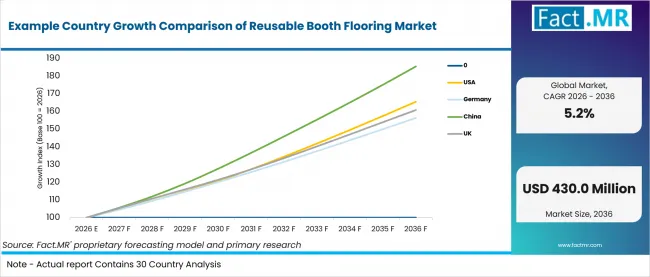
Example Country Growth Comparison Of Reusable Booth Flooring Market | Source: Fact.MR
| Country | CAGR (2026-2036) |
|---|---|
| UAE | 5.9% |
| USA | 5.2% |
| Japan | 5.1% |
| UK | 4.9% |
| Germany | 4.6% |
Source: Fact.MR analysis. Updated Jul 28, 2026
Why does rapid event turnover matter in the UAE?
5.9% CAGR, driven by high event throughput and international participation.
The UAE market is shaped by venues that host international exhibitions within tight schedules. Flooring providers may have only a short period to remove one booth, inspect the material, and prepare it for the next event. This increases the value of rental inventories, local service crews, and clearly numbered installation systems. Quick replacement of damaged pieces also helps contractors avoid delays during stand construction.
What defines purchasing decisions in the USA?
5.2% CAGR, supported by measurement-led exhibitor purchasing.
USA adoption depends on whether reusable flooring can deliver a clear return across repeated shows. Exhibit houses compare installation hours, freight volume, replacement frequency, and storage costs before approving a system. Broad reuse claims carry less weight than measurable performance records. Client approval becomes easier when the flooring keeps the same appearance across events held in different locations.
How do compact exhibition layouts influence Japan?
5.1% CAGR, shaped by compact systems and reliable operation.
Japan’s market develops around space efficiency rather than large flooring inventories. Compact booths require accurate panel alignment because small height differences are easy to notice. Storage limits also favor systems that stack neatly after dismantling. Providers must therefore balance low storage volume with secure installation, especially during heavily attended events where flooring remains under constant use.
Why does rental inventory support UK growth?
4.9% CAGR, supported by recurring exhibitions and rental inventory use.
The UK opportunity is closely linked to contractors that circulate flooring between recurring trade shows. Profitability depends on how many times carpet tiles and modular panels can return to service before refurbishment is needed. Inspection after dismantling plays an important role because providers must separate units that need simple cleaning from those with damaged corners, compressed surfaces, or weakened joints.
What shapes Germany’s more controlled growth path?
4.6% CAGR, driven by an international and technically demanding trade-fair base.
Germany places greater emphasis on installation documentation and technical fit within complex booth designs. Raised floors often need to accommodate power cables, data lines, and transitions without creating visible gaps or trip points. Purchasing therefore goes beyond surface appearance. Exhibit builders review load stability, ramp placement, and underfloor access before approval, which can slow qualification but support demand for better-engineered systems.
Who leads the Reusable Booth Flooring Market?
Brumark and ExpoFloor have the strongest direct presence, while Signature Systems, Stand-On, and Matéflex support the wider modular flooring market.
Brumark offers trade show carpet, raised floors, interlocking systems, and rental services. ExpoFloor provides reusable raised flooring for exhibitions across Europe. Signature Systems supplies temporary event flooring. Stand-On focuses on reusable booth floors, while Matéflex offers modular tile systems for temporary event spaces.
From 2026 to 2036, competition will focus on fast installation, strong edges, and flooring condition after repeated use. Buyers will also compare cleaning needs, storage space, replacement parts, and service support. Providers that keep flooring reliable after transport, cleaning, and reinstallation are likely to attract more exhibit houses and rental companies.
Which companies are the key providers?
Key companies include Brumark, ExpoFloor, Signature Systems, Stand-On, and Matéflex.
- Brumark
- ExpoFloor
- Signature Systems
- Stand-On
- Matéflex
Bibliography
- U.S. Environmental Protection Agency. (2026, March 18). Comprehensive procurement guidelines for construction products.
- European Commission, Directorate-General for Environment. (2025, July 11). Plan to boost circular and efficient products on the European market: Ecodesign for Sustainable Products and Energy Labelling Working Plan 2025–2030.
- Ministry of Housing, Communities and Local Government. (2025, February). Construction products reform green paper 2025. Government of the United Kingdom.
- Brumark. (2026, March 16). EXHIBITORLIVE partnership advances sustainable flooring standards with leadership from FERN and infrastructure from Brumark.
This Report Answers
- The report provides strategic intelligence on the Reusable Booth Flooring Market across Flooring Type and Surface Finish choices that shape booth installation programs.
- Segment analysis covers Interlocking tiles and Carpet finish as the share leaders within the 2026 market.
- Country outlook evaluates China and UAE alongside USA and Japan. UK and Germany complete the growth comparison across the profiled markets.
- Competitive analysis profiles Brumark and ExpoFloor alongside Signature Systems and Stand-On. Matéflex completes the provider set with broader sustainable exhibit relevance.
- Adjacent review connects booth flooring with floor POP displays because exhibitors evaluate floor finish with visible booth presentation assets. Display planning connects with backlit displays when booth appearance depends on lighting and surface consistency.
What does the Reusable Booth Flooring Market cover?
Modular exhibition floor systems are used for repeated installation across exhibitions and conferences. Activations and related temporary business events are included when the floor is reused.
The reusable booth flooring market covers interlocking tiles and raised modular floors. Reusable carpet tiles and vinyl plank systems are included when they support repeated booth use. Recycled rubber panels are included when they serve the defined event-flooring function.
The market differs from general event equipment because commercial value comes from floor condition after repeated installation. Single-use carpet and permanent commercial flooring remain outside the valuation. Venue slab work and waste-disposal charges are excluded.
What is included in the scope?
Reusable booth flooring systems are used by exhibit houses and event rental companies. Convention centers and brand owners are included when they buy or rent the defined flooring package.
The scope includes Flooring Type and Surface Finish alongside Reuse Cycle. Buyer and Sustainability Claim complete the segment structure. Coverage spans interlocking tiles and raised modular floors. Reusable carpet tiles and vinyl plank systems are included when used for booth flooring.
What is excluded from the scope?
Single-use carpet and permanent commercial flooring remain outside the scope of this market. General event management is excluded unless it includes the defined flooring product.
The scope excludes unrelated venue construction and floor-space rental. Concrete floor work is excluded unless the value is directly tied to temporary booth flooring. Services that do not deliver the defined flooring function are outside the market boundary.
How Was the Analysis Built?
The analysis draws on 120+ sources, 35+ company portfolios, 25+ countries, and more than 20 industry interviews.
- Primary Research: Primary research includes discussions with manufacturers, service providers, technology developers, distributors, end users, procurement teams, and subject-matter experts. These conversations examine purchasing priorities, product adoption, operational challenges, approval requirements, competitive positioning, and the factors that influence wider market acceptance.
- Desk Research: Desk research covers government statistics, regulatory publications, company filings, trade data, technical studies, industry associations, standards, public policy, and other authoritative sources. Every source used in the analysis is documented in the bibliography.
- Market Sizing and Forecasting: Market estimates combine historical performance, demand indicators, pricing and volume trends, segment shares, company participation, country-level growth, adoption patterns, investment activity, and barriers to market expansion.
- Data Validation and Update Cycle: Findings are validated by comparing primary interviews with public data, company activity, regulatory changes, trade patterns, and industry developments. Regular updates review new product launches, capacity changes, partnerships, approvals, procurement trends, and shifts in commercial adoption.
Segmentation
What is the report’s scope and coverage?
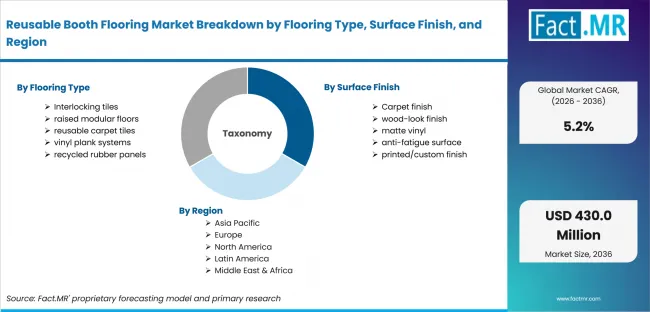
Reusable Booth Flooring Market Breakdown By Flooring Type Surface Finish And Region | Source: Fact.MR
| Attribute | Details |
|---|---|
| Quantitative Units | USD million in 2026 to USD million by 2036 at a CAGR |
| Market Definition | Modular exhibition floor systems intended for repeated installation across multiple events when offered as a commercial event solution. |
| Flooring Type | Interlocking tiles, raised modular floors, reusable carpet tiles, vinyl plank systems, recycled rubber panels |
| Surface Finish | Carpet finish, wood-look finish, matte vinyl, anti-fatigue surface, printed/custom finish |
| Reuse Cycle | 2-3 uses, 4-6 uses, 7-10 uses, >10 uses, refurbished stock |
| Buyer | Exhibit houses, event rental companies, convention centers, brand owners, booth fabricators |
| Sustainability Claim | Reusable, recyclable, recycled-content, low-VOC, landfill-diversion certified |
| Regions Covered | North America, Latin America, Europe, East Asia, South Asia & Oceania, Middle East & Africa |
| Countries Covered | USA, Canada, Brazil, Mexico, Germany, U.K., France, Italy, Spain, South Korea, Japan, Australia & New Zealand, GCC Countries, South Africa, UAE |
| Key Companies Profiled | Brumark, ExpoFloor, Signature Systems, Stand-On, Matéflex |
| Forecast Period | 2026 to 2036 |
| Approach | Hybrid top-down and bottom-up approach using exhibition-flooring demand indicators, reuse-cycle assumptions, country growth, provider participation, rental and purchase behavior, installation requirements, service depth, condition recovery, and adoption barriers. |
Source: Fact.MR analysis. Updated Jul 28, 2026
How is the market segmented?
-
By Flooring Type:
- Interlocking tiles
- Raised modular floors
- Reusable carpet tiles
- Vinyl plank systems
- Recycled rubber panels
-
By Surface Finish:
- Carpet finish
- Wood-look finish
- Matte vinyl
- Anti-fatigue surface
- Printed/custom finish
-
By Reuse Cycle:
- 2-3 uses
- 4-6 uses
- 7-10 uses
- >10 uses
- Refurbished stock
-
By Buyer:
- Exhibit houses
- Event rental companies
- Convention centers
- Brand owners
- Booth fabricators
-
By Sustainability Claim:
- Reusable
- Recyclable
- Recycled-content
- Low-VOC
- Landfill-diversion certified
-
By Region:
- North America
- USA
- Canada
- Latin America
- Brazil
- Mexico
- Rest of Latin America
- Europe
- Germany
- U.K.
- France
- Italy
- Spain
- Rest of Europe
- East Asia
- South Korea
- Japan
- China
- South Asia & Oceania
- India
- Australia & New Zealand
- Rest of South Asia & Oceania
- Middle East & Africa
- GCC Countries
- South Africa
- UAE
- Rest of Middle East & Africa
- North America
Frequently Asked Questions
Which Flooring Type leads the market?
Which Surface Finish leads the market?
Which Reuse Cycle leads the market?
Which Buyer leads the market?
Which country records the fastest listed CAGR?
What is the primary driver in this market?
What is the main restraint?
Why do exhibit houses lead demand?
Who worked on this report


Preview the report firsthand - request a free sample
Free SampleGet the brochure for pricing and purchase details
Download PDF