- Base Value(2025): 7.2 Bn
- Estimated Value(2026): 7.7 Bn
- Forecast Value (2036): 14.5 Bn
- CAGR (2026 - 2036): 6.6%
Robot Vision System Market Analysis and Forecast by Fact.MR
- The global market for robot vision systems is estimated to be around US$ 7.68 billion in 2026 and has been forecast to expand at a CAGR of 6.6% to end up at US$ 15.50 billion by 2036.
- Robot vision systems are imaging, processing, and analysis platforms that enable robotic systems to perceive, interpret, and respond to their visual environment.
- Configurations span 2D, 3D, and AI-based vision architectures deployed across inline, robot-mounted, and standalone setups.
- These systems integrate cameras, optics, lighting, and processing hardware with deep learning and rule-based software for tasks including quality inspection, pick-and-place guidance, assembly verification, and dimensional measurement.
- Growth is supported by rising automation investment, tightening quality requirements, and expanding AI inference capability at the production edge.
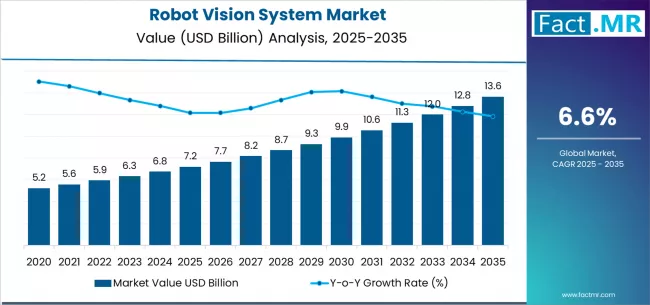
Robot Vision System Market Value Analysis | Source: Fact.MR
Summary of the Robot Vision System Market
- Market Snapshot
- In 2025, the global Robot Vision System Market was valued at approximately USD 7.68 Billion.
- The market is estimated to reach USD 7.68 Billion in 2026 and is projected to attain USD 15.50 Billion by 2036.
- The robot vision system market is likely to expand at a CAGR of 6.6% during the forecast period.
- The market is anticipated to create an absolute dollar opportunity of USD 7.3 Billion between 2026 and 2036.
- 2D robot vision systems account for 28.9% of product segment share in 2026.
- USA (7.4%) and Mexico (7.0%) are the key growth markets during the forecast period.
- Demand and Growth Drivers
- Tightening quality tolerance standards across automotive, electronics, and pharmaceutical manufacturing are increasing the specification rate for inline vision systems on production lines.
- Expanding AI inference capability at the production edge is enabling vision systems to detect complex, previously unclassifiable defects without reliance on external computing infrastructure.
- Rising adoption of collaborative robots with integrated vision guidance is broadening the addressable market for compact, easy-to-deploy vision configurations.
- Growing use of 3D vision for bin picking, depalletizing, and random object handling is expanding vision system demand beyond traditional structured inspection applications.
- Increasing integration between vision platforms and manufacturing execution systems is enabling closed-loop quality feedback that links defect detection to upstream process adjustment.
- Product and Segment View
- 2D robot vision systems account for 28.9% of the product segment in 2026, supported by their lower cost, faster processing speeds, and broad applicability across barcode reading, label inspection, and surface defect detection.
- Quality inspection represents 31.4% of the application segment in 2026, driven by demand for automated defect detection, dimensional verification, and compliance checking across automotive, electronics, and packaging lines.
- Inline vision systems hold 33.5% of the deployment segment, reflecting the preference for vision systems integrated directly into production flow for real-time pass/fail decisions without operator intervention.
- Key segmentation includes:
- Product Type: 2D Robot Vision System, 3D Robot Vision System, AI Based Robot Vision System
- Application: Quality Inspection, Pick And Place Guidance, Assembly Verification, Measurement And Gauging, Surface Inspection
- End Use: Automotive Industry, Electronics Industry, Industrial Manufacturing, Food And Beverage, Pharmaceutical Industry
- These systems enable:
- Real-time visual inspection, defect classification, and dimensional measurement within production line cycle times
- Vision-guided robot positioning for pick-and-place, bin picking, and assembly operations
- Closed-loop quality feedback between vision detection systems and upstream manufacturing process controls
- Geography and Competitive Outlook
- North America leads country-level growth, with USA at 7.4% CAGR reflecting automotive quality automation, electronics inspection investment, and AI vision adoption across manufacturing.
- Europe shows strong demand, with Germany at 6.8% supported by automotive OEM vision system modernization and Industrie 4.0 inline inspection programs.
- Asia Pacific maintains high adoption density, with Japan, South Korea, and China accounting for the largest installed base of vision-guided robotic systems globally.
- Key companies include Cognex, Keyence, Teledyne DALSA, Basler, Omron, SICK, Hexagon, Qualcomm Technologies, National Instruments, and ISRA Vision.
- Analyst Opinion
- Shambhu Nath Jha, Principal Consultant at Fact.MR, says 'The robot vision system market is shifting from rule-based pattern matching toward AI-powered classification that learns from production data. This transition is expanding the types of defects and anomalies that can be detected automatically, opening vision system deployment to applications that were previously uneconomical to automate. The competitive differentiation is moving from camera hardware toward software capability, specifically the ability to train models with small datasets, deploy inference at the edge without external PCs, and integrate with cloud-based model management platforms. Companies that reduce the programming barrier for non-specialist users will capture the broadest adoption.'
Key Growth Drivers, Constraints, and Opportunities
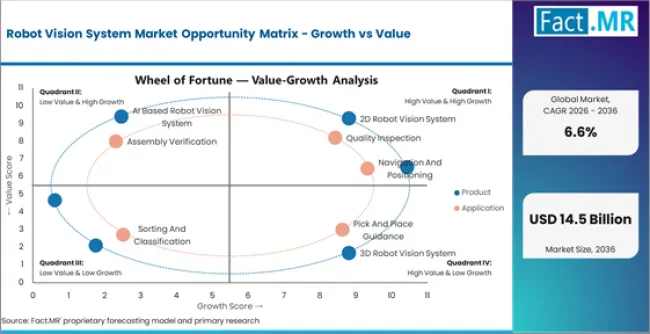
Robot Vision System Market Opportunity Matrix Growth Vs Value | Source: Fact.MR
Key Factors Driving Growth
- AI-powered edge inference is enabling vision systems to classify complex defects using small training datasets, reducing the expertise and time required for deployment in new applications.
- Rising quality compliance requirements in automotive, pharmaceutical, and electronics manufacturing are making inline vision inspection a procurement standard rather than an optional upgrade.
- 3D vision system costs are declining as structured light and time-of-flight sensor prices fall, expanding economic viability for bin picking, depalletizing, and random object handling tasks.
Key Market Constraints
- Application-specific tuning and lighting design remain significant deployment costs, limiting adoption among manufacturers without dedicated automation engineering teams.
- Interoperability gaps between different vision platforms and robot controller ecosystems create friction in multi-vendor production environments.
- High-speed production lines with sub-second cycle times impose processing latency constraints that limit the complexity of AI models deployable in real-time inspection.
Key Opportunity Areas
- Cloud-to-edge vision platforms that enable centralized model training with distributed edge deployment are creating new software licensing and subscription revenue models.
- Food and pharmaceutical inspection, where human visual assessment is still prevalent, represents a large underpenetrated vertical for AI-powered vision systems with hygienic design ratings.
- Embedded AI vision controllers that eliminate the need for external PCs are lowering integration complexity and broadening the buyer base to include smaller manufacturers and contract packagers.
Segment-wise Analysis of the Robot Vision System Market
- 2D robot vision systems hold 28.9% of the product segment in 2026, supported by proven performance across high-speed barcode reading, label verification, and surface defect detection.
- Quality inspection represents 31.4% of the application segment, driven by regulatory compliance, product liability considerations, and customer quality expectations across automotive and electronics.
- The automotive industry accounts for 26.8% of the end-use segment, reflecting concentrated investment in inline inspection for body panels, painted surfaces, component assemblies, and weld integrity verification.
The robot vision system market is segmented by product type, application, end use, technology, and deployment type. 2D systems lead by installed base and volume, while 3D and AI-based systems are driving growth through expanding capability in unstructured environments and complex defect classification.
Which Product Type Segment Dominates the Robot Vision System Market?
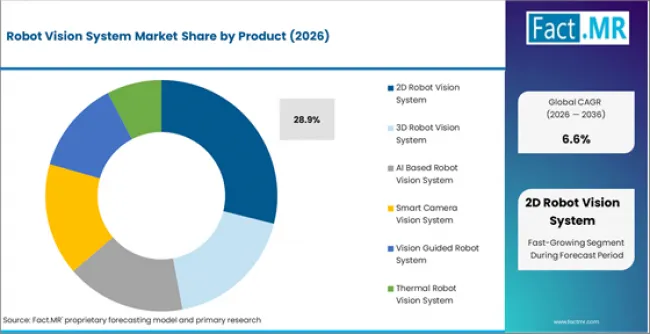
Robot Vision System Market Analysis By Product | Source: Fact.MR
2D robot vision systems account for 28.9% of the product segment in 2026. Their leadership reflects the large installed base across high-throughput inspection applications where speed, cost, and reliability are primary procurement criteria. 2D systems excel in structured environments with controlled lighting and consistent part presentation, making them the default choice for barcode reading, label verification, presence detection, and surface anomaly inspection.
The segment benefits from mature software libraries, broad camera compatibility, and well-documented integration procedures that lower deployment risk. As AI inference engines become embedded in 2D camera platforms, the functional gap between 2D and 3D systems narrows for many inspection tasks, reinforcing the volume position of 2D architectures.
Which Application Segment Dominates the Robot Vision System Market?
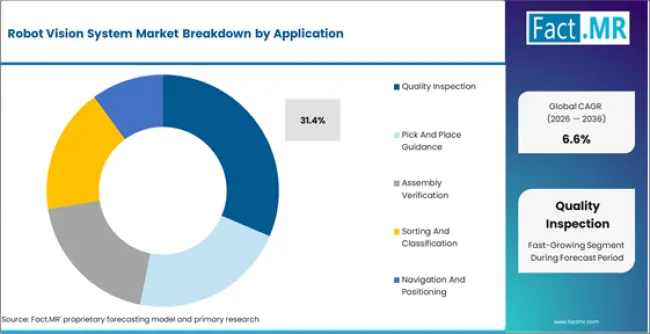
Robot Vision System Market Analysis By Application | Source: Fact.MR
Quality inspection accounts for 31.4% of the application segment in 2026. Demand reflects the central role of vision-based inspection in meeting manufacturing quality targets, regulatory compliance obligations, and end-customer defect tolerance specifications. Automotive body inspection, electronics solder joint verification, and pharmaceutical label compliance are among the highest-volume application channels.
The inspection application also benefits from the shift toward zero-defect manufacturing targets in automotive and medical device production, where missed defects carry significant warranty, recall, and liability costs. As AI models improve detection accuracy for cosmetic and functional defects, the economic case for vision-based inspection strengthens further.
Which Product Trend is Shaping the Next Phase of Growth in the Robot Vision System Market?
AI-based robot vision systems are emerging as the fastest-growing product category, driven by their ability to classify defects that rule-based algorithms cannot reliably detect. Unlike traditional vision systems that require explicit programming for each defect type, AI-based platforms learn from labeled image datasets and generalize to new variations. This reduces setup time for new applications and enables deployment on inspection tasks where defect appearance is variable or difficult to define in advance.
The trend is supported by embedded AI hardware that eliminates the need for external PCs. Vision controllers powered by dedicated AI inference processors can run deep learning models at production speed without adding computing infrastructure to the factory floor. This architectural simplification, combined with training tools that require as few as 10 to 20 labeled images, is pulling demand from manufacturers that previously considered AI vision too complex or costly to deploy.
Regional Outlook Across Key Markets
- USA at 7.4% CAGR reflects automotive quality automation investment, semiconductor inspection demand, and growing deployment of AI-powered vision systems across manufacturing and logistics.
- Mexico at 7.0% growth is supported by nearshoring investment in automotive and electronics manufacturing facilities where rising production complexity requires vision-guided quality and assembly verification.
- Germany at 6.8% reflects Industrie 4.0 inline inspection programs, automotive OEM vision system modernization, and DIN/EU quality certification requirements driving vision system specification.
.webp "Top Country Growth Comparison Robot Vision System Market Cagr (2026 2036)")
Top Country Growth Comparison Robot Vision System Market Cagr (2026 2036) | Source: Fact.MR
CAGR Table
| Country | CAGR (%) |
|---|---|
| USA | 7.4% |
| Mexico | 7.0% |
| Germany | 6.8% |
Source: Fact.MR analysis. Updated Jun 4, 2026
Source: Fact MR (FMR) analysis, based on proprietary forecasting model and primary research.
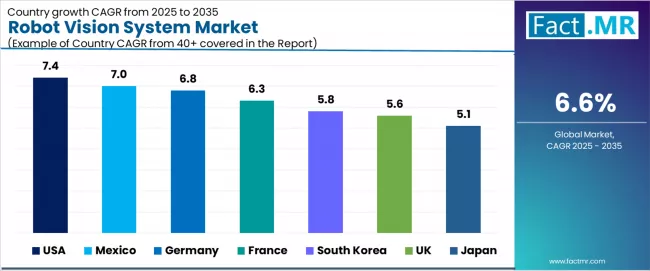
Robot Vision System Market Cagr Analysis By Country | Source: Fact.MR
Market Outlook for Robot Vision Systems in the United States
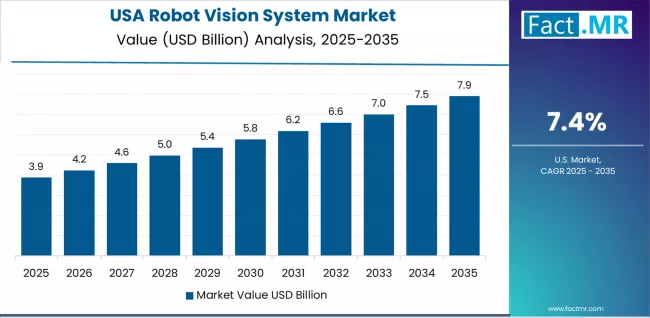
Robot Vision System Market Country Value Analysis | Source: Fact.MR
Demand is concentrated across automotive quality inspection, semiconductor wafer and die verification, electronics assembly guidance, and logistics sortation applications. CHIPS Act investments in semiconductor fabrication are creating procurement pipelines for cleanroom-rated vision systems with sub-micron inspection capability. Reshoring of automotive and electronics manufacturing under IRA provisions is generating incremental demand for inline and robot-mounted vision configurations.
- Semiconductor fabrication investment under the CHIPS Act creates demand for high-resolution vision systems with cleanroom compatibility and sub-micron defect detection.
- Automotive quality compliance requirements sustain specification of inline 2D and 3D vision systems for body panel, paint, and assembly verification.
Mexico Robot Vision System Demand Trends
Manufacturing facility construction by automotive and electronics OEMs across northern and central Mexico is generating embedded vision system procurement as part of new production line commissioning. Robot density remains below USA averages, creating growth headroom as line automation complexity increases. Vision-guided quality inspection is becoming a standard specification for export-oriented facilities where customer tolerance standards require documented automated verification.
- Automotive OEM production facility expansion generates embedded demand for inline vision inspection systems at the point of line commissioning.
- Export quality compliance requirements for electronics contract manufacturers are driving adoption of vision-guided assembly and inspection systems.
Germany Robot Vision System Market Growth Assessment
EU Machinery Regulation requirements and DIN quality standards shape procurement toward certified vision systems with documented inspection performance metrics. Automotive OEM production lines continue to represent the largest single demand channel, with vision systems deployed across body-in-white, paint shop, and final assembly inspection stations. Industrie 4.0 programs are accelerating integration of vision data with manufacturing execution systems for real-time quality analytics and process feedback.
- Automotive production line modernization sustains demand for high-speed inline vision inspection across body, paint, and assembly operations.
- DIN/EU quality certification requirements create procurement preference for vision systems with documented detection rates and traceable inspection records.
Competitive Benchmarking and Company Positioning
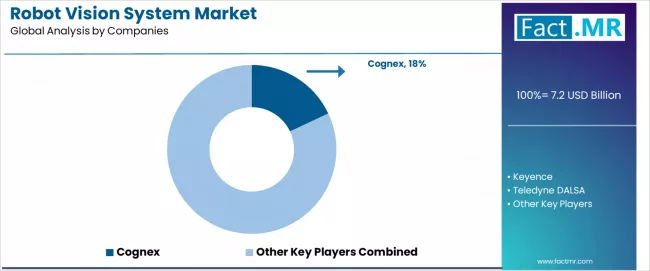
Robot Vision System Market Analysis By Company | Source: Fact.MR
Robot Vision System Market Analysis By Company
- Cognex and Keyence hold the strongest market positions, supported by broad product portfolios spanning 2D, 3D, and AI-based vision platforms with established distribution and application engineering networks across global manufacturing regions.
- Teledyne DALSA, Basler, and Omron compete across specific camera, sensor, and integration tiers, with strength in high-resolution imaging components, cost-effective camera platforms, and robot-integrated vision modules.
- AI inference capability is reshaping competitive differentiation, with embedded edge processing, few-sample training, and cloud-to-edge model management becoming primary specification criteria alongside traditional imaging performance metrics.
The competitive landscape is moderately concentrated, with Cognex and Keyence together accounting for a large share of the industrial machine vision market. These companies compete through comprehensive product ecosystems that span smart cameras, vision controllers, software libraries, and application engineering support. Cognex has accelerated its AI strategy with NVIDIA-powered embedded controllers and a cloud-to-edge platform, while Keyence maintains strength through bundled deployment support and rapid commissioning capability.
Below these leaders, Teledyne DALSA, Basler, SICK, Omron, and ISRA Vision compete across specific imaging technologies, price points, and application specializations. Competition is increasingly determined by software capability, specifically the ease of training AI models, the speed of edge inference, and the depth of integration with robot controllers and manufacturing execution systems.
Key Companies in the Robot Vision System Market
- Cognex and Keyence are the leading global players, supported by comprehensive vision product ecosystems, established manufacturing OEM partnerships, and accelerating investment in embedded AI and cloud-based model management platforms.
- Teledyne DALSA, Basler, Omron, SICK, Hexagon, ISRA Vision, Qualcomm Technologies, and National Instruments hold meaningful positions across specific vision technologies, applications, and regional markets.
Recent Industry Developments
- Cognex, Product Launch, In-Sight 3900 AI Vision System (May 2026): Cognex launched the In-Sight 3900, an embedded AI vision system powered by Qualcomm Dragonwing platforms, delivering up to 4X faster processing, support for 25 MP imaging, and PC-free real-time edge inspection capability for high-speed manufacturing lines.
- Cognex, Product Launch, In-Sight 6900 Vision Controller (April 2026): Cognex introduced the In-Sight 6900 Vision Controller powered by NVIDIA Jetson technology, delivering up to 157 TOPS of AI processing capacity with modular camera and optics configuration, enabling manufacturers to handle demanding inspection workloads without external PCs.
- Cognex, Product Launch, DataMan 290 and 390 Barcode Readers (January 2025): Cognex launched the DataMan 290 and 390 barcode readers, expanding its fixed-mount reading portfolio with improved decode rates and processing speed for high-throughput logistics and manufacturing applications.
- Keyence, Platform Update, CV-X/XG-X Machine Vision Series (2025): Keyence updated its CV-X/XG-X series machine vision platform with integrated deep learning algorithms for real-time defect detection, strengthening its position in high-speed inspection applications across automotive and electronics manufacturing.
Leading Companies Shaping the Robot Vision System Market
- Cognex
- Keyence
- Teledyne DALSA
- Basler
- Omron
- SICK
- Hexagon
- ISRA Vision
- Qualcomm Technologies
- National Instruments
Sources and Research References
- Cognex Corporation. Vision system product portfolio, AI platform updates, and technology announcements.
- Keyence Corporation. Machine vision platform updates and deep learning integration releases.
- International Federation of Robotics (IFR). World Robotics annual installation and density statistics.
- Automated Imaging Association (AIA). Machine vision market surveys and industry benchmarks.
- Automotive OEM quality standards publications, electronics manufacturing trade databases, and company product catalogs.
- Primary interviews with vision system manufacturers, robot OEMs, system integrators, and manufacturing end users.
This bibliography is provided for reader reference and is not exhaustive. The full report contains the complete reference list and detailed citations.
Key Questions This Report Addresses
- What is the current and future size of the Robot Vision System Market?
- How fast is the Robot Vision System Market expected to grow between 2026 and 2036?
- Which product type is likely to lead the market by 2026?
- Which application segment is expected to account for the highest demand by 2026?
- What factors are driving demand for robot vision systems globally?
- How is AI-powered edge inference influencing market growth?
- Why is the USA emerging as one of the fastest-growing markets?
- How are quality compliance requirements supporting demand?
- Which countries are projected to show the fastest growth through 2036?
- Who are the key companies active in the Robot Vision System Market?
- How does Fact.MR estimate and validate the market forecast?
Robot Vision System Market Definition
The robot vision system market covers imaging, processing, and analysis platforms that enable robotic systems to perceive and respond to their visual environment. It includes 2D, 3D, and AI-based vision architectures across inline, robot-mounted, and standalone deployment configurations used for inspection, guidance, verification, and measurement.
Robot Vision System Market Inclusions
- The scope covers global and regional market size and forecasts for 2026 to 2036 across product type, application, end use, technology, deployment type, and region.
- It includes regional demand analysis based on manufacturing automation investment, quality compliance requirements, robot installation volumes, and AI adoption trends.
- The report covers technology trends, pricing analysis, competitive dynamics, and product portfolio benchmarking across leading and emerging players.
Robot Vision System Market Exclusions
- The scope excludes general-purpose security cameras, consumer imaging products, and surveillance systems without integration into robotic or automated manufacturing workflows.
- It excludes standalone image processing software sold without bundled hardware, as well as research-stage vision prototypes not available for commercial procurement.
- The report excludes medical imaging systems, satellite imaging platforms, and autonomous vehicle perception modules not used in industrial robotic applications.
Robot Vision System Market Research Methodology
- The methodology combines secondary research, primary interviews, and forecast modelling.
- It draws on 120+ secondary sources and benchmarks 60+ company product portfolios.
- Market sizing covers 30+ countries through a demand-side model, supported by top-down validation.
- Key inputs include robot installation volumes, manufacturing quality investment, AI adoption benchmarks, and inspection throughput requirements.
- Primary validation includes 25+ interviews across vision system manufacturers, robot OEMs, system integrators, and manufacturing end users.
Segmentation
Scope of Analysis
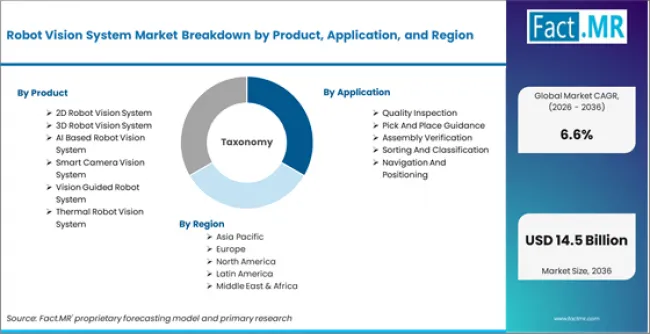
Robot Vision System Market Breakdown By Product, Application, And Region | Source: Fact.MR
| Parameter | Details |
|---|---|
| Quantitative Units | USD 8.18 Billion to USD 15.50 Billion, at a CAGR of 6.6% |
| Market Definition | The Robot Vision System Market covers imaging, processing, and analysis platforms enabling robotic systems to perceive and respond to their visual environment across 2D, 3D, and AI-based architectures. |
| Regions Covered | North America, Latin America, Europe, East Asia, South Asia and Pacific, Middle East and Africa |
| Countries Covered | USA, Mexico, Germany, Japan, South Korea, 30 plus countries |
| Key Companies | Cognex, Keyence, Teledyne DALSA, Basler, Omron, SICK, Hexagon, ISRA Vision, Qualcomm Technologies, National Instruments |
| Forecast Period | 2026 to 2036 |
| Approach | Hybrid demand-side and top-down methodology built on robot installation data, manufacturing quality investment, AI adoption benchmarks, and primary interviews |
Source: Fact.MR analysis. Updated Jun 4, 2026
Robot Vision System Market Segmentation
-
Robot Vision System Market Segmented by Product:
- 2D Robot Vision System
- Line Scan Vision System
- High Speed Production Inspection
- Packaging Line Quality Control
- Area Scan Vision System
- General Industrial Inspection
- Pick And Place Guidance
- Line Scan Vision System
- 3D Robot Vision System
- Stereo Vision System
- Depth Based Object Detection
- Robotic Bin Picking
- Laser Triangulation Vision System
- Precision Assembly Guidance
- Dimensional Measurement Tasks
- Stereo Vision System
- AI Based Robot Vision System
- Deep Learning Vision System
- Defect Detection Automation
- Surface Inspection Analysis
- Computer Vision Analytics System
- Object Classification Tasks
- Real Time Quality Inspection
- Deep Learning Vision System
- Smart Camera Vision System
- Embedded Smart Camera System
- Standalone Inspection Units
- Compact Manufacturing Cells
- Industrial Smart Camera Network
- Factory Wide Vision Integration
- Multi Station Inspection Systems
- Embedded Smart Camera System
- Vision Guided Robot System
- Robot Mounted Vision System
- Dynamic Pick And Place Operations
- Flexible Assembly Line Control
- Fixed Station Vision Guidance System
- Precision Positioning Tasks
- Industrial Automation Cells
- Robot Mounted Vision System
- Thermal Robot Vision System
- Thermal Imaging Inspection System
- Electrical Fault Detection
- Heat Signature Monitoring
- Infrared Vision System
- Process Monitoring Applications
- Industrial Safety Inspection
- Thermal Imaging Inspection System
- 2D Robot Vision System
-
Robot Vision System Market Segmented by Application:
- Quality Inspection
- Surface Defect Detection
- Electronics Manufacturing Inspection
- Automotive Part Inspection
- Dimensional Measurement
- Precision Engineering Verification
- Tolerance Analysis
- Surface Defect Detection
- Pick And Place Guidance
- Bin Picking Operations
- Random Object Handling
- Warehouse Automation Support
- Precision Placement Tasks
- Electronics Assembly Support
- Component Positioning
- Bin Picking Operations
- Assembly Verification
- Component Alignment Verification
- Automotive Assembly Lines
- Electronics Assembly Validation
- Weld Inspection Systems
- Metal Fabrication Quality Control
- Structural Integrity Checking
- Component Alignment Verification
- Sorting And Classification
- Automated Sorting Systems
- Logistics Parcel Sorting
- Packaging Line Classification
- Product Identification Systems
- Barcode And Label Recognition
- Manufacturing Sorting Lines
- Automated Sorting Systems
- Navigation And Positioning
- Robot Path Guidance Systems
- Dynamic Environment Navigation
- Industrial Mobility Support
- Autonomous Position Correction
- Assembly Line Calibration
- Precision Movement Control
- Robot Path Guidance Systems
- Quality Inspection
-
Robot Vision System Market Segmented by End Use:
- Automotive Industry
- Vehicle Manufacturers
- Assembly Line Vision Inspection
- Welding Quality Control
- Automotive Component Suppliers
- Precision Part Verification
- Surface Defect Detection
- Vehicle Manufacturers
- Electronics Industry
- Semiconductor Manufacturers
- Wafer Inspection Systems
- Chip Defect Detection
- Consumer Electronics Manufacturers
- Device Assembly Verification
- Component Placement Accuracy
- Semiconductor Manufacturers
- Industrial Manufacturing
- Metal Fabrication Companies
- Welding Inspection Systems
- Surface Quality Monitoring
- Plastics Manufacturers
- Injection Mold Inspection
- Defect Detection Systems
- Metal Fabrication Companies
- Logistics And Warehousing
- Ecommerce Fulfillment Centers
- Automated Sorting Systems
- Package Recognition
- Third Party Logistics Providers
- Inventory Tracking Systems
- Barcode Inspection Automation
- Ecommerce Fulfillment Centers
- Healthcare And Pharmaceutical
- Medical Device Manufacturers
- Precision Component Inspection
- Sterile Manufacturing Verification
- Pharmaceutical Companies
- Packaging Inspection Systems
- Tablet And Capsule Inspection
- Medical Device Manufacturers
- Automotive Industry
-
Robot Vision System Market Segmented by Technology:
- Computer Vision Technology
- Image Processing Algorithms
- Object Detection Systems
- Pattern Recognition
- Machine Learning Vision Systems
- Deep Learning Models
- Adaptive Inspection Algorithms
- Image Processing Algorithms
- Imaging Technology
- CCD And CMOS Sensors
- High Resolution Imaging
- Industrial Grade Cameras
- Laser Imaging Systems
- 3D Depth Mapping
- Precision Measurement Imaging
- CCD And CMOS Sensors
- Lighting Technology
- LED Illumination Systems
- Controlled Inspection Lighting
- High Contrast Imaging
- Laser Lighting Systems
- Structured Light Projection
- 3D Vision Enhancement
- LED Illumination Systems
- Processing Technology
- Edge Processing Systems
- Real Time Image Processing
- Low Latency Inspection
- Cloud Vision Processing
- Big Data Image Analytics
- Remote Inspection Systems
- Edge Processing Systems
- Integration Technology
- Robot Vision Integration Platforms
- PLC And Control System Sync
- Factory Automation Integration
- Industrial IoT Vision Systems
- Smart Factory Connectivity
- Data Driven Inspection
- Robot Vision Integration Platforms
- Computer Vision Technology
-
Robot Vision System Market Segmented by Deployment:
- Inline Vision Systems
- Production Line Integration
- Continuous Inspection Systems
- Real Time Quality Control
- Stationary Inspection Cells
- Fixed Position Analysis
- Batch Inspection Systems
- Production Line Integration
- Robot Mounted Vision Systems
- Mobile Inspection Systems
- Dynamic Production Environments
- Flexible Automation Cells
- End Effector Vision Systems
- Adaptive Robotic Control
- Precision Handling Tasks
- Mobile Inspection Systems
- Standalone Vision Systems
- Independent Inspection Units
- Manual Production Support
- Laboratory Testing Systems
- Portable Vision Devices
- Field Inspection Applications
- Maintenance And Repair Tasks
- Independent Inspection Units
- Inline Vision Systems
-
Robot Vision System Market by Region:
- North America
- USA
- Canada
- Mexico
- Latin America
- Brazil
- Chile
- Rest of Latin America
- Western Europe
- Germany
- UK
- Italy
- Spain
- France
- Nordic
- BENELUX
- Rest of Western Europe
- Eastern Europe
- Russia
- Poland
- Hungary
- Balkan & Baltic
- Rest of Eastern Europe
- East Asia
- China
- Japan
- South Korea
- South Asia and Pacific
- India
- ASEAN
- Australia & New Zealand
- Rest of South Asia and Pacific
- Middle East & Africa
- Kingdom of Saudi Arabia
- Other GCC Countries
- Turkiye
- South Africa
- Other African Union
- Rest of Middle East & Africa
- North America
Frequently Asked Questions
How big is the robot vision system market in 2026?
What will be the size of robot vision system market in 2036?
How much will be the robot vision system market growth between 2026 and 2036?
What are the key product types in the robot vision system market?
Which application segment is expected to contribute significant share in the robot vision system market in 2026?
Who worked on this report


Preview the report firsthand - request a free sample
Free SampleGet the brochure for pricing and purchase details
Download PDF