- Market Value (2025):USD 130 Million
- Estimated Value (2026):USD 158 Million
- Forecast Value (2036): USD 650 Million
- CAGR (2026-2036):15.2%
What is the robotic trocar sleeves market forecast to be worth by 2036?
USD 158 million in 2026 to USD 650 million by 2036, at 15.2% CAGR.
- The robotic trocar sleeves market crossed a valuation of USD 130 million in 2025. Demand is expected to increase from USD 158 million in 2026 to USD 650 million by 2036.
- The market is forecast to record 15.2% CAGR from 2026 to 2036 as robotic-assisted procedures create recurring demand for controlled access consumables.
- Robotic trocar sleeves sit between the patient and the robotic instrument. The category connects with laparoscopic devices because the sleeve still performs the core access function used in minimally invasive surgery.
- The difference is that robotic sleeves must handle instrument articulation and robotic arm positioning with platform fit.
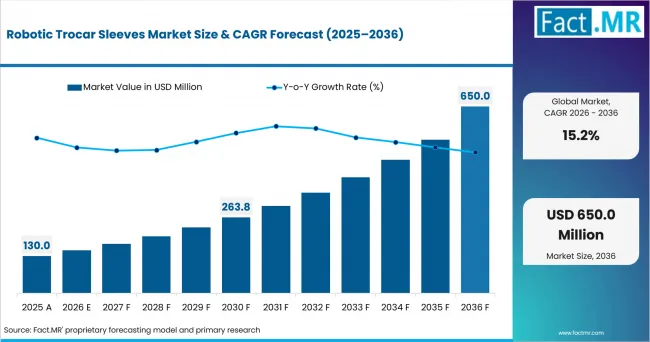
Robotic Trocar Sleeves Market Market Value Analysis | Source: Fact.MR
What are the defining numbers behind robotic trocar sleeves market growth?
USD 492 million absolute opportunity by 2036, led by robotic procedure volume and platform-specific access needs.
- Demand Drivers in the Market
- Robotic surgery program directors need sleeves that maintain stable access during instrument articulation.
- Operating room managers need access products that reduce case disruption and support predictable turnover.
- Sterile processing teams need clear choices between reusable sleeve economics and disposable sleeve convenience.
- OEM channel teams need platform-compatible sleeves that strengthen recurring consumable demand.
- Key Segments Analyzed
- By Sleeve Type: Disposable sleeves are expected to hold 46.0% share in 2026 because robotic case flow favors sterile, ready-to-use access products.
- By Robot Platform: Multi-arm systems lead because established robotic surgery programs commonly use multi-port operating setups. The segment is projected to capture 52.0% share in 2026.
- By Procedure: Urology is likely to account for 34.0% share in 2026 because robotic-assisted surgery is deeply embedded in prostate, kidney and bladder procedures.
- By Customer Type: Hospitals lead because most robotic platforms are installed in high-acuity surgical departments. The segment is expected to hold 61.0% share in 2026.
- By Geography: The United States is projected to record 16.8% CAGR through 2036 as robotic surgery programs create recurring sleeve use.
- Analyst Opinion at Fact.MR
- Shambhu Nath Jha, Senior Analyst at Fact.MR, states, “Robotic trocar sleeves look like small consumables, but the operating room sees them as access-control products. We see hospitals asking whether a sleeve protects seal stability, supports instrument exchange and fits the robotic platform already in use. Suppliers that prove procedure reliability will have stronger access than suppliers that compete only on product price.”
- Strategic Implications
- Robotic platform OEMs should treat sleeves as part of the procedure ecosystem, not a peripheral accessory.
- Hospitals should evaluate sleeve economics through case continuity and reprocessing burden.
- Consumable suppliers can gain entry through platform fit, procedure-specific design and reliable sterile packaging.
- Distributors should build product sets around robotic procedure volume instead of general trocar demand.
FDA documentation for da Vinci 5 describes the system as a software-controlled electromechanical platform used with endoscopes, EndoWrist instruments and accessories. FDA documentation for Versius also describes robotic control of endoscopic instruments and accessories for soft tissue minimal access surgery. These signals show why sleeves, seals and instrument ports are not simple trocar add-ons inside robotic programs.
The United States is projected to record 16.8% CAGR through 2036 as robotic urology and general surgery programs expand access-consumable use. Germany is expected to post 15.9% CAGR through 2036 as hospitals standardize robotic access products around procedure workflows. Japan is likely to record 15.2% CAGR as compact surgical programs favor stable sleeve formats. China is forecast to advance at 14.6% CAGR as private hospitals adopt robotic soft-tissue surgery. South Korea is set to record 14.1% CAGR as robotic surgery centers improve minimally invasive procedure flow.
How does the robotic trocar sleeves market break down by segment?
Disposable sleeves lead at 46.0%; multi-arm systems lead at 52.0%.
Which sleeve type dominates?
Disposable sleeves hold 46.0% share in 2026.
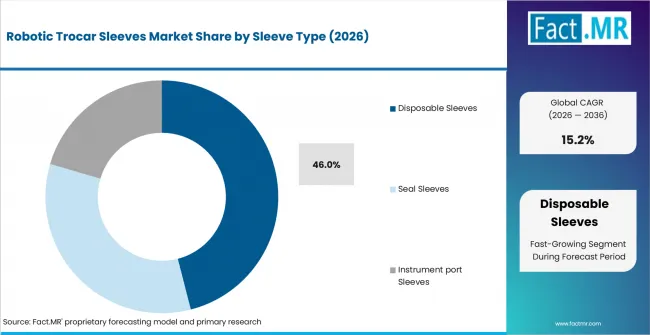
Robotic Trocar Sleeves Market Analysis By Sleeve Type | Source: Fact.MR
Disposable sleeves are expected to hold 46.0% share in 2026 because robotic operating rooms value sterile readiness and predictable setup. These sleeves reduce handling steps before the case begins. Reusable sleeves are relevant where hospitals have strong cleaning capacity, but robotic programs often prefer products that lower setup variation. Seal sleeves gain importance because robotic instrument movement can challenge insufflation stability. Obturator sleeves support controlled entry, while instrument port sleeves help manage repeated tool exchange. The segment connects with disposable trocars because single-use access products are already familiar to operating room teams.
Which robot platform dominates?
Multi-arm systems capture 52.0% share in 2026.
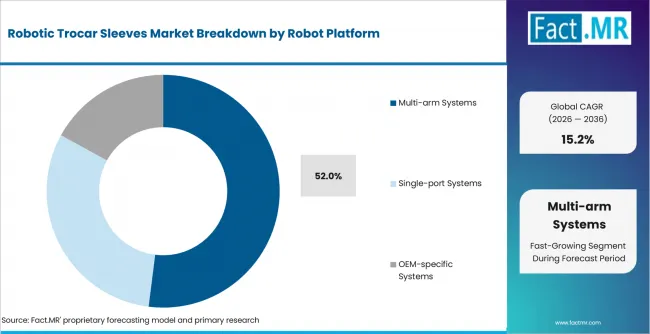
Robotic Trocar Sleeves Market Analysis By Robot Platform | Source: Fact.MR
Multi-arm systems lead because established robotic programs commonly rely on several access points. The procedure team needs sleeves that hold position while robotic arms operate around the patient. The segment is projected to capture 52.0% share in 2026 as multi-port surgical workflows continue to define many robotic programs. Single-port systems create a different access challenge because several instruments may move through one entry pathway. Modular robots increase demand for adaptable sleeve formats because arm placement can differ by room layout. Laparoscopic robotic platforms keep sleeve demand tied to surgical procedures that already use access ports.
Which procedure dominates?
Urology holds 34.0% share in 2026.
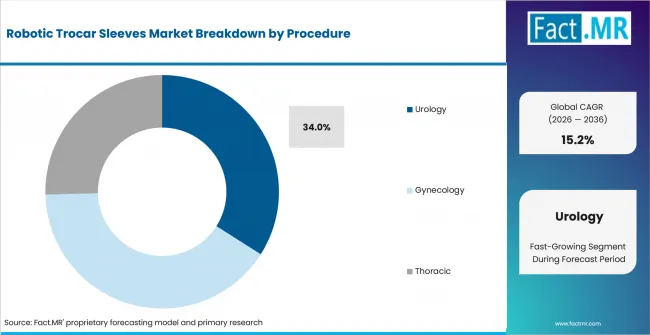
Robotic Trocar Sleeves Market Analysis By Procedure | Source: Fact.MR
Urology leads because robotic-assisted surgery has deep use in prostate, kidney and bladder procedures. The procedure segment is likely to account for 34.0% share in 2026 as robotic systems support repeat case volume in high-acuity hospitals. FDA clearance for robotic systems in urologic procedures supports the procedure base behind robotic access consumables. Gynecology is another important application because robotic access points must support delicate tissue work and stable visualization. General surgery adds volume through cholecystectomy, hernia repair and colorectal procedures. Thoracic procedures need stable access inside constrained working spaces.
Which customer type dominates?
Hospitals hold 61.0% share in 2026.
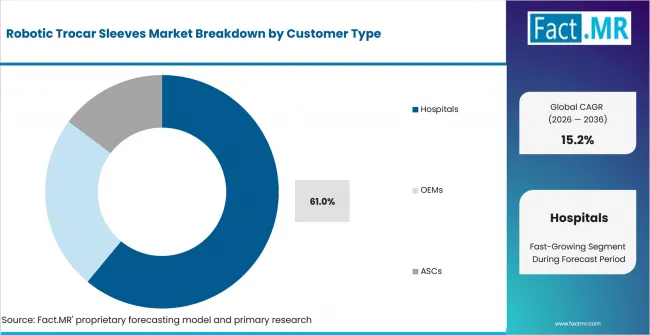
Robotic Trocar Sleeves Market Analysis By Customer Type | Source: Fact.MR
Hospitals lead because most robotic platforms sit inside large surgical departments with trained teams and capital equipment support. These institutions evaluate sleeves through reliability, platform fit and supply continuity. The hospital segment is expected to hold 61.0% share in 2026 because high-acuity facilities still control the largest installed base of robotic systems. Robotic surgery centers are growing where procedure focus improves utilization. ASCs can become more important as selected robotic procedures move into lower-acuity settings. OEMs influence access where sleeves are sold within platform ecosystems. Distributors matter where hospitals source through surgical kits and access-device contracts.
What is accelerating robotic trocar sleeve adoption, and what is holding it back?
Robotic-assisted procedure growth and platform-specific access needs are driving adoption, while compatibility complexity and reusable sleeve reprocessing burden restrain it.
Drivers Impact Analysis
| DRIVER | (~) % IMPACT ON CAGR | GEOGRAPHIC RELEVANCE | IMPACT TIMELINE |
|---|---|---|---|
| Robotic-assisted soft-tissue procedures creating repeat sleeve use | +1.2% | North America, Europe, East Asia | Medium term (2–4 years) |
| Platform-specific access needs across robotic systems | +1.0% | United States, Europe, Japan, South Korea | Medium term (2–4 years) |
| Shift toward disposable sterile sleeves for predictable case setup | +0.8% | North America, private hospitals in Asia | Short term (≤ 2 years) |
| Urology and gynecology programs standardizing robotic access products | +0.7% | United States, Germany, United Kingdom, Japan | Medium term (2–4 years) |
| OEM accessory bundling around robotic platforms | +0.5% | Global, strongest in mature robotic surgery centers | Long term (≥ 4 years) |
Source: Fact.MR analysis. Updated Jul 1, 2026
Robotic-assisted procedure use
Robotic-assisted surgery is creating repeat demand for trocar sleeves because every case needs stable access before robotic instruments can work properly. The sleeve is a small product, but it controls the entry point for the instrument. If access is unstable, the operating room team can face seal loss or instrument exchange issues. This is why robotic trocar sleeves are commercially tied to the wider endoscopy operative category, while still forming a specialized access consumable.
Platform-specific access needs
Robotic platforms do not create the same access requirements as manual laparoscopy. The instrument moves through a controlled robotic arm, so the sleeve must support movement without creating friction at the port site. Multi-arm systems need sleeve stability across several access points. Single-port and modular systems create different sleeve-fit needs. This makes compatibility a major driver, especially for hospitals using more than one robotic system.
Disposable sterile sleeve adoption
Disposable sleeves are gaining ground because robotic surgery teams value predictable setup. Hospitals want products that are ready for use and less dependent on reprocessing capacity. This is important when robotic operating rooms run tight schedules. Reusable sleeves still matter where hospitals control sterilization well, but disposable formats reduce handling variation and support faster turnover.
Procedure standardization
Urology and gynecology programs are helping sleeve demand become more predictable. These specialties often run repeat robotic procedures, which makes access-product standardization easier. Once surgeons and operating room teams settle on a sleeve format, switching becomes less attractive. This supports recurring purchasing and gives suppliers a route to build account-level continuity.
OEM accessory bundling
Robotic platform makers and channel partners are shaping sleeve selection through accessory ecosystems. Hospitals often prefer sleeves that are clearly compatible with the robotic system they already use. This reduces uncertainty for surgeons and purchasing teams. Over time, OEM-linked sleeve bundles can strengthen recurring consumable revenue, especially in robotic surgery centers with high platform utilization.
Opportunity Impact Analysis
| OPPORTUNITY | (~) % IMPACT ON CAGR | GEOGRAPHIC RELEVANCE | IMPACT TIMELINE |
|---|---|---|---|
| Procedure-specific sleeve kits for urology and colorectal surgery | +0.8% | United States, Europe, Japan | Medium term (2–4 years) |
| ASC robotic surgery expansion needing compact access consumables | +0.6% | United States, South Korea, Gulf countries | Long term (≥ 4 years) |
| Reusable sleeves with validated reprocessing support | +0.5% | Europe, Japan, large hospital networks | Medium term (2–4 years) |
| Co-developed sleeves for modular and single-port robotic systems | +0.5% | North America, Europe, East Asia | Long term (≥ 4 years) |
Source: Fact.MR analysis. Updated Jul 1, 2026
Procedure-specific sleeve kits
Procedure-specific kits create room for suppliers to move beyond plain sleeve sales. Urology sleeves may need different access behavior than colorectal or thoracic cases. A kit that combines sleeve, obturator and seal components can reduce setup confusion for operating room teams. This creates a stronger value story because hospitals are paying for procedure flow, not just a plastic access tube.
ASC robotic surgery expansion
Ambulatory surgery centers can open a new demand pocket as lower-acuity robotic procedures move outside large hospitals. ASCs usually prefer lean inventory and faster room turnover. This creates room for compact sleeve kits that are easy to store and simple to use. The opportunity will grow fastest where robotic platforms become smaller and easier for outpatient teams to manage.
Reusable sleeves with reprocessing support
Reusable sleeves can gain share where hospitals want to control consumable cost. The opportunity is strongest when suppliers provide clear cleaning instructions, validated reprocessing workflows and product traceability. European hospitals and large public systems may find this model attractive because purchasing teams often examine long-term cost per procedure. The challenge is making reusable sleeves simple enough for busy sterile processing teams.
Co-developed robotic sleeve formats
Single-port and modular robotic systems create space for new sleeve designs. These systems may need different access geometry compared with established multi-arm platforms. Suppliers that work with robotic platform developers can design sleeves around actual instrument movement. This can improve compatibility and reduce trial-and-error purchasing for hospitals. The opportunity depends on platform adoption and surgeon confidence.
Restraints Impact Analysis
| RESTRAINT | (~) % IMPACT ON CAGR | GEOGRAPHIC RELEVANCE | IMPACT TIMELINE |
|---|---|---|---|
| Compatibility complexity across robotic platforms | -0.7% | Global, strongest in multi-platform hospitals | Medium term (2–4 years) |
| Reprocessing burden for reusable sleeves | -0.5% | Europe, Japan, public hospital systems | Short term (≤ 2 years) |
| Higher recurring cost of disposable sleeves | -0.4% | Asia-Pacific, Latin America, cost-sensitive hospitals | Medium term (2–4 years) |
| Bundling risk limiting independent supplier access | -0.3% | North America, Europe | Long term (≥ 4 years) |
Source: Fact.MR analysis. Updated Jul 1, 2026
Compatibility complexity
Compatibility is the biggest restraint because robotic trocar sleeves must match the platform and instrument pathway. A hospital using more than one robotic system may need separate sleeve formats. This creates inventory pressure and raises the risk of selecting the wrong product during setup. The issue is structural because robotic systems are not fully standardized across vendors.
Reusable sleeve reprocessing burden
Reusable sleeves can reduce product waste and lower recurring purchase pressure, but they add work for sterile processing teams. Each sleeve needs cleaning and sterilization before reuse. If the hospital lacks strong reprocessing capacity, the product can slow case flow. This limits reusable sleeve adoption in busy robotic programs where operating room teams want fewer steps before surgery.
Disposable sleeve cost pressure
Disposable sleeves simplify setup, but recurring cost can become a concern as robotic procedure volume rises. Purchasing teams may question whether every case needs a disposable format, especially in cost-sensitive hospitals. This does not stop demand, but it can slow premium product adoption. Suppliers need to show that sterile readiness and reduced handling justify the added cost.
Bundling risk
OEM accessory bundling can make it harder for independent sleeve suppliers to enter hospital accounts. If a robotic platform already comes with preferred access components, purchasing teams may avoid alternatives. This can limit price competition and reduce supplier choice. Independent manufacturers will need strong compatibility proof and surgeon acceptance before they can displace bundled products.
Which countries are scaling robotic trocar sleeves fastest?
United States 16.8%; Germany 15.9%; Japan 15.2%; China 14.6%; South Korea 14.1%.
Based on regional analysis, the robotic trocar sleeves market is segmented into North America, Europe, East Asia, South Asia, Latin America, and Middle East and Africa.
| Country | CAGR |
|---|---|
| United States | 16.8% |
| Germany | 15.9% |
| Japan | 15.2% |
| China | 14.6% |
| South Korea | 14.1% |
Source: Fact.MR analysis. Updated Jul 1, 2026
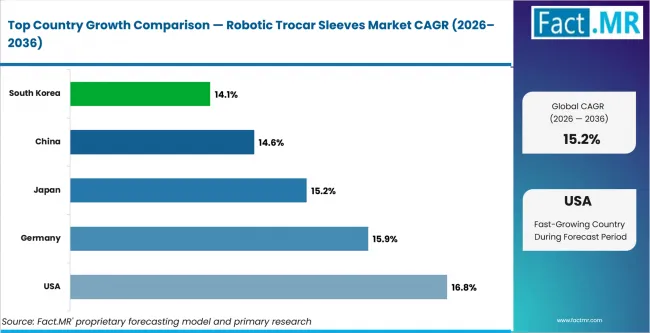
Robotic Trocar Sleeves Market Cagr Analysis By Country | Source: Fact.MR
What is powering the United States lead?
16.8% CAGR, driven by Intuitive Surgical and robotic urology programs.
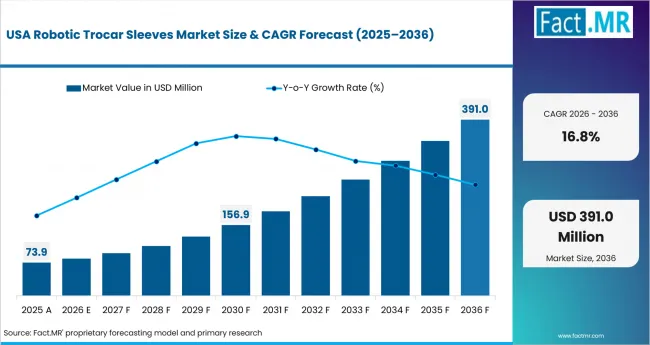
Robotic Trocar Sleeves Market Country Value Analysis | Source: Fact.MR
The United States is projected to record 16.8% CAGR from 2026 to 2036 as hospitals use robotic systems across repeat soft-tissue procedures. Intuitive Surgical supports the largest robotic surgery installed base, while Medtronic adds another urology pathway through Hugo clearance. Sleeve demand will favor products that fit robotic workflows and protect case continuity.
How is Germany scaling robotic trocar sleeve demand?
Germany captures 15.9% CAGR, driven by hospital procedure standardization and advanced minimally invasive surgery infrastructure.
Hospitals need access products that fit robotic systems without complicating sterile setup. Germany is expected to post 15.9% CAGR through 2036 as urology and gynecology programs standardize sleeve selection around robotic case flow. Growth will favor suppliers that can support tender documentation and reusable-versus-disposable choice.
What supports Japan’s outlook?
15.2% CAGR, driven by precision surgery programs and compact operating room needs.
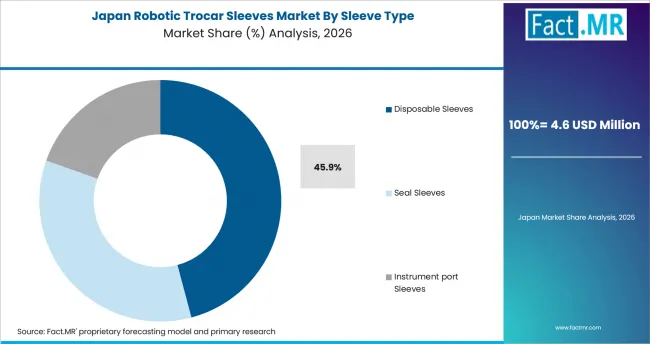
Robotic Trocar Sleeves Market Japan Market Share Analysis By Sleeve Type | Source: Fact.MR
Japan is likely to record 15.2% CAGR by 2036 as advanced hospitals use robotic systems for urology and general surgery. Compact operating rooms create demand for sleeves that maintain position without adding setup complexity. Hospitals will favor products with predictable handling and clear compatibility. Growth will be strongest where suppliers combine access performance with training support.
What underpins China’s growth?
China advances at 14.6% CAGR, driven by robotic soft-tissue surgery in premium private hospitals and large urban care centers.
Sleeve demand will grow as platform use moves from showcase installations toward repeat procedure schedules. China is forecast to advance at 14.6% CAGR through 2036 as hospitals build recurring consumable pathways around robotic operating rooms. Cost-effective sleeves with local service support will have stronger traction.
How is South Korea scaling robotic trocar sleeve adoption?
14.1% CAGR, driven by robotic surgery centers and advanced minimally invasive care.
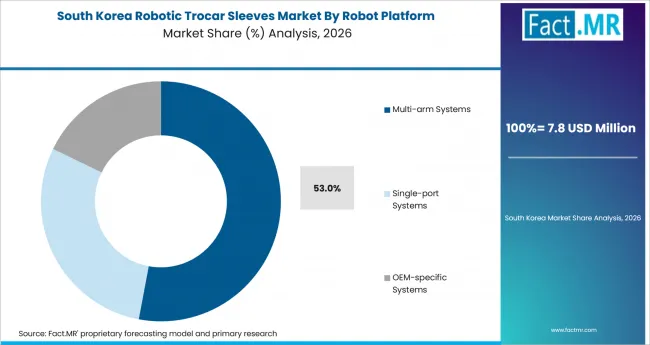
Robotic Trocar Sleeves Market South Korea Market Share Analysis By Robot Platform | Source: Fact.MR
South Korea is set to record 14.1% CAGR through 2036 as hospitals and specialty centers refine robotic procedure flow. Sleeve demand will benefit from urology, colorectal and gynecology applications. Operating room teams need stable access products that match robotic instruments and reduce case variation. Growth will favor suppliers with surgeon education and strong distributor coverage.
Who leads the robotic trocar sleeves market?
Intuitive Surgical and Medtronic lead through robotic platform ecosystems and recurring accessory pathways.
Robotic trocar sleeves are supplied by robotic surgery companies, access-device manufacturers and surgical consumable suppliers. Intuitive Surgical leads through da Vinci platform depth and its instruments and accessories ecosystem. Medtronic is positioned through Hugo RAS and its broader surgical portfolio. CMR Surgical supports competition through Versius and modular robotic system design.
Applied Medical and CONMED are relevant because access-device experience can be adapted toward robotic trocar sleeve needs. Applied Medical’s Kii access systems emphasize removable seals and fixation technologies. CONMED’s AirSeal access platform supports stable pneumoperitoneum and smoke evacuation during laparoscopic and robotic-assisted general surgery. These features show why sleeve design connects with image-guided and robotic operating workflows where access stability matters.
Competition through 2036 will depend on platform fit, seal reliability, sterile packaging and hospital contracting. Suppliers that treat sleeves as ordinary trocar components will face pricing pressure. Suppliers that connect sleeve design with robotic procedure flow can gain stronger access. The product may be small, but the purchase logic sits inside a high-value surgical ecosystem.
Which companies are the key providers?
Intuitive Surgical and Medtronic are key providers. Johnson & Johnson MedTech / Ethicon and CMR Surgical are also profiled. Asensus Surgical, Applied Medical and CONMED complete the company set.
- Intuitive Surgical
- Medtronic
- Johnson & Johnson MedTech / Ethicon
- CMR Surgical
- Asensus Surgical
- Applied Medical
- CONMED
Bibliography
- U.S. Food and Drug Administration. (2024, March 14). K232610: Da Vinci Surgical System Model IS5000, da Vinci Insufflator and Tube Set with Smoke Evacuation. U.S. Department of Health and Human Services.
- U.S. Food and Drug Administration. (2024, October 11). DEN230078: Versius Surgical System. U.S. Department of Health and Human Services.
- Medtronic. (2025, December 3). Medtronic announces FDA clearance of Hugo™ robotic-assisted surgery system for urologic surgical procedures. Medtronic.
- Intuitive Surgical. (2024, March 14). Intuitive announces FDA clearance of fifth-generation robotic system, da Vinci 5. Intuitive Surgical.
- CMR Surgical. (2024, October 14). CMR Surgical receives U.S. FDA marketing authorization for Versius. CMR Surgical.
- Applied Medical. (2026). Kii access systems. Applied Medical Resources Corporation.
- CONMED Corporation. (2026). AirSeal® Robotic Solution. CONMED Corporation.
This Report Addresses
- Strategic intelligence on robotic trocar sleeves across sleeve type and robot platform.
- Segment analysis covering Disposable Sleeves and Multi-arm Systems.
- Regional outlook covering the United States, Germany, Japan, China and South Korea.
- Competitive analysis of Intuitive Surgical, Medtronic, Johnson & Johnson MedTech / Ethicon, CMR Surgical, Asensus Surgical, Applied Medical and CONMED.
- Technology assessment covering seal stability, platform compatibility, sleeve fixation and robotic instrument exchange.
- Use case assessment covering urology, gynecology, general surgery, thoracic surgery and colorectal procedures.
- Primary interviews, provider checks and official source review support the forecast.
What does the robotic trocar sleeves market cover?
Robot-compatible sleeves and instrument port sleeves.
The robotic trocar sleeves market covers access sleeves used during robot-assisted laparoscopic and soft-tissue procedures. It includes reusable sleeves and disposable sleeves. It also covers obturator sleeves and instrument port sleeves when they support robotic instrument entry and controlled port-site access.
The market differs from conventional trocar use because the sleeve must work with robotic motion. A manual laparoscopic sleeve mainly supports surgeon-handled instrument movement. A robotic sleeve must maintain position while the robotic arm moves through a controlled access point. This makes the category narrower than broad robotic surgery, but commercially tied to robotic case volume.
What is included in the scope?
Robotic access sleeves used across multi-arm systems and laparoscopic robotic platforms.
The scope includes reusable sleeves and instrument port sleeves. It also includes OEM-specific sleeves when the sleeve is designed for use with a defined robotic platform. The scope covers sleeves used in urology and colorectal procedures.
The scope includes products supplied to hospitals and distributors. It includes sleeve formats sold as standalone products and sleeve formats bundled with robotic access kits. The category also connects with minimally invasive surgery because sleeve design supports small-incision access while robotic systems add higher compatibility requirements.
What is excluded from the scope?
Conventional trocars without robotic compatibility are outside the scope.
The scope excludes standard laparoscopic trocars when they are not positioned for robotic-assisted procedures. It excludes robotic arms and general surgical tools. It also excludes general insufflation tubing and surgical drapes unless the sleeve is specified for robotic use. Broader surgical equipment categories are excluded when they do not directly support robotic instrument access.
How was the analysis built?
100+ sources, 40+ company portfolios, 25+ countries, 20+ interviews.
- Primary Research: Primary research includes interviews with robotic surgery program directors and operating room managers. It includes input from sterile processing leaders and hospital supply chain teams.
- Desk Research: Desk research reviews FDA robotic surgery documentation and official company platform updates. It covers robotic accessories, access systems, trocar sleeves, seal designs and robotic procedure workflows.
- Market-Sizing and Forecasting: Forecasting uses robotic procedure adoption, installed platform utilization, sleeve replacement cycles and sleeve attachment rates. Hospital contracting and OEM accessory pathways support the market assessment.
- Data Validation and Update Cycle: Forecasts are validated through provider checks and procurement feedback. Product portfolio reviews and robotic surgery adoption signals help confirm market direction.
Segmentation
What is the report’s scope and coverage?
| Attribute | Details |
|---|---|
| Quantitative Units | USD Million in 2026 to USD Million by 2036 at CAGR |
| Market Definition | Robot-compatible sleeves used to maintain controlled instrument access during robotic-assisted procedures |
| Sleeve Type | Reusable sleeves; disposable sleeves; obturator sleeves; seal sleeves; instrument port sleeves |
| Robot Platform | Multi-arm systems; single-port systems; modular robots; laparoscopic robotic platforms; OEM-specific systems |
| Procedure | Urology; gynecology; general surgery; thoracic; colorectal |
| Customer Type | Hospitals; robotic surgery centers; ASCs; OEMs; distributors |
| Regions Covered | North America; Europe; East Asia; South Asia; Latin America; Middle East and Africa |
| Countries Covered | United States; Germany; Japan; China; South Korea |
| Key Companies Profiled | Intuitive Surgical; Medtronic; Johnson & Johnson MedTech / Ethicon; CMR Surgical; Asensus Surgical; Applied Medical; CONMED |
| Forecast Period | 2026 to 2036 |
| Approach | Hybrid top-down and bottom-up approach using robotic procedure adoption, sleeve attachment rates, platform compatibility and provider validation |
Source: Fact.MR analysis. Updated Jul 1, 2026
How is the market segmented?
-
By Sleeve Type:
- Reusable sleeves
- Disposable sleeves
- Obturator sleeves
- Seal sleeves
- Instrument port sleeves
-
By Robot Platform:
- Multi-arm systems
- Single-port systems
- Modular robots
- Laparoscopic robotic platforms
- OEM-specific systems
-
By Procedure:
- Urology
- Gynecology
- General surgery
- Thoracic
- Colorectal
-
By Customer Type:
- Hospitals
- Robotic surgery centers
- ASCs
- OEMs
- Distributors
-
Region:
- North America
- United States
- Canada
- Europe
- Germany
- United Kingdom
- France
- Italy
- Netherlands
- East Asia
- Japan
- China
- South Korea
- South Asia
- India
- Thailand
- Singapore
- Latin America
- Brazil
- Mexico
- Chile
- Middle East & Africa
- UAE
- Saudi Arabia
- South Africa
- Israel
- North America
Frequently Asked Questions
Which sleeve type leads the Robotic Trocar Sleeves Market?
Which robot platform leads the Robotic Trocar Sleeves Market?
Which procedure leads the Robotic Trocar Sleeves Market?
Which customer type leads the Robotic Trocar Sleeves Market?
Which region leads the Robotic Trocar Sleeves Market?
Which country expands fastest in the Robotic Trocar Sleeves Market?
How does Germany perform in the Robotic Trocar Sleeves Market?
How does Japan perform in the Robotic Trocar Sleeves Market?
How does China perform in the Robotic Trocar Sleeves Market?
How does South Korea perform in the Robotic Trocar Sleeves Market?
What is the primary driver in the Robotic Trocar Sleeves Market?
What is the main restraint in the Robotic Trocar Sleeves Market?
Why are disposable sleeves important in this market?
Why are multi-arm systems important for sleeve demand?
Who worked on this report


Preview the report firsthand - request a free sample
Free SampleGet the brochure for pricing and purchase details
Download PDF