Disposable Trocars Market
Disposable Trocars Market Size and Share Forecast Outlook 2025 to 2035
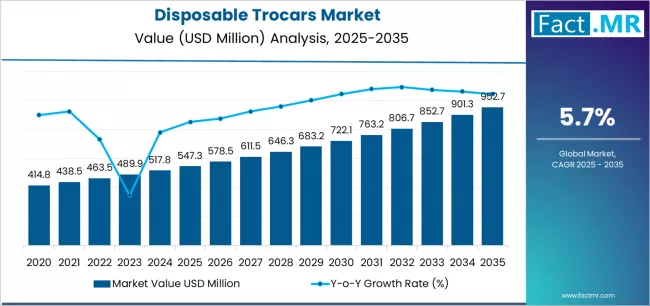
Disposable trocars market is projected to grow from USD 547.3 million in 2025 to USD 952.7 million by 2035, at a CAGR of 5.7%. Bladeless Trocars will dominate with a 35.4% market share, while general surgery will lead the application segment with a 27.2% share.
Disposable Trocars Market Forecast and Outlook 2025 to 2035
The global disposable trocars market is projected to grow from USD 547.3 million in 2025 to approximately USD 952.7 million by 2035, recording an extraordinary absolute increase of USD 405.4 million over the forecast period. This translates into a total growth of 74.1%, with the market forecast to expand at a compound annual growth rate (CAGR) of 5.7% between 2025 and 2035.
Quick Stats on Disposable Trocars Market
- Disposable Trocars Market Value (2025): USD 547.3 million
- Disposable Trocars Market Forecast Value (2035): USD 952.7 million
- Disposable Trocars Market Forecast CAGR (2025 to 2035): 5.7%
- Leading Tip Type in Disposable Trocars Market: Bladeless Trocars (35.4%)
- Leading Application in Disposable Trocars Market: General Surgery (27.2%)
- Leading Region in Disposable Trocars Market: North America (31.5%)
- Key Growth Regions in Disposable Trocars Market: Asia Pacific, North America, and Europe
- Key Players in Disposable Trocars Market: Medtronic, Ethicon (Johnson & Johnson), B. Braun SE, Applied Medical Resources Corporation, CooperSurgical Inc., Teleflex Incorporated, CONMED Corporation, Zhejiang Geyi Medical Instrument Co. Ltd, Purple Surgical, Lepus Medical Technology (Beijing) Co. Ltd.

The overall market size is expected to grow by approximately 1.7X during this period, supported by exponential demand for minimally invasive surgical devices, rising adoption of single-use surgical instrument protocols, and growing emphasis on infection prevention innovation and patient safety optimization across global surgical operations.
The disposable trocars market is positioned for substantial expansion, driven by increasing recognition of minimally invasive surgery advantages, growing surgical procedure volumes with enhanced safety standard requirements, and rising adoption of bladeless trocar and optical visualization technologies across laparoscopic surgery facilities globally.
The market demonstrates robust fundamentals supported by expanding ambulatory surgical infrastructure, surgeons' focus on patient safety protocols, and rising recognition of disposable trocars as critical surgical components in achieving enhanced procedural outcomes, infection control capabilities, and operative efficiency effectiveness within modern surgical architectures across diverse procedural applications.
Market growth is underpinned by technological innovations in trocar design procedures, particularly bladeless trocar advancements and optical entry system integration, which offer enhanced safety profiles, improved tissue preservation outcomes, and superior compatibility with comprehensive minimally invasive surgical protocols prevalent in contemporary operating room practices.
Surgical facilities increasingly prioritize trocar solutions that deliver optimal balance between safety performance, ease of use, and cost-effectiveness while adhering to increasingly stringent infection control standards and surgical quality requirements across global healthcare markets.
The convergence of minimally invasive surgery expansion in developed healthcare regions, ambulatory surgery center growth in cost-conscious economies, and laparoscopic infrastructure development in emerging markets creates multifaceted growth opportunities for trocar manufacturers and surgical facility operators.
The disposable trocars landscape is experiencing transformative changes as surgeons adopt sophisticated access devices including safety-engineered bladeless trocars, advanced optical visualization systems, and integrated insufflation platforms that enable optimal peritoneal access and reduced complication rates.
These technological advancements are complemented by evolving design capabilities encompassing ergonomic handles, adjustable length options, and innovative seal technologies that significantly improve surgical workflow and gas leak prevention outcomes.
The integration of single-use convenience and infection elimination benefits further expands disposable trocar adoption, particularly benefiting high-volume surgical centers and quality-focused facilities where reprocessing risks remain concerning.
Between 2025 and 2030, the disposable trocars market is projected to expand from USD 547.3 million to USD 726.4 million, demonstrating strong foundational growth driven by global minimally invasive surgery adoption expansion, increasing utilization of single-use surgical devices, and initial deployment of advanced safety-engineered trocar technologies across hospital and ambulatory surgical center platforms. This growth phase establishes market infrastructure, validates infection prevention protocols, and creates comprehensive surgical supply networks supporting global laparoscopic surgery operations.
From 2030 to 2035, the market is forecast to reach USD 952.7 million, driven by mature minimally invasive surgery penetration, next-generation robotic surgery integration requiring specialized trocar compatibility, and comprehensive adoption of value-based purchasing systems demanding enhanced safety and efficiency. The growing utilization of bladeless trocar designs, specialized pediatric surgical applications, and emerging market surgical infrastructure will drive demand for comprehensive disposable trocar solutions with enhanced safety characteristics and seamless surgical workflow integration functionality.
Disposable Trocars Market Key Takeaways
| Metric | Value |
|---|---|
| Estimated Value (2025E) | USD 547.3 million |
| Forecast Value (2035F) | USD 952.7 million |
| Forecast CAGR (2025 to 2035) | 5.7% |
Why is the Disposable Trocars Market Growing?
Market expansion is being supported by the exponential increase in minimally invasive surgery volumes and the corresponding need for sophisticated single-use access devices in laparoscopic procedure applications across global surgical operations. Modern surgeons are increasingly focused on advanced trocar solutions that can improve patient safety, enhance procedural efficiency, and eliminate infection transmission risks while meeting stringent quality requirements. The proven efficacy of disposable trocars in reducing healthcare-associated infection risks and simplifying surgical workflow makes them an essential component of comprehensive surgical safety strategies and quality improvement programs.
The growing emphasis on infection prevention standards and single-use device integration is driving demand for disposable trocars that meet stringent performance specifications and safety requirements for surgical applications. Surgical facilities' preference for reliable, high-safety access devices that eliminate reprocessing concerns is creating opportunities for innovative trocar designs and specialized procedural solutions. The rising influence of value-based purchasing models and patient safety initiatives is also contributing to increased adoption of premium-grade disposable trocar devices across different surgical specialties and healthcare systems requiring advanced surgical technology.
Opportunity Pathways - Disposable Trocars Market
The disposable trocars market represents a transformative growth opportunity, expanding from USD 547.3 million in 2025 to USD 952.7 million by 2035 at a 5.7% CAGR. As surgeons prioritize patient safety optimization, specialized procedural efficiency, and clinical excellence in complex laparoscopic environments, disposable trocars have evolved from basic access instruments to essential surgical components enabling precise peritoneal entry, comprehensive infection prevention strategies, and multi-specialty procedural operations across general surgery platforms and specialty surgical applications.
The convergence of minimally invasive surgery acceleration, increasing single-use device penetration, advanced safety technology integration, and stringent infection control mandates creates momentum in demand. High-safety bladeless trocar designs offering superior injury prevention outcomes, versatile optical entry systems balancing visualization with safety, and specialized applications for pediatric surgery will capture market premiums, while geographic expansion into high-growth Asian surgical markets and emerging laparoscopic ecosystems will drive volume leadership. Surgical facility emphasis on safety innovation and efficiency optimization provides structural support.
- Pathway A - Bladeless Trocars Tip Dominance: Leading with 35.4% market share, bladeless trocar applications drive primary demand through complex laparoscopic workflows requiring comprehensive safety-engineered solutions for peritoneal access procedures. Advanced bladeless designs enabling reduced vessel and organ injury risks, improved tissue preservation, and enhanced patient safety outcomes command premium pricing from surgical facilities requiring superior safety specifications and liability reduction. Expected revenue pool: USD 193.7-337.4 million.
- Pathway B - General Surgery Application Leadership: Dominating with 27.2% market share through optimal balance of procedure volume and trocar utilization requirements, general surgery applications serve most disposable trocar requirements while meeting diverse laparoscopic procedure demands. This application addresses both routine cholecystectomy and complex bariatric surgery expectations, making it the preferred category for general surgeons and healthcare operations seeking comprehensive surgical access capabilities. Opportunity: USD 148.9-259.1 million.
- Pathway C - North American Market Leadership: North America with 31.5% market share leads regional growth through advanced surgical infrastructure, comprehensive minimally invasive surgery adoption, and established single-use device preferences. Strategic market positioning in major hospital systems, ambulatory surgery centers, and academic medical institutions enables sustained trocar utilization in high-volume surgical and specialty procedure markets. Geographic revenue leadership: USD 172.4-300.1 million.
- Pathway D - Optical Trocars Tip Segment: Optical trocar designs with 25.0% market share serve critical visualization-guided entry applications requiring direct visual control for diverse surgical populations. Optimized optical systems supporting safe peritoneal entry, reduced blind insertion risks, and proven safety effectiveness maintain significant volumes from surgeons and surgical facilities prioritizing entry visualization. Revenue potential: USD 136.8-238.2 million.
- Pathway E - Advanced Technologies & Safety Innovation: Companies investing in sophisticated radially expanding designs, integrated illumination systems, and advanced seal technologies gain competitive advantages through differentiated safety delivery and surgical performance. Advanced capabilities enabling customized trocar specifications and procedure-specific optimization capture premium surgical facility partnerships. Technology premium: USD 109.5-190.5 million.
- Pathway F - Gynecological Surgery Applications: Specialized gynecological procedure utilization, strategic minimally invasive gynecology integration, and reliable laparoscopic access platforms create significant market opportunity in women's health surgical markets. Companies offering appropriate sizing options, obstetric safety considerations, and gynecology-specific features gain preferred supplier status among gynecological surgeons. Application value: USD 123.1-214.4 million.
- Pathway G - Emerging Markets & Surgical Infrastructure Development: Beyond traditional developed healthcare markets, disposable trocars in emerging Asian surgical centers, Latin American hospital modernization, and Middle Eastern healthcare expansion represent growth opportunities. Companies developing market access programs, supporting training initiatives, and expanding into underserved surgical markets capture incremental demand while improving global surgical safety standards. Emerging opportunity: USD 87.6-152.4 million.
Segmental Analysis
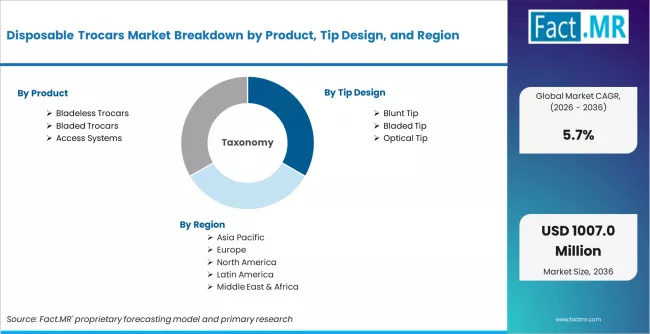
The market is segmented by tip, application, and region. By tip, the market is divided into bladeless trocars, optical trocars, blunt trocars, and bladed trocars. Based on application, the market is categorized into general surgery, gynecological surgery, urological surgery, pediatric surgery, and other surgeries. Regionally, the market is divided into North America, Europe, Asia Pacific, Latin America, and MEA.
What Drives Bladeless Trocars' Market Leadership Position?

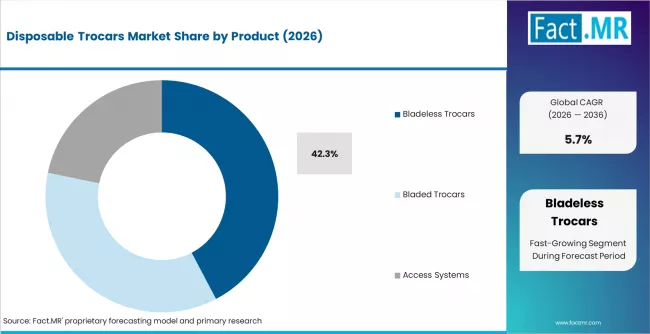
The bladeless trocars tip segment is projected to account for 35.4% of the disposable trocars market in 2025, reaffirming its position as the category's dominant design specification. Surgeons increasingly recognize the optimal balance of safety performance and ease of use offered by bladeless trocar technology for laparoscopic access applications, particularly in routine general surgery procedures and specialty surgical environments. This tip category addresses both vessel injury prevention requirements and organ damage reduction demands while providing superior safety outcomes across diverse laparoscopic surgical operations.
This segment forms the foundation of most contemporary minimally invasive surgery protocols for safe peritoneal access and patient protection, as it represents the most safety-focused and clinically validated trocar design in the laparoscopic surgery device industry. Clinical evidence standards and extensive safety outcome data continue to strengthen confidence in bladeless trocar utilization among surgical specialists and operating room professionals.
With increasing recognition of access-related complication impact on patient outcomes and liability considerations, bladeless trocar designs align with both current surgical safety practices and risk mitigation goals, making them the central technology driver of comprehensive laparoscopic access strategies across multiple surgical specialty platforms.
Bladeless trocars utilize radially expanding or dilating mechanisms to separate tissue layers rather than cutting through them, providing gentler tissue handling that reduces trauma to abdominal wall structures and underlying organs while maintaining secure access and effective pneumoperitoneum management throughout laparoscopic procedures.
How does General Surgery Application Command Market Dominance?

General surgery application is projected to represent 27.2% of disposable trocars demand in 2025, underscoring its role as the primary surgical specialty category driving market adoption and device utilization. Surgical administrators recognize that general surgery requirements, including high-volume cholecystectomy procedures, varied hernia repair techniques, and comprehensive bariatric surgery protocols, provide the largest addressable trocar market among laparoscopic surgical specialties. Disposable trocars utilized in general surgery offer standardized access solutions and procedural efficiency essential for serving routine laparoscopic procedures and complex abdominal surgery requirements.
The segment is supported by the expanding nature of minimally invasive general surgery adoption globally, driven by cholecystectomy procedure volumes, appendectomy laparoscopic conversion, and bariatric surgery growth requiring multiple trocar placements per procedure, and the increasing recognition that standardized single-use trocars enable efficient surgical workflow and eliminate reprocessing logistics. Additionally, surgical facilities increasingly adopt disposable device protocols that facilitate simplified inventory management and consistent device performance across high-volume general surgery services. As understanding of surgical efficiency optimization advances and infection control becomes more critical, disposable trocar utilization will continue to play a crucial role in comprehensive general surgery quality strategies.
Gynecological surgery represents 22.5% of applications, reflecting significant trocar utilization for minimally invasive gynecological procedures including hysterectomy, myomectomy, and ovarian surgery requiring specialized access considerations for female pelvic anatomy and reproductive organ procedures.
Why does North America Demonstrate Regional Market Leadership?

North America is projected to account for 31.5% of the disposable trocars market in 2025, establishing its position as the leading geographic market. Healthcare market analysts recognize that North American surgical infrastructure, encompassing advanced hospital systems, extensive ambulatory surgery centers, and comprehensive minimally invasive surgery adoption, represents the most mature and volume-intensive market requiring disposable surgical devices. This region delivers both high procedural volumes and established single-use device preferences essential for sustained trocar market leadership in global surgical device industry.
The segment is supported by the well-established nature of minimally invasive surgery in North American healthcare, driven by surgeon training emphasis on laparoscopic techniques, patient preference for minimally invasive options, and insurance coverage supporting advanced surgical approaches, and the universal recognition that single-use devices provide optimal infection control and liability protection. Additionally, healthcare facilities throughout North America prioritize operational efficiency and patient safety through standardized disposable device protocols that eliminate reprocessing infrastructure requirements and associated quality risks.
Asia Pacific represents 20.0% of regional distribution, reflecting rapid surgical infrastructure development and growing minimally invasive surgery adoption across major Asian healthcare markets including China, India, and Japan requiring expanded trocar utilization for increasing laparoscopic procedure volumes.
What are the Drivers, Restraints, and Key Trends of the Disposable Trocars Market?
The disposable trocars market is advancing rapidly due to increasing recognition of infection prevention importance and growing adoption of minimally invasive surgical techniques across the global healthcare sector. However, the market faces challenges, including higher per-procedure costs compared to reusable alternatives in budget-constrained facilities, environmental concerns regarding medical waste generation from single-use devices, and limited reimbursement differentiation between disposable and reusable trocar options. Innovation in safety-engineered designs and sustainable manufacturing approaches continues to influence product development and market expansion patterns.
Proliferation of Safety-Engineered Trocar Designs and Injury Prevention Technologies
The accelerating development of advanced safety mechanisms is enabling reduced access-related complications and improved patient outcomes that address surgical quality priorities in laparoscopic procedure environments.
Surgeons increasingly adopt bladeless and optical trocar technologies that minimize vessel injury risks, with radially expanding designs and direct visualization capabilities providing clinically proven safety advantages over traditional cutting trocars. Advanced safety technologies offer opportunities for complication reduction that can significantly improve surgical outcomes while reducing liability exposure and healthcare costs associated with access-related adverse events.
Integration of Robotic Surgery Platforms and Specialized Access Requirements
Modern surgical organizations are incorporating robotic-assisted laparoscopic systems that require compatible trocar specifications, specialized sealing mechanisms, and optimized working channel configurations to enhance surgical capabilities and procedural outcomes. These systems create demand for trocar designs that accommodate robotic instrument diameter requirements, provide secure sealing around robotic arms throughout extended procedures, and enable optimal triangulation and instrument maneuverability.
Advanced robotic compatibility capabilities also enable seamless integration between conventional laparoscopic and robotic-assisted techniques, supporting flexible surgical approach selection based on case complexity and surgeon preference.
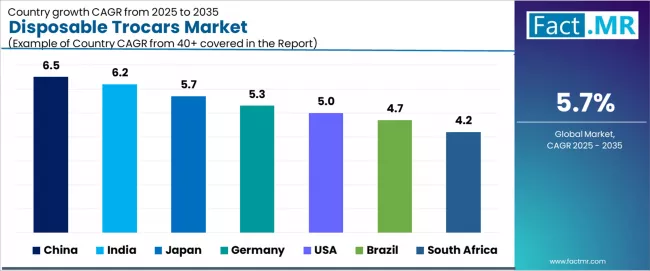
Analysis of the Disposable Trocars Market by Key Countries

| Country | CAGR (2025-2035) |
|---|---|
| China | 6.5% |
| India | 6.2% |
| Japan | 5.7% |
| Germany | 5.3% |
| USA | 5.0% |
| Brazil | 4.7% |
| South Africa | 4.2% |
The disposable trocars market is experiencing exceptional growth globally, with China leading at a 6.5% CAGR through 2035, driven by rising surgical procedure volumes, rapid minimally invasive surgery adoption, and expanding laparoscopic infrastructure across major urban hospital centers. India follows at 6.2%, supported by healthcare infrastructure expansion, growing medical tourism for surgical procedures, and increasing laparoscopic training programs. Japan demonstrates 5.7% growth, emphasizing advanced surgical technology adoption and aging population requiring increased surgical interventions.
Germany shows 5.3% growth with high minimally invasive surgery penetration and robust hospital equipment infrastructure. The USA records 5.0% growth, representing large baseline surgical volumes and widespread disposable device preferences. Brazil shows 4.7% growth with gradual minimally invasive surgery adoption and increased healthcare investment, while South Africa demonstrates 4.2% growth, representing private healthcare expansion and modern surgical center development.
How does China Demonstrate Exceptional Market Potential with Rising Surgical Volumes?
The disposable trocars market in China is projected to exhibit exceptional growth with a CAGR of 6.5% through 2035, driven by massive population healthcare needs and rapid minimally invasive surgery technique adoption across expanding hospital infrastructure. The country's increasing surgical procedure volumes and modernizing healthcare facilities are creating significant opportunities for disposable trocar deployment across both established urban hospitals and developing regional medical centers.
Major international medical device manufacturers and domestic producers are establishing market presence to serve growing surgical demand across tertiary hospitals, specialty surgical centers, and emerging ambulatory facilities throughout China's diverse healthcare regions.
The Chinese healthcare system's emphasis on surgical quality improvement and infection control enhancement is driving medical device market development and single-use product adoption. This modernization focus, combined with the country's enormous patient population and expanding medical insurance coverage, creates favorable conditions for disposable trocar market expansion. Chinese surgeons are increasingly trained in laparoscopic techniques, with disposable access devices representing essential components in advancing minimally invasive surgical capabilities.
- Rising surgical procedure volumes and rapid laparoscopic surgery adoption are driving demand for disposable trocar devices across general surgery and specialty surgical segments
- Healthcare infrastructure modernization and hospital equipment upgrading are supporting increased utilization of advanced surgical access devices nationwide
- Surgeons and healthcare facilities are increasingly prioritizing patient safety and infection prevention, creating expanded single-use device demand
- Growing medical device manufacturing capabilities and improving product quality standards are enabling domestic trocar production serving local market needs
What makes India Demonstrate Market Leadership with Healthcare Infrastructure Expansion?
The disposable trocars market in India is expanding at a CAGR of 6.2%, supported by rapidly developing healthcare infrastructure, growing medical tourism for cost-effective surgical procedures, and expanding laparoscopic surgery training across the country's developing hospital corridors.
The country's increasing surgical volumes and improving access to minimally invasive surgery are driving trocar demand in both metropolitan specialty hospitals and emerging tier-2 city medical facilities. International device manufacturers and domestic suppliers are expanding distribution to serve growing surgical device requirements while supporting India's healthcare quality improvement initiatives.
India's surgical device sector continues to benefit from healthcare investment growth, expanding private hospital networks, and increasing emphasis on surgical quality standards. The country's position as a medical tourism destination and cost-effective healthcare provider is driving investments in modern surgical equipment including disposable access devices. This development is particularly important for trocar applications, as facilities seek to demonstrate international quality standards and patient safety practices to attract both domestic and international patients.
- Expanding healthcare infrastructure and new hospital construction are creating opportunities for surgical device market growth across metropolitan and emerging urban markets
- Medical tourism growth and international patient services are supporting adoption of international-standard disposable surgical devices
- Laparoscopic surgery training expansion and surgical skill development programs are driving minimally invasive procedure volume increases
- Private hospital sector growth and quality-focused healthcare delivery are enabling premium surgical device adoption among competitive medical facilities
Why does Japan Maintain Advanced Surgical Technology Leadership?

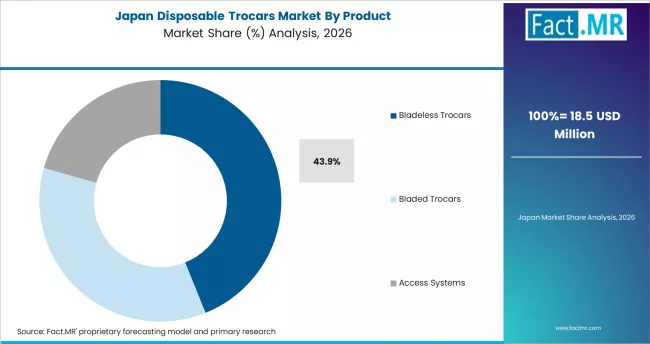
Japan's mature disposable trocars market demonstrates steady growth with a 5.7% CAGR through 2035, driven by advanced surgical technology adoption, comprehensive laparoscopic surgery expertise, and aging population demographics requiring increased surgical intervention volumes. The country's sophisticated healthcare infrastructure and high surgical quality standards create sustained demand for premium disposable trocar devices across diverse surgical specialties. Japanese surgeons emphasize meticulous technique and advanced technology utilization in minimally invasive procedures.
Market dynamics focus on high-quality surgical devices that balance advanced features with reliability considerations important to Japanese medical practice standards and patient safety priorities. Aging population expansion creates ongoing surgical volume growth supporting consistent trocar utilization.
Strategic Market Considerations:
- University hospitals and advanced surgical centers demonstrating growth with emphasis on cutting-edge laparoscopic techniques and technology adoption
- High surgical quality expectations driving premium disposable trocar specifications with advanced safety features and performance characteristics
- Established minimally invasive surgery infrastructure and comprehensive surgical training supporting sustained high-volume trocar utilization
- Aging population demographics and increased surgical needs maintaining steady procedural volume growth across multiple surgical specialties
What drives Germany’s Market Growth with High MIS Penetration?
Germany's established disposable trocars market demonstrates solid growth with a 5.3% CAGR through 2035, driven by high minimally invasive surgery penetration rates, comprehensive hospital equipment infrastructure, and systematic approach to surgical quality management.
The country's advanced surgical capabilities and strong emphasis on patient safety create sustained trocar demand across diverse laparoscopic procedures. German surgical facilities prioritize evidence-based device selection and standardized surgical protocols. Market dynamics focus on clinically validated surgical devices that demonstrate safety effectiveness and operational reliability important to German healthcare quality standards. Established minimally invasive surgery infrastructure creates consistent demand for disposable access devices.
Strategic Market Considerations:
- University hospitals and community surgical centers demonstrating growth with systematic laparoscopic surgery utilization across general and specialty procedures
- Strong quality management systems and device evaluation processes supporting evidence-based trocar selection decisions
- Comprehensive surgical training infrastructure and standardized technique protocols ensuring consistent minimally invasive surgery adoption
- Healthcare system efficiency emphasis and value-based purchasing considerations influencing disposable versus reusable device decisions
What drives USA’s Market Growth with Large Surgical Volume?

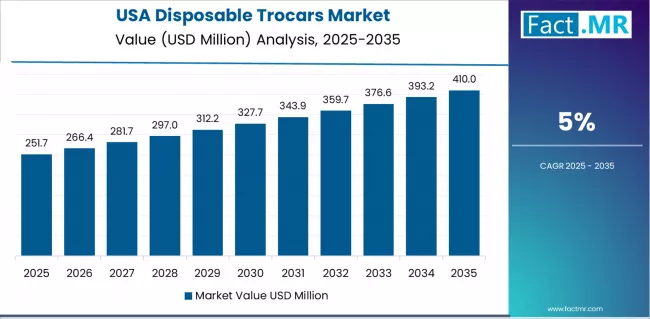
USA's mature disposable trocars market demonstrates steady growth with a 5.0% CAGR through 2035, driven by large baseline surgical procedure volumes, widespread single-use device preferences, and comprehensive ambulatory surgery center infrastructure supporting high-volume laparoscopic procedures.
The country's established minimally invasive surgery adoption and strong infection control emphasis create sustained disposable trocar demand. American surgical facilities universally prioritize single-use devices for patient safety and operational efficiency.
Market dynamics focus on convenient single-use solutions that balance performance reliability with cost considerations important to diverse healthcare facility types from major hospital systems to independent ambulatory surgery centers. Established minimally invasive surgery volumes create stable market foundation.
Strategic Market Considerations:
- Hospital systems and ambulatory surgery centers demonstrating sustained demand with established laparoscopic procedure volumes across multiple surgical specialties
- Universal single-use device preference and infection control priorities supporting disposable trocar market stability
- Diverse surgical facility types from academic medical centers to independent surgery centers maintaining consistent trocar utilization
- Value-based purchasing and group purchasing organization contracts influencing product selection and pricing dynamics
What drives Brazil’s Market Growth with MIS Adoption Expansion?
Brazil's developing disposable trocars market demonstrates moderate growth with a 4.7% CAGR through 2035, driven by gradual minimally invasive surgery adoption expansion, increasing healthcare investment, and modernizing hospital surgical capabilities across major metropolitan markets. The country's growing surgical volumes and improving access to laparoscopic techniques create opportunities for trocar market development. Brazilian surgical facilities are progressively adopting minimally invasive approaches for appropriate surgical indications.
Market dynamics focus on cost-effective surgical access solutions that enable minimally invasive surgery adoption while addressing budget considerations important to Brazilian healthcare economics. Growing surgical training infrastructure creates opportunities for expanded laparoscopic procedure volumes.
Strategic Market Considerations:
- Urban hospital systems and private surgical facilities leading growth with gradual minimally invasive surgery program expansion
- Healthcare investment and surgical infrastructure modernization supporting laparoscopic equipment acquisition and program development
- Surgical training advancement and technique dissemination enabling broader minimally invasive surgery adoption across diverse facilities
- Economic considerations and cost-value balance influencing adoption pace and device selection decisions in price-sensitive healthcare environment
What drives South Africa’s Market Growth with Private Healthcare Expansion?
South Africa's emerging disposable trocars market demonstrates moderate growth with a 4.2% CAGR through 2035, driven by private healthcare sector investment, modern surgical center development, and quality-focused medical facility expansion in major urban centers. The country's dual healthcare system and growing private hospital infrastructure create opportunities for advanced surgical device adoption. South African private facilities emphasize international-standard surgical capabilities and patient safety practices.
Market dynamics focus on quality surgical devices that align with private healthcare positioning and international patient service strategies. Private sector investment creates opportunities for advanced surgical technology adoption.
Strategic Market Considerations:
- Private hospitals and specialized surgical centers leading adoption with emphasis on modern laparoscopic capabilities and quality positioning
- Healthcare infrastructure investment and facility modernization supporting surgical equipment acquisition in competitive private sector
- Medical tourism potential and international patient services driving adoption of international-standard surgical devices and safety practices
- Market segmentation between well-resourced private facilities and budget-constrained public sector influencing adoption patterns and growth dynamics
Europe Market Split by Country

The disposable trocars market in Europe is projected to grow from USD 136.8 million in 2025 to USD 238.2 million by 2035, registering a CAGR of 5.7% over the forecast period. Germany is expected to maintain its leadership position with a 32.4% market share in 2025, rising to 33.8% by 2035, supported by its dominant hospital infrastructure, comprehensive minimally invasive surgery capabilities, and advanced surgical technology adoption throughout major university hospitals and community surgical center networks.
France follows with a 24.6% share in 2025, projected to reach 25.2% by 2035, driven by comprehensive surgical care systems, established laparoscopic surgery expertise, and expanding ambulatory surgery development serving both domestic and European surgical communities. The United Kingdom holds a 19.8% share in 2025, expected to increase to 20.4% by 2035, supported by NHS surgical modernization and minimally invasive surgery pathway implementation.
Italy commands a 13.2% share in 2025, projected to reach 12.1% by 2035, while Spain accounts for 8.4% in 2025, expected to reach 7.3% by 2035. The Rest of Europe region, including Nordic countries with advanced surgical systems, Eastern European emerging healthcare markets, and smaller Western European surgical centers, is anticipated to hold 1.6% in 2025, declining slightly to 1.2% by 2035, attributed to market consolidation toward larger core markets with established surgical infrastructure and medical device distribution expertise.
Competitive Landscape of the Disposable Trocars Market

The disposable trocars market is characterized by intense competition among established medical device manufacturers, specialized laparoscopic equipment producers, and comprehensive surgical instrument organizations focused on delivering high quality, safe, and reliable access devices.
Companies are investing in safety innovation programs, ergonomic design development, strategic surgeon partnership initiatives, and comprehensive clinical education programs to deliver effective, user-friendly, and safe disposable trocars that meet stringent regulatory standards and surgical performance expectations. Product differentiation, clinical evidence generation, and surgeon preference strategies are central to strengthening device portfolios and market presence.
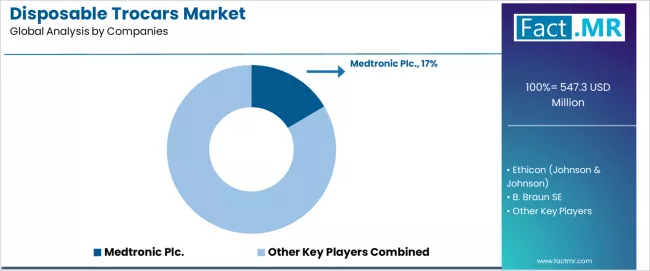
Medtronic Plc. leads the market with a 16.5% market share, offering comprehensive disposable trocar solutions with focus on safety-engineered design expertise and bladeless trocar innovation capabilities for diverse laparoscopic surgical applications.
Ethicon (Johnson & Johnson) provides specialized trocar platforms with emphasis on optical entry systems and comprehensive surgical access portfolios across global minimally invasive surgery markets. B. Braun SE focuses on European market leadership and quality engineering serving international surgical communities. Applied Medical Resources Corporation delivers innovative trocar design expertise with strong safety feature development and direct surgeon relationships.
CooperSurgical Inc. operates with focus on gynecological surgery applications and women's health surgical specialization. Teleflex Incorporated provides comprehensive surgical device portfolios emphasizing versatility and procedural adaptability. CONMED Corporation specializes in surgical access solutions with emphasis on visualization technologies. Zhejiang Geyi Medical Instrument Co. Ltd delivers cost-effective solutions to enhance market accessibility in price-sensitive markets.
Purple Surgical and Lepus Medical Technology (Beijing) Co. Ltd focus on specialized regional market development and competitive trocar offerings, emphasizing product quality and comprehensive surgical performance characteristics through dedicated laparoscopic access device strategies.
Key Players in the Disposable Trocars Market
- Medtronic Plc.
- Ethicon (Johnson & Johnson)
- B. Braun SE
- Applied Medical Resources Corporation
- CooperSurgical Inc.
- Teleflex Incorporated
- CONMED Corporation
- Zhejiang Geyi Medical Instrument Co. Ltd
- Purple Surgical
- Lepus Medical Technology (Beijing) Co. Ltd
Scope of the Report
| Items | Values |
|---|---|
| Quantitative Units (2025) | USD 547.3 Million |
| Tip | Bladeless Trocars, Optical Trocars, Blunt Trocars, Bladed Trocars |
| Application | General Surgery, Gynecological Surgery, Urological Surgery, Pediatric Surgery, Other Surgeries |
| Regions Covered | North America, Europe, Asia Pacific, Latin America, MEA |
| Countries Covered | USA, Germany, UK, Japan, China, India, Brazil, South Africa and 40+ countries |
| Key Companies Profiled | Medtronic, Ethicon (Johnson & Johnson), B. Braun SE, Applied Medical Resources Corporation, CooperSurgical Inc., Teleflex Incorporated, CONMED Corporation, Zhejiang Geyi Medical Instrument Co. Ltd, Purple Surgical, Lepus Medical Technology (Beijing) Co. Ltd |
| Additional Attributes | Dollar sales by tip type, application, regional demand trends, competitive landscape, surgeon preferences for specific trocar designs, integration with comprehensive laparoscopic surgical systems, innovations in safety technology development, ergonomic design advancement, and patient outcome optimization capabilities |
Disposable Trocars Market by Segments
-
Tip :
- Bladeless Trocars
- Optical Trocars
- Blunt Trocars
- Bladed Trocars
-
Application :
- General Surgery
- Gynecological Surgery
- Urological Surgery
- Pediatric Surgery
- Other Surgeries
-
Region :
-
North America
- United States
- Canada
- Mexico
-
Europe
- Germany
- France
- United Kingdom
- Italy
- Spain
- Nordic
- BENELUX
- Rest of Europe
-
Asia Pacific
- China
- India
- Japan
- South Korea
- ASEAN
- Australia & New Zealand
- Rest of Asia Pacific
-
Latin America
- Brazil
- Argentina
- Chile
- Rest of Latin America
-
MEA
- Kingdom of Saudi Arabia
- Other GCC Countries
- Turkey
- South Africa
- Other African Countries
- Rest of MEA
-
Table of Content
- Executive Summary
- Global Market Outlook
- Demand to side Trends
- Supply to side Trends
- Technology Roadmap Analysis
- Analysis and Recommendations
- Market Overview
- Market Coverage / Taxonomy
- Market Definition / Scope / Limitations
- Market Background
- Market Dynamics
- Drivers
- Restraints
- Opportunity
- Trends
- Scenario Forecast
- Demand in Optimistic Scenario
- Demand in Likely Scenario
- Demand in Conservative Scenario
- Opportunity Map Analysis
- Product Life Cycle Analysis
- Supply Chain Analysis
- Investment Feasibility Matrix
- Value Chain Analysis
- PESTLE and Porter’s Analysis
- Regulatory Landscape
- Regional Parent Market Outlook
- Production and Consumption Statistics
- Import and Export Statistics
- Market Dynamics
- Global Market Analysis 2020 to 2024 and Forecast, 2025 to 2035
- Historical Market Size Value (USD Million) Analysis, 2020 to 2024
- Current and Future Market Size Value (USD Million) Projections, 2025 to 2035
- Y to o to Y Growth Trend Analysis
- Absolute $ Opportunity Analysis
- Global Market Pricing Analysis 2020 to 2024 and Forecast 2025 to 2035
- Global Market Analysis 2020 to 2024 and Forecast 2025 to 2035, By Tip
- Introduction / Key Findings
- Historical Market Size Value (USD Million) Analysis By Tip, 2020 to 2024
- Current and Future Market Size Value (USD Million) Analysis and Forecast By Tip, 2025 to 2035
- Bladeless Trocars
- Optical Trocars
- Blunt Trocars
- Bladed Trocars
- Y to o to Y Growth Trend Analysis By Tip, 2020 to 2024
- Absolute $ Opportunity Analysis By Tip, 2025 to 2035
- Global Market Analysis 2020 to 2024 and Forecast 2025 to 2035, By Application
- Introduction / Key Findings
- Historical Market Size Value (USD Million) Analysis By Application, 2020 to 2024
- Current and Future Market Size Value (USD Million) Analysis and Forecast By Application, 2025 to 2035
- General Surgery
- Gynecological Surgery
- Urological Surgery
- Pediatric Surgery
- Other Surgeries
- Y to o to Y Growth Trend Analysis By Application, 2020 to 2024
- Absolute $ Opportunity Analysis By Application, 2025 to 2035
- Global Market Analysis 2020 to 2024 and Forecast 2025 to 2035, By Region
- Introduction / Key Findings
- Historical Market Size Value (USD Million) Analysis By Region, 2020 to 2024
- Current and Future Market Size Value (USD Million) Analysis and Forecast By Region, 2025 to 2035
- North America
- Europe
- Latin America
- Asia Pacific
- MEA
- Y to o to Y Growth Trend Analysis By Region, 2020 to 2024
- Absolute $ Opportunity Analysis By Region, 2025 to 2035
- Global Market Analysis 2020 to 2024 and Forecast 2025 to 2035, By Region
- Introduction
- Historical Market Size Value (USD Million) Analysis By Region, 2020 to 2024
- Current Market Size Value (USD Million) Analysis and Forecast By Region, 2025 to 2035
- North America
- Latin America
- Western Europe
- Eastern Europe
- East Asia
- South Asia and Pacific
- Middle East & Africa
- Market Attractiveness Analysis By Region
- North America Market Analysis 2020 to 2024 and Forecast 2025 to 2035, By Country
- Historical Market Size Value (USD Million) Trend Analysis By Market Taxonomy, 2020 to 2024
- Market Size Value (USD Million) Forecast By Market Taxonomy, 2025 to 2035
- By Country
- USA
- Canada
- Mexico
- By Tip
- By Application
- By Region
- By Country
- Market Attractiveness Analysis
- By Country
- By Tip
- By Application
- By Region
- Key Takeaways
- Latin America Market Analysis 2020 to 2024 and Forecast 2025 to 2035, By Country
- Historical Market Size Value (USD Million) Trend Analysis By Market Taxonomy, 2020 to 2024
- Market Size Value (USD Million) Forecast By Market Taxonomy, 2025 to 2035
- By Country
- Brazil
- Chile
- Rest of Latin America
- By Tip
- By Application
- By Region
- By Country
- Market Attractiveness Analysis
- By Country
- By Tip
- By Application
- By Region
- Key Takeaways
- Western Europe Market Analysis 2020 to 2024 and Forecast 2025 to 2035, By Country
- Historical Market Size Value (USD Million) Trend Analysis By Market Taxonomy, 2020 to 2024
- Market Size Value (USD Million) Forecast By Market Taxonomy, 2025 to 2035
- By Country
- Germany
- UK
- Italy
- Spain
- France
- Nordic
- BENELUX
- Rest of Western Europe
- By Tip
- By Application
- By Region
- By Country
- Market Attractiveness Analysis
- By Country
- By Tip
- By Application
- By Region
- Key Takeaways
- Eastern Europe Market Analysis 2020 to 2024 and Forecast 2025 to 2035, By Country
- Historical Market Size Value (USD Million) Trend Analysis By Market Taxonomy, 2020 to 2024
- Market Size Value (USD Million) Forecast By Market Taxonomy, 2025 to 2035
- By Country
- Russia
- Poland
- Hungary
- Balkan & Baltic
- Rest of Eastern Europe
- By Tip
- By Application
- By Region
- By Country
- Market Attractiveness Analysis
- By Country
- By Tip
- By Application
- By Region
- Key Takeaways
- East Asia Market Analysis 2020 to 2024 and Forecast 2025 to 2035, By Country
- Historical Market Size Value (USD Million) Trend Analysis By Market Taxonomy, 2020 to 2024
- Market Size Value (USD Million) Forecast By Market Taxonomy, 2025 to 2035
- By Country
- China
- Japan
- South Korea
- By Tip
- By Application
- By Region
- By Country
- Market Attractiveness Analysis
- By Country
- By Tip
- By Application
- By Region
- Key Takeaways
- South Asia and Pacific Market Analysis 2020 to 2024 and Forecast 2025 to 2035, By Country
- Historical Market Size Value (USD Million) Trend Analysis By Market Taxonomy, 2020 to 2024
- Market Size Value (USD Million) Forecast By Market Taxonomy, 2025 to 2035
- By Country
- India
- ASEAN
- Australia & New Zealand
- Rest of South Asia and Pacific
- By Tip
- By Application
- By Region
- By Country
- Market Attractiveness Analysis
- By Country
- By Tip
- By Application
- By Region
- Key Takeaways
- Middle East & Africa Market Analysis 2020 to 2024 and Forecast 2025 to 2035, By Country
- Historical Market Size Value (USD Million) Trend Analysis By Market Taxonomy, 2020 to 2024
- Market Size Value (USD Million) Forecast By Market Taxonomy, 2025 to 2035
- By Country
- Kingdom of Saudi Arabia
- Other GCC Countries
- Turkiye
- South Africa
- Other African Union
- Rest of Middle East & Africa
- By Tip
- By Application
- By Region
- By Country
- Market Attractiveness Analysis
- By Country
- By Tip
- By Application
- By Region
- Key Takeaways
- Key Countries Market Analysis
- USA
- Pricing Analysis
- Market Share Analysis, 2024
- By Tip
- By Application
- By Region
- Canada
- Pricing Analysis
- Market Share Analysis, 2024
- By Tip
- By Application
- By Region
- Mexico
- Pricing Analysis
- Market Share Analysis, 2024
- By Tip
- By Application
- By Region
- Brazil
- Pricing Analysis
- Market Share Analysis, 2024
- By Tip
- By Application
- By Region
- Chile
- Pricing Analysis
- Market Share Analysis, 2024
- By Tip
- By Application
- By Region
- Germany
- Pricing Analysis
- Market Share Analysis, 2024
- By Tip
- By Application
- By Region
- UK
- Pricing Analysis
- Market Share Analysis, 2024
- By Tip
- By Application
- By Region
- Italy
- Pricing Analysis
- Market Share Analysis, 2024
- By Tip
- By Application
- By Region
- Spain
- Pricing Analysis
- Market Share Analysis, 2024
- By Tip
- By Application
- By Region
- France
- Pricing Analysis
- Market Share Analysis, 2024
- By Tip
- By Application
- By Region
- India
- Pricing Analysis
- Market Share Analysis, 2024
- By Tip
- By Application
- By Region
- ASEAN
- Pricing Analysis
- Market Share Analysis, 2024
- By Tip
- By Application
- By Region
- Australia & New Zealand
- Pricing Analysis
- Market Share Analysis, 2024
- By Tip
- By Application
- By Region
- China
- Pricing Analysis
- Market Share Analysis, 2024
- By Tip
- By Application
- By Region
- Japan
- Pricing Analysis
- Market Share Analysis, 2024
- By Tip
- By Application
- By Region
- South Korea
- Pricing Analysis
- Market Share Analysis, 2024
- By Tip
- By Application
- By Region
- Russia
- Pricing Analysis
- Market Share Analysis, 2024
- By Tip
- By Application
- By Region
- Poland
- Pricing Analysis
- Market Share Analysis, 2024
- By Tip
- By Application
- By Region
- Hungary
- Pricing Analysis
- Market Share Analysis, 2024
- By Tip
- By Application
- By Region
- Kingdom of Saudi Arabia
- Pricing Analysis
- Market Share Analysis, 2024
- By Tip
- By Application
- By Region
- Turkiye
- Pricing Analysis
- Market Share Analysis, 2024
- By Tip
- By Application
- By Region
- South Africa
- Pricing Analysis
- Market Share Analysis, 2024
- By Tip
- By Application
- By Region
- USA
- Market Structure Analysis
- Competition Dashboard
- Competition Benchmarking
- Market Share Analysis of Top Players
- By Regional
- By Tip
- By Application
- By Region
- Competition Analysis
- Competition Deep Dive
- Medtronic Plc.
- Overview
- Product Portfolio
- Profitability by Market Segments (Product/Age /Sales Channel/Region)
- Sales Footprint
- Strategy Overview
- Marketing Strategy
- Product Strategy
- Channel Strategy
- Ethicon (Johnson & Johnson)
- B. Braun SE
- Applied Medical Resources Corporation
- CooperSurgical Inc.
- Teleflex Incorporated
- CONMED Corporation
- Zhejiang Geyi Medical Instrument Co. Ltd
- Purple Surgical
- Lepus Medical Technology (Beijing) Co. Ltd
- Medtronic Plc.
- Competition Deep Dive
- Assumptions & Acronyms Used
- Research Methodology
List Of Table
- Table 1: Global Market Value (USD Million) Forecast by Region, 2020 to 2035
- Table 2: Global Market Value (USD Million) Forecast by Tip, 2020 to 2035
- Table 3: Global Market Value (USD Million) Forecast by Application, 2020 to 2035
- Table 4: Global Market Value (USD Million) Forecast by Region, 2020 to 2035
- Table 5: North America Market Value (USD Million) Forecast by Country, 2020 to 2035
- Table 6: North America Market Value (USD Million) Forecast by Tip, 2020 to 2035
- Table 7: North America Market Value (USD Million) Forecast by Application, 2020 to 2035
- Table 8: North America Market Value (USD Million) Forecast by Region, 2020 to 2035
- Table 9: Latin America Market Value (USD Million) Forecast by Country, 2020 to 2035
- Table 10: Latin America Market Value (USD Million) Forecast by Tip, 2020 to 2035
- Table 11: Latin America Market Value (USD Million) Forecast by Application, 2020 to 2035
- Table 12: Latin America Market Value (USD Million) Forecast by Region, 2020 to 2035
- Table 13: Western Europe Market Value (USD Million) Forecast by Country, 2020 to 2035
- Table 14: Western Europe Market Value (USD Million) Forecast by Tip, 2020 to 2035
- Table 15: Western Europe Market Value (USD Million) Forecast by Application, 2020 to 2035
- Table 16: Western Europe Market Value (USD Million) Forecast by Region, 2020 to 2035
- Table 17: Eastern Europe Market Value (USD Million) Forecast by Country, 2020 to 2035
- Table 18: Eastern Europe Market Value (USD Million) Forecast by Tip, 2020 to 2035
- Table 19: Eastern Europe Market Value (USD Million) Forecast by Application, 2020 to 2035
- Table 20: Eastern Europe Market Value (USD Million) Forecast by Region, 2020 to 2035
- Table 21: East Asia Market Value (USD Million) Forecast by Country, 2020 to 2035
- Table 22: East Asia Market Value (USD Million) Forecast by Tip, 2020 to 2035
- Table 23: East Asia Market Value (USD Million) Forecast by Application, 2020 to 2035
- Table 24: East Asia Market Value (USD Million) Forecast by Region, 2020 to 2035
- Table 25: South Asia and Pacific Market Value (USD Million) Forecast by Country, 2020 to 2035
- Table 26: South Asia and Pacific Market Value (USD Million) Forecast by Tip, 2020 to 2035
- Table 27: South Asia and Pacific Market Value (USD Million) Forecast by Application, 2020 to 2035
- Table 28: South Asia and Pacific Market Value (USD Million) Forecast by Region, 2020 to 2035
- Table 29: Middle East & Africa Market Value (USD Million) Forecast by Country, 2020 to 2035
- Table 30: Middle East & Africa Market Value (USD Million) Forecast by Tip, 2020 to 2035
- Table 31: Middle East & Africa Market Value (USD Million) Forecast by Application, 2020 to 2035
- Table 32: Middle East & Africa Market Value (USD Million) Forecast by Region, 2020 to 2035
List Of Figures
- Figure 1: Global Market Pricing Analysis
- Figure 2: Global Market Value (USD Million) Forecast 2020 to 2035
- Figure 3: Global Market Value Share and BPS Analysis by Tip, 2025 and 2035
- Figure 4: Global Market Y to o to Y Growth Comparison by Tip, 2025 to 2035
- Figure 5: Global Market Attractiveness Analysis by Tip
- Figure 6: Global Market Value Share and BPS Analysis by Application, 2025 and 2035
- Figure 7: Global Market Y to o to Y Growth Comparison by Application, 2025 to 2035
- Figure 8: Global Market Attractiveness Analysis by Application
- Figure 9: Global Market Value Share and BPS Analysis by Region, 2025 and 2035
- Figure 10: Global Market Y to o to Y Growth Comparison by Region, 2025 to 2035
- Figure 11: Global Market Attractiveness Analysis by Region
- Figure 12: Global Market Value (USD Million) Share and BPS Analysis by Region, 2025 and 2035
- Figure 13: Global Market Y to o to Y Growth Comparison by Region, 2025 to 2035
- Figure 14: Global Market Attractiveness Analysis by Region
- Figure 15: North America Market Incremental Dollar Opportunity, 2025 to 2035
- Figure 16: Latin America Market Incremental Dollar Opportunity, 2025 to 2035
- Figure 17: Western Europe Market Incremental Dollar Opportunity, 2025 to 2035
- Figure 18: Eastern Europe Market Incremental Dollar Opportunity, 2025 to 2035
- Figure 19: East Asia Market Incremental Dollar Opportunity, 2025 to 2035
- Figure 20: South Asia and Pacific Market Incremental Dollar Opportunity, 2025 to 2035
- Figure 21: Middle East & Africa Market Incremental Dollar Opportunity, 2025 to 2035
- Figure 22: North America Market Value Share and BPS Analysis by Country, 2025 and 2035
- Figure 23: North America Market Value Share and BPS Analysis by Tip, 2025 and 2035
- Figure 24: North America Market Y to o to Y Growth Comparison by Tip, 2025 to 2035
- Figure 25: North America Market Attractiveness Analysis by Tip
- Figure 26: North America Market Value Share and BPS Analysis by Application, 2025 and 2035
- Figure 27: North America Market Y to o to Y Growth Comparison by Application, 2025 to 2035
- Figure 28: North America Market Attractiveness Analysis by Application
- Figure 29: North America Market Value Share and BPS Analysis by Region, 2025 and 2035
- Figure 30: North America Market Y to o to Y Growth Comparison by Region, 2025 to 2035
- Figure 31: North America Market Attractiveness Analysis by Region
- Figure 32: Latin America Market Value Share and BPS Analysis by Country, 2025 and 2035
- Figure 33: Latin America Market Value Share and BPS Analysis by Tip, 2025 and 2035
- Figure 34: Latin America Market Y to o to Y Growth Comparison by Tip, 2025 to 2035
- Figure 35: Latin America Market Attractiveness Analysis by Tip
- Figure 36: Latin America Market Value Share and BPS Analysis by Application, 2025 and 2035
- Figure 37: Latin America Market Y to o to Y Growth Comparison by Application, 2025 to 2035
- Figure 38: Latin America Market Attractiveness Analysis by Application
- Figure 39: Latin America Market Value Share and BPS Analysis by Region, 2025 and 2035
- Figure 40: Latin America Market Y to o to Y Growth Comparison by Region, 2025 to 2035
- Figure 41: Latin America Market Attractiveness Analysis by Region
- Figure 42: Western Europe Market Value Share and BPS Analysis by Country, 2025 and 2035
- Figure 43: Western Europe Market Value Share and BPS Analysis by Tip, 2025 and 2035
- Figure 44: Western Europe Market Y to o to Y Growth Comparison by Tip, 2025 to 2035
- Figure 45: Western Europe Market Attractiveness Analysis by Tip
- Figure 46: Western Europe Market Value Share and BPS Analysis by Application, 2025 and 2035
- Figure 47: Western Europe Market Y to o to Y Growth Comparison by Application, 2025 to 2035
- Figure 48: Western Europe Market Attractiveness Analysis by Application
- Figure 49: Western Europe Market Value Share and BPS Analysis by Region, 2025 and 2035
- Figure 50: Western Europe Market Y to o to Y Growth Comparison by Region, 2025 to 2035
- Figure 51: Western Europe Market Attractiveness Analysis by Region
- Figure 52: Eastern Europe Market Value Share and BPS Analysis by Country, 2025 and 2035
- Figure 53: Eastern Europe Market Value Share and BPS Analysis by Tip, 2025 and 2035
- Figure 54: Eastern Europe Market Y to o to Y Growth Comparison by Tip, 2025 to 2035
- Figure 55: Eastern Europe Market Attractiveness Analysis by Tip
- Figure 56: Eastern Europe Market Value Share and BPS Analysis by Application, 2025 and 2035
- Figure 57: Eastern Europe Market Y to o to Y Growth Comparison by Application, 2025 to 2035
- Figure 58: Eastern Europe Market Attractiveness Analysis by Application
- Figure 59: Eastern Europe Market Value Share and BPS Analysis by Region, 2025 and 2035
- Figure 60: Eastern Europe Market Y to o to Y Growth Comparison by Region, 2025 to 2035
- Figure 61: Eastern Europe Market Attractiveness Analysis by Region
- Figure 62: East Asia Market Value Share and BPS Analysis by Country, 2025 and 2035
- Figure 63: East Asia Market Value Share and BPS Analysis by Tip, 2025 and 2035
- Figure 64: East Asia Market Y to o to Y Growth Comparison by Tip, 2025 to 2035
- Figure 65: East Asia Market Attractiveness Analysis by Tip
- Figure 66: East Asia Market Value Share and BPS Analysis by Application, 2025 and 2035
- Figure 67: East Asia Market Y to o to Y Growth Comparison by Application, 2025 to 2035
- Figure 68: East Asia Market Attractiveness Analysis by Application
- Figure 69: East Asia Market Value Share and BPS Analysis by Region, 2025 and 2035
- Figure 70: East Asia Market Y to o to Y Growth Comparison by Region, 2025 to 2035
- Figure 71: East Asia Market Attractiveness Analysis by Region
- Figure 72: South Asia and Pacific Market Value Share and BPS Analysis by Country, 2025 and 2035
- Figure 73: South Asia and Pacific Market Value Share and BPS Analysis by Tip, 2025 and 2035
- Figure 74: South Asia and Pacific Market Y to o to Y Growth Comparison by Tip, 2025 to 2035
- Figure 75: South Asia and Pacific Market Attractiveness Analysis by Tip
- Figure 76: South Asia and Pacific Market Value Share and BPS Analysis by Application, 2025 and 2035
- Figure 77: South Asia and Pacific Market Y to o to Y Growth Comparison by Application, 2025 to 2035
- Figure 78: South Asia and Pacific Market Attractiveness Analysis by Application
- Figure 79: South Asia and Pacific Market Value Share and BPS Analysis by Region, 2025 and 2035
- Figure 80: South Asia and Pacific Market Y to o to Y Growth Comparison by Region, 2025 to 2035
- Figure 81: South Asia and Pacific Market Attractiveness Analysis by Region
- Figure 82: Middle East & Africa Market Value Share and BPS Analysis by Country, 2025 and 2035
- Figure 83: Middle East & Africa Market Value Share and BPS Analysis by Tip, 2025 and 2035
- Figure 84: Middle East & Africa Market Y to o to Y Growth Comparison by Tip, 2025 to 2035
- Figure 85: Middle East & Africa Market Attractiveness Analysis by Tip
- Figure 86: Middle East & Africa Market Value Share and BPS Analysis by Application, 2025 and 2035
- Figure 87: Middle East & Africa Market Y to o to Y Growth Comparison by Application, 2025 to 2035
- Figure 88: Middle East & Africa Market Attractiveness Analysis by Application
- Figure 89: Middle East & Africa Market Value Share and BPS Analysis by Region, 2025 and 2035
- Figure 90: Middle East & Africa Market Y to o to Y Growth Comparison by Region, 2025 to 2035
- Figure 91: Middle East & Africa Market Attractiveness Analysis by Region
- Figure 92: Global Market - Tier Structure Analysis
- Figure 93: Global Market - Company Share Analysis
- FAQs -
How big is the disposable trocars market in 2025?
The global disposable trocars market is estimated to be valued at USD 547.3 million in 2025.
What will be the size of disposable trocars market in 2035?
The market size for the disposable trocars market is projected to reach USD 952.7 million by 2035.
How much will be the disposable trocars market growth between 2025 and 2035?
The disposable trocars market is expected to grow at a 5.7% CAGR between 2025 and 2035.
What are the key product types in the disposable trocars market?
The key product types in disposable trocars market are bladeless trocars, optical trocars, blunt trocars and bladed trocars.
Which application segment to contribute significant share in the disposable trocars market in 2025?
In terms of application, general surgery segment to command 27.2% share in the disposable trocars market in 2025.