- Base Value(2025): 8.8 Bn
- Forecast Value (2036): 19.3 Bn
- CAGR (2036): 7.4%
Laparoscopic Devices Market Forecast and Outlook 2026 to 2036
In 2025, the laparoscopic devices market was valued at USD 8.8 billion. Based on Fact.MR analysis, demand for laparoscopic devices is estimated to reach approximately USD 9.4 billion in 2026 and USD 19.3 billion by 2036. Fact.MR projects a CAGR of 7.4% during the forecast period. Market progression reflects sustained growth in minimally invasive surgical procedures, expansion of ambulatory surgical infrastructure, and increasing adoption of advanced energy and visualization systems.
The market adds roughly USD 10.5 billion in value over the forecast window, indicating strong compounding driven by procedure expansion rather than unit price escalation alone. Early period growth is supported by rising laparoscopic adoption in general, gynecological, and urological surgeries, particularly across emerging healthcare systems. Mid-period performance aligns with broader deployment of advanced energy systems, improved imaging, and higher utilization of disposable access devices in hospitals and surgical centers. In the later years, value growth is increasingly shaped by robot assisted laparoscopic platforms and premium instrumentation, where higher system and per procedure costs offset slower volume growth in mature healthcare markets.
Germany leads European demand with a 24.8% regional share in 2025, supported by high surgical throughput and early adoption of minimally invasive techniques. France follows with 17.1% driven by public hospital procedure volumes, while Italy accounts for 13.0% aligned with steady expansion in laparoscopic general and colorectal surgeries. BENELUX represents 11.9% supported by advanced surgical infrastructure, while Spain holds 9.4% linked to rising bariatric and gynecological procedures. Nordic countries contribute 8.9%, and the rest of Europe collectively accounts for 15.0%, reflecting balanced adoption across secondary healthcare markets.
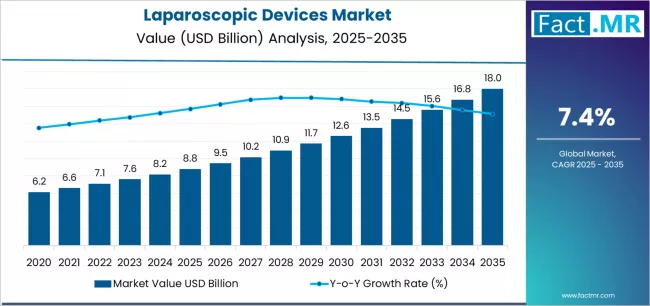
Laparoscopic Devices Market Market Value Analysis | Source: Fact.MR
Laparoscopic Devices Market Definition
The laparoscopic devices market covers surgical instruments and systems used to perform minimally invasive procedures through small incisions in the abdomen or pelvis. These devices allow surgeons to visualize internal organs and carry out procedures using specialized tools guided by a camera. Laparoscopic surgery reduces tissue trauma compared with open surgery and is used across general surgery, gynecology, urology, and bariatric procedures. Device safety, classification, and clinical use are regulated by medical device authorities such as the US Food and Drug Administration and international health bodies.[1]
Laparoscopic Devices Market Inclusions
The report covers global and regional market size estimates in volume and value terms with a forecast period from 2026 to 2036. Segmentation includes device type such as trocars, laparoscopes, energy devices, and hand instruments, application by surgical specialty, and end use across hospitals and ambulatory surgical centers. The scope also includes regional demand patterns, pricing benchmarks, and international trade flows for regulated surgical devices.
Laparoscopic Devices Market Exclusions
The scope excludes open surgical instruments that are not designed for minimally invasive access. Robotic surgical platforms and computer assisted navigation systems are not included unless sold as standalone laparoscopic instruments. Surgical implants, sutures, and consumables not specific to laparoscopic access are excluded. Training simulators, laboratory research tools, experimental devices without regulatory clearance, and surgical services are also outside the scope.
Laparoscopic Devices Market Research Methodology
- Primary Research: Primary research involved interviews with laparoscopic device manufacturers, surgeons, hospital procurement managers, and clinical engineering staff.
- Desk Research: Desk research used medical device classification databases and safety guidance issued by the US Food and Drug Administration and the World Health Organization, national procedure volume statistics, and company annual reports and regulatory filings.
- Market Sizing and Forecasting: Market sizing applied a hybrid top down and bottom up model using surgical procedure volumes, device utilization rates by procedure type, and replacement cycles for reusable instruments.
- Data Validation and Update Cycle:Outputs were cross checked against hospital purchasing data, regulatory approval records, trade statistics, and public healthcare expenditure disclosures, with updates applied when verified public data sources issue revisions.
Summary of Laparoscopic Devices Market
- Market definition
- The laparoscopic devices market covers regulated surgical instruments and systems used to perform minimally invasive abdominal and pelvic procedures through small incisions, enabling visualization, cutting, sealing, and tissue manipulation under camera guidance.
- Demand drivers
- Rising procedural volumes in general, gynecological, bariatric, and colorectal surgery increase routine utilisation of laparoscopic instruments in hospital operating rooms.
- Hospitals prioritise minimally invasive surgery to reduce length of stay, postoperative complications, and overall treatment costs, supporting repeat device consumption.
- Regulatory clearance and safety oversight for laparoscopic instruments, as defined by, [2] guide hospital procurement and device standardisation.
- Key segments analyzed
- Product: Laparoscopic energy systems lead demand due to their role in cutting, coagulation, and vessel sealing across multiple procedures.
- Application: Bariatric surgery represents the largest application share, reflecting higher instrument intensity and longer procedure durations.
- Geography: Europe remains a major demand centre, supported by high procedural penetration and structured reimbursement frameworks, aligned with guidance from. [3]
- Analyst opinion at FMI
- Shambhu Nath Jha, Principal Consultant at Fact.MR, opines, ‘CXOs will find this report useful for understanding how procedural volume growth, hospital adoption of minimally invasive surgery, and product-level standardisation are shaping long-term demand patterns and portfolio prioritisation in laparoscopic devices.’
- Strategic Implications / Executive Takeaways
- Manufacturers should align product portfolios with high-frequency procedures rather than episodic capital equipment cycles.
- Investment focus should remain on reliability, ergonomics, and compatibility with established operating room workflows.
- Suppliers must balance reusable and disposable instrument strategies to meet infection control and cost containment objectives.
- Methodology
- Based on interviews with surgeons, hospital procurement teams, and device manufacturers.
- Market sizing derived from surgical procedure volumes and device utilisation rates.
- Findings validated against regulatory approvals, hospital purchasing data, and public healthcare disclosures.
Segmental Analysis
Laparoscopic Devices Market Analysis by Product
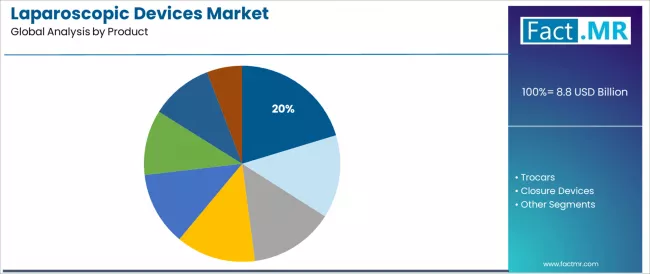
Laparoscopic Devices Market Analysis By Product | Source: Fact.MR
Based on Fact.MR analysis, consumption of laparoscopic energy systems is estimated to hold 25% share of the global market. Fact.MR analysts note that energy systems lead because they enable cutting, coagulation, and vessel sealing within a single device platform, reducing instrument exchanges during minimally invasive procedures. As per Fact.MR, this product category addresses surgeon requirements for procedural efficiency, controlled thermal spread, and compatibility with advanced laparoscopic workflows used across multiple surgical specialties.
- Clinical practice context: Minimally invasive surgical guidelines emphasize reduced operative trauma and controlled hemostasis, supporting routine use of laparoscopic energy devices.
Procedure standardization: Fact.MR analysts note that energy platforms are commonly standardized across operating rooms to support bariatric, gynecological, and general laparoscopic procedures. - Operating room efficiency: Consolidation of cutting and sealing functions into single devices reduces procedure time and instrument handling.
Laparoscopic Devices Market Analysis by Application
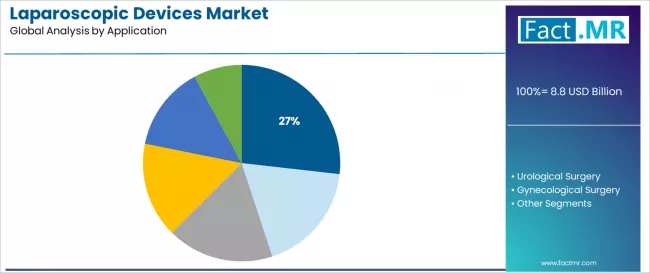
Laparoscopic Devices Market Analysis By Application | Source: Fact.MR
Based on Fact.MR analysis, consumption of laparoscopic devices in bariatric surgery is estimated to hold 35% share of the global market. Fact.MR opines that this application leads due to sustained growth in minimally invasive weight-loss procedures that require multiple specialized laparoscopic instruments. As per Fact.MR, bariatric surgery demands reliable visualization, access, and tissue management tools to support longer procedure durations and complex anatomical manipulation.
- Public health linkage: Government health agencies recognize bariatric surgery as a treatment option for severe obesity under defined clinical criteria.
Procedure volume: Fact.MR analysts reference increasing adoption of laparoscopic approaches for bariatric interventions due to shorter hospital stays. - Device utilization: Bariatric procedures typically involve higher instrument counts per case, supporting elevated demand for laparoscopic systems.
Laparoscopic Devices Market Drivers, Restraints, And Opportunities
Fact.MR analysis indicates that the laparoscopic devices market exists as a key surgical technology segment used in minimally invasive procedures across general surgery, gynecology, urology, and bariatric specialties. As per Fact.MR assessment, laparoscopic surgery involves the use of specialised instruments and imaging systems inserted through small incisions, which are guided under regulatory frameworks that define device classification, design controls, and performance requirements, such as those established by the U.S. Food and Drug Administration (FDA) for laparoscopic surgical instruments and endoscopes. Fact.MR analysts observe that the market’s current scale is tied to increasing surgical volume, preference for procedures with shorter hospital stays, and clinical guidelines that recommend minimally invasive approaches where appropriate.
Fact.MR is of the opinion that current market dynamics reflect a transition in procedural and device preferences as manufacturers innovate around ergonomics, imaging integration, and disposable versus reusable instrument models. Based on Fact.MR assessment, conventional open surgery tools remain in use in settings with limited access to minimally invasive technologies, but demand for advanced laparoscopic devices grows in markets where clinical protocols emphasise reduced postoperative complications and faster recovery times. Advanced instrument sets, high-definition imaging systems, and integrated energy devices typically carry higher per-unit pricing because of complexity and performance testing requirements, meaning realised value can grow even where procedural volume uptake is gradual. Fact.MR analysis suggests this interplay between procedural shifts and premium device placement shapes near-term market progression.
- Regulatory classification and approval pathways: Fact.MR analysts note that regulatory frameworks such as the U.S. FDA’s guidance for laparoscopes and related accessories influence design, testing, and market entry criteria for laparoscopic devices Shift toward minimally invasive protocols: Based on Fact.MR assessment, clinical preference for minimally invasive surgery drives demand for a wide range of laparoscopic instruments and imaging systems that support reduced hospital stay and recovery time.
- Asia Pacific surgical infrastructure growth: Fact.MR opines that expansion of surgical facilities and investment in minimally invasive surgical programmes in markets such as China, India, and Southeast Asia supports regional demand in both public and private healthcare settings.
Regional Analysis
Based on regional assessment, the laparoscopic devices sector in Europe reflects uneven distribution of demand, shaped by procedure volumes, healthcare infrastructure maturity, and adoption of minimally invasive surgical techniques. Western and Central European countries account for the largest share due to higher surgical penetration, advanced hospital networks, and consistent reimbursement frameworks. The analysis also presents a comparative view of regional attractiveness grounded in procedure mix and healthcare spending patterns.
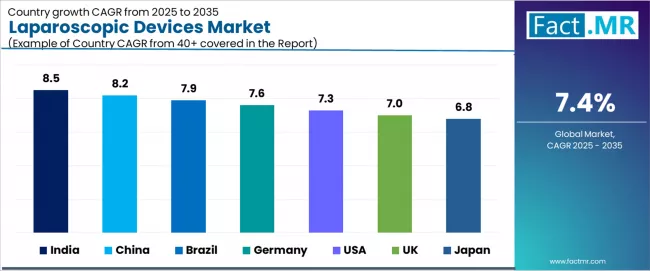
Laparoscopic Devices Market Cagr Analysis By Country | Source: Fact.MR
| Country / Region | Share (%) |
|---|---|
| Germany | 24.8% |
| France | 17.1% |
| Italy | 13.0% |
| BENELUX | 11.9% |
| Spain | 9.4% |
| Nordic | 8.9% |
Source: Fact.MR analysis. Updated Feb 19, 2026
Source: Fact.MR analysis, based on proprietary forecasting models and primary research.
Europe Laparoscopic Devices Market Analysis
Europe operates as a regulation- and reimbursement-driven healthcare devices market for laparoscopic systems, shaped by centralized approval frameworks, public healthcare funding, and hospital procurement protocols. Adoption is governed by EU Medical Device Regulation compliance, national reimbursement policies, and clinical guideline alignment. Demand is concentrated in public hospitals and university medical centers, with purchasing decisions influenced by tender-based procurement, procedural volume, and minimally invasive surgery adoption across general surgery, gynecology, and urology.
- Germany: Germany accounts for 24.8% share of the European laparoscopic devices market. Adoption is supported by high procedural volumes in public hospitals and reimbursement under the statutory health insurance system, with procurement aligned to DRG-based funding and MDR-compliant device listings, as per Fact.MR.
- France: France represents 17.1% share of the market. Usage is driven by public hospital investment programs and reimbursement under Assurance Maladie, with laparoscopic procedures guided by national clinical recommendations and centralized hospital purchasing frameworks, according to Fact.MR.
- Italy: Italy holds 13.0% share of the European laparoscopic devices market. Adoption follows regional healthcare procurement systems and reimbursement under the Servizio Sanitario Nazionale, with demand concentrated in tertiary care hospitals and surgical centers, as per Fact.MR.
- BENELUX: The BENELUX region accounts for 11.9% share. Demand is shaped by high penetration of minimally invasive surgery, centralized hospital procurement, and reimbursement through national health insurance systems in Belgium, the Netherlands, and Luxembourg, according to Fact.MR.
- Spain: Spain represents 9.4% share of the market. Adoption is driven by public healthcare investment and regional hospital procurement under the national health system, with laparoscopic surgery integrated into standard care pathways, as per Fact.MR.
- Nordic: The Nordic region holds 8.9% share. Usage is supported by publicly funded healthcare systems, high surgical technology adoption, and centralized hospital purchasing across Sweden, Denmark, Norway, and Finland, according to Fact.MR.
Fact.MR’s analysis of the Laparoscopic Devices Market in Europe consists of country- and region-wise assessment that includes Germany, France, Italy, BENELUX, Spain, and the Nordic region. Readers can find reimbursement structures, hospital procurement models, regulatory compliance requirements, and procedure-driven demand insights.
Competitive Landscape of Laparoscopic Devices Market
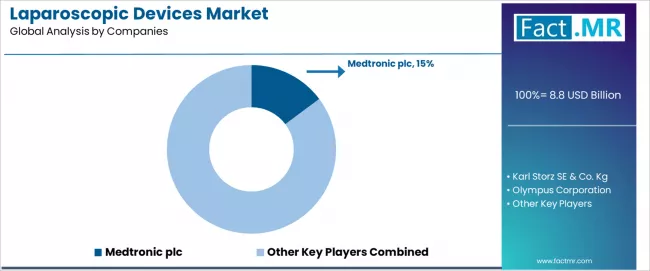
Laparoscopic Devices Market Analysis By Company | Source: Fact.MR
As per Fact.MR analysis, the 2026 laparoscopic devices market is defined by validated procedural efficacy, regulatory compliance, and hospital network adoption, which determine competitive advantage. Medtronic and Karl Storz SE lead with end-to-end instrument portfolios and integrated visualization systems, which strengthens adoption in global hospitals and surgical centers. Olympus and Johnson & Johnson (Ethicon) focus on high-precision optics and ergonomic instrumentation, which reduces procedural risk and improves surgeon confidence. B. Braun Melsungen and CONMED emphasize disposable and reusable instruments with documented sterility and durability, which enhances operating room efficiency and reduces infection incidence. Intuitive Surgical offers robotic-assisted platforms with validated performance data, which improves patient outcomes and creates system-level lock-in. BD and The Cooper Companies provide ancillary laparoscopic supplies with verified compliance, which ensures multi-region regulatory acceptance. Richard Wolf, Stryker, Smith & Nephew, Boston Scientific, Applied Medical, and Teleflex focus on modular, validated device systems, which enhance flexibility for different procedures. Across the market, procedural efficacy, validated safety, and hospital integration form enduring competitive moats, reducing reliance on pricing or isolated product claims.
Recent Industry Developments
- FDA Clearance of Medtronic’s Hugo RAS System for Urology (December 2025)
- In December 2025, Medtronic achieved a major milestone with the U.S. FDA clearance of its Hugo™ robotic-assisted surgery system specifically for urologic procedures. This launch provides the first significant multi-port robotic alternative to Intuitive Surgical in the U.S. market. The Hugo system’s modular design allows its arms to be moved between operating rooms, addressing the cost and space constraints of traditional laparoscopic setups. [4]
- Full-Scale Global Rollout of Intuitive’s Da Vinci 5 (Third Quarter 2025)
- Following its initial limited release, Intuitive Surgical made the da Vinci 5 system broadly available in the U.S., Europe, and Japan in late 2025. The new platform features "Force Feedback" technology a first for the market which allows surgeons to "feel" the resistance of tissues through the robotic console. By early 2026, Intuitive reported that the da Vinci 5 was driving 11% higher utilization rates compared to previous generations due to improved autonomous features. [5]
Key Players in Laparoscopic Devices Market
- Medtronic plc
- Karl Storz SE & Co. Kg
- Olympus Corporation
- Johnson & Johnson (Ethicon)
- B. Braun Melsungen AG
- CONMED Corporation
- Intuitive Surgical, Inc.
- BD (Becton, Dickinson and Company)
- The Cooper Companies, Inc.
- Richard Wolf GmbH
- Stryker Corporation
- Smith & Nephew plc
- Boston Scientific Corporation
- Applied Medical Resources Corporation
- Teleflex Incorporated
Bibliography
- [1] U.S. Food and Drug Administration. (2024). Medical devices: Regulation, classification, and safety oversight for surgical instruments. U.S. Department of Health and Human Services.
- [2] U.S. Food and Drug Administration. (2024). Medical device regulations and guidance for laparoscopic instruments and accessories. U.S. Department of Health and Human Services.
- [3] World Health Organization. (2024). Medical devices: Policy, regulation, and health system strengthening. World Health Organization.
- [4] Medtronic plc. (2025). Medtronic announces FDA clearance of the Hugo™ robotic-assisted surgery system for urologic surgical procedures. Medtronic Newsroom.
- [5] Intuitive Surgical, Inc. (2025). Intuitive announces preliminary fourth quarter and full-year results and expanded global rollout of da Vinci 5. Intuitive Surgical Investor Relations.
Segmentation
Scope of the Report
| Metric | Value |
|---|---|
| Quantitative Units | USD 9.4 billion (2026) to USD 19.3 billion (2036), at a CAGR of 7.4% |
| Market Definition | The laparoscopic devices market covers surgical instruments and systems used to perform minimally invasive procedures through small incisions in the abdomen or pelvis. Devices include laparoscopes, trocars, energy systems, hand access instruments, insufflation devices, suction/irrigation devices, closure devices, and robot-assisted platforms. These devices are regulated by authorities such as the FDA and WHO. |
| Product Segmentation | Energy Systems, Trocars, Closure Devices, Laparoscopes, Robot-Assisted Systems, Suction/Irrigation Devices, Hand Access Instruments, Insufflation Devices |
| Application Segmentation | Bariatric Surgery, Urological Surgery, Gynecological Surgery, General Surgery, Colorectal Surgery, Other |
| End Use Segmentation | Hospitals, Ambulatory Surgical Centers, Clinics |
| Regions Covered | Asia Pacific, Europe, North America, Latin America, Middle East & Africa |
| Countries Covered | Germany, France, Italy, BENELUX, Spain, Nordic, United States, Japan, China, India, South Korea, Indonesia, Australia & New Zealand, ASEAN, Rest of Asia Pacific, United Kingdom, Italy, Spain, Benelux, Nordics, Central & Eastern Europe, Rest of Europe, Canada, Mexico, Brazil, Argentina, Chile, Rest of Latin America, Kingdom of Saudi Arabia, United Arab Emirates, South Africa, Turkey, Rest of Middle East & Africa |
| Key Companies Profiled | Medtronic plc, Karl Storz SE & Co. Kg, Olympus Corporation, Johnson & Johnson (Ethicon), B. Braun Melsungen AG, CONMED Corporation, Intuitive Surgical, Inc., BD (Becton Dickinson), The Cooper Companies, Inc., Richard Wolf GmbH, Stryker Corporation, Smith & Nephew plc, Boston Scientific Corporation, Applied Medical Resources Corporation, Teleflex Incorporated |
| Forecast Period | 2026 to 2036 |
| Approach | Hybrid top-down and bottom-up modeling validated through primary interviews with surgeons, hospital procurement managers, clinical engineers, and laparoscopic device manufacturers. Market sizing supported by procedure volumes, device utilization rates, replacement cycles, regulatory compliance data from FDA and WHO, and hospital purchasing patterns. |
Source: Fact.MR analysis. Updated Feb 19, 2026
Laparoscopic Devices Market Analysis by Segments
-
Product:
- Energy Systems
- Trocars
- Closure Devices
- Laparoscopes
- Robot-Assisted Systems
- Suction/Irrigation Devices
- Hand Access Instruments
- Insufflation Devices
-
Application:
- Bariatric Surgery
- Urological Surgery
- Gynecological Surgery
- General Surgery
- Colorectal Surgery
- Others
-
End Use:
- Hospitals
- Ambulatory Surgical Centers
- Clinics
-
Region
- Asia Pacific
- India
- China
- Japan
- South Korea
- Indonesia
- Australia & New Zealand
- ASEAN
- Rest of Asia Pacific
- Europe
- Germany
- Italy
- France
- United Kingdom
- Spain
- Benelux
- Nordics
- Central & Eastern Europe
- Rest of Europe
- North America
- United States
- Canada
- Mexico
- Latin America
- Brazil
- Argentina
- Chile
- Rest of Latin America
- Middle East & Africa
- Kingdom of Saudi Arabia
- United Arab Emirates
- South Africa
- Turkey
- Rest of Middle East & Africa
- Asia Pacific
Frequently Asked Questions
How large is the laparoscopic devices market in 2026?
What will the market size be by 2036?
What CAGR is expected for the laparoscopic devices market during 2026–2036?
How much absolute value will the market add over the forecast window?
What is the primary driver behind market expansion?
Is growth mainly price-driven or volume-driven?
Which product category leads demand in the laparoscopic devices market?
Why do energy systems account for the largest product share?
Which application segment represents the largest share of demand?
Why does bariatric surgery drive higher device demand?
How does early-period market growth differ from later years?
What role do robotic-assisted systems play in long-term value growth?
Which country leads European demand for laparoscopic devices?
How significant is France’s share within Europe?
What share does Italy hold in the European market?
How important is the BENELUX region in Europe?
What is Spain’s contribution to European demand?
How much do Nordic countries contribute to European demand?
What portion of the market is held by the rest of Europe?
What factors most influence purchasing decisions in this market?
Who worked on this report


Preview the report firsthand - request a free sample
Free SampleGet the brochure for pricing and purchase details
Download PDF