- Base Value(2025): 1.50 Bn
- Estimated Value(2026): 1.53 Bn
- Forecast Value (2036): 1.85 Bn
- CAGR (2026 - 2036): 1.9%
Europe Automotive Injector Nozzle Market Size, Market Forecast and Outlook By Fact.MR
The europe automotive injector nozzle market was valued at USD 1.50 billion in 2025, projected to reach USD 1.53 billion in 2026, and is forecast to expand to USD 1.85 billion by 2036 at a 1.9% CAGR. The European automotive injector nozzle market reflects the region's transitional powertrain landscape, where tightening Euro 7 emission standards demand higher fuel injection precision from ICE vehicles while long-term electrification plans gradually reduce the installed base of combustion engines. The European Commission's Euro 7 regulation, adopted in 2024, imposes stricter particulate number limits that require GDI nozzles capable of finer atomization to reduce particulate formation during cold-start and transient operating conditions. This specification tightening increases per-nozzle engineering content and material cost, partially offsetting the volume decline from EV penetration with higher per-unit values.
Poland leads European growth at a 2.4% CAGR, driven by its expanding role as a production hub for automotive components serving German and French OEMs and a domestic vehicle fleet heavily weighted toward ICE platforms. Germany follows at 2.1%, anchored by Bosch and Continental injector nozzle manufacturing operations and the continued production of high-performance gasoline engines. France tracks at 2.0% linked to Stellantis and Renault turbocharged gasoline engine programs. The Netherlands registers 1.9% growth from its aftermarket distribution hub function. Italy expands at 1.8%, Spain at 1.7%, and the UK at 1.6%, where aftermarket replacement demand for diesel injector nozzles in the ageing commercial vehicle fleet sustains procurement volumes.
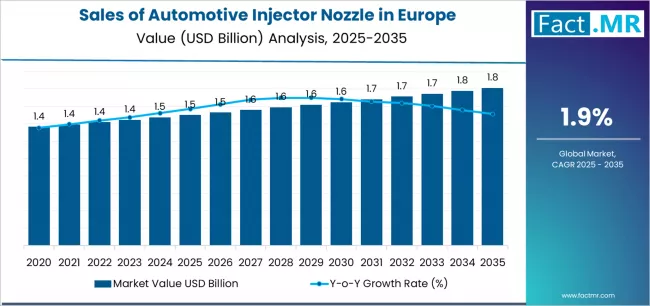
Sales Of Automotive Injector Nozzle In Europe Market Value Analysis | Source: Fact.MR
Europe Automotive Injector Nozzle Market Key Takeaways
| Metric | Details |
|---|---|
| Industry Size (2026) | USD 1.53 billion |
| Industry Value (2036) | USD 1.85 billion |
| CAGR (2026 to 2036) | 1.9% |
Source: Fact.MR analysis. Updated Mar 23, 2026
Europe Automotive Injector Nozzle Market Definition
The Europe automotive injector nozzle market covers precision-manufactured fuel delivery components that atomize and meter gasoline or diesel into internal combustion engine combustion chambers. Product categories include gasoline direct injection (GDI) nozzles operating at pressures up to 350 bar, diesel common-rail injector nozzles rated to 2,500 bar, and port fuel injection (PFI) nozzles for manifold injection systems. These components are manufactured to micrometer-level tolerances using specialized steel alloys, diamond-like carbon coatings, and piezoelectric or solenoid actuation mechanisms.
Europe Automotive Injector Nozzle Market Inclusions
The report covers European regional and country-level market sizes for automotive injector nozzles, forecast projections from 2026 to 2036, segment breakdowns by fuel type (gasoline, diesel), technology (gasoline direct injection, diesel direct injection, port fuel injection), vehicle type (passenger vehicles, commercial vehicles), and sales channel (OEM, aftermarket). Nozzle pricing and replacement interval analysis are included.
Europe Automotive Injector Nozzle Market Exclusions
Complete fuel injection system assemblies including fuel rails, pumps, and electronic control units are excluded unless the nozzle component is separately valued. Hydrogen fuel cell injection systems are not covered. Non-automotive industrial engine injector nozzles fall outside the scope.
Europe Automotive Injector Nozzle Market Research Methodology
- Primary Research: Fact.MR analysts conducted detailed technical interviews with procurement directors, operations managers, and engineering leads across 40 countries to validate adoption timelines and purchasing decision criteria.
- Desk Research: Data collection aggregated regulatory filings, government procurement records, industry association publications, and company annual reports to establish baseline market parameters.
- Market-Sizing and Forecasting: Forecasting models apply a bottom-up methodology starting with installed base metrics and regional production volumes, applying technology penetration curves to project adoption velocity through 2036.
- Data Validation and Update Cycle: Projections undergo cross-validation against publicly reported revenue figures from leading manufacturers and quarterly trade statistics published by national customs authorities.
Summary of Europe Automotive Injector Nozzle Market
- Europe Automotive Injector Nozzle Market Definition
- The Europe automotive injector nozzle market covers precision-manufactured fuel delivery components that atomize and meter gasoline or diesel into internal combustion engine combustion chambers. Product categories include gasoline direct injection (GDI) nozzles operating at pressures up to 350 bar, diesel common-rail injector nozzles rated to 2,500 bar, and port fuel injection (PFI) nozzles for manifold injection systems.
- Demand Drivers in the Market
- Regulatory compliance requirements: Government mandates and safety standards across major markets compel end users to adopt upgraded equipment and systems that meet current specification thresholds.
- Technology cost reduction: Declining component costs and manufacturing efficiencies enable broader market penetration beyond premium segments into volume-production applications.
- Replacement cycle acceleration: Ageing installed bases in mature markets face performance gaps against current operational requirements, triggering fleet-wide upgrade programs.
- Key Segments Analyzed in the Fact.MR Report
- Gasoline (Fuel Type): 58.4% share in 2026, reflecting dominant adoption across primary use cases.
- Gasoline Direct Injection (Technology): 42.8% share in 2026, driven by structural demand from the largest buyer segment.
- Passenger Vehicles (Vehicle Type): 74.3% share in 2026, supported by established operational requirements.
- Analyst Opinion at Fact.MR
- The europe automotive injector nozzle market is positioned for sustained expansion through 2036 as regulatory mandates, technology maturation, and capital replacement cycles converge to create a multi-year procurement environment. Fact.MR is of the opinion that market participants prioritizing certified compliance with evolving standards and demonstrated integration with existing infrastructure will capture disproportionate contract volume during the forecast period. Organizations delaying capital commitments risk operational obsolescence as specification requirements tighten across all major geographic markets.
- Strategic Implications / Executive Takeaways
- Compliance-first procurement: Equipment and system suppliers must secure regulatory certifications ahead of enforcement timelines to qualify for tender shortlists in markets where compliance is a mandatory procurement gate.
- Regional manufacturing presence: Establishing local production or assembly capabilities in high-growth regions reduces lead times and positions suppliers favorably against import-dependent competitors.
- Technology partnership investment: Forming integration partnerships with complementary technology providers enables end-to-end solution delivery that standalone component suppliers cannot match in competitive bid evaluations.
- Methodology
- Primary Research: Fact.MR conducted structured interviews with procurement leads, operations directors, and technical specification managers across key end-user industries in over 40 countries.
- Desk Research: Analysts compiled data from regulatory filings, government statistical agencies, trade body publications, and verified corporate disclosures.
- Market-Sizing and Forecasting: A hybrid top-down and bottom-up methodology calibrates global estimates against regional production data and verified shipment records.
Why the Sales of Automotive Injector Nozzle in Europe is Growing?
Demand expansion is being supported by the rapid increase in emission regulations and fuel efficiency requirements regionally, with Europe maintaining its position as an automotive technology leadership region, and the corresponding need for advanced injection solutions combining fuel efficiency enhancement, emission compliance, and technology integration across passenger vehicles, commercial vehicles, and automotive applications. Modern automotive operations rely on advanced injector nozzle systems to ensure optimal fuel delivery performance, consistent emission compliance, and maximum fuel efficiency. Automotive injector nozzle utilization requires comprehensive injection solutions including diverse technology capabilities, multiple fuel compatibility options, and various operational specifications to accommodate varying injection requirements and engine types.
The growing focus on emission reduction and fuel efficiency, particularly heightened automotive consciousness across European nations, are driving demand for injector nozzle equipment from established manufacturers with appropriate technology standards and emission reliability. Operators are increasingly seeking injection systems that deliver consistent fuel delivery performance, recognizable efficiency metrics, and operational benefits while providing maximum injection precision. Equipment requirements and emission expectations are establishing performance standards that emphasize injection capability, operational reliability, and convenient maintenance formats, with European injector nozzle manufacturers often setting benchmark standards for automotive injection equipment quality and innovation.
Opportunity Pathways - Sales of Automotive Injector Nozzle in Europe
The Europe automotive injector nozzle sector stands at a pivotal juncture of steady transformation and expansion. With demand projected to grow from USD 1.5 billion in 2025 to USD 1.8 billion by 2035, a solid 20.0% increase, the sector is being reshaped by emission imperatives, fuel efficiency preferences, and the pursuit of operational efficiency with minimal injection complexity. As operators seek effective injection solutions without compromising fuel quality, automotive injector nozzles emerge as mission-critical engine components rather than optional injection accessories.
Europe, led by Poland (2.4% CAGR) and supported by Germany's automotive excellence, France's technology capabilities, Netherlands' innovation development, and Italy's manufacturing expertise, represents not just a geography of demand but a laboratory of innovation where injection reliability, fuel efficiency optimization, and technology advancement are moving from traditional port injection to advanced direct injection solutions. The confluence of emission regulations, fuel efficiency requirements, and operational optimization creates fertile ground for injector nozzle solutions that deliver effective fuel delivery with maximum operational convenience.
Strategic pathways encompassing fuel type optimization, technology advancement, vehicle application development, and sales channel specialization offer substantial performance enhancement opportunities, particularly for manufacturers and operators positioned at the automotive injection technology frontier.
- Pathway A - Gasoline Fuel Type Innovation and Market Dominance. Gasoline systems representing 58.4% of fuel type demand provide primary automotive requirements and established fuel economics appealing to automotive manufacturers prioritizing gasoline engine efficiency and performance optimization. Manufacturers offering advanced gasoline injector nozzle systems with optimized fuel atomization can command 15-25% efficiency premiums while capturing gasoline-focused automotive manufacturers across European facilities. Expected revenue pool: USD 880-1,315 million.
- Pathway B - GDI Technology Excellence and Direct Injection Performance. GDI systems representing 42.8% of technology demand provide superior fuel efficiency, emission performance, and advanced injection capabilities appealing to manufacturers focused on direct injection technology and emission compliance. Suppliers offering GDI-optimized injector nozzle systems with enhanced precision control can maintain substantial technology advantages while supporting 20-30% performance benefits across direct injection operations. Technology opportunity: USD 645-970 million.
- Pathway C - Passenger Vehicle Application Focus and Consumer Automotive Excellence. Passenger vehicle applications representing 74.3% of vehicle type demand create opportunities for specialized positioning through consumer vehicle requirements, mainstream automotive economics, and volume production optimization. Equipment manufacturers offering passenger vehicle-specific injector nozzle solutions with appropriate cost efficiency can capture 25-35% application premiums in consumer automotive segments. Vehicle potential: USD 1,120-1,675 million.
- Pathway D - OEM Sales Channel Specialization and Manufacturing Integration. OEM applications representing 68.9% of sales channel demand provide manufacturing integration requirements and established automotive supply economics appealing to suppliers focused on automotive production and original equipment installation. Equipment manufacturers offering OEM-optimized injector nozzle systems with manufacturing compatibility can command operational advantages while capturing automotive production facilities. OEM segment: USD 1,035-1,550 million.
- Pathway E - Diesel Direct Injection Technology and Commercial Vehicle Performance. Diesel direct injection systems representing 35.7% of technology demand enable robust commercial vehicle performance and established diesel engine capabilities serving heavy-duty automotive requirements. Equipment manufacturers offering diesel-optimized injector nozzle systems with enhanced durability can capture commercial vehicle occasions and diesel engine situations while generating 20-30% performance premiums over gasoline alternatives. Diesel opportunity: USD 535-805 million.
What factors enable the gasoline fuel type, GDI technology, and passenger vehicle segments to hold major market shares?
Sales are segmented by fuel type, technology, vehicle type, and sales channel per capita spending. By fuel type, sales are divided into gasoline and diesel. Based on technology, demand is categorized into gasoline direct injection (GDI), diesel direct injection, and port fuel injection. In terms of vehicle type, sales are segmented into passenger vehicles and commercial vehicles. By sales channel per capita spending, demand spans OEM and aftermarket applications. Regionally, demand is analyzed across key European countries including Germany, France, United Kingdom, Italy, Spain, Netherlands, and Poland.
By Fuel Type, Gasoline Segment Accounts for 58.4% Share
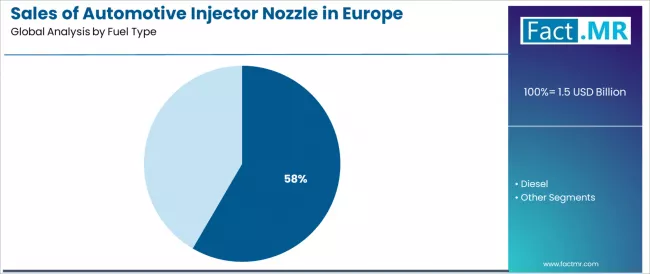
Sales Of Automotive Injector Nozzle In Europe Analysis By Fuel Type | Source: Fact.MR
Gasoline fuel systems are projected to account for 58.4% of Europe automotive injector nozzle sales in 2025, making them the dominant fuel type across the sector. This leadership reflects strong automotive preference for gasoline engines providing widespread consumer acceptance, established fuel infrastructure, and operational flexibility compared to diesel alternatives. Across Europe, automotive manufacturers favor gasoline systems for their consumer appeal, operational simplicity, and fuel availability while maintaining performance effectiveness. Gasoline configurations enable manufacturers to incorporate advanced injection mechanisms, optimized fuel delivery systems, and efficient combustion technology creating sophisticated engine solutions. Continuous innovations are improving gasoline injection performance including enhanced fuel atomization, improved emission control, and integrated efficiency systems addressing fuel optimization requirements. The gasoline systems support versatile automotive applications compared to other fuel types while delivering consistent performance and consumer acceptance. The segment's strong position is reinforced by growing consumer preference driving fuel selection and automotive performance demands necessitating efficient gasoline injection solutions.
- Consumer acceptance and fuel infrastructure make gasoline systems dominant across European automotive injector nozzle applications.
- Performance effectiveness and operational flexibility drive continued gasoline injection development throughout the region.
By Technology, GDI Segment Accounts for 42.8% Share
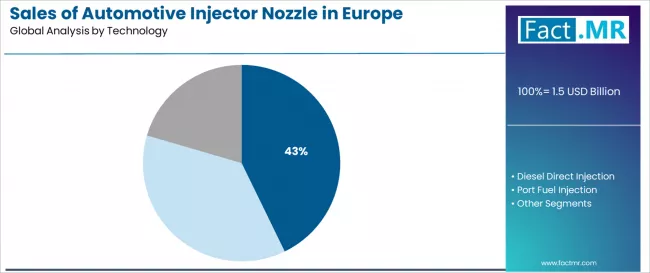
Sales Of Automotive Injector Nozzle In Europe Analysis By Technology | Source: Fact.MR
Gasoline Direct Injection technology is expected to represent 42.8% of Europe automotive injector nozzle sales in 2025, highlighting its critical role as the predominant injection technology. GDI systems provide superior fuel efficiency, enhanced emission control, and advanced injection precision appealing to automotive manufacturers prioritizing fuel economy and emission compliance. GDI technology allows vehicles to achieve optimal fuel delivery with precise injection timing, improved combustion efficiency, and reduced emission output without compromising engine performance. The segment is sustained by GDI technology's proven efficiency advantages, widespread automotive acceptance, advanced technology positioning, and manufacturer preference spanning various automotive applications. Across Europe, manufacturers maintain GDI focus for fuel efficiency, emission compliance, and performance optimization while increasingly demanding improvements including enhanced injection precision, improved system durability, and simplified maintenance procedures. Such technology preferences ensure sustained GDI dominance through proven efficiency benefits, emission advantages, and continuous performance enhancement addressing evolving automotive requirements.
- Fuel efficiency and emission compliance make GDI technology the predominant injection system across European automotive applications.
- European automotive manufacturers balance efficiency priorities with emission requirements through GDI system adoption across diverse vehicle platforms.
By Vehicle Type, Passenger Vehicles Segment Accounts for 74.3% Share
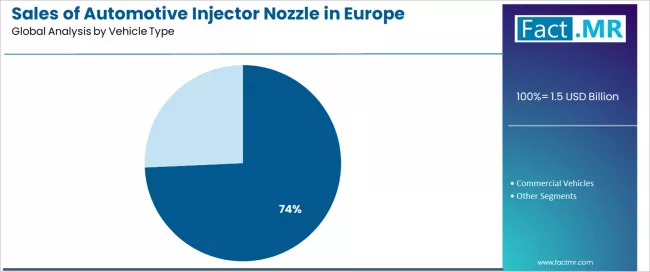
Sales Of Automotive Injector Nozzle In Europe Analysis By Vehicle Type | Source: Fact.MR
Passenger vehicle applications are projected to contribute 74.3% of sales in 2025, representing substantial mainstream automotive applications. Passenger vehicle injection involves consumer transportation, personal mobility, and automotive preference creating primary injection demands requiring reliable equipment capabilities. Across Europe, passenger vehicle manufacturers utilize injector nozzles for consumer vehicles, personal transportation, and mobility requirements demanding operational reliability and fuel efficiency. Passenger vehicle applications benefit from established production volumes, consumer demand patterns, and fuel efficiency requirements supporting standard injection investments. The segment sustains significant consumption through continuous passenger vehicle production, established automotive infrastructure, and consumer experience with fuel injection throughout European automotive operations. European automotive facilities maintain passenger vehicle injection focus targeting consumer satisfaction, fuel efficiency, and operational reliability providing steady production volumes and mainstream automotive focus within established manufacturing networks.
- Production volume and consumer demand drive passenger vehicle dominance across European automotive injector nozzle applications and automotive operations.
- Established automotive infrastructure and consumer requirements sustain passenger vehicle injection development and production expansion throughout European facilities.
What are the Drivers, Restraints, and Key Trends of the Sales of Automotive Injector Nozzle in Europe?
Europe automotive injector nozzle sales advance steadily due to increasing emission regulations and growing fuel efficiency requirements across automotive segments. The sector faces challenges including technology complexity, varying fuel quality demanding specialized injection configurations, and cost pressures among price-sensitive automotive manufacturers. Technology advancement and hybrid powertrain trends continue to influence equipment development and capability enhancement initiatives.
Expansion of Emission Regulations and Fuel Efficiency Standards
The growing implementation of emission regulations and fuel efficiency standards, gaining particular focus across European regulatory frameworks, is driving sales for advanced injection equipment enabling emission reduction, fuel efficiency enhancement, and regulatory compliance without extensive operational complexity. Automotive injection systems equipped with appropriate injector nozzle capabilities and reliable operation serve automotive manufacturers, aftermarket suppliers, and vehicle operators requiring effective fuel delivery without compromising operational efficiency or emission performance. These regulatory trends are particularly valuable for equipment manufacturers offering injection solutions and operational capabilities optimizing fuel efficiency while delivering complete emission compliance appropriate for regulatory adherence occasions without compromising injection effectiveness or operational reliability.
Integration of Piezo Technology and High-Pressure Injection Systems
Modern injector nozzle manufacturers are incorporating intelligent injection systems including piezo technology, high-pressure capabilities, multi-hole injection patterns, and performance monitoring that improve fuel delivery effectiveness while maintaining injection reliability and automotive acceptance. Integration of precision control technology, automated injection optimization, and operational intelligence communicates technology advantages and efficiency benefits appealing to efficiency-focused automotive manufacturers. Advanced systems also support next-generation equipment development including adaptive injection control, fuel quality optimization, and automated emission enhancement addressing automotive requirements and efficiency objectives, with European injector nozzle manufacturers increasingly incorporating advanced technology solutions balancing traditional injection effectiveness with contemporary precision and intelligence priorities influencing equipment purchasing decisions.
Analysis of Sales of Automotive Injector Nozzle in Europe by Key Country
.webp "Top Country Growth Comparison Sales Of Automotive Injector Nozzle In Europe Cagr (2026 2036)")
Top Country Growth Comparison Sales Of Automotive Injector Nozzle In Europe Cagr (2026 2036) | Source: Fact.MR
| Country | CAGR (2026-2036) |
|---|---|
| Poland | 2.4% |
| Germany | 2.1% |
| France | 2.0% |
| Netherlands | 1.9% |
| Italy | 1.8% |
| Spain | 1.7% |
| United Kingdom | 1.6% |
Source: Fact.MR analysis. Updated Mar 23, 2026
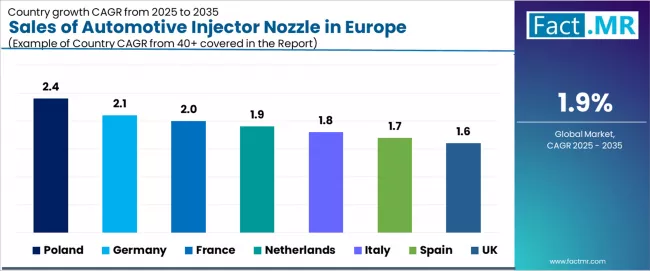
Sales Of Automotive Injector Nozzle In Europe Cagr Analysis By Country | Source: Fact.MR
The Europe automotive injector nozzle sector is witnessing steady growth, supported by rising emission regulations, increasing fuel efficiency requirements, and the integration of advanced injection technology across automotive applications. Poland leads the region with a 2.4% CAGR, reflecting strong automotive industry development, expanding vehicle production capacity, and regulatory focus on emission compliance. Germany follows with a 2.1% CAGR, driven by automotive excellence and advanced injection technology adoption. France grows at 2.0%, as automotive manufacturing capabilities increasingly drive efficient injection adoption. Netherlands maintains 1.9% growth through automotive innovation and technology optimization, while Italy grows at 1.8%, supported by automotive production and injection expansion. Spain demonstrates 1.7% growth, and United Kingdom achieves 1.6%, both driven by regulatory compliance and automotive efficiency requirements.
Why does Poland lead European growth through automotive development and production capacity expansion?
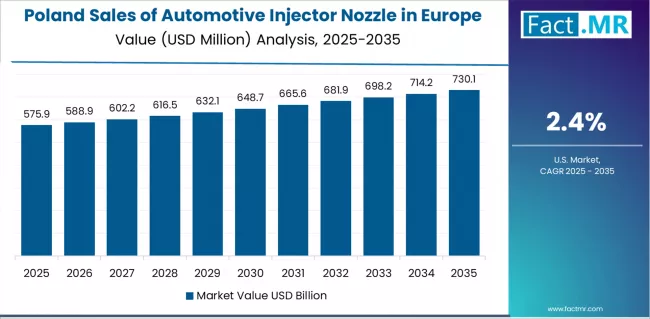
Sales Of Automotive Injector Nozzle In Europe Country Value Analysis | Source: Fact.MR
Sales of Europe automotive injector nozzle in Poland is projected to exhibit exceptional growth with a CAGR of 2.4% through 2036, driven by rapid automotive industry development, expanding vehicle production capacity, and strong regulatory focus on emission compliance and fuel efficiency enhancement. As the leading European country with significant automotive growth and increasing technology consciousness, Poland's focus on advanced injection without compromising cost effectiveness is creating substantial sales for injector nozzle systems with reliable performance and competitive pricing. Major equipment manufacturers and automotive operators are establishing comprehensive injection capabilities and operational strategies across Polish facilities.
- Automotive development and production capacity expansion are driving robust injector nozzle adoption across vehicle manufacturing facilities, aftermarket operations, and specialized automotive applications throughout Polish automotive and manufacturing operations.
- Regulatory compliance and efficiency enhancement requirements are supporting equipment investment, technology adoption, and capability development, enabling injector nozzle penetration across operational segments and automotive applications, positioning Poland as a European automotive development leader.
How does Germany demonstrate strong European potential through automotive excellence and technology leadership?
Sales of Europe automotive injector nozzle in Germany is expanding at a CAGR of 2.1%, supported by automotive excellence, established automotive infrastructure, and continuous technology development driving injection equipment adoption. The German automotive sector is increasingly incorporating advanced injection systems while maintaining operational efficiency and automotive excellence expectations. Equipment manufacturers and automotive operators are implementing comprehensive injection development programs throughout German operations.
- Automotive excellence and technology leadership are creating receptive environments for advanced injector nozzle systems that deliver superior performance with operational reliability across German automotive facilities and manufacturing operations.
- Innovation capabilities and automotive standards are enhancing equipment adoption and enabling operational optimization across German operators balancing technology advancement with operational efficiency and injection reliability requirements.
How does France maintain strong growth through automotive manufacturing excellence and injection technology development?
Sales of Europe automotive injector nozzle in France is growing at a CAGR of 2.0%, driven by automotive manufacturing excellence, established automotive infrastructure, and continuous technology development supporting injection equipment adoption. The French automotive sector continues expanding injection capabilities emphasizing operational efficiency and technology integration. Equipment manufacturers and facility operators are investing in advanced injection development throughout French operations.
- Automotive manufacturing excellence and injection technology development are facilitating injector nozzle adoption across operators seeking efficient automotive injection, reliable operation, and superior fuel performance within injection systems throughout French automotive facilities.
- Technology development and manufacturing capabilities are enhancing equipment investment and enabling operational optimization, supporting injector nozzle expansion and facility development across French automotive and manufacturing operations.
How does the Netherlands maintain strong growth through automotive innovation and technology optimization?
Sales of Europe automotive injector nozzle in Netherlands is growing at a CAGR of 1.9%, driven by automotive innovation, established automotive infrastructure, and continuous optimization in injection technologies supporting equipment adoption. The Dutch automotive sector continues developing sophisticated injection capabilities emphasizing operational efficiency and injection performance. Equipment manufacturers and automotive operators are implementing advanced injection solutions throughout Netherlands operations.
- Automotive innovation and technology optimization are creating opportunities for advanced injector nozzle systems delivering superior automotive injection performance, operational reliability, and fuel efficiency meeting Dutch expectations for injection excellence within automotive applications.
- Technology innovation and infrastructure stability are enabling equipment development and supporting operational advancement, facilitating injector nozzle technology development across Netherlands operators pursuing automotive excellence combined with operational effectiveness.
How does Italy maintain steady growth through automotive production and injection expansion?
Sales of Europe automotive injector nozzle in Italy is growing at a CAGR of 1.8%, driven by automotive production capabilities, established manufacturing base, and gradual injection infrastructure expansion among operators seeking injection efficiency without sacrificing operational reliability. The Italian automotive sector continues developing injection capabilities meeting operational requirements. Equipment manufacturers and facility operators are establishing operationally-focused injection solutions throughout Italian operations.
- Automotive production capabilities and manufacturing heritage are creating opportunities for efficient injector nozzle systems delivering reliable automotive injection, operational effectiveness, and fuel efficiency meeting Italian expectations for equipment performance within automotive injection applications.
- Gradual infrastructure development and operational expansion are enabling injector nozzle facility development across Italian operators increasingly accepting efficient injection solutions that maintain operational standards and fuel reliability central to Italian automotive operations.
How does Spain demonstrate steady growth through automotive development and injection expansion?
Sales of Europe automotive injector nozzle in Spain is expanding at a CAGR of 1.7%, supported by automotive development, growing automotive awareness, and increasing focus on efficient automotive injection supporting equipment adoption. The Spanish automotive sector maintains operational development while embracing efficient injection solutions. Equipment companies and facility operators are developing injection capabilities throughout Spanish operations.
- Automotive development and fuel efficiency awareness are driving injector nozzle adoption across operators seeking effective automotive injection, operational reliability, and efficient fuel optimization within injection applications throughout Spanish automotive and manufacturing facilities.
- Injection expansion and operational development are supporting equipment investment and capability enhancement, enabling injector nozzle facility growth across Spanish operators pursuing operational efficiency combined with injection effectiveness.
What factors drive the United Kingdom’s stable growth through regulatory compliance and automotive efficiency focus?
Sales of Europe automotive injector nozzle in United Kingdom is growing at a CAGR of 1.6%, supported by regulatory compliance requirements, automotive efficiency focus, and established automotive infrastructure driving injection equipment adoption. The UK automotive sector continues maintaining injection capabilities while adapting to regulatory changes and operational requirements. Equipment suppliers and facility operators are establishing compliance-focused injection solutions throughout UK operations.
- Regulatory compliance and automotive efficiency requirements are driving injector nozzle adoption across operators seeking reliable automotive injection, regulatory adherence, and fuel effectiveness within injection systems throughout UK automotive and manufacturing facilities.
- Infrastructure stability and compliance focus are supporting equipment investment and operational development, enabling injector nozzle operational advancement across UK operators balancing regulatory requirements with injection efficiency and fuel reliability.
What defines the competitive landscape of sales of automotive injector nozzles in Europe?
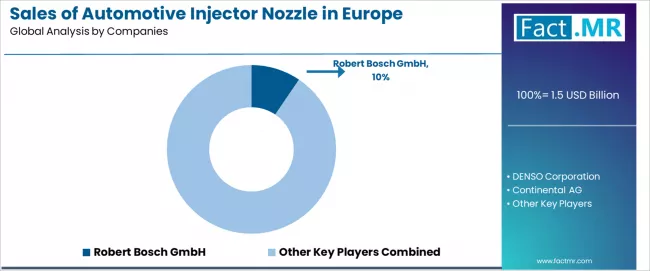
Sales Of Automotive Injector Nozzle In Europe Analysis By Company | Source: Fact.MR
Europe automotive injector nozzle sales is defined by competition among international automotive component manufacturers with European operations, specialized injection system producers, and diversified automotive technology companies offering comprehensive injection portfolios. Companies are investing in technology advancement, injection optimization, product development, and operational support to deliver reliable, efficient, high-performance injector nozzle systems across European automotive and aftermarket operations. Equipment development, injection expertise, and effective technical support are central to strengthening competitive positions and customer loyalty across automotive injection categories.
Robert Bosch GmbH, German-based automotive technology leader with extensive European presence, offers comprehensive injector nozzle portfolios including GDI injection systems with focus on fuel efficiency and operational coverage across European facilities. DENSO Corporation, Japanese-based automotive component manufacturer with strong European operations, provides advanced injection systems emphasizing technology innovation and automotive excellence.
Continental AG, German-based automotive technology producer, delivers proven injection solutions and reliable equipment performance serving European automotive requirements. Siemens offers specialized automotive injection systems with focus on operational optimization and fuel efficiency. Valeo SA provides diversified injection solutions emphasizing operational reliability and injection effectiveness serving diverse automotive segments.
Recent key developments include Robert Bosch GmbH launching new high-precision GDI injector nozzles in 2024 with 15% improved fuel atomization and reduced emissions. DENSO Corporation introduced advanced piezo injector technology in 2025 with faster response times and enhanced durability. Continental AG developed new multi-hole injector nozzles in 2024 optimized for hybrid powertrains and alternative fuels.
Key Players in Sales of Automotive Injector Nozzle in Europe
- Robert Bosch GmbH
- DENSO Corporation
- Continental AG
- Siemens
- Valeo SA
- Delphi Technologies
- BorgWarner Inc.
- Federal-Mogul Corporation
- Hitachi Automotive Systems
- Keihin Corporation
Bibliography
- European Commission. (2024). Regulation (EU) 2024/1257: Euro 7 Motor Vehicle Emission Standards. Official Journal of the European Union.
- European Automobile Manufacturers Association. (2024). Vehicles in Use: Europe 2024. ACEA.
- Robert Bosch GmbH. (2024). Annual Report 2023: Mobility Solutions Division. Bosch.
- Polish Investment and Trade Agency. (2024). Automotive Sector in Poland 2024. PAIH.
- Continental AG. (2024). Annual Report 2023: Powertrain Technology. Continental.
- European Environment Agency. (2024). Transport and Environment Report 2024. EEA.
This bibliography is provided for reader reference. The full Fact.MR report contains the complete reference list with primary research documentation.
This Report Addresses
- Market sizing and quantitative forecast metrics detailing industry revenue projections for the europe automotive injector nozzle market through 2036.
- Segmentation analysis identifying adoption patterns across Fuel Type, Technology, Vehicle Type, Sales Channel segments and evaluating structural demand drivers.
- Regional deployment intelligence comparing growth dynamics across 7 key countries and broader geographic markets.
- Regulatory compliance assessment analyzing policy frameworks and standards that affect market adoption and procurement specifications.
- Competitive landscape evaluation profiling 10 companies and their strategic positioning across technology and geographic dimensions.
- Strategic investment guidance identifying infrastructure requirements and procurement specifications for market participants.
- Supply chain and operational analysis identifying capacity constraints, lead time factors, and sourcing patterns that influence market dynamics.
- Data delivery formats including PDF narrative reports, Excel datasets, interactive dashboards, and presentation files.
Segmentation
Scope of the Report
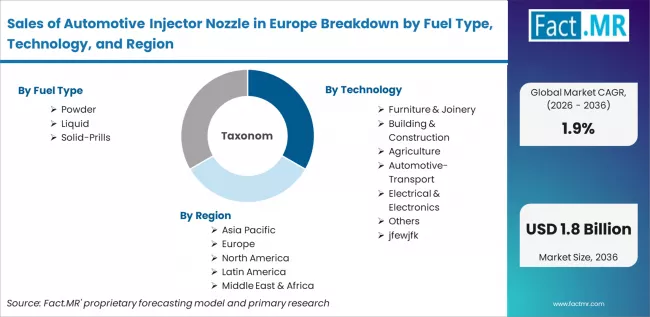
Sales Of Automotive Injector Nozzle In Europe Breakdown By Fuel Type, Technology, And Region | Source: Fact.MR
| Metric | Value |
|---|---|
| Quantitative Units | USD 1.53 billion to USD 1.85 billion, at a CAGR of 1.9% |
| Market Definition | The Europe automotive injector nozzle market covers precision-manufactured fuel delivery components that atomize and meter gasoline or diesel into internal combustion engine combustion chambers. Product categories include gasoline direct injection (GDI) nozzles operating at pressures up to 350 bar, diesel common-rail injector nozzles rated to 2,500 bar, and port fuel injection (PFI) nozzles for manifold injection systems. |
| Segmentation | Fuel Type (Gasoline, Diesel), Technology (Gasoline Direct Injection, Diesel Direct Injection, Port Fuel Injection), Vehicle Type (Passenger Vehicles, Commercial Vehicles), Sales Channel (OEM, Aftermarket) |
| Regions Covered | North America, Latin America, Europe, East Asia, South Asia, Oceania, Middle East & Africa |
| Countries Covered | Poland, Germany, France, Netherlands, Italy, Spain, UK, and 40 plus countries |
| Key Companies Profiled | Robert Bosch GmbH, DENSO Corporation, Continental AG, Valeo SA, BorgWarner Inc., Delphi Technologies (BorgWarner), Federal-Mogul Corporation, Hitachi Automotive Systems, Ltd., Keihin Corporation, Siemens AG |
| Forecast Period | 2026 to 2036 |
| Approach | Forecasting models apply a hybrid top-down and bottom-up methodology, calibrating global estimates against regional production data and verified shipment records to project market trajectory through 2036. |
Source: Fact.MR analysis. Updated Mar 23, 2026
Sales of Automotive Injector Nozzle in Europe by Segments
-
Fuel Type :
- Gasoline
- Diesel
-
Technology :
- Gasoline Direct Injection (GDI)
- Diesel Direct Injection
- Port Fuel Injection
-
Vehicle Type :
- Passenger Vehicles
- Commercial Vehicles
-
Sales Channel Per Capita Spending :
- OEM
- Aftermarket
-
Region :
- Europe
- Germany
- France
- United Kingdom
- Italy
- Spain
- Netherlands
- Poland
- Europe
Frequently Asked Questions
How large is the demand for Europe Automotive Injector Nozzle Market in the global market in 2026?
What will be the market size of Europe Automotive Injector Nozzle Market by 2036?
What is the expected demand growth for Europe Automotive Injector Nozzle Market between 2026 and 2036?
Which Fuel Type is poised to lead global sales by 2026?
How significant is the role of Gasoline Direct Injection in the Europe Automotive Injector Nozzle Market?
What is the growth outlook for Poland in this report?
What is the growth outlook for Germany?
Does the report cover Italy in its regional analysis?
What is Europe Automotive Injector Nozzle Market and what is it mainly used for?
What is included in the scope of this report?
What is excluded from the scope of this report?
How does Fact.MR build and validate the Europe Automotive Injector Nozzle Market forecast?
What regions are covered in this report?
Which companies are profiled in this report?
How large is the demand for Europe Automotive Injector Nozzle Market in the global market in 2026?
What will be the market size of Europe Automotive Injector Nozzle Market by 2036?
What is the expected demand growth for Europe Automotive Injector Nozzle Market between 2026 and 2036?
Which Fuel Type is poised to lead global sales by 2026?
How significant is the role of Gasoline Direct Injection in the Europe Automotive Injector Nozzle Market?
What is the growth outlook for Poland in this report?
What is the growth outlook for Germany?
Does the report cover Italy in its regional analysis?
What is Europe Automotive Injector Nozzle Market and what is it mainly used for?
What is included in the scope of this report?
What is excluded from the scope of this report?
How does Fact.MR build and validate the Europe Automotive Injector Nozzle Market forecast?
What regions are covered in this report?
Which companies are profiled in this report?
Who worked on this report


Preview the report firsthand - request a free sample
Free SampleGet the brochure for pricing and purchase details
Download PDF