Off-Highway Diesel Engine Market Size, Share, Growth and Forecast (2026 - 2036)
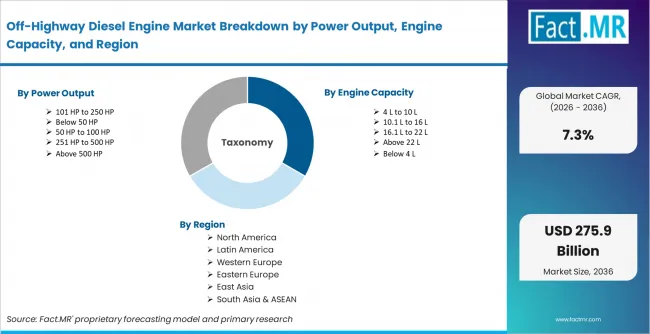
The Off-Highway Diesel Engine Market is segmented by Power Output (Below 50 HP, 50 HP to 100 HP, 101 HP to 250 HP, 251 HP to 500 HP, and Above 500 HP), Engine Capacity (Below 4 L, 4 L to 10 L, 10.1 L to 16 L, 16.1 L to 22 L, and Above 22 L), Application (Construction Equipment, Agricultural Equipment, Mining Equipment, Material Handling Equipment, and Industrial Equipment), End Use (Construction, Agriculture & Forestry, Mining, Industrial Manufacturing, and Oil & Gas), Sales Channel (Direct OEM Supply, Distributor Sales, Aftermarket Replacement, Rental Fleet Supply, and Service Network Supply), and Region. Forecast for 2026 to 2036.
Fact.MR analysis indicates that the off-highway diesel engine market is experiencing a power-reliability-versus-emission-compliance dynamic. Construction, mining, agriculture, and industrial equipment continue to need diesel engines because these machines operate under high-load and long-hour duty cycles.
Off-Highway Diesel Engine Market Forecast and Outlook By Fact.MR
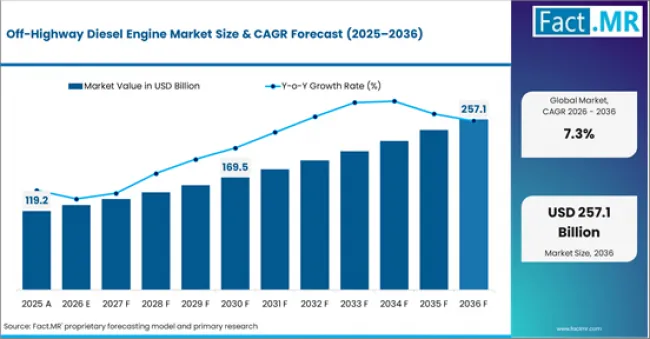
- The off-highway diesel engine market was valued at USD 119.2 billion in 2025.
- According to Fact.MR, demand is projected to reach USD 127.1 billion in 2026 and expand to USD 257.1 billion by 2036, reflecting a CAGR of 7.3% during the forecast period.
| Metric | Value |
|---|---|
| Estimated Value in 2026 | USD 127.1 billion |
| Forecast Value in 2036 | USD 257.1 billion |
| Forecast CAGR (2026 to 2036) | 7.3% |
Summary of Off-Highway Diesel Engine Market
- Market Definition
- The market includes diesel engines used in construction machinery, agricultural equipment, mining machines, material handling fleets, and industrial nonroad equipment.
- Demand Drivers
- Construction OEMs are using off-highway diesel engines where heavy-duty machines require high torque and reliable load response.
- Agricultural equipment producers need diesel engines for tractors, harvesters, irrigation pumps, and forestry machines used across long operating cycles.
- Emission rules are increasing demand for engines with aftertreatment systems, electronic controls, and compliant calibration. [2]
- Key Segments Analyzed
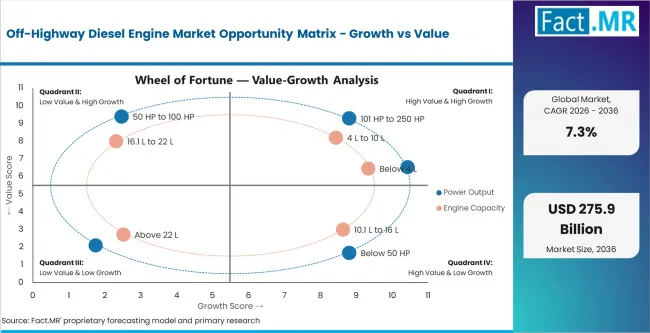
- By Power Output: 101 HP to 250 HP engines are expected to hold approximately 34.0% share in 2026, supported by broad use in loaders, tractors, and mid-size excavators.
- By Engine Capacity: 4 L to 10 L engines lead in 2026 with about 38.0% share because they suit a wide range of construction and farm equipment.
- By Application: Construction equipment accounts for around 35.0% share in 2026, supported by excavators, loaders, compactors, graders, and cranes.
- By End Use: Agriculture & forestry holds nearly 28.0% share in 2026, since tractors, harvesters, and forestry machines require durable diesel power.
- By Sales Channel: Direct OEM supply is projected to lead with 57.0% share in 2026, as equipment makers integrate engines during machine production.
- By Geography: China leads growth through 2036 at 8.2% CAGR, supported by construction machinery, mining fleets, and industrial equipment output.
- Analyst Opinion at Fact.MR
- Shambhu Nath Jha, Senior Analyst at Fact.MR, states, “Off-highway diesel engine demand is no longer tied only to equipment volume. The stronger shift is toward emission compliance, high-duty performance, uptime support, and OEM integration. Suppliers that can deliver efficient engines with aftertreatment compatibility, service coverage, and application-specific calibration will hold a better position than companies competing only on horsepower.”
- Strategic Implications
- Manufacturers should strengthen Tier 4 Final and Stage V-compliant engine lines because emission rules influence OEM qualification.
- OEMs need stronger engine integration support because machine productivity depends on torque response, cooling design, and aftertreatment packaging.
- Distributors should improve service and parts availability, since off-highway equipment owners prioritize uptime over engine purchase cost alone.
- Methodology
- Market sizing uses equipment production, engine replacement cycles, horsepower demand, capacity mix, and average selling prices.
- Analysis includes EPA nonroad diesel rules, EU Stage V regulation, Cummins engine application data, John Deere engine references, and OEM portfolio reviews.
- Forecasts account for infrastructure spending, farm mechanization, mining equipment demand, emission compliance, rental fleet replacement, and regional manufacturing capacity.
The market is expected to generate an absolute opportunity of USD 130.0 billion between 2026 and 2036, supported by strong equipment demand across multiple industries. Growth is being driven by construction equipment expansion, farm mechanization, mining haulage, material handling fleets, and industrial generator use. Environmental Protection Agency notes that nonroad diesel engines are widely used in excavators, tractors, forklifts, airport equipment, generators, pumps, and compressors, reinforcing the broad equipment base that supports sustained demand for off-highway diesel engines. [1]
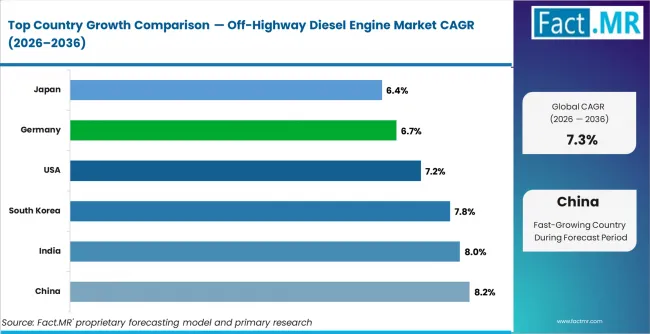
China is expected to lead with an 8.2% CAGR through 2036, supported by construction machinery demand and industrial equipment production. India is anticipated to follow at 8.0%, helped by infrastructure spending and farm mechanization. South Korea is projected to advance at 7.8%, backed by shipyard equipment demand and industrial power needs. The USA is likely to grow at 7.2%, supported by construction fleets and agricultural machinery replacement. Germany is forecast to post a 6.7% CAGR, driven by Stage V-compliant engines and equipment exports. Japan is estimated to record 6.4%, with growth linked to compact construction machinery and high-reliability diesel engines.
Segmental Analysis
Off-Highway Diesel Engine Market Analysis by Power Output
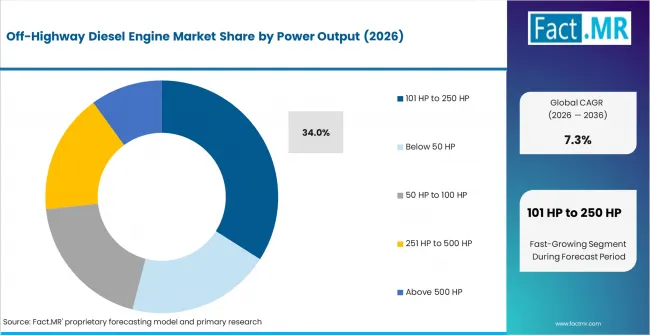
101 HP to 250 HP engines are expected to hold 34.0% share in 2026 as this power band serves a large equipment base across compact loaders, mid-size excavators, tractors, forklifts, and utility machines. These engines balance torque, fuel use, durability, and installation flexibility. Below 50 HP engines remain important for compact equipment, pumps, and small agricultural machines. Higher-horsepower engines serve mining trucks, large dozers, heavy excavators, and large generators. Cummins lists off-highway engines across construction, agriculture, mining, oil and gas, and rail-related applications, showing the wide power spread in the category [3]. Buyers select power output based on duty cycle, machine weight, and hydraulic demand.
- Mid-Power Demand: 101 HP to 250 HP engines fit high-volume construction and farm machines.
- Compact Equipment: Below 50 HP engines remain important in small tractors, pumps, compressors, and light-duty machinery.
- Heavy-Duty Use: Above 500 HP engines serve mining, quarrying, large earthmoving, and high-load industrial equipment.
Off-Highway Diesel Engine Market Analysis by Engine Capacity
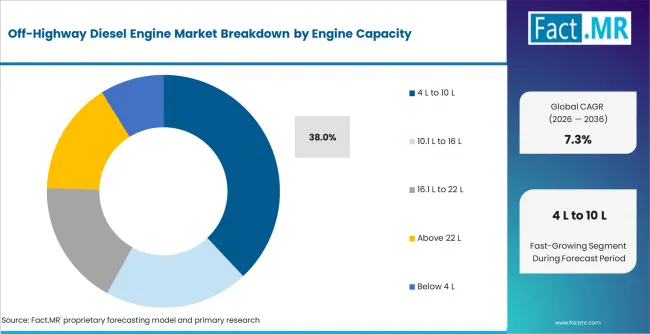
Off-highway machinery often requires engines that balance power density, fuel economy, cooling performance, and durability. Engines in the 4 L to 10 L range are widely used because they fit tractors, wheel loaders, excavators, backhoe loaders, and mid-size industrial equipment. The segment is expected to account for 38.0% share in 2026. Smaller engines below 4 L serve compact equipment and light-duty utility machines. Engines above 16 L are used in mining, large construction, and generator applications where continuous high-load output matters. Engine capacity selection depends on equipment weight, hydraulic load, emissions packaging, and expected service life.
- Core Capacity Band: 4 L to 10 L engines support broad construction and agricultural equipment use.
- Compact Machinery: Below 4 L engines fit smaller machines where space and fuel economy matter.
- Large Engines: Above 16 L engines serve heavy mining, large earthmoving, and industrial generator applications.
Off-Highway Diesel Engine Market Analysis by Application
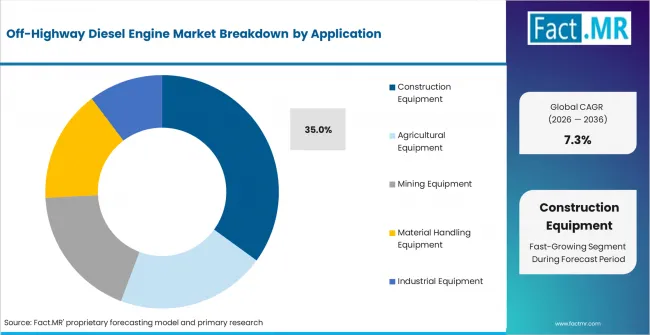
Construction equipment leads because excavators, loaders, dozers, graders, compactors, cranes, and telehandlers need reliable diesel power for high-load operations. Mining equipment adds demand through haul trucks, drilling rigs, loaders, and crushers. Agricultural equipment remains strong because tractors, combines, and harvesters require long operating hours during seasonal windows. Construction equipment is estimated to hold 35.0% share in 2026 as infrastructure projects and equipment replacement support engine demand. EPA states that nonroad compression-ignition engines are used in excavators, farm tractors, forklifts, generators, pumps, and compressors, reinforcing the broad application scope. Application growth depends on equipment cycles, fuel efficiency, and emission compliance.
- Construction Base: Excavators, loaders, dozers, and graders create steady engine demand across infrastructure work.
- Farm Machinery: Tractors and harvesters require diesel power because seasonal work demands torque and durability.
- Mining Demand: Haul trucks and drilling machines use high-horsepower engines for heavy-duty site operations.
Off-Highway Diesel Engine Market Analysis by End Use
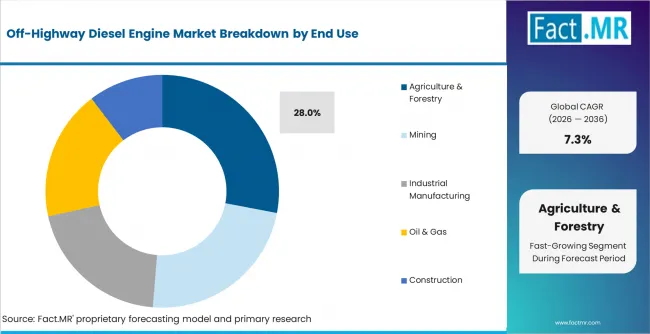
Construction remains a major end-use sector, but agriculture and forestry create a large recurring demand base through tractors, harvesters, irrigation pumps, and timber equipment. Agriculture & forestry is likely to account for 28.0% share in 2026, supported by farm mechanization and equipment replacement. Mining uses large diesel engines where haulage, drilling, crushing, and earthmoving equipment operate under extreme loads. Industrial manufacturing uses engines in compressors, forklifts, pumps, and generators. Oil and gas use remains cyclical but important for drilling and field equipment. End-use demand depends on capital spending, fuel cost, equipment utilization, and regional emission rules.
- Farm Mechanization: Agriculture and forestry users need engines that can operate through long seasonal cycles.
- Construction Workload: Infrastructure and building projects sustain demand for diesel-powered equipment fleets.
- Industrial Operations: Pumps, compressors, and generators create steady nonroad engine replacement demand.
Off-Highway Diesel Engine Market Analysis by Sales Channel
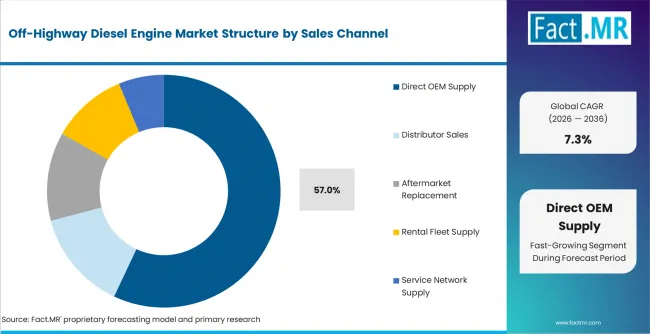
OEMs prefer direct engine supply because engine integration affects machine layout, cooling, emissions packaging, and service access. Distributor sales remain important for replacement engines, smaller equipment makers, and regional buyers. Aftermarket replacement supports older fleets where rebuilding or replacing engines is more economical than buying new equipment. Direct OEM supply is expected to account for 57.0% share in 2026 because off-highway equipment makers need qualified engine platforms and long-term supply programs. Rental fleet supply is growing where fleet managers need standardized engines and service continuity. Service network supply supports downtime reduction through parts, diagnostics, and replacement availability.
- OEM Integration: Direct supply helps equipment makers align engines with cooling, hydraulics, and aftertreatment systems.
- Aftermarket Need: Replacement channels support older machines with long operating lives.
- Fleet Support: Rental and service networks value engines with strong parts access and diagnostic support.
Drivers, Restraints, and Opportunities
Construction activity, mining production, farm mechanization, and industrial backup power are sustaining off-highway diesel engine demand. Diesel engines remain important because off-highway equipment often needs torque, long operating hours, field repairability, and fuel availability. Cummins states that its off-highway engines support construction, industrial, marine, mining, oil and gas, and rail industries, reflecting the breadth of diesel engine use across heavy work applications. John Deere also positions Final Tier 4 and Stage V engines around meeting emissions regulations while maintaining power and productivity.
Emission compliance, electrification pressure, and high aftertreatment cost restrain faster growth. EPA has adopted emission standards for nonroad engines, equipment, and vehicles, while EU Stage V rules set emission limits and type-approval requirements for non-road mobile machinery engines. OEMs must package aftertreatment hardware, cooling systems, sensors, and electronic controls without reducing machine productivity. Smaller equipment users face higher service costs when advanced engine systems require diagnostics, certified parts, or trained technicians.
- Emission-Compliant Engines: Tier 4 Final and Stage V demand creates opportunities for efficient engines with aftertreatment integration.
- Rental Fleet Replacement: Rental operators need durable, service-friendly engines with predictable parts support.
- Hybrid-Ready Platforms: Diesel engines paired with electric assist can support productivity where full electrification remains difficult.
Regional Analysis
The off-highway diesel engine market is assessed across North America, Europe, East Asia, South Asia and Pacific, Latin America, and Middle East and Africa, covering 40+ countries with demand profiles shaped by infrastructure spending, farm mechanization, mining activity, construction equipment production, emission regulation, rental fleet growth, and OEM manufacturing capacity.
.webp)
| Country | CAGR (2026 to 2036) |
|---|---|
| China | 8.2% |
| India | 8.0% |
| South Korea | 7.8% |
| USA | 7.2% |
| Germany | 6.7% |
| Japan | 6.4% |
Source: Fact.MR analysis, based on revised forecasting model and primary research.
Asia Pacific Off-Highway Diesel Engine Market Analysis
Asia Pacific is the primary demand growth region because construction machinery, farm equipment, mining fleets, and industrial equipment production are expanding together. China and India anchor volume growth through infrastructure development and mechanization. South Korea and Japan add higher-specification demand through equipment manufacturing, construction machinery exports, and advanced engine technologies. Regional demand depends on fuel efficiency, emission compliance, uptime, and service coverage. Suppliers must balance cost-sensitive buyers with OEMs that require advanced engines and aftertreatment-ready platforms.
- China: China is expected to account for 8.2% CAGR from 2026 to 2036 as construction equipment, mining machines, and industrial fleets sustain high diesel engine demand. Domestic machinery makers need engines for excavators, loaders, cranes, and agricultural equipment used across large infrastructure and resource projects. Emission tightening is increasing demand for electronic controls and aftertreatment-ready designs. Local supply chains give Chinese engine producers scale advantages, while premium OEMs still need higher-efficiency platforms. Suppliers with reliable service networks and application-specific calibration can protect demand across construction and industrial equipment clusters.
- India: Infrastructure investment, farm mechanization, and rural equipment replacement are strengthening off-highway diesel engine demand in India. Demand is forecast to advance at 8.0% CAGR through 2036 as tractors, backhoe loaders, excavators, pumps, and generators continue to require durable diesel power. Buyers remain cost-sensitive, but uptime and service access are becoming stronger purchase factors. Construction and agricultural machinery OEMs need engines that can handle dust, heat, load variation, and long operating hours. Suppliers with localized production, parts availability, and fuel-efficient platforms can improve adoption across regional equipment markets.
- South Korea: South Korea’s off-highway diesel engine market is supported by construction equipment manufacturing, shipyard equipment, industrial machinery, and export-focused component supply. Demand is likely to rise at 7.8% CAGR by 2036 as OEMs continue to require compact, efficient, and emissions-compliant engines. Buyers place strong weight on electronic control, fuel efficiency, and aftertreatment compatibility. Domestic machine builders also need engine platforms that can serve global markets with different regulatory requirements. Suppliers that combine engineering support, compliance documentation, and reliable parts access can strengthen relationships with Korean OEMs.
North America Off-Highway Diesel Engine Market Analysis
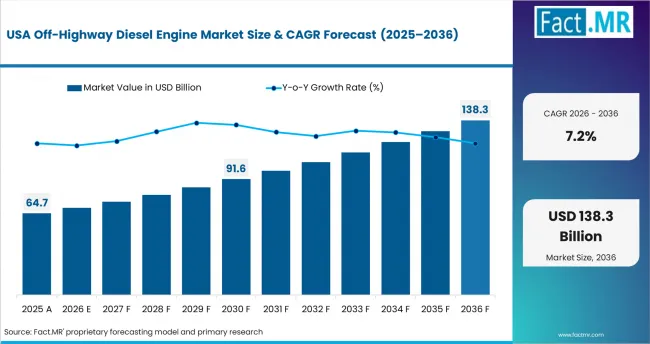
North America remains a high-value region because construction fleets, agricultural machinery, mining operations, and rental equipment companies rely on diesel power. The USA anchors regional demand through earthmoving equipment, tractors, generators, oilfield machinery, and material handling equipment. EPA rules for nonroad compression-ignition engines make compliance, aftertreatment systems, and service documentation central to engine selection. Growth is supported by fleet replacement and infrastructure projects, while electrification pressure affects compact equipment categories faster than heavy-duty applications.
- USA: A large construction fleet, advanced farm equipment base, and established rental industry support diesel engine demand in the USA. Off-highway diesel engine demand is expected to grow at 7.2% CAGR over the assessment period, as infrastructure work, agricultural replacement, and mining equipment use sustain engine sales. OEMs and fleet owners evaluate engines through uptime, fuel efficiency, Tier 4 compliance, and service network strength. Electrification is growing in compact equipment, but diesel remains essential where heavy loads, remote sites, and long duty cycles limit charging practicality.
Europe Off-Highway Diesel Engine Market Analysis
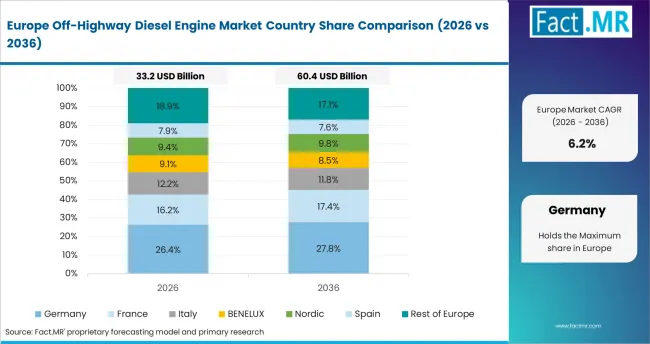
Europe shows steady demand because construction machinery, agricultural equipment, compact machines, and industrial generator applications require reliable engines under strict emission rules. Germany is a major equipment and engine technology center, while other European markets use Stage V-compliant engines across non-road mobile machinery. The EU NRMM framework sets emission limits and type-approval procedures for engines placed on the EU market. Buyers prioritize emission compliance, compact installation, fuel economy, and service support. Growth is moderate because replacement demand is steady, but regulatory complexity raises engine value.
- Germany: Germany’s off-highway diesel engine demand is linked to construction machinery, agricultural equipment, industrial generators, and export-oriented machine building. Demand is likely to expand at 6.7% CAGR by 2036 as OEMs continue to use Stage V-compliant engines in premium equipment platforms. German buyers focus on engineering support, emissions documentation, and long-term parts availability. Machine builders also need engines that can meet different export market rules without excessive redesign. Suppliers with compact aftertreatment packaging and strong integration support can protect demand across Germany’s equipment manufacturing base.
- Japan: Japan’s off-highway diesel engine market is shaped by compact construction equipment, agricultural machines, generators, and premium industrial applications. Demand is expected to grow at 6.4% CAGR through 2036, with buyers focused on reliability, fuel economy, and low-noise performance. Japanese OEMs serve both domestic and export markets, requiring engines that meet strict quality and regulatory expectations. Growth is steady rather than volume-led because the market is mature. Suppliers with high-quality components, precise calibration, and strong OEM engineering support remain better placed in Japan’s specification-driven equipment industry.
Fact.MR analysis of regional demand covers North America, Europe, East Asia, South Asia and Pacific, Latin America, and Middle East and Africa. The study assesses construction equipment output, farm machinery demand, mining equipment use, emission rules, horsepower mix, replacement cycles, rental fleets, and service network strength across major markets.
Competitive Aligners for Market Players
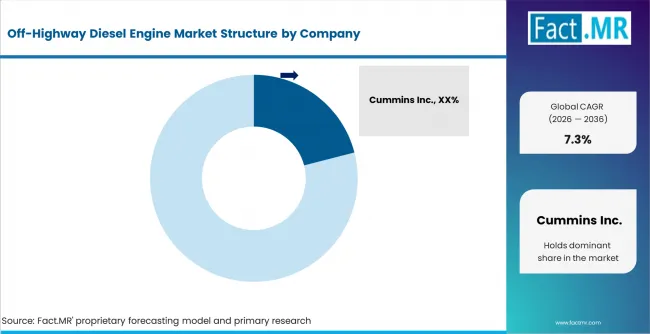
The off-highway diesel engine market is moderately concentrated among global engine makers, equipment OEMs, and regional powertrain suppliers. Cummins, Caterpillar, John Deere, Kubota, Yanmar, Perkins, Deutz, Volvo Penta, FPT Industrial, Kohler, and Isuzu represent key supplier groups across compact, mid-range, and heavy-duty engine platforms. These companies benefit from emission-compliant portfolios, established OEM relationships, global parts networks, and service support.
Competitive advantage depends on fuel efficiency, torque response, emissions compliance, aftertreatment packaging, uptime support, and total operating cost. Cummins states that its off-highway engines support construction, mining, agriculture, and industrial applications, reflecting the broad application base for leading suppliers. John Deere positions its Final Tier 4 and Stage V engines around emissions compliance while maintaining power and productivity, showing how regulatory fit and machine value influence competition. [4]
The market is divided between high-volume compact and mid-power engines and premium high-horsepower engines used in mining, large construction, and industrial power. Compact engine suppliers compete through cost, integration ease, and service support. Heavy-duty suppliers compete through durability, cooling performance, torque output, and aftertreatment reliability. Regional suppliers can gain share where local production, parts availability, and price discipline matter more than global brand reach.
Key Players
- Cummins Inc.
- Caterpillar Inc.
- Deere & Company
- Kubota Corporation
- Yanmar Holdings Co., Ltd.
- Perkins Engines Company Limited
- Deutz AG
- Volvo Penta
- FPT Industrial
- Kohler Co.
- Isuzu Motors Limited
- Mahindra & Mahindra Ltd.
Bibliography
- Bibliography
- [1] United States Environmental Protection Agency. (2026). Regulations for emissions from nonroad vehicles and engines. EPA.
- [2] European Commission. (n.d.). Emissions from non-road mobile machinery. European Commission.
- [3] Cummins Inc. (n.d.). Off-highway engines. Cummins.
- [4] Deere & Company. (n.d.). Final Tier 4/Stage V industrial engines. John Deere.
This Report Addresses
• Strategic intelligence on off-highway diesel engine demand across construction machinery, agricultural equipment, mining fleets, material handling equipment, industrial generators, pumps, and compressors globally.
• Market forecast from USD 127.1 billion in 2026 to USD 257.1 billion by 2036 at a CAGR of 7.3%.
• Growth opportunity mapping across China construction machinery demand, India farm mechanization, South Korea OEM production, USA fleet replacement, Germany Stage V-compliant equipment exports, and Japan compact machinery engines.
• Segment analysis by power output, engine capacity, application, end use, sales channel, and region.
• Regional outlook covering Asia Pacific infrastructure and farm machinery growth, North America Tier 4-compliant fleet replacement, and Europe Stage V engine integration.
• Competitive analysis of Cummins, Caterpillar, John Deere, Kubota, Yanmar, Perkins, Deutz, Volvo Penta, FPT Industrial, Kohler, Isuzu, and Mahindra & Mahindra.
• Product adoption analysis covering horsepower demand, fuel efficiency, aftertreatment packaging, torque response, uptime support, emission compliance, and service network availability.
• Report delivered with market sizing, segment outlook, regional analysis, company profiling, and forecast assumptions.
Off-Highway Diesel Engine Market Definition
The market covers diesel engines used in nonroad and off-highway equipment across construction, agriculture, mining, material handling, industrial manufacturing, oil and gas, and generator applications. It includes compact, mid-range, heavy-duty, and high-horsepower engines installed in excavators, loaders, tractors, harvesters, graders, dozers, forklifts, haul trucks, crushers, pumps, compressors, and other mobile or stationary nonroad machinery.
Off-Highway Diesel Engine Market Inclusions
Covers global and regional forecasts from 2026 to 2036. Includes diesel engines used in construction machinery, agricultural tractors, forestry machines, mining equipment, industrial pumps, compressors, generators, material handling equipment, and oilfield machinery. Covers Tier 4 Final, Stage V, electronically controlled, turbocharged, aftertreatment-ready, and high-horsepower engines supplied through OEM, distributor, aftermarket, rental fleet, and service channels.
Off-Highway Diesel Engine Market Exclusions
Excludes on-highway truck engines, passenger vehicle diesel engines, marine propulsion engines not used in off-highway industrial work, locomotive engines, gasoline engines, electric motors, battery packs, hydrogen fuel cells, and finished equipment when the engine is not separately valued. Focus remains on diesel power units used in off-highway machinery and nonroad industrial applications.
Off-Highway Diesel Engine Market Research Methodology
- Primary Research
- Interviews with engine manufacturers, construction equipment OEMs, agricultural machinery producers, mining fleet operators, rental fleet managers, diesel engine distributors, and service network managers across major producing and consuming regions.
- Desk Research
- Uses EPA nonroad diesel engine regulations, EU non-road mobile machinery rules, company engine portfolios, emissions documentation, equipment production trends, mining equipment references, agricultural machinery data, and public industry documentation.
- Market-Sizing and Forecasting
- Hybrid model using equipment production, replacement demand, horsepower mix, engine capacity distribution, application-level engine use, regional emission compliance costs, and average selling prices.
- Data Validation and Update Cycle
- Validated using OEM channel checks, engine capacity references, distributor feedback, replacement cycle indicators, emission rule timelines, and application-level demand review. Updated annually.
Scope of Report

| Attribute | Details |
|---|---|
| Quantitative Units | USD 127.1 billion in 2026 to USD 257.1 billion by 2036, at a CAGR of 7.3% |
| Market Definition | Diesel engines used in nonroad and off-highway construction, agriculture, mining, material handling, and industrial equipment |
| Forecast Period | 2026 to 2036 |
| Historical Reference | 2024 and 2025 |
| Power Output Covered | Below 50 HP, 50 HP to 100 HP, 101 HP to 250 HP, 251 HP to 500 HP, Above 500 HP |
| Engine Capacity Covered | Below 4 L, 4 L to 10 L, 10.1 L to 16 L, 16.1 L to 22 L, Above 22 L |
| Application Covered | Construction Equipment, Agricultural Equipment, Mining Equipment, Material Handling Equipment, Industrial Equipment |
| End Use Covered | Construction, Agriculture & Forestry, Mining, Industrial Manufacturing, Oil & Gas |
| Sales Channel Covered | Direct OEM Supply, Distributor Sales, Aftermarket Replacement, Rental Fleet Supply, Service Network Supply |
| Regions Covered | North America, Europe, East Asia, South Asia and Pacific, Latin America, Middle East and Africa |
| Countries Covered | USA, Canada, Mexico, Germany, UK, France, Italy, Spain, China, Japan, South Korea, India, ASEAN, Australia, Brazil, GCC, South Africa, and Rest of World |
| Key Companies Profiled | Cummins, Caterpillar, John Deere, Kubota, Yanmar, Perkins, Deutz, Volvo Penta, FPT Industrial, Kohler, Isuzu, Mahindra & Mahindra |
| Approach | Hybrid top-down and bottom-up model using equipment production, horsepower demand, capacity mix, engine replacement cycles, emission compliance costs, average selling prices, and primary interviews with OEMs and distributors |
Off-Highway Diesel Engine Market by Segments
-
By Power Output:
- Below 50 HP
- 50 HP to 100 HP
- 101 HP to 250 HP
- 251 HP to 500 HP
- Above 500 HP
-
By Engine Capacity:
- Below 4 L
- 4 L to 10 L
- 10.1 L to 16 L
- 16.1 L to 22 L
- Above 22 L
-
By Application:
- Construction Equipment
- Agricultural Equipment
- Mining Equipment
- Material Handling Equipment
- Industrial Equipment
-
By End Use:
- Construction
- Agriculture & Forestry
- Mining
- Industrial Manufacturing
- Oil & Gas
-
By Sales Channel:
- Direct OEM Supply
- Distributor Sales
- Aftermarket Replacement
- Rental Fleet Supply
- Service Network Supply
-
By Region:
- North America
- United States
- Canada
- Mexico
- Latin America
- Brazil
- Argentina
- Chile
- Rest of Latin America
- Western Europe
- Germany
- France
- United Kingdom
- Italy
- Spain
- Rest of Western Europe
- Eastern Europe
- Russia
- Poland
- Hungary
- Balkan and Baltic
- Rest of Eastern Europe
- East Asia
- China
- Japan
- South Korea
- South Asia and Pacific
- India
- ASEAN
- Australia
- Rest of South Asia and Pacific
- Middle East and Africa
- Kingdom of Saudi Arabia
- Other GCC Countries
- South Africa
- Rest of Middle East and Africa
- North America
- Frequently Asked Questions -
How large is the global off-highway diesel engine market in 2025?
The global off-highway diesel engine market was valued at USD 119.2 billion in 2025.
What will the market size be in 2026?
Based on revised Fact.MR analysis, demand for off-highway diesel engines is estimated to grow to USD 127.1 billion in 2026.
What is the projected market size by 2036?
The market is projected to reach USD 257.1 billion by 2036, generating USD 130.0 billion in absolute opportunity.
What is the expected CAGR from 2026 to 2036?
Fact.MR projects a CAGR of 7.3% for the global off-highway diesel engine market during the forecast period.
Which power output segment is poised to lead the market?
101 HP to 250 HP engines lead with approximately 34.0% share in 2026 due to broad use in construction and farm equipment.
Which engine capacity holds the largest share?
4 L to 10 L engines account for around 38.0% share in 2026 because they fit mid-range machinery across several applications.
Which application accounts for the largest demand?
Construction equipment accounts for nearly 35.0% share in 2026 because excavators, loaders, dozers, and cranes require durable diesel power.
Which end use leads the market?
Agriculture & forestry holds around 28.0% share in 2026 because tractors, harvesters, forestry machines, and pumps need reliable engines.
Which sales channel leads demand?
Direct OEM supply holds approximately 57.0% share in 2026 because equipment makers integrate engines during machine production.
Which country shows the fastest growth?
China leads with 8.2% CAGR through 2036, supported by construction machinery, mining equipment, and industrial fleet demand.
What is driving demand for off-highway diesel engines?
Demand is driven by construction equipment, farm mechanization, mining fleets, industrial generators, rental fleet replacement, and emission-compliant engine upgrades.
What is the key challenge in this market?
Emission compliance costs, aftertreatment complexity, electrification pressure, fuel cost volatility, and service requirements can limit faster adoption in some applications.
Table of Content
- Executive Summary
- Global Market Outlook
- Demand to side Trends
- Supply to side Trends
- Technology Roadmap Analysis
- Analysis and Recommendations
- Market Overview
- Market Coverage / Taxonomy
- Market Definition / Scope / Limitations
- Research Methodology
- Chapter Orientation
- Analytical Lens and Working Hypotheses
- Market Structure, Signals, and Trend Drivers
- Benchmarking and Cross-market Comparability
- Market Sizing, Forecasting, and Opportunity Mapping
- Research Design and Evidence Framework
- Desk Research Programme (Secondary Evidence)
- Company Annual and Sustainability Reports
- Peer-reviewed Journals and Academic Literature
- Corporate Websites, Product Literature, and Technical Notes
- Earnings Decks and Investor Briefings
- Statutory Filings and Regulatory Disclosures
- Technical White Papers and Standards Notes
- Trade Journals, Industry Magazines, and Analyst Briefs
- Conference Proceedings, Webinars, and Seminar Materials
- Government Statistics Portals and Public Data Releases
- Press Releases and Reputable Media Coverage
- Specialist Newsletters and Curated Briefings
- Sector Databases and Reference Repositories
- Fact.MR Internal Proprietary Databases and Historical Market Datasets
- Subscription Datasets and Paid Sources
- Social Channels, Communities, and Digital Listening Inputs
- Additional Desk Sources
- Expert Input and Fieldwork (Primary Evidence)
- Primary Modes
- Qualitative Interviews and Expert Elicitation
- Quantitative Surveys and Structured Data Capture
- Blended Approach
- Why Primary Evidence is Used
- Field Techniques
- Interviews
- Surveys
- Focus Groups
- Observational and In-context Research
- Social and Community Interactions
- Stakeholder Universe Engaged
- C-suite Leaders
- Board Members
- Presidents and Vice Presidents
- R&D and Innovation Heads
- Technical Specialists
- Domain Subject-matter Experts
- Scientists
- Physicians and Other Healthcare Professionals
- Governance, Ethics, and Data Stewardship
- Research Ethics
- Data Integrity and Handling
- Primary Modes
- Tooling, Models, and Reference Databases
- Desk Research Programme (Secondary Evidence)
- Data Engineering and Model Build
- Data Acquisition and Ingestion
- Cleaning, Normalisation, and Verification
- Synthesis, Triangulation, and Analysis
- Quality Assurance and Audit Trail
- Market Background
- Market Dynamics
- Drivers
- Restraints
- Opportunity
- Trends
- Scenario Forecast
- Demand in Optimistic Scenario
- Demand in Likely Scenario
- Demand in Conservative Scenario
- Opportunity Map Analysis
- Product Life Cycle Analysis
- Supply Chain Analysis
- Investment Feasibility Matrix
- Value Chain Analysis
- PESTLE and Porter’s Analysis
- Regulatory Landscape
- Regional Parent Market Outlook
- Production and Consumption Statistics
- Import and Export Statistics
- Market Dynamics
- Global Market Analysis 2021 to 2025 and Forecast, 2026 to 2036
- Historical Market Size Value (USD Million) Analysis, 2021 to 2025
- Current and Future Market Size Value (USD Million) Projections, 2026 to 2036
- Y to o to Y Growth Trend Analysis
- Absolute $ Opportunity Analysis
- Global Market Pricing Analysis 2021 to 2025 and Forecast 2026 to 2036
- Global Market Analysis 2021 to 2025 and Forecast 2026 to 2036, By Grade
- Introduction / Key Findings
- Historical Market Size Value (USD Million) Analysis By Grade , 2021 to 2025
- Current and Future Market Size Value (USD Million) Analysis and Forecast By Grade , 2026 to 2036
- Technical MDI
- Specialty/Purified MDI
- Technical MDI
- Y to o to Y Growth Trend Analysis By Grade , 2021 to 2025
- Absolute $ Opportunity Analysis By Grade , 2026 to 2036
- Global Market Analysis 2021 to 2025 and Forecast 2026 to 2036, By Application
- Introduction / Key Findings
- Historical Market Size Value (USD Million) Analysis By Application, 2021 to 2025
- Current and Future Market Size Value (USD Million) Analysis and Forecast By Application, 2026 to 2036
- PU Foams
- Coatings & Adhesives
- Elastomers
- Sealants
- Others
- PU Foams
- Y to o to Y Growth Trend Analysis By Application, 2021 to 2025
- Absolute $ Opportunity Analysis By Application, 2026 to 2036
- Global Market Analysis 2021 to 2025 and Forecast 2026 to 2036, By Form
- Introduction / Key Findings
- Historical Market Size Value (USD Million) Analysis By Form, 2021 to 2025
- Current and Future Market Size Value (USD Million) Analysis and Forecast By Form, 2026 to 2036
- Liquid Bulk
- Packaged Drums
- Intermediate Bulk Containers
- Tanker Supply
- Specialty Blends
- Liquid Bulk
- Y to o to Y Growth Trend Analysis By Form, 2021 to 2025
- Absolute $ Opportunity Analysis By Form, 2026 to 2036
- Global Market Analysis 2021 to 2025 and Forecast 2026 to 2036, By End Use
- Introduction / Key Findings
- Historical Market Size Value (USD Million) Analysis By End Use, 2021 to 2025
- Current and Future Market Size Value (USD Million) Analysis and Forecast By End Use, 2026 to 2036
- Construction
- Automotive
- Furniture & Bedding
- Appliances
- Industrial Manufacturing
- Construction
- Y to o to Y Growth Trend Analysis By End Use, 2021 to 2025
- Absolute $ Opportunity Analysis By End Use, 2026 to 2036
- Global Market Analysis 2021 to 2025 and Forecast 2026 to 2036, By Sales Channel
- Introduction / Key Findings
- Historical Market Size Value (USD Million) Analysis By Sales Channel, 2021 to 2025
- Current and Future Market Size Value (USD Million) Analysis and Forecast By Sales Channel, 2026 to 2036
- Direct Institutional Sales
- Distributor Sales
- Contract Supply
- Regional Chemical Supply
- Technical Service-Based Supply
- Direct Institutional Sales
- Y to o to Y Growth Trend Analysis By Sales Channel, 2021 to 2025
- Absolute $ Opportunity Analysis By Sales Channel, 2026 to 2036
- Global Market Analysis 2021 to 2025 and Forecast 2026 to 2036, By Region
- Introduction
- Historical Market Size Value (USD Million) Analysis By Region, 2021 to 2025
- Current Market Size Value (USD Million) Analysis and Forecast By Region, 2026 to 2036
- North America
- Latin America
- Western Europe
- Eastern Europe
- East Asia
- South Asia and Pacific
- Middle East & Africa
- Market Attractiveness Analysis By Region
- North America Market Analysis 2021 to 2025 and Forecast 2026 to 2036, By Country
- Historical Market Size Value (USD Million) Trend Analysis By Market Taxonomy, 2021 to 2025
- Market Size Value (USD Million) Forecast By Market Taxonomy, 2026 to 2036
- By Country
- USA
- Canada
- Mexico
- By Grade
- By Application
- By Form
- By End Use
- By Sales Channel
- By Country
- Market Attractiveness Analysis
- By Country
- By Grade
- By Application
- By Form
- By End Use
- By Sales Channel
- Key Takeaways
- Latin America Market Analysis 2021 to 2025 and Forecast 2026 to 2036, By Country
- Historical Market Size Value (USD Million) Trend Analysis By Market Taxonomy, 2021 to 2025
- Market Size Value (USD Million) Forecast By Market Taxonomy, 2026 to 2036
- By Country
- Brazil
- Chile
- Rest of Latin America
- By Grade
- By Application
- By Form
- By End Use
- By Sales Channel
- By Country
- Market Attractiveness Analysis
- By Country
- By Grade
- By Application
- By Form
- By End Use
- By Sales Channel
- Key Takeaways
- Western Europe Market Analysis 2021 to 2025 and Forecast 2026 to 2036, By Country
- Historical Market Size Value (USD Million) Trend Analysis By Market Taxonomy, 2021 to 2025
- Market Size Value (USD Million) Forecast By Market Taxonomy, 2026 to 2036
- By Country
- Germany
- UK
- Italy
- Spain
- France
- Nordic
- BENELUX
- Rest of Western Europe
- By Grade
- By Application
- By Form
- By End Use
- By Sales Channel
- By Country
- Market Attractiveness Analysis
- By Country
- By Grade
- By Application
- By Form
- By End Use
- By Sales Channel
- Key Takeaways
- Eastern Europe Market Analysis 2021 to 2025 and Forecast 2026 to 2036, By Country
- Historical Market Size Value (USD Million) Trend Analysis By Market Taxonomy, 2021 to 2025
- Market Size Value (USD Million) Forecast By Market Taxonomy, 2026 to 2036
- By Country
- Russia
- Poland
- Hungary
- Balkan & Baltic
- Rest of Eastern Europe
- By Grade
- By Application
- By Form
- By End Use
- By Sales Channel
- By Country
- Market Attractiveness Analysis
- By Country
- By Grade
- By Application
- By Form
- By End Use
- By Sales Channel
- Key Takeaways
- East Asia Market Analysis 2021 to 2025 and Forecast 2026 to 2036, By Country
- Historical Market Size Value (USD Million) Trend Analysis By Market Taxonomy, 2021 to 2025
- Market Size Value (USD Million) Forecast By Market Taxonomy, 2026 to 2036
- By Country
- China
- Japan
- South Korea
- By Grade
- By Application
- By Form
- By End Use
- By Sales Channel
- By Country
- Market Attractiveness Analysis
- By Country
- By Grade
- By Application
- By Form
- By End Use
- By Sales Channel
- Key Takeaways
- South Asia and Pacific Market Analysis 2021 to 2025 and Forecast 2026 to 2036, By Country
- Historical Market Size Value (USD Million) Trend Analysis By Market Taxonomy, 2021 to 2025
- Market Size Value (USD Million) Forecast By Market Taxonomy, 2026 to 2036
- By Country
- India
- ASEAN
- Australia & New Zealand
- Rest of South Asia and Pacific
- By Grade
- By Application
- By Form
- By End Use
- By Sales Channel
- By Country
- Market Attractiveness Analysis
- By Country
- By Grade
- By Application
- By Form
- By End Use
- By Sales Channel
- Key Takeaways
- Middle East & Africa Market Analysis 2021 to 2025 and Forecast 2026 to 2036, By Country
- Historical Market Size Value (USD Million) Trend Analysis By Market Taxonomy, 2021 to 2025
- Market Size Value (USD Million) Forecast By Market Taxonomy, 2026 to 2036
- By Country
- Kingdom of Saudi Arabia
- Other GCC Countries
- Turkiye
- South Africa
- Other African Union
- Rest of Middle East & Africa
- By Grade
- By Application
- By Form
- By End Use
- By Sales Channel
- By Country
- Market Attractiveness Analysis
- By Country
- By Grade
- By Application
- By Form
- By End Use
- By Sales Channel
- Key Takeaways
- Key Countries Market Analysis
- USA
- Pricing Analysis
- Market Share Analysis, 2025
- By Grade
- By Application
- By Form
- By End Use
- By Sales Channel
- Canada
- Pricing Analysis
- Market Share Analysis, 2025
- By Grade
- By Application
- By Form
- By End Use
- By Sales Channel
- Mexico
- Pricing Analysis
- Market Share Analysis, 2025
- By Grade
- By Application
- By Form
- By End Use
- By Sales Channel
- Brazil
- Pricing Analysis
- Market Share Analysis, 2025
- By Grade
- By Application
- By Form
- By End Use
- By Sales Channel
- Chile
- Pricing Analysis
- Market Share Analysis, 2025
- By Grade
- By Application
- By Form
- By End Use
- By Sales Channel
- Germany
- Pricing Analysis
- Market Share Analysis, 2025
- By Grade
- By Application
- By Form
- By End Use
- By Sales Channel
- UK
- Pricing Analysis
- Market Share Analysis, 2025
- By Grade
- By Application
- By Form
- By End Use
- By Sales Channel
- Italy
- Pricing Analysis
- Market Share Analysis, 2025
- By Grade
- By Application
- By Form
- By End Use
- By Sales Channel
- Spain
- Pricing Analysis
- Market Share Analysis, 2025
- By Grade
- By Application
- By Form
- By End Use
- By Sales Channel
- France
- Pricing Analysis
- Market Share Analysis, 2025
- By Grade
- By Application
- By Form
- By End Use
- By Sales Channel
- India
- Pricing Analysis
- Market Share Analysis, 2025
- By Grade
- By Application
- By Form
- By End Use
- By Sales Channel
- ASEAN
- Pricing Analysis
- Market Share Analysis, 2025
- By Grade
- By Application
- By Form
- By End Use
- By Sales Channel
- Australia & New Zealand
- Pricing Analysis
- Market Share Analysis, 2025
- By Grade
- By Application
- By Form
- By End Use
- By Sales Channel
- China
- Pricing Analysis
- Market Share Analysis, 2025
- By Grade
- By Application
- By Form
- By End Use
- By Sales Channel
- Japan
- Pricing Analysis
- Market Share Analysis, 2025
- By Grade
- By Application
- By Form
- By End Use
- By Sales Channel
- South Korea
- Pricing Analysis
- Market Share Analysis, 2025
- By Grade
- By Application
- By Form
- By End Use
- By Sales Channel
- Russia
- Pricing Analysis
- Market Share Analysis, 2025
- By Grade
- By Application
- By Form
- By End Use
- By Sales Channel
- Poland
- Pricing Analysis
- Market Share Analysis, 2025
- By Grade
- By Application
- By Form
- By End Use
- By Sales Channel
- Hungary
- Pricing Analysis
- Market Share Analysis, 2025
- By Grade
- By Application
- By Form
- By End Use
- By Sales Channel
- Kingdom of Saudi Arabia
- Pricing Analysis
- Market Share Analysis, 2025
- By Grade
- By Application
- By Form
- By End Use
- By Sales Channel
- Turkiye
- Pricing Analysis
- Market Share Analysis, 2025
- By Grade
- By Application
- By Form
- By End Use
- By Sales Channel
- South Africa
- Pricing Analysis
- Market Share Analysis, 2025
- By Grade
- By Application
- By Form
- By End Use
- By Sales Channel
- USA
- Market Structure Analysis
- Competition Dashboard
- Competition Benchmarking
- Market Share Analysis of Top Players
- By Regional
- By Grade
- By Application
- By Form
- By End Use
- By Sales Channel
- Competition Analysis
- Competition Deep Dive
- Covestro AG
- Overview
- Product Portfolio
- Profitability by Market Segments (Product/Age /Sales Channel/Region)
- Sales Footprint
- Strategy Overview
- Marketing Strategy
- Product Strategy
- Channel Strategy
- BASF SE
- Wanhua Chemical Group Co., Ltd.
- Huntsman Corporation
- Dow Inc.
- Tonon BioPolymer
- INEOS Group
- NOCIL Limited
- MDI Global
- Mitsui Chemicals, Inc.
- Covestro AG
- Competition Deep Dive
- Assumptions & Acronyms Used
List Of Table
- Table 1: Global Market Value (USD Million) Forecast by Region, 2021 to 2036
- Table 2: Global Market Value (USD Million) Forecast by Grade, 2021 to 2036
- Table 3: Global Market Value (USD Million) Forecast by Application, 2021 to 2036
- Table 4: Global Market Value (USD Million) Forecast by Form, 2021 to 2036
- Table 5: Global Market Value (USD Million) Forecast by End Use, 2021 to 2036
- Table 6: Global Market Value (USD Million) Forecast by Sales Channel, 2021 to 2036
- Table 7: North America Market Value (USD Million) Forecast by Country, 2021 to 2036
- Table 8: North America Market Value (USD Million) Forecast by Grade, 2021 to 2036
- Table 9: North America Market Value (USD Million) Forecast by Application, 2021 to 2036
- Table 10: North America Market Value (USD Million) Forecast by Form, 2021 to 2036
- Table 11: North America Market Value (USD Million) Forecast by End Use, 2021 to 2036
- Table 12: North America Market Value (USD Million) Forecast by Sales Channel, 2021 to 2036
- Table 13: Latin America Market Value (USD Million) Forecast by Country, 2021 to 2036
- Table 14: Latin America Market Value (USD Million) Forecast by Grade, 2021 to 2036
- Table 15: Latin America Market Value (USD Million) Forecast by Application, 2021 to 2036
- Table 16: Latin America Market Value (USD Million) Forecast by Form, 2021 to 2036
- Table 17: Latin America Market Value (USD Million) Forecast by End Use, 2021 to 2036
- Table 18: Latin America Market Value (USD Million) Forecast by Sales Channel, 2021 to 2036
- Table 19: Western Europe Market Value (USD Million) Forecast by Country, 2021 to 2036
- Table 20: Western Europe Market Value (USD Million) Forecast by Grade, 2021 to 2036
- Table 21: Western Europe Market Value (USD Million) Forecast by Application, 2021 to 2036
- Table 22: Western Europe Market Value (USD Million) Forecast by Form, 2021 to 2036
- Table 23: Western Europe Market Value (USD Million) Forecast by End Use, 2021 to 2036
- Table 24: Western Europe Market Value (USD Million) Forecast by Sales Channel, 2021 to 2036
- Table 25: Eastern Europe Market Value (USD Million) Forecast by Country, 2021 to 2036
- Table 26: Eastern Europe Market Value (USD Million) Forecast by Grade, 2021 to 2036
- Table 27: Eastern Europe Market Value (USD Million) Forecast by Application, 2021 to 2036
- Table 28: Eastern Europe Market Value (USD Million) Forecast by Form, 2021 to 2036
- Table 29: Eastern Europe Market Value (USD Million) Forecast by End Use, 2021 to 2036
- Table 30: Eastern Europe Market Value (USD Million) Forecast by Sales Channel, 2021 to 2036
- Table 31: East Asia Market Value (USD Million) Forecast by Country, 2021 to 2036
- Table 32: East Asia Market Value (USD Million) Forecast by Grade, 2021 to 2036
- Table 33: East Asia Market Value (USD Million) Forecast by Application, 2021 to 2036
- Table 34: East Asia Market Value (USD Million) Forecast by Form, 2021 to 2036
- Table 35: East Asia Market Value (USD Million) Forecast by End Use, 2021 to 2036
- Table 36: East Asia Market Value (USD Million) Forecast by Sales Channel, 2021 to 2036
- Table 37: South Asia and Pacific Market Value (USD Million) Forecast by Country, 2021 to 2036
- Table 38: South Asia and Pacific Market Value (USD Million) Forecast by Grade, 2021 to 2036
- Table 39: South Asia and Pacific Market Value (USD Million) Forecast by Application, 2021 to 2036
- Table 40: South Asia and Pacific Market Value (USD Million) Forecast by Form, 2021 to 2036
- Table 41: South Asia and Pacific Market Value (USD Million) Forecast by End Use, 2021 to 2036
- Table 42: South Asia and Pacific Market Value (USD Million) Forecast by Sales Channel, 2021 to 2036
- Table 43: Middle East & Africa Market Value (USD Million) Forecast by Country, 2021 to 2036
- Table 44: Middle East & Africa Market Value (USD Million) Forecast by Grade, 2021 to 2036
- Table 45: Middle East & Africa Market Value (USD Million) Forecast by Application, 2021 to 2036
- Table 46: Middle East & Africa Market Value (USD Million) Forecast by Form, 2021 to 2036
- Table 47: Middle East & Africa Market Value (USD Million) Forecast by End Use, 2021 to 2036
- Table 48: Middle East & Africa Market Value (USD Million) Forecast by Sales Channel, 2021 to 2036
List Of Figures
- Figure 1: Global Market Pricing Analysis
- Figure 2: Global Market Value (USD Million) Forecast 2021-2036
- Figure 3: Global Market Value Share and BPS Analysis by Grade, 2026 and 2036
- Figure 4: Global Market Y-o-Y Growth Comparison by Grade, 2026 to 2036
- Figure 5: Global Market Attractiveness Analysis by Grade
- Figure 6: Global Market Value Share and BPS Analysis by Application, 2026 and 2036
- Figure 7: Global Market Y-o-Y Growth Comparison by Application, 2026 to 2036
- Figure 8: Global Market Attractiveness Analysis by Application
- Figure 9: Global Market Value Share and BPS Analysis by Form, 2026 and 2036
- Figure 10: Global Market Y-o-Y Growth Comparison by Form, 2026 to 2036
- Figure 11: Global Market Attractiveness Analysis by Form
- Figure 12: Global Market Value Share and BPS Analysis by End Use, 2026 and 2036
- Figure 13: Global Market Y-o-Y Growth Comparison by End Use, 2026 to 2036
- Figure 14: Global Market Attractiveness Analysis by End Use
- Figure 15: Global Market Value Share and BPS Analysis by Sales Channel, 2026 and 2036
- Figure 16: Global Market Y-o-Y Growth Comparison by Sales Channel, 2026 to 2036
- Figure 17: Global Market Attractiveness Analysis by Sales Channel
- Figure 18: Global Market Value (USD Million) Share and BPS Analysis by Region, 2026 and 2036
- Figure 19: Global Market Y-o-Y Growth Comparison by Region, 2026 to 2036
- Figure 20: Global Market Attractiveness Analysis by Region
- Figure 21: North America Market Incremental Dollar Opportunity, 2026 to 2036
- Figure 22: Latin America Market Incremental Dollar Opportunity, 2026 to 2036
- Figure 23: Western Europe Market Incremental Dollar Opportunity, 2026 to 2036
- Figure 24: Eastern Europe Market Incremental Dollar Opportunity, 2026 to 2036
- Figure 25: East Asia Market Incremental Dollar Opportunity, 2026 to 2036
- Figure 26: South Asia and Pacific Market Incremental Dollar Opportunity, 2026 to 2036
- Figure 27: Middle East & Africa Market Incremental Dollar Opportunity, 2026 to 2036
- Figure 28: North America Market Value Share and BPS Analysis by Country, 2026 and 2036
- Figure 29: North America Market Value Share and BPS Analysis by Grade, 2026 and 2036
- Figure 30: North America Market Y-o-Y Growth Comparison by Grade, 2026 to 2036
- Figure 31: North America Market Attractiveness Analysis by Grade
- Figure 32: North America Market Value Share and BPS Analysis by Application, 2026 and 2036
- Figure 33: North America Market Y-o-Y Growth Comparison by Application, 2026 to 2036
- Figure 34: North America Market Attractiveness Analysis by Application
- Figure 35: North America Market Value Share and BPS Analysis by Form, 2026 and 2036
- Figure 36: North America Market Y-o-Y Growth Comparison by Form, 2026 to 2036
- Figure 37: North America Market Attractiveness Analysis by Form
- Figure 38: North America Market Value Share and BPS Analysis by End Use, 2026 and 2036
- Figure 39: North America Market Y-o-Y Growth Comparison by End Use, 2026 to 2036
- Figure 40: North America Market Attractiveness Analysis by End Use
- Figure 41: North America Market Value Share and BPS Analysis by Sales Channel, 2026 and 2036
- Figure 42: North America Market Y-o-Y Growth Comparison by Sales Channel, 2026 to 2036
- Figure 43: North America Market Attractiveness Analysis by Sales Channel
- Figure 44: Latin America Market Value Share and BPS Analysis by Country, 2026 and 2036
- Figure 45: Latin America Market Value Share and BPS Analysis by Grade, 2026 and 2036
- Figure 46: Latin America Market Y-o-Y Growth Comparison by Grade, 2026 to 2036
- Figure 47: Latin America Market Attractiveness Analysis by Grade
- Figure 48: Latin America Market Value Share and BPS Analysis by Application, 2026 and 2036
- Figure 49: Latin America Market Y-o-Y Growth Comparison by Application, 2026 to 2036
- Figure 50: Latin America Market Attractiveness Analysis by Application
- Figure 51: Latin America Market Value Share and BPS Analysis by Form, 2026 and 2036
- Figure 52: Latin America Market Y-o-Y Growth Comparison by Form, 2026 to 2036
- Figure 53: Latin America Market Attractiveness Analysis by Form
- Figure 54: Latin America Market Value Share and BPS Analysis by End Use, 2026 and 2036
- Figure 55: Latin America Market Y-o-Y Growth Comparison by End Use, 2026 to 2036
- Figure 56: Latin America Market Attractiveness Analysis by End Use
- Figure 57: Latin America Market Value Share and BPS Analysis by Sales Channel, 2026 and 2036
- Figure 58: Latin America Market Y-o-Y Growth Comparison by Sales Channel, 2026 to 2036
- Figure 59: Latin America Market Attractiveness Analysis by Sales Channel
- Figure 60: Western Europe Market Value Share and BPS Analysis by Country, 2026 and 2036
- Figure 61: Western Europe Market Value Share and BPS Analysis by Grade, 2026 and 2036
- Figure 62: Western Europe Market Y-o-Y Growth Comparison by Grade, 2026 to 2036
- Figure 63: Western Europe Market Attractiveness Analysis by Grade
- Figure 64: Western Europe Market Value Share and BPS Analysis by Application, 2026 and 2036
- Figure 65: Western Europe Market Y-o-Y Growth Comparison by Application, 2026 to 2036
- Figure 66: Western Europe Market Attractiveness Analysis by Application
- Figure 67: Western Europe Market Value Share and BPS Analysis by Form, 2026 and 2036
- Figure 68: Western Europe Market Y-o-Y Growth Comparison by Form, 2026 to 2036
- Figure 69: Western Europe Market Attractiveness Analysis by Form
- Figure 70: Western Europe Market Value Share and BPS Analysis by End Use, 2026 and 2036
- Figure 71: Western Europe Market Y-o-Y Growth Comparison by End Use, 2026 to 2036
- Figure 72: Western Europe Market Attractiveness Analysis by End Use
- Figure 73: Western Europe Market Value Share and BPS Analysis by Sales Channel, 2026 and 2036
- Figure 74: Western Europe Market Y-o-Y Growth Comparison by Sales Channel, 2026 to 2036
- Figure 75: Western Europe Market Attractiveness Analysis by Sales Channel
- Figure 76: Eastern Europe Market Value Share and BPS Analysis by Country, 2026 and 2036
- Figure 77: Eastern Europe Market Value Share and BPS Analysis by Grade, 2026 and 2036
- Figure 78: Eastern Europe Market Y-o-Y Growth Comparison by Grade, 2026 to 2036
- Figure 79: Eastern Europe Market Attractiveness Analysis by Grade
- Figure 80: Eastern Europe Market Value Share and BPS Analysis by Application, 2026 and 2036
- Figure 81: Eastern Europe Market Y-o-Y Growth Comparison by Application, 2026 to 2036
- Figure 82: Eastern Europe Market Attractiveness Analysis by Application
- Figure 83: Eastern Europe Market Value Share and BPS Analysis by Form, 2026 and 2036
- Figure 84: Eastern Europe Market Y-o-Y Growth Comparison by Form, 2026 to 2036
- Figure 85: Eastern Europe Market Attractiveness Analysis by Form
- Figure 86: Eastern Europe Market Value Share and BPS Analysis by End Use, 2026 and 2036
- Figure 87: Eastern Europe Market Y-o-Y Growth Comparison by End Use, 2026 to 2036
- Figure 88: Eastern Europe Market Attractiveness Analysis by End Use
- Figure 89: Eastern Europe Market Value Share and BPS Analysis by Sales Channel, 2026 and 2036
- Figure 90: Eastern Europe Market Y-o-Y Growth Comparison by Sales Channel, 2026 to 2036
- Figure 91: Eastern Europe Market Attractiveness Analysis by Sales Channel
- Figure 92: East Asia Market Value Share and BPS Analysis by Country, 2026 and 2036
- Figure 93: East Asia Market Value Share and BPS Analysis by Grade, 2026 and 2036
- Figure 94: East Asia Market Y-o-Y Growth Comparison by Grade, 2026 to 2036
- Figure 95: East Asia Market Attractiveness Analysis by Grade
- Figure 96: East Asia Market Value Share and BPS Analysis by Application, 2026 and 2036
- Figure 97: East Asia Market Y-o-Y Growth Comparison by Application, 2026 to 2036
- Figure 98: East Asia Market Attractiveness Analysis by Application
- Figure 99: East Asia Market Value Share and BPS Analysis by Form, 2026 and 2036
- Figure 100: East Asia Market Y-o-Y Growth Comparison by Form, 2026 to 2036
- Figure 101: East Asia Market Attractiveness Analysis by Form
- Figure 102: East Asia Market Value Share and BPS Analysis by End Use, 2026 and 2036
- Figure 103: East Asia Market Y-o-Y Growth Comparison by End Use, 2026 to 2036
- Figure 104: East Asia Market Attractiveness Analysis by End Use
- Figure 105: East Asia Market Value Share and BPS Analysis by Sales Channel, 2026 and 2036
- Figure 106: East Asia Market Y-o-Y Growth Comparison by Sales Channel, 2026 to 2036
- Figure 107: East Asia Market Attractiveness Analysis by Sales Channel
- Figure 108: South Asia and Pacific Market Value Share and BPS Analysis by Country, 2026 and 2036
- Figure 109: South Asia and Pacific Market Value Share and BPS Analysis by Grade, 2026 and 2036
- Figure 110: South Asia and Pacific Market Y-o-Y Growth Comparison by Grade, 2026 to 2036
- Figure 111: South Asia and Pacific Market Attractiveness Analysis by Grade
- Figure 112: South Asia and Pacific Market Value Share and BPS Analysis by Application, 2026 and 2036
- Figure 113: South Asia and Pacific Market Y-o-Y Growth Comparison by Application, 2026 to 2036
- Figure 114: South Asia and Pacific Market Attractiveness Analysis by Application
- Figure 115: South Asia and Pacific Market Value Share and BPS Analysis by Form, 2026 and 2036
- Figure 116: South Asia and Pacific Market Y-o-Y Growth Comparison by Form, 2026 to 2036
- Figure 117: South Asia and Pacific Market Attractiveness Analysis by Form
- Figure 118: South Asia and Pacific Market Value Share and BPS Analysis by End Use, 2026 and 2036
- Figure 119: South Asia and Pacific Market Y-o-Y Growth Comparison by End Use, 2026 to 2036
- Figure 120: South Asia and Pacific Market Attractiveness Analysis by End Use
- Figure 121: South Asia and Pacific Market Value Share and BPS Analysis by Sales Channel, 2026 and 2036
- Figure 122: South Asia and Pacific Market Y-o-Y Growth Comparison by Sales Channel, 2026 to 2036
- Figure 123: South Asia and Pacific Market Attractiveness Analysis by Sales Channel
- Figure 124: Middle East & Africa Market Value Share and BPS Analysis by Country, 2026 and 2036
- Figure 125: Middle East & Africa Market Value Share and BPS Analysis by Grade, 2026 and 2036
- Figure 126: Middle East & Africa Market Y-o-Y Growth Comparison by Grade, 2026 to 2036
- Figure 127: Middle East & Africa Market Attractiveness Analysis by Grade
- Figure 128: Middle East & Africa Market Value Share and BPS Analysis by Application, 2026 and 2036
- Figure 129: Middle East & Africa Market Y-o-Y Growth Comparison by Application, 2026 to 2036
- Figure 130: Middle East & Africa Market Attractiveness Analysis by Application
- Figure 131: Middle East & Africa Market Value Share and BPS Analysis by Form, 2026 and 2036
- Figure 132: Middle East & Africa Market Y-o-Y Growth Comparison by Form, 2026 to 2036
- Figure 133: Middle East & Africa Market Attractiveness Analysis by Form
- Figure 134: Middle East & Africa Market Value Share and BPS Analysis by End Use, 2026 and 2036
- Figure 135: Middle East & Africa Market Y-o-Y Growth Comparison by End Use, 2026 to 2036
- Figure 136: Middle East & Africa Market Attractiveness Analysis by End Use
- Figure 137: Middle East & Africa Market Value Share and BPS Analysis by Sales Channel, 2026 and 2036
- Figure 138: Middle East & Africa Market Y-o-Y Growth Comparison by Sales Channel, 2026 to 2036
- Figure 139: Middle East & Africa Market Attractiveness Analysis by Sales Channel
- Figure 140: Global Market - Tier Structure Analysis
- Figure 141: Global Market - Company Share Analysis