- Forecast Value (2036): 0.68 Bn
- CAGR (2036): 14.2%
What is the saliva collection funnels market forecast to be worth by 2036?
USD 0.18 billion in 2026 to USD 0.68 billion by 2036, at 14.2% CAGR.
- The saliva collection funnels market reached approximately USD 0.16 billion in 2025.
- Demand is expected to increase from USD 0.18 billion in 2026 to USD 0.68 billion by 2036.
- The market is forecast to record 14.2% CAGR from 2026 to 2036 as self-collection programs, genetic testing providers and molecular laboratories use funnel-based saliva kits for safer sample capture.
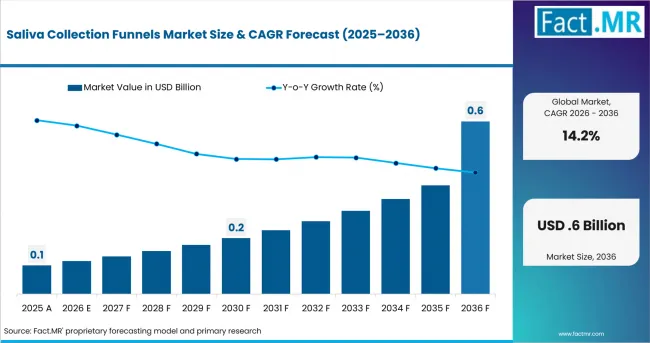
Saliva Collection Funnels Market Value Analysis | Source: Fact.MR
What are the defining numbers behind saliva collection funnels market growth?
USD 0.5 billion absolute opportunity by 2036, led by the United States and the United Kingdom.
- Demand Drivers in the Market
- Genetic testing providers need simple collection funnels for home sampling.
- Diagnostic labs need low-error sample capture for molecular workflows.
- Clinical researchers need passive drool aids that improve participant compliance.
- Kit assemblers need sterile funnel formats that fit multiple tube sizes.
- Key Segments Analyzed
- By Funnel Format: Screw-On Funnel Kits are expected to hold 37.0% share in 2026 because they reduce leakage risk during saliva transfer.
- By Collection Mode: Passive Drool Collection leads because it collects whole saliva without absorbent material. The share is projected at 46.0% in 2026.
- By Tube Capacity: 5 mL Collection Tubes are likely to account for 41.0% share in 2026 because they suit home collection and shipping.
- By Application: Genetic Testing and Molecular Diagnostics lead with 44.0% share in 2026 because saliva is widely used for DNA and RNA workflows.
- By End Use: Direct-to-Consumer Testing Programs are expected to hold 35.0% share in 2026 because mailed saliva kits need donor-friendly collection aids.
- By Geography: The United States is projected to record 16.2% CAGR through 2036 as self-collection programs expand.
- Analyst Opinion at Fact.MR
- Shambhu Nath Jha, Senior Analyst at Fact.MR, states, “Saliva collection funnels are small components with high workflow impact. Suppliers that combine cleanroom manufacturing with user-friendly funnel design will gain stronger access to self-collection programs.”
- Strategic Implications
- Funnel suppliers should design products around fill-line visibility and leak control.
- Kit assemblers should validate funnel fit with tube and cap systems.
- Diagnostic companies should test donor usability before large remote sampling programs.
- Research labs should match funnel type with sample volume and analyte stability needs.
Saliva collection funnels are disposable plastic aids that guide saliva into tubes or preservative containers. The category connects with molecular diagnostics because many saliva samples are collected for nucleic acid testing. The strongest adoption case comes from remote sampling where the donor must complete collection without specialist help.
Isohelix stated in 2024 that its saliva collection kits use a unique funnel design intended to prevent buffer spillages or flow-back. This shows why funnel geometry matters when samples are collected outside laboratories.
The United States is projected to record 16.2% CAGR through 2036 as self-collection, genetic testing and molecular diagnostics programs expand. The United Kingdom is expected to post 15.4% CAGR through 2036 as Isohelix and research sampling programs support remote saliva collection. Germany is likely to record 14.8% CAGR as clinical research and IVD workflows adopt assisted drool devices. China is forecast to advance at 14.1% CAGR as NEST Scientific and local kit manufacturers supply sterile funnel kits. Japan is set to record 13.5% CAGR as compact clinical research programs use saliva sampling for non-invasive testing.
How does the saliva collection funnels market break down by segment?
Screw-On Funnel Kits lead at 37.0%; Passive Drool Collection leads at 46.0%.
Which funnel format dominates?
Screw-On Funnel Kits hold 37.0% share in 2026.
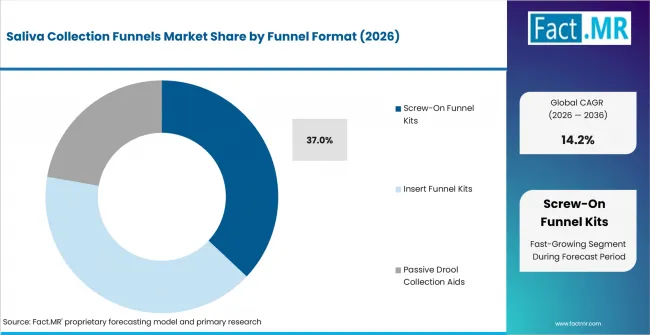
Saliva Collection Funnels Market Analysis By Funnel Format | Source: Fact.MR
Screw-On Funnel Kits are expected to hold 37.0% share in 2026 because they attach directly to collection tubes and reduce handling error. The format works well when donors collect samples at home. It also helps kit makers pair funnels with pre-labeled tubes. The segment connects with clinical diagnostics because collection consistency supports reliable test results.
Which collection mode dominates?
Passive Drool Collection accounts for 46.0% share in 2026.
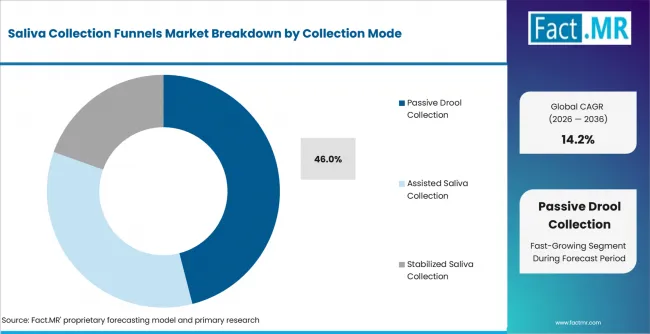
Saliva Collection Funnels Market Analysis By Collection Mode | Source: Fact.MR
Passive Drool Collection leads because it collects whole saliva without absorbent pads. The collection mode is projected to capture 46.0% share in 2026. Salimetrics’ 2024 guidance describes the Saliva Collection Aid as a tool for collecting whole saliva by passive drool. This mode is common in biomarker studies because researchers can assess volume and flow rate. It also reduces sample transfer steps.
Which tube capacity dominates?
5 mL Collection Tubes hold 41.0% share in 2026.
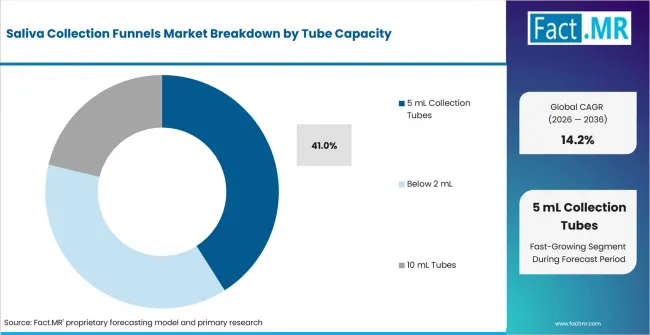
Saliva Collection Funnels Market Analysis By Tube Capacity | Source: Fact.MR
5 mL Collection Tubes lead because they balance collection volume and shipping convenience. The capacity range is likely to account for 41.0% share in 2026. FDA’s SalivaDirect summary lists a funnel format paired with a 5 mL transport tube. This supports the common use of 5 mL tubes in at-home saliva collection kits. Larger tubes remain useful for raw saliva workflows.
Which application dominates?
Genetic Testing and Molecular Diagnostics hold 44.0% share in 2026.
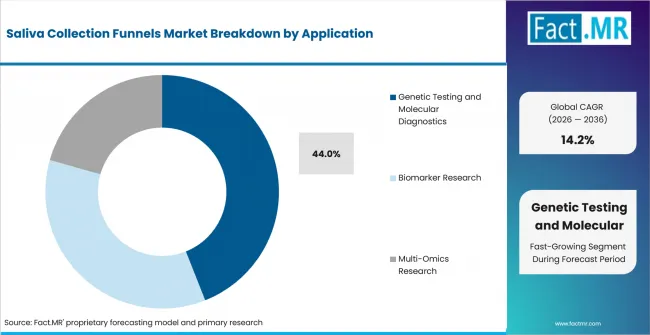
Saliva Collection Funnels Market Analysis By Application | Source: Fact.MR
Genetic Testing and Molecular Diagnostics lead because saliva is a convenient non-invasive sample for DNA and RNA workflows. The application is expected to hold 44.0% share in 2026. Funnel-based kits help donors deliver sample volume into stabilizing tubes.
Which end use dominates?
Direct-to-Consumer Testing Programs lead with 35.0% share in 2026.
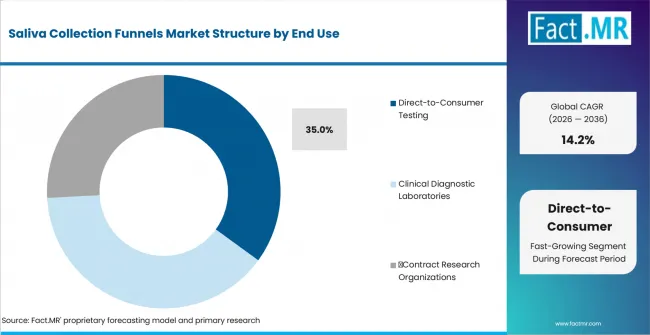
Saliva Collection Funnels Market Analysis By End Use | Source: Fact.MR
Direct-to-Consumer Testing Programs lead because mailed saliva kits need simple instructions and low-error hardware. The end use is expected to hold 35.0% share in 2026. DNA Genotek’s Oragene collection instructions describe closing the funnel lid to release stabilizing liquid before discarding the funnel. This illustrates how the funnel can be part of a controlled donor workflow. The in-vitro diagnostics layer matters because collection devices must support regulated downstream testing.
What is accelerating saliva collection funnel demand, and what is holding it back?
Remote sampling drives demand; donor error restrains collection reliability.
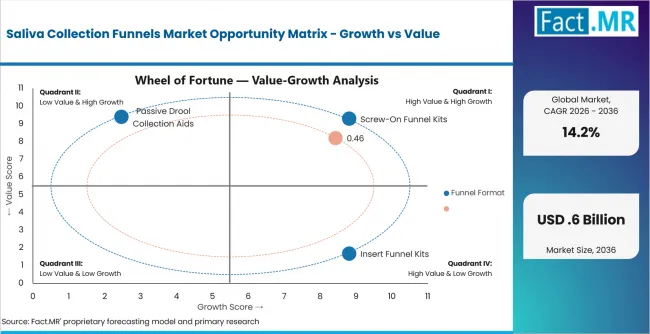
Saliva Collection Funnels Market Opportunity Matrix Growth Vs Value | Source: Fact.MR
Remote sampling is the main driver. Health systems and testing companies want specimens collected outside clinics without reducing sample quality. Funnel-based kits make saliva collection easier for donors who are not trained in laboratory technique.
Stabilized saliva workflows also support demand. Zymo Research states that SafeCollect includes a funnel and supports ambient storage or transport without refrigeration. This reinforces the use of funnels in transport-ready saliva kits.
The main restraint is donor error. Some users may underfill tubes or create foam during collection. Funnel suppliers and kit makers need clearer instructions before scaling large at-home programs.
Where do the biggest saliva collection funnel opportunities sit?
Remote genetic testing, clinical research and stabilized saliva kits.
- Remote Genetic Testing: DTC programs can use screw-on funnels to improve mailed sample quality.
- Clinical Research: Passive drool aids can support biomarker studies with repeat sampling.
- Stabilized Saliva Kits: Diagnostic developers can pair funnels with preservative tubes for molecular testing.
Which countries are scaling saliva collection funnels fastest?
United States 16.2%, United Kingdom 15.4%, Germany 14.8%, China 14.1%, Japan 13.5%.
Based on regional analysis, the saliva collection funnels market covers North America and Western Europe. Asia Pacific is also included. Latin America and Middle East and Africa complete the regional scope.
.webp "Top Country Growth Comparison Saliva Collection Funnels Market Cagr (2026 2036)")
Top Country Growth Comparison Saliva Collection Funnels Market Cagr (2026 2036) | Source: Fact.MR
| Country | CAGR |
|---|---|
| United States | 16.2% |
| United Kingdom | 15.4% |
| Germany | 14.8% |
| China | 14.1% |
| Japan | 13.5% |
Source: Fact.MR analysis. Updated Jun 26, 2026
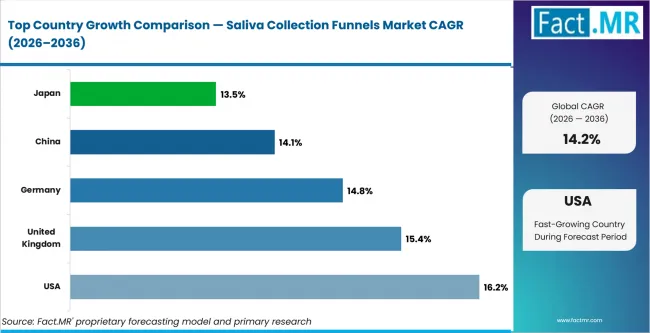
Saliva Collection Funnels Market Cagr Analysis By Country | Source: Fact.MR
What is powering the United States lead?
16.2% CAGR, driven by DNA Genotek and DTC genetic testing workflows.
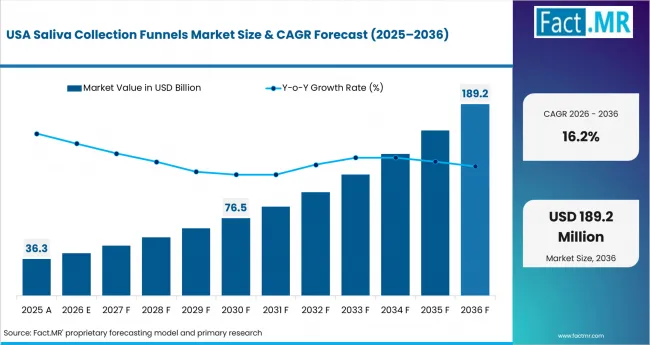
Saliva Collection Funnels Market Country Value Analysis | Source: Fact.MR
The United States is projected to record 16.2% CAGR by 2036 as self-collection and genetic testing programs expand. DNA Genotek and Zymo Research support funnel-enabled saliva collection. Diagnostic labs need simple donor workflows. Growth will favor suppliers with FDA-cleared or validation-ready collection systems.
How is the United Kingdom scaling saliva collection funnel demand?
15.4% CAGR, supported by Isohelix and research sampling programs.
The United Kingdom is expected to post 15.4% CAGR through 2036 as research programs use home saliva collection. Isohelix supports GeneFix saliva kits with funnel-based sample capture. Remote studies need kit formats that reduce spillage. Growth will favor suppliers with stable buffers and mail-ready packaging.
What supports Germany’s outlook?
14.8% CAGR, driven by clinical research and IVD sampling workflows.
Germany is likely to record 14.8% CAGR by 2036 as clinical research teams use non-invasive saliva sampling. Salimetrics’ passive drool aid is distributed through European channels. IVD users need collection aids that fit regulated sample handling. Growth will favor clean, single-use designs with strong documentation.
What underpins China’s growth?
14.1% CAGR, backed by NEST Scientific and local kit manufacturing.
China is forecast to advance at 14.1% CAGR through 2036 as local manufacturers supply sterile saliva collection kits. NEST Scientific offers dry saliva kits with screw or insert funnels. Hospitals and research institutes need cost-effective sample collection components. Growth will favor scalable cleanroom manufacturing.
How is Japan scaling saliva collection funnel adoption?
13.5% CAGR, due to clinical research and compact testing programs.
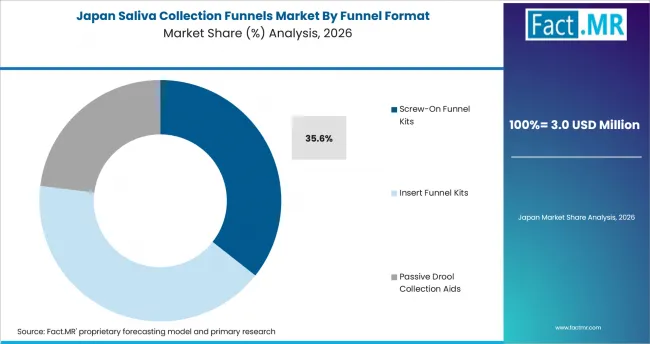
Saliva Collection Funnels Market Japan Market Share Analysis By Funnel Format | Source: Fact.MR
Japan is set to record 13.5% CAGR by 2036 as compact research studies and diagnostic programs use non-invasive samples. Saliva collection reduces clinic burden for repeat sampling. Funnel kits can support home collection in aging populations. Growth will favor designs that are easy to understand and compatible with local logistics.
Who leads the saliva collection funnels market?
DNA Genotek and Spectrum Solutions lead through validated saliva collection device experience.
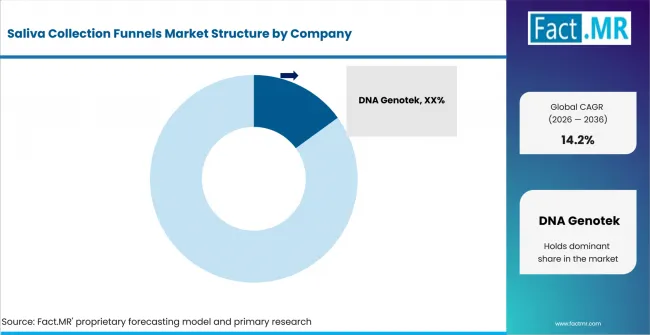
Saliva Collection Funnels Market Analysis By Company | Source: Fact.MR
Saliva collection funnels are supplied by biological sample collection firms and lab consumable manufacturers. DNA Genotek leads through Oragene and related saliva collection devices. Spectrum Solutions is important through SDNA saliva collection devices and stabilized molecular sample workflows.
Zymo Research competes through SafeCollect saliva kits with funnel-based collection. Salimetrics supports passive drool collection aids for research and biomarker studies. Isohelix supplies GeneFix saliva collection kits with funnel-based sample transfer. NEST Scientific supplies dry saliva collection kits with screw and insert funnel formats.
Competition through 2036 will depend on usability and documentation. Suppliers need strong molding quality and clear collection instructions. Diagnostic testing depends on collection quality because test performance can be affected before the sample reaches the laboratory.Molecular quality controls are relevant because collection consistency supports reliable assay validation.
Which companies are the key providers?
DNA Genotek and Spectrum Solutions are key providers. Zymo Research and Salimetrics are also profiled. Isohelix and NEST Scientific complete the company set.
- DNA Genotek
- Spectrum Solutions
- Zymo Research
- Salimetrics
- Isohelix
- NEST Scientific
Bibliography
- [1] U.S. Food and Drug Administration. (2024, July 1). SalivaDirect At-Home Collection Kit: EUA summary. FDA.
- [2] Isohelix. (2024, March 8). Isohelix sample collection: Research highlights from 2023. Isohelix.
- [3] Zymo Research. (2025, January). DNA/RNA Shield™ SafeCollect™ Saliva Collection Kit CE-IVD user instruction manual. Zymo Research.
- [4] Salimetrics. (2024, December 13). Collection methods: Passive drool using the Saliva Collection Aid. Salimetrics.
- [5] DNA Genotek. (2024). Oragene DNA saliva collection kit instructions. DNA Genotek.
This Report Addresses
- Strategic intelligence on saliva collection funnels across funnel format and collection mode.
- Segment analysis covering Screw-On Funnel Kits and Passive Drool Collection.
- Regional outlook covering the United States, the United Kingdom, Germany, China and Japan.
- Competitive analysis of DNA Genotek, Spectrum Solutions, Zymo Research, Salimetrics, Isohelix and NEST Scientific.
- Technology assessment covering funnel geometry, fill-line usability and tube compatibility.
- Use case assessment covering remote genetic testing, clinical research and stabilized saliva kits.
- Primary interviews, provider checks and official source review support the forecast.
What does the saliva collection funnels market cover?
Disposable funnel aids used to guide saliva into collection tubes or preservative containers.
The saliva collection funnels market covers screw-on funnels, insert funnels and passive drool collection aids used with saliva tubes. It includes dry collection kits and stabilized saliva kits when the funnel is part of the collection workflow. The scope connects with sample preparation because collection quality affects downstream extraction and amplification.
The market differs from general saliva collection devices because the funnel is the sample capture interface. A poorly designed funnel can cause spillage or donor error. A better design improves fill-line visibility and helps laboratories receive usable specimens.
What is included in the scope?
Screw-on funnels, insert funnels and passive drool collection aids.
The scope includes single-use funnels used with empty collection tubes and preservative-filled tubes. It covers passive drool aids used with cryovials. It also includes funnel-enabled kits used for DNA, RNA and biomarker testing.
The scope includes clinical diagnostics, genetic testing and research sampling workflows. It covers home collection kits and clinic-based sample capture. The market also includes bulk funnel supply when funnels are sold to kit assemblers.
What is excluded from the scope?
Swabs, straws and liquid collection tubes without funnel use.
The scope excludes oral swabs and sponge-based collection devices when no funnel is used. It excludes straw-only saliva kits. It excludes transport media sold without a funnel component. It also excludes diagnostic assays unless the assay is sold with a funnel-based saliva collection kit.
How was the analysis built?
100+ sources, 40+ company portfolios, 25+ countries, 20+ interviews.
- Primary Research: Primary research includes interviews with diagnostic kit assemblers and saliva collection device suppliers. It includes input from genomics labs and clinical research coordinators.
- Desk Research: Desk research reviews official FDA summaries and supplier instructions. It covers saliva collection formats, passive drool aids and point-of-care diagnostics workflows that use non-invasive sampling.
- Market-Sizing and Forecasting: Forecasting uses saliva kit volumes and self-collection program adoption. Genomics testing activity and remote sampling demand support the market assessment.
- Data Validation and Update Cycle: Forecasts are validated through supplier checks and laboratory workflow references. Product instructions and regulatory documents help confirm market direction.
Segmentation
What is the report’s scope and coverage?
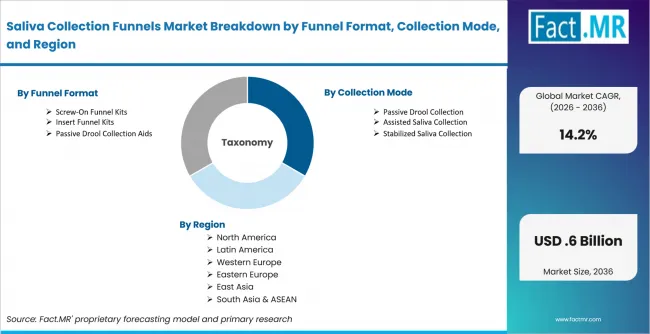
Saliva Collection Funnels Market Breakdown By Funnel Format, Collection Mode, And Region | Source: Fact.MR
| Attribute | Details |
|---|---|
| Quantitative Units | USD Billion in 2026 to USD Billion by 2036 at CAGR |
| Market Definition | Disposable funnel aids used to guide saliva into collection tubes or preservative containers |
| Funnel Format | Screw-On Funnel Kits; Insert Funnel Kits; Passive Drool Collection Aids; Funnel-Lid Stabilizer Devices; Bulk Standalone Funnels |
| Collection Mode | Passive Drool Collection; Assisted Saliva Collection; Stabilized Saliva Collection; Dry Saliva Collection; At-Home Self-Collection |
| Tube Capacity | Below 2 mL; 2 mL to 5 mL; 5 mL Tubes; 10 mL Tubes; Custom Capacity Tubes |
| Application | Genetic Testing and Molecular Diagnostics; Biomarker Research; Infectious Disease Testing; Hormone and Stress Testing; Multi-Omics Research |
| End Use | Direct-to-Consumer Testing Programs; Clinical Diagnostic Laboratories; Academic Research Centers; Contract Research Organizations; Public Health Programs |
| Regions Covered | North America; Western Europe; Asia Pacific; Latin America; Middle East and Africa |
| Countries Covered | United States; United Kingdom; Germany; China; Japan |
| Key Companies Profiled | DNA Genotek; Spectrum Solutions; Zymo Research; Salimetrics; Isohelix; NEST Scientific |
| Forecast Period | 2026 to 2036 |
| Approach | Hybrid top-down and bottom-up approach using saliva kit demand, DTC testing programs, diagnostic collection workflows and supplier validation |
Source: Fact.MR analysis. Updated Jun 26, 2026
How is the market segmented?
-
By Funnel Format:
- Screw-On Funnel Kits
- Insert Funnel Kits
- Passive Drool Collection Aids
- Funnel-Lid Stabilizer Devices
- Bulk Standalone Funnels
-
By Collection Mode:
- Passive Drool Collection
- Assisted Saliva Collection
- Stabilized Saliva Collection
- Dry Saliva Collection
- At-Home Self-Collection
-
By Tube Capacity:
- Below 2 mL
- 2 mL to 5 mL
- 5 mL Tubes
- 10 mL Tubes
- Custom Capacity Tubes
-
By Application:
- Genetic Testing and Molecular Diagnostics
- Biomarker Research
- Infectious Disease Testing
- Hormone and Stress Testing
- Multi-Omics Research
-
By End Use:
- Direct-to-Consumer Testing Programs
- Clinical Diagnostic Laboratories
- Academic Research Centers
- Contract Research Organizations
- Public Health Programs
-
Region:
- North America
- United States
- Canada
- Europe
- United Kingdom
- Germany
- France
- Switzerland
- Netherlands
- Asia Pacific
- China
- Japan
- South Korea
- Singapore
- India
- Latin America
- Brazil
- Mexico
- Argentina
- Middle East & Africa
- UAE
- Saudi Arabia
- South Africa
- Israel
- North America
Frequently Asked Questions
Which funnel format leads the Saliva Collection Funnels Market?
Which collection mode leads the Saliva Collection Funnels Market?
Which tube capacity leads the Saliva Collection Funnels Market?
Which application leads the Saliva Collection Funnels Market?
Which end use leads the Saliva Collection Funnels Market?
Which country expands fastest in the Saliva Collection Funnels Market?
How does the United Kingdom perform in the Saliva Collection Funnels Market?
How does Germany perform in the Saliva Collection Funnels Market?
How does China perform in the Saliva Collection Funnels Market?
How does Japan perform in the Saliva Collection Funnels Market?
What is the primary driver in the Saliva Collection Funnels Market?
What is the main restraint in the Saliva Collection Funnels Market?
Why are screw-on funnel kits important?
Why are passive drool aids gaining adoption?
Who worked on this report


Preview the report firsthand - request a free sample
Free SampleGet the brochure for pricing and purchase details
Download PDF